
The phrase “world’s oldest library” can refer to several institutions, depending on whether age, continuous operation, or surviving contents matter most. For the earliest known systematically assembled collection, historians usually point to the Royal Library of Ashurbanipal, created in the seventh century B.C. at Nineveh, the capital of the Assyrian Empire. Its surviving tablets offer an extraordinary record of Mesopotamian literature, medicine, religion, language, and government.
Exploring the story behind humanity’s oldest organized library requires setting aside the modern image of shelves filled with bound books. Ashurbanipal’s collection consisted mainly of clay tablets covered with wedge-shaped cuneiform writing, although wooden writing boards and other materials may also have been present. Nearly 32,000 tablets and fragments from Nineveh survive, preserving parts of a much larger body of ancient knowledge.
The Scholar Who Became a Powerful King
Ashurbanipal ruled Assyria from approximately 668 to 630 B.C., during a period in which the empire controlled large sections of the ancient Near East. Assyrian kings were better known for military campaigns than academic interests, but Ashurbanipal claimed that he could read difficult scholarly texts. His education gave him a personal connection to the written traditions that supported royal authority.
Knowledge held practical value in the Assyrian court because rulers relied on trained experts to interpret celestial events, diagnose illnesses, conduct rituals, and advise them about possible dangers. Collecting written material allowed Ashurbanipal to place generations of specialist learning within reach of his palace. The library wasn’t a public institution where ordinary residents could casually browse, since it primarily served the king and a limited group of scholars and advisers.
Much of the collection was inherited from earlier Assyrian rulers, but Ashurbanipal expanded it aggressively. Officials requested tablets from temples and scholarly centers, while scribes copied works that the royal administration considered useful. Some material also reached Nineveh through military conquest, demonstrating that the king viewed control over knowledge as another form of political power.
What the Ancient Tablets Contained
The collection covered far more than royal laws and administrative records. Surviving tablets include medical treatments, religious rituals, dictionaries, historical inscriptions, hymns, omens, magical instructions, and observations of the heavens. Scholars used lexical lists to understand languages and train scribes, while divination texts helped court advisers interpret events that might affect the empire.
Among the library’s most famous works is the Epic of Gilgamesh, a Mesopotamian narrative centered on kingship, friendship, loss, and the human desire to escape death. Versions of the story existed long before Ashurbanipal’s reign, but important surviving copies came from Nineveh. Without those tablets, modern readers would have a much less complete understanding of one of the earliest major works of world literature.
The tablets also reveal how Mesopotamian scholars organized information across generations. Many texts belonged to established series, with sections identified through headings, sequence numbers, catchlines, or notes written by scribes. Colophons placed at the ends of certain tablets recorded ownership, copying details, or warnings against removing the material, which helped researchers connect the works to Ashurbanipal’s royal collection.
Destruction, Discovery, and an Accidental Rescue
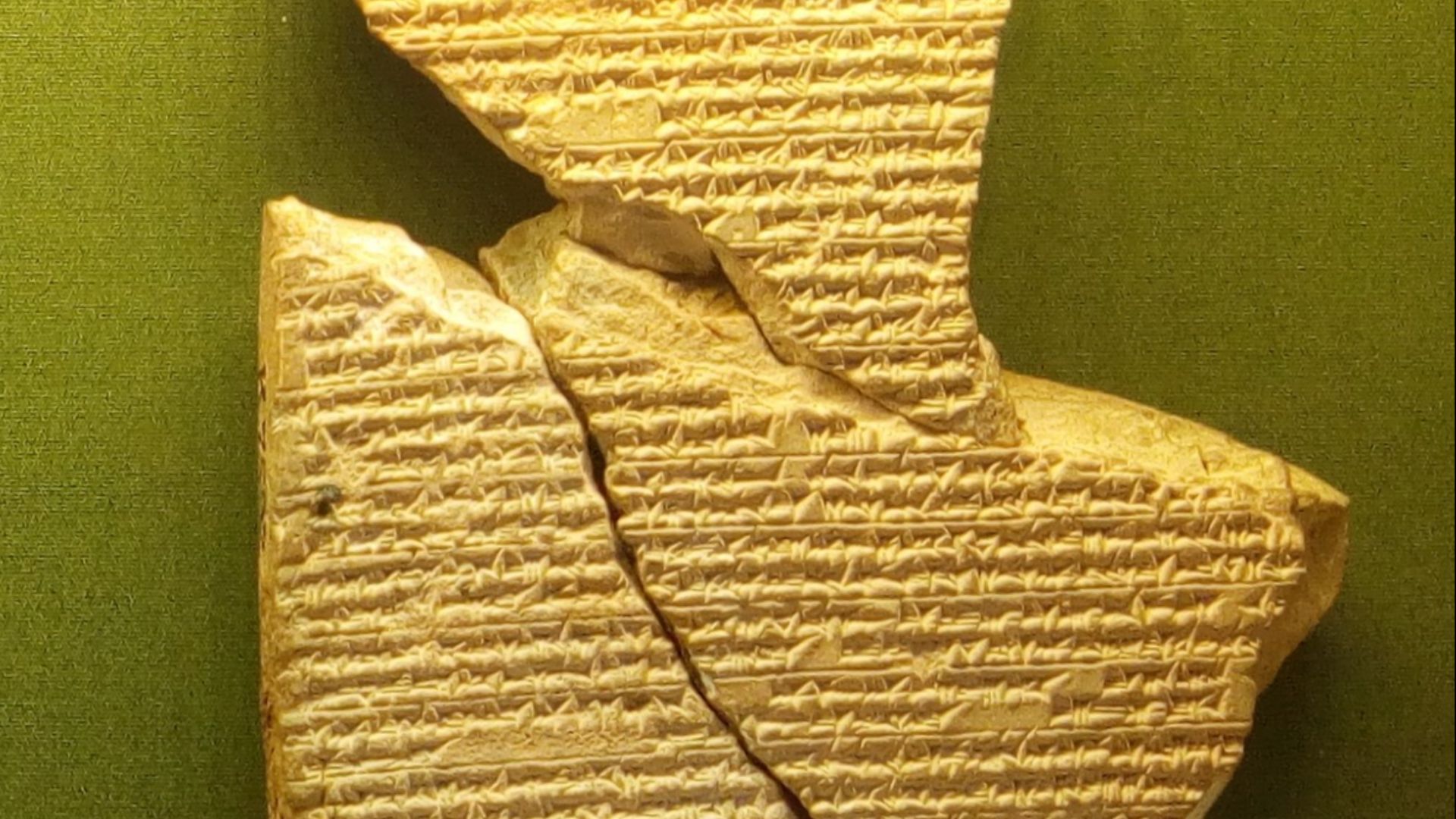
Nineveh fell in 612 B.C. after forces led by the Babylonians and Medes attacked the Assyrian capital. Fires destroyed royal buildings and brought the empire’s dominance to an end, but the heat hardened many clay tablets that might otherwise have crumbled over time. The destruction of the city therefore helped preserve part of the library, although writing on wood, wax, leather, or other perishable materials disappeared.
For more than two thousand years, the tablets remained buried beneath the ruins near modern Mosul in northern Iraq. British archaeologist Austen Henry Layard’s team uncovered large groups of tablets in the Southwest Palace around 1850. Hormuzd Rassam, an Iraqi-born archaeologist working for the British Museum, later made crucial discoveries in Ashurbanipal’s North Palace, although early excavation methods caused tablets from different locations to become mixed.
Once the fragments reached Britain, scholars faced the enormous task of cleaning, sorting, joining, and translating them. The tablets contributed significantly to the decipherment of cuneiform and the recovery of Akkadian literature, but thousands remain fragmentary. Modern researchers use digital photography, databases, handwriting analysis, and reconstructed texts to understand how the collection developed and how its individual pieces originally fit together.
The Royal Library of Ashurbanipal wasn’t the first place where written records were stored, and calling it the oldest library requires a careful definition. Its importance comes from its remarkable scale, scholarly range, and deliberate attempt to gather centuries of learning into a royal collection. What began as a tool of imperial government now allows you to hear voices from ancient Mesopotamia, making its damaged clay tablets one of history’s most valuable intellectual inheritances.
KEEP ON READING