

My Niece Asked Me to Alter Her Wedding Dress—When I Recognized the Lace, My Blood Ran Cold
My Niece Asked Me to Alter Her Wedding Dress—When I Recognized the Lace, My Blood Ran Cold
The Call That Changed Everything
The call came on a Tuesday afternoon while I was on my knees in Mrs. Henderson's front room, pinning the hem of her new curtains. My phone buzzed against the hardwood floor and I almost let it go to voicemail — I had a mouthful of pins and both hands full of ivory linen. But I saw Clara's name on the screen and I set everything down. I always picked up for Clara. Her voice came through warm and a little breathless, the way it gets when she's excited about something. She was getting married in six weeks, she reminded me, as if I could have forgotten. The alterations shop had done the basics, she said, but the dress needed someone who really understood delicate work. Someone who knew what they were doing with fine fabric. There was a pause, and then she asked if I might be willing to take a look. I told her I'd be honored. I meant it completely. Mrs. Henderson glanced over from her armchair and raised an eyebrow, and I mouthed 'my niece' and smiled. By the time I hung up, the curtains were forgotten entirely. Clara's voice stayed with me the rest of the afternoon, warm and close, like something I hadn't realized I'd been missing.
 Image by RM AI
What Else Would I Say
I didn't even have to think about it. Of course I would help. That was never a question. I told Clara to bring the dress Thursday evening, that I'd clear my cutting table and have good light ready, and she thanked me in this quiet way that was almost a whisper. It caught me for just a second — Clara was usually so easy and bright on the phone, full of details and tangents. But I figured she was tired. Planning a wedding in six weeks is no small thing, and she'd always carried stress in her voice before she carried it anywhere else. I've been the one she calls when things need fixing for as long as I can remember. The leaky faucet in her first apartment. The hem on her graduation dress the night before the ceremony. The time her car broke down forty minutes from home and she called me before she called anyone else. I never minded. Honestly, I loved being that person for her. There's something that settles in your chest when someone trusts you with the things that matter to them. We said our goodbyes, and just before the line went quiet, I heard her exhale — long and slow, like she'd been holding her breath the whole time we'd been talking.
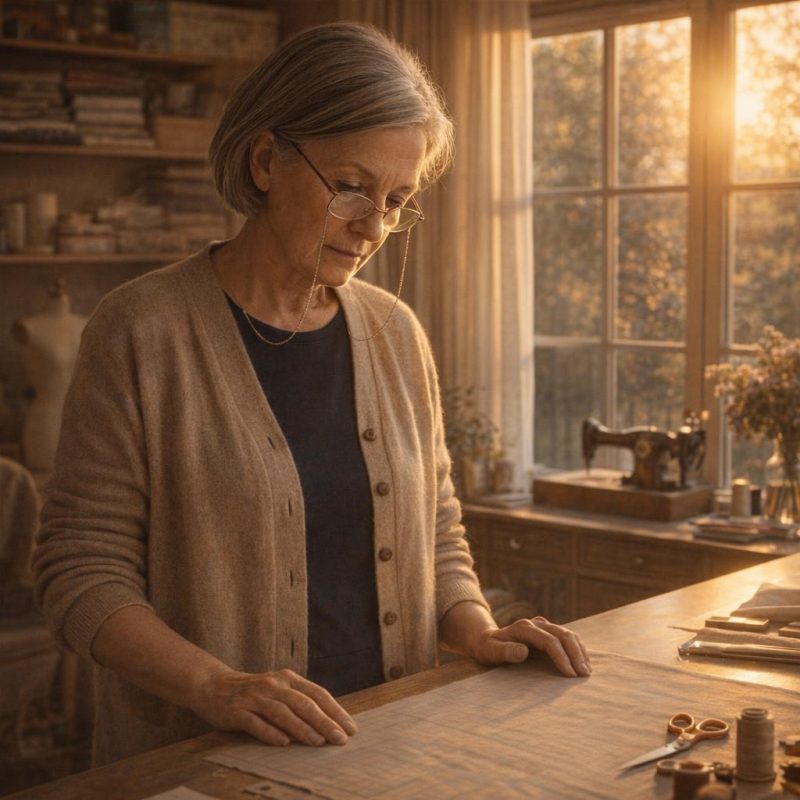 Image by RM AI
Different Languages of Love
Diane had Clara young, at twenty-two, and I don't think she ever quite knew what to do with a little girl who wanted to sit still and watch someone sew. Diane's way of loving things was to replace them when they wore out — new shoes instead of resoled ones, a new toaster instead of a repaired one. She wasn't cruel about it. That's not the right word. She was just practical in a way that left no room for sentiment. I was the opposite, and Clara seemed to understand that about me before she had words for it. She'd come to my house on weekends and pull fabric scraps out of my basket and ask me what they used to be. I'd tell her. A bridesmaid dress from 1987. A tablecloth from my grandmother's kitchen. She listened like those stories mattered. Diane noticed, I think, but she never said much. She'd pick Clara up on Sunday evenings and there'd be this brief tightening around her eyes when Clara ran to show her whatever small thing we'd made together. I paid for Clara's braces the year Diane's hours got cut. I made her birthday cakes every year until she turned eighteen. I told myself it was just what family did. The memory of Clara climbing into my lap one Christmas morning, passing right by Diane's open arms, still sat somewhere low in my chest, tender as an old bruise.
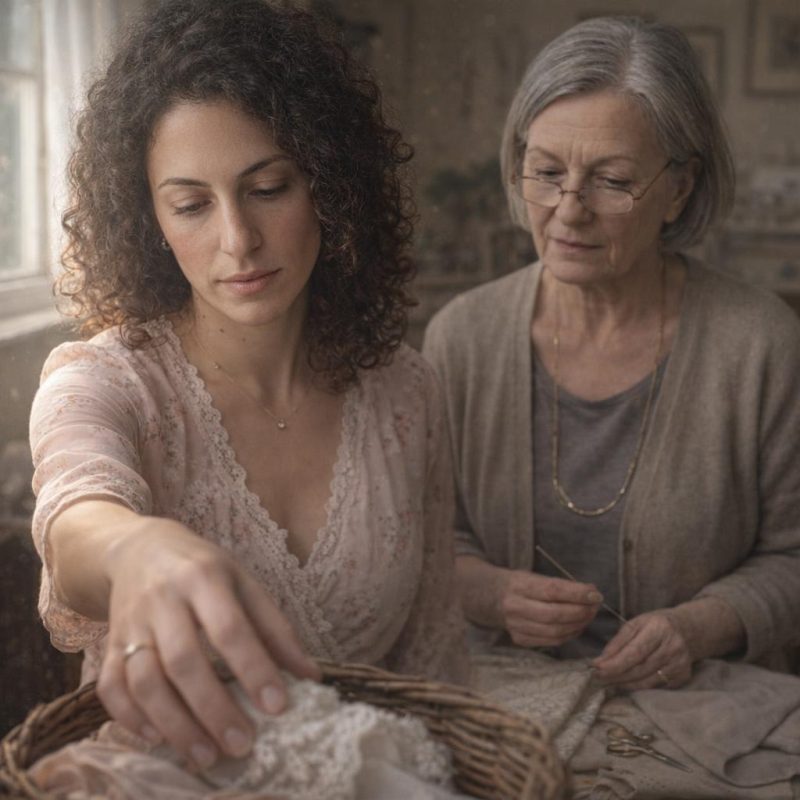 Image by RM AI
What Cloth Remembers
I cleared my cutting table Wednesday morning, moving spools and pattern weights to the shelves along the wall and laying out my good shears and the magnifying lamp I use for fine work. There's a particular kind of quiet in my sewing room that I've always found steadying. The light comes in from the north window, flat and honest, the kind that doesn't flatter anything but shows you exactly what you're working with. I've always believed that cloth remembers. Not in any mystical sense — just that fabric holds the shape of what it's been through. A dress worn to a funeral drapes differently than one worn to a party, even after cleaning. Wedding dresses especially. They carry the weight of a specific day, a specific hope, and you can feel it in the way the grain runs, the way the seams were set. I pressed my hands flat on the empty table and looked up at the highest shelf. The preservation box sat where it always does, wrapped in acid-free tissue, sealed against light and air. I don't open it often. There are pieces inside that never got their moment — fabric cut for futures that simply didn't unfold the way anyone planned. I left it where it was. Some things are better kept whole and untouched, held carefully in the dark.
 Image by RM AI
The Days Between
Wednesday passed the way Wednesdays do — quietly, with purpose. I finished the final pressing on Mrs. Henderson's curtains and folded them into a clean bag for delivery. Thursday morning I drove them over, and she met me at the door in her housecoat, delighted the way she always is when something comes back better than she left it. She made me tea and showed me a photograph of the curtains she'd had in that room thirty years ago, ivory with a narrow border, and told me mine were even nicer. I didn't argue. I drove home with the payment in my pocket and a good feeling in my chest, the kind that comes from work done right. Back home, I tidied the sewing room one more time — straightened the spools, repositioned the lamp, laid out a clean pressing cloth. I wasn't expecting Clara until seven. I told myself I wasn't watching the window, but I was. Around half past five I heard a car slow on the street outside, and when I looked up from the cutting table, Clara's car was already turning into my driveway, a full hour and a half ahead of schedule.
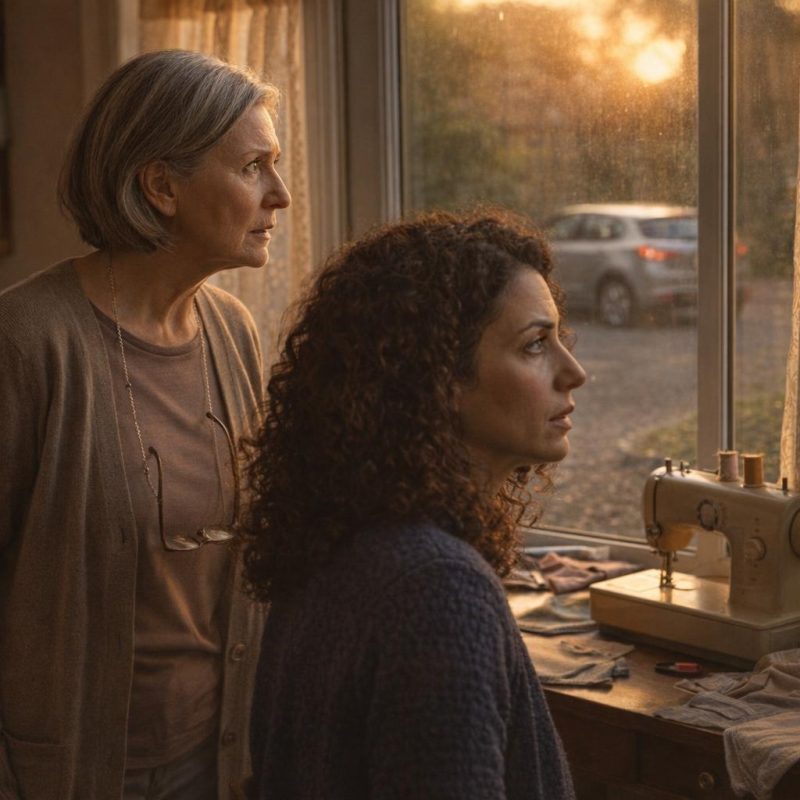 Image by RM AI
The Garment Bag
I had the porch light on before she even got her door open. She came up the front walk carrying a plain white garment bag with both arms, the kind with no logo, no shop name printed on the side. I held the door and she stepped in, and I noticed right away that she was moving carefully — not the careful of someone tired, but the careful of someone carrying something they didn't want to jostle. She set the bag across my cutting table with both hands, lowering it slowly, and then she straightened up and looked at me with a smile that didn't quite reach her eyes. I asked if she'd eaten. She said she'd grabbed something on the way. I offered tea and she said yes, then changed it to water, then said tea was fine after all. I put the kettle on and let her settle. She stood near the table the whole time I was in the kitchen, close to the bag, one hand resting lightly on the zipper pull. When I came back with the mugs, she was still standing there, shoulders drawn in just slightly, the garment bag cradled in the crook of her arm like something fragile she wasn't quite ready to hand over.
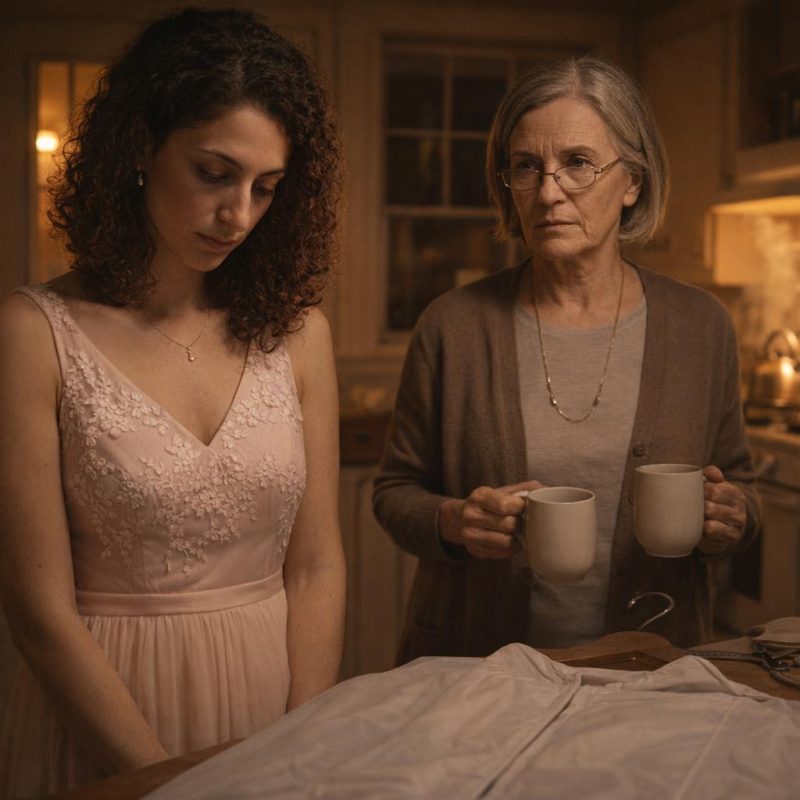 Image by RM AI
The Unzipping
I set my mug down and reached for the zipper. Clara went very still on the other side of the table. The bag opened smoothly, and the first thing I noticed was the lace — the way the light from my north window caught it and seemed to split, like the fabric was reflecting in two directions at once. I've worked with a lot of lace over the years and I know how it behaves under good light, and something about this wasn't quite sitting right. I told myself it was probably just the way it had been folded in the bag. I lifted the dress out slowly, one hand under the skirt and one supporting the bodice, the way you handle anything that deserves care. It was heavier than I expected. The satin had real weight to it, the kind you don't find in modern fabric, and the lace overlay was intricate — genuinely beautiful work, the sort that takes time and skill. Clara hadn't moved. I could hear her breathing, shallow and even, from across the table. I turned the bodice toward the lamp to get a better look at the construction, and that's when I saw it — the seams along the bodice panels didn't align, left side pulling away from right as if two separate pieces had been joined by someone working in a hurry.
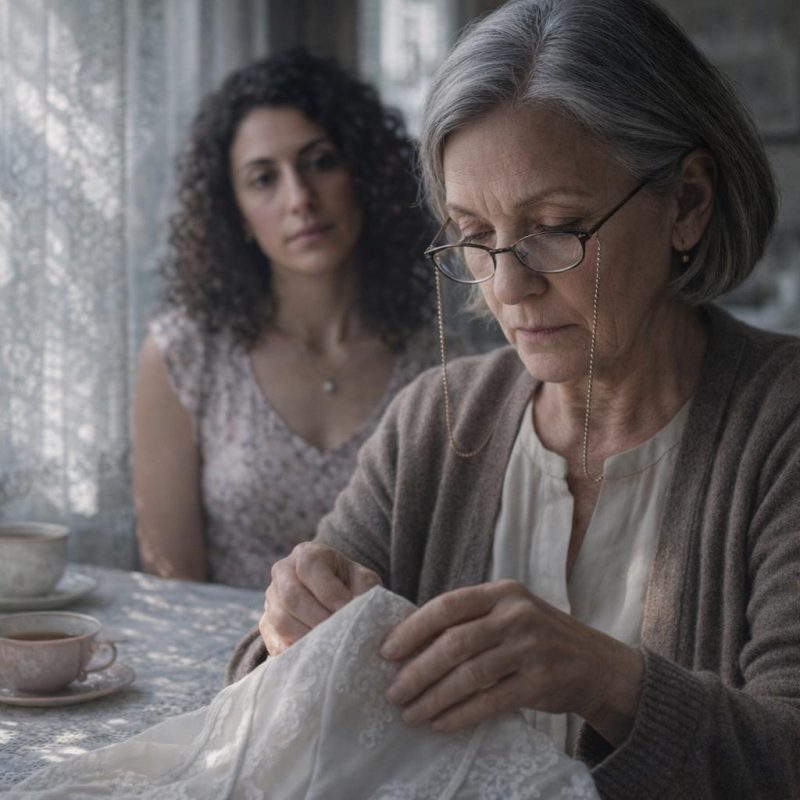 Image by RM AI
Construction Issues
I spread the dress fully across the cutting table and pulled the magnifying lamp closer. The misalignment wasn't subtle once you knew to look — the left bodice panel sat a full quarter-inch higher than the right, and the seam allowances were uneven, wider in some places and nearly nonexistent in others. Whoever had done this work had been rushing, or hadn't known what they were dealing with. The satin itself was extraordinary. I ran my fingers along the grain and felt the quality of it — a heavy duchess, the kind with a slight sheen that shifts as you move it, the kind that costs real money and holds a press beautifully. But where the satin met the lace overlay, the join was uneven, the lace bunching slightly at the left hip where it had been tacked rather than properly set. I checked the back seam. Same story — stitching that started fine and then lost its tension halfway down, as if whoever was sewing had changed their mind mid-seam. I felt the particular frustration I always feel when good fabric has been treated carelessly, the way you feel watching someone handle a book by its spine. The dress deserved better than this. I held the bodice up to the light and turned it slowly, the weight of it settling across my palms, beautiful and slightly broken.
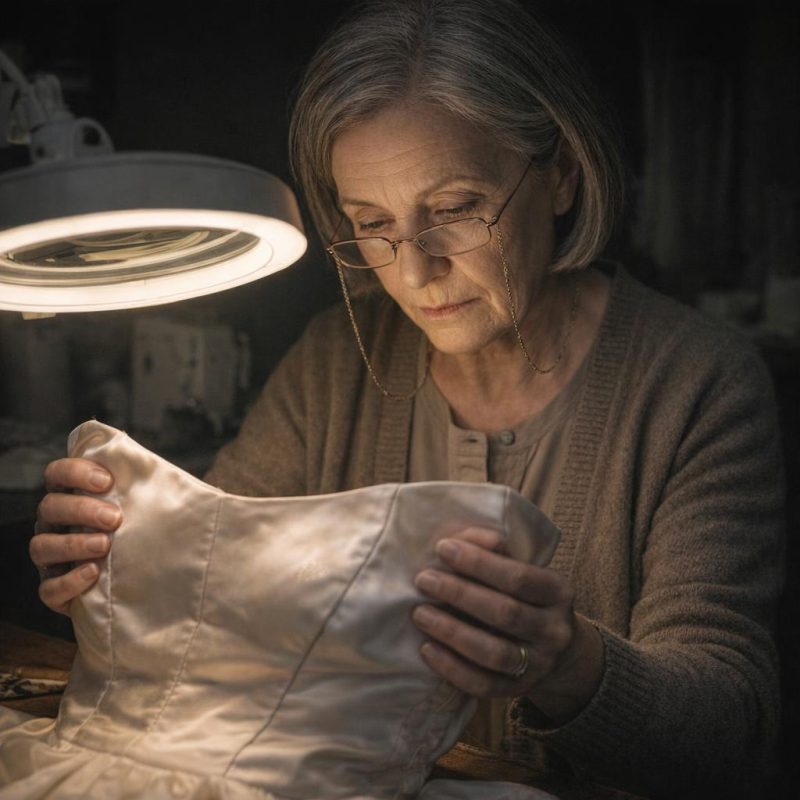 Image by RM AI
Lace Appliqués
I turned the bodice toward the window and let the afternoon light fall across it at a different angle. That's when I noticed the appliqués — small lace medallions, four of them, placed at intervals along the left side panel and one more near the hip. They were pretty enough, delicate even, but something about their placement nagged at me. They weren't decorative in the way a designer would place them, balanced and intentional. They sat over areas that should have been smooth satin, as if someone had needed to cover something up. I assumed construction errors — a tear, maybe, or a stain that hadn't come out. It happened more than people admitted. Clara was sitting on the stool near the window, watching me work, and I didn't say anything yet. I just kept turning the fabric slowly, watching how the light moved across it. The lace caught the light differently than the satin did, which was expected — different fibers, different weave. But there was something else, some quality I couldn't quite name, as if the lace and the satin were each remembering a different room, a different time.
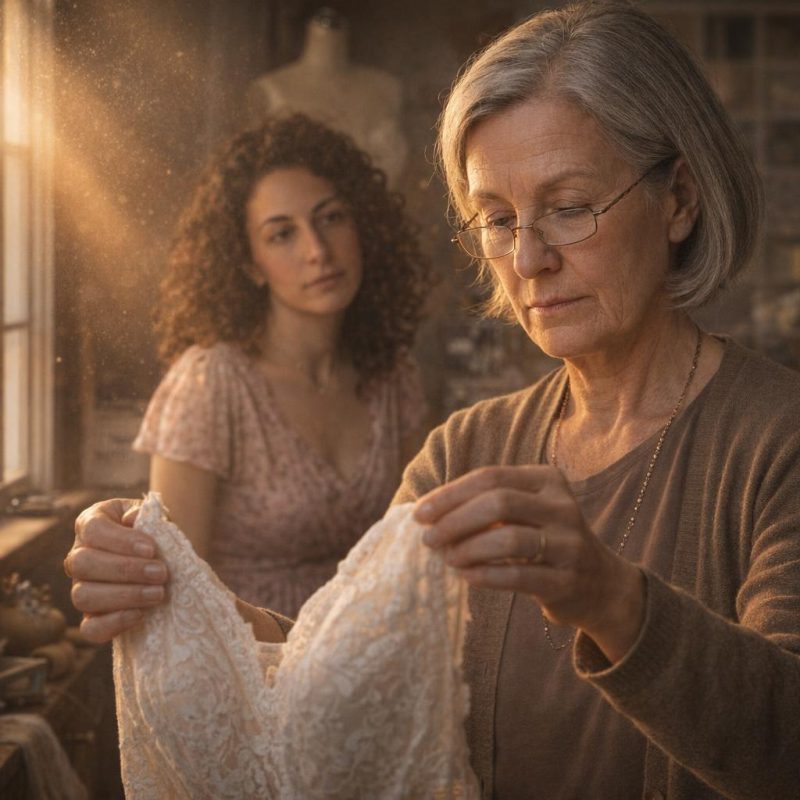 Image by RM AI
The Side Seam
I set the bodice down and moved to the side seam, running my fingers along it the way I always do — slowly, with just enough pressure to feel what the eye might miss. The satin felt smooth at first, then I caught it: a faint puckering beneath the surface, the fabric bunching in a way that meant the seam underneath had been pulled off-grain. Someone had tried to correct it, or at least hide it. There was extra trim along that section, a narrow ribbon of lace laid right over the problem area, tacked down with small, hurried stitches. It was cosmetic work, not structural. The kind of fix that looks fine in a photograph and falls apart under a seamstress's hands. I started making a mental list — the misaligned bodice, the uneven seam allowances, the appliqués over the smooth panels, and now this. Clara asked if everything was alright, and I told her yes, just taking stock. I kept my voice even. But I was already wondering what kind of shop had touched this dress before it came to me, because whoever it was had left me a considerable amount of work to undo — and then, running my fingers a little further along the seam, I felt where the trim ended and the original fabric began, and the puckering there was deep enough to have split the underlining clean through.
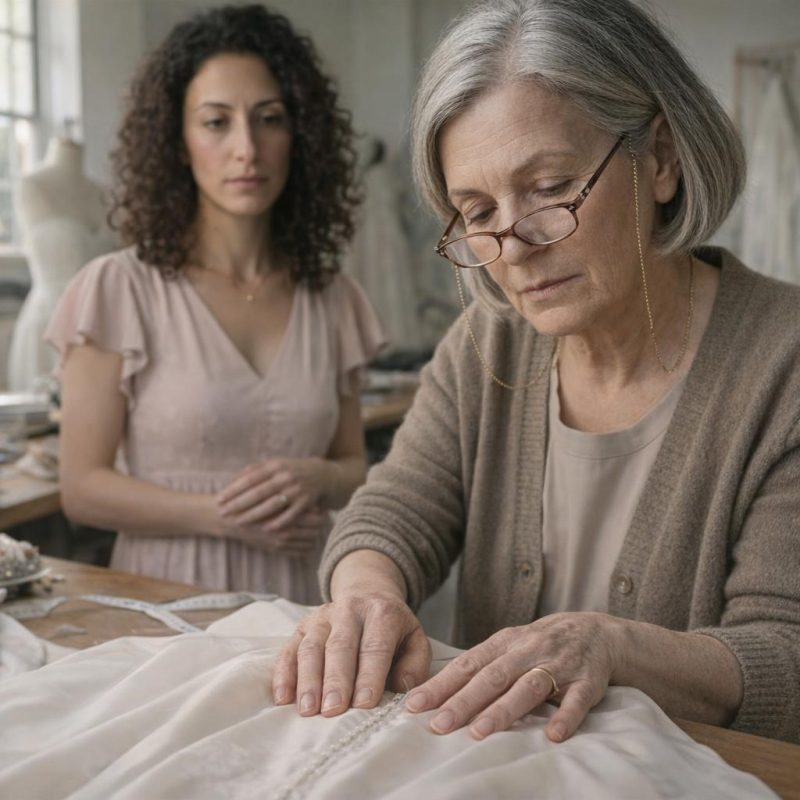 Image by RM AI
Where Did You Get This Lace
I kept my voice easy, the way you do when you don't want to alarm a nervous bride. I asked Clara where the lace had come from — the appliqués, the trim, all of it. Just curious, I said. Trying to understand what I was working with. She answered right away. Vintage trim, she said. Her mother had found it. The words came out smooth and quick, no pause to search her memory, no small hesitation the way people have when they're actually trying to remember something. I nodded and looked back down at the fabric. It was a perfectly reasonable answer. Diane had a habit of collecting things — old buttons, remnant fabric, odds and ends from estate sales. It made complete sense that she'd have a length of vintage lace tucked away somewhere. I told myself the small tightness in my chest was nothing, just the particular anxiety I always felt when a dress came to me already damaged. Clara was watching me with those careful eyes of hers, and I smiled at her and said we'd have it sorted in no time. But even as I said it, the words of her answer sat in the air between us, too neat, too ready, like something that had been waiting to be said.
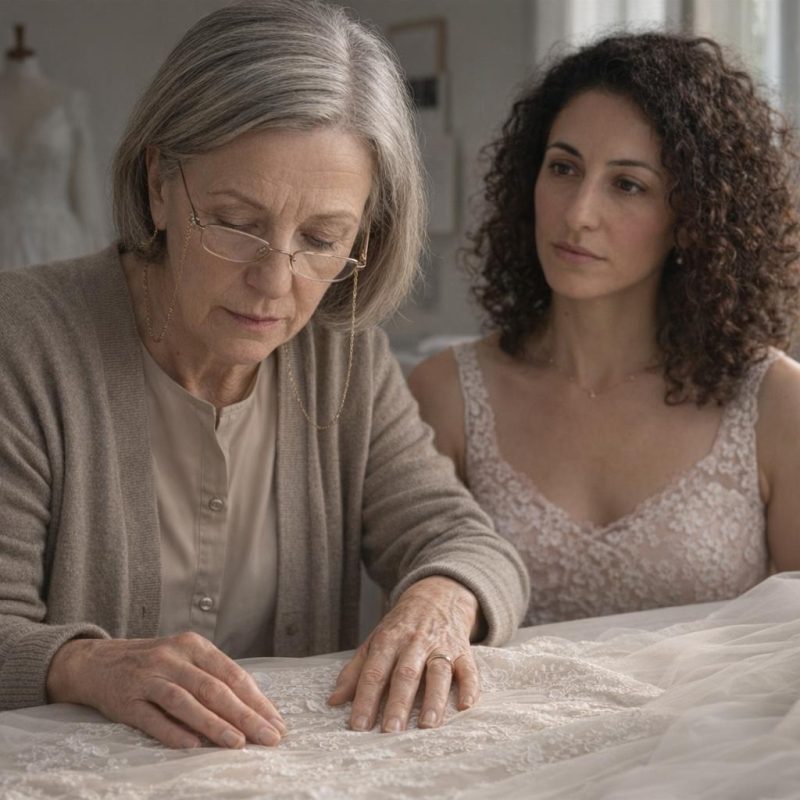 Image by RM AI
Hand-Done Edging
I brought the magnifying lamp down close and looked at the lace properly for the first time. Not as a problem to solve, but as a thing in itself. The edging was hand-done — I could see that immediately. Each scallop had been worked individually, the thread tension consistent in a way that machines simply cannot replicate, the tiny picots along the outer edge formed with a patience that belonged to another era entirely. I've handled a lot of lace in my years. Most of what comes through my workroom now is machine-made, even the expensive stuff, and there's nothing wrong with that. But this was different. This was the kind of work that took hours per inch, the kind that required someone to sit in good light with fine thread and give the work their full attention. I ran my fingertip along one of the scalloped edges, feeling the slight raised texture of each tiny loop. Clara had gone quiet behind me. The craftsmanship was exceptional — mid-century at the earliest, possibly older. And as my finger traced the pattern, something at the very edge of my memory shifted, the way a word does when it's almost on the tip of your tongue but won't quite come.
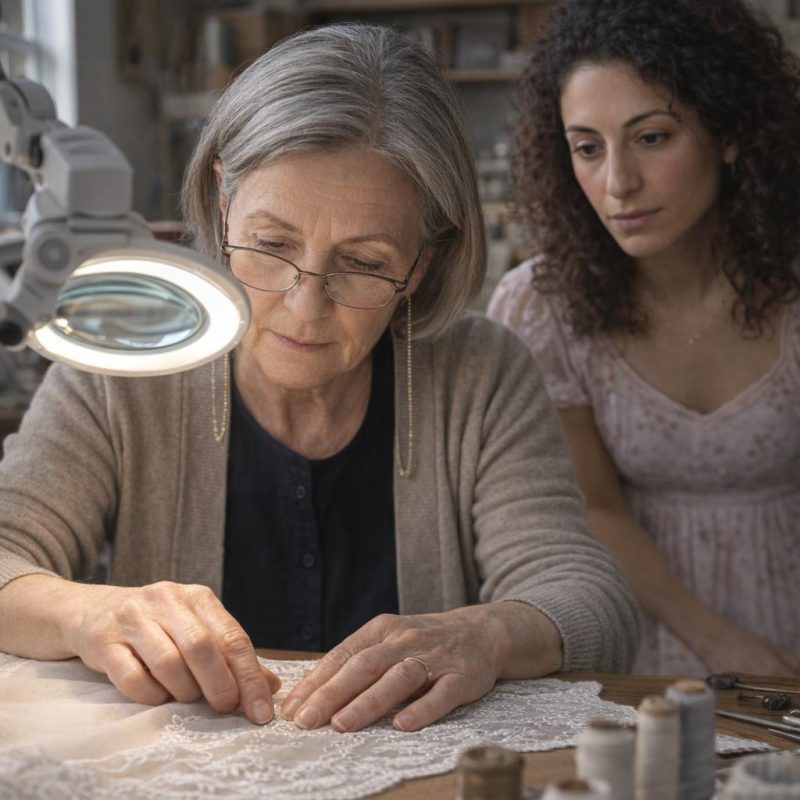 Image by RM AI
The First Night
Clara left around six, and I locked the front door and changed into my work clothes — the old ones, soft from washing, that I kept for long evenings at the table. I set up the dress under the good lamp, the one with the daylight bulb that shows true color, and I started where the damage was worst: the bodice seams. I unpicked the poor stitching carefully, a seam ripper in one hand and my fingers holding the tension in the other, working slowly so I didn't stress the satin. The fabric was forgiving once you treated it properly. I realigned the left panel, pinned it, checked the grain, pinned it again. Then I threaded my needle and began. The stitches had to be small and even, the tension consistent all the way down. It was the kind of work that asks everything of your attention and gives back a particular quiet in return. The room settled around me — the hum of the lamp, the faint pull of thread through fabric, the occasional sound of the street outside going distant and unimportant. Hours passed the way they do when the work is absorbing. By the time I set the needle down, my shoulders ached and the bodice seam lay straight and true, and the rhythm of it had carried me somewhere calm.
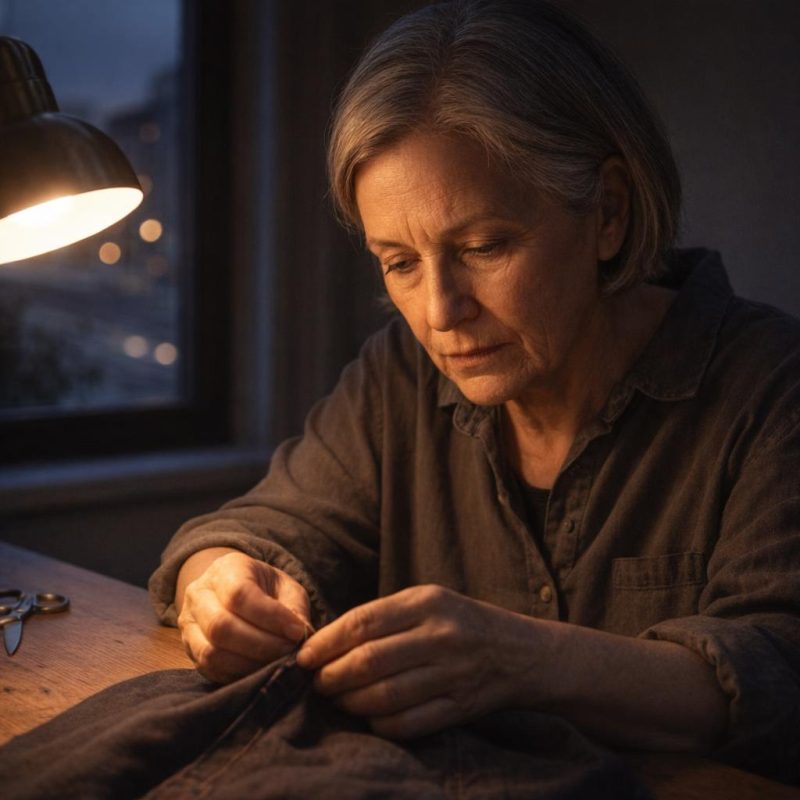 Image by RM AI
Rare Vintage Work
I took a break from the seam repairs sometime after nine and let myself look at the lace again. I'd been avoiding it, in a way — keeping my focus on the structural work, the practical problems. But now I set down my needle and brought the lamp close and just looked. The scalloped edges caught the light beautifully. Each one was slightly different from the next, the way handmade things always are, each scallop carrying the small signature of the person who'd formed it. The thread was fine, almost impossibly so, and the pattern had a regularity to it that spoke of real skill — not just patience, but mastery. I found myself wondering about the woman who had made this. Because it would have been a woman, almost certainly, sitting somewhere with good light and quiet around her, working this into existence one careful loop at a time. I felt the particular respect I always feel for that kind of labor, the kind that leaves no room for shortcuts. Whoever she was, she had known exactly what she was doing. The lace was old enough that she was likely long gone, and yet here was her work, still holding, still beautiful, the quality of it settling into my awareness like something that deserved to be acknowledged.
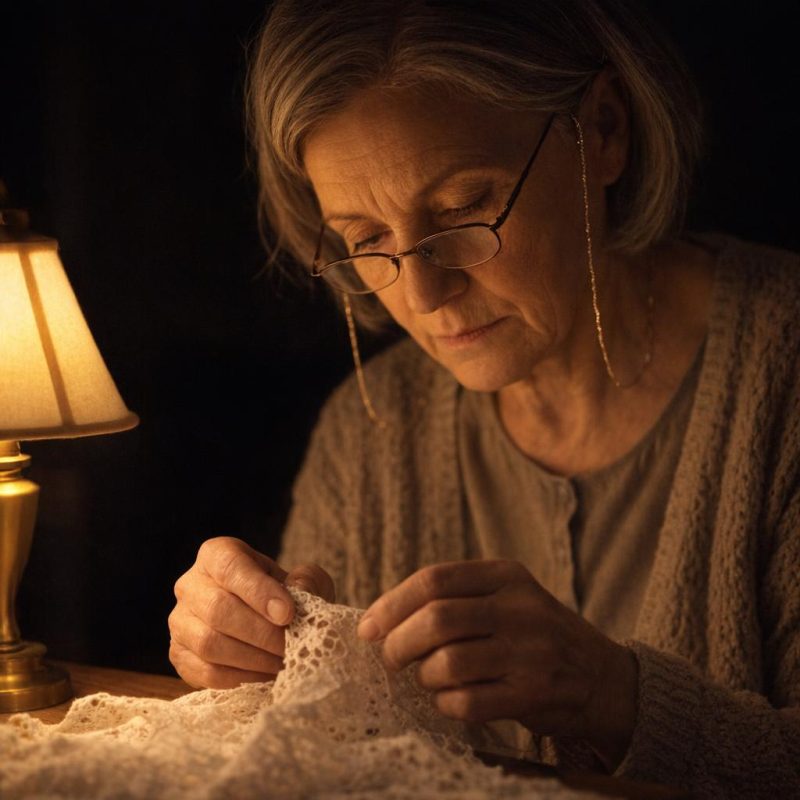 Image by RM AI
Too Particular
I told myself I was being too particular. It was an occupational hazard — years of close work had made me the kind of person who noticed things other people didn't, and sometimes that was a liability. The dress had problems, yes, but I was fixing them. The lace was unusual, yes, but unusual wasn't the same as wrong. I made myself a cup of tea and stood at the kitchen window for a few minutes, letting my eyes rest on something that wasn't fabric. I was tired. It was late. The strange feeling in my chest was probably just the accumulated frustration of working on someone else's poor alterations, nothing more. I went back to the workroom and picked up my needle and focused on the side seam, which still needed another pass. I worked steadily for a while and felt better for it. Then I set the needle down to rethread, and my eyes drifted to the lace appliqué near the hip, and I sat there looking at it, and I realized it was the third time that hour I'd stopped what I was doing to stare at that same section of lace without quite knowing why.
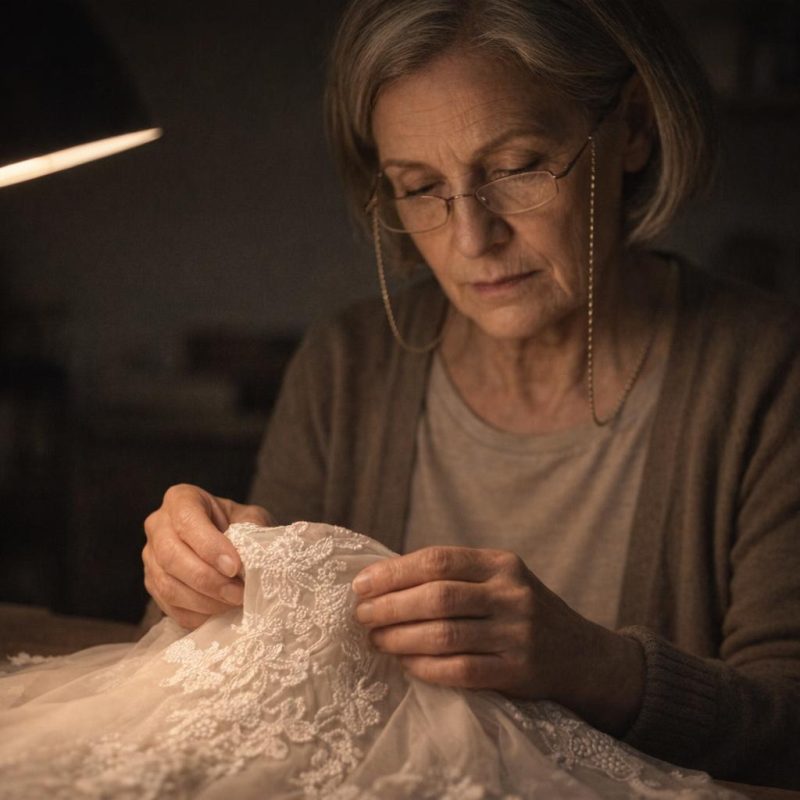 Image by RM AI
Every Movement
Clara came by the next afternoon, earlier than I'd expected. She said she just wanted to see how things were going, and I told her we were making good progress, which was true. I had the dress on the dress form by then, the bodice seams corrected and the side seam repaired, and it looked considerably better than it had when she'd brought it in. Clara stood close to the cutting table, closer than she needed to, and watched me work. I was doing a careful check of the appliqués, pressing each one lightly to assess how they'd been attached, and I noticed that every time my fingers moved toward the lace, Clara leaned forward slightly. Not dramatically — just a small shift in her weight, a tightening in her posture. I told myself it was bride nerves. A wedding dress is an emotional object, and it made sense that she'd be anxious watching someone handle it. I kept working, moving my hand along the lace near the hip, and I felt her attention follow every movement, her eyes tracking each brush of my fingers against the fabric.
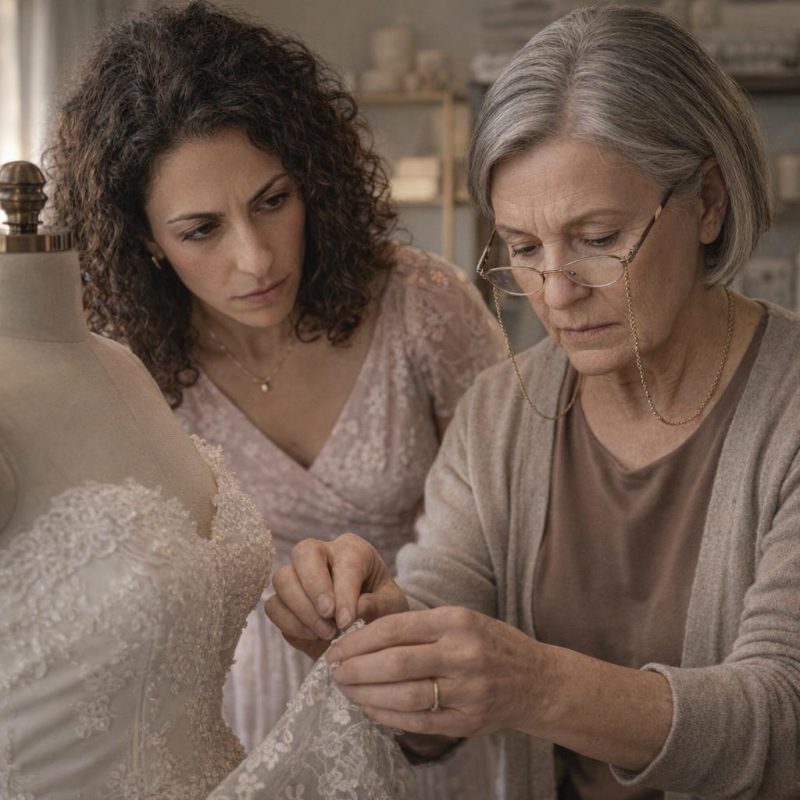 Image by RM AI
Almost Speaking
Clara didn't leave when she said she would. She kept finding reasons to stay — asking about the thread I was using, picking up a spool and setting it back down, drifting to the window and then drifting back. I didn't push her. I've known Clara since she was small enough to fall asleep in my sewing chair, and I know the difference between her wanting company and her wanting to say something she hasn't found the words for yet. This felt like the second thing. I kept my eyes on the dress, giving her room. The first time her mouth opened, I thought she was going to ask about the timeline. Then she closed it. The second time, she drew a breath like she was about to start a sentence, and I slowed my stitching without looking up. Nothing came. The third time, she actually said my name — just that, just the one word — and then stopped, pressing her lips together like she was physically holding something back. I told her the dress was coming along beautifully, which was true, and she nodded and said that was good, and the silence between us settled back into place like a weight. I threaded a new needle and waited. Her mouth opened for the fourth time — and closed again, without a sound.
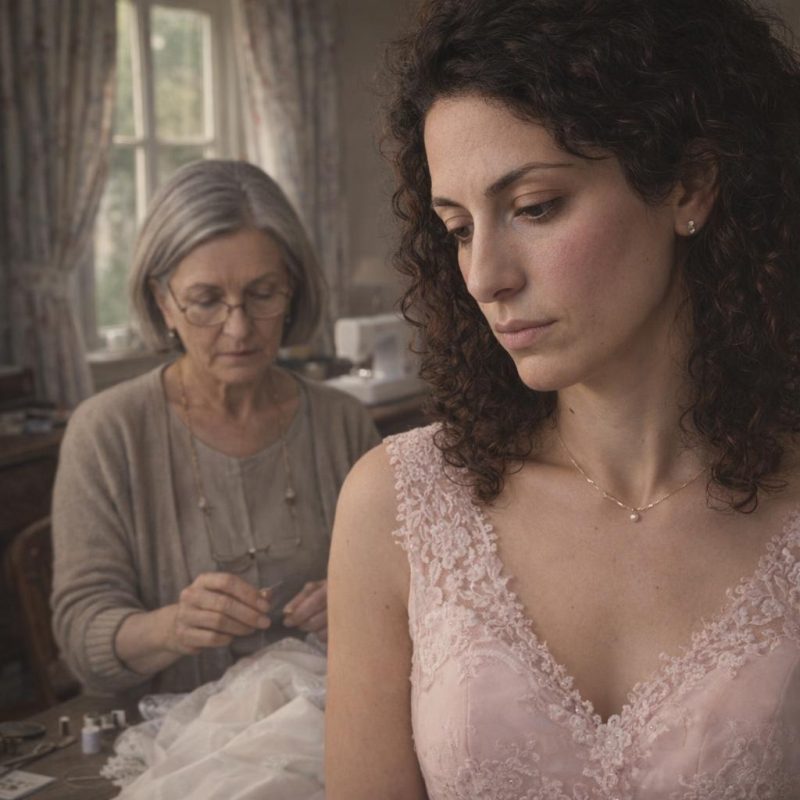 Image by RM AI
Tea with Sarah
I called Sarah the next morning and asked if she wanted to meet for tea, and she said yes before I'd finished the sentence, which is one of the things I love most about her. We sat at the little café on Mercer Street, the one with the mismatched chairs, and I wrapped both hands around my cup and tried to explain what I couldn't quite explain. I told her about Clara's dress — the construction problems, the poorly set sleeves, the buttons that had been put in wrong. Sarah listened the way she always does, with her full attention and no interruptions. Then I told her about the lace. I said it was beautiful, genuinely beautiful, the kind of work you don't see much anymore, and that something about it had been sitting with me in a way I couldn't account for. She asked if I thought the dress was damaged beyond what I could fix. I said no, the work itself was going fine. She asked what was bothering me, then. I opened my mouth and found I didn't have an answer. I just said it felt strange, being close to it. Sarah nodded slowly and didn't try to solve it, and somehow that was exactly what I needed. The afternoon light came through the window and lay across the table between us, and for a little while the strangeness felt smaller just for having been said out loud.
 Image by RM AI
The Second Night
I went back to the dress after dinner, when the house had gone quiet and the light outside had turned that particular shade of deep blue that means the day is truly finished. The back closures were the next thing that needed attention — twelve covered buttons, each one set at the wrong interval, the loops too loose to hold them properly. Whoever had done this work had been in a hurry, or hadn't cared, or both. I removed each button carefully, marking the correct placement with tailor's chalk, taking my time. There's a kind of peace in that sort of work, the slow undoing of someone else's mistakes, the restoration of what should have been there from the start. My needle moved in and out of the fabric with a rhythm that asked nothing of me except steadiness, and I gave it that. The house made its small nighttime sounds around me — the furnace cycling on, a branch brushing the side window, the particular creak of the hallway floor that I've never bothered to fix. I wasn't thinking about Clara, or about the odd feeling the dress gave me, or about anything much at all. I was just working, the way I have worked for forty years, and the clock on the mantle moved past eleven and then past midnight, and the silence settled around me like something familiar and kind.
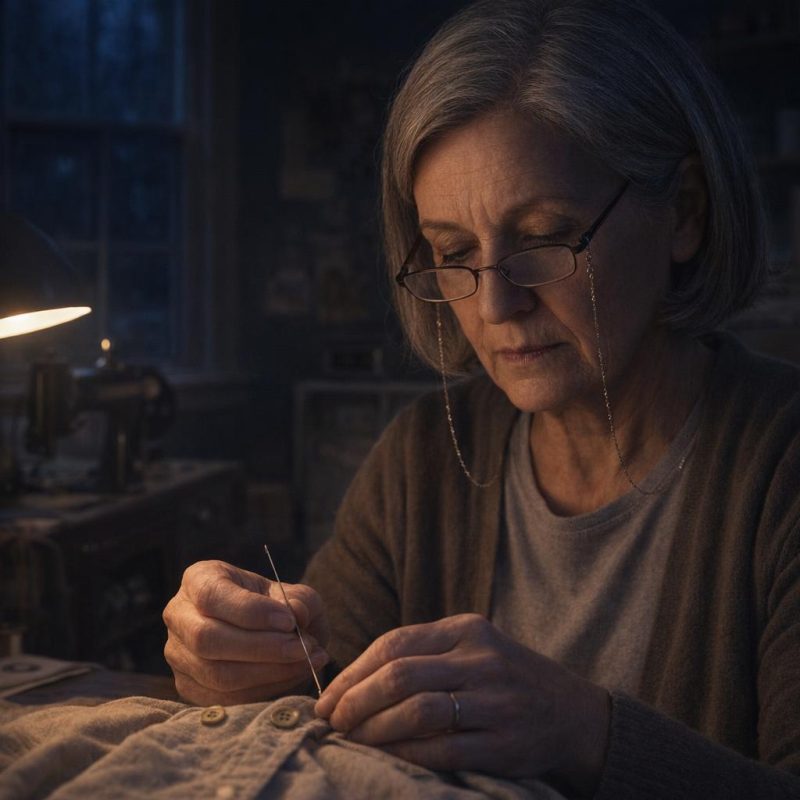 Image by RM AI
Hand-Finishing the Train
The closures were done by half past midnight, and I should have stopped there. I knew I should have stopped. But the train was spread across the cutting table and the lace appliqués along its border were only loosely basted, and I told myself I'd just tack down a few before bed. That's always how it goes with me and a dress that's nearly finished — the work pulls you forward whether you mean to go or not. I moved my lamp closer and threaded a fresh needle with fine silk thread, the kind that disappears into lace if you use it right. The appliqués were beautiful, I'll say that again. Each one was a small scalloped oval with a floral center, and they'd been placed along the train's edge with real care, whatever else had gone wrong with the rest of the construction. I began at the left corner of the hem and worked my way along, pressing each piece flat before I secured it, feeling the edges with my fingertips to make sure the placement was true. The scalloped border curved under my fingers in a way that was easy and unhurried, and I let my hands lead while my mind went quiet. By the midpoint of the train, I was tacking down the appliqués along the border, my fingers tracing each pattern slowly.
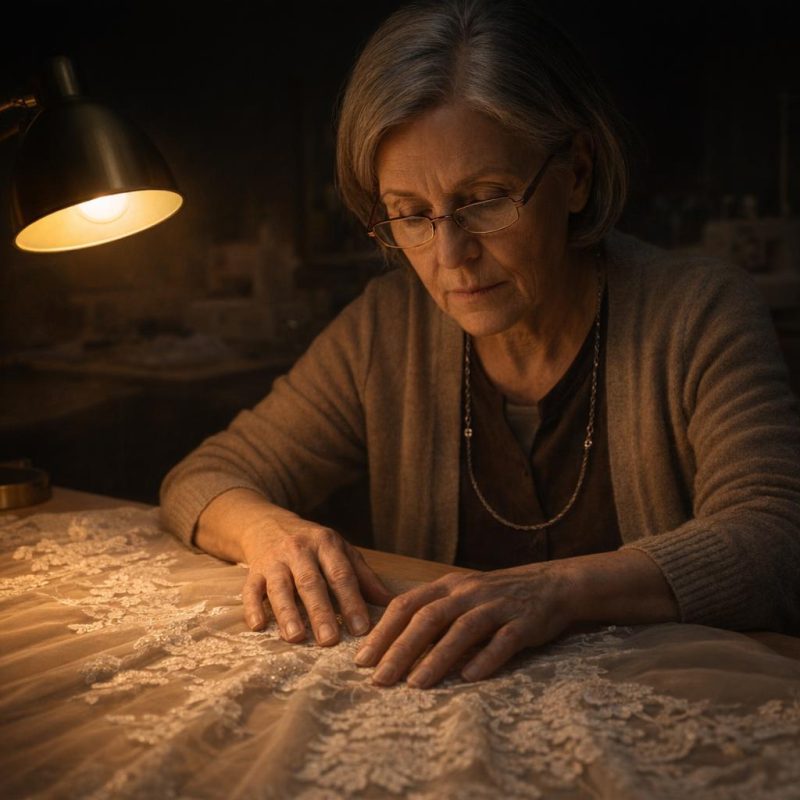 Image by RM AI
The Scalloped Edge
I didn't stop working, not exactly. My hands kept moving, kept pressing and stitching, but something had shifted underneath the motion. The scalloped edges of the appliqués moved under my fingertips in a way that felt less like touching fabric and more like reading something written in a language I used to know. I traced the outer curve of one piece, then another, and the shape of it — the specific arc, the way it narrowed at the point and widened again at the base — felt less like observation and more like memory. I've handled a great deal of lace in my life. Antique pieces, reproduction work, machine-made and hand-done, Belgian and French and domestic. You develop a vocabulary for it, a way of knowing what you're touching without having to think. But this wasn't that kind of knowing. This was something older and less organized, something that lived in the muscles of my hands rather than in my mind. I set down my needle and pressed both palms flat against the train, feeling the pattern beneath them. The floral centers sat at even intervals along the scalloped border, each one raised slightly from the base, each one constructed in the same careful way. My hands knew the shape of them. I didn't know how, or from where, or what it meant. I just sat there in the lamplight with that weight settling somewhere in my chest, quiet and nameless.
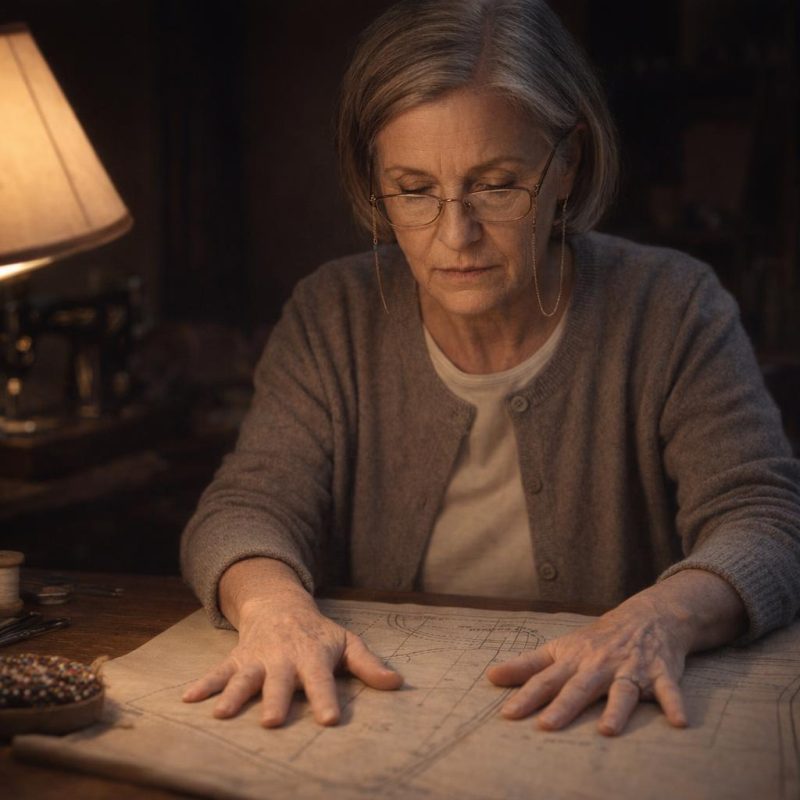 Image by RM AI
Tiny Floral Centers
I picked up my magnifying glass and bent close to one of the floral centers, the way I do when I need to understand a piece of work rather than just admire it. Each petal was formed separately, built up from the base with a technique that layered the thread in a specific sequence — not the way most lacemakers work, not the shortcut method that gets you a similar result faster. This was the longer way, the more deliberate way, the way that produces a petal with a slightly raised center and a softness at the edges that you can feel as much as see. I moved to the next appliqué and found the same thing. Then the next. Every single one was made the same way, with the same sequence, the same slight raise at the center, the same soft finish at the petal tips. I sat back and took off my glasses and pressed my fingers against my eyes for a moment. There's a particular feeling when you encounter a technique so specific that it stops being a style and starts being a signature — like recognizing someone's handwriting on an envelope before you've read the name. That was what this felt like. Not a general familiarity, not the vague sense of having seen something similar somewhere. The petals were formed exactly as I would have formed them, in exactly the order I would have chosen, and the feeling of them under my fingertips was like reading words I had written myself.
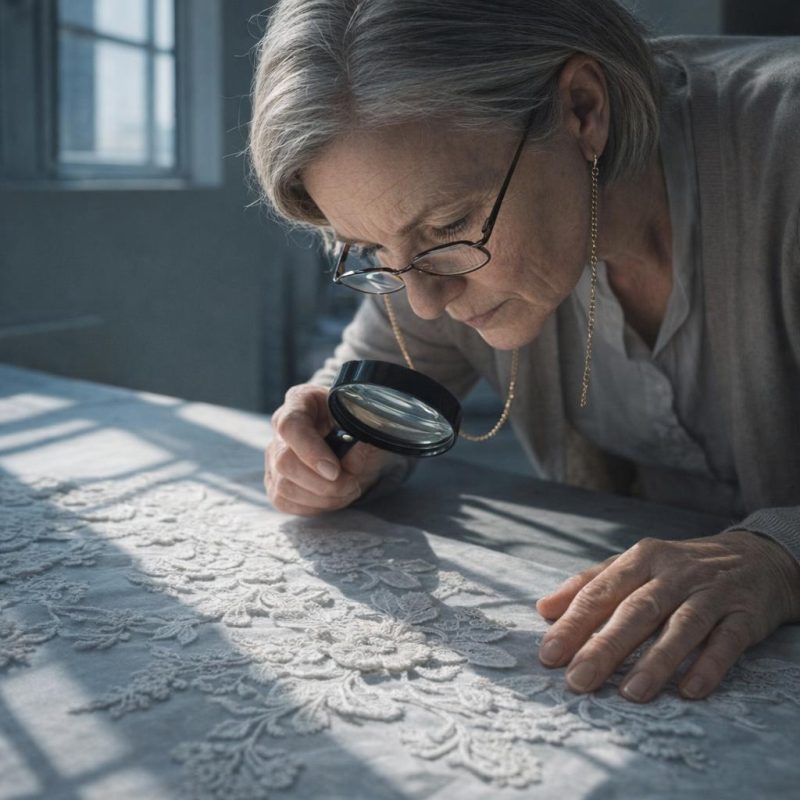 Image by RM AI
The Doubling Technique
I turned the edge of the train over and looked at the back of one of the appliqués, where the thread work is always most honest. On the front, a skilled maker can disguise a great deal. On the back, you see exactly what choices were made and in what order. The thread on this piece doubled back on itself at each petal join in a very specific way — not the standard method, not the way you'd find in any pattern book or instructional guide I'd ever seen. It was a technique I had worked out myself, years ago, when I was still learning and found that the standard method left a small weakness at the join that bothered me. My solution had been to loop the thread back through the previous stitch before moving forward, creating a lock that was nearly invisible from the front but unmistakable from the back. I had never seen anyone else do it that way. I had never taught it to anyone. I had never written it down. My pulse had gone strange and quick without my quite noticing when it happened. I turned the appliqué slowly in the lamplight, following the thread path with the tip of my finger, and there it was — the exact spot where the thread looped back through itself in the pattern I had invented alone, in a cold apartment, more than twenty-five years ago.
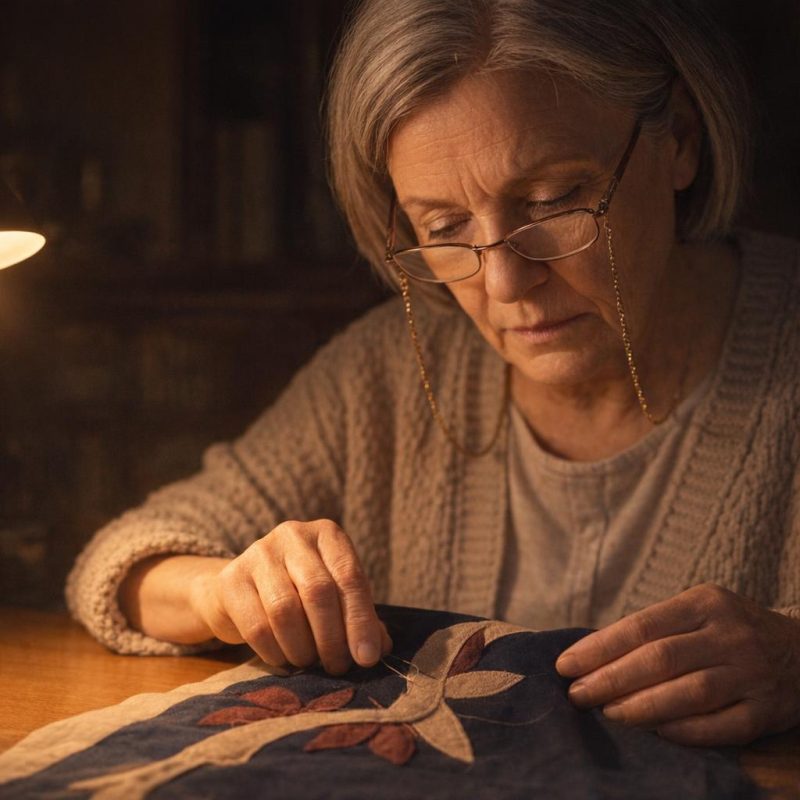 Image by RM AI
A Half-Remembered Song
I set the train down across my lap and sat very still. The house was completely quiet now, the kind of quiet that only comes after midnight when even the street outside has given up for the night. I wasn't stitching anymore. I was just holding the lace, the way you hold something when you're not sure yet what it is you're holding. I tried to think clearly. There are only so many explanations for a thing like this — a technique that specific, that personal, appearing in a piece of work I'd never seen before. I turned the possibilities over slowly, the way you turn a stone to see what's underneath. A coincidence. Someone who had learned from the same source I had, though I couldn't think what source that would be. Someone who had arrived at the same solution independently, though the odds of that felt very small. My mind kept reaching for the memory that the pattern was pulling toward, the way you reach for a word that's sitting just at the edge of your tongue. I didn't know this lace the way you know something you've studied or admired. I knew it the way you know your own face in a mirror, or the sound of your own voice on a recording — immediate and slightly strange. I pressed my fingers flat against the scalloped edge and held them there, and the pattern beneath them was as familiar as my own name.
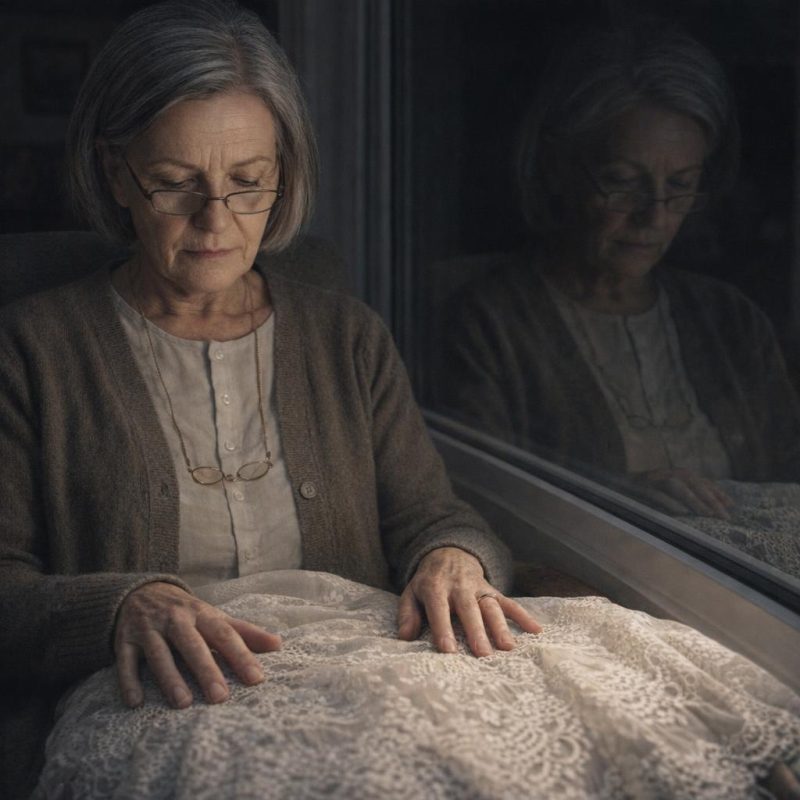 Image by RM AI
Strangely Familiar
I tried to go back to the work. I threaded the needle again, smoothed the fabric across my lap, positioned my fingers the way I have ten thousand times before. But my hands wouldn't cooperate. They kept stilling over the lace, hovering just above the surface like they were waiting for permission to continue. I told myself it was late, that my eyes were tired, that the hour was making me fanciful. I've worked past midnight plenty of times and never lost my focus like this. The pattern kept pulling at something I couldn't name — not a thought exactly, more like a pressure behind a thought, the way a word sits on the tip of your tongue and refuses to come forward. I set a stitch. Then another. Then I stopped and just looked at the scalloped edge again, tracing it without touching, following the rhythm of it with my eyes. There was something here I needed to understand before I could go any further. I could feel that much with complete certainty. I set the needle down on the cutting table beside me, and I knew I wasn't picking it back up tonight.
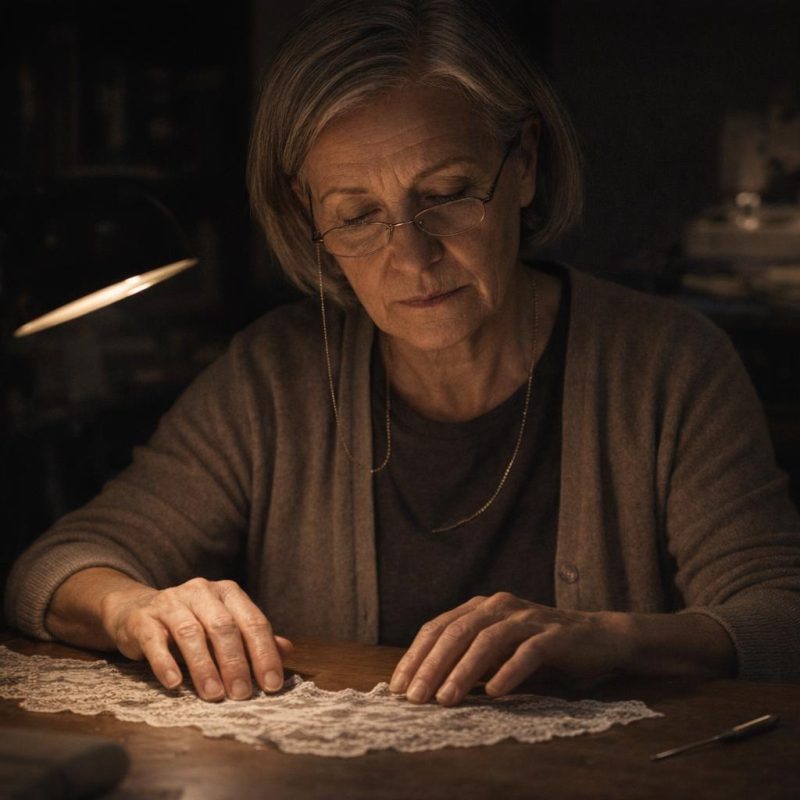 Image by RM AI
Where Have I Seen This
I pushed back from the cutting table and sat very still, the dress pooled in my lap, my hands resting open on top of it. I closed my eyes. That's something I learned years ago — sometimes the memory you're reaching for won't come if you chase it directly. You have to go quiet and let it find you. I tried to think through every piece of lace work I'd handled over the years. Antique Brussels, Honiton, Chantilly. Pieces that came through the shop in various states of ruin. Veils I'd restored for women whose grandmothers had worn them. I have a good memory for this kind of thing — fabric and pattern stay with me the way faces stay with other people. But nothing I turned up matched what was sitting in my lap right now. The scallop count, the floral centers, the particular weight of the thread — it wasn't matching anything in my recent catalog of work. Whatever this was reaching toward, it wasn't recent. It was older. Deeper. The answer was somewhere in there, I could feel the shape of it, but it stayed just out of reach, quiet and patient in the dark.
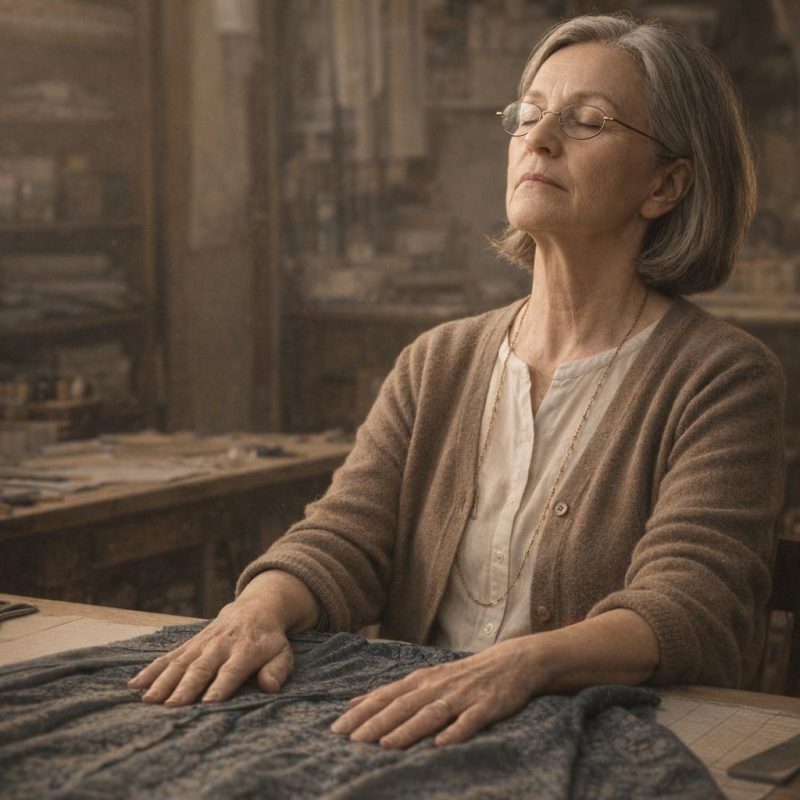 Image by RM AI
Many Vintage Laces
I tried the reasonable explanation next. I told myself that vintage lace shares characteristics — that after enough decades, certain patterns recur, certain techniques converge. I've handled hundreds of pieces over my career, maybe more. It would be stranger, in some ways, if I never encountered something that felt familiar. Lacemakers in the same tradition work from the same foundational grammar of knots and loops and scalloped edges. Of course things would echo each other. Of course I would sometimes feel a false recognition. I pressed my fingers against the border again and tried to believe that. I am a professional. I know how to separate feeling from fact. I know how suggestion can color perception, how a late hour and a quiet house can make the mind reach for meaning that isn't there. I told myself all of this carefully, the way you talk yourself down from something. But my hands weren't listening. They kept reading the lace the way they'd read something known, something handled before, and the reasonable explanation I was building in my head felt thin and unconvincing even as I assembled it.
 Image by RM AI
This Specific Scallop
I pulled the magnifying glass from the drawer and bent close to the scalloped border, the way I do when I need the work to speak plainly. I wasn't going to trust feeling alone. I was going to look at the facts. The scallops themselves were small and even, each one a precise arc, and I began counting the points along the edge — the tiny raised peaks that defined each scallop's boundary. Most vintage lace runs seven points, sometimes nine. Occasionally five on a finer piece. I counted slowly, moving along the border with the tip of my finger, keeping track. The number came up the same on the first scallop, and the second, and the third. I moved to a different section of the border and counted again. Same result. I sat back and looked at the number I'd arrived at, and something in my chest went very still. Eleven. Every scallop along this entire border carried exactly eleven points. I had never seen that in any piece I hadn't personally specified.
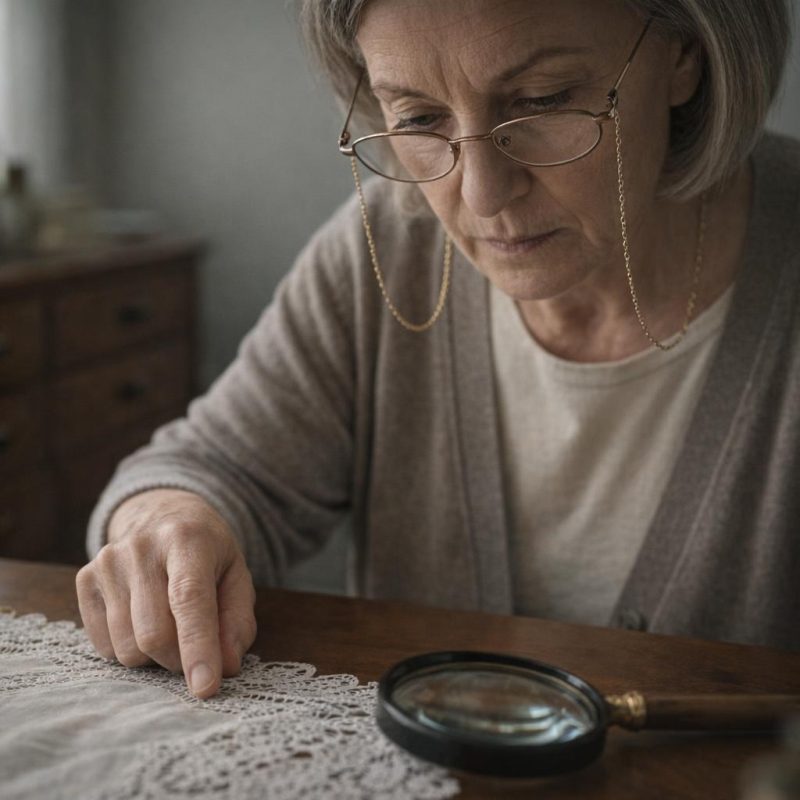 Image by RM AI
This Flower Center
I set the magnifying glass down and looked at the floral motifs next — the small appliquéd flowers scattered across the body of the lace, each one centered with a raised dome that caught the light differently than the surrounding fabric. I knew this technique. Not from study, not from admiring someone else's work. I knew it from doing it, from the particular frustration of getting the padding layer right underneath so the center would sit up properly without puckering the surrounding threads. It requires a specific sequence — the padding stitched first in a tight spiral, then the covering threads laid over in a particular direction, then the finishing pass that locks everything flat at the edges while the center stays proud. Most modern lacemakers don't bother. It's slow and exacting and the difference is subtle enough that most people won't notice. But I notice. And whoever had made this lace had known exactly how to do it, had done it consistently across every single motif, with a patience and precision that didn't come from a pattern book. I sat with my hands in my lap and felt the weight of that settle over me.
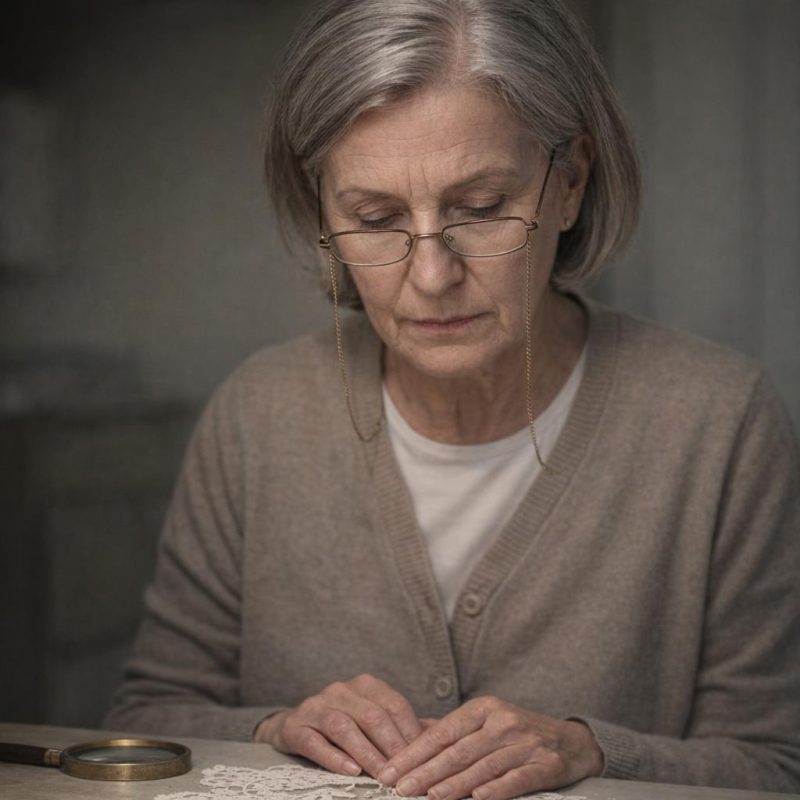 Image by RM AI
Fighting Growing Certainty
I wanted to stop. I want to be honest about that. Part of me was very aware that I could set this dress aside, go to bed, and come back to it in the morning with fresh eyes and a more sensible frame of mind. I've been sewing long enough to know that late nights breed strange thoughts, that the mind finds patterns where none exist when it's tired and alone. I tried that argument. I tried it sincerely. But every time I looked back down at the lace, another detail confirmed what I was trying not to think. The thread weight. The tension of the knots. The way the scallop border met the floral field at a particular angle that wasn't accidental — that was the result of someone thinking carefully about how the two elements would relate to each other. Each detail I examined added itself to the others, quietly and without drama, and the accumulation of them was pressing against something I didn't want to name. I was afraid of where this was going — the way you're afraid when the ground feels unsteady and you can't yet see what lies ahead.
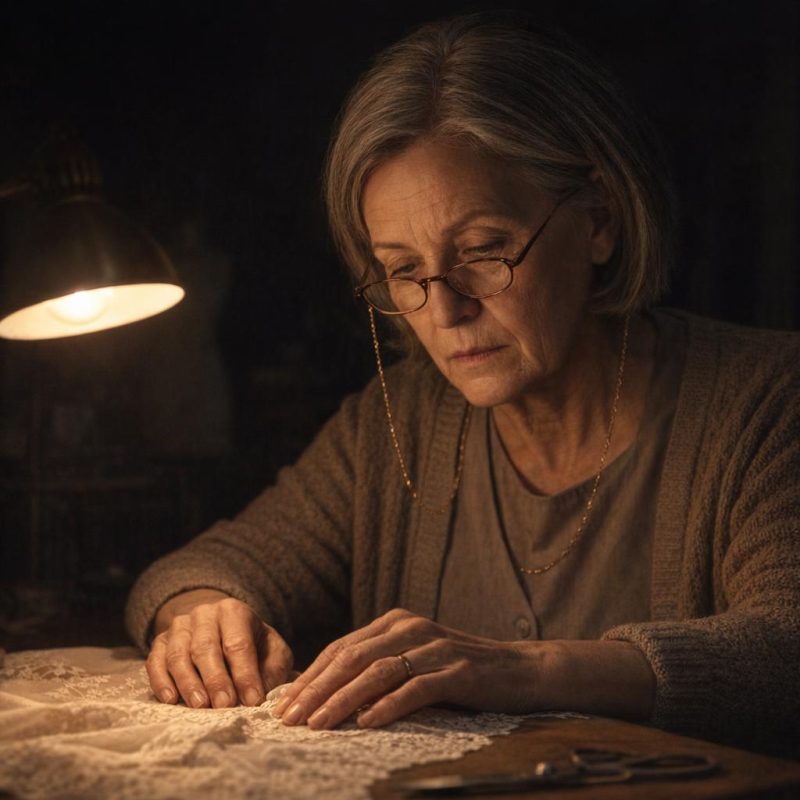 Image by RM AI
Commissioned Lace
And then the memory came, the way they sometimes do — not gradually but all at once, like a door opening in a dark room. I was younger. I had a date set and a dress being made and a hundred small decisions still ahead of me. I had gone to a shop — a small place, the kind that doesn't exist anymore, tucked into the ground floor of an old building with bolts of fabric stacked to the ceiling and a smell of sizing and cedar that I can still bring back if I try. There had been an elderly woman there, small and precise, with hands that moved over fabric the way a musician's hands move over keys. I had brought her a sketch. I had sat across from her at a worktable covered in samples and explained exactly what I wanted — the scallop count, the floral centers, the raised technique for the dome of each motif. She had listened without interrupting, which I remembered because it was unusual. And then the memory sharpened further, and I could see the shop again as clearly as if I were standing in it — the low light, the bolts of ivory and cream, the woman's careful hands smoothing my sketch flat on the table.
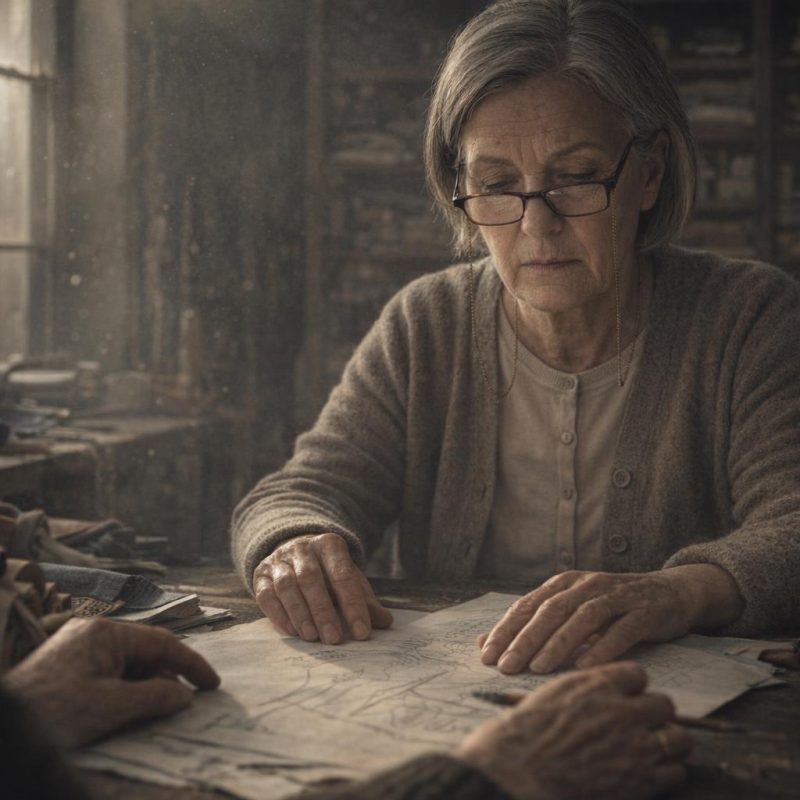 Image by RM AI
The Pattern Was Unique
She had looked at my sketch for a long time before she spoke. I remembered that pause — the way she studied the scallop count, the floral placement, the notes I'd written in the margins about the raised centers. When she finally looked up, she said it was an unusual request. Not difficult, she was clear about that, but unusual. She told me she had been making lace for over forty years and no one had ever brought her this particular combination before. The scallop count alone was uncommon, she said, and paired with the raised floral technique I was describing, it would be something she hadn't made before. She seemed pleased by that. She said she would work from my specifications exactly, that the pattern would be made to my design. And then she looked up from the sketch one more time and told me plainly: *This pattern will be yours alone. No one else has asked for this. No one else will have it.*
 Image by RM AI
Same Doubling Technique
I set the dress down and picked up my magnifying glass. I had been telling myself I was wrong — that memory plays tricks, that twenty-five years is a long time, that lace is lace and patterns repeat. But I needed to look again, properly, the way I would look at any piece of work I was trying to understand. I started at the corner of the hem where the doubling technique was clearest. The thread was looped back on itself in a specific way — not the standard method, not the shortcut most lacemakers use, but the particular doubling I had described to the woman in the shop all those years ago. I had asked for it because it added density without adding weight. She had said it was an unusual request. I traced the path of the thread with the tip of my finger, following the loop where it turned and anchored. I moved to the next section. Then the next. The spacing between each doubled thread was consistent — not just similar, but exact. The tension was the same. The rhythm of the pattern was the same. Every technical detail I had specified in that sketch seemed to be there under my hands, stitch by stitch, loop by loop, all the way to the end of the border.
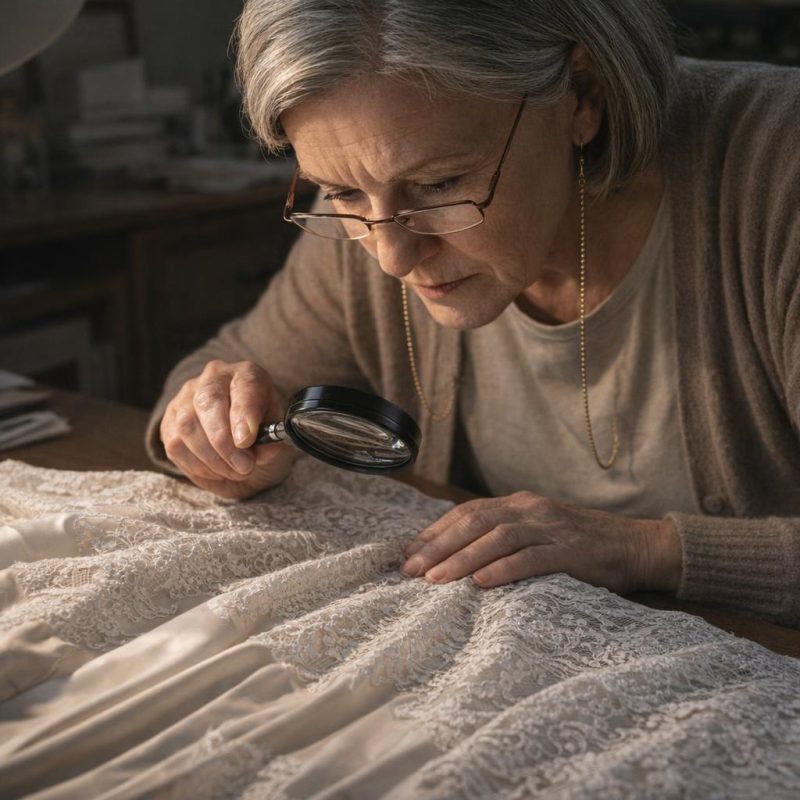 Image by RM AI
Only One Way to Know
I put the magnifying glass down and sat very still. The workroom felt smaller than it had an hour ago. I had been in this room for thirty years, surrounded by other people's fabric and other people's occasions, and I had always been able to keep my own history neatly folded away on its shelf. But the evidence under my hands was not something I could fold away. The thread path. The doubling technique. The scallop count. The raised floral centers. Each detail on its own might have been coincidence. Together they formed something I couldn't dismiss, no matter how much I wanted to. There was only one way to be certain. I had known it from the moment the comparison started forming in my mind, and I had been pushing the thought away because of what it would mean to act on it. The preservation box had sat on the highest shelf in this room for twenty-five years. I had never opened it here. I had barely let myself think about what was inside. The idea of disturbing it — of pulling it down and holding it under the light and comparing it to the dress on my table — made me feel physically ill. But I didn't have a choice anymore. The cold weight of that settled over me and didn't lift.
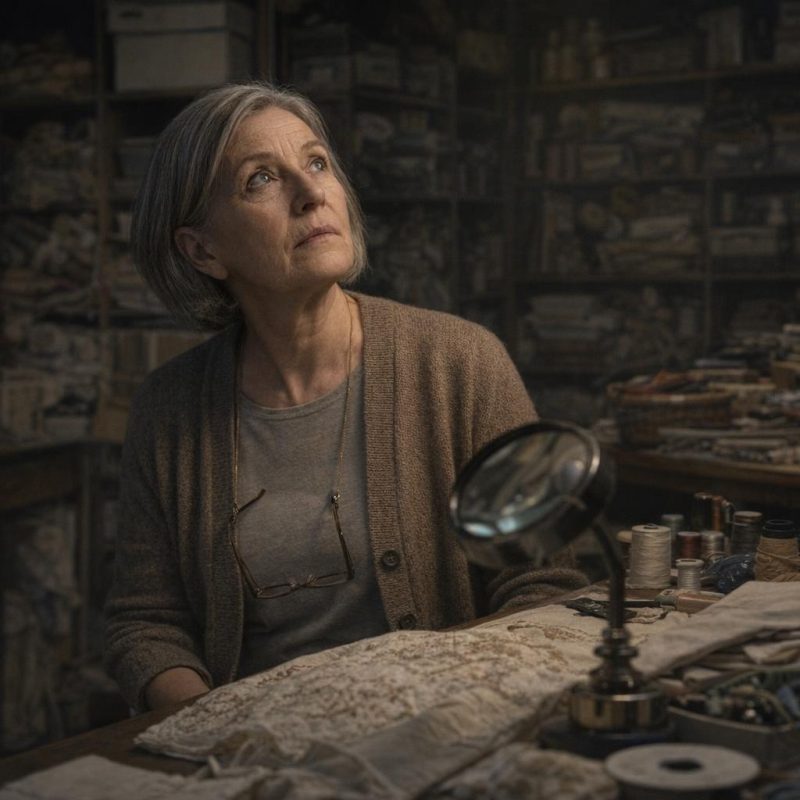 Image by RM AI
The Highest Shelf
I didn't move right away. I sat at the cutting table with my hands flat on the surface and made myself breathe. Then I looked up. The highest shelf ran along the back wall of the workroom, above the bolts of interfacing and the stacked pattern boxes, above the things I reached for every day. The preservation box sat at the far left end, exactly where I had placed it when I moved into this house. It was wrapped in brown paper, tied with cotton twine, the way archival suppliers recommend for long-term storage. I had done everything right. Acid-free tissue inside, controlled light, no humidity. I had taken care of it the way I took care of everything — methodically, thoroughly, without letting myself think too hard about why I was being so careful with something I never intended to open. Twenty-five years. The paper had yellowed slightly at the edges. The twine had gone a little stiff. But the box itself was intact, undisturbed, exactly as I had left it. I had walked past it thousands of times without letting my eyes rest on it for more than a second. Now I looked at it directly, and it sat there on the shelf above me, waiting.
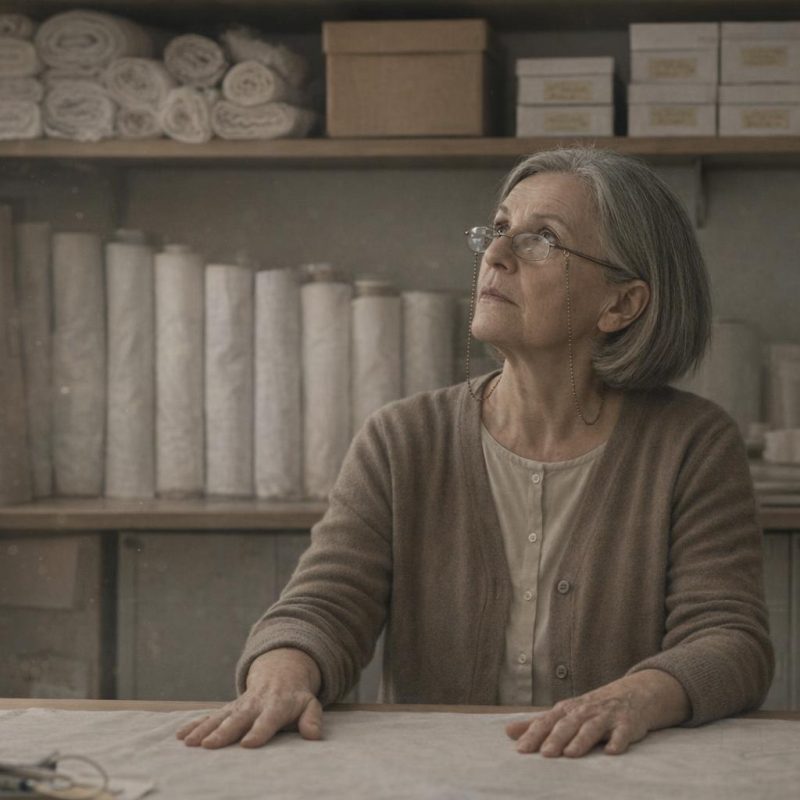 Image by RM AI
Standing
I pushed back from the cutting table. The chair legs scraped against the floor and the sound was too loud in the quiet room. I stood up slowly, and my legs felt wrong beneath me — not weak exactly, but uncertain, like the floor had shifted slightly and I hadn't adjusted yet. I stood there for a moment with one hand on the table edge. The workroom had always been a place where I felt competent. Every tool in its place, every process understood, every problem solvable with enough patience and the right technique. I had built that feeling deliberately over thirty years. It had held me through a great deal. But standing there looking at the shelf, I felt none of it. I felt only the distance between where I was standing and where I needed to go, and the knowledge that once I crossed it, I couldn't uncross it. I let go of the table. I took the first step, then another. The shelf was only across the room — twelve feet, maybe fifteen — but each step felt like it was costing me something I couldn't name and couldn't get back. The light through the workroom window was the same light it always was. Nothing had changed. And yet every step toward that shelf felt like walking to the edge of something I could not see the bottom of.
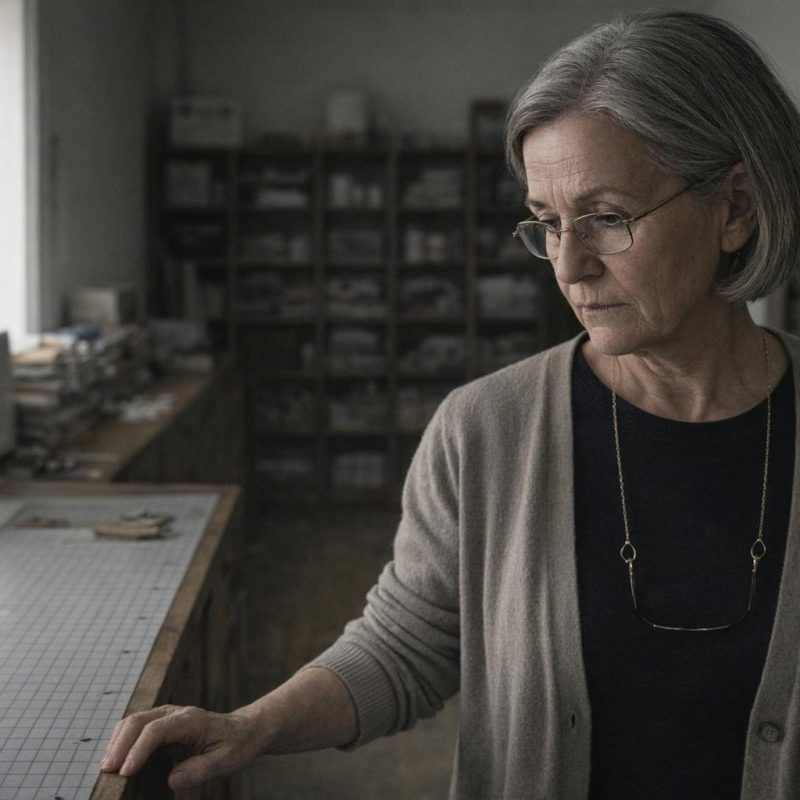 Image by RM AI
Reaching
I reached up with both hands. The box was on the highest shelf and I had to go up on my toes to reach it, the way I always had to when I first put it there. My fingers found the edge of the brown paper wrapping and I steadied my grip before I pulled it forward. It came off the shelf more easily than I expected. I had been bracing for resistance, for the weight of twenty-five years to make itself felt in some physical way, but the box was lighter than I remembered. That surprised me. I stood there for a moment with it in my hands, not moving. The cotton twine was rough under my fingers. The brown paper crinkled faintly where I held it, and the sound of it was very small in the quiet room. I could feel the shape of what was inside — the soft give of tissue paper over fabric, the slight shift of something folded and settled over a long time. I had not held this box since the day I carried it into this house and put it on that shelf. I had not let myself hold it. The weight of it in my hands now — lighter than memory, heavier than I could account for — stayed with me as I stood there, not yet ready to move.
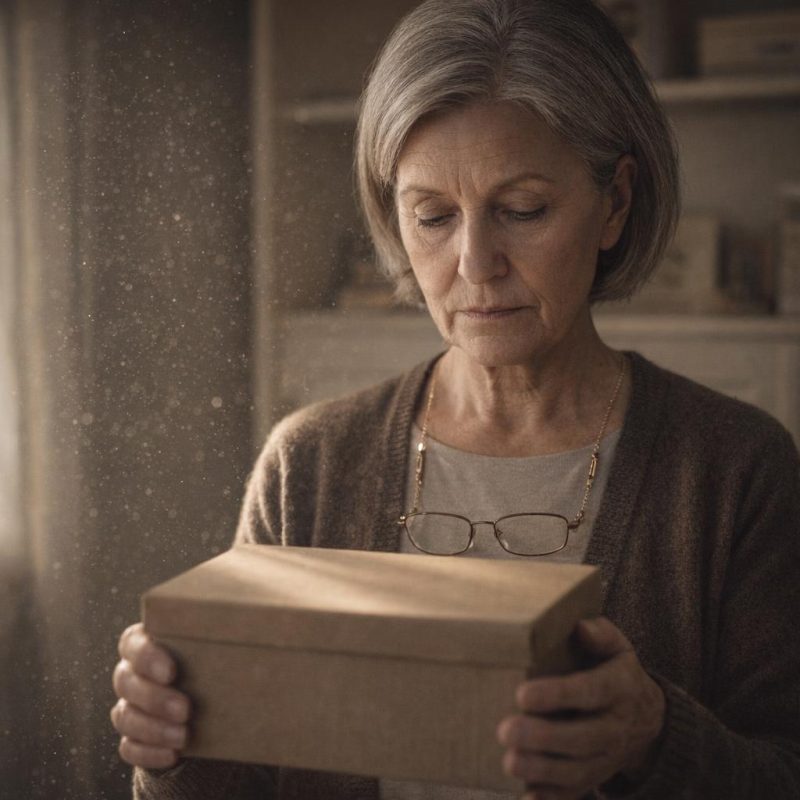 Image by RM AI
Twenty-Five Years
I carried the box to the cutting table and set it down beside Clara's dress. I didn't look at the two of them together yet. I wasn't ready for that. Instead I stood with my hands resting on the edge of the table and let the memories come, because they were coming whether I invited them or not. The fire had started in the building's electrical system — that was what the report said. It had moved fast. By the time anyone knew, the apartment was gone. Michael's apartment, where we had been storing things for the wedding. The dress had been there. Most of it had been there. I remembered standing in the street afterward, not quite understanding what I was looking at, and Michael beside me with his hand on my arm saying something I couldn't hear over the sound of the water from the hoses. We didn't get married that spring. We didn't get married at all, in the end. There were reasons for that beyond the fire, reasons I had spent a long time not examining too closely. Diane had helped me go through what was left of the apartment afterward — she had been there when someone found the partial train in the debris, still wrapped in the garment bag, scorched at the edges but not entirely gone. I had kept it. I had always kept it. I set the box down on the table beside Clara's dress and made myself look at them both.
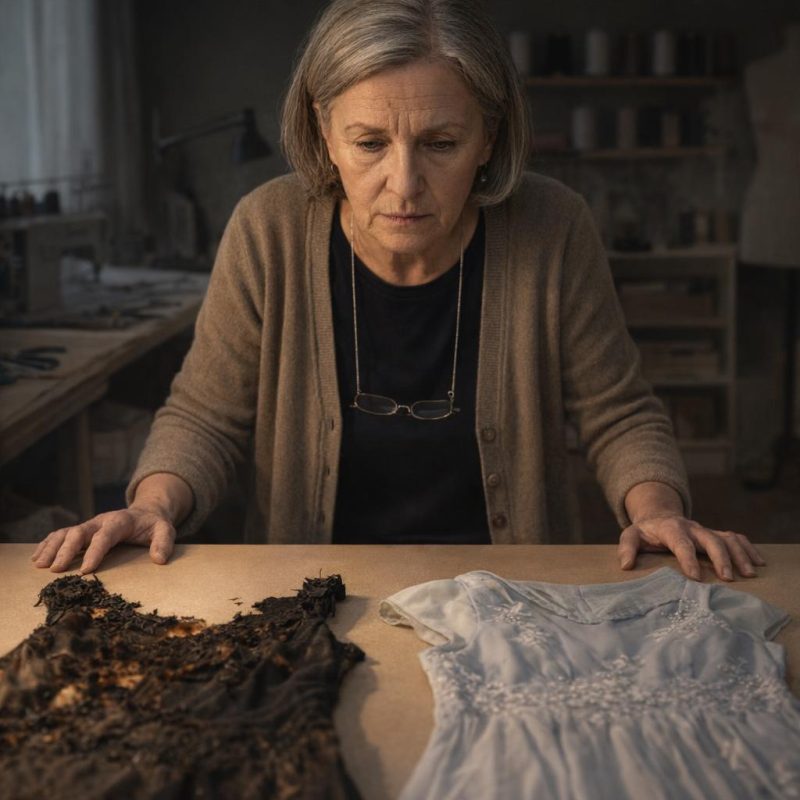 Image by RM AI
Opening the Tissue
I untied the cotton twine first. My fingers were steadier than I expected, which surprised me — some part of me had thought I would fall apart the moment I started, but the hands that had spent thirty years handling delicate fabric knew what to do even when the rest of me didn't. I folded the brown paper back carefully and set it aside. Inside was the acid-free tissue, layered the way I had packed it, still white after all this time. I peeled back the first layer, then the second. The smell reached me before I saw anything — a faint trace of something old and closed-away, and beneath it, so faint I might have imagined it, the ghost of smoke. Then I saw the fabric. The center of the train was gone — destroyed in the fire, the silk reduced to nothing. What remained was the border: a wide band of lace running along the outer edge of what had once been a six-foot train, scorched at the very margins where the fire had reached it, the edges blackened and brittle. But between the scorched margins and the destroyed center, a section of the lace had survived. I could see the scalloped edge. I could see the raised floral centers. I sat with my hands in my lap and looked at what the fire had left behind, and the room around me went very quiet.
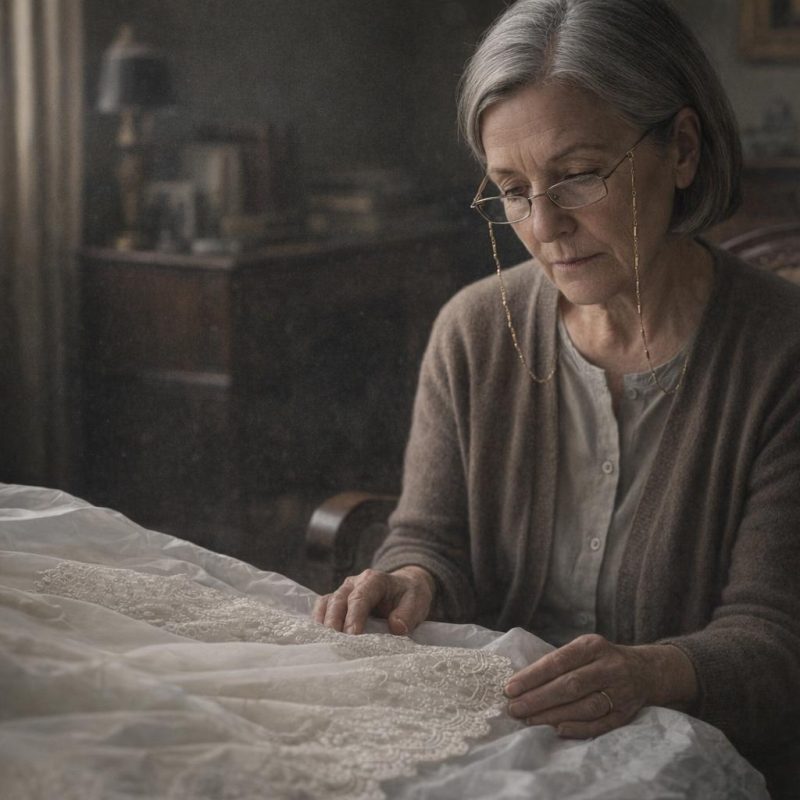 Image by RM AI
Partial Train Survived
I lifted the remnant out of the box with both hands, the way you lift something you are afraid of damaging further. The scorched edges were fragile — I could feel the brittleness in the blackened threads where the fire had reached them — so I kept my grip to the intact section, the part that had survived. The center of the train was simply absent, a ragged void where the silk had burned away entirely. But the lace border had held. Along the outer edge, running the full length of what remained, the scalloped edging was intact. The floral centers were there — raised, precise, exactly as I had drawn them in that sketch. The thread doubling was visible even without the magnifying glass. I turned the remnant slightly in my hands to catch the light, and the pattern came clear against the pale tissue beneath it. There was enough. That was the thing I kept coming back to as I held it — there was enough of the pattern left to see it whole, to trace it, to compare it properly against another piece of lace if I needed to. I set the remnant down gently on the tissue paper and let my hands rest at the edge of the table, the intact lace edging lying open in the light after twenty-five years in the dark.
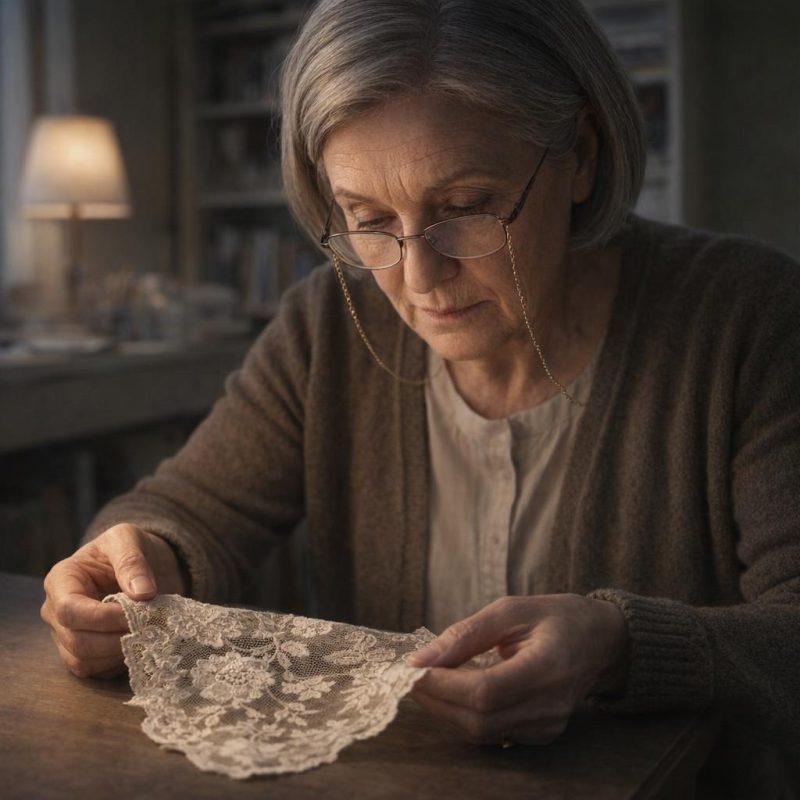 Image by RM AI
Side by Side
I carried the remnant to the cutting table the way you carry something that might shatter — both hands flat beneath it, no pressure on the edges, no sudden movements. Clara's dress was already spread there, the skirt fanned out across the white surface, the lace border catching the overhead light. I set the remnant down on the left side, leaving a few inches of space between them, and then I stood back and looked at what I had done. Two pieces of lace on the same table. My hands were trembling — not badly, just a fine, persistent tremor I couldn't will away. I pressed my palms flat against the table edge for a moment and breathed. There was still a part of me that wanted to believe I was wrong, that the similarity was coincidence, that lace patterns repeat across decades and across makers and that none of this meant what I was afraid it meant. I straightened the remnant slightly so the scalloped edge ran parallel to the border on Clara's dress. The two pieces lay side by side under the light, waiting.
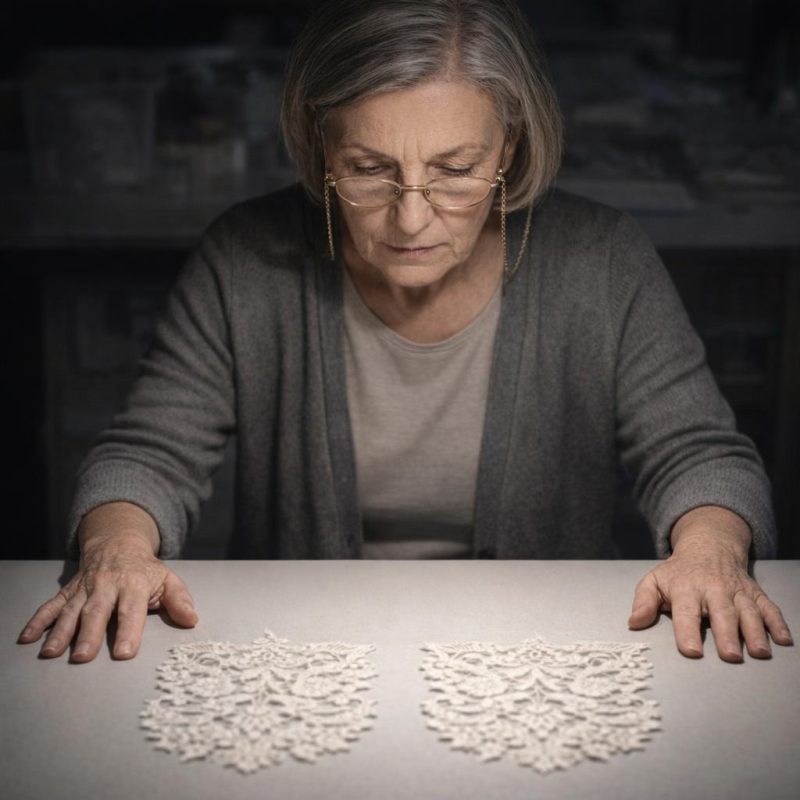 Image by RM AI
Counting Stitches
I started with the scallop points because those were the hardest to replicate consistently. I counted the points on the first full scallop of the remnant — seven — and then moved to the corresponding section on Clara's dress and counted again. Seven. I wrote nothing down. I just held the numbers in my head and moved to the next scallop. Seven again. And again. I picked up my small ruler and measured the depth of the curve on the remnant: eleven millimeters. I measured the same curve on Clara's dress. Eleven millimeters. My hands were shaking enough that I had to reposition the ruler twice to be sure of the reading. I checked the spacing between the floral centers next, measuring the gap from the outermost petal of one motif to the nearest petal of the next. Forty-three millimeters on the remnant. I moved the ruler to Clara's dress and set it carefully against the same points. The work steadied me, the way precise work always had — each measurement a small, contained thing I could hold onto while everything else felt like it was tilting. I recorded the number in my head and moved on.
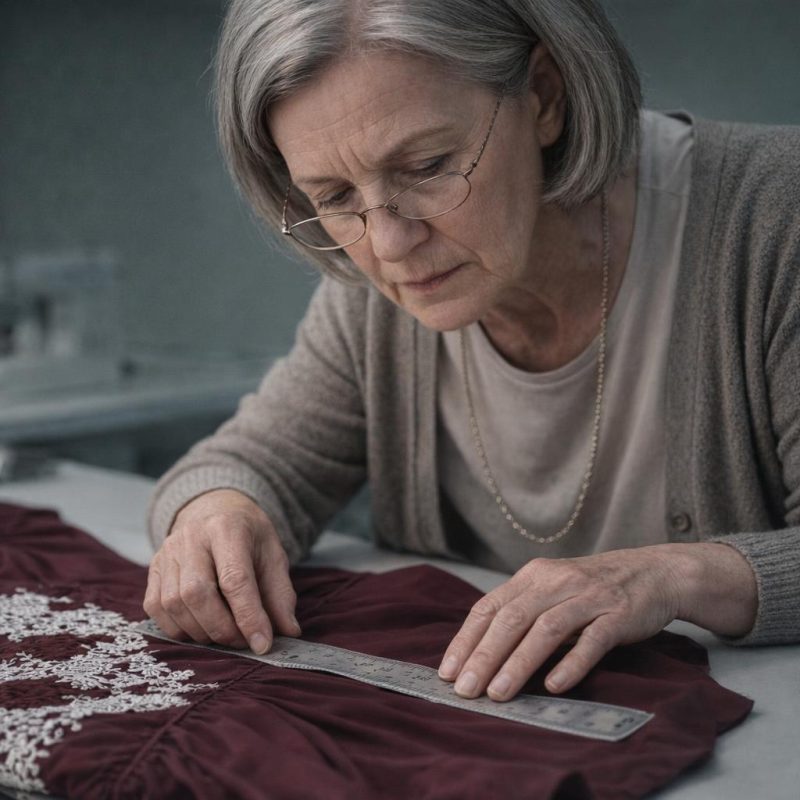 Image by RM AI
Thread Weight
Thread weight was the detail that was hardest to fake and hardest to match across different makers. I had learned that early, in the first years of working with vintage lace — two pieces could look identical at arm's length and fall apart under a loupe because the thread itself was different, spun to a different tension, twisted a different number of times per inch. I picked up the magnifying glass and bent over the remnant first, counting the twists in a single thread across a measured half-inch. I counted twelve. I moved to Clara's dress and found the same thread, the same half-inch span, and counted again. My lips moved slightly as I worked, the way they always did when I was counting something I couldn't afford to miscount. I set the magnifying glass down and straightened up. The floral centers used a slightly heavier thread for the raised work — I checked that next, pressing the glass close, counting the twist in the thicker cord. The remnant gave me eight twists per half-inch. I moved to Clara's dress, positioned the glass, and counted. Eight twists per half-inch, pulled to the same tension, sitting at the same angle in the weave.
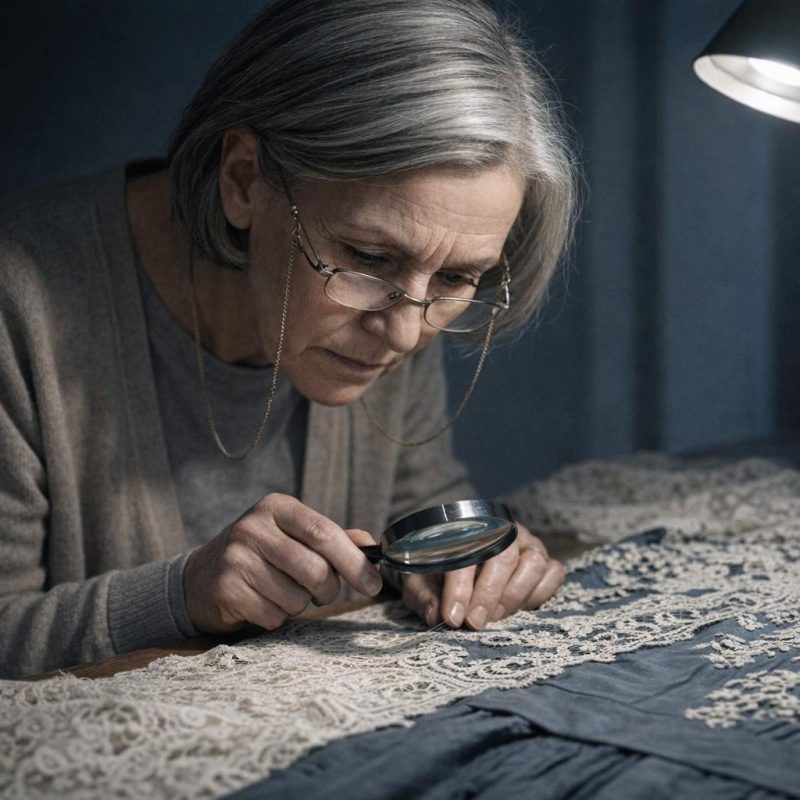 Image by RM AI
Hoping to Be Wrong
I went back to the beginning and started over. I told myself I had miscounted somewhere, that my hands were shaking too much for the ruler to be reliable, that grief and memory were making me see a match that wasn't there. I measured the scallop depth again on both pieces. Eleven millimeters, eleven millimeters. I counted the floral petals on three separate motifs in the remnant and then found the corresponding motifs on Clara's dress and counted those. Five petals, five petals, five petals. I checked the ground net — the fine mesh that formed the background of the lace — pressing the magnifying glass close and counting the mesh diamonds per square centimeter. I got sixteen on the remnant. I moved to Clara's dress and counted again, slowly, starting from a fixed point and working outward. Sixteen. I set the magnifying glass down on the table and stood very still. I looked at the two pieces lying side by side under the light. I picked up the ruler one more time and measured the full pattern repeat — the distance from the center of one floral motif to the center of the next — on the remnant: sixty-two millimeters. I placed the ruler against Clara's dress. Sixty-two millimeters.
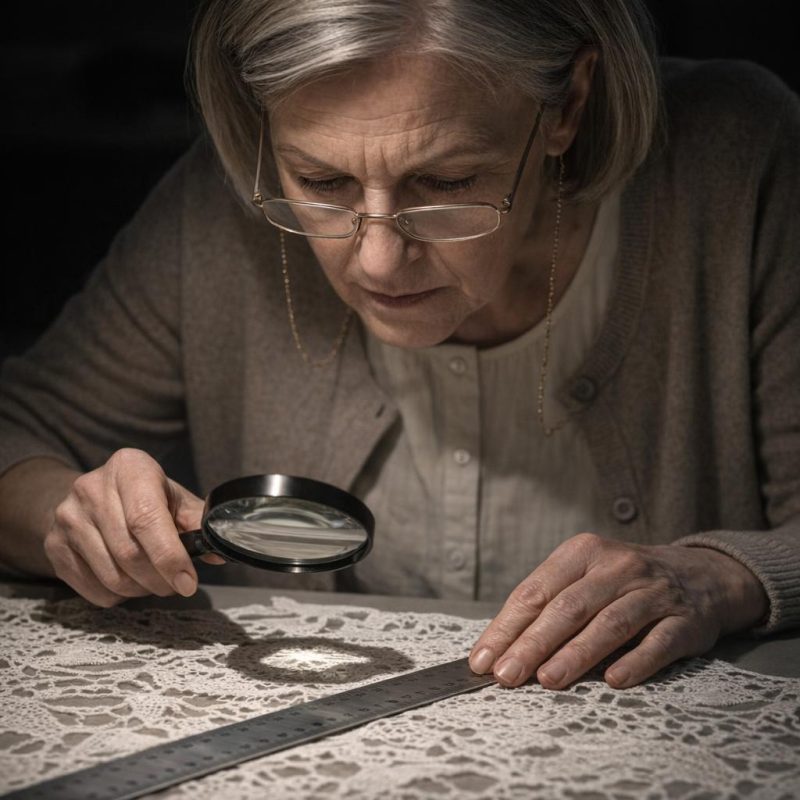 Image by RM AI
My Dress
I stepped back from the table. I needed the distance. I needed to see both pieces at once without the magnifying glass, without the ruler, without the numbers — just the lace itself, lying there in the light. And standing back, looking at them together, there was no question left to ask. This was not similar lace. This was not a pattern that had been reproduced by another maker in another decade. The scallop depth, the floral centers, the thread weight, the twist count, the ground net, the pattern repeat — every single measurement was identical because it was the same piece. Clara's dress was not a new gown with vintage trim. It was my dress. The one I had sewn for a wedding that never happened, the one I had been told was destroyed in the fire twenty-five years ago, the one I had grieved and let go of and carried as a loss for the better part of my adult life. Diane had told me it was gone. She had stood in the wreckage of that apartment and told me there was nothing left of it. And all this time, the dress had been somewhere — kept, preserved, hidden — and now it was here on my cutting table, and the cold of that understanding moved through me like something had been dropped into still water.
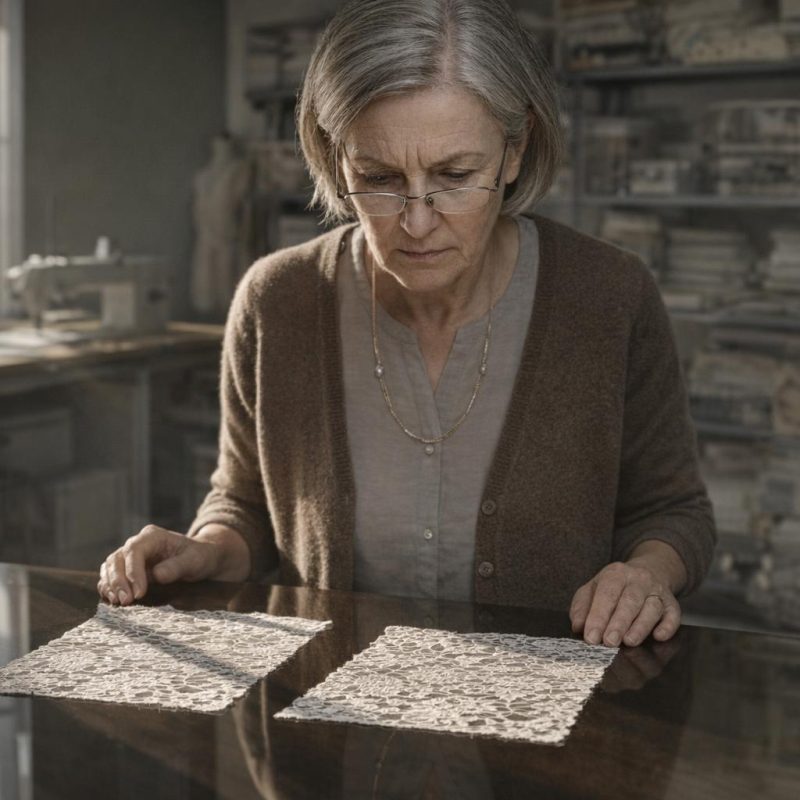 Image by RM AI
Diane Said It Was Destroyed
I remembered the days after the fire with a clarity that surprised me, given how hard I had worked over the years not to think about them. Diane had come to help me sort through what remained of the apartment — two days after, maybe three. She had been practical about it in the way she was always practical, moving through the rooms with garbage bags and a kind of brisk efficiency that I had been grateful for at the time because I couldn't move at all. I remembered standing in the doorway of the bedroom while she worked, unable to make myself go in. She had come out at some point and put her hand on my arm and told me the dress was gone. Not damaged — gone. She had used that word specifically. I remembered it because I had asked her twice, and both times she had said the same thing: gone, completely destroyed, nothing worth keeping. Her face had been composed and certain and sad in the way a face looks when it is delivering a verdict. I had believed her without question because she was my sister and she was standing in the wreckage and I had no reason not to. And now I could see that face again — the exact set of it, the steadiness in her eyes — as she said the words: the dress was completely destroyed.
 Image by RM AI
Twenty-Five Years of Keeping
Twenty-five years. I kept coming back to that number as I stood at the cutting table. Not a moment of weakness, not a decision made in the chaos of the fire and then regretted — twenty-five years of keeping the dress somewhere, of knowing it existed while I believed it was ash, of watching me grieve it and saying nothing. I had mourned that dress the way you mourn something that cannot be recovered. I had let it become part of the larger loss of that time — Michael, the wedding, the future I had imagined — and I had eventually made a kind of peace with all of it, the way you do when you have no other choice. And all that time, the dress had been folded somewhere in Diane's keeping. She had watched me carry that grief. She had sat across from me at holiday tables and birthday dinners and ordinary afternoons and she had known, and she had said nothing, and now she had given the dress to Clara for her wedding as though it were hers to give. The cutting table held both pieces of lace under the light, and the room was very quiet, and the weight of it sat in my chest like something that had no intention of moving.
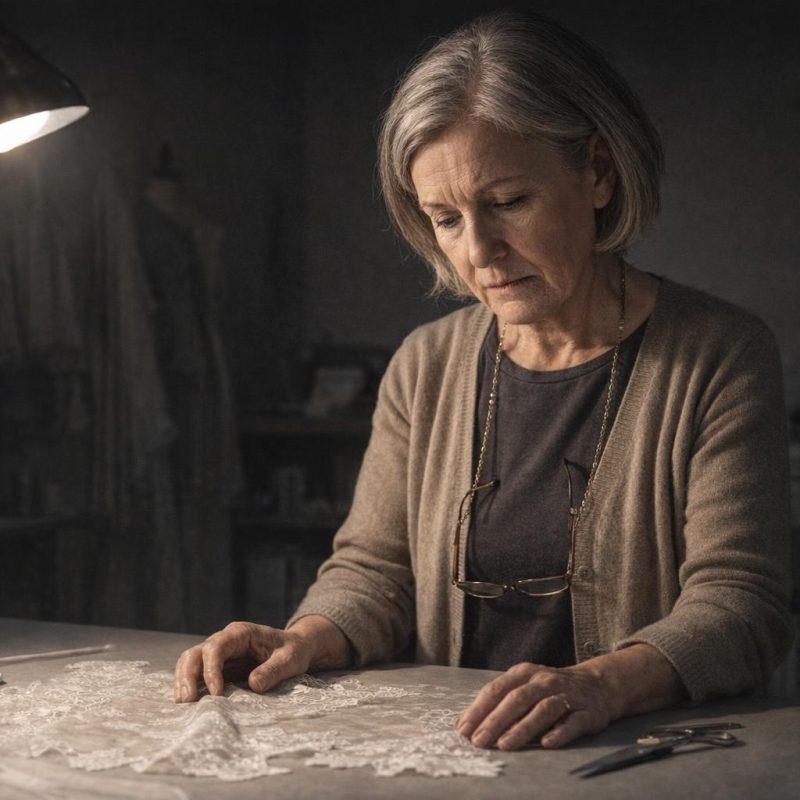 Image by RM AI
The Hack Job
I looked at Clara's dress differently now. I looked at the misaligned seams along the bodice, the appliqués placed over sections of the skirt, the uneven stitching where the original construction had been altered. I had catalogued all of it when Clara first brought the dress in, had noted each flaw with the detached professionalism of someone assessing damage. I had assumed careless workmanship. I had assumed whoever altered the dress simply hadn't known what they were doing. But standing here now, I could see the logic in every flaw. The appliqués were not decorative — they covered the sections of the skirt where the original construction would have been most recognizable to someone who had made it. The seams had been taken apart and resewn at slightly different angles, just enough to change the silhouette. The stitching that I had thought was sloppy was sloppy in specific places, over specific details. None of it was incompetence. Every cut, every poorly placed stitch, every piece of added fabric sat over something that would have told me immediately what I was looking at. Each flaw in that dress was a door closed against recognition, and I had nearly walked through the whole thing without seeing any of them for what they were.
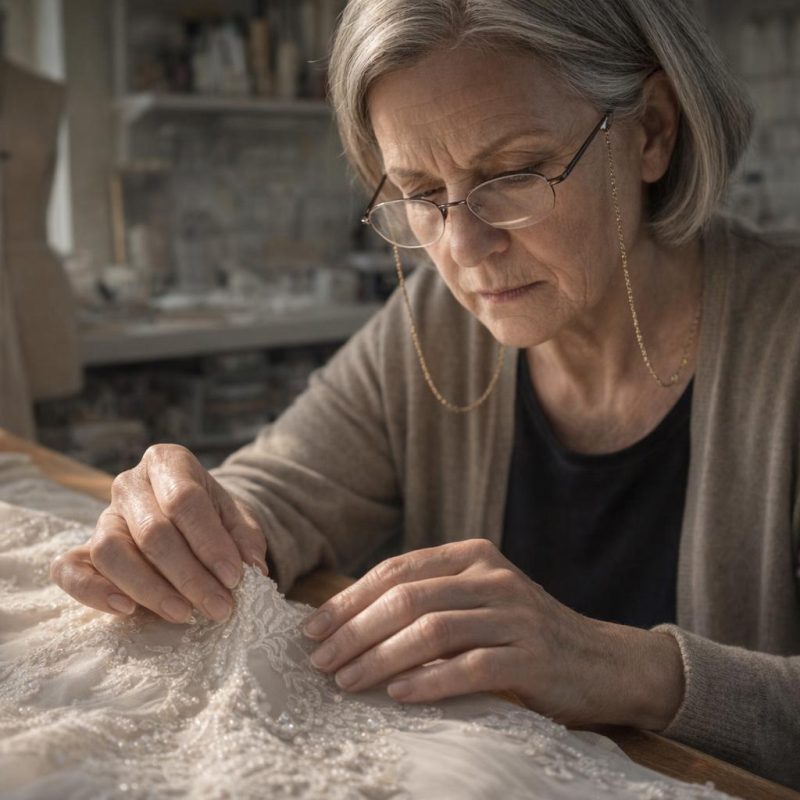 Image by RM AI
Thursday Evening
I heard the car before I saw the headlights sweep across the workroom wall. A familiar engine, the slight rattle in the exhaust I'd noticed a dozen times before when Clara pulled into my driveway. I stood very still, the dress hanging finished on the dress form behind me, every alteration complete, every seam pressed flat. My hands were steady. I was surprised by that. I had spent the last hour sitting at my worktable trying to decide what I was going to say, running through versions of it the way you run your thumb along a fraying edge — testing, feeling for the weak point. I hadn't landed on anything that felt right. The car door closed with a soft thud, and the sound of it moved through me like a stone dropping into still water. I reached up and straightened the dress on the form, a small, automatic gesture, the kind your hands make when your mind has gone somewhere else entirely. I heard the gate latch lift at the end of the front path. Then her footsteps on the porch boards, slow and deliberate, coming toward the door.
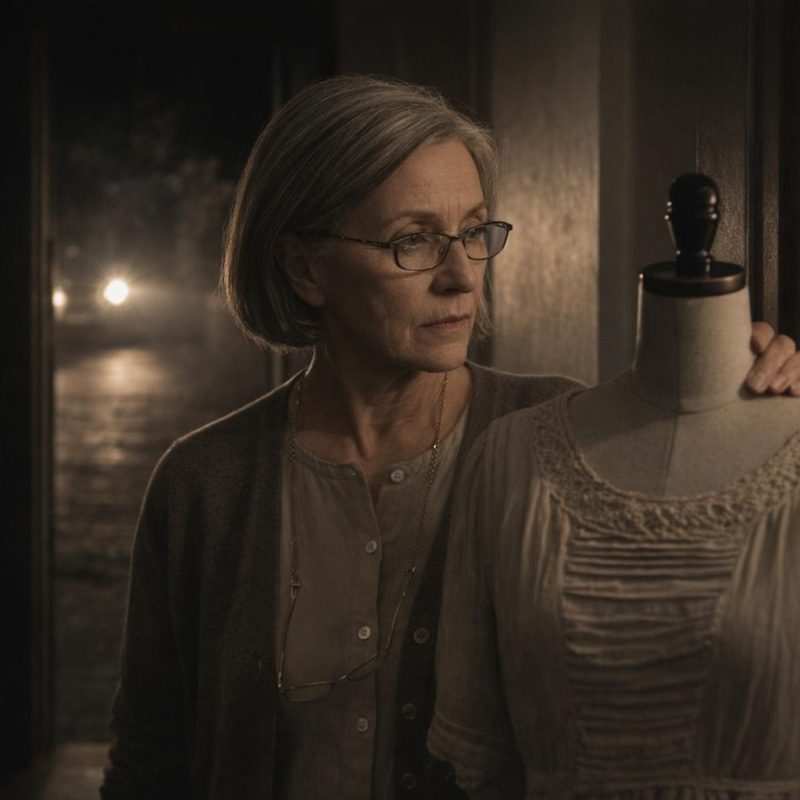 Image by RM AI
She Knew
Clara stepped inside and her eyes went straight to the dress. She crossed the room slowly, the way you approach something you're not sure you're allowed to touch, and stood in front of it for a long moment without speaking. I watched her take it in — the restored lace, the corrected seams, the bodice sitting exactly as it was meant to sit. Then she turned to face me, and her eyes were already full. The tears came fast, spilling over before she could do anything about them, and she said thank you in a voice so small it barely reached me. She crossed the remaining distance between us and wrapped her arms around me, pulling me in tight, her shoulders shaking against mine. I held her. I didn't know what else to do in that moment, so I held her and I felt the weight of her crying and I understood something I hadn't let myself fully form until right then. These weren't tears of relief. They weren't the tears of a bride seeing her dress finished and beautiful. Her arms held on too hard, her breath came too ragged, and the thank you she'd whispered had carried something underneath it that gratitude alone doesn't carry. Clara's arms tightened around me, and her whole body shook with it.
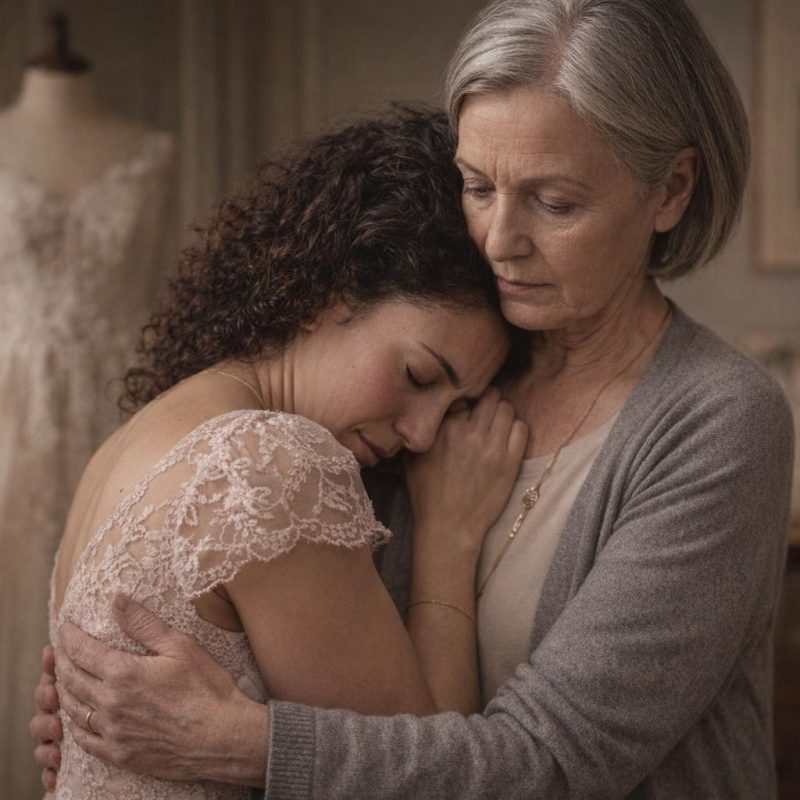 Image by RM AI
The Barn Venue
The barn sat at the end of a long gravel drive lined with mason jars full of wildflowers, and when I stepped out of my car on the morning of the wedding, the first thing I noticed was how beautiful it all was. That was the cruelest part, I think — how genuinely, carefully beautiful. Someone had wound greenery along every beam. Bundles of lavender and Queen Anne's lace hung from the rafters in loose, artful clusters. The light came through the high windows in long pale columns and caught the dust motes floating in the air, and for a moment, standing at the entrance, I could see exactly what Clara had imagined when she planned this day. I carried my small clutch and my knowledge in equal measure, one in each hand, and I walked through the doors. The wooden floors had been swept clean and scattered with rose petals. Round tables draped in ivory linen filled the reception space beyond the ceremony rows. Everything was arranged with the kind of attention that takes months of thought. I found my seat near the aisle and sat down, and the wildflowers on the altar blurred slightly at the edges, and all that careful, lovely beauty sat around me like something I couldn't quite reach.
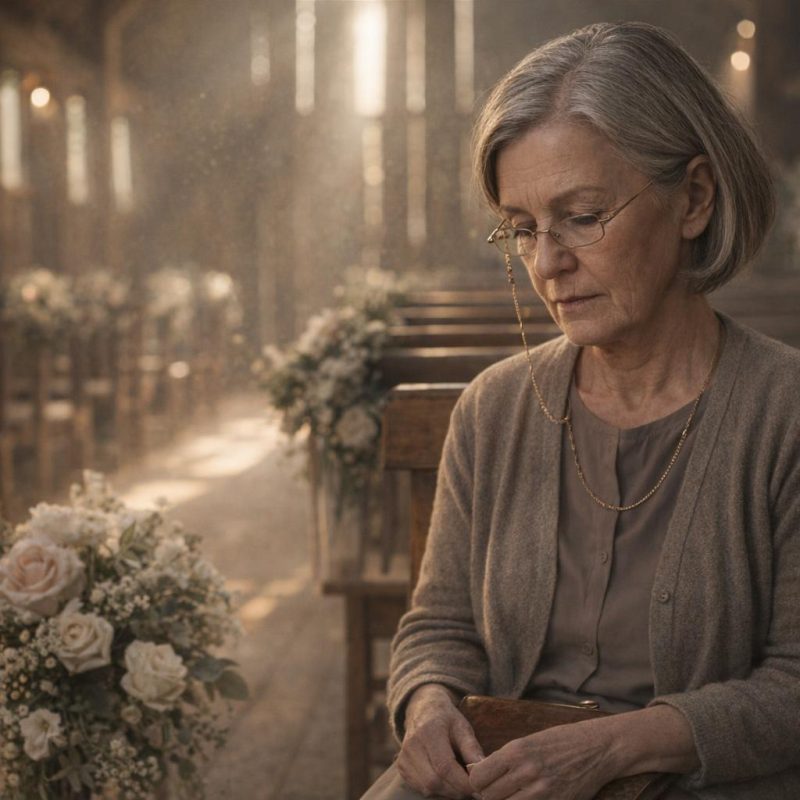 Image by RM AI
Greeting Guests
People arrived in clusters, filling the barn with the low hum of voices and the rustle of good clothes. I stood near the entrance for a while, greeting the ones I recognized — cousins I saw at Christmas, a neighbor of Diane's I'd met once at a birthday party years ago, a woman from Clara's office whose name I couldn't quite place but whose face I knew. I smiled and said the right things. I asked about the drive, commented on the flowers, laughed at the right moments. Sarah found me near the second row of chairs and pressed my hand without saying anything, just held it for a second and looked at me with those steady eyes of hers, and I had to look away before I lost the composure I'd been holding together since I walked through the door. I saw Diane across the room twice. The first time she was talking to someone I didn't recognize, gesturing with her hands the way she does when she's performing ease. The second time she glanced in my direction, and I turned back to the person beside me and kept talking. The words came out of my mouth and I have no memory of what they were. By the time the ushers began directing people to their seats, something behind my sternum had gone very, very tired.
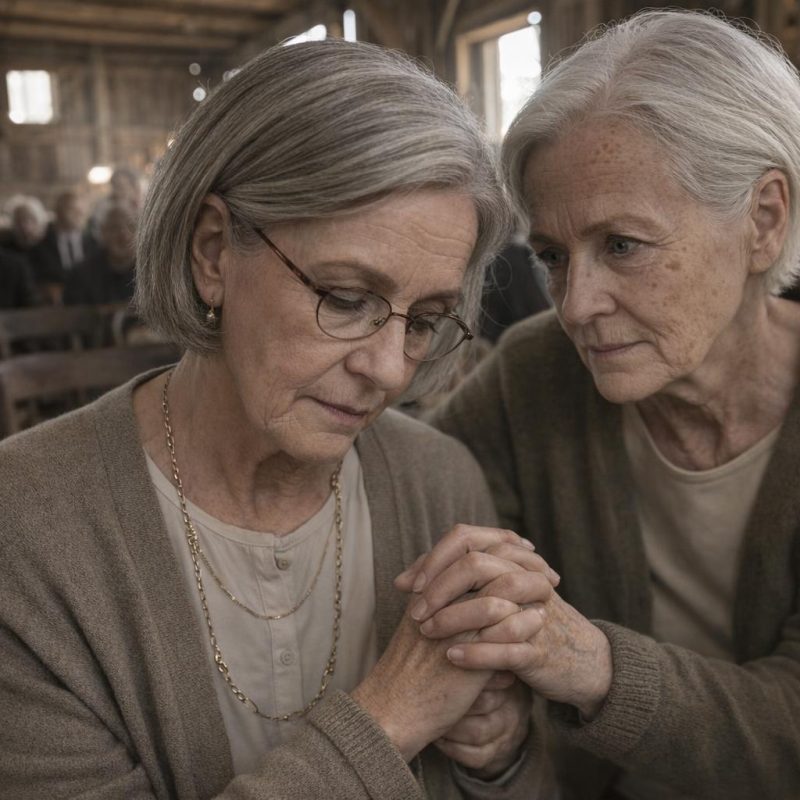 Image by RM AI
The Ceremony Begins
The music shifted and everyone rose, turning toward the back of the barn in that collective, instinctive way people do when a bride is about to appear. I stood with them. I turned. Clara was at the entrance, framed by the open barn doors and the afternoon light coming in behind her, and the dress — my dress, the lace I had chosen and ordered and waited six weeks for, the lace I had cut and pinned and sewn by hand in the apartment I shared with Michael — caught the light and held it. She walked slowly. The train moved behind her across the wooden floor, and I could see the way the fabric fell, the particular drape of it that I had known before I ever saw it on a dress form, because I had known it in my hands first. James was at the altar, smiling the way people smile when they can't help it, when the feeling is too large for their face to contain. Diane stood in the front row, her chin lifted, watching her daughter come down the aisle. I watched too. I watched the lace travel the length of that barn, stitch by stitch, every inch of it familiar, and the music filled the space around me, and I stood very still inside all of it.
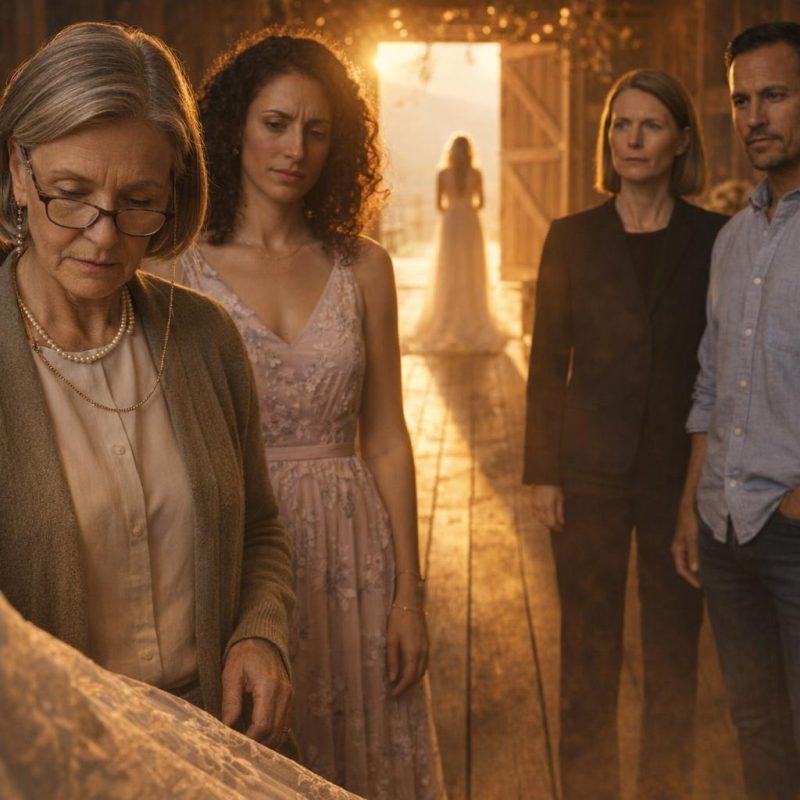 Image by RM AI
Every Stitch
I couldn't follow the words of the ceremony. The officiant spoke and the guests listened and somewhere in the rows around me people were moved, dabbing at their eyes, leaning into each other. I sat with my hands folded in my lap and I looked at the dress. I saw the bodice seams I had let out and repressed, the slight curve at the waist that I had restored to its original line. I saw the lace appliqués I had tacked down along the skirt, each one placed to cover what lay beneath, and I knew now what lay beneath. I saw the sleeve caps, the way the fabric gathered at the shoulder in a particular fold that I had always thought was a quirk of the original pattern. I had thought that for twenty-five years because I had made it that way. Clara and James exchanged rings, their voices low and private, and the guests leaned forward slightly as people do at that moment. I didn't lean forward. Then the vows ended and the stillness broke, and I saw it fully — the train spread out behind Clara in a wide arc across the old wooden boards, every inch of that lace lying open in the light.
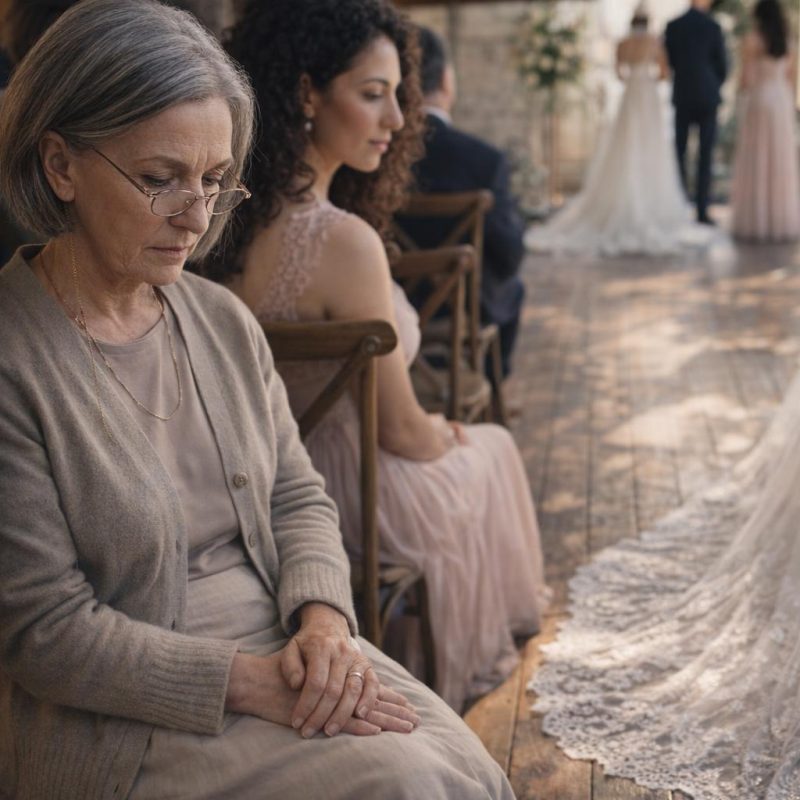 Image by RM AI
The Corner
When the ceremony ended, the barn filled with noise and movement all at once — chairs scraping, voices rising, the particular relief of a crowd released from stillness. I let the current of people carry me toward the reception space and then I stepped out of it, moving along the edge of the room. I was looking for Clara. I told myself I didn't know what I would say when I found her, but that wasn't entirely true. I moved past the bar setup and around a cluster of guests taking photographs near the wildflower arch, and that's when I saw them. Clara and Diane were standing in the far corner of the barn, half behind one of the structural posts, their heads bent toward each other. Clara's veil was pushed back over her hair and her bouquet hung loose at her side. Diane had one hand on Clara's arm. They were speaking quietly, close enough that whatever passed between them stayed between them, and neither of them had noticed me yet. I stopped walking. I stood there and I looked at the two of them — the angle of their shoulders, the way they had turned inward toward each other, the small closed circle they made together in that corner.
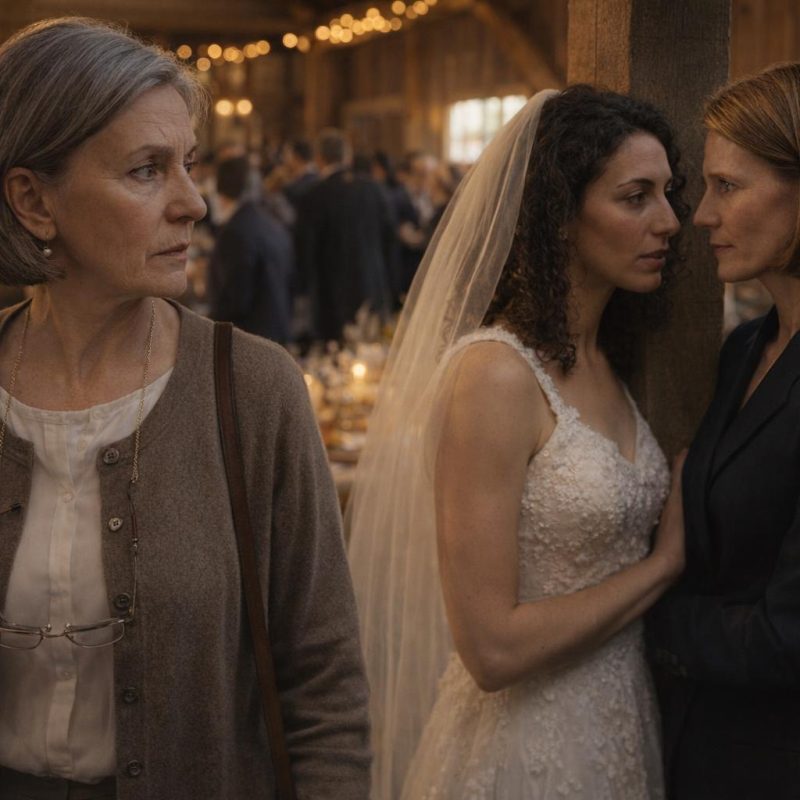 Image by RM AI
Complete Silence
I started walking toward them. I don't know exactly when they saw me coming — somewhere in the last few yards, I think, because the shift was sudden. Clara's head came up first. Then Diane's. Whatever they had been saying stopped, completely and immediately, the way a sound stops when you enter a room and the people in it weren't expecting you. There was a beat of stillness, just a second or two, and then the smiles arrived. Clara's came with a brightness that didn't match her eyes, which were still carrying something careful and watchful behind it. Diane's settled into place more smoothly, the practiced ease of someone who has done this particular thing many times before — composed herself quickly, arranged her expression, offered the room whatever it needed to see. I kept walking. I watched those smiles take shape on their faces, and I thought about all the times I had taken something frayed and damaged and worked it back into something that looked whole from a distance. I knew better than anyone what that kind of repair looked like up close. Their smiles sat on their faces, bright and perfectly placed, and not one living thing behind them.
 Image by RM AI
Beyond Mending
I didn't say anything at first. I just stood there and looked at them — really looked, the way I look at a seam when I'm trying to understand where it failed. Diane's smile held. Clara's started to slip at the edges. And in that silence, everything I had been turning over in my mind for days settled into something I couldn't argue with anymore. Diane had taken the dress. Not borrowed it, not stumbled across it — taken it, deliberately, from the wreckage of the worst night of my life, and kept it for twenty-five years without a word. And Clara had known. Maybe not from the beginning, but she had known, and she had brought that dress to me anyway, sat across my cutting table and watched me run my hands over Michael's mother's lace, and said nothing. They had made me restore my own stolen wedding dress. I looked at my sister and my niece standing there in the warm barn light, and I understood something I hadn't let myself understand until that moment. There are things you can mend — fabric, seams, hems frayed by time and use. And there are things that, once broken, hold no stitch.
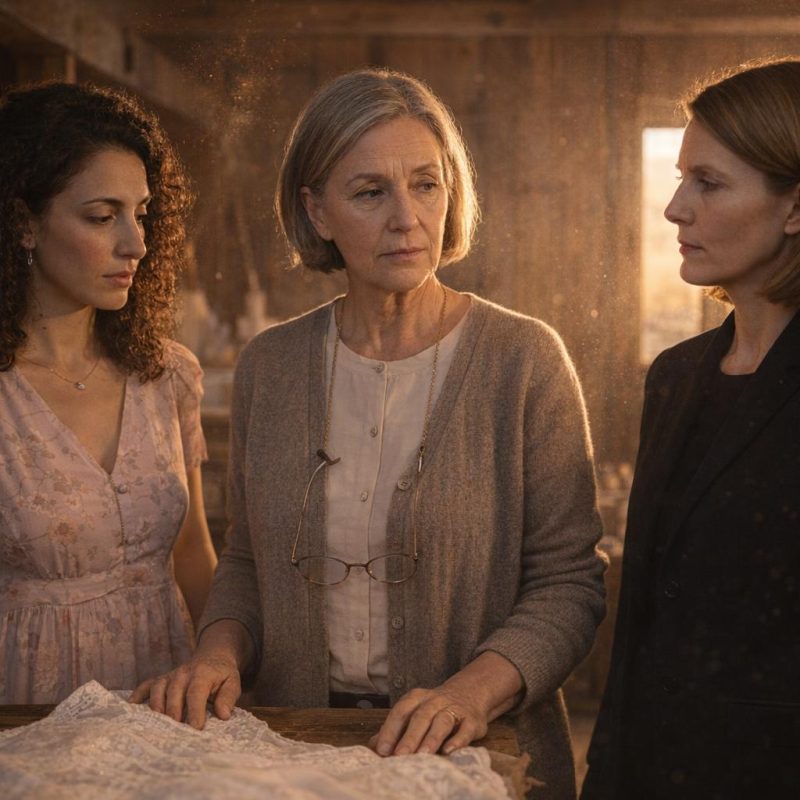 Image by RM AI
Leaving the Barn
I turned away from them without a word. I didn't trust my voice, and I didn't want to give either of them the satisfaction of watching me fall apart. The barn was full of people — guests laughing, glasses raised, someone's child chasing a ribbon across the dance floor — and none of them had any idea what had just happened in the corner near the wildflowers. I moved through the room carefully, the way you move when you're carrying something fragile and don't want anyone to notice. I passed the long tables with their mason jar centerpieces, the strings of warm light overhead, the smell of cut grass drifting in from outside. I kept my chin level and my hands at my sides. When I reached the barn door, I pushed it open with one palm and stepped through. The evening air came at me all at once — cool and clean and smelling of nothing that had anything to do with lace or lies or the last twenty-five years. I let the door swing shut behind me, and the music inside went quiet, and I stood there for just a moment in the dark before I started walking to my car.
 Image by RM AI
The Drive Home
I sat in the car for a minute before I started the engine. The parking area was uneven grass, and I could feel the ground soft beneath the tires when I finally pulled out onto the road. I didn't turn the radio on. I didn't want noise. The evening had gone fully dark by then, the kind of dark that comes on fast in early summer when you're not paying attention, and the headlights cut a narrow path ahead of me. I thought about Clara first — the little girl who used to sit on my workroom floor and sort buttons by color, who called me when she was frightened, who I had loved like she was my own. I thought about how long she must have known, and how she had sat across from me anyway. Then I thought about Diane, and the years of silence, and what it costs a person to carry a secret that long without once flinching. I had spent my whole life believing I could find the damage in anything and work it back to whole. The road stretched out ahead of me, dark and quiet, and the understanding of what I had lost settled into the car around me like something that had always been there, waiting.
 Image by RM AI
Some Things Beyond Mending
I got home just after nine. The house was dark except for the porch light I always leave on, and I stood in the front hall for a moment before I climbed the stairs. My sewing room was the way I had left it — cutting table cleared, tools in their places, the good scissors hanging on their hook by the window. I stood in the doorway and looked at all of it. The spools of thread arranged by weight. The pincushion my mother made me. The small lamp I use for close work, its shade tilted just so. I have spent most of my adult life in this room, taking broken things and making them whole again. Torn seams, collapsed hems, lace so fragile it came apart if you breathed on it wrong. I had always believed that patience and the right tools could fix almost anything. I walked to the cutting table and rested both hands flat on its surface. The wood was cool and smooth and solid under my palms. Some things can be taken apart and rebuilt. Some damage runs too deep for thread or needle or any amount of careful work. I stood there in the quiet of my sewing room, and I let that be true.
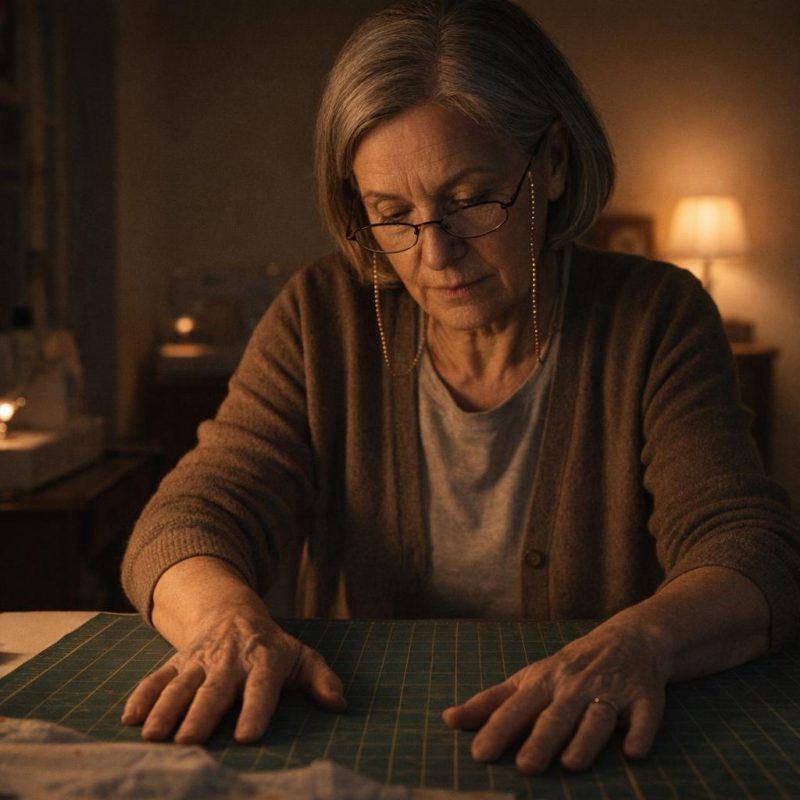 Image by RM AI
KEEP ON READING

The 10 Youngest Monarchs In History & The 10 Oldest
Age Is Just A Number. Imagine being crowned king or…
By Chase Wexler Mar 11, 2025
You Think You Have Problems? These Royal Families Were Cursed
Boasson and Eggler St. Petersburg Nevsky 24. on WikimediaHeavy is…
By Ashley Bast Dec 5, 2025
You Can Thank This Greek-Canadian For Creating Pineapple On Pizza…
Love it or hate it, pineapple on pizza sparks debate…
By David Davidovic Dec 1, 2025
Yes, Female Gladiators Existed, And Here's Everything You Need To…
History of Women in Combat. Most people picture gladiators as…
By David Davidovic Jan 17, 2026
Yes, Australians Once Lost A Battle Against Flightless Birds
David Clode on UnsplashIn 1932, the Australian military went to…
By David Davidovic Nov 24, 2025
The Y2K Bug: Why Did Everyone Think Year 2000 Was…
Alan W on UnsplashOn December 31, 1999, people all over…
By Christy Chan Dec 22, 2025