

My Niece Asked Me to Alter Her Wedding Dress—Then I Realized Where the 'Vintage' Lace Came From
My Niece Asked Me to Alter Her Wedding Dress—Then I Realized Where the 'Vintage' Lace Came From
The Call That Changed Everything
I was on my knees in Mrs. Henderson's living room, pinning the hem of her new curtains, when my phone buzzed against the hardwood floor. I almost let it go to voicemail — I had a mouthful of pins and both hands full of ivory linen — but I saw Clara's name on the screen and set everything down. She asked if I was busy, which is always how she starts when she wants something and feels guilty about wanting it. I told her I was never too busy for her, and I meant it. She explained that the alterations shop had done the basics on her wedding dress but that the finishing work needed someone who actually understood delicate fabric, someone with a real eye for it. She said it so carefully, like she was worried I'd say no. I didn't even let her finish the sentence before I said yes. There was a pause on the line after that — not an awkward one, just a quiet one — and then she thanked me in something barely above a whisper. I heard her exhale, slow and long, like she'd been holding her breath the whole time she was asking.
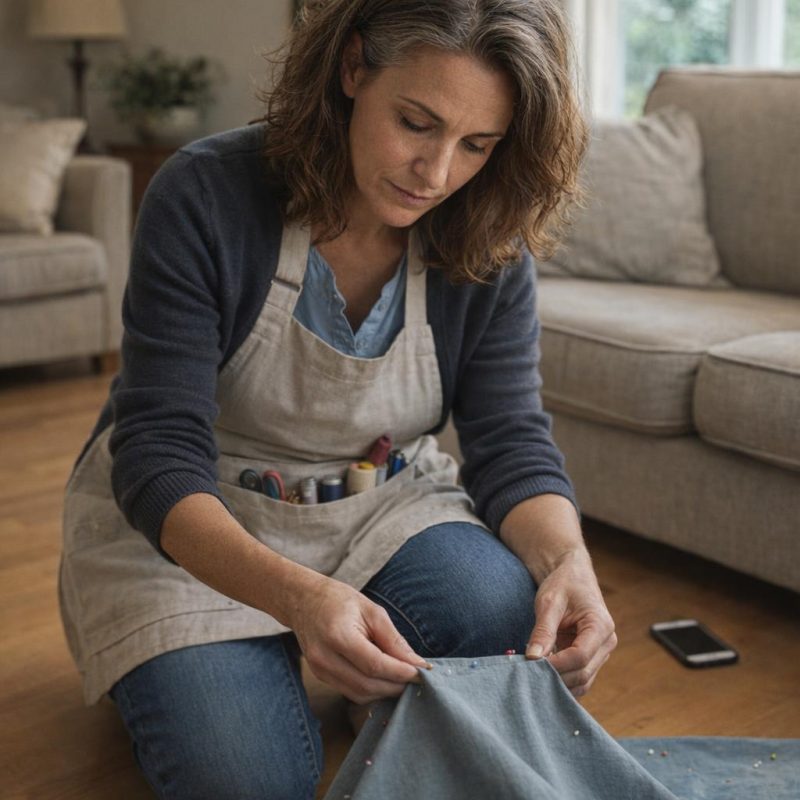 Image by RM AI
The One Who Always Fixed Things
Diane and I are only four years apart, but we've always moved through the world like we came from different families entirely. She had Clara at twenty-three, young and overwhelmed, and I think she expected motherhood to feel more natural than it did. I never judged her for that. But Clara started gravitating toward me early, and I could see it bothered Diane even when she pretended it didn't. I made Clara's birthday cakes from scratch every single year — the lopsided unicorn when she turned seven, the princess castle that took me two full days when she turned nine. When Clara needed braces and Diane said she couldn't cover the full amount, I paid half without being asked twice. I told myself we just showed love in different languages, Diane and I, and that neither one was wrong. But I knew which language Clara understood better. I think about that sometimes — how love can be present and still miss the person it's meant for. There was a family gathering when Clara was maybe four years old, and she climbed down from Diane's lap mid-conversation, crossed the room, and crawled right into mine.
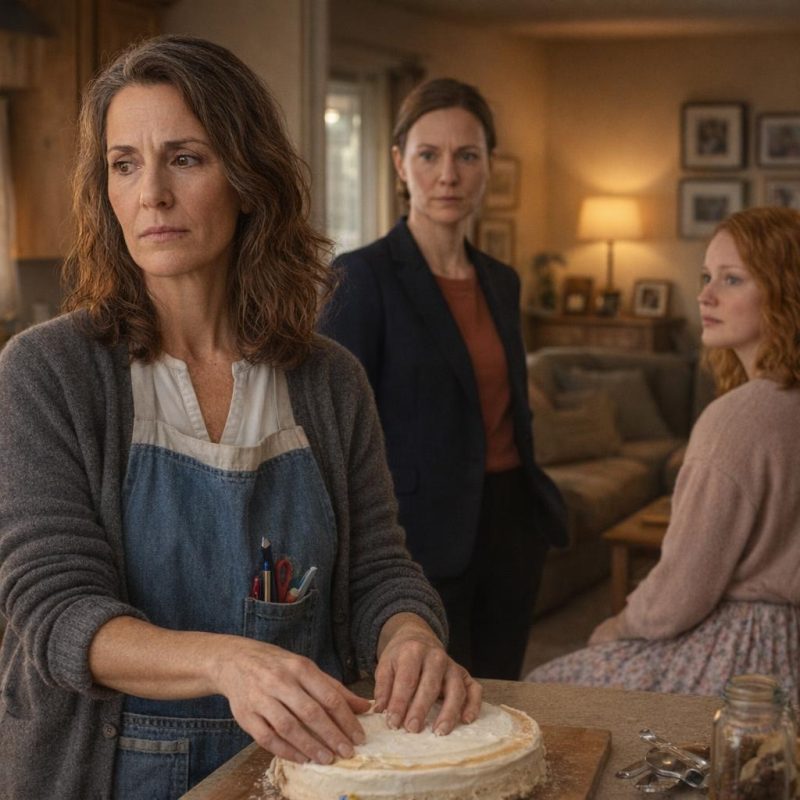 Image by RM AI
The Language of Mending
I've always believed that cloth remembers things. Not in any mystical way — just that fabric holds the shape of what it's been through, the tension of the hands that worked it, the weight of the occasion it was made for. Wedding dresses carry hope in their seams. Baby blankets hold something that feels almost like lullabies, soft and repeated and worn into the weave. I've spent forty years working with both. I cleared my worktable that afternoon and thought about all the dresses I'd touched over the years — women who danced in them at receptions, who packed them away in cedar chests, who grew old and let their daughters try them on in spare bedrooms. Most of those dresses got their moment. They fulfilled what they were made for. But some pieces didn't. Some were made for futures that shifted before they arrived, for occasions that got quietly cancelled or indefinitely postponed. Those are the hardest ones to keep. I have a preservation box on the highest shelf of my sewing room, wrapped in acid-free tissue, holding the pieces that never got their moment.
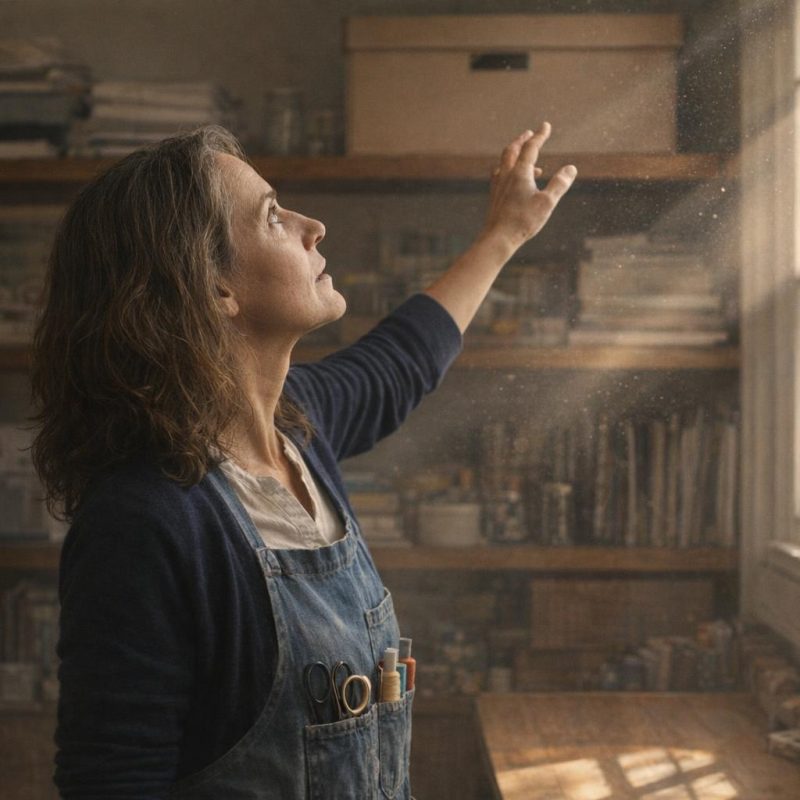 Image by RM AI
Preparing the Workspace
I finished Mrs. Henderson's curtains the next morning and cleared the cutting table completely by early afternoon. There's a particular satisfaction in an empty work surface — all that clean space waiting to become something. I laid out my best shears, the Ginghers I've had for twenty years, and my seam ripper with the fine tip I use for delicate work. I organized my thread spools along the back edge of the table, sorted by weight first and then by color within each weight, the way I always do when I'm starting a serious project. I adjusted the dress form to the measurements Clara had texted me — a thirty-four bust, twenty-six waist, thirty-seven hip — and stood back to look at it for a moment. Then I checked my work lamp and repositioned it so the light would fall at a low angle across the fabric surface, the way you need it to catch any irregularities in stitching or seam alignment. Wedding dresses have their own particular demands. The construction has to hold up under movement and emotion and a full day of wear. I wanted to be ready. The cutting table sat empty under the lamp, waiting for whatever Clara would bring.
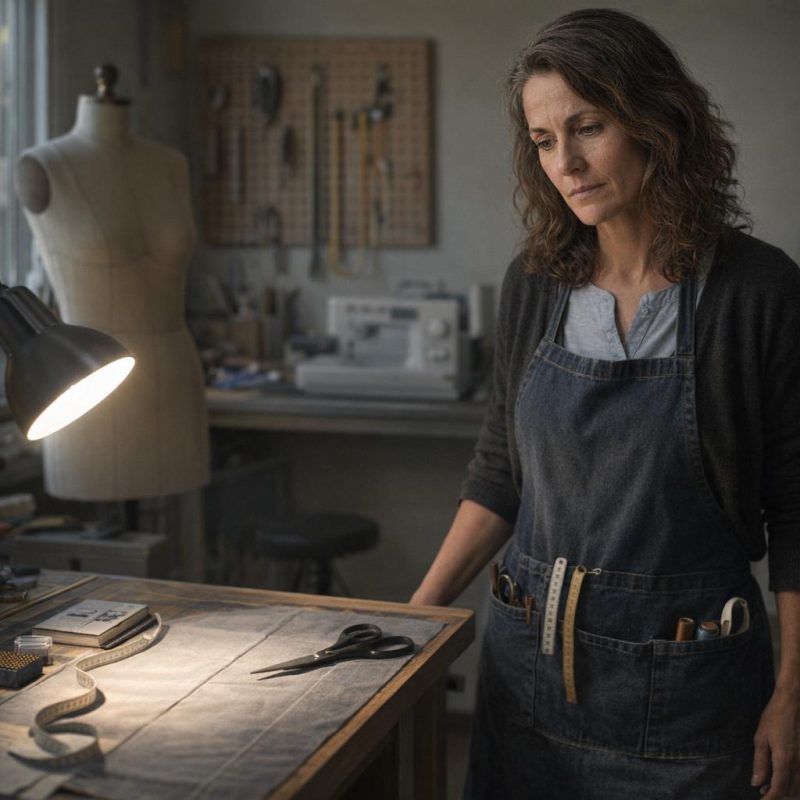 Image by RM AI
The Garment Bag
Clara arrived Thursday evening just after six, later than I expected, with the dress draped over her arm in a plain white garment bag from a mid-range bridal shop downtown. She stood in my doorway for a moment before I'd even opened the door all the way, shifting her weight from one foot to the other the way she used to do as a little girl when she was nervous about something. I told her to come in, come in, and she stepped inside carefully, like she was carrying something fragile. She laid the bag across my cutting table with both hands, smoothing it flat before she let go, and I noticed how gently she did it — not the way you handle a dress you bought off a rack, but the way you handle something that matters. I asked her how she was feeling about everything, and she said fine, good, almost too quickly. I unzipped the garment bag from the top, folding the sides back, and lifted the dress out by the shoulders to hold it up to the light — and the lace caught the lamp at an odd angle, throwing a shadow I didn't quite expect.
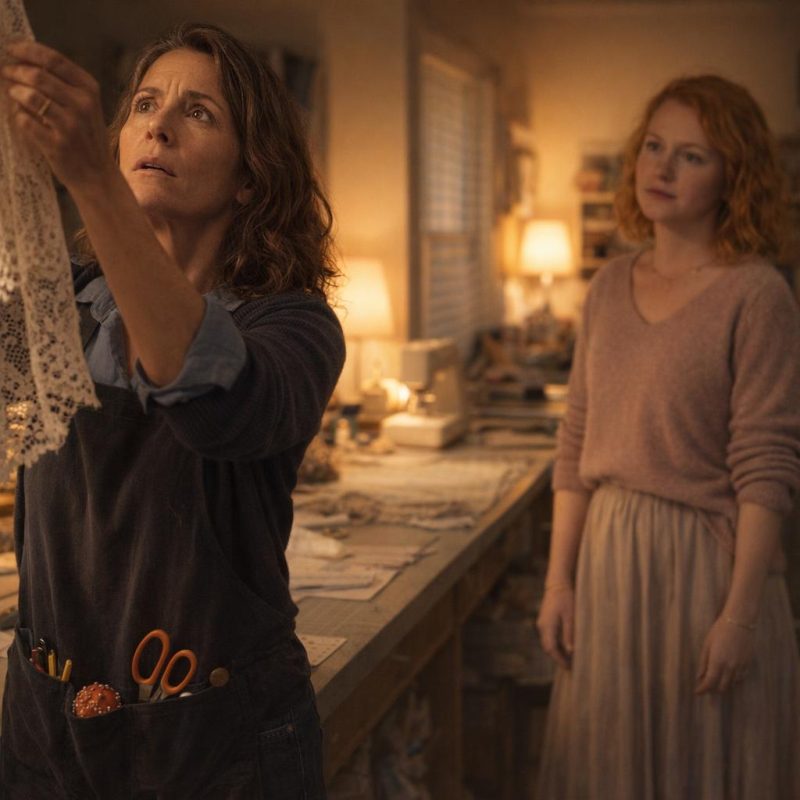 Image by RM AI
Construction Problems
I hung the dress on the form and stepped back to look at it properly. Something about the construction felt off right away, though I couldn't have said exactly what in those first few seconds. I leaned in and checked the bodice seams first — they didn't quite align with the seams in the skirt, which told me the two sections hadn't been cut from the same pattern draft, or hadn't been assembled by the same hands. The stitching was uneven in a way that bothered me professionally: some of it was clean machine work, and some of it was hand-stitching that didn't match in tension or spacing. Lace appliqués had been added in several places, and not as part of the original design — they sat on top of the fabric like afterthoughts, positioned in spots that didn't follow any natural line in the dress. I lifted one edge of an appliqué near the hip and saw that the fabric underneath had been gathered unevenly. The whole thing felt like someone had been solving problems as they went rather than working from a plan. I ran my fingers slowly along the left side seam, pressing gently, and felt the fabric pucker beneath a strip of extra trim that had been laid right over it.
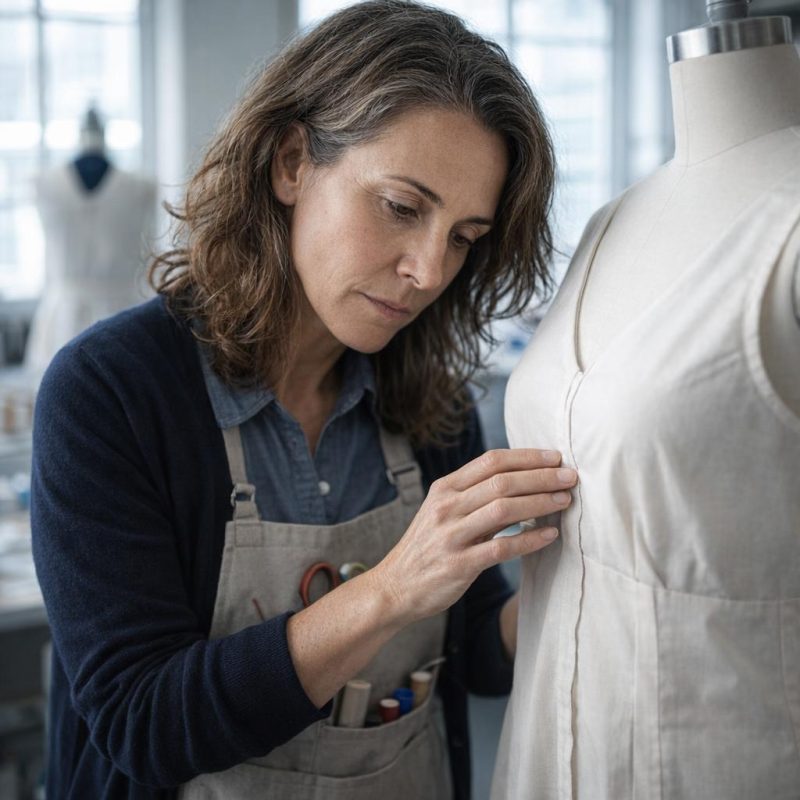 Image by RM AI
The Question About Lace
I kept my eyes on the dress and my voice easy. Clara was sitting on the stool near the window, watching my hands the way she always did when I was working — she'd done it since she was small, just quietly watching. I ran my thumb along the edge of one of the lace appliqués, feeling the weight of it, the way it draped. It was genuinely beautiful work, the lace itself — whatever problems existed in how it had been applied, the material was something else entirely. Fine, with a delicacy in the pattern that you don't find in modern trim. It had a particular hand to it, a softness that came from age rather than manufacture. I'd worked with enough vintage fabric to know the difference. I smoothed the appliqué flat against the bodice and looked up at Clara. I kept my tone the same way I'd keep my hands steady over a seam — light, unhurried, just making conversation. I told her the lace was really something, that it had a quality you didn't see much anymore. I turned the hem of one piece between my fingers while I waited, and then I asked her where it came from.
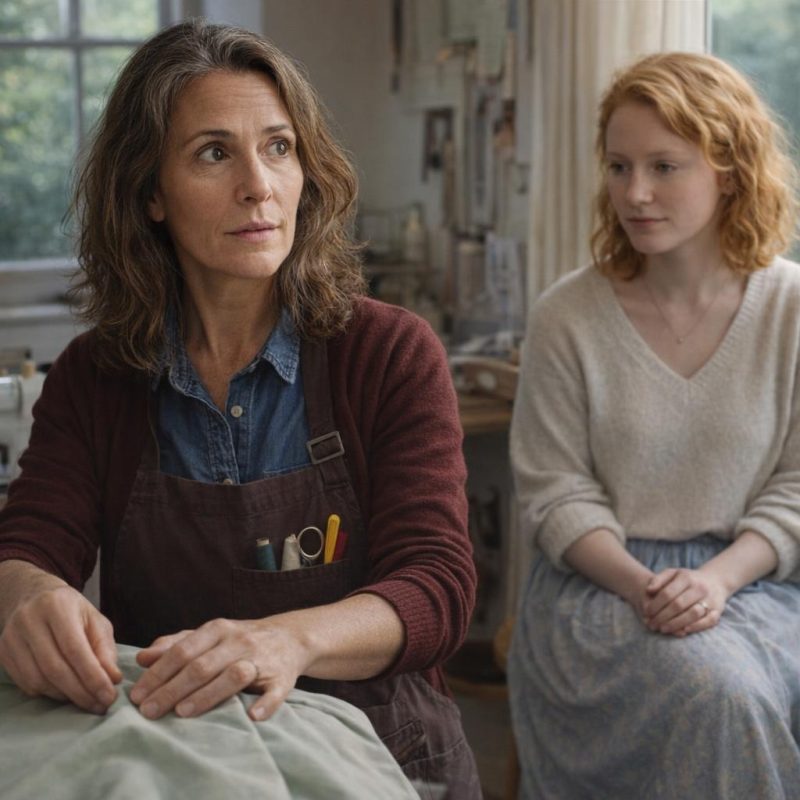 Image by RM AI
Vintage Trim
The answer came before I'd quite finished asking. Vintage trim, Clara said — her mom had found it. The words arrived smooth and complete, no searching, no pause. I nodded and looked back down at the appliqué, pressing the edge flat with my thumb. I told her it was beautiful, that Diane had a good eye. Clara laughed a little at that, a short sound, and said something about her mom always knowing where to look for that kind of thing. I kept nodding. I kept my hands moving. I told myself the small catch I felt somewhere in my chest was just my professional instincts being fussy — the way I get when a construction doesn't add up and I can't yet identify why. It wasn't about the answer itself. The answer was perfectly reasonable. Diane found vintage trim; people found vintage trim all the time. I pressed my thumb along the lace one more time and made myself focus on the seam beneath it. But my fingers had gone still on the appliqué, and something in the way Clara's answer had arrived — so quickly, so complete — sat with me in a way I couldn't quite set down.
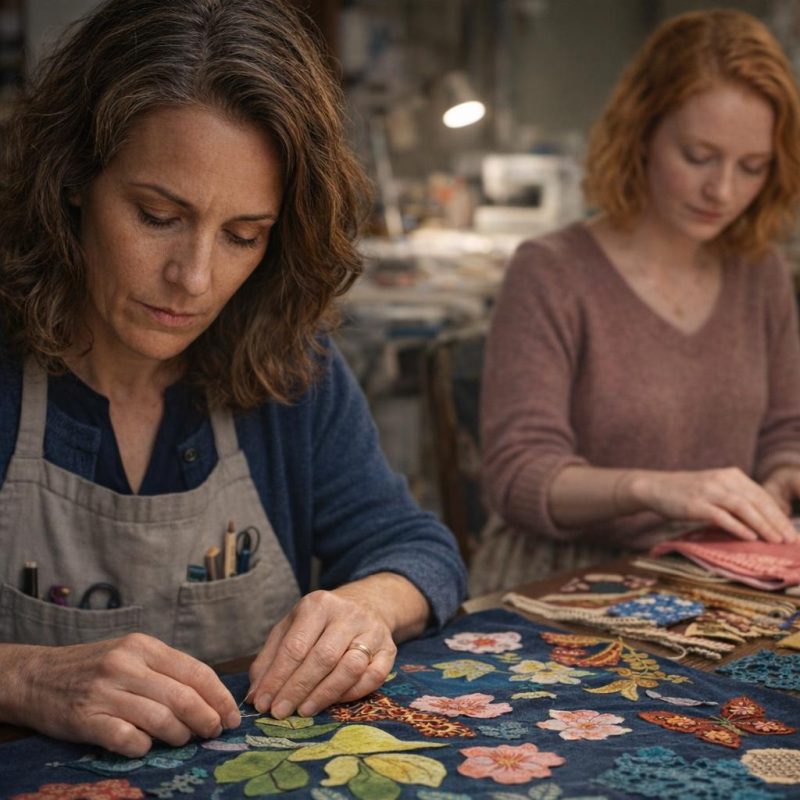 Image by RM AI
Hand-Done Edging
I bent closer to the lace, tilting the fabric toward the lamp. The edging was hand-done — genuinely hand-done, not the machine-mimicry you see on most bridal trim these days. Tiny scallops, each one consistent, each one finished with a whip stitch so fine it was almost invisible. I told Clara it was remarkable work, that you almost never found this kind of detail on vintage trim anymore, that whoever had made it had real skill. Clara smiled and said yes, her mom had thought it was special too. I turned the appliqué over to look at the back, checking how the pattern had been constructed from the underside. The floral centers were worked in a raised satin stitch, the petals radiating outward in a way that took patience and a steady hand. I said something about how rare it was, and Clara said mmm, still watching me. I noticed that — the watching. Every time my fingers moved across the lace, she leaned in just slightly, her eyes tracking my hands. I told myself it was normal. Brides got anxious about their dresses; they watched you handle the fabric the way you'd watch someone hold something breakable. Clara's lips parted once, like she was about to say something, then closed again. I kept my eyes on the lace and told myself it was just nerves.
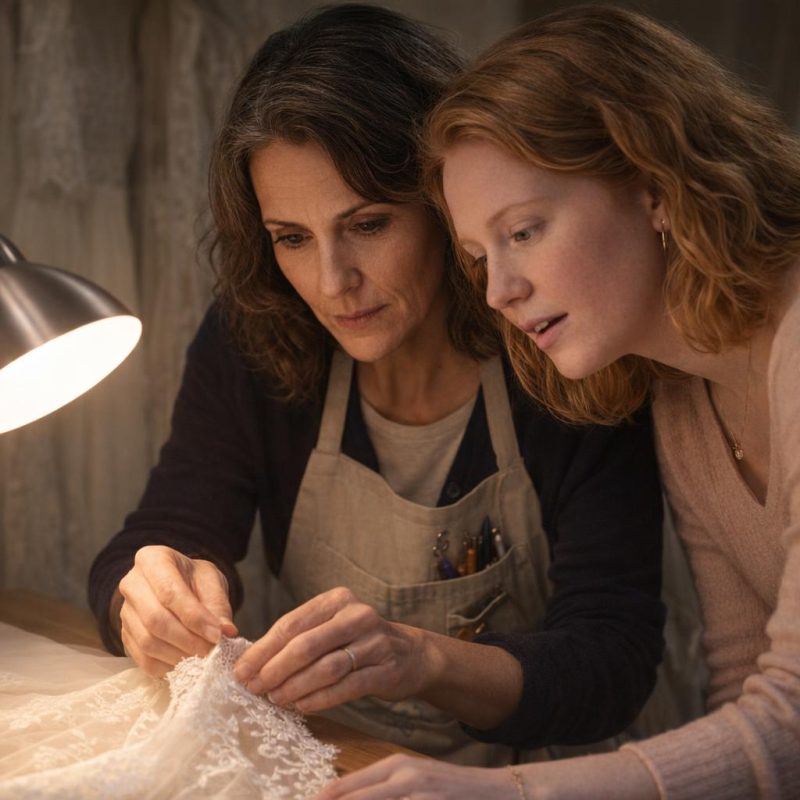 Image by RM AI
Wedding Jitters
I walked Clara to the door and we hugged the way we always did, her chin tucking briefly against my shoulder. She said she trusted me completely with the dress, that she knew it was in good hands, and I squeezed her arm and told her not to worry. After she left I stood in the doorway for a moment, listening to her car back out of the drive. Then I went back to the cutting table and stood over the dress with my hands on my hips, taking stock. The weird feeling I'd had — that small catch in my chest — I decided it was just contagion. Brides were anxious creatures in the weeks before a wedding, and that anxiety had a way of transferring itself to everyone around them. I'd felt it before with other clients, that low-grade hum of someone else's nerves settling into your own shoulders. Clara was getting married in three weeks. Of course she was watching me handle the dress. Of course her answers came quickly — she'd probably been fielding questions about every detail of this wedding for months. I pulled my notepad over and started listing what needed doing: bodice reconstruction, sleeve taper, shoulder seam adjustment, back closures, train hem, lace tacking. There was real work here, enough to keep me busy and focused. I picked up my seam ripper, and the dress was still lying there on the cutting table when I finally turned off the light.
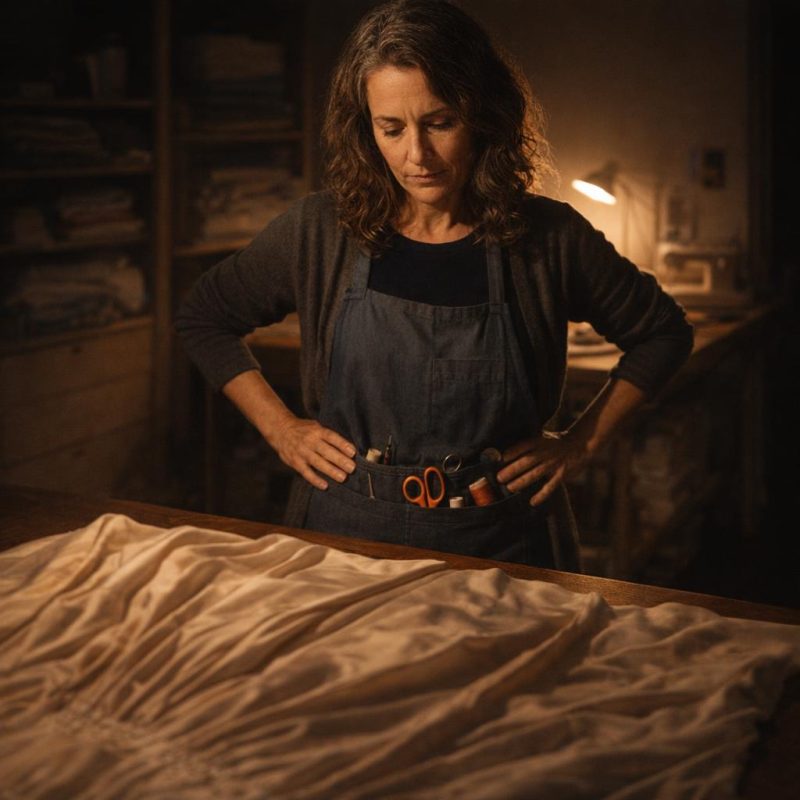 Image by RM AI
First Night's Work
I worked late that first night, later than I'd planned. The bodice was the worst of it — whoever had constructed it had rushed the princess seams, and the panels weren't sitting flush against each other the way they needed to. I took it apart carefully, piece by piece, pressing each panel flat before I set it aside. There's a particular kind of quiet that settles over the workroom after midnight, when the street outside goes still and the only sounds are the snip of scissors and the pull of thread. I've always done my best work in that quiet. I re-cut the seam allowances where they'd been uneven, basted the panels back together, checked the grain line on each one before I committed to a stitch. The bodice wanted to pull to the left — a common problem when the side panels are cut slightly off-grain — and I eased it back into alignment with my hands before pinning it down. By two in the morning I had the bodice reassembled, the princess lines running clean and unbroken from the shoulder down through the waist. I pressed the seams open and hung the bodice section on the dress form to check the fall. The lines ran the way they were supposed to, smooth and continuous, each seam meeting its neighbor without a pucker or a drag.
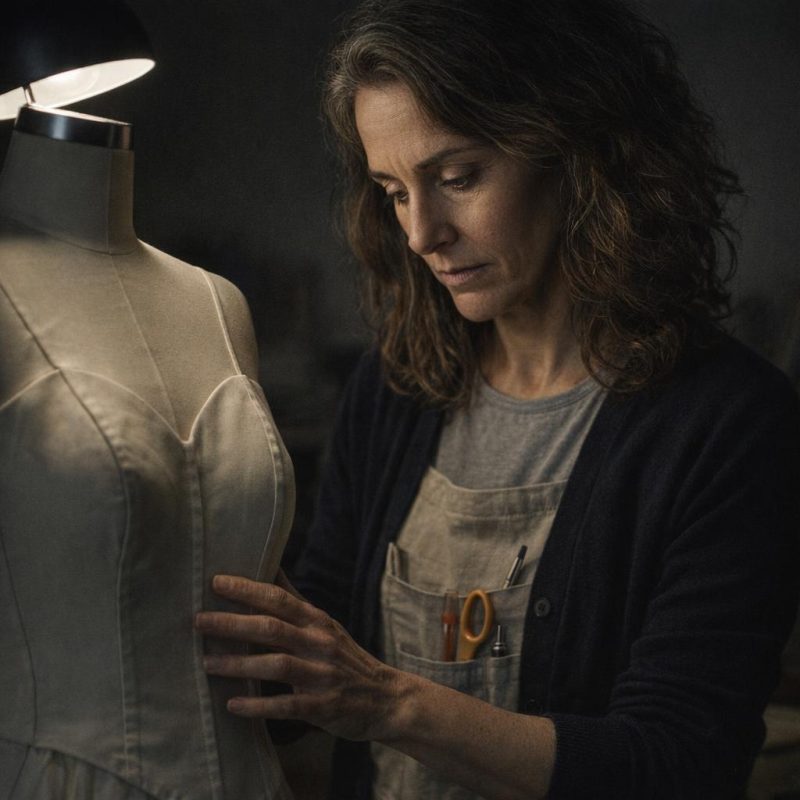 Image by RM AI
Sleeves and Shoulders
The sleeves were next, and they were a different kind of problem — not structural, exactly, but sloppy. There was too much fabric through the upper arm, and it had been gathered rather than tapered, which gave the whole sleeve a bunched, amateur look that didn't belong on a dress this otherwise carefully made. I unpicked the sleeve attachment at the armscye and laid each sleeve flat on the cutting table. I could see immediately where the excess was sitting. I trimmed carefully, taking a little at a time the way you have to when you're working with fabric you can't replace, and re-tapered from just below the shoulder cap down to the wrist. The shoulder seams needed lifting too — a quarter inch on the right, slightly less on the left — and I adjusted each one separately, checking the balance in the mirror after every pin. I reattached the sleeves with the smallest stitches I could manage, the kind that disappear into the weave of the fabric and leave no trace. I worked past midnight again, not minding it. There's a satisfaction in correcting someone else's careless work that's almost better than building something from scratch — the pleasure of seeing a thing become what it was always supposed to be. When I finally stepped back and looked at the sleeve line running clean from shoulder to wrist, the bunching gone and the drape falling the way it should, I felt it settle somewhere quiet in my chest.
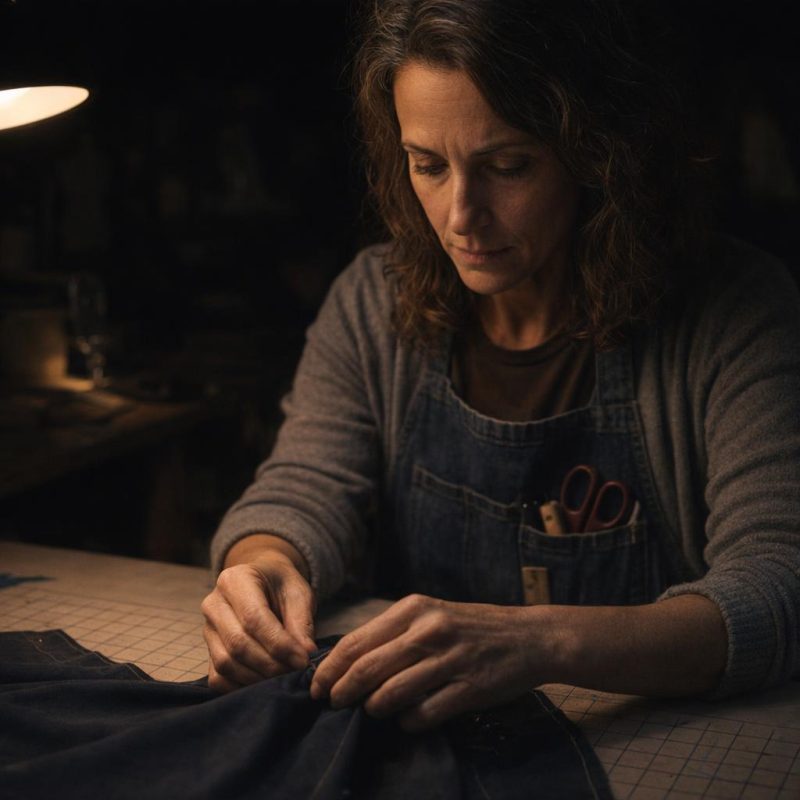 Image by RM AI
The Back Closures
The back closures were the second night's first task, and I could see the problem before I'd even touched them. The button loops were too loose — not just slightly, but noticeably, the kind of loose that would have the dress gaping open before Clara made it halfway down the aisle. I removed every loop and every button, setting them in a small dish so I wouldn't lose them. The original loops had been made from a bias strip that was too wide and not turned tightly enough, so they had no real tension to hold a button. I cut new strips, narrower, and turned them properly, stitching each one closed with a doubled thread before I attached them. Then I repositioned the buttons, spacing them evenly down the placket. That was when I noticed it. I laid my ruler along the original button placement marks — the small chalk dots the original seamstress had left behind — and the spacing was off by nearly half an inch, inconsistent from one button to the next in a way that made no sense if you were working from a measured plan. I sat back and looked at the marks for a moment. Half an inch didn't sound like much, but in button spacing it was the difference between a dress that closed cleanly and one that pulled and puckered across the back.
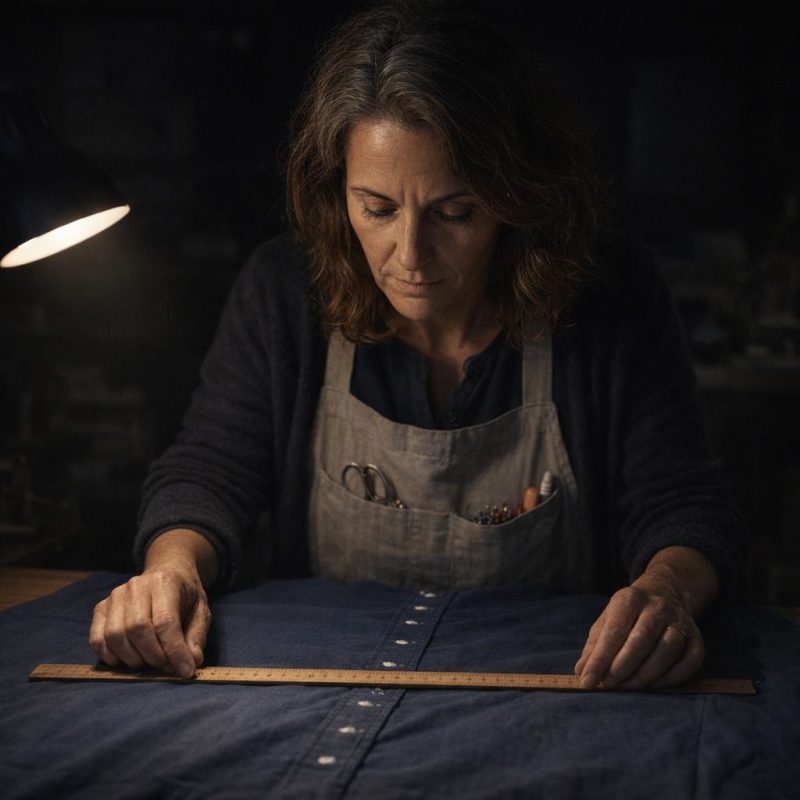 Image by RM AI
The Train's Edge
By the time I got to the train it was past eleven, and the workroom had gone to that deep nighttime quiet I'd come to expect. The train's edge needed hand-finishing — the original hem was machine-stitched with a thread that didn't quite match, and it showed when the fabric moved. I clipped it out and started again with my best silk thread, the color I'd mixed myself years ago to match ivory bridal satin. Hand-finishing a train takes time. You work in small sections, keeping the tension even, making sure the hem rolls under cleanly without pulling the grain. I didn't mind the time. There's a kind of meditation in that work, the needle moving in and out in a steady rhythm, the fabric turning slowly under your hands. When the hem was done I moved to the lace appliqués along the train's border, which needed re-tacking — the original stitching had been too sparse and several of the appliqués had already begun to lift at the edges. I threaded a fresh needle and began working my way along the border, pressing each appliqué flat and securing it with small, close stitches around the perimeter.
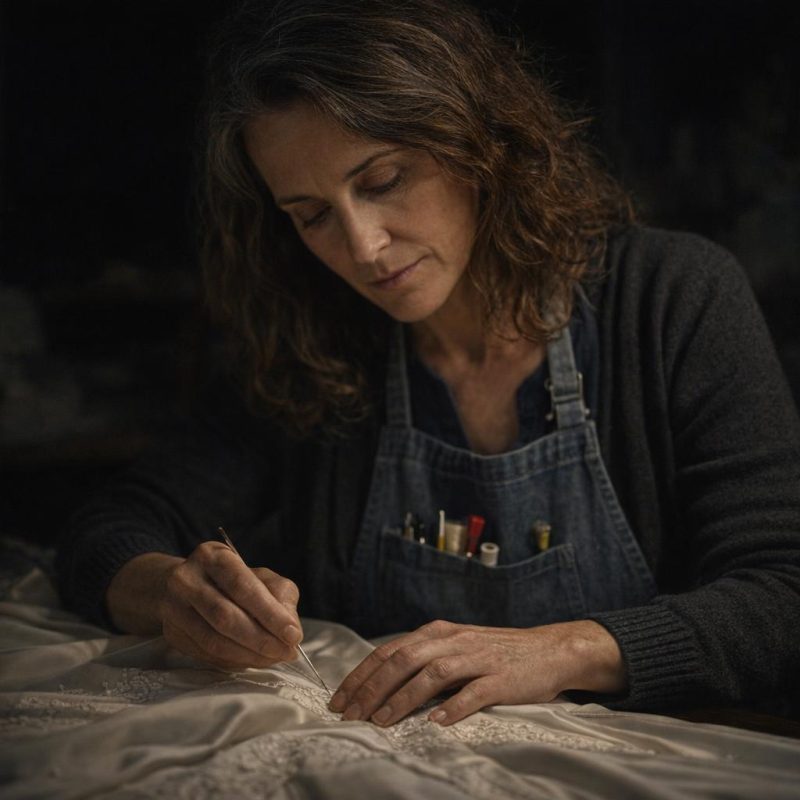 Image by RM AI
A Song Half-Remembered
I worked my way down the train slowly, appliqué by appliqué, until I reached the last one near the point. It was the largest of them, a full floral medallion with scalloped edges radiating outward from a raised center. I pressed it flat with my fingertips and began stitching around the perimeter the way I had with all the others. But somewhere in the middle of that last appliqué, my fingers slowed without my telling them to. I kept stitching, but my hand had gone to a kind of automatic, the way it does when something else is pulling at your attention. The pattern under my fingertips — the scalloped outer edge, the way the petals fanned from the center, the particular rhythm of the raised satin stitch — had a quality I couldn't quite place. Something about the feel of it snagged at the edge of my attention the way a texture sometimes does when you've worked with many fabrics over many years. I finished the last few stitches and knotted the thread. I told myself it was nothing — late nights and close work playing tricks on tired hands. I set the needle down, and the pattern moved under my fingertips like something half-remembered from a long time ago.
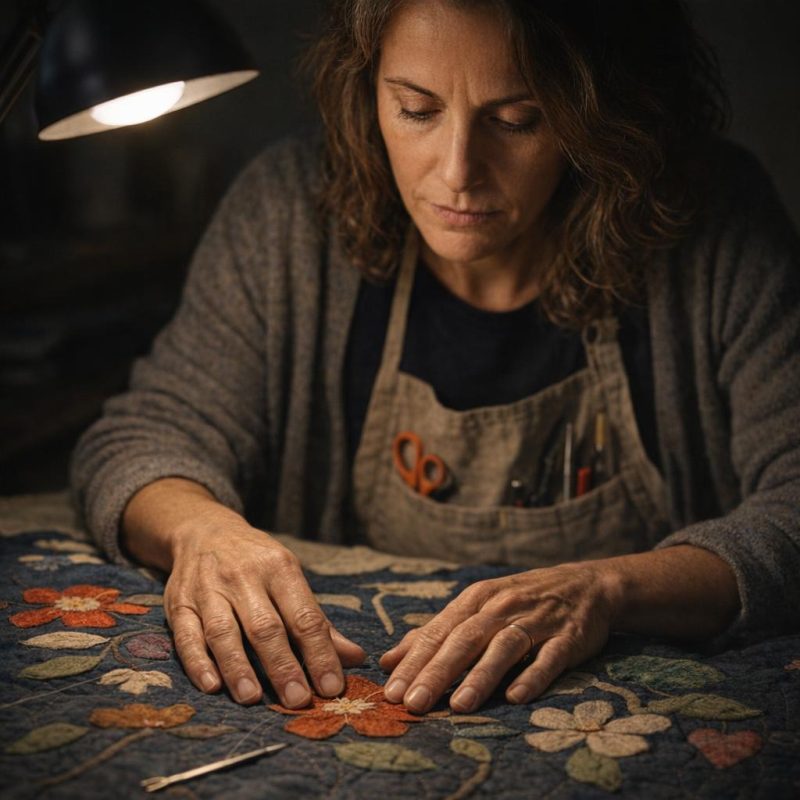 Image by RM AI
The Finished Dress
I finished the last of the alterations sometime after one in the morning and sat for a few minutes at the worktable without moving, the way I always do at the end of a long job. Then I lifted the dress carefully off the cutting table and carried it to the dress form, smoothing the bodice over the form's shoulders and letting the skirt fall. I stepped back. The princess lines ran clean and unbroken the way they were supposed to. The sleeves tapered smoothly from shoulder to wrist, no bunching, no drag. The back closures sat in a straight, even column down the placket. The train spread behind the form in a long, quiet arc, the hand-finished hem lying flat against the floor, the lace appliqués tacked down and still along the border. I felt the satisfaction of it — the particular satisfaction of work done carefully, of a thing made right. There was still that faint, unplaceable feeling about the lace, the same one that had slowed my fingers the night before, but I didn't follow it anywhere. I was tired, and the dress was finished, and it was beautiful. The workroom lamp caught the ivory satin and the lace lay perfect and still along the train, and the dress hung there on the form in the quiet, complete and ready.
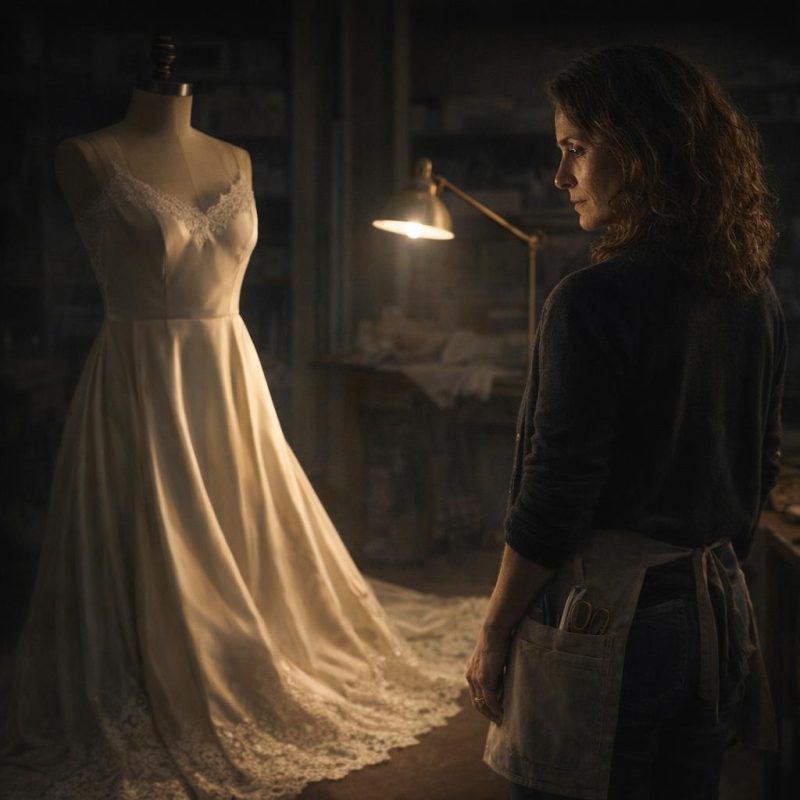 Image by RM AI
Three Days Before
Clara arrived on a Thursday afternoon, three days before the wedding, and I heard her car in the driveway before I saw her. I'd been in the workroom all morning, doing small things — tidying the cutting table, reorganizing the thread drawer — the kind of puttering you do when you're proud of something and waiting for someone to see it. When she appeared in the doorway, I felt that pride rise up in my chest the way it always does when a job has gone right. She looked smaller than usual somehow, standing there in the frame of the door with the afternoon light behind her, her shoulders drawn in slightly, her hands loose at her sides. I said her name and gestured toward the dress form, and I watched her eyes find the dress. I'd hung it carefully that morning, smoothed every panel, let the train spread just so across the floor. The princess seams ran clean and true, the sleeves lay perfectly tapered, the lace along the train flat and even and still. I wanted her to see all of it — the work, the care, the hours. She stepped into the room slowly, like she was moving through water, and she reached out and laid her hand against the bodice.
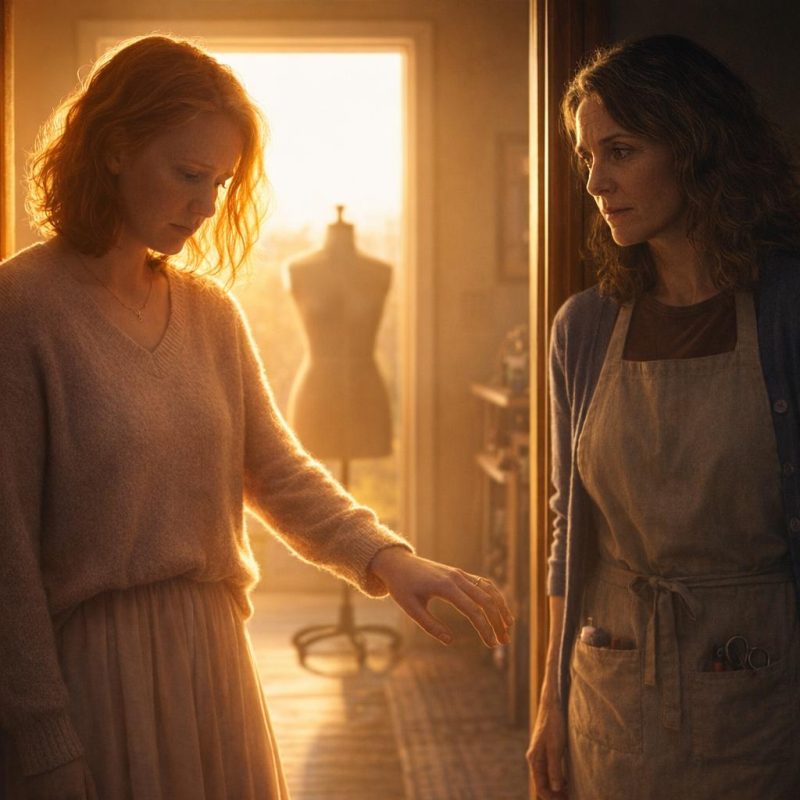 Image by RM AI
Thank You
She stood there with her hand on the bodice for just a moment, and then she turned to me, and her face had completely crumpled. The tears came fast — not the pretty, dabbing kind, but the real kind, the kind that comes from somewhere deep and doesn't ask permission. She said thank you, and then she said it again, and again, her voice breaking apart on the second syllable each time. Before I could say anything she had her arms around me, both of them, holding on the way she used to when she was small and something had frightened her. I wrapped my arms around her and smoothed her hair back from her face the way I'd done a hundred times when she was little, and I told her the dress was beautiful and she was going to be beautiful and that everything was going to be just fine. I told myself this was wedding nerves, the accumulated weight of months of planning finally releasing itself. I'd seen brides cry before. I'd cried myself, once, a long time ago. I held her and let her shake against me and said soft, meaningless, comforting things, and the minutes stretched out, and I felt the dampness of her tears soaking through the shoulder of my shirt.
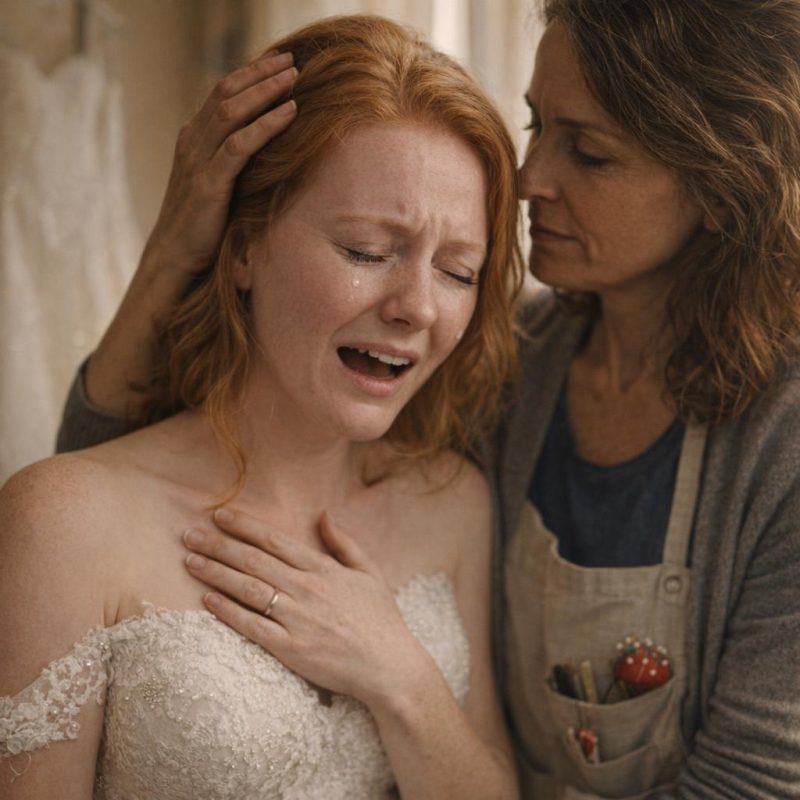 Image by RM AI
Averted Eyes
She pulled back eventually, drawing in a long, unsteady breath, and reached past me for the tissue box I keep on the corner of the worktable. I started to say something — something about how Tom was going to lose his breath when he saw her come down the aisle — the kind of thing you say to a bride three days out. But I stopped, because something had snagged my attention without my quite knowing what it was. I stood there and watched her pull a tissue from the box and press it to her face, and I tried to work out what felt different. Then I understood what I was noticing. She hadn't looked at me. Not once during the whole of it — not when she'd turned from the dress, not when she'd held on to me, not when she'd pulled away. I'd been looking at her face the entire time and she'd been looking somewhere else, somewhere slightly to the side or down at the floor. I started to say her name, to ask if she was all right, and she turned — not toward me, but toward the window, pressing the tissue to her cheeks while the afternoon light caught the wet on her face, her profile quiet and still against the glass.
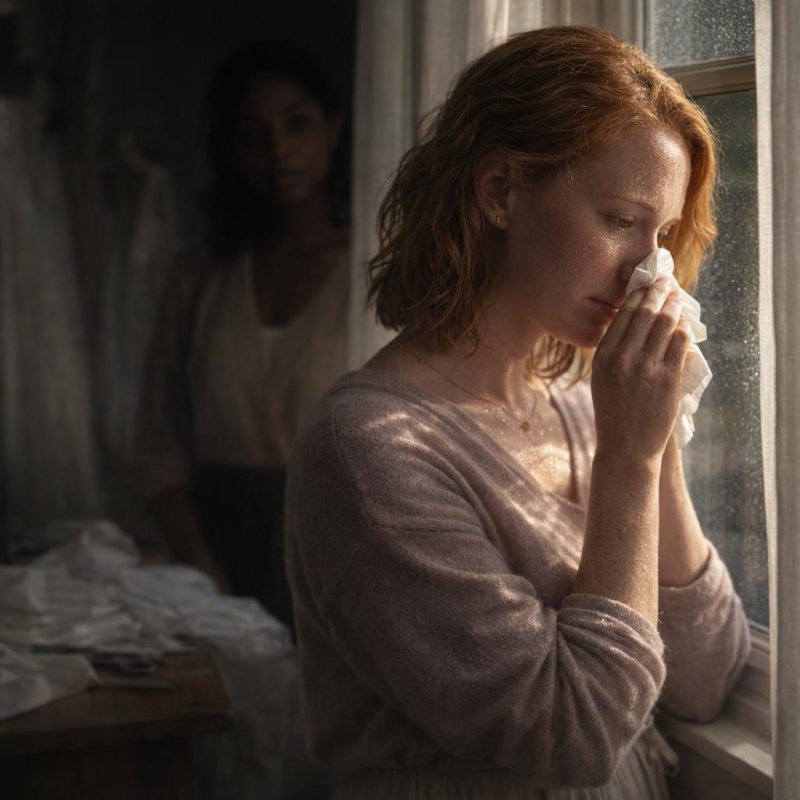 Image by RM AI
The Days Between
The two days between Clara picking up the dress and the wedding were ordinary days, the kind that fill themselves with small tasks if you let them. I did laundry. I returned a library book. I went to the grocery store and stood in the cereal aisle for longer than I needed to. I kept telling myself I was overthinking things — that Clara had been emotional because she was a bride three days from her wedding, and brides cry, and there was nothing unusual about any of it. I'd comforted her and she'd felt better and she'd driven away with the dress carefully laid across the back seat, and that was the whole of it. But the feeling didn't quite leave. It sat somewhere just below my sternum, not sharp enough to be worry, not vague enough to ignore. I thought about the way she'd held on to me, tighter than wedding nerves usually warrant. I thought about her face turned toward the window. I told myself I was a woman who spent too much time alone in a workroom and had started reading things into ordinary moments. On the evening before the wedding I stood in front of my open closet, running my hand along the hangers, and I kept thinking about Clara's tears and the way she hadn't once looked me in the eye.
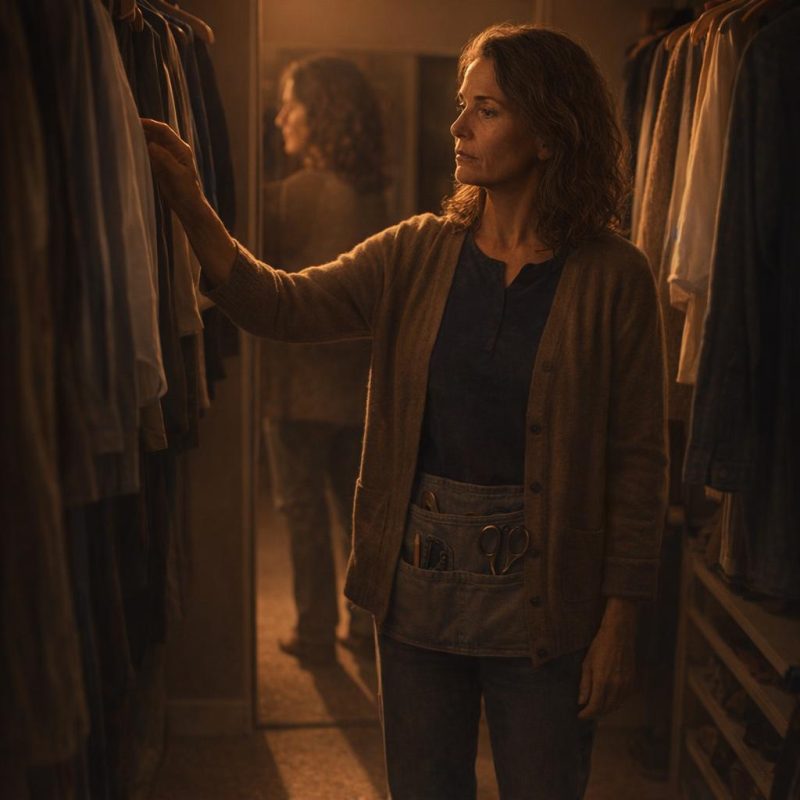 Image by RM AI
The Morning of the Wedding
I woke early on the morning of the wedding, before my alarm, the way I always do when something is waiting. The house was quiet in that particular way it gets before the neighborhood stirs — no traffic, no dogs, just the refrigerator hum and the sound of my own feet on the kitchen floor. I made coffee and sat at the table with both hands around the mug and thought about Clara putting on the dress I'd spent two nights getting right. I thought about the way the princess seams would sit against her frame, the way the train would move behind her when she walked. I'd put real hours into that dress, real care, and I wanted the day to be good for her. I wanted it to be everything she'd hoped for. I told myself the unease I'd been carrying all week was just my own anxiety attaching itself to something convenient — I'd always been prone to that, to finding a shape for a feeling that didn't have one yet. Today was Clara's wedding day. Whatever I'd been sensing in her on Thursday was probably already gone, dissolved in the happiness of the morning. I sat with my coffee and listened to the house settle around me in the quiet before everything would begin.
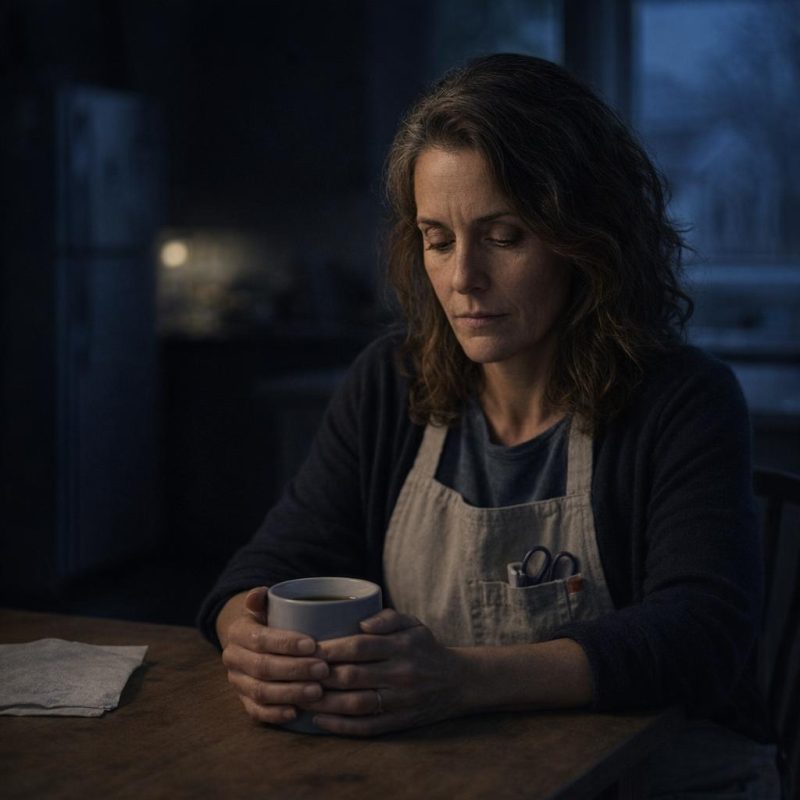 Image by RM AI
Getting Ready
I put on the blue dress I'd chosen earlier in the week — a deep navy with a simple neckline, nothing that would draw attention away from the bride. I clipped on the pearl earrings my mother had left me, the small ones, and stood in front of the full-length mirror on the back of the bedroom door. The woman looking back at me was put-together enough. Hair pinned neatly, earrings straight, dress hanging the way it was supposed to. I practiced a smile — the kind you wear at weddings, open and warm and uncomplicated. It looked almost right. Almost. There was something in my eyes that the smile didn't reach, a kind of watchfulness I didn't entirely recognize, or maybe didn't want to. I told myself I was being ridiculous. I told myself I was a fifty-eight-year-old woman who had altered her niece's wedding dress and done a beautiful job of it, and today I was going to sit in a pretty barn and watch that niece marry a kind young man and eat good food and feel nothing but glad. I straightened my collar, picked up my bag, and looked one more time at the mirror. The expression looking back at me had not changed.
 Image by RM AI
The Drive to the Venue
The venue was about forty minutes outside the city, and the directions took me off the highway and onto roads that got narrower and quieter the further I went. The suburbs thinned out and gave way to fields, and the fields gave way to stretches of old fence line and tree cover, and I found myself thinking that Clara had chosen well — there was something genuinely peaceful about this part of the county, the kind of landscape that makes a person breathe differently. I'd been to the barn once before, at the tasting event Clara had invited me to back in the spring, but I'd forgotten how it looked from the road. I almost missed the turn. The gravel lane curved gently through a stand of old oaks, and then the trees opened up and I could see the building ahead — the big sliding doors thrown wide, bunting along the fence, clusters of guests already moving across the lawn in their good clothes. I slowed the car and let myself take it in for a moment. Then I turned into the gravel lot, tires crunching, and through the windshield I could see the whole front of the barn strung with warm white lights that glowed even in the afternoon sun, wildflowers massed in galvanized buckets along the entrance path.
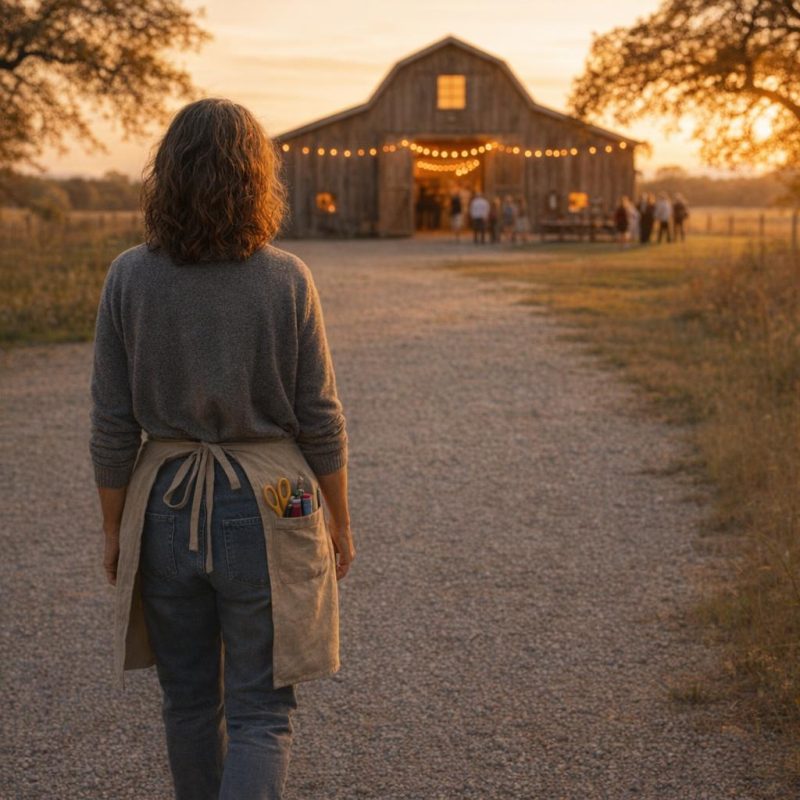 Image by RM AI
Entering the Bridal Suite
Inside, the main space smelled of cut flowers and old wood and something warm from the catering kitchen at the back. I stopped to say hello to a couple I recognized from Clara's engagement party, exchanged the usual pleasantries about the weather and the drive, and then made my way toward the staircase at the far end of the room. The bridal suite was up a narrow flight of steps, behind a door someone had decorated with a small wreath of eucalyptus and white ribbon. I knocked once and pushed it open. Clara was there, standing near the window in the dress, her back to me, and two women I didn't know were moving around her with hairpins and a small steamer. The room was bright with afternoon light and full of flowers — roses and something trailing and green — and there was soft music coming from a phone propped on the vanity. It should have felt festive. It should have felt like the inside of a happy day. I stood in the doorway and took it in, and something in the set of Clara's shoulders, something in the way the two women moved around her without speaking, something in the quality of the silence underneath the music sat wrong against my skin.
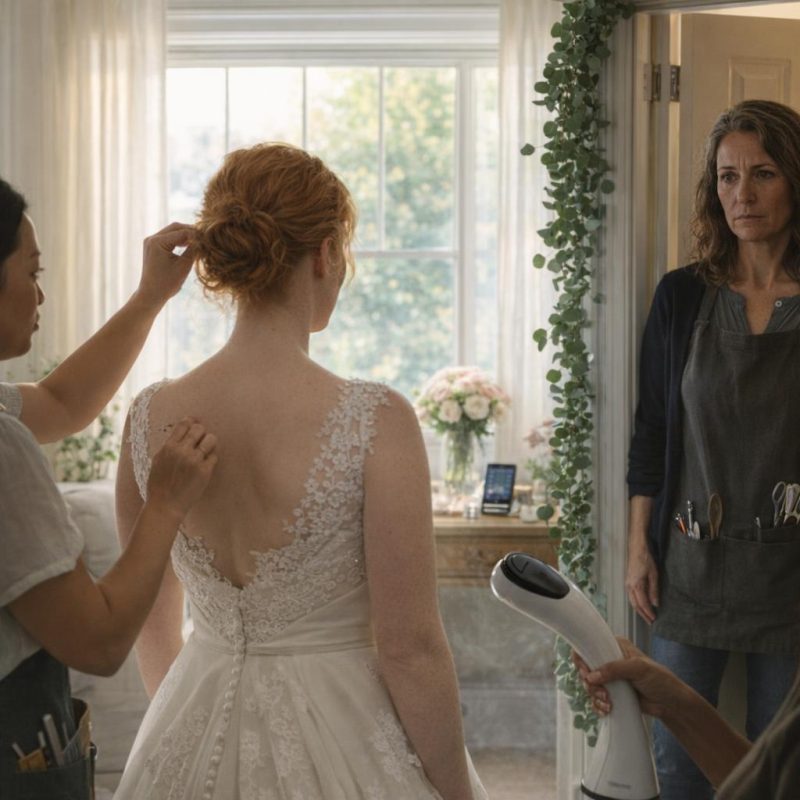 Image by RM AI
Clara in the Dress
Clara turned from the window when she heard me come in, and for a moment I forgot everything else. The dress was — I don't have a better word for it — perfect. The bodice sat exactly as I'd hoped, following the line of her shoulders without pulling, the altered seams invisible from where I stood. The train caught the afternoon light as she moved, and the lace overlay I'd worked so carefully to preserve fell in soft waves around her feet. She looked like something out of a dream, my niece, and I felt that particular ache that comes when you've put your hands into something and watched it become more than you imagined. I pressed my fingers together and just looked at her for a moment, taking it in. The two women with the steamer had stepped back, and the room had gone quiet in that way rooms do when something beautiful is standing in the middle of them. Clara smiled at me across the space between us, and she started walking toward me, and I smiled back — and then I noticed it. The smile was there, fully formed, but something behind her eyes hadn't caught up with it yet.
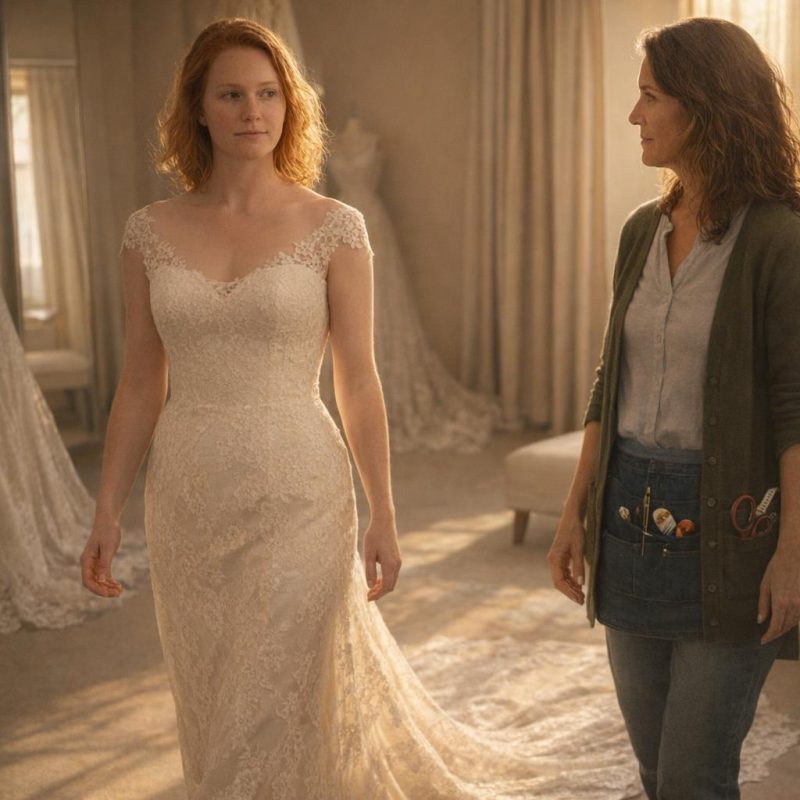 Image by RM AI
The Impulse to Check
I've been doing alterations long enough that my hands sometimes move before my brain does. It's not rudeness — it's just the way the work lives in me. I can be standing in a room, perfectly relaxed, and the moment I see a seam or a hem or a bodice sitting on someone's shoulders, some part of me is already reaching. I've embarrassed myself at dinner parties, smoothing a friend's collar without asking. Clara knew this about me. She'd grown up watching me do it. So when she stopped a few feet away and I stepped toward her, it was pure instinct — I wanted to check the fit at the shoulder, to feel whether the boning was sitting flush, to make sure the alterations I'd spent three evenings on were holding the way they were supposed to. The room was bright and warm and full of flowers, and Clara was standing very still in front of me, and I was already murmuring something about just wanting to check the left side, my hands lifting toward the fabric.
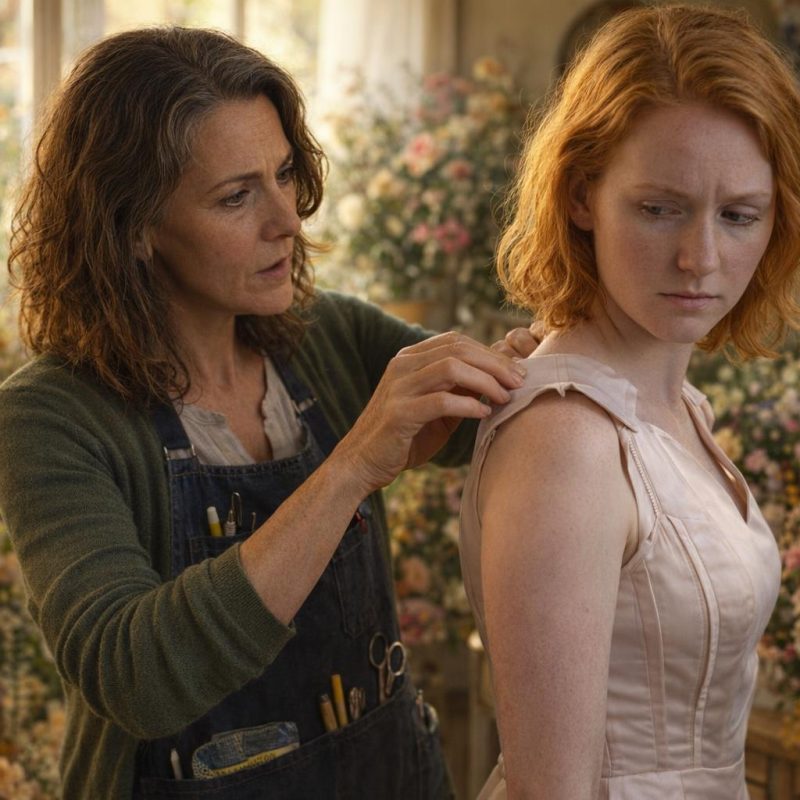 Image by RM AI
The Step Backward
It was a small movement. If I hadn't been watching her so closely, I might have missed it entirely. My hands were almost at the bodice — close enough that I could feel the faint warmth coming off the fabric — when Clara shifted her weight and took one quiet step back. Not a stumble. Not a flinch. Just a step, smooth and deliberate, that put another foot of air between us. She kept her eyes on me the whole time, and her expression didn't change exactly, but something in it closed, the way a door closes when someone pushes it gently from the other side. My hands stayed where they were for a moment, suspended in the space she'd just left, fingers still curved toward fabric that was no longer there. I lowered them slowly. I didn't say anything. Neither did she. The two women with the steamer had drifted toward the vanity and weren't watching, and the soft music from the phone kept playing, and the room looked exactly as it had a moment before. But the distance between us — that foot of air she'd put there — sat between us like something solid.
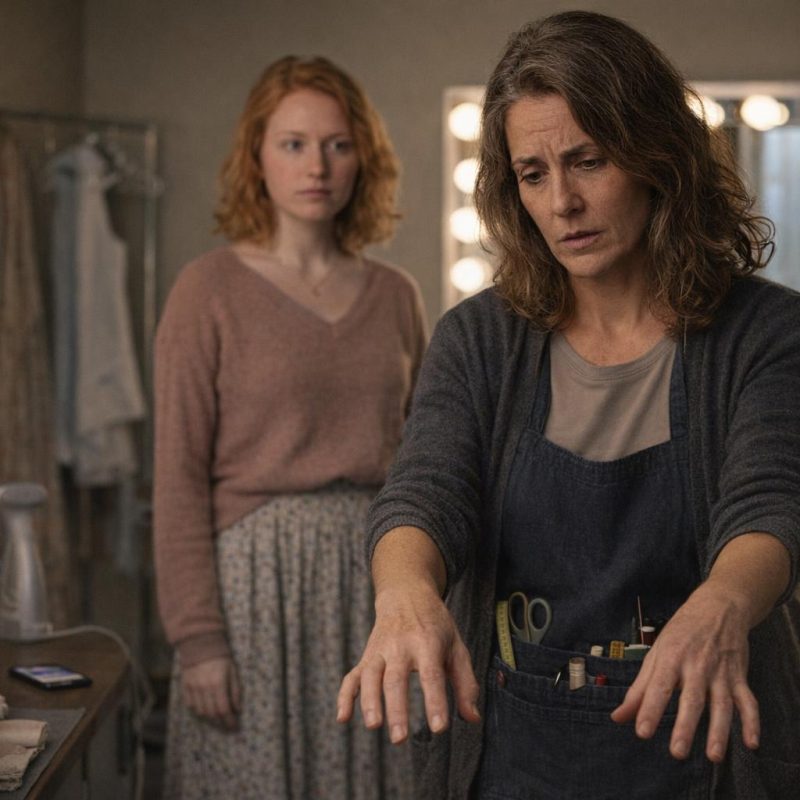 Image by RM AI
The Excuse
Then Clara laughed. It came out light and easy, the kind of laugh that's meant to smooth something over, and she shook her head a little and said, "Bev, stop — it's perfect, you've already done everything, don't fuss." She said it warmly, the way you'd say it to someone you loved, and she even reached out and briefly touched my arm as she said it, which should have made it feel better and somehow didn't. I said something like, "I just wanted to check the shoulder," and she said, "It's sitting beautifully, I promise, I can feel it," and she smiled again and bent to gather her train with both hands, adjusting the way it pooled behind her. It was a reasonable thing to say. It was the kind of thing a bride says when she's nervous and doesn't want anyone hovering. I knew that. I told myself that. But the laugh had come a half-second too fast, and the touch on my arm had felt like a redirect more than a reassurance, and I was still standing there trying to decide what I actually thought about it when I heard a sound behind me and turned — and Diane was standing in the doorway.
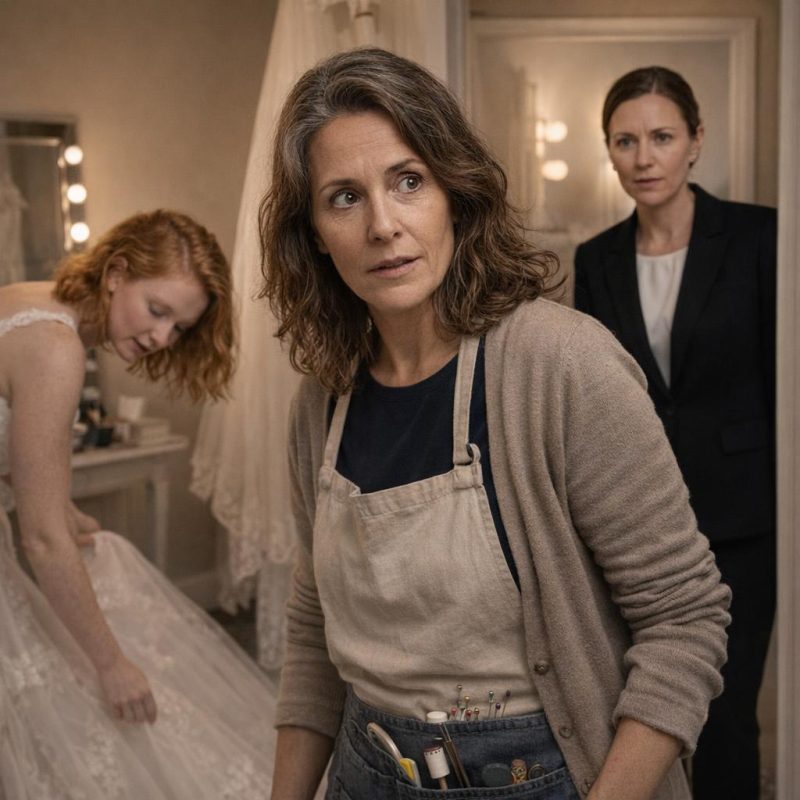 Image by RM AI
Diane's Arrival
My younger sister has always known how to enter a room. She came in with that particular energy she carries — shoulders back, eyes already moving, taking inventory before she'd fully crossed the threshold. She was dressed sharply, the way she always is for occasions that matter to her image, and she looked at me briefly and said, "Beverly," in that tone that manages to be both a greeting and a dismissal at the same time. I said her name back. We've been doing that for years, the two of us — exchanging names like we're checking boxes. She moved past me toward Clara, and I turned to watch, and that's when I noticed it. Clara's face had changed. Not dramatically — Clara has always been careful with her expressions around her mother — but something had shifted in the set of her mouth and the line of her shoulders. A moment ago she'd been a bride in a sunlit room. Now she looked like someone bracing for something, though I couldn't have said what, or whether I was reading it right. Diane said something to her quietly, and Clara nodded, and whatever had passed between them in that look settled over the room and stayed there.
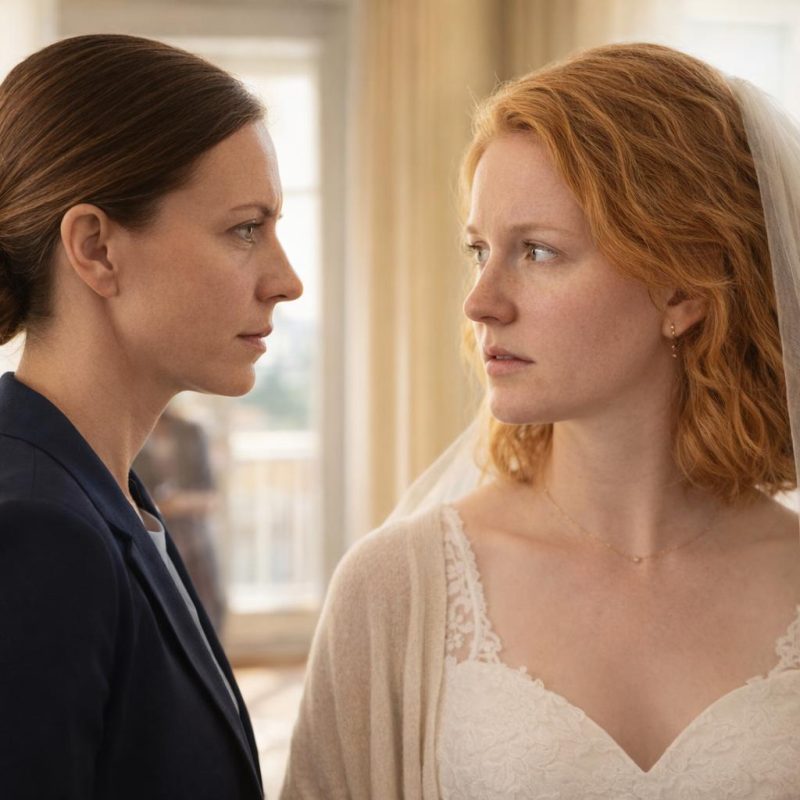 Image by RM AI
They Need to Start Photos
Diane turned to the room with the air of someone who has decided things are taking too long. "We need to get started on photos," she said, and her voice had that clipped, organizing quality I've known since we were girls — the tone that means she's already three steps ahead and everyone else is an obstacle. She spoke to the two women near the vanity, told them something about the photographer waiting downstairs, and they began gathering their things with the quiet efficiency of people who recognize authority when they hear it. I watched from near the window, feeling the way I sometimes feel at family events — present but peripheral, like a piece of furniture that's been moved to make room for something else. Diane crossed to Clara and put her hand on her arm, just above the elbow, and leaned in close to say something. Clara's eyes cut briefly toward me and then back to her mother. The touch didn't look casual. It looked like the kind of touch that means something, that carries a message in the pressure of it, though I couldn't have told you what the message was.
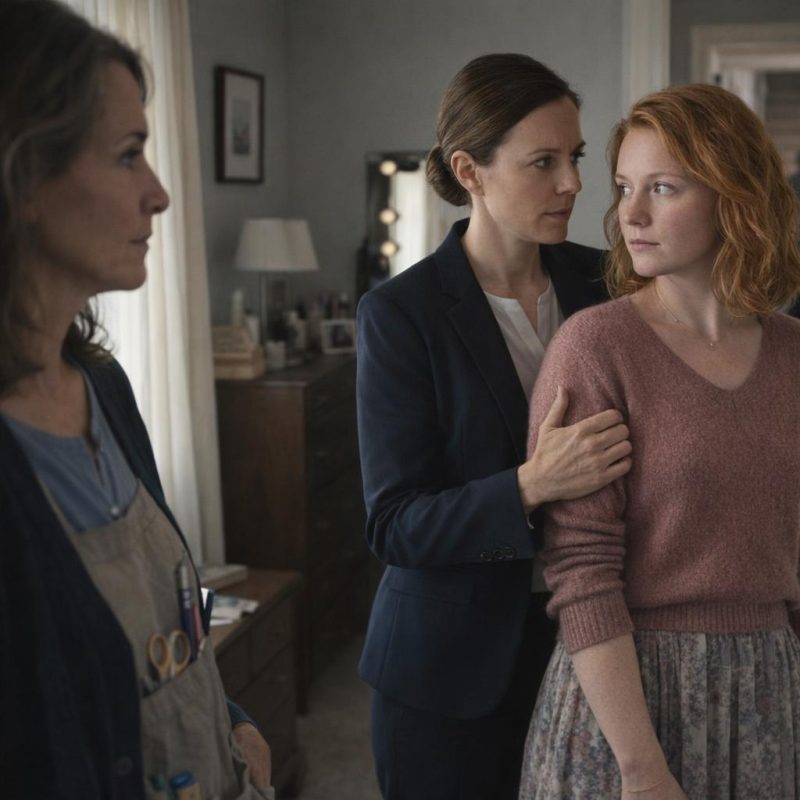 Image by RM AI
Moving Closer
They were speaking too quietly for me to hear from where I stood. I could see Diane's mouth moving, and Clara's head tilted slightly toward her, and whatever was passing between them had a quality to it — a closeness, a lowered register — that made me feel like I was watching something I wasn't supposed to see. I told myself it was nothing. Mother and daughter, wedding day, a hundred small things to coordinate. I told myself I was being oversensitive, reading tension into ordinary moments because I was already unsettled from the step backward and the too-fast laugh. But I took a step toward them anyway, just one, quiet, wanting to catch even a word or two. The heel of my shoe clicked against the hardwood floor — a small sound, barely anything — and both of them turned at exactly the same moment, and the conversation stopped.
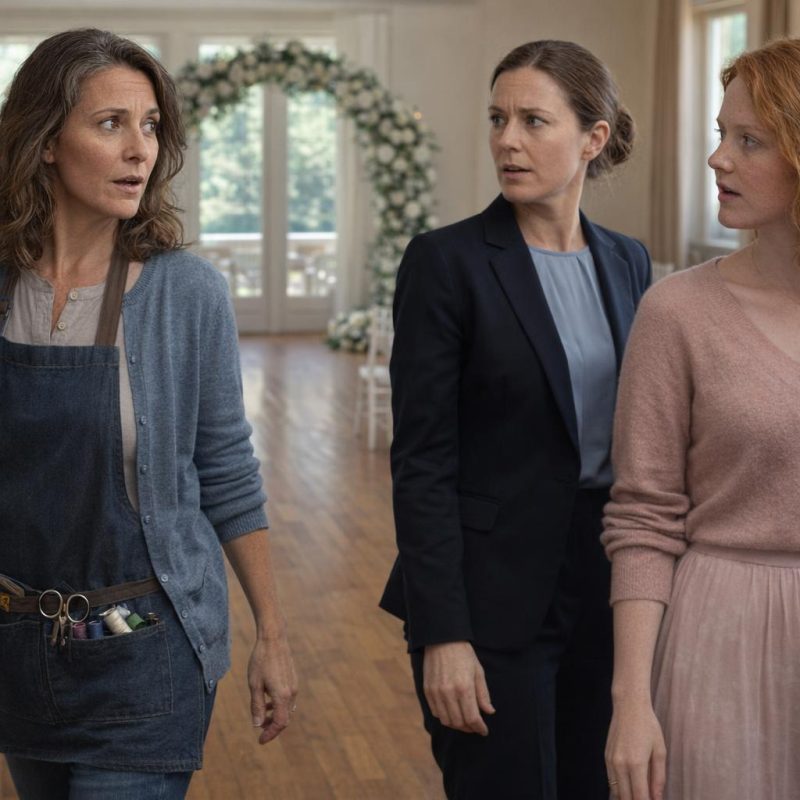 Image by RM AI
The Whispered Conversation
The three of us stood there for a moment, the silence landing between us like something dropped. Clara's face had gone carefully neutral, the kind of neutral that takes effort. Diane's hand was still resting on Clara's arm, fingers curved just above the elbow, and she was looking at me with an expression I couldn't quite name — not hostile, not warm, just watchful. I said something about the photographer, asked if we should head downstairs, kept my voice easy. Clara said yes, of course, and began gathering her train again, and Diane said something about checking on the bouquets. It all sounded perfectly normal. But I'd been close enough, just before my heel hit the floor, to catch the shape of it — not the words, but the rhythm and the pitch of what Diane had been saying, low and fast and pressed close to Clara's ear, the way you speak when what you're saying cannot wait.
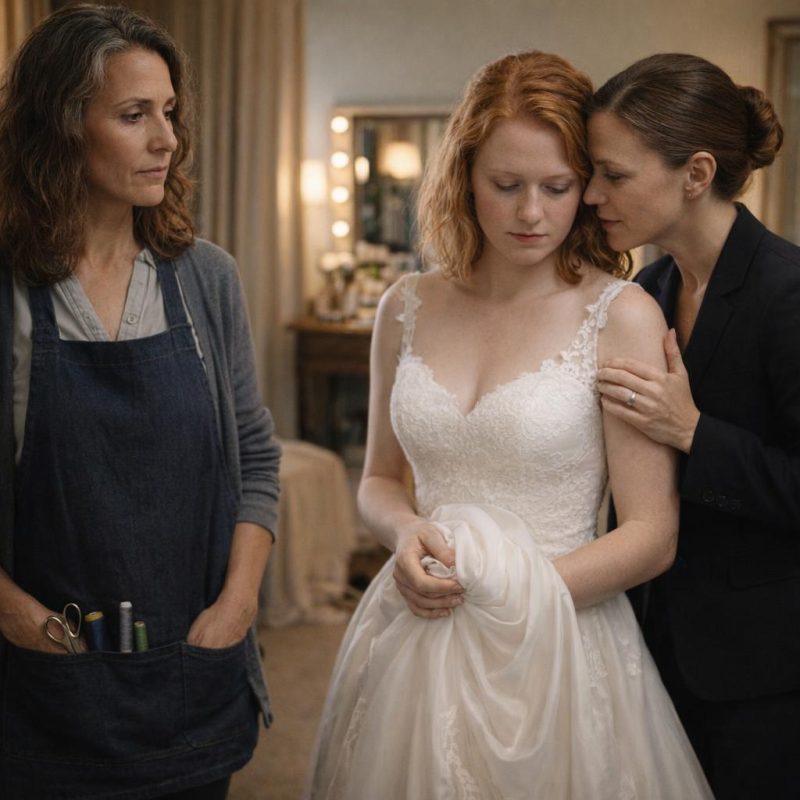 Image by RM AI
The Silence
The hallway outside the bridal suite had gone very quiet. I stood there with my hands loose at my sides, waiting for one of them to say something — anything — to fill the space. Clara was looking at a point somewhere past my left shoulder. Diane had her chin lifted slightly, the way she does when she's waiting for a situation to resolve itself without her having to move. I tried a small smile. Neither of them returned it. I thought about asking again whether we should head down, but the words felt wrong before I even formed them. So I just stood there. The silence stretched out long enough that it stopped feeling accidental. I found myself thinking about Clara's answer earlier — how quickly it had come, how smooth and complete it was, the way an answer sounds when it's been said before rather than thought through just now. I hadn't thought much of it at the time. Standing here now, with both of them watching me without speaking, I thought about it again. I couldn't say what I was missing. But something about the way they were both looking at me — still, patient, waiting — made the back of my neck go cold.
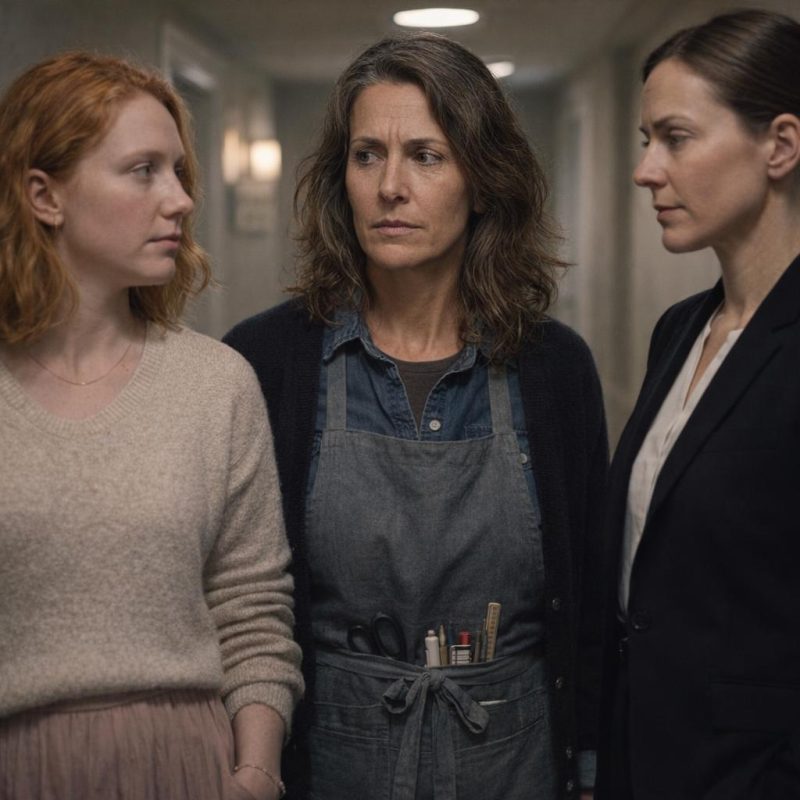 Image by RM AI
Leaving the Bridal Suite
I made some excuse about checking my seat assignment and slipped away down the corridor. Neither of them tried to stop me. I walked slowly at first, then faster, my low heels quiet on the hardwood, and I didn't look back. The hallway smelled of cut flowers and something warm and woody from the barn below, and under any other circumstances I would have found it lovely. I kept turning things over as I walked. Clara stepping back from my hand on her shoulder. The way her eyes had gone somewhere else when I hugged her. Diane's voice, low and pressed close, cutting off the moment my heel hit the floor. And that answer about the lace — Diane found it at an estate sale, Clara had said, quick and certain, the words landing without any of the texture that comes when someone is actually remembering something. I'd accepted it. I'd smiled and gone back to my pinning. Maybe I was overthinking all of it. Maybe the nerves of the morning had made everyone a little strange, including me. I stopped at the top of the staircase and stood there for a moment, one hand on the newel post. Behind me, the door to the bridal suite was closed.
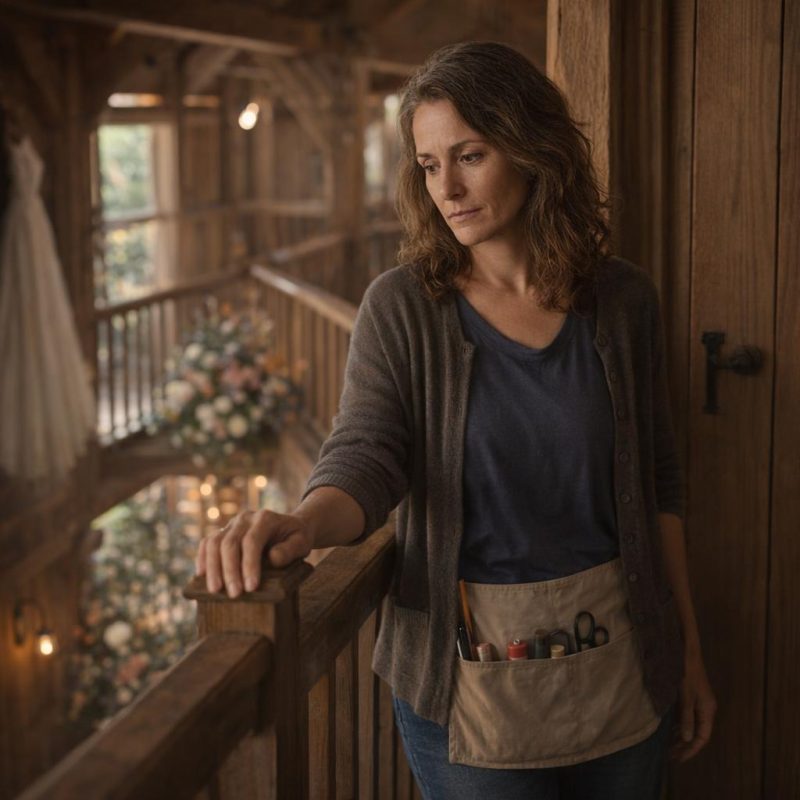 Image by RM AI
Ceremony Preparation
The barn had transformed since I'd last seen it two days before. String lights looped in long arcs from the rafters, and someone had wound wildflowers — Queen Anne's lace and pale blue chicory — around every post and beam. Guests were filtering in through the wide double doors, finding their programs, leaning together in the low murmur that fills a room before something important begins. I came down the stairs slowly, one hand trailing the rail, still not quite back inside myself. Near the front, Tom was standing with a cluster of people I didn't recognize, shaking hands, laughing at something, his easy smile doing what it always does. He looked genuinely happy. Uncomplicated. I watched him for a moment and felt something I couldn't name — not envy exactly, more like distance, the way you feel when everyone else in a room seems to be reading from a script you weren't given. The musicians in the far corner were tuning up, small careful sounds threading through the conversation. A woman in a pale green dress was arranging the last of the programs on the end chairs. Everything was in its place. Everything was ready.
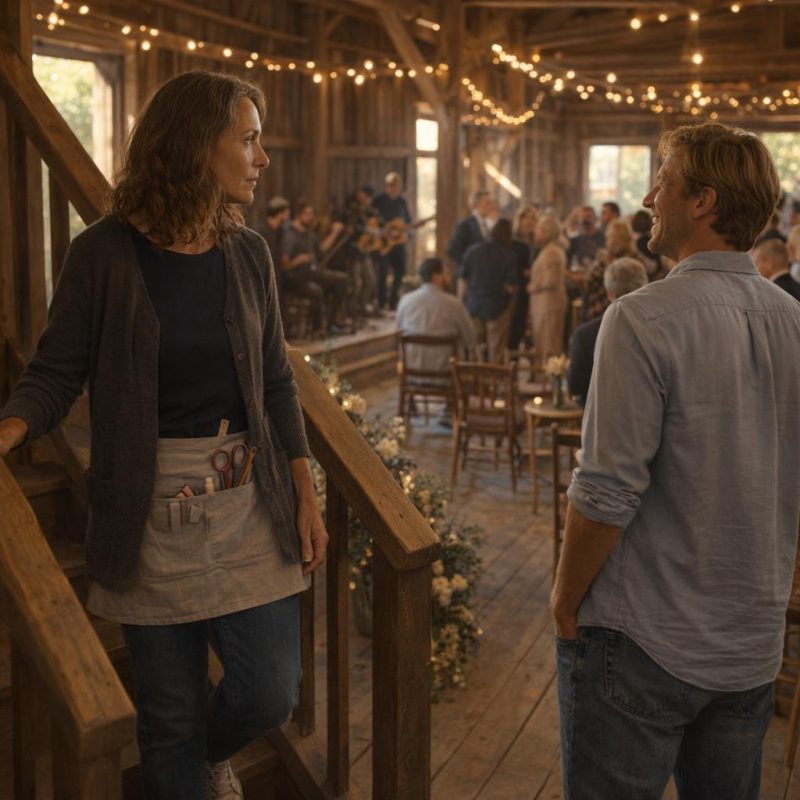 Image by RM AI
Finding a Seat
I found the family section without needing to check the program. Third row, left side, an ivory card with my name in Clara's handwriting tucked into the seat. I smoothed my dress and sat down. Around me, cousins and aunts I hadn't seen in years were settling in, exchanging the kind of bright, surface-level greetings that weddings require. I gave what was asked of me — a smile here, a squeeze of someone's hand there — but I was only half present. The barn was filling with light and warmth and the smell of those wildflowers, and I knew I should have been feeling something soft and glad. Clara had asked me to make her dress. She'd trusted me with that. I kept trying to hold onto that thought, to let it be enough. The musicians had moved from tuning to something gentle and instrumental, and the sound settled over the room like a hand laid flat. I looked at the chair to my left. Empty, with another ivory card in the seat. Diane would come and sit there after she walked Clara down the aisle, and we would sit side by side through the whole ceremony, and I had no idea what I would say to her.
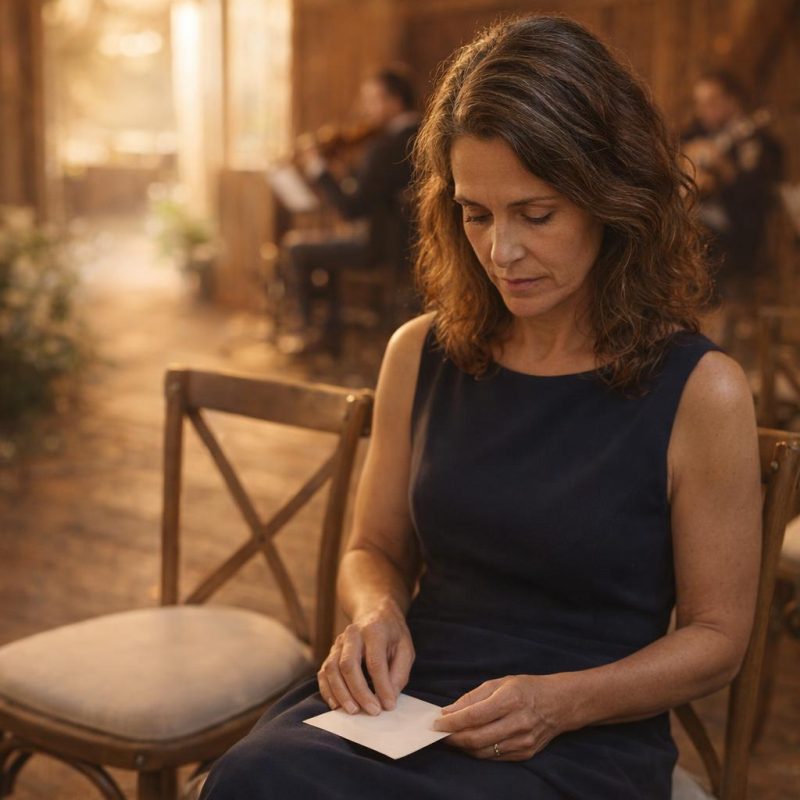 Image by RM AI
Replaying the Moments
The music continued its soft loop and I sat with my hands folded in my lap and tried to be still. I kept going back over things. Three weeks ago, Clara's phone call — her voice a little too careful, asking if I'd be willing to work on the dress, mentioning the lace almost as an afterthought. At the time I'd thought she was just nervous about asking a favor. Then the fitting, when she'd cried. I'd assumed it was emotion, the ordinary overwhelm of a bride. But she hadn't met my eyes when she cried. She'd looked down at the fabric, at the lace trim along the train, and her shoulders had curved inward in a way that hadn't looked like happiness. And this morning — the way she'd gone still under my hands when I smoothed the back of the bodice. The small step away. The careful neutral face in the hallway. I'd been reading each of these moments on its own, filing them away as nerves or family tension or the general strangeness of wedding days. Sitting here now, I let myself look at them together. I still couldn't see the shape of what they made. But I kept coming back to Clara's eyes, wet and averted, fixed on the lace she wouldn't look up from.
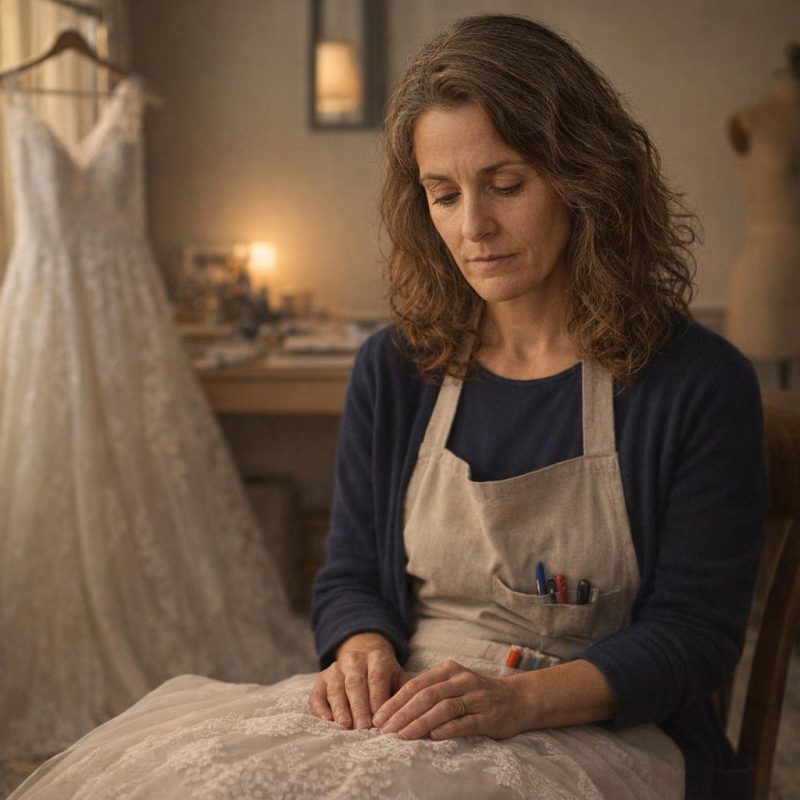 Image by RM AI
The Familiar Pattern
The musicians shifted into something slower, and the guests around me straightened almost imperceptibly, the way people do when they sense a ceremony is about to begin. I should have been doing the same. Instead I was back in my sewing room, three weeks ago, the train spread across my worktable under the good lamp. I'd been attaching the lace to the underlining, working the needle through in the small careful stitches I use for anything delicate, and I remembered pausing. Just for a moment. The pattern had snagged something in my memory — not a clear thought, more like the feeling of a word sitting just out of reach. The scalloped outer edge, the way each curve was finished with a tiny doubled thread before it turned. The floral centers, six petals each, with a single seed stitch at the heart. Something about it felt familiar in a way I couldn't place. At the time I'd told myself it was a common enough pattern, that I was probably thinking of something I'd seen in a catalog or a bridal magazine. I'd gone back to my stitching and let the feeling pass. But sitting here now, with the music rising around me, I couldn't let it pass. My fingers remembered the scalloped edges, the floral centers, the exact give of those threads.
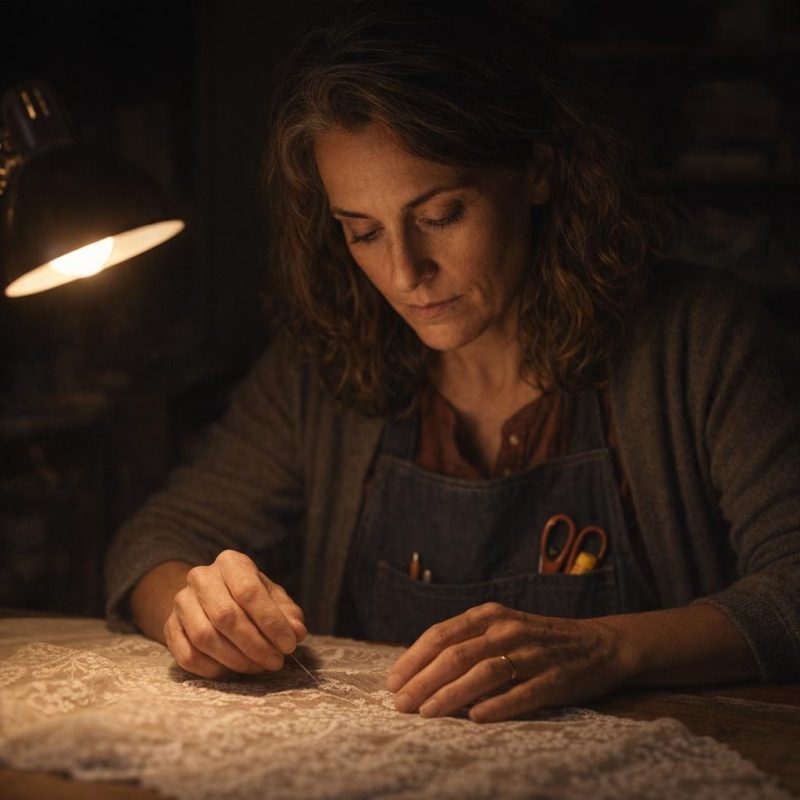 Image by RM AI
The Preservation Box
There is a box on the highest shelf in my sewing room. It's been there for almost thirty years. I wrapped it myself in acid-free tissue, the kind you use when you want something to last, and I've moved it through three houses without ever opening it. I know what's inside without looking. A dress I made when I was twenty-six, for a wedding that didn't happen. I'd spent four months on it. The lace alone had taken six weeks — I'd ordered it from a supplier in Belgium, a specific pattern I'd chosen from a sample book, scalloped edges with floral centers, six petals each, a seed stitch at the heart of every flower. A pattern I had never worked with before or since, as far as I could remember. I'd put the dress in the box the week after the engagement ended, folded it in tissue, set it on the shelf, and told myself I'd deal with it someday. Someday had never come. I sat in my chair as the music swelled around me and the guests shifted in their seats, and I tried to tell myself I was wrong, that I was making connections that weren't there, that lace patterns repeat and overlap and nothing I was thinking could possibly be true. The thought sat in my chest anyway, heavy and still.
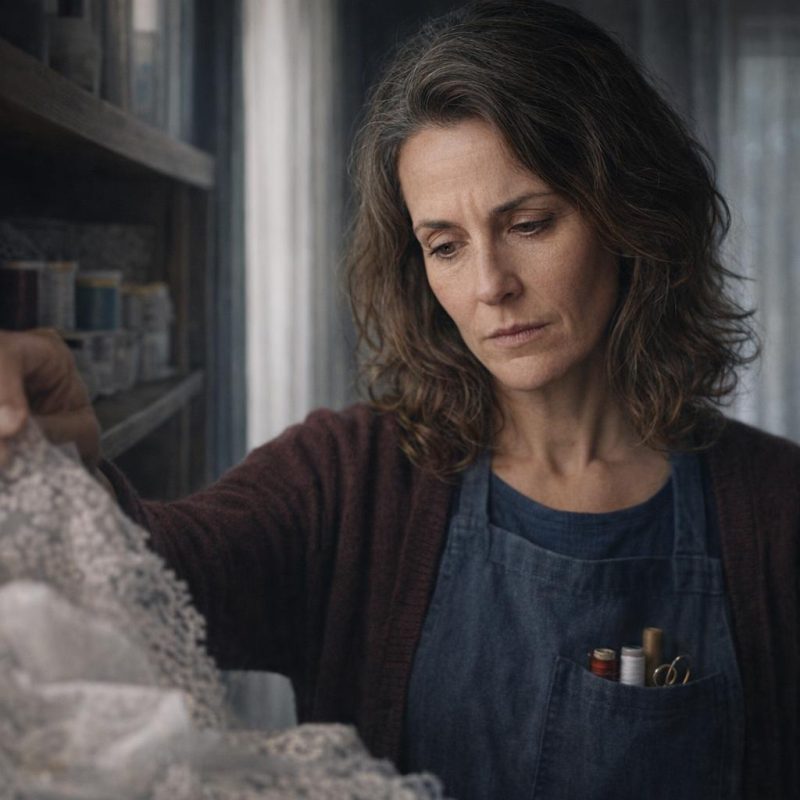 Image by RM AI
The Music Begins
The first notes of the processional came through clear and bright, and everyone around me rose. I stood a half-beat behind the rest, my legs doing the work without much help from me. Someone behind me said something warm and quiet to the person beside them. A child near the aisle craned up on her toes. The barn filled with that particular held-breath feeling that comes just before a bride appears, and I stood in the middle of it with my hands clasped in front of me and my mind somewhere else entirely. I was thinking about the tissue paper. The way I'd folded it over the sleeves first, then the bodice, then the train, smoothing each layer flat before I closed the box. I was thinking about the shelf, and the three houses, and the thirty years. I was thinking about how I had never once considered that anyone else knew the box was there, or what was inside it, or why it mattered. The music rose into the rafters and caught in the string lights and poured back down over all of us, and I stood very still inside it, unable to look away from the end of the aisle, terrified of what I was about to see walking toward me.
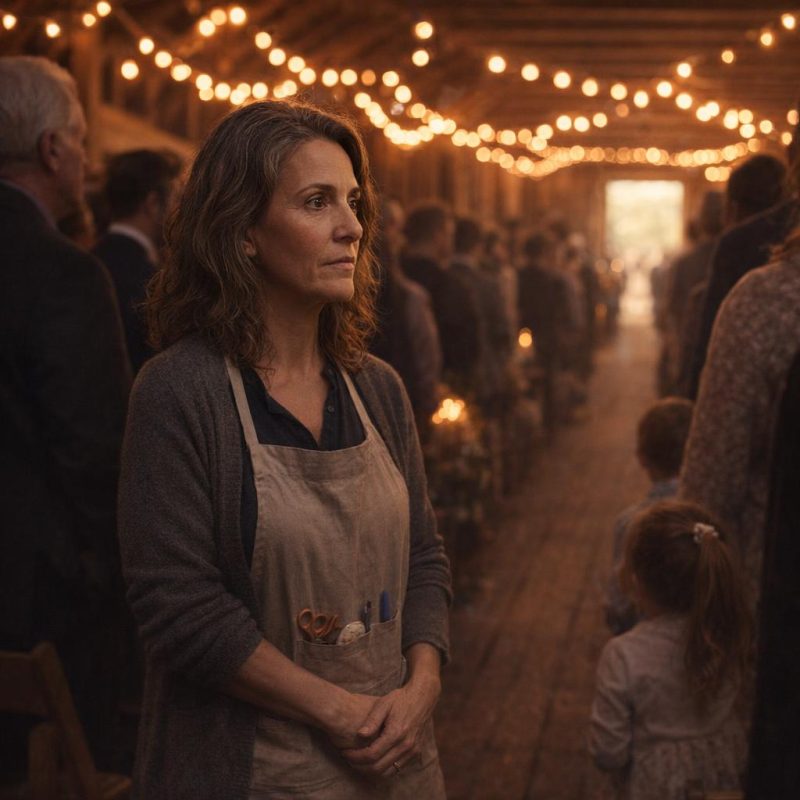 Image by RM AI
Walking Down the Aisle
She appeared at the far end of the aisle and the whole barn seemed to exhale at once. Clara. My niece, in white, with Diane at her side and Tom waiting at the front with his easy smile and his kind eyes. I should have been crying the way everyone around me was crying. Instead I was leaning forward almost imperceptibly, my hands pressed flat against my thighs, trying to see. The dress moved beautifully — I'd made sure of that, had spent hours on the hem and the fit — but it was the train I couldn't stop watching. It fanned out behind her as she walked, catching the light from the string lights overhead, and every time it shifted I tried to hold the image still in my mind long enough to really look. The guests around me were watching Clara's face, watching Tom's face, watching the moment unfold the way it was supposed to. I was watching the floor behind her. The lace on the train caught the light again as she passed my row, the scalloped edges flaring bright for just a second before the shadows took them back.
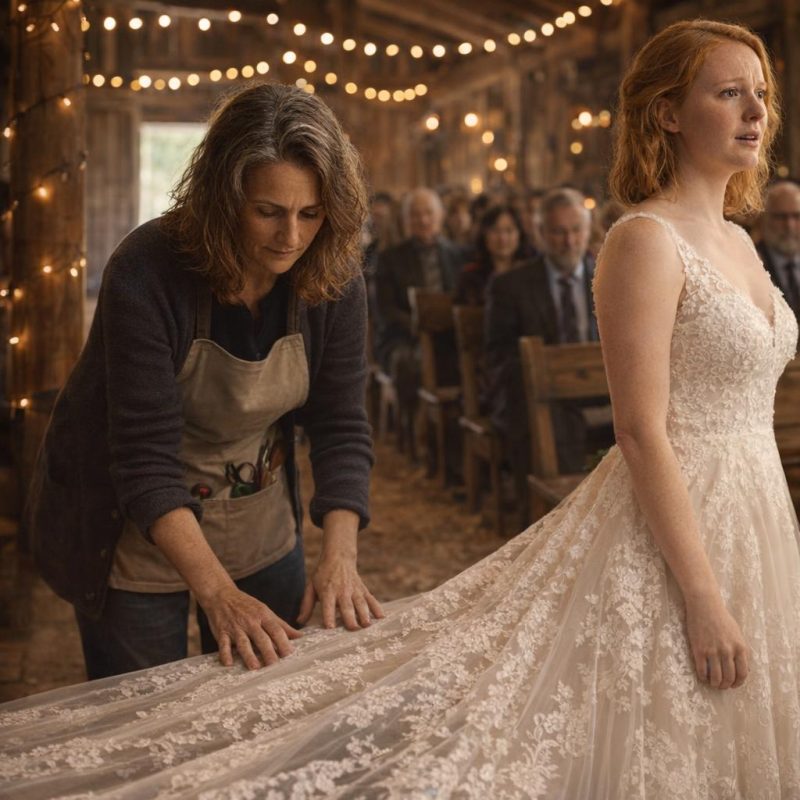 Image by RM AI
Studying the Lace
I turned in my seat as she passed, just slightly, the way you might shift to follow the music. Nobody would have noticed. My eyes went straight to the train where it pooled and moved along the aisle runner behind her. The scalloped edges were the part I kept coming back to. They had a particular shape — not just scalloped the way most lace is scalloped, but with a slight elongation on every third curve, a rhythm that wasn't standard. I had stared at lace patterns for thirty years. I knew what standard looked like. I leaned forward another inch. The floral centers inside each scallop were small and tight, four petals arranged just off-square, and the way the threads doubled back through the curves had a specific tension to it, a particular density that came from the way the needle had been worked. My chest felt strange and tight. I told myself I was too far away to be sure. I told myself the light in here was warm and uneven and I was seeing what I was afraid of seeing. But the elongated third curve caught the light one more time, and the shape of it was exact.
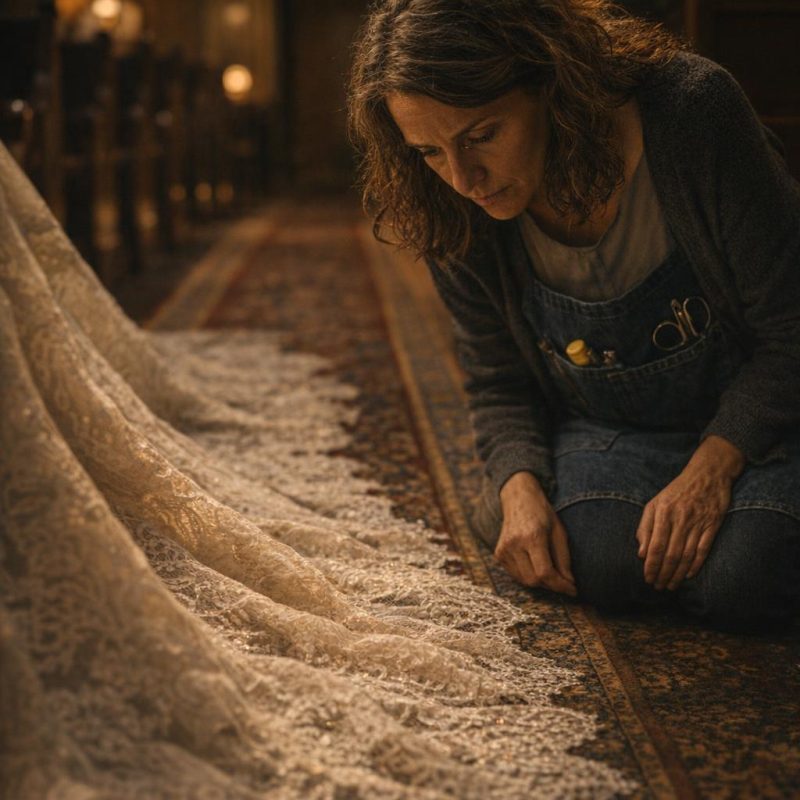 Image by RM AI
Refusing to Believe
I made myself look away. I fixed my eyes on Tom's face at the front of the barn, on the way he was watching Clara walk toward him, and I told myself firmly that I was wrong. Vintage lace was vintage lace. Patterns repeated. Craftswomen in the same tradition working from the same references produced similar results — that was the whole point of a tradition. The elongated curve could be a coincidence. The four-petal centers could be a coincidence. I had been anxious about this dress for weeks and anxiety did things to perception, made you find what you were looking for whether it was there or not. Clara reached the front of the aisle and turned to face Tom, and the train settled behind her in a slow, graceful arc. I exhaled. I told myself: you altered this dress, you handled every inch of it, and you didn't recognize it then, so you're not recognizing it now. You're frightening yourself over nothing. And then the train shifted as Clara took Tom's hands, and the light fell across the lower left corner of the lace border — and I saw the small uneven stitch I had made at seventeen, the one I'd always meant to go back and fix.
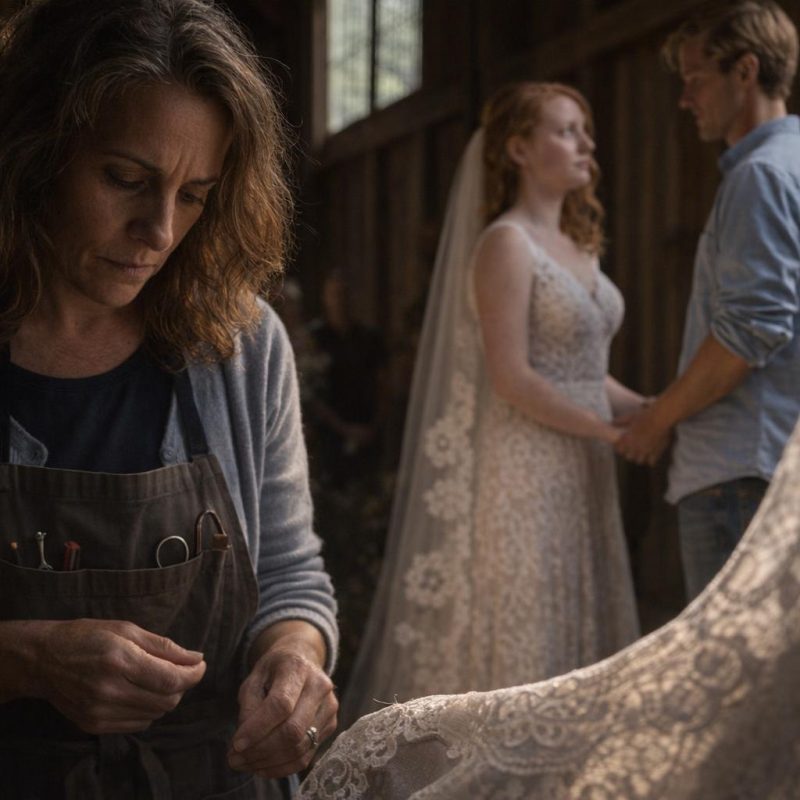 Image by RM AI
The Weight of Recognition
The officiant's voice rose and fell at the front of the barn, warm and unhurried, and the guests around me settled into the ceremony with that particular softness people carry when they're witnessing something they believe in. I sat very still. My hands were in my lap and I couldn't feel them. The uneven stitch was small — most people would never notice it, would never know to look — but I had made it, and I had looked at it for years, and there was no version of the world in which two pieces of lace had that same small imperfection in that same position. The lace on Clara's train was my lace. I didn't know yet how it had gotten there, didn't know what it meant about the preservation box on the shelf in my sewing room, didn't know what it meant about the story Clara had told me about vintage trim. I only knew what my hands had made thirty years ago, and I was looking at it now, thirty feet away, stitched onto my niece's wedding dress. The ceremony continued around me, gentle and bright, and I sat inside it with that knowledge settling over me like something I couldn't put down.
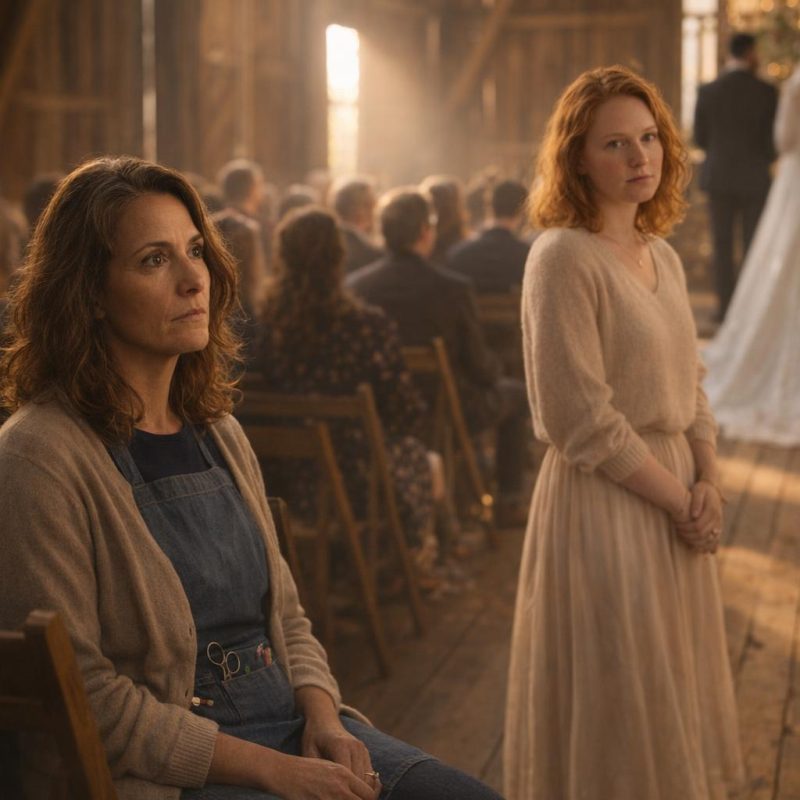 Image by RM AI
The Lace From My Wedding Dress
The lace had come from my wedding dress. I knew it the way you know your own handwriting — not because you can explain every curve, but because your hand made it and your eye remembers. Thirty years ago I had cut and stitched that border myself, working from a pattern I'd adapted, and the elongated third curve and the four tight petals and that small uneven stitch at the lower left were mine. The dress had never been worn. I had folded it in tissue paper and put it in the preservation box and carried it through three houses because I couldn't let it go, and I had never once opened that box in front of anyone. But someone had opened it. Someone had gone into my sewing room, climbed to the highest shelf, lifted the lid, and taken the lace from a dress I had made for a wedding that never happened. There was only one person who had ever known what was in that box. Only one person who had been in that room enough times, who had watched me work, who had known what I kept and why and where. Diane had gone into my sewing room and taken the most painful thing I owned, and Clara was wearing it down the aisle.
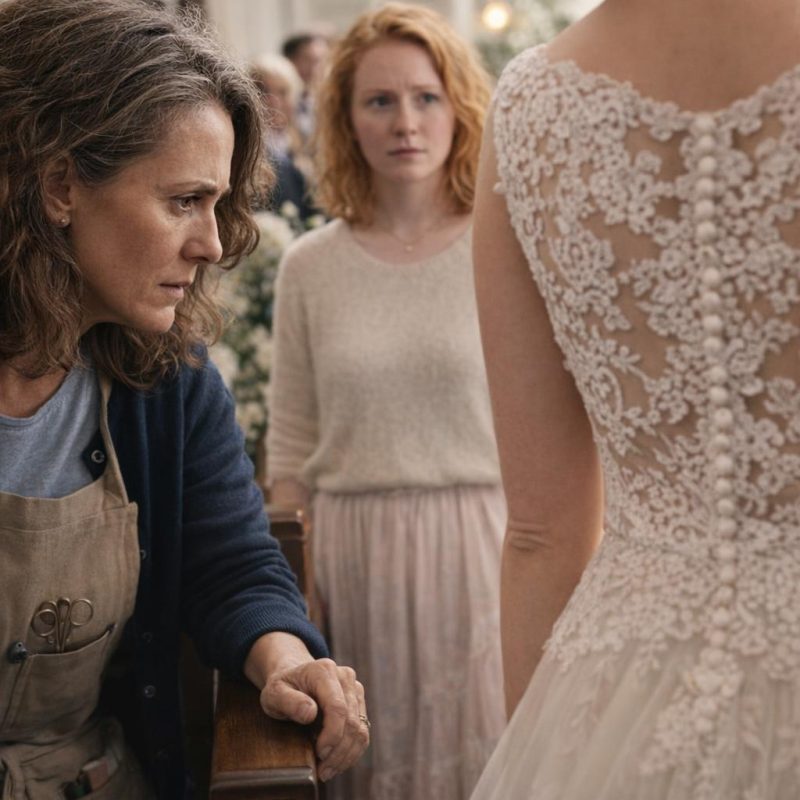 Image by RM AI
Understanding the Theft
The ceremony kept moving forward the way ceremonies do, indifferent to what was happening inside me. Tom said something that made the guests laugh softly. Clara's shoulders dropped a little, the way they do when you're finally somewhere safe. I sat with my hands folded in my lap and thought about my sewing room. The shelf above the cutting table. The box with the pale green lid that I had never once left open, never left accessible, never mentioned to anyone who didn't already know. Diane knew. Diane had always known, the way younger siblings know the things you try to keep private — not because you told them, but because they watched. She had gone in there and opened it and taken scissors to something I had spent months making for a life that fell apart before it started. She had cut my lace into pieces and handed them to a seamstress to sew onto her daughter's dress, and then I had altered that dress with my own hands, running my fingers over my own work without knowing what I was touching. I sat in the middle of a barn full of people celebrating, and the weight of what my sister had done pressed down on me without moving.
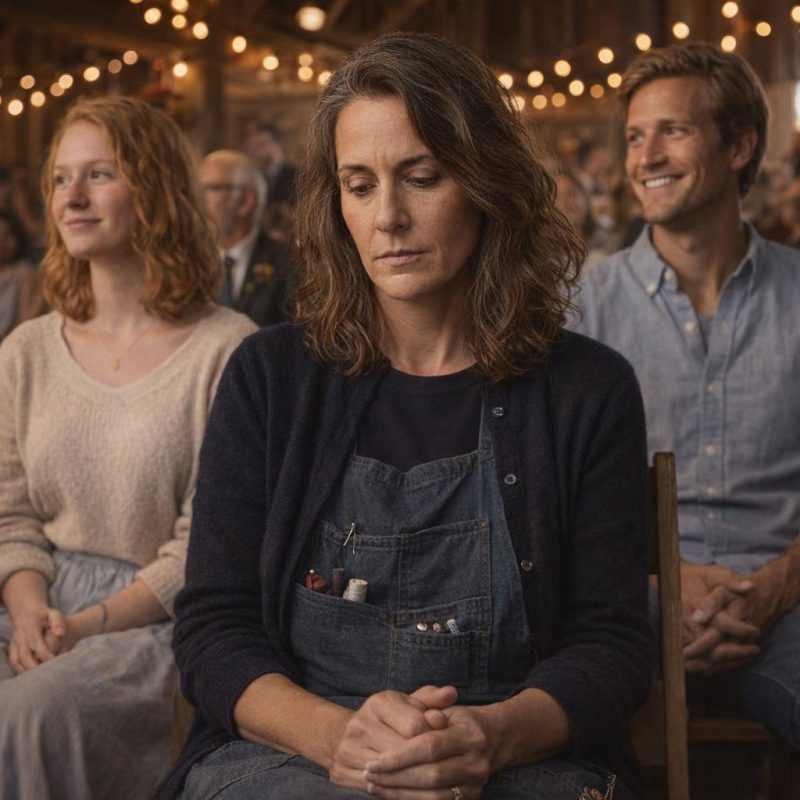 Image by RM AI
Clara's Guilt Makes Sense
And then, like a door opening onto a room I hadn't known was there, I understood Clara. The nervousness when she'd arrived with the garment bag, the way she'd held it slightly away from her body as she carried it in. The too-quick answer when I'd asked about the trim — vintage, she'd said, from a shop, and moved on before I could ask anything else. The way she'd watched my hands when I worked the lace, not with the idle curiosity of a bride watching her dress being altered, but with something tighter, something that kept pulling her eyes back. The afternoon she'd picked up the finished dress and cried, and I'd thought it was happiness, bridal emotion, the ordinary overwhelm of a wedding week. She'd stepped away when I tried to hug her. I'd thought she was just tired. And this morning, before the ceremony, the whispered exchange with Diane near the barn entrance that had stopped the moment I came close. Clara had known. She had known what was in that lace and what it had cost me, and she had carried it here anyway, and every strange moment between us over the past three weeks had been the weight of that. The memory of her tears in my workroom came back to me now, and they looked entirely different than they had before.
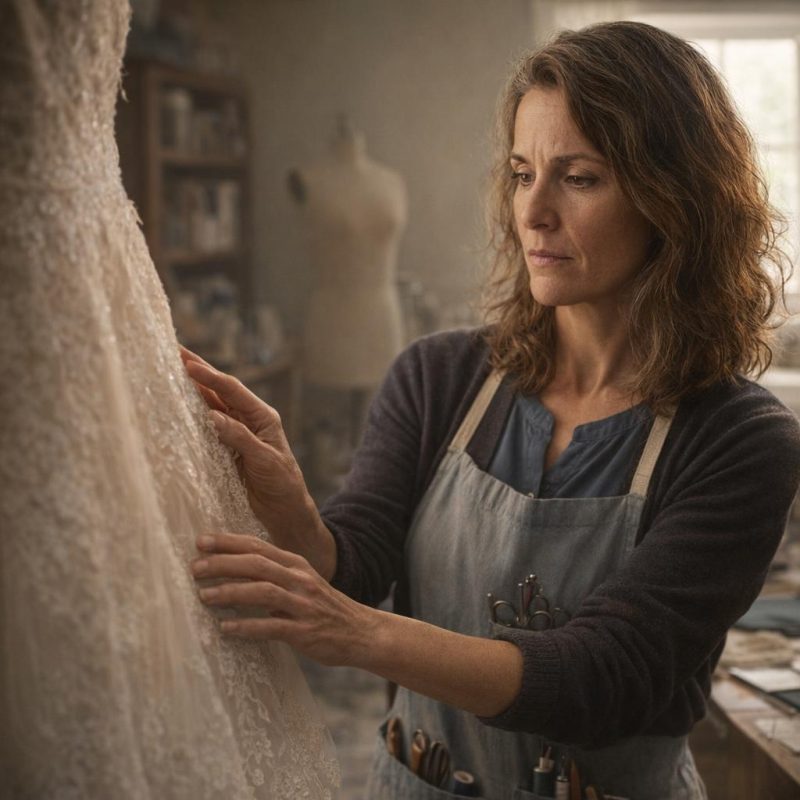 Image by RM AI
Every Strange Moment
Three weeks. I turned it over slowly in my mind while the officiant spoke about love and commitment and the life two people build together. Three weeks since Clara's phone call, the one where she'd asked so carefully, so gently, and there had been a pause after I said yes — a pause I'd read as relief but that now felt like something else entirely. The careful way she'd handled the garment bag, never setting it down carelessly, never letting me see the inside until she was ready. The odd construction I'd noticed when I first opened it, the way the lace had been attached with a technique slightly different from the rest of the dress, as if added by different hands at a different time. Clara watching my face when I touched the border, not my hands — my face. The rehearsed ease of vintage trim, from a little shop. Diane appearing at the fitting, standing just far enough back to seem casual. The whispers. The careful management of every moment I'd spent near that dress. I had moved through all of it with my seamstress's hands and my trusting heart, and every piece of it had been arranged around a secret I was never supposed to find. The whole shape of the last three weeks settled into place around me, and I sat with it, still and quiet, while Clara and Tom promised each other everything.
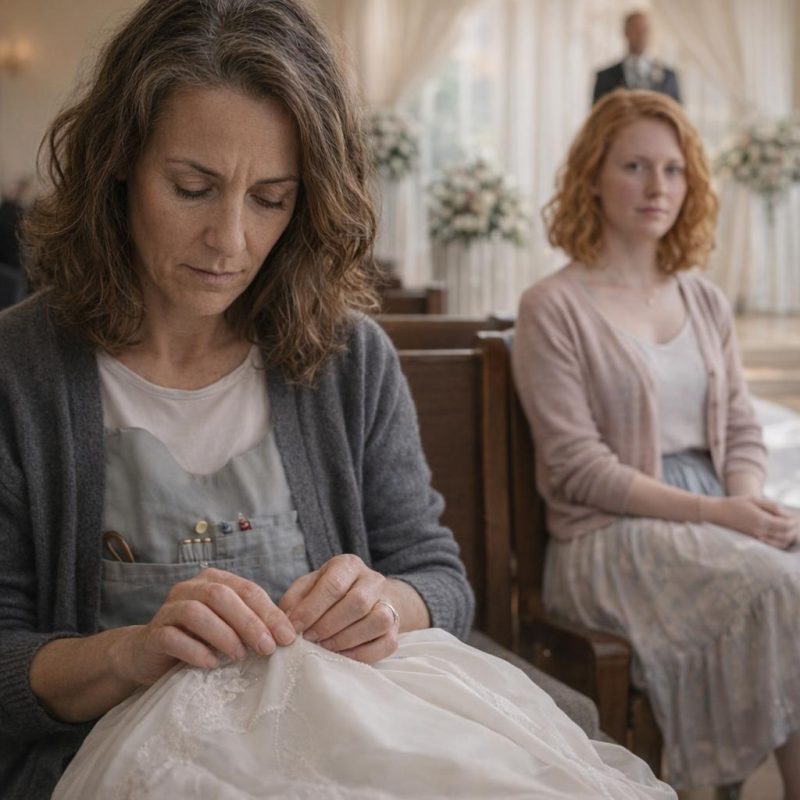 Image by RM AI
Sitting Through the Vows
The officiant's voice carried across the barn in that particular way voices do when a room goes quiet for something sacred, and I heard the words — I do, and I will, and all the days of my life — but they reached me from a distance, like sound traveling through water. Around me, people were leaning forward in their chairs. A woman two rows ahead pressed a tissue to her cheek. Someone's phone camera clicked softly. I sat with my hands folded in my lap and watched Clara at the front of the room, her face turned up toward Tom's, her shoulders finally free of the tension I'd watched her carry for weeks. The dress caught the afternoon light coming through the barn's high windows, and the lace along the train — my lace, the lace I'd spent two nights carefully securing — shimmered in a way that made the people around me smile. I didn't smile. I thought about a different ceremony, one that never happened, a dress that had hung in a garment bag for thirty years waiting for a day that never came. The music swelled softly from somewhere behind me. The world kept moving, the way it always does, whether you're ready for it or not.
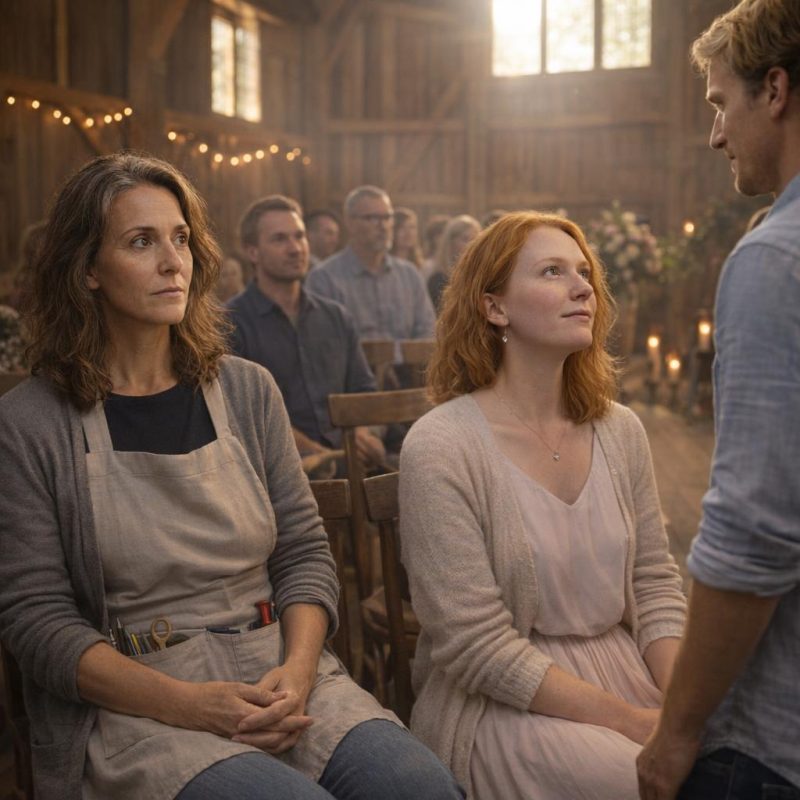 Image by RM AI
The Ceremony Ends
When the officiant said the words — I now pronounce you husband and wife — the barn erupted. People rose to their feet around me and I rose with them, my body doing what bodies do in crowds, following the motion of everyone else. Clara and Tom turned to face us, and Clara was laughing, actually laughing, her eyes bright with tears, and Tom looked like a man who couldn't believe his luck. They walked back down the aisle together, and the train moved behind Clara in a long sweep, the lace catching light with every step. I watched it pass. I watched it the way you watch something that belongs to you being carried away by someone who doesn't know it's yours. The guests around me were already turning, already talking, already moving toward the open doors where the reception waited. Someone touched my arm — a woman I didn't know, smiling, saying wasn't that just beautiful — and I said yes, it was, because what else do you say. I found myself moving with the crowd toward the reception, and across the shifting heads and shoulders I caught a glimpse of Diane, already working the room, already smiling, and I stood still while everyone flowed around me.
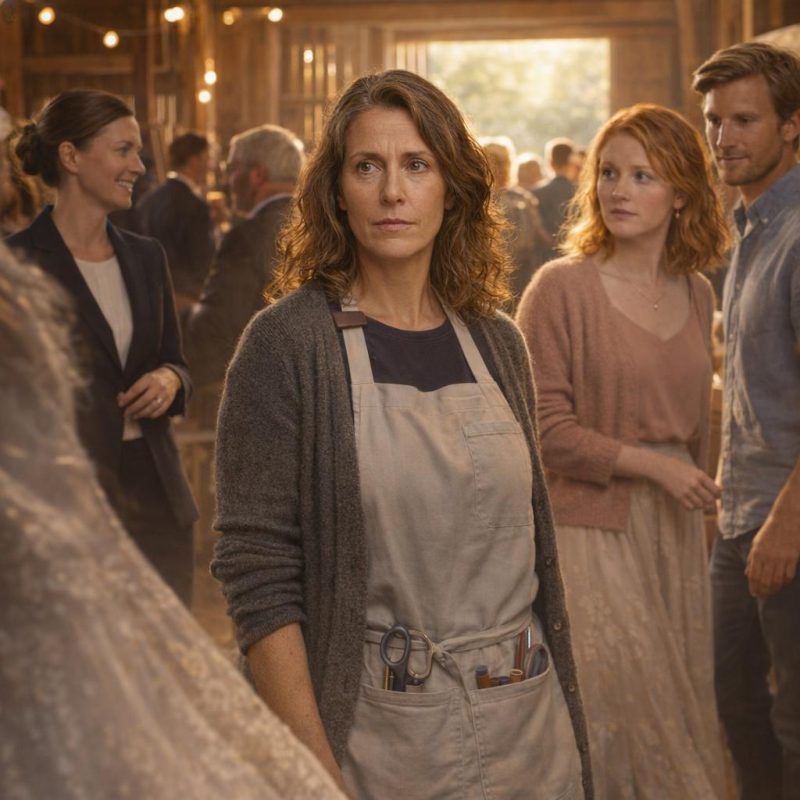 Image by RM AI
At the Reception Threshold
I stood just inside the entrance to the reception space and let the crowd move past me. The barn had been transformed — string lights, long tables draped in white linen, flowers in mason jars, the kind of wedding that looks effortless and costs a fortune. People were finding their seats, hugging each other, reaching for glasses of champagne from trays carried by young servers in black. It was beautiful. I could see that clearly, even through everything I was carrying. I thought about walking straight to Diane and saying it plainly: I know what you took. I thought about what her face would do. I thought about Clara, still in the doorway with Tom, still laughing, still luminous in a way that a bride only is once. If I said anything tonight, that would be the thing Clara remembered. Not the vows. Not Tom's face when he saw her. Me, standing in the middle of her wedding reception, turning the day into something else. I had spent thirty years learning when to hold a seam and when to let it breathe. I knew the difference between a repair that needed doing now and one that would hold until morning. I stood at the threshold and let the noise of the celebration wash over me, and I didn't move.
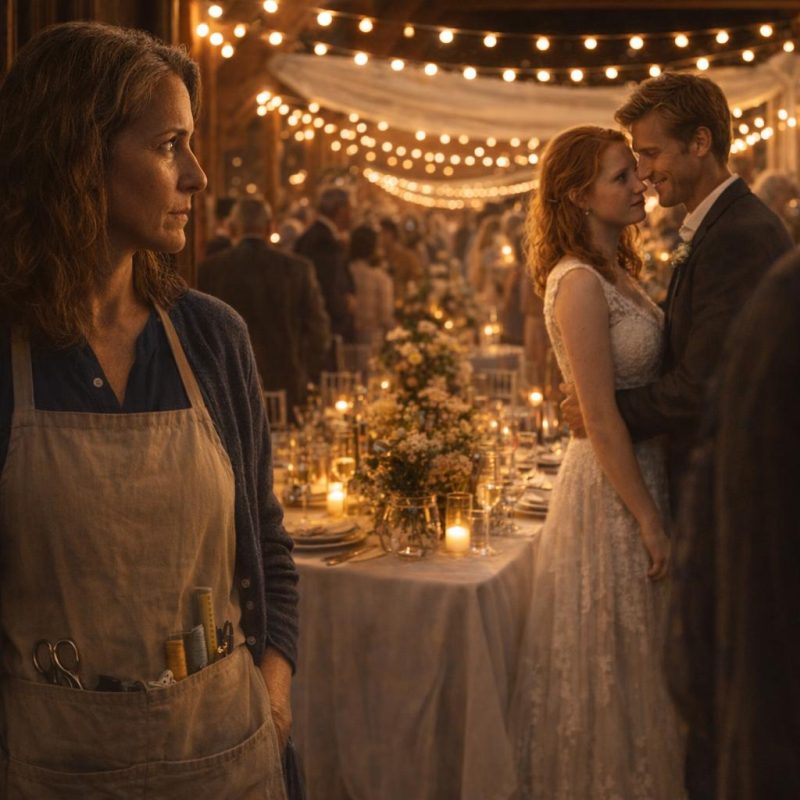 Image by RM AI
Moving Through the Reception
I went in. I didn't know what else to do, so I went in and I found a place near the edge of the room where I could stand without being required to perform happiness at anyone. The band was setting up near the far wall. Tables were filling. Someone had placed small cards with guests' names at each seat, and I watched people hunting for their places with that particular mix of mild anxiety and festivity that wedding receptions always produce. A woman I didn't recognize stopped near me and said to her companion, did you see the lace on that train, it's absolutely stunning, and I looked down at my glass and said nothing. I heard it twice more before the first course was served — the lace, the beautiful vintage lace, isn't it something. Each time, something in my chest pulled tighter. I accepted a glass of champagne I didn't drink. I watched Tom's family cluster near the bar, loud and warm and easy with each other. I watched Diane move through the room like she'd organized it herself, which I supposed in some ways she had. I was looking for a reason to leave and a reason to stay in equal measure, and then I saw Clara across the room, and she saw me at the same moment.
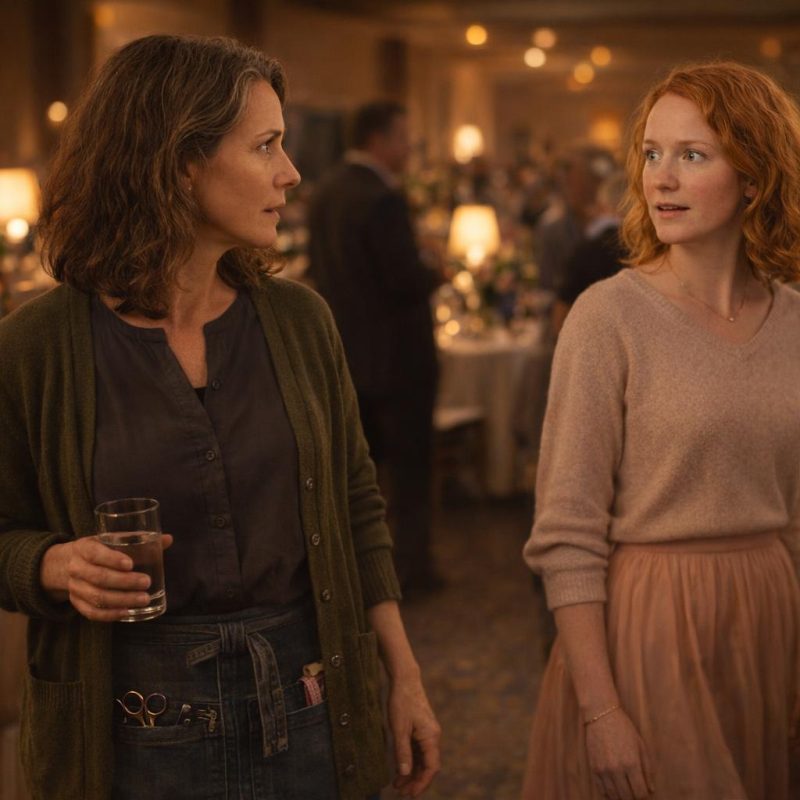 Image by RM AI
Clara Dancing
The first dance started before I could do anything with that look that had passed between us. Someone dimmed the lights, the band shifted into something slow and sweet, and Tom took Clara's hand and led her to the center of the floor. The guests formed a loose ring around them, phones raised, faces soft with the particular tenderness that other people's happiness can produce when you let it. I stayed where I was at the edge of the room. Clara moved into Tom's arms with the ease of someone who had practiced this, and the dress moved with her — the skirt spreading, the train fanning out across the polished floor in a slow arc. I watched it settle. I had pressed every inch of that train with a damp cloth and a warm iron. I had worked the lace flat with my fingertips, feeling for puckers, smoothing the joins where old fabric met new. I had done it carefully, the way I do everything, because I thought I was doing it for Clara. The music turned, and Tom spun her gently, and the train lifted and spread wide across the floor, my lace catching the low light, swirling outward in a circle around them both.
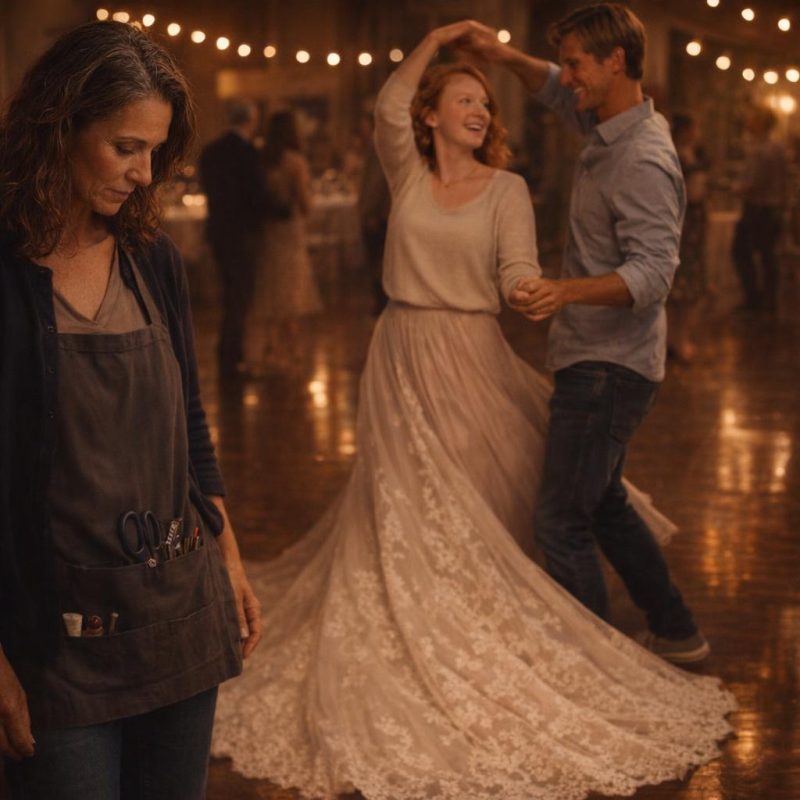 Image by RM AI
Seeing Diane
I pulled my eyes away from the dance floor and that's when I found Diane. She was standing maybe fifteen feet to my left, close enough that I could see her face clearly in the warm light. She was watching Clara and Tom with her arms loosely crossed, her chin lifted, and there was an expression on her face I hadn't seen there in years — something open and unguarded, something that looked almost like pride. Not the performed kind she wore at family gatherings, the kind that was really about her. This was quieter than that. She looked like a woman watching something she'd built come together exactly as she'd imagined. I thought about my sewing room. I thought about the garment bag that had sat on the high shelf for thirty years, the one I'd never opened in front of anyone because some things you keep private. I thought about Diane's hands going through my things, finding it, deciding. She hadn't looked at me once since the ceremony ended. She was watching her daughter dance, and she looked completely, entirely satisfied, and the anger I'd been holding carefully in place all afternoon shifted in my chest like something coming loose from a wall.
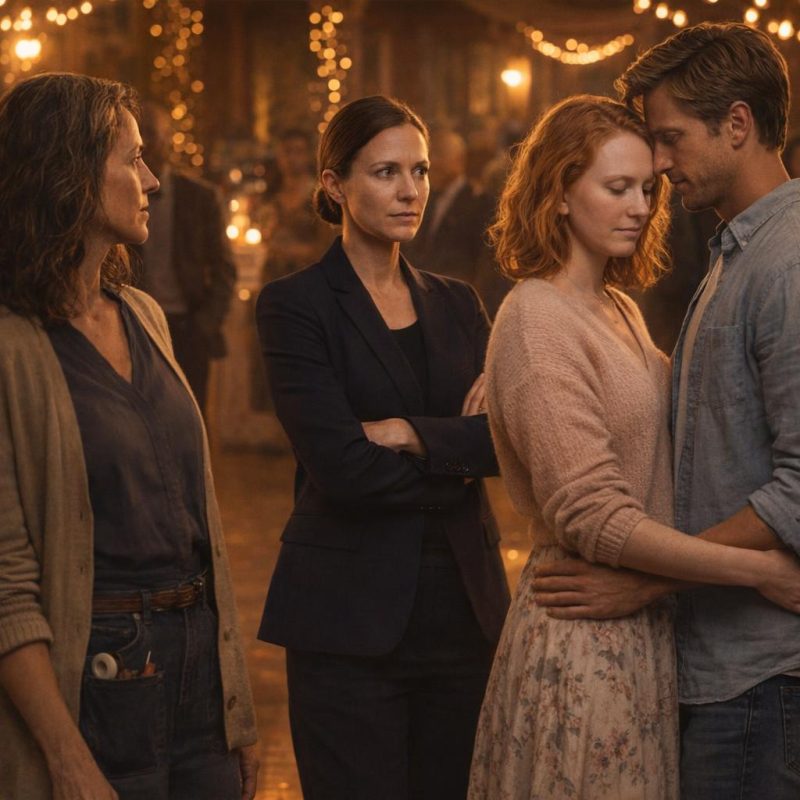 Image by RM AI
The Decision to Confront
I set my champagne glass down on the nearest table. I didn't slam it. I set it down with the same deliberate care I use when I'm putting away good scissors — controlled, precise, final. My hands were shaking, but only a little, and I pressed them flat against my thighs for a moment and breathed. I had spent the entire ceremony telling myself to wait. I had spent the reception telling myself that tonight wasn't the night, that Clara's happiness mattered more than my anger, that there would be a better time and a better place. But I kept coming back to the same thing: there was no version of this where I stayed quiet and felt right about it afterward. Not tonight, not tomorrow, not in a year. I had made the dress beautiful. I had given two nights of careful work to something built on a theft I wasn't supposed to discover, and I had done it with love, and that deserved to be said out loud. I started walking. The crowd shifted around me as I moved, and I kept my eyes on the spot near the edge of the dance floor where Diane and Clara had come to stand together, and with every step I took, something in me settled into a quiet, certain stillness.
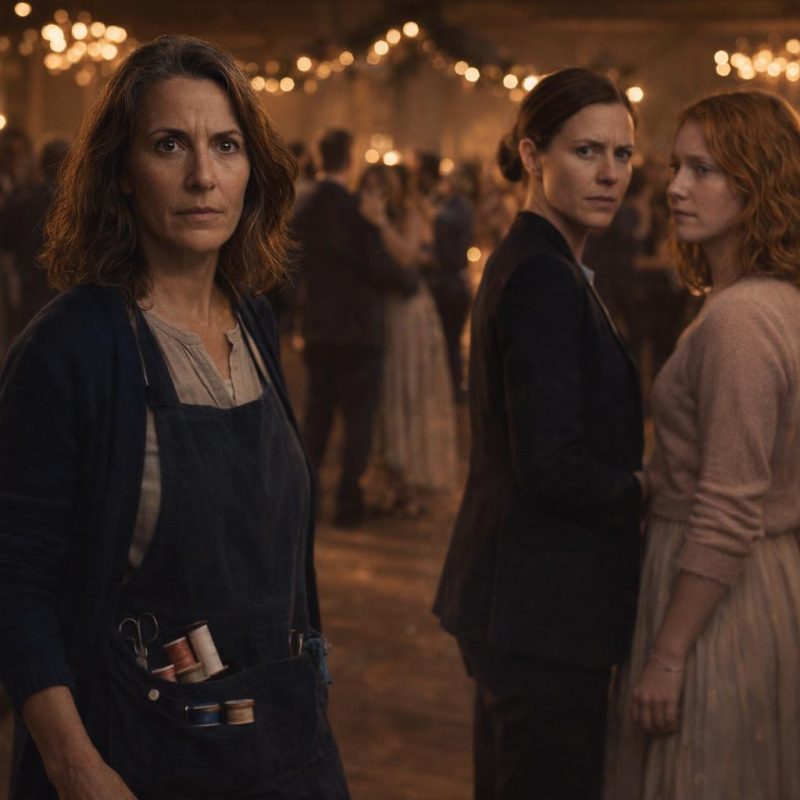 Image by RM AI
Approaching Them
They were standing close together, Diane with one hand resting on Clara's arm, both of them watching the other couples who'd joined the dance floor. I came to a stop in front of them and I didn't say anything for a moment. I just stood there. Clara turned first. The color left her face so quickly it was like watching a light switch off — she saw my expression and she knew, immediately and completely, that I knew. Diane turned a half-second later and her face arranged itself into a smile, the practiced kind, and she started to say something — Bev, there you are, wasn't it just — and I said, quietly, not yet. Just those two words. Not yet. The smile held on Diane's face but her eyes changed. Clara's hand came up and touched the lace at her hip, a small unconscious gesture, and she looked at me with something that was equal parts guilt and grief. The band played on behind us. Someone laughed loudly near the bar. I stood in front of my sister and my niece with everything I needed to say gathered in my chest, and the three of us were perfectly, completely still.
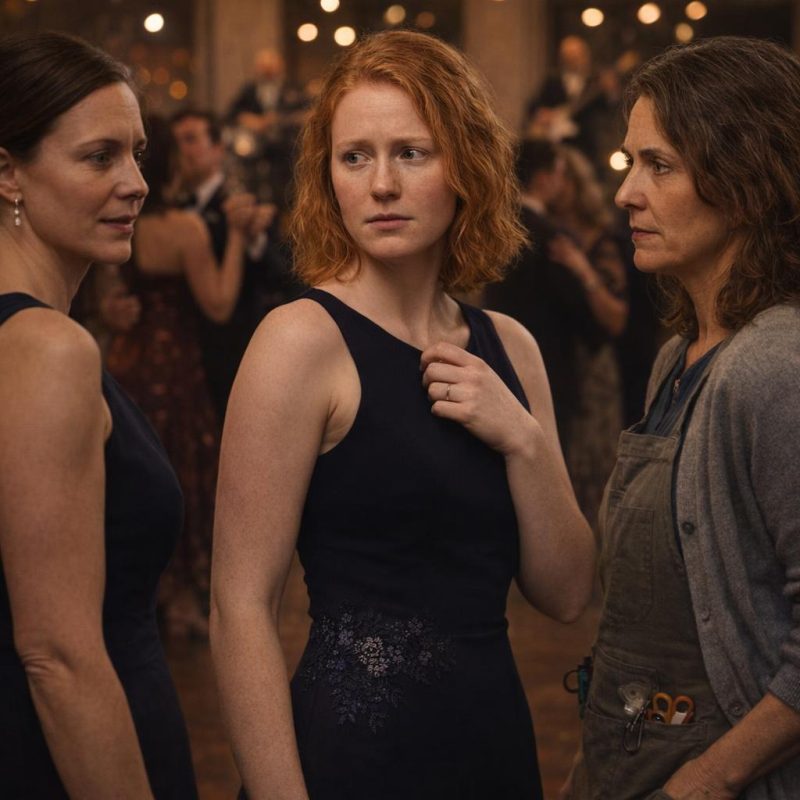 Image by RM AI
The Question
I looked at my sister and I said it plainly, the way you say something when you've been holding it so long that the holding is finally over. I asked her where the lace came from. Not the story she'd told Clara, not the vintage trim she'd supposedly found — the real answer. Where did it come from. Diane's practiced smile didn't move at first, but something behind her eyes did, a small recalibration, and I watched it happen. I told her I recognized it. I told her I knew every stitch of it because I had put every stitch of it there myself, thirty years ago, in a dress I had made and preserved and kept in a box in my sewing room that no one was supposed to touch. I asked her if she had gone into that room. I asked her if she had opened that box. Clara made a sound beside her, something small and broken, and her hand went back to the lace at her hip like she was trying to cover it. Diane's mouth opened. I waited. The band was still playing somewhere behind me, and the three of us stood in the middle of all that noise, and the silence between us was absolute.
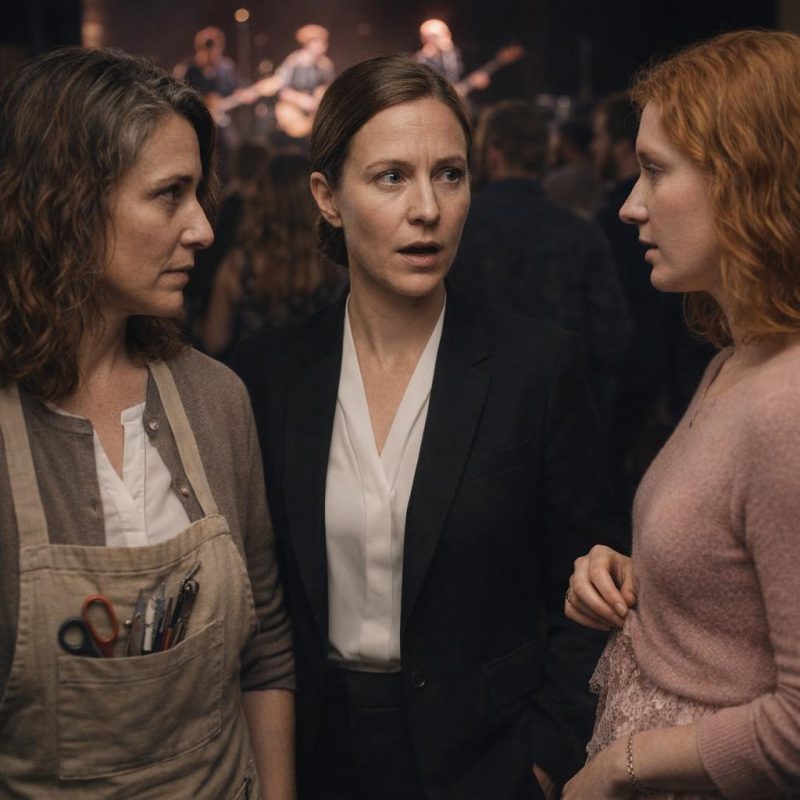 Image by RM AI
Diane's Defense
Diane said it like it was the most reasonable thing in the world. She said the dress had just been sitting there. In a box. For thirty years. She said she didn't think I was using it, that it seemed a shame to let something so beautiful go to waste, that Clara needed something special and the lace was perfect and she thought — she actually said this — she thought I wouldn't mind. I wouldn't mind. I stood there and let the words reach me one at a time. She said it wasn't like she'd taken something I needed. She said I could have just told her if it was important to me. As if I had been consulted. As if she had asked. She called it borrowing, at one point, and when I didn't respond to that she shifted and said she'd done it for Clara, for the wedding, because she wanted her daughter to have something meaningful. Clara was crying quietly beside her, whispering that she was sorry, that she hadn't known what to do. Diane didn't look at her. Diane looked at me with the expression of someone waiting to be told they were forgiven, and I understood then, with a clarity that settled into my bones, that she did not believe she had done anything wrong.
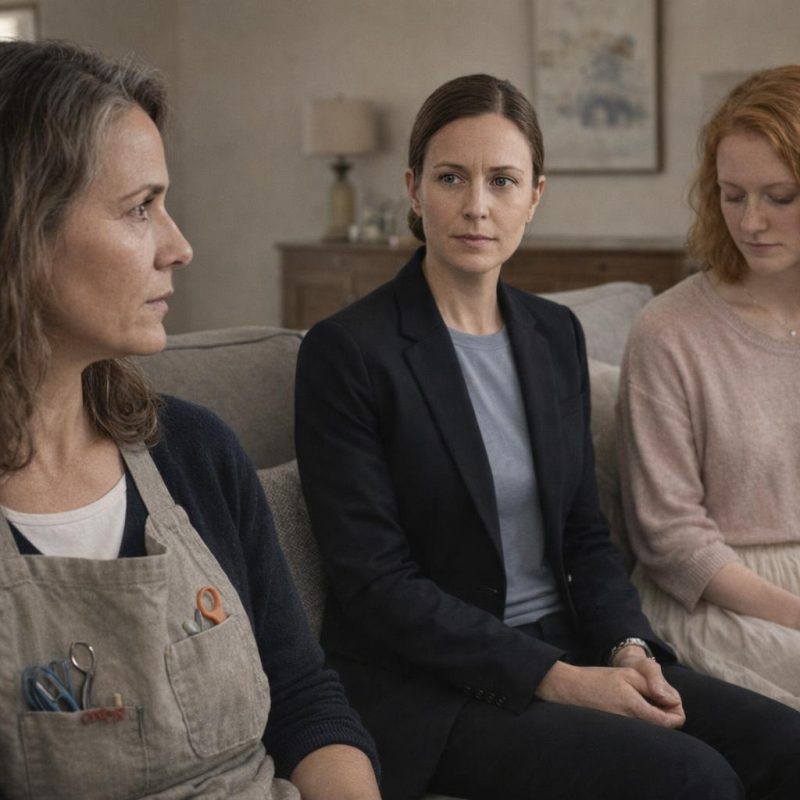 Image by RM AI
The Full Betrayal
I told them what the dress was. I told them clearly, because they needed to hear it said out loud. Thirty years ago I made that dress for myself, for a wedding that never happened, for a man I loved who died four months before we were supposed to stand in front of our families and make promises. I had sewn every panel of it in the months before I lost him, and after, I couldn't look at it, but I couldn't let it go either, so I wrapped it in acid-free tissue and I put it in a preservation box and I kept it. I kept it for thirty years. That lace was the last beautiful thing I made when I still believed my life was going to go a certain way. I turned to Clara then, because Clara had known — she had seen the box, she had recognized what it was, and she had worn it anyway and said nothing to me for weeks. I told her that the silence had hurt me as much as the taking. And then I looked at Diane, and I told her that what she had done wasn't borrowing, wasn't repurposing, wasn't doing something nice for her daughter. I told her she had reached into the place where I kept my grief and she had cut it up and sewn it onto someone else's happiness without ever once asking me if that was something I could bear.
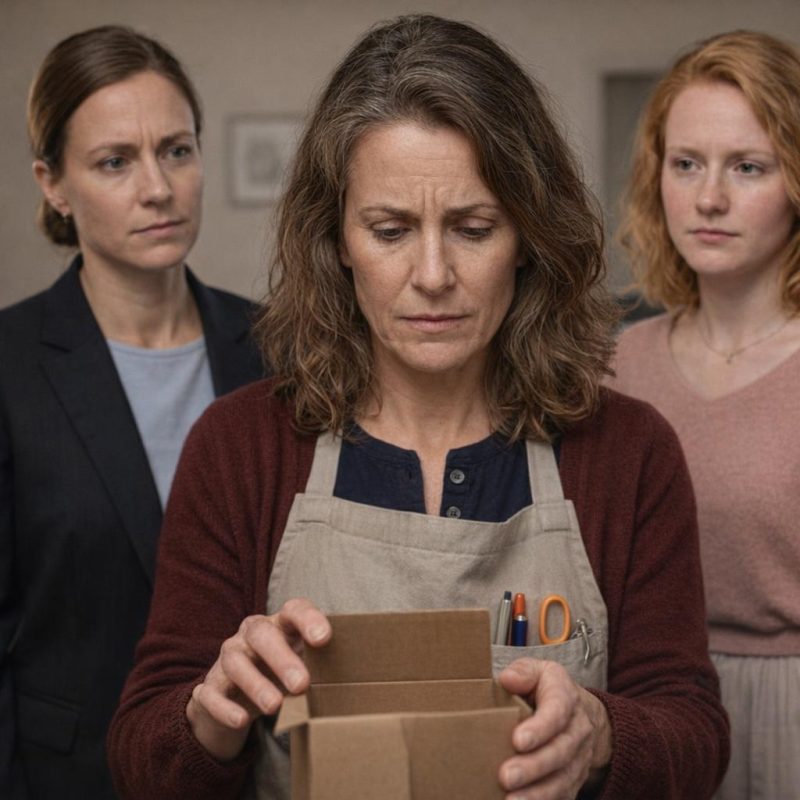 Image by RM AI
What I've Lost and Learned
I left the reception not long after. I didn't make a scene of it — I found my coat, I said goodbye to no one, and I walked out into the night air and stood beside my car for a while before I could drive. In the days that followed I thought about the preservation box, about the tissue paper I had folded so carefully, about the way I had believed that keeping something safe meant it was safe. I thought about Clara, about all the years she had come to me first, and I wondered whether that relationship could hold the weight of what had happened. I didn't know yet. I thought about Diane and I found I had very little left to wonder about her — she had shown me, plainly and without apology, exactly how she understood the boundary between what was hers and what was mine. Some things, once you see them clearly, don't require much more examination. What I understood, sitting with all of it, was that I had spent a long time keeping my most tender things in boxes, trusting that love was enough protection. It wasn't. Going forward, I would have to be the one who decided what I shared, and with whom, and I would have to mean it — because no one else was going to guard what mattered to me with the care it deserved.
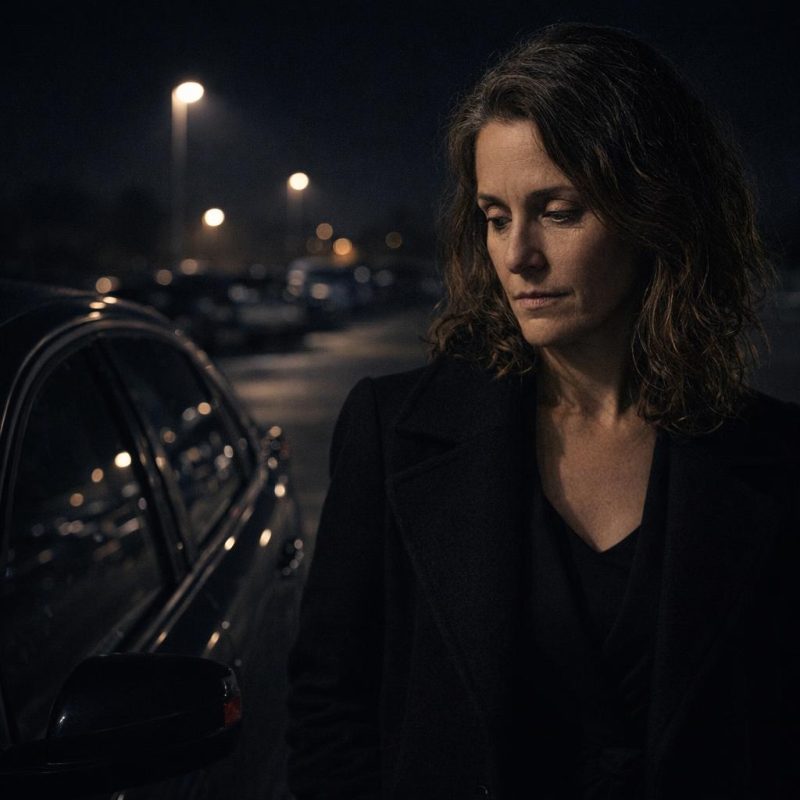 Image by RM AI
KEEP ON READING
20 Weirdest Historical Objects in Museums
Check Out the Pickled Heart of a Saint. Museums carry…
By Rob Shapiro Oct 1, 2025
20 Scariest Missing Persons Cases in History
Eerie Disappearances. There's something uniquely unsettling about a person who…
By Christy Chan May 1, 2026
20 Greatest Ancient Athletes In History
Ancient Olympics. Long before modern stadiums and multimillion-dollar endorsements, athletes…
By Sara Springsteen May 1, 2026
10 Phenomenal Mythical Creatures & 10 That Are Just Plain…
Legends Both Majestic And Peculiar. Do you ever wonder why…
By Chase Wexler Oct 1, 2025
10 Presidents Who Never Served In The Military & 10…
Commanders And Civilians In Office. Power can rise from very…
By David Davidovic Sep 1, 2025
20 Wars That Could Have Ended Much Sooner Than They…
Wars That Lasted Far Too Long. Wars are often remembered…
By David Davidovic Sep 1, 2025