


I Thought My Husband Was Cheating—Then I Found His Secret Apartment and Discovered the Devastating Truth
I Thought My Husband Was Cheating—Then I Found His Secret Apartment and Discovered the Devastating Truth
The Perfect Marriage Myth
I need you to understand something before I tell you this story—my marriage to David was solid. I know everyone says that, right? But we'd been together for eight years, married for six, and we were the couple people actually liked being around. We didn't fight over stupid things. We laughed at the same terrible jokes. Saturday mornings meant coffee in bed and crossword puzzles neither of us could finish. Sure, we'd been struggling with fertility treatments for the past two years, and yeah, that put stress on us like nothing else could. The appointments, the medications, the disappointments—they wore us down month after month. But we talked about it. We held each other through the failures. Dr. Chen kept telling us stress was normal, that couples either grew closer or fell apart during this process, and we were determined to be the ones who grew closer. I genuinely believed we were handling it well. I thought I knew my husband inside and out, thought I could read every expression on his face, every shift in his mood. But six months ago, everything I thought I knew began to unravel.
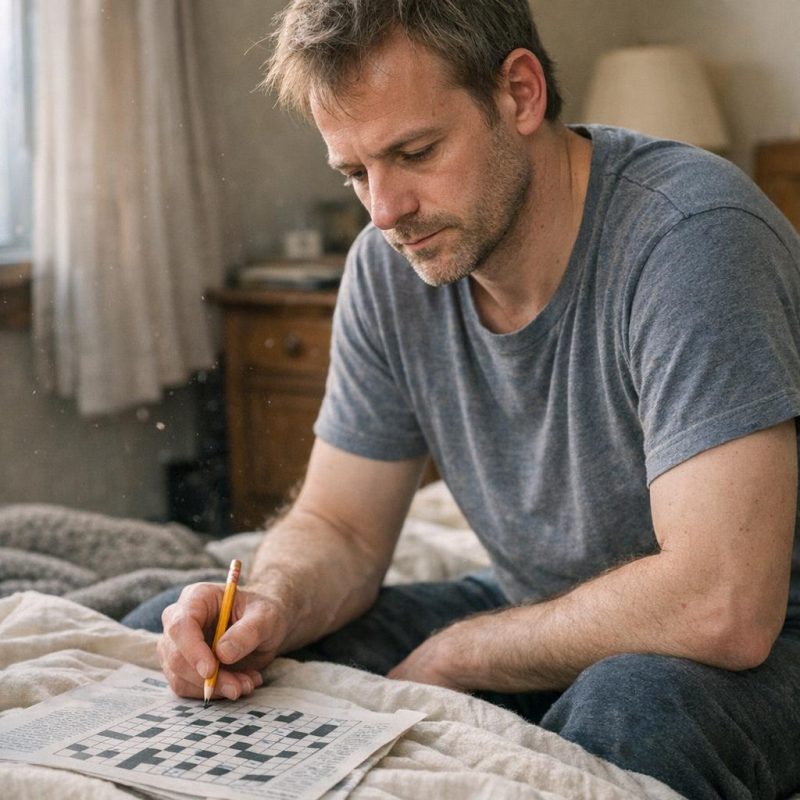 Image by RM AI
The First Late Night
It started in late October with something so small I almost didn't notice it. David came home at 7:30 instead of 6:30 on a Thursday. I remember because I'd made pasta primavera, and it was getting cold on the stove. When he walked in, he looked tired—more than usual—and he kissed my forehead while mumbling something about a project deadline. 'Richardson needs the presentation by Monday, and the team's scrambling,' he said, loosening his tie. 'Sorry, babe. I should've texted.' I told him it was fine, that I understood, and I heated up his plate while he changed out of his work clothes. We ate dinner watching some cooking competition show, and he seemed normal. Maybe a little quiet, but nothing alarming. He worked in software development at a consulting firm, and deadline crunches happened. I'd seen them before. This didn't feel different. He held my hand while we watched TV, and when we went to bed, he pulled me close like he always did. I believed him then—I had no reason not to.
 Image by RM AI
Cycles of Hope and Disappointment
Two weeks later, we sat in Dr. Chen's office for our follow-up appointment, and I could feel my hope crumbling before she even opened her mouth. The waiting room always smelled like lavender and false optimism, and I'd memorized every stupid motivational poster on those walls. Dr. Chen was kind—she always was—but her expression told me everything. 'I'm sorry,' she said, glancing at the test results on her computer screen. 'Your hormone levels indicate the cycle wasn't successful.' I felt David's hand tighten around mine, but I couldn't look at him. I just stared at the diagram of a uterus on the wall and tried not to cry in front of this woman who'd seen me cry a dozen times already. She talked about adjusting medications, maybe trying a different protocol, but her words felt hollow. We'd heard it all before. The drive home was quiet except for the radio playing some cheerful pop song that made me want to scream. David squeezed my hand in the parking lot, but his eyes looked somewhere far away.
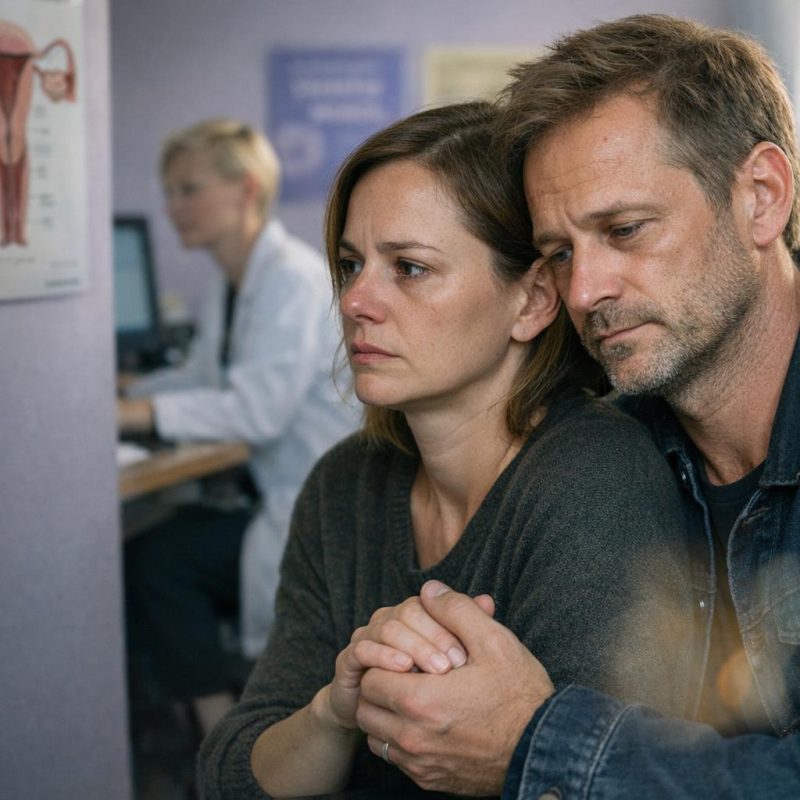 Image by RM AI
Three Nights a Week
After that appointment, David's late nights became a pattern I couldn't ignore anymore. It wasn't just Thursdays now—it was Mondays, Wednesdays, sometimes Fridays too. Three or four nights a week, he'd text me around 5:30 saying he'd be home late. 'Stuck in a meeting.' 'Richardson wants revisions.' 'Team dinner I can't skip.' The excuses were always work-related, always vague enough to sound plausible but specific enough that I felt guilty questioning them. I'd set the table for two and then put his plate in the fridge. I'd watch TV alone, scrolling through my phone, trying not to calculate how many hours he'd been gone. When he finally came home—sometimes 8:00, sometimes 9:30—he'd apologize, kiss my cheek, and head straight for the shower. I told myself this was just a busy season at work, that it would pass. But a voice in my head kept count: three nights this week, four nights last week. I started noticing the pattern, but I pushed my doubts down—I didn't want to be that wife.
 Image by RM AI
The Phone Screen
The phone thing started around the same time, and it made my stomach twist in ways I didn't want to acknowledge. David had never been protective of his phone before. It usually sat on the coffee table or kitchen counter, forgotten and unlocked. But suddenly, he was different. I'd walk into the living room, and he'd tilt the screen away from me or flip it face-down on the couch. Sometimes I'd catch him typing rapidly, his face illuminated by that blue glow, and the moment he sensed me behind him, he'd lock it. One night, I sat down next to him and casually asked, 'What are you reading?' He barely looked at me. 'Work emails,' he said, his thumb already pressing the lock button. The screen went black. I wanted to ask more, wanted to say something like 'Since when do you hide work emails from me?' but the words stuck in my throat. Maybe I was being paranoid. Maybe fertility stress was making me imagine things. When I asked what he was reading, he just said 'work emails' and locked the screen.
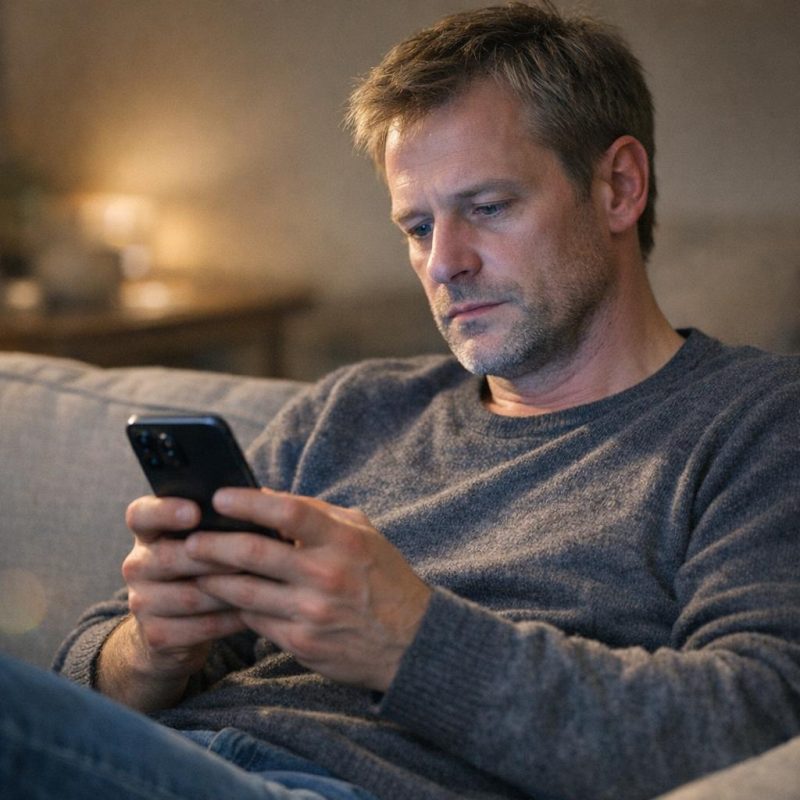 Image by RM AI
Cash Withdrawals
I wasn't snooping—at least that's what I told myself when I logged into our bank account to check our balance before paying the electricity bill. We'd always been transparent about finances, everything in joint accounts, everything visible to both of us. That's why the cash withdrawals jumped out at me like flashing red lights. Three hundred dollars from an ATM near his office. Four hundred dollars two weeks later. Another three-fifty the week after that. David and I used credit cards for everything—we liked the points, the tracking, the simplicity. Cash withdrawals were rare, maybe for a farmers market or a cash-only restaurant. But these amounts? Multiple times? I scrolled back through six weeks of statements, my heart pounding harder with each entry I found. Some weeks had two withdrawals. I grabbed a notebook and started writing down dates and amounts, my hand shaking slightly as the numbers added up. When I checked our bank account that night, I counted over $2,000 withdrawn in six weeks.
 Image by RM AI
The Smell of Vanilla
The perfume was what broke me. David came home just after 9:00 on a Wednesday, and when he kissed my cheek, I smelled it—vanilla and lavender, sweet and floral and absolutely not mine. I wear citrus scents, bright and clean, nothing like what was clinging to his shirt collar. He didn't seem to notice me freeze, didn't see my expression as he walked past me toward the bedroom. 'Long day,' he said, already pulling his tie loose. I followed him, my mind racing, trying to find innocent explanations. Maybe someone at work wore that perfume. Maybe he'd hugged a colleague. Maybe I was losing my mind. But the smell was strong, intimate, the kind that lingers when someone's been close to you. After he went to shower, I stood alone in our bedroom, holding his discarded shirt to my face like some pathetic detective. The scent was unmistakable. I stood in the bathroom that night, smelling my own perfumes, trying to convince myself I was imagining things.
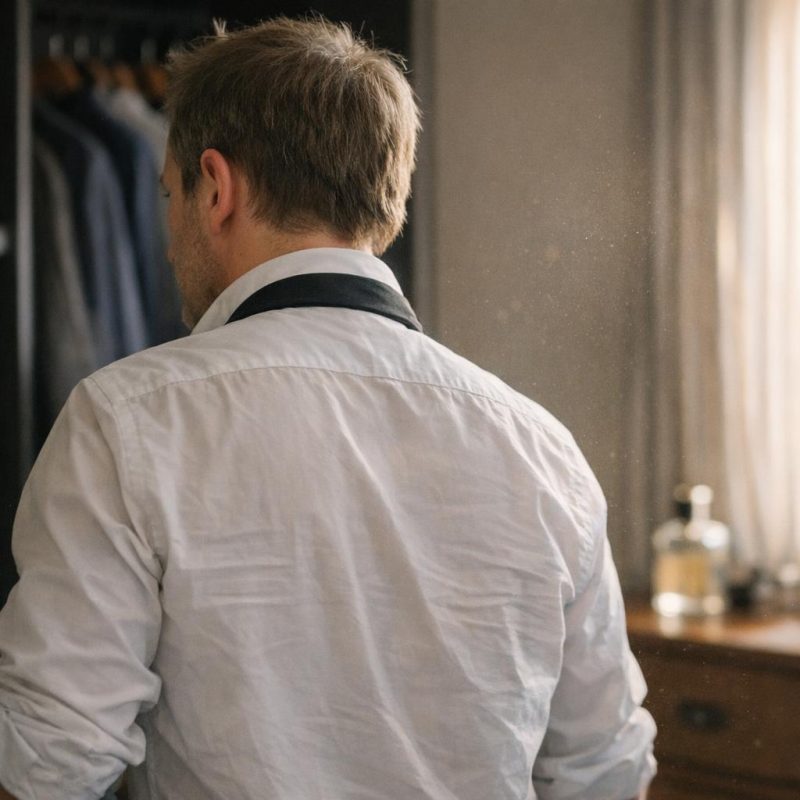 Image by RM AI
Confiding in Rachel
I couldn't hold it together anymore. I called Rachel the next morning, my best friend since college, and when she answered, I just started crying. We met at the coffee shop near her apartment, and I told her everything—the late nights, the phone, the cash, the perfume. I laid it all out like evidence in a trial I didn't want to prosecute. She listened without interrupting, her expression growing more serious with every detail. 'Vanessa,' she said carefully, stirring her latte, 'I hate to say this, but it really sounds like—' 'I know what it sounds like,' I cut her off, because hearing the word 'affair' out loud would make it too real. She reached across the table and squeezed my hand. 'You need to know for sure. You can't just live with suspicion eating you alive.' I told her I didn't know how to find proof without becoming someone I hated, someone who rifled through pockets and checked phone records. Rachel looked at me with sad, knowing eyes and said, 'Vanessa, you need to check his car.'
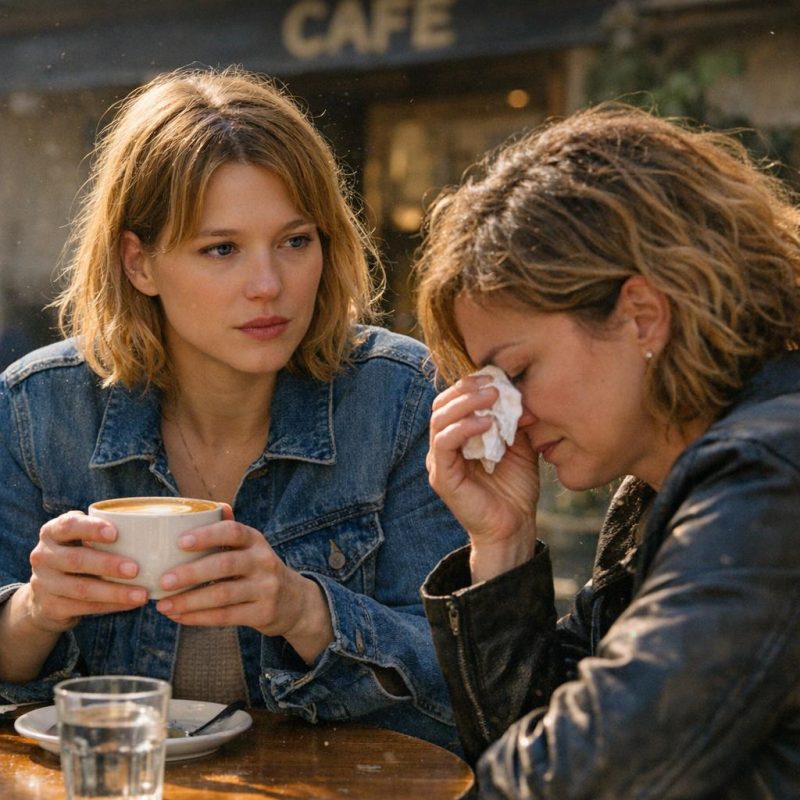 Image by RM AI
The Glove Compartment
Rachel's advice echoed in my head for three days before I finally worked up the nerve. David was in the shower Thursday evening, and I could hear the water running upstairs—which meant I had maybe ten minutes. My heart was hammering so hard I thought I might pass out as I slipped on my shoes and went outside to his car. The dome light illuminated the interior like a spotlight on my betrayal of trust, but I didn't care anymore. I needed to know. I opened the glove compartment with shaking hands, pushing aside the registration and insurance papers, old receipts from gas stations, a pair of sunglasses. Then I saw it—a newer receipt, folded once, with something taped to the back. I unfolded it slowly. It was a rental receipt. Cash payment for a studio apartment, dated from two months ago. And taped to the cardboard backing with clear packing tape was a small silver key. My vision blurred as I read the address again, trying to make sense of it. My hands trembled as I read the address—it was in the worst part of the city, a place David would never go for work.
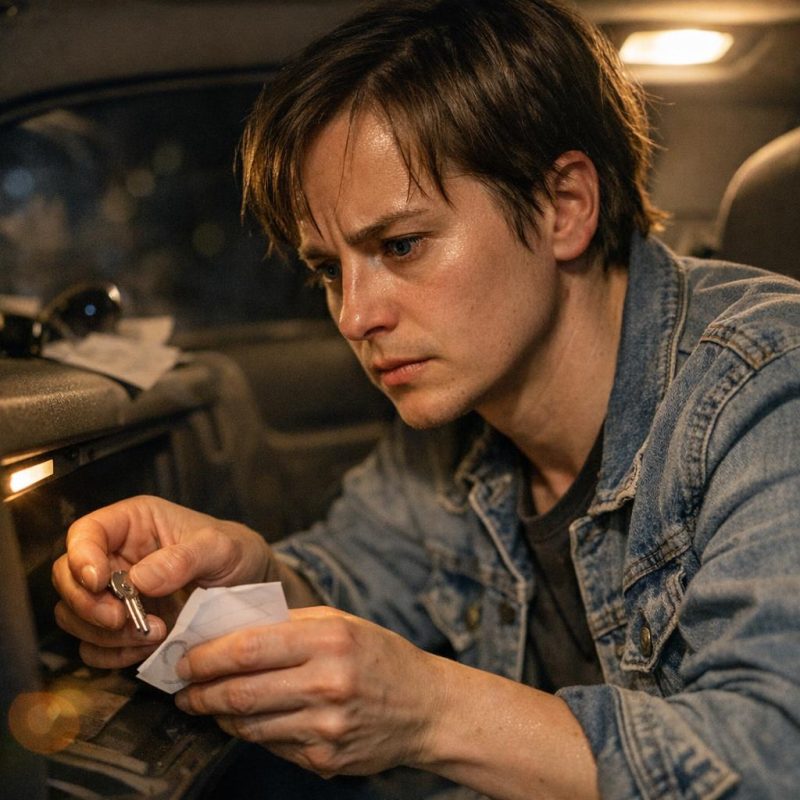 Image by RM AI
The Weight of Proof
I sat in his car for I don't know how long, just staring at that receipt and key like they might rearrange themselves into something less devastating. The address was burned into my brain now: 447 Riverside, Apartment 3B. I'd driven past that area before—crumbling buildings, broken streetlights, the kind of neighborhood where you lock your doors at red lights. Why would David, my careful, professional husband, rent a place there? Unless he needed somewhere cheap and anonymous. Somewhere to meet someone. The key felt heavy in my palm, like it weighed a thousand pounds instead of a few ounces. This was it. This was the proof I'd been both desperate for and terrified to find. Part of me wanted to storm inside right then and throw it in his face, scream until my voice gave out. But another part—the part that was still clinging to some slim hope that I'd misunderstood everything—knew I needed more. I needed to see it with my own eyes. I didn't confront him that morning—I needed to see it with my own eyes.
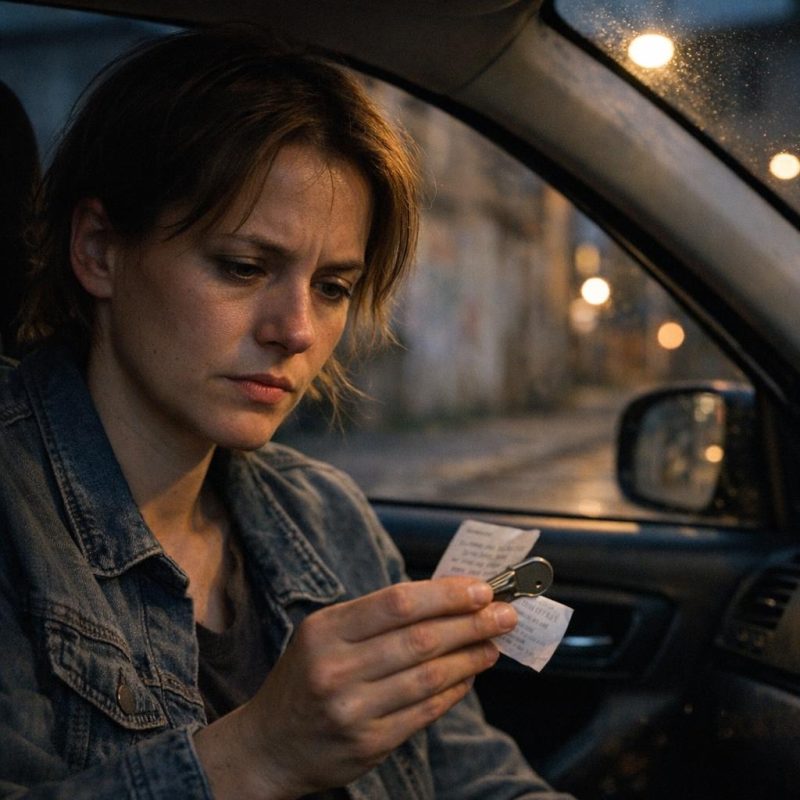 Image by RM AI
Pretending Everything Is Normal
The weekend was the longest of my life. I acted like everything was fine, like I hadn't just discovered my husband's secret apartment. Saturday morning, David made pancakes and I sat at the counter watching him flip them, wondering if her mouth had tasted his. When he smiled at me and asked if I wanted blueberries, I said yes and felt like I was watching myself from outside my body. We went to the farmers market like we did most Sundays. I picked out tomatoes I didn't care about while he chatted with the vegetable vendor. He held my hand. He kissed my temple in the produce aisle. And I let him, even though every touch felt like a lie pressed against my skin. That night we watched a movie on the couch, and he fell asleep with his head on my shoulder, and I just sat there in the dark with tears running silently down my face. I didn't move. I barely breathed. Every smile he gave me felt like a knife, and I smiled back through tears I only let fall in the shower.
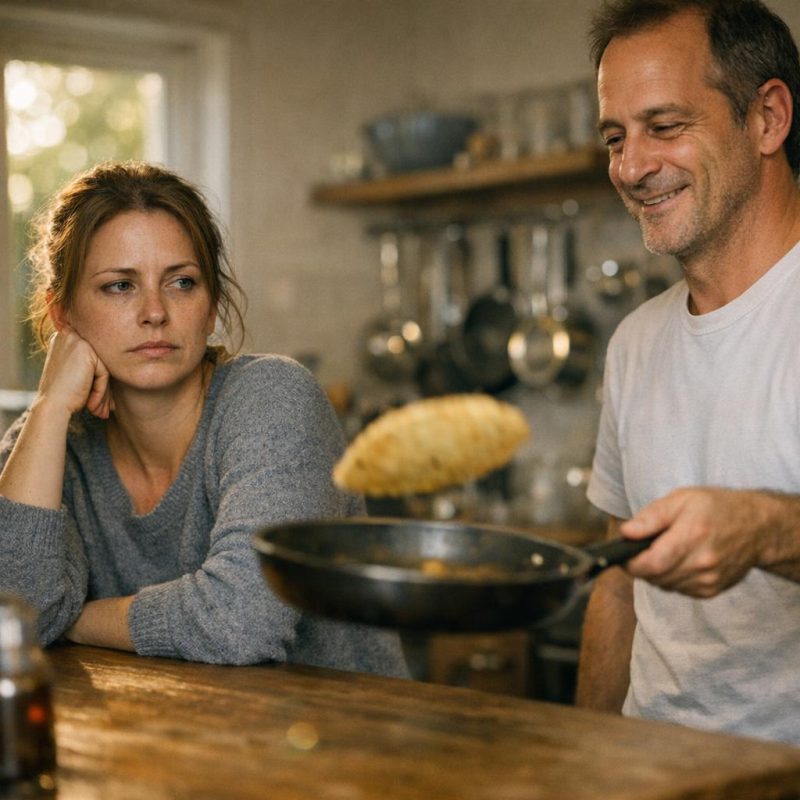 Image by RM AI
The Setup
Monday dragged by in a haze. Tuesday morning I woke up with a knot of anxiety so tight in my stomach I could barely eat breakfast. David seemed normal, tired maybe, but normal. He kissed me goodbye before work like always, and I watched him drive away wondering if today would be the day. Then at four-thirty, my phone buzzed. A text from David: 'Late meeting tonight, probably home around 9. Love you.' I stared at that 'love you' until the screen went dark. This was it. This was the night I'd been dreading and planning for. I texted back a casual 'ok, be safe' with a heart emoji that made me want to throw my phone across the room. At six-fifteen, I heard his car in the driveway. He came in, changed out of his work clothes into jeans and a sweater—not the suit he'd wear to a real meeting. He grabbed his keys, kissed my cheek, and I tasted ashes. I watched his car pull out of the driveway, waited thirty seconds, and followed him into the night.
 Image by RM AI
The Drive
I stayed three cars back like they do in movies, my hands gripping the steering wheel so tight my knuckles went white. David drove south through downtown, then east toward the river, further and further from anywhere he'd normally go. Traffic thinned out as the neighborhoods got rougher. Streetlights flickered or didn't work at all. I saw boarded-up storefronts, chain-link fences, groups of people huddled on corners. My GPS said forty minutes had passed since we left our house. The whole drive, my mind was racing—spiraling through images I couldn't stop. Her opening the door in a silk robe. Him kissing her the way he used to kiss me. The two of them laughing about what an idiot his wife was for not noticing sooner. I felt sick. Actually physically sick, like I might have to pull over. Then his brake lights flared red and he turned into a parking spot on a street that looked abandoned. When he finally parked in front of the crumbling brick building, I felt like I might vomit.
 Image by RM AI
Two Bags of Groceries
I parked half a block down, killed my headlights, and watched. The building was worse in person than I'd imagined—dark brick stained with decades of grime, windows covered with sheets or newspapers, graffiti crawling up one side. David got out of his car and that's when I saw them: two grocery bags in his hands, the plastic handles stretched white with weight. For a moment, I was confused. Groceries? He was bringing groceries to his secret apartment? Maybe she lived there full-time, I thought. Maybe this wasn't just an affair—maybe he was setting up a whole other life with her. The groceries made it worse somehow, more domestic, more real. This wasn't just sex in some anonymous hotel room; this was him shopping for her, caring for her, playing house in this horrible building while I sat at home like an idiot waiting for him. He disappeared through the entrance, the door closing behind him with a distant thud I could hear even from my car. Maybe she lives there, I thought—maybe he's playing house with her.
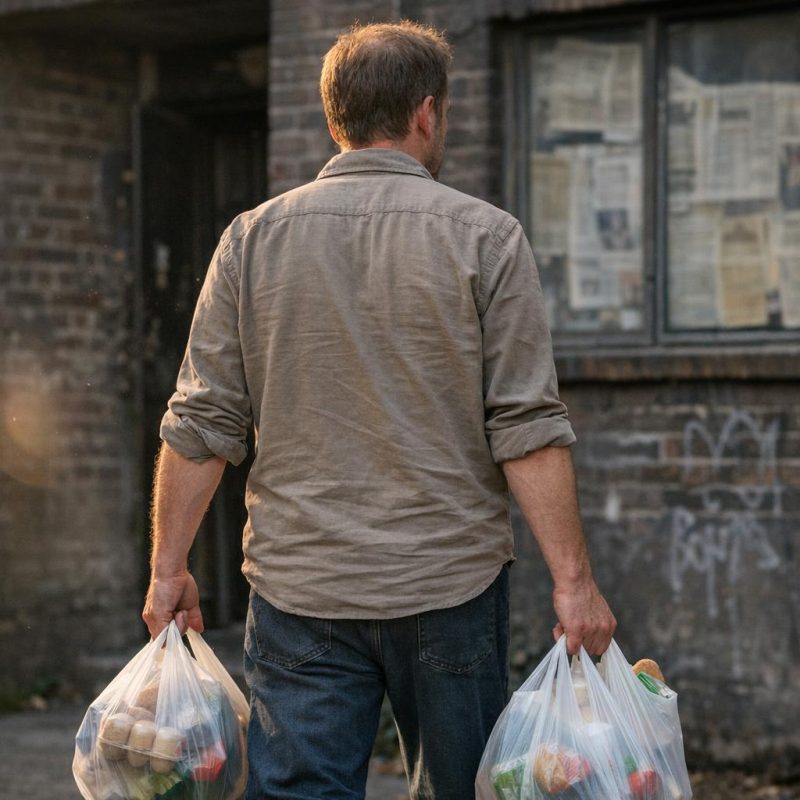 Image by RM AI
Ten Minutes of Hell
I sat there in the dark for exactly ten minutes—I watched the clock on my dashboard, every minute an eternity. My mind wouldn't stop spinning out worst-case scenarios. Her answering the door. Him setting the groceries down on her counter. Them cooking dinner together, something intimate and easy like they'd done it a hundred times before. Him touching her waist as he moved past her in that tiny kitchen. I imagined her younger than me, prettier, wearing that vanilla perfume that had haunted me for weeks, the scent clinging to his clothes afterward. I imagined them laughing about something—about me, maybe, about how clueless I'd been. The tears started and I couldn't stop them. They poured down my face in the dark car, and I let them come because in a few minutes I'd have to be strong. I'd have to face this. Face them. The clock read 7:03. Time to end this nightmare. I imagined her wearing that vanilla perfume, laughing with my husband, and something inside me snapped.
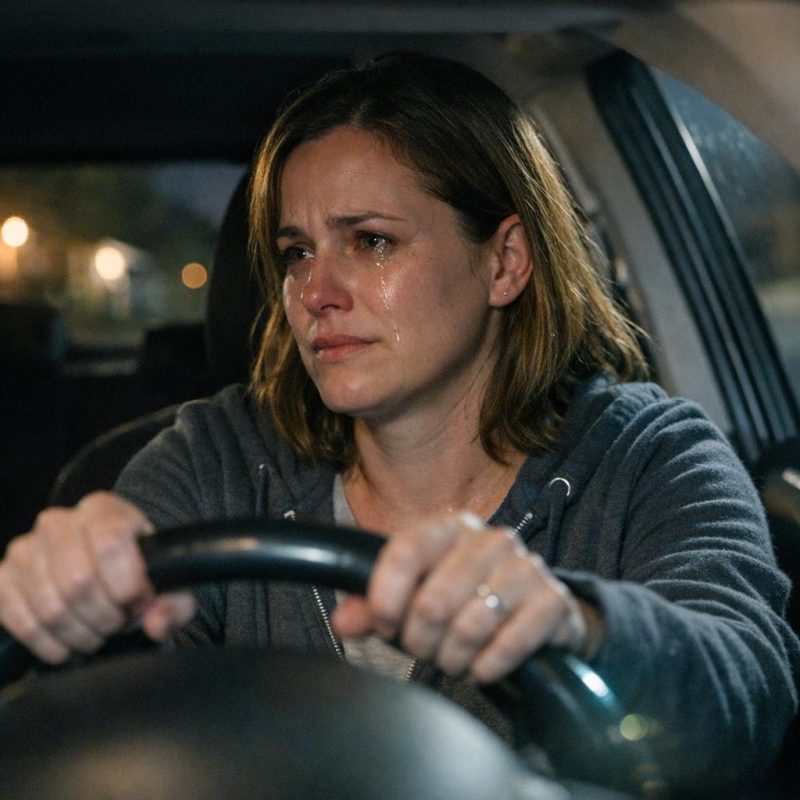 Image by RM AI
The Climb
The building's entrance wasn't even locked—the door just pushed open when I tried it, revealing a dimly lit hallway that smelled like mildew and old cigarette smoke. My footsteps echoed on the cracked tile floor as I found the stairwell. Each step up felt like climbing toward my own execution. First floor. Second floor. The railing was loose under my hand. By the time I reached the third floor, my legs were shaking and my breath was coming in short, sharp gasps. Apartment 3A. 3B was next door. I could see the number on the tarnished brass plate from where I stood frozen at the top of the stairs. There were voices inside—muffled but definitely voices. A man's voice. David's voice. And another voice, higher, softer. I couldn't make out words but I could hear the rhythm of conversation, almost gentle. The spare key was in my pocket, and I pulled it out with a hand that wouldn't stop trembling. This was it. This was the moment everything ended. I stood outside the door with the spare key in my shaking hand, listening to voices inside.
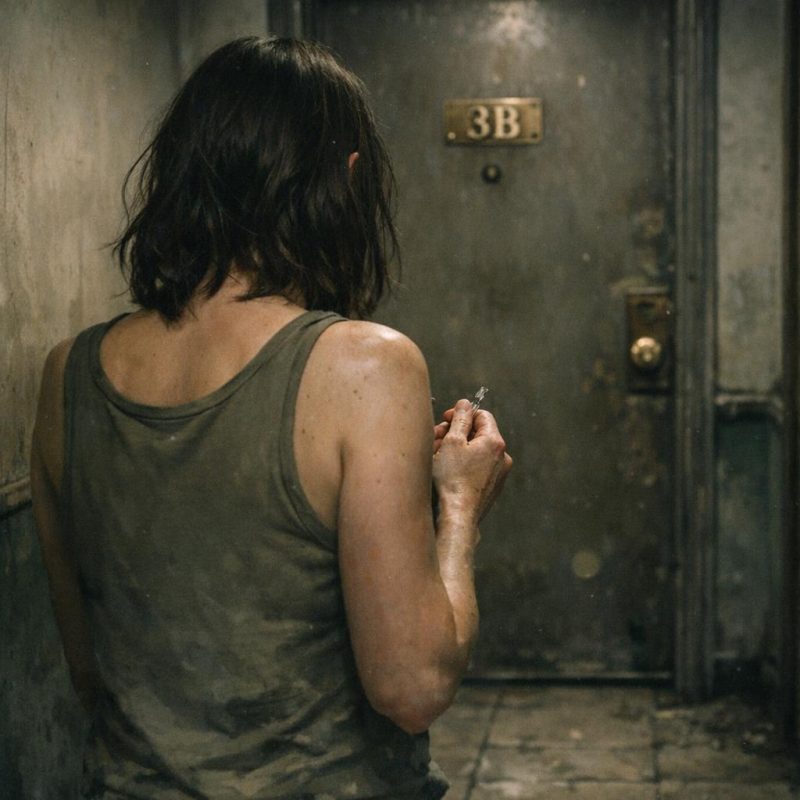 Image by RM AI
The Door Opens
I didn't think. I just moved. The key slid into the lock and I turned it hard, shoving the door open so fast it slammed against the interior wall. 'David!' I screamed his name like a battle cry, like I was declaring war. My whole body was coiled, ready to fight, ready to see her—whoever she was—sitting there in his secret little love nest. I was ready for lipstick on wine glasses. I was ready for rumpled sheets. I was ready for the worst thing I could possibly imagine. My heart was hammering so hard I could feel it in my throat, and my hands were clenched into fists at my sides. The door bounced slightly from the force of my entry, and I stepped inside, my eyes scanning wildly for the woman who'd stolen my husband. For the scene that would confirm every terrible suspicion that had been eating me alive for months. But the apartment that came into focus around me wasn't what I expected. Not even close. What I saw inside froze the air in my lungs.
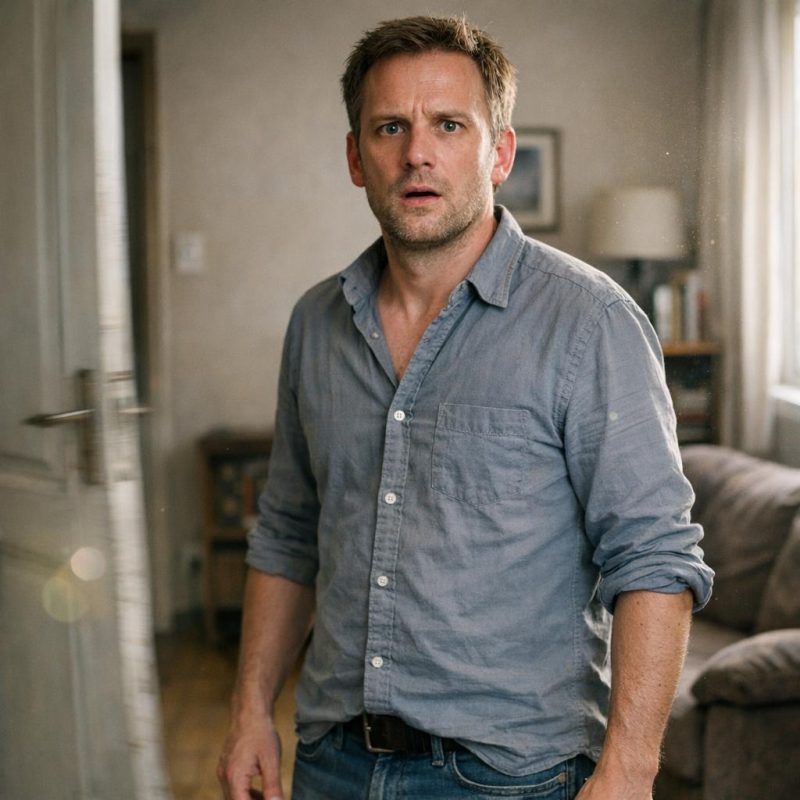 Image by RM AI
No Mistress
The space was tiny—maybe three hundred square feet—with cracked linoleum floors and a single window covered by a thin yellow curtain. There was a small kitchenette against one wall, barely more than a hot plate and a mini fridge. And against the opposite wall, taking up most of the room, was a hospital bed. An actual hospital bed with metal rails and an IV stand beside it. In that bed was an elderly woman, probably in her late sixties, with thin gray hair and papery skin. She had an oxygen tube in her nose connected to a portable tank, and her eyes were closed. The whole room smelled like antiseptic and something medicinal, not perfume. Not sex. Not betrayal. David was sitting in a folding chair beside the bed, holding a bowl of soup in one hand and a spoon in the other. He'd been feeding her. That's what he was doing. Feeding this frail, sick woman soup. David jumped up, dropping the spoon, his eyes wide with shock—'Vanessa? What are you doing here?'
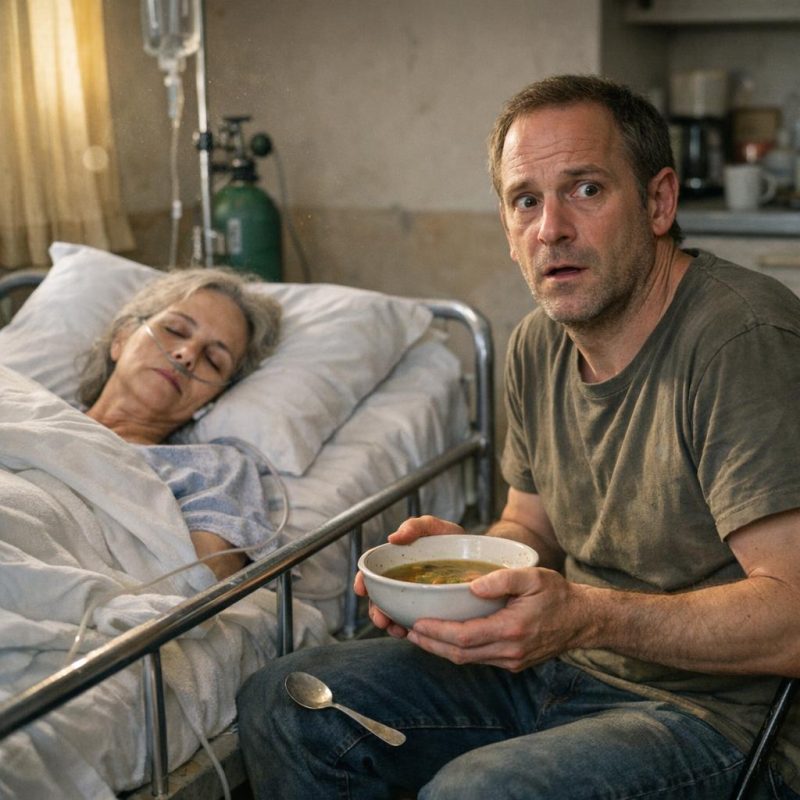 Image by RM AI
Who Is She?
My brain couldn't process what I was seeing. None of it made sense. The hospital bed, the oxygen tank, this woman who looked like she could barely breathe on her own. 'Who is she?' I demanded, my voice coming out strangled and confused. I looked from David to the woman and back again, trying to fit the pieces together and failing completely. This wasn't an affair. There was no mistress here. But then what the hell was this? Why was my husband spending every spare moment in this depressing little apartment caring for a dying stranger? The woman's eyes fluttered open at the sound of my voice, but they were unfocused, cloudy. She didn't seem to register that I was there. David stood frozen between us, the bowl of soup still in his hand, and I saw his face go through about seventeen different emotions in the span of three seconds. Fear. Shame. Guilt. Resignation. He set the bowl down on the small bedside table with shaking hands. David looked at the woman, then at me, his eyes full of tears—'Vanessa, this is my mother.'
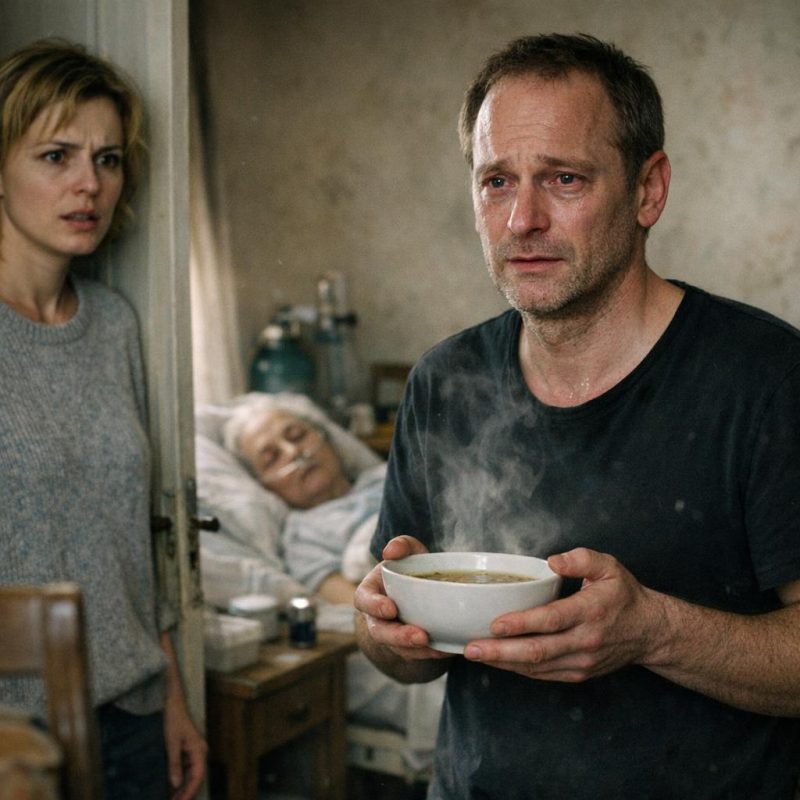 Image by RM AI
But She's Dead
'That's not possible,' I said immediately, shaking my head. My voice sounded distant, like it was coming from underwater. 'Your mother's dead, David. You told me she died when you were a teenager.' I'd heard that story so many times over the years. He never wanted to talk about it, always changed the subject quickly, but he'd told me the basic facts: cancer, he was sixteen, it was sudden and awful. That was the story. That was what I knew about his past. So this woman—whoever she was—couldn't be his mother. It didn't make any sense. David's face crumpled, and he took a step toward me, then seemed to think better of it. He glanced back at the woman in the bed, who'd closed her eyes again, her breathing shallow and rattling. 'I know,' he whispered. 'I know what I told you. I'm sorry. Vanessa, please—can we step outside? I need to explain, but I don't want to disturb her.' David pulled me into the hallway, closing the door softly, and I saw the exhaustion carved into his face.
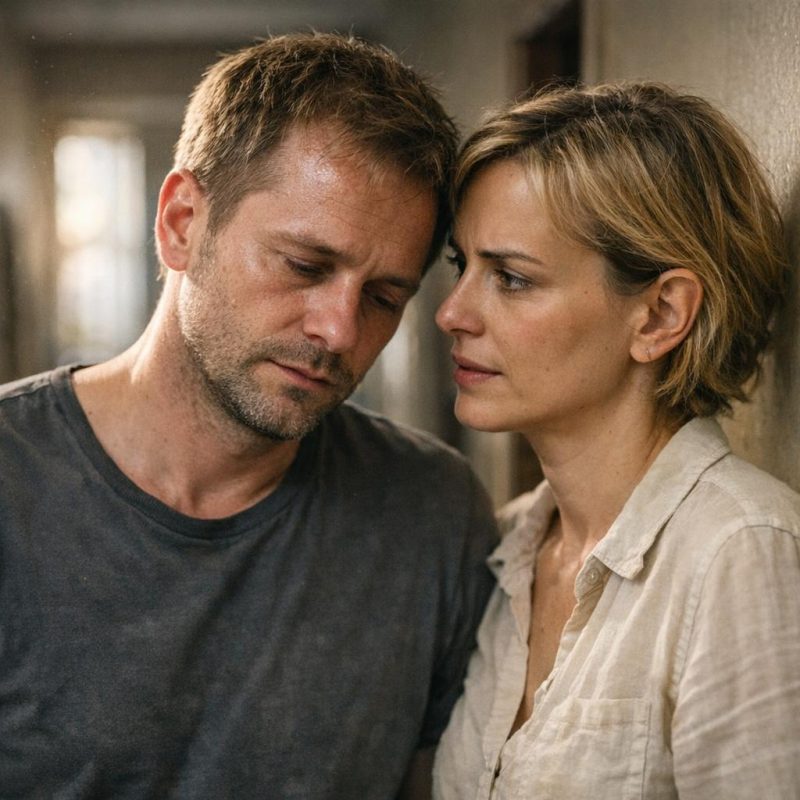 Image by RM AI
The Hallway Confession Begins
The hallway was even more depressing than the apartment—water-stained walls and a flickering fluorescent light that buzzed like an angry wasp. David leaned against the wall and covered his face with his hands for a moment, and when he looked at me again, he looked about ten years older than he had that morning. 'My mother didn't die,' he said quietly. 'I lied to you. I lied to everyone. She's been alive this whole time.' He took a shaky breath. 'She has paranoid schizophrenia, Vanessa. Severe, treatment-resistant paranoid schizophrenia. She's been sick since I was a kid—maybe even before I was born, I don't know. But by the time I was old enough to remember, she was...' He trailed off, his jaw working. 'She had episodes. Violent episodes. She thought people were trying to poison her. She thought I was possessed by demons. She locked me in closets. Burned my things. Screamed at me for hours about conspiracies that didn't exist.' His voice cracked. 'She was abusive, Vanessa—dangerous. I ran away at 18 to save my own life.'
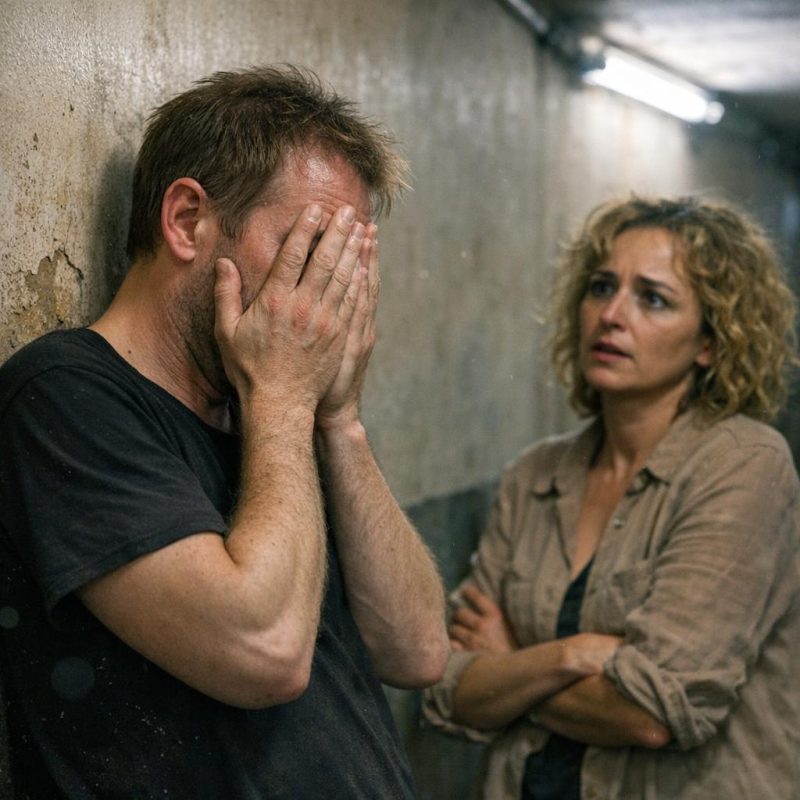 Image by RM AI
A Life Built on a Lie
I stood there staring at him, trying to absorb what he was telling me. All those years, all those conversations where he'd shut down when I asked about his family, about his childhood—this was why. 'So you told everyone she was dead,' I said slowly. It wasn't a question. David nodded, and I could see the shame written all over him. 'I know how that sounds,' he said. 'I know it was a lie. But when I left, I had to cut all ties with her or I never would have survived. I changed my phone number, moved states, started over completely. And when people asked about my family, I just... I couldn't explain. I couldn't tell them my mother was a paranoid schizophrenic who used to beat me with extension cords and tell me I was the spawn of Satan.' His voice broke on the last words. 'I couldn't talk about her without falling apart, so I just... erased her from my life.'
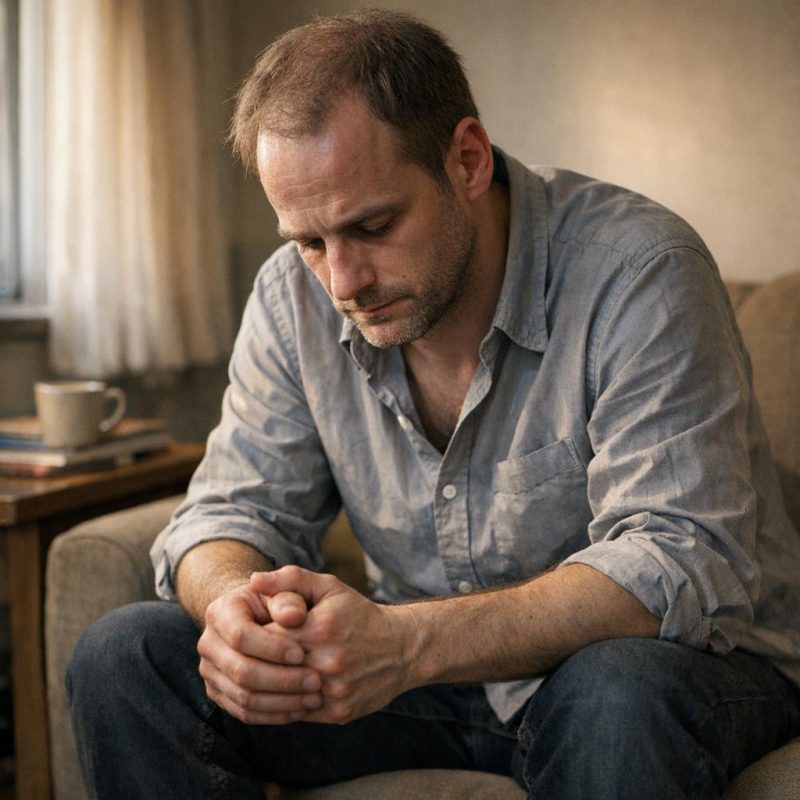 Image by RM AI
The Social Worker's Call
My anger was draining away, replaced by something more complicated—a mix of horror and pity and confusion that I didn't know how to name. 'But why now?' I asked. 'Why is she here? How did you even...' David rubbed his eyes, and I noticed how bloodshot they were, how deep the circles beneath them had gotten. 'Three months ago,' he said, 'I got a call from a social worker. I don't even know how she found me—I guess they have ways of tracking people down. She said my mother had been living in state housing for years, barely managing, but she'd been evicted because the place was being demolished. And she's sick, Vanessa. Really sick.' He looked at me with so much pain in his eyes I almost couldn't stand it. 'She's dying of lung cancer, Vanessa. She has maybe weeks, maybe a month.'
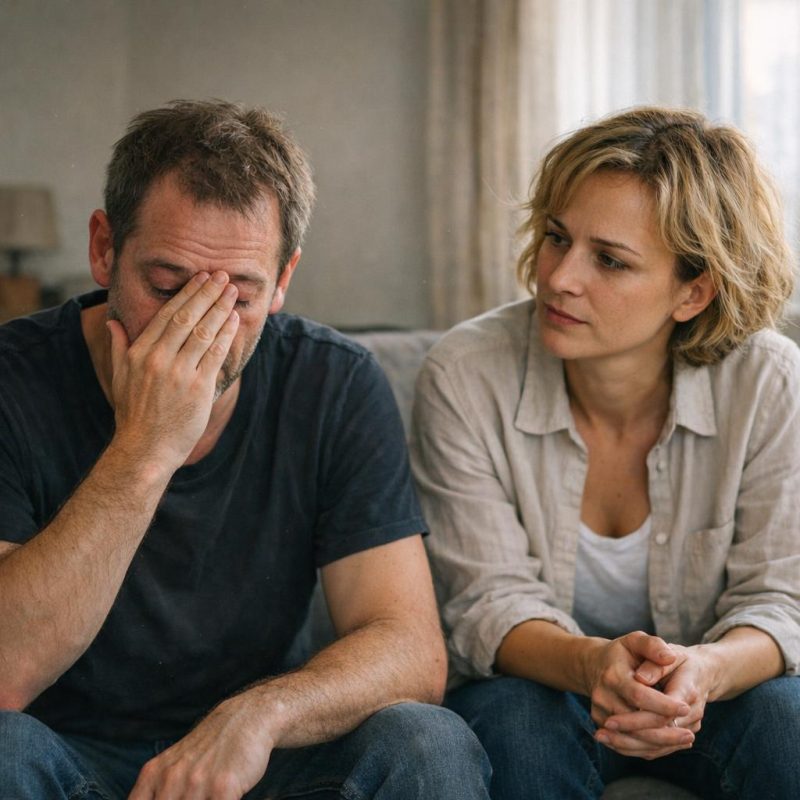 Image by RM AI
The Impossible Choice
I wanted to say something, but my throat was too tight. David kept talking, the words pouring out now like he'd been holding them in for too long. 'The social worker said she was going to end up on the street or in some terrible facility where she'd die alone. And I know what she did to me. Believe me, I remember every single thing. I have scars, Vanessa. Physical scars from her.' He pressed his palms against his eyes. 'But I couldn't do it. I couldn't let her die on the street like an animal. She's still my mother, even after everything. So I rented this place, the cheapest thing I could find. I've been taking care of her. Feeding her, managing her meds, making sure she's not in pain.' He looked at me desperately, and I saw the guilt radiating off him. 'I couldn't bring her into our home—I couldn't expose you to her, especially after everything we've been through.'
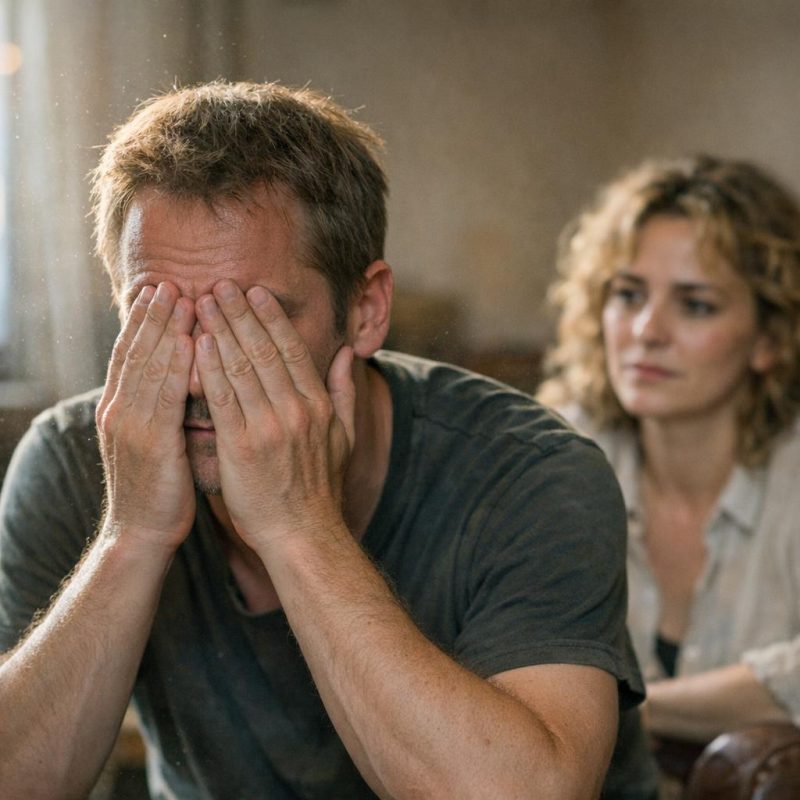 Image by RM AI
Protecting Our Home
David looked at me with this kind of desperation I'd never seen before, like he needed me to understand something vital. 'I couldn't bring her into our home, Vanessa,' he said again, his voice cracking. 'You have to understand that. Our apartment—it's our sanctuary. It's the only place where I feel safe, where I can breathe. Where we built something good together.' He was wringing his hands, that nervous gesture I'd noticed so many times but never understood. 'She can still be cruel, even now, even dying. The dementia doesn't take that away—it just removes the filter she used to have. She says horrible things. Vicious things.' He paused, swallowing hard. 'I couldn't expose you to that. I couldn't let her poison the one good thing in my life. I've spent my entire childhood walking on eggshells around her, and I couldn't—I just couldn't bring that darkness into our home.' I felt something shift inside me as he spoke, this awful realization creeping in. He wasn't hiding an affair. He was protecting me. 'She can still be cruel, Vanessa. Even now, even dying. I didn't want that poison in our sanctuary.'
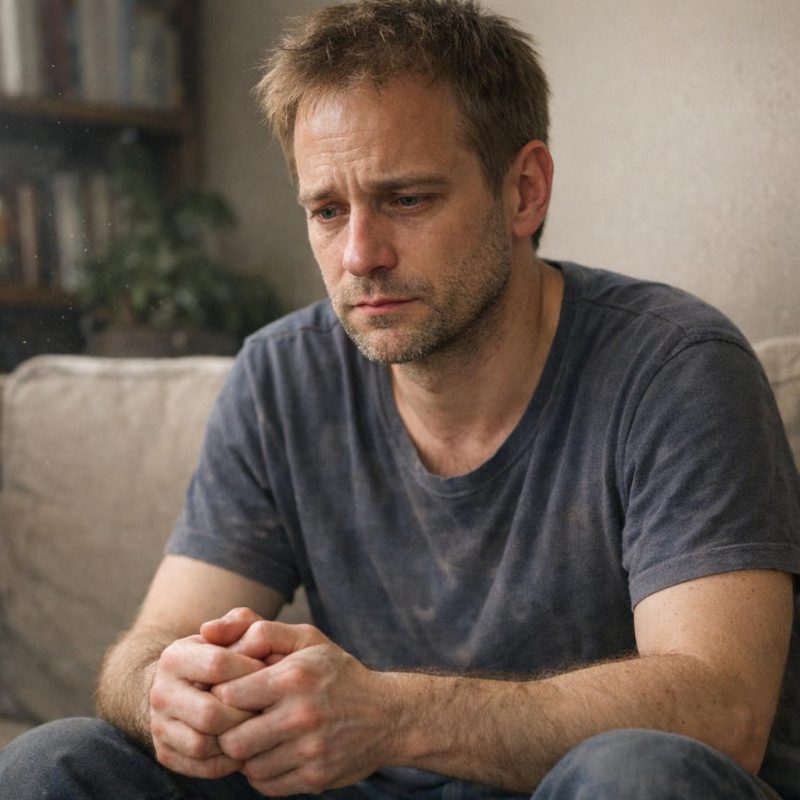 Image by RM AI
The Exhaustion in His Eyes
I looked at David—I mean really looked at him for the first time in months. The dark circles under his eyes weren't from late nights with another woman. They were from exhaustion, from carrying this impossible weight alone. The distance I'd felt wasn't him pulling away from me. It was him trying to shield me from something terrible. All those evenings he'd been 'working late'—he'd been feeding his dying mother, the woman who'd abused him as a child. Changing her sheets. Managing her medication. Sitting with her in that depressing apartment while she hurled insults at him, probably. And he'd done it all without telling me because he loved me too much to burden me with it. God, I felt like such an idiot. Such a selfish, paranoid idiot. Here I'd been following him around, checking his phone, building this entire fantasy about some imaginary mistress named Sarah, when the reality was so much more heartbreaking. He'd been carrying this alone because he thought he had to. Because he'd always carried everything alone. I started crying, not from anger anymore, but from shame for doubting him.
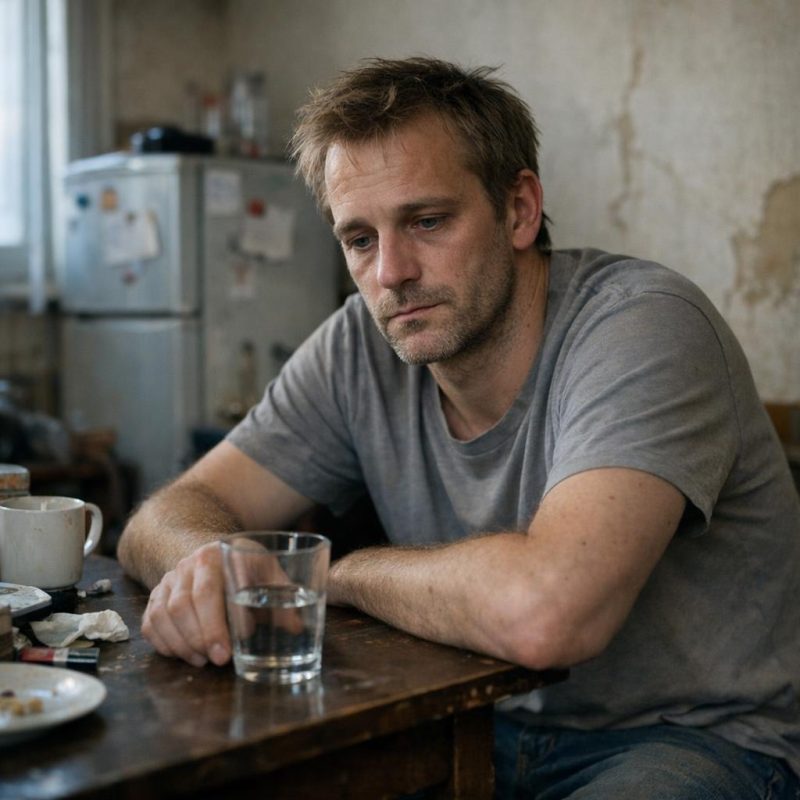 Image by RM AI
The Hug
I moved toward him without thinking, wrapping my arms around him and pulling him close. I hugged him tighter than I think I ever had in our entire relationship, pressing my face against his shoulder. 'David,' I whispered, 'you don't have to do this alone anymore. I'm here. I'm your wife. Let me help you carry this.' I felt him stiffen for a moment, like he didn't know how to accept comfort, like he'd forgotten what it felt like to have someone on his side. Then something broke inside him. His body started shaking, and I realized he was crying—not just tearing up, but really sobbing, these deep, wrenching sounds that seemed to come from somewhere ancient and wounded. 'I'm so tired, Vanessa,' he choked out between sobs. 'I'm so tired of carrying this. I'm so tired of being scared and alone with it.' I held him tighter, running my hand through his hair the way I used to when we first got together. 'You're not alone,' I kept saying. 'You're not alone anymore.' David collapsed into my arms and sobbed—it was the first time I'd ever seen him truly break.
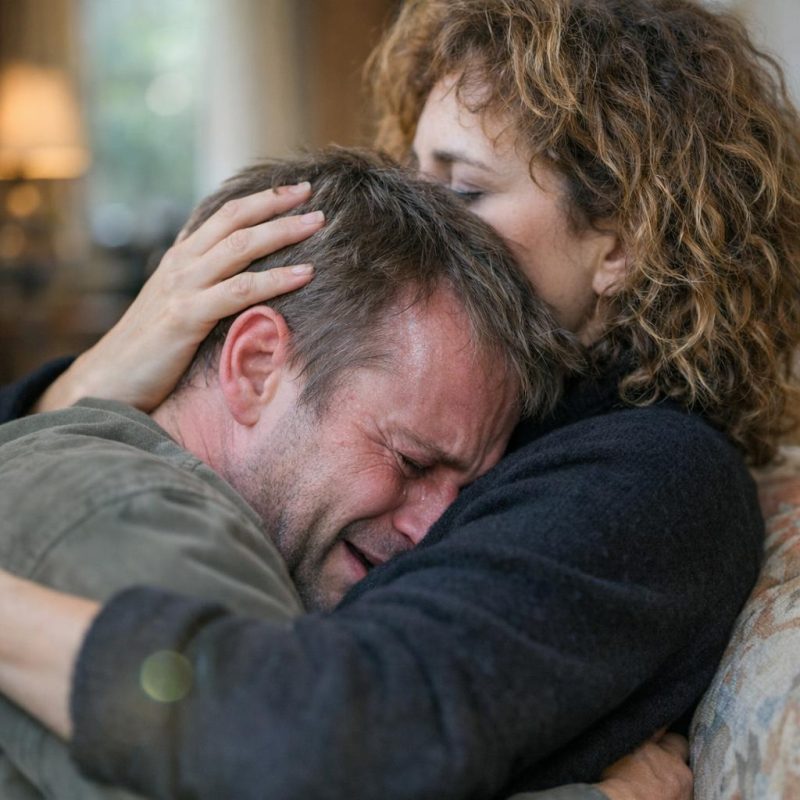 Image by RM AI
Meeting Her Properly
Two days later, David and I went back to the apartment together. My hands were shaking as we climbed those stairs, and David kept glancing at me like he was worried I might change my mind. When we walked in, his mother was sitting in that same chair, wrapped in a different bathrobe—this one stained with what looked like soup. She turned her head slowly when she heard us, and her eyes focused on me with surprising clarity. 'Who's this?' she asked David, her voice hoarse but sharp. 'This is Vanessa, Mom,' David said quietly. 'My wife. I told you about her.' She made a dismissive sound and studied me up and down with this calculating look that made my skin crawl. I tried to smile, to be warm and open, to show her I was there to help. I was prepared for confusion, maybe some memory issues, questions about who I was or why I was there. I was not prepared for what she actually said. She looked at me with clouded eyes and said, 'You're too pretty for him—what's wrong with you?'
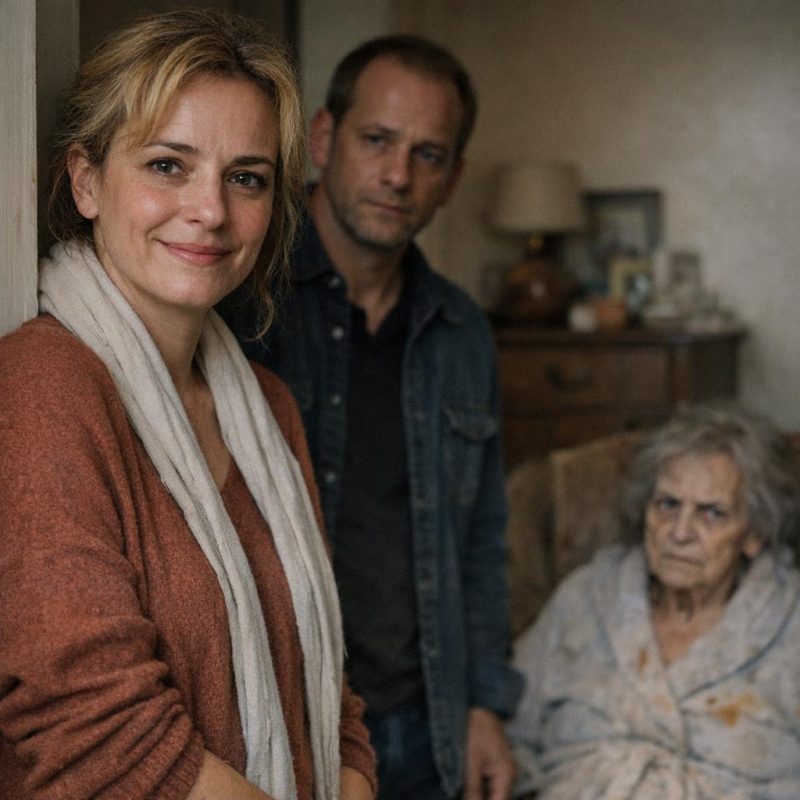 Image by RM AI
David's Warning
After his mother dozed off in her chair, David pulled me into the tiny kitchen area, speaking in a low voice. 'I need to warn you about something,' he said, glancing back toward where she sat. 'She has good days and bad days. Today is actually one of her better ones, believe it or not.' I must have looked skeptical because he gave me this sad, knowing smile. 'On the bad days, she says things—really cruel things. She'll find whatever hurts most and just keep hitting that spot over and over. Sometimes she knows exactly what she's doing. Other times I think the dementia just removes all her inhibitions and what comes out is pure poison.' He rubbed his face, looking exhausted. 'I just need you to know that when it happens, it's not about you. It's not even really about me anymore. It's just who she is, who she's always been, but worse now because there's no filter left.' I reached out and squeezed his hand, trying to show him I understood, that I could handle it. I nodded, but I didn't really understand—not yet.
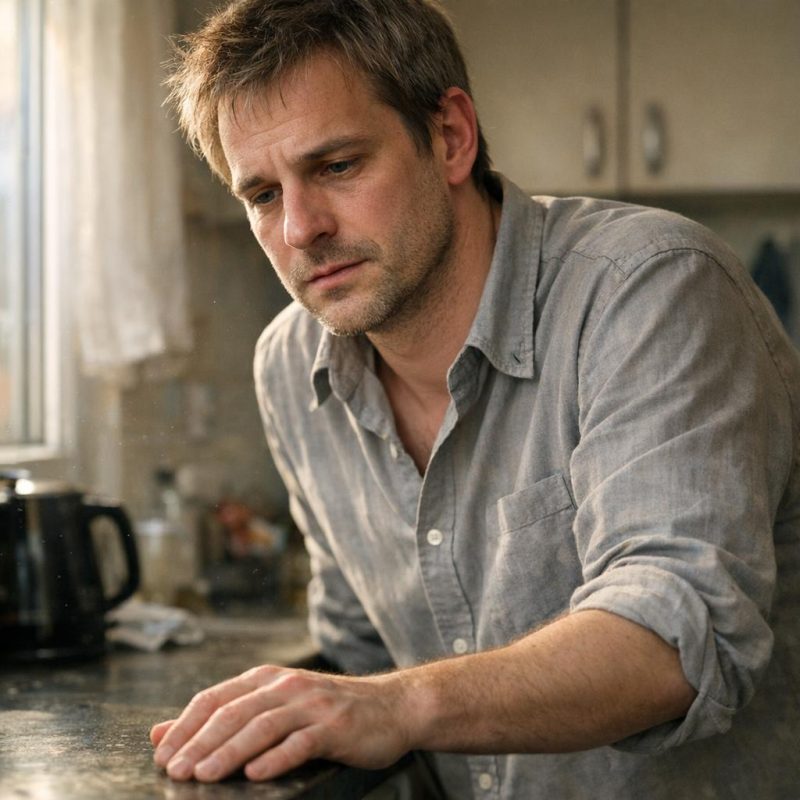 Image by RM AI
The First Evening Together
We spent that first evening together at the apartment, and I tried to make myself useful. David heated up some soup while I straightened the small living area, folding the blankets and organizing the pill bottles on the side table. His mother watched me with this suspicious expression, like I was an intruder in her space. When David brought her the soup, she complained that it was too hot, then too cold, then the wrong flavor entirely. I offered to help her eat, but she waved me off irritably. 'I'm not an invalid,' she snapped. After she finished eating, David helped her to the bathroom while I cleaned up the dishes in the tiny kitchen. The whole place felt suffocating—small and sad and filled with this heavy tension that made it hard to breathe. I was scrubbing a pot when I heard her voice behind me, not loud but perfectly clear. David was still in the bathroom with her, helping her wash her hands or something, but her words carried. As I washed dishes in the tiny kitchen, I heard her mutter, 'He always picks weak ones.'
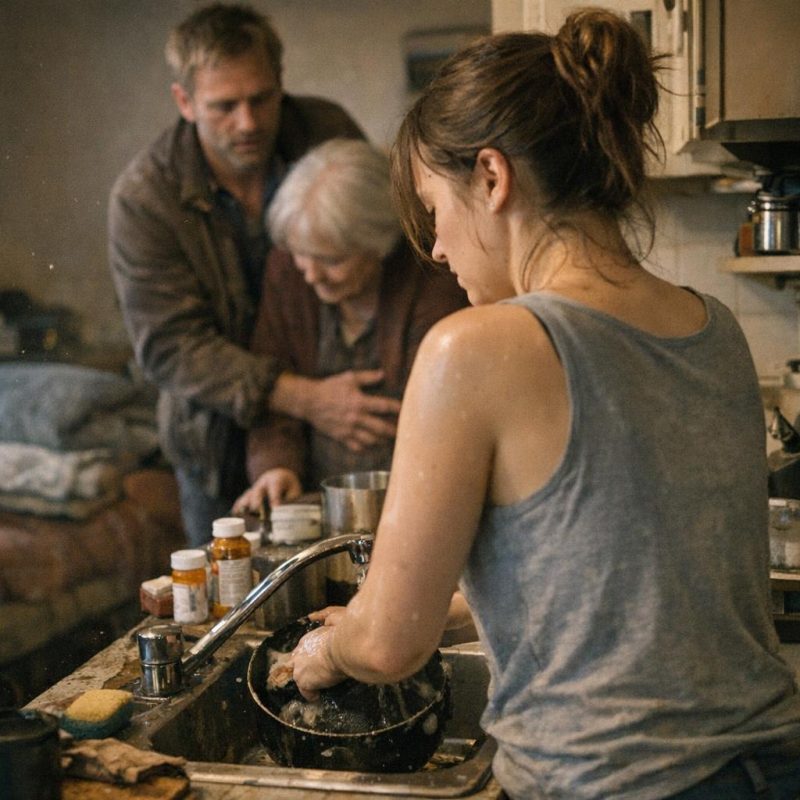 Image by RM AI
Driving Home in Silence
The drive home that night was silent. Not the angry silence we'd had for months, but something heavier and more complex. I kept stealing glances at David, watching the way the streetlights illuminated his profile, the tightness in his jaw, the exhaustion etched into every line of his face. I was processing everything—the apartment, his mother's cruelty, the magnitude of what David had been dealing with alone. The weight of it was enormous, and I'd only spent a few hours there. He'd been carrying this for months. My mind kept replaying that comment his mother had made, the casual viciousness of it. Was that what David had grown up with? That constant stream of cutting remarks and emotional violence? No wonder he'd been so desperate to keep it away from our home, from me. We pulled up to our building, and David turned off the engine but didn't move to get out. We just sat there in the dark car, both of us overwhelmed. I reached over and held David's hand, and he squeezed it so hard I thought my bones might break.
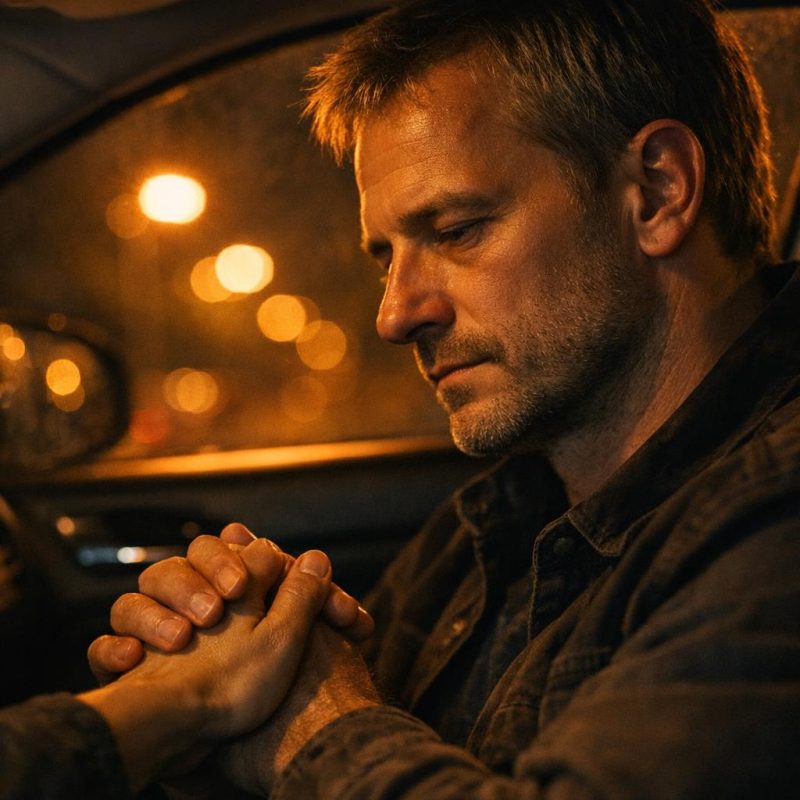 Image by RM AI
Telling Rachel
That weekend, I called Rachel. I needed to talk to someone, to process everything that had happened, and she was the only person who knew about my suspicions. 'So,' she answered, 'did you talk to him? What happened?' I took a deep breath and told her everything—the secret apartment, David's dying mother, the abuse he'd suffered as a child, his desperate attempt to protect our home from her toxicity. Rachel was silent for a long moment after I finished. 'Oh my God, Vanessa,' she finally said, her voice soft with shock. 'I thought—we all thought—' 'I know,' I interrupted. 'I thought so too.' She was quiet again, and I could picture her on the other end of the line, processing it all the way I had. 'That's why he was so distant? Because he was dealing with all of that alone?' 'Yeah,' I said, my throat tight. 'And I accused him of having an affair. I followed him around like some paranoid detective while he was taking care of his abusive dying mother.' 'Jesus, Vanessa,' Rachel breathed. 'That poor man. That poor woman. That poor you.'
 Image by RM AI
Adjusting the Routine
Over the next few weeks, David and I established a new routine. We started visiting the apartment together three or four evenings a week, splitting the caregiving duties with the hospice nurse who came during the day. I'd bring groceries and help prepare simple meals while David managed medications and handled the more difficult physical care. Some nights his mother slept the whole time we were there. Other nights she'd be awake, confused, calling David by his father's name or asking about people who'd been dead for decades. I learned to change sheets, to speak softly during her agitated moments, to know when to leave the room and give David space. It wasn't what I'd imagined doing with my evenings—far from it—but there was something about facing it together that changed everything between us. We'd drive home exhausted, sometimes too tired to even speak, but we'd hold hands in the car. We'd collapse into bed and just exist in the same space, knowing we'd done something hard and necessary. It was exhausting, but somehow it brought us closer—we were a team again.
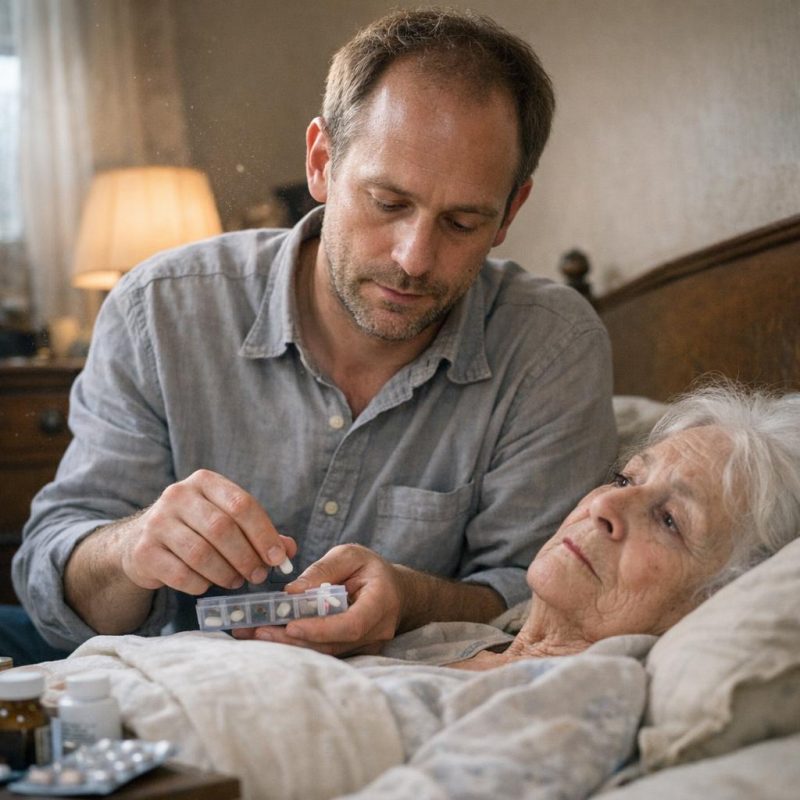 Image by RM AI
A Moment of Lucidity
One evening about three weeks in, something unexpected happened. I was sitting by the window in the apartment, folding some clean towels the nurse had left, when David's mother suddenly spoke from her bed. Her voice was different—clearer, softer. 'You're David's wife?' she asked. I looked up, startled. Her eyes were focused, actually seeing me for the first time since we'd met. 'Yes,' I said carefully. 'I'm Vanessa.' She nodded slowly, her thin fingers picking at the blanket. 'He's lucky,' she said quietly. 'You didn't have to come here. You didn't have to help.' I didn't know what to say. This wasn't the confused, angry woman I'd grown accustomed to. This was someone else—someone buried underneath the illness and pain. 'It's okay,' I managed. 'We're managing.' She looked at me for a long moment, and I saw tears forming in her clouded eyes. 'You're kind,' she whispered. 'Kinder than I deserve.'
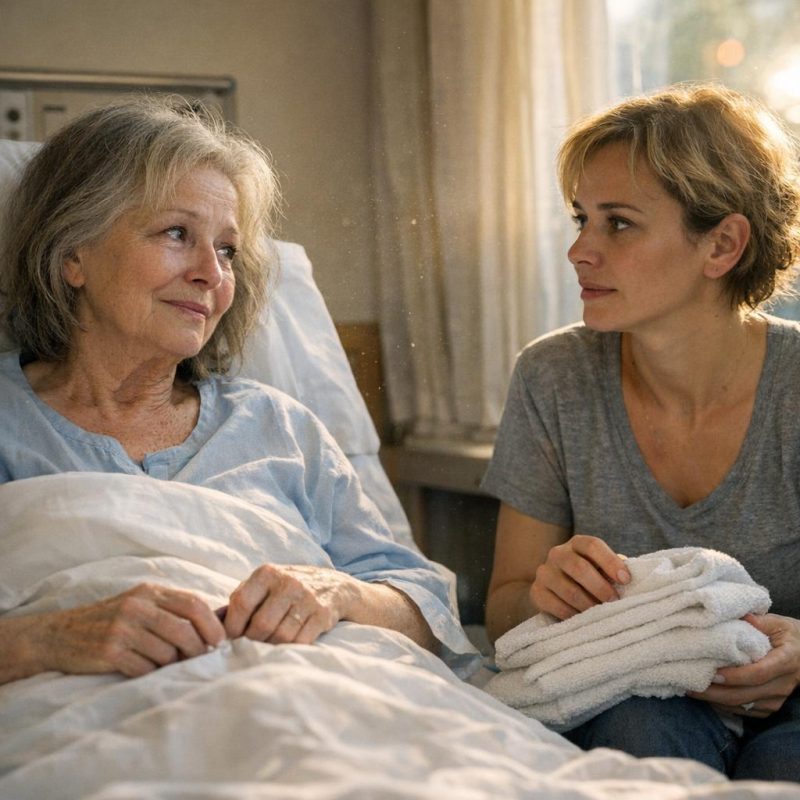 Image by RM AI
A Cruel Episode
But two nights later, everything flipped again. We'd barely walked through the door when she started shouting. 'Where have you been?' she demanded, her voice sharp and cutting. 'I've been alone here for days! Days!' David tried to explain that we'd been there just yesterday, that the nurse had been with her all day, but she wasn't having it. 'You abandoned me,' she spat, struggling to sit up in bed. 'You ungrateful, selfish boy. I gave you everything, and you left me to rot.' The words came faster, meaner. She accused him of stealing from her, of lying, of never loving her. David's face went completely blank—not angry, not defensive, just empty. He stood there by her bedside and let her tear into him, his hands loose at his sides. I wanted to interrupt, to defend him, but something stopped me. I realized this wasn't new. This was a script he'd heard his entire childhood, words that had shaped him long before I ever met him. David just stood there and took it, his face blank, like he'd heard it a thousand times before.
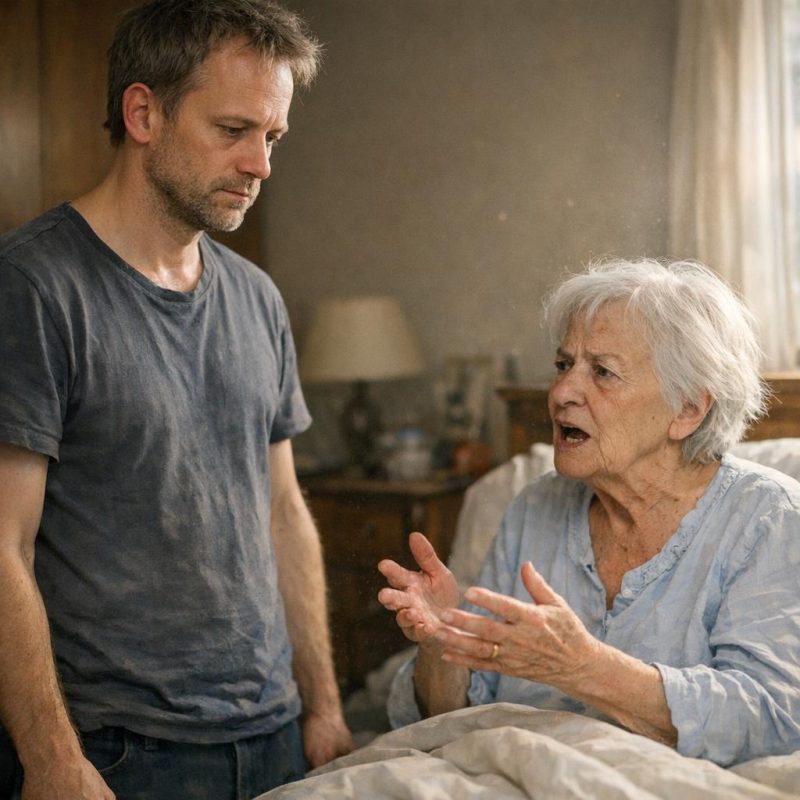 Image by RM AI
Understanding His Childhood
We left earlier than usual that night. David didn't say anything as we walked to the car, didn't acknowledge what had just happened. His jaw was tight, his movements mechanical. When we reached the parking lot, I couldn't take it anymore. I grabbed his arm and pulled him toward me. 'David,' I said. 'David, look at me.' He did, finally, and I saw it all in his eyes—years and years of pain, of being told he was worthless, of absorbing cruelty like it was normal. 'I'm sorry,' he whispered. 'I'm so sorry you had to see that.' But I wasn't sorry. I mean, I was sorry for him, but I needed to see it. I needed to understand why he'd run away at sixteen, why he'd never looked back, why he'd built an entire life without ever mentioning where he came from. He'd been protecting me from this darkness—this toxic, soul-crushing darkness that had defined his childhood. I held him in the parking lot and realized he'd been protecting me from this darkness all along.
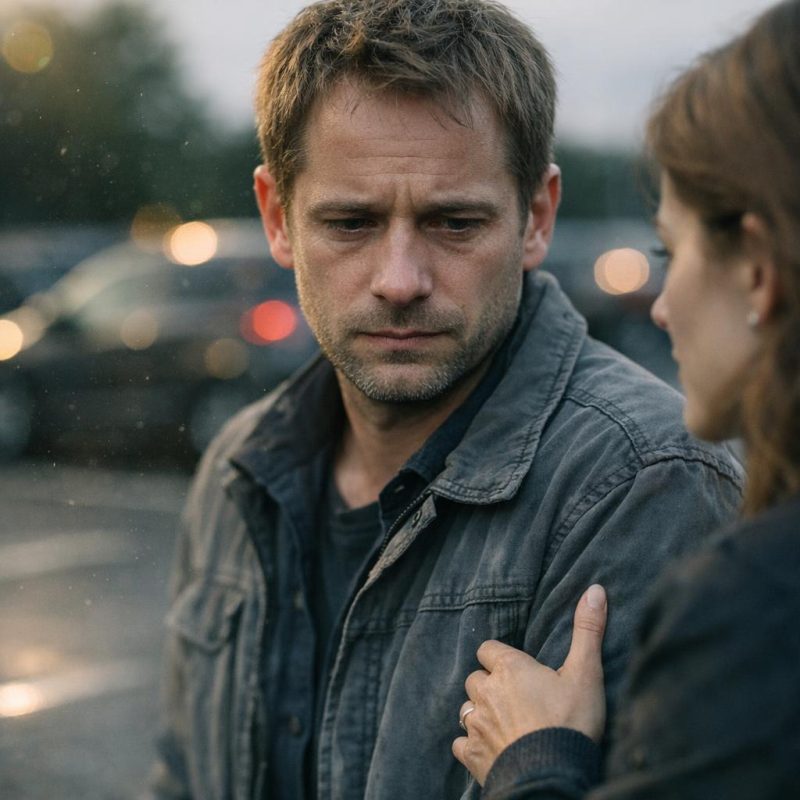 Image by RM AI
The Vanilla Perfume
A few days later, as we were driving to the apartment again, I finally asked the question that had been nagging at me. 'The vanilla smell,' I said carefully. 'On your clothes sometimes. What is that?' David glanced at me, confused for a second, then understanding dawned on his face. 'Oh,' he said. 'It's the lotion. The hospice nurse uses this cheap vanilla-scented lotion on my mom's skin. To prevent bedsores.' He said it so matter-of-factly, like it was the most obvious thing in the world. 'It gets on everything—the sheets, my clothes, my hands. I've washed my jacket three times and it still smells like it.' I sat there in stunned silence. The perfume. The mysterious vanilla scent that I'd convinced myself belonged to another woman, that I'd imagined on some faceless mistress. It was lotion. Medical lotion. Used to care for his dying mother. I felt like an idiot—every clue I'd found had an innocent explanation I'd twisted into betrayal.
 Image by RM AI
The Cash Explained
That same conversation opened the floodgates. 'And the money,' I said, needing to understand it all. 'All those cash withdrawals?' David sighed. 'Rent for the apartment,' he explained. 'The landlord's old-school, doesn't take checks. And then medical supplies that insurance doesn't cover—special bed pads, the good pain medication, nutritional drinks she can actually keep down. Plus groceries, because she refuses to eat the stuff the hospice provides.' He listed it all so plainly, like he'd been carrying a mental accounting in his head for months. 'It adds up fast,' he added. 'Some weeks it's five hundred dollars, some weeks more.' I thought about all those bank statements I'd scrutinized, all those missing hundreds I'd convinced myself were funding secret romantic dinners or hotel rooms. It was bed pads. It was Ensure. It was keeping his mother comfortable while she died. 'I should have told you,' he said quietly, his hands gripping the steering wheel. 'I just didn't know how.'
 Image by RM AI
Why He Couldn't Tell Me
Later that night, after we'd gotten home and settled into our own bed, David finally opened up completely. We were lying in the dark, and I could feel the weight of everything he'd been carrying pressing down on both of us. 'I was ashamed,' he said suddenly. 'Of where I came from. Of her. Of what she did to me.' His voice cracked slightly. 'I built this whole life—our life—and it felt clean and good and nothing like my childhood. And then she got sick, and suddenly my past was back, and I didn't want you anywhere near it.' I reached for his hand. 'But why couldn't you tell me?' I asked gently. 'Because I thought you'd see me differently,' he whispered. 'I thought you'd see me the way she always did—broken, damaged, not worth loving. I thought if you knew the truth about where I came from, what I survived...' He paused, his breath shaky. 'I thought you'd think I was broken,' he whispered. 'I thought you'd leave.'
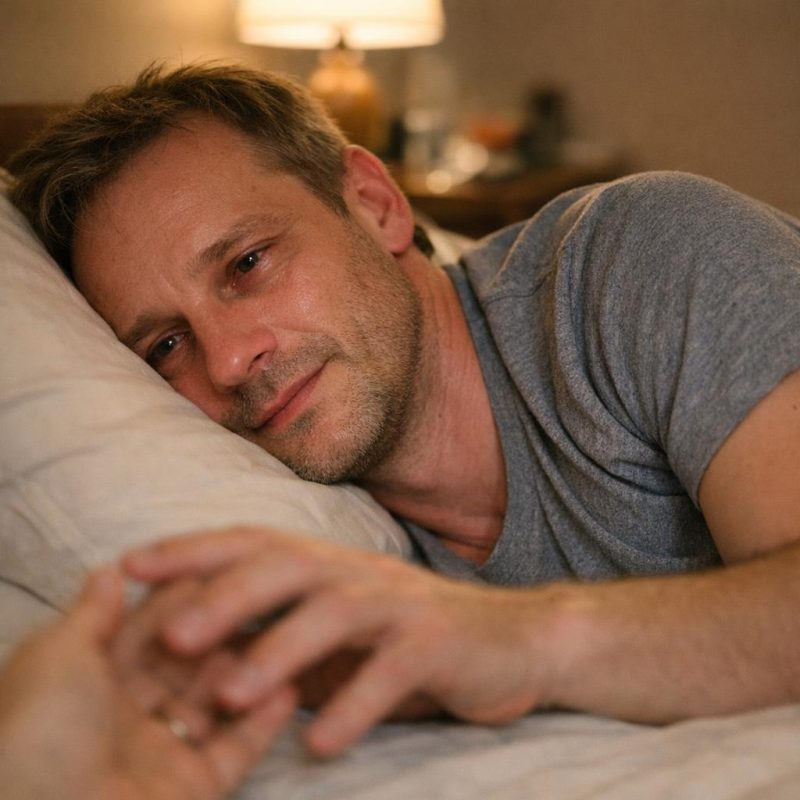 Image by RM AI
I Could Never Leave
I rolled toward him in the darkness, finding his face with my hands. 'David,' I said firmly. 'Look at me.' He did. 'I could never leave you. Never.' I felt tears on my own cheeks now. 'Your past doesn't define you. What she did to you doesn't define you. If anything, I love you more for surviving it, for becoming the man you are despite everything she put you through.' He started crying then—really crying, not the silent tears I'd seen before but deep, shaking sobs. I held him and let him release everything he'd been holding in for months, maybe years. 'You're not broken,' I kept repeating. 'You're not broken.' We held each other for a long time, and then something shifted. The grief turned into need, into connection, into a desperate desire to feel close again. We made love that night like we were rediscovering each other, and for the first time in months, we both cried tears of relief.
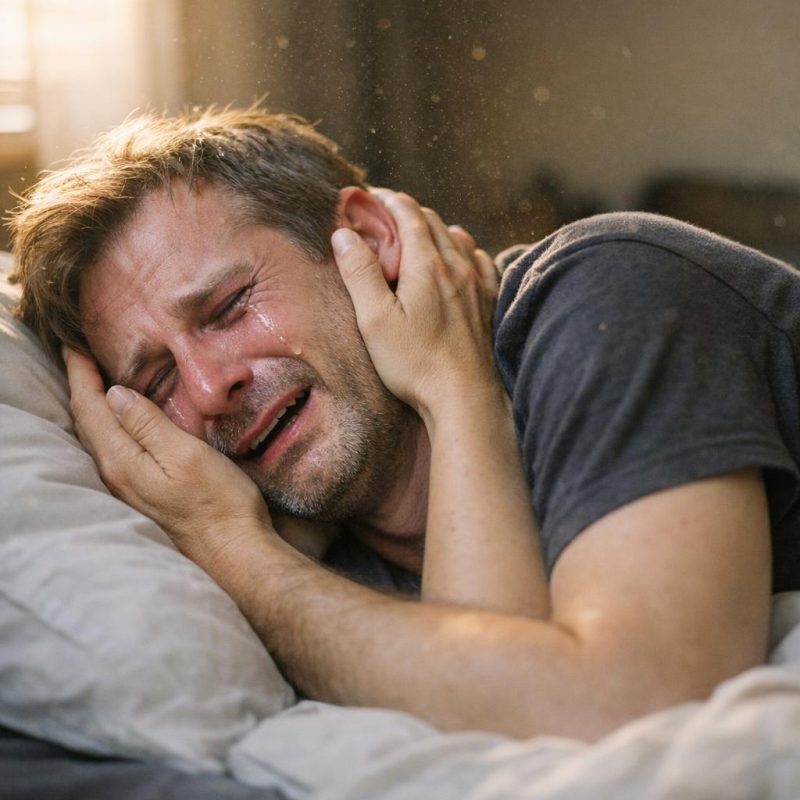 Image by RM AI
The Decline Begins
The doctor's call came on a Tuesday morning while David and I were having coffee. I watched his face go pale as he listened, nodding slowly, his hand gripping the edge of the kitchen counter. When he hung up, he just stood there for a moment before he could speak. 'Her kidneys are failing,' he said quietly. 'The doctor says we have maybe two weeks. Probably less.' The reality of it hit me like a physical blow. I'd known this was coming—we all knew—but somehow I'd let myself believe we had more time. David's mother had been declining for months, but this was different. This was the final countdown. I set down my cup and wrapped my arms around him. He felt rigid, like he was holding himself together by sheer force of will. 'I'll call work,' I said. 'I'll take family leave. Whatever you need.' He pulled back and looked at me with red-rimmed eyes. 'You don't have to do this, Vanessa. You barely know her.' 'But I know you,' I said firmly. I wasn't ready to watch someone die, but I wasn't going to let David do it alone.
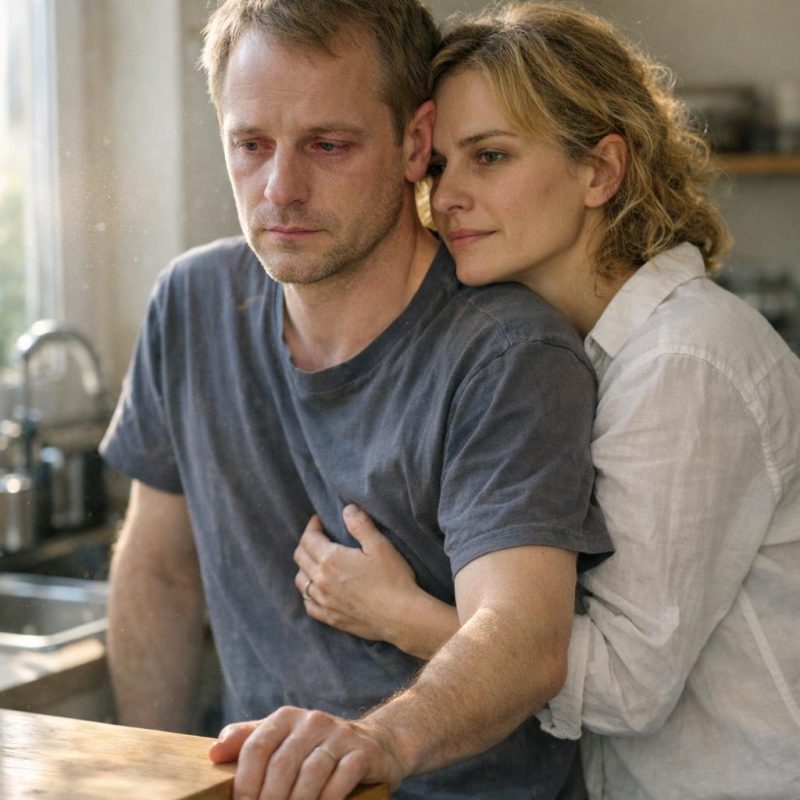 Image by RM AI
Around the Clock
We moved into the apartment that same day, bringing sleeping bags, pillows, and enough clothes for a week. David set up a schedule—he'd take the night shift, I'd take mornings, and we'd trade off throughout the day so neither of us burned out completely. But schedules don't really work when someone is dying. She'd cry out in pain at two in the morning, and we'd both be there. She'd wake confused at four, calling for people who'd been dead for decades, and we'd sit with her until she calmed. The hospice nurse came twice a day to adjust medications and check vitals, her face kind but professionally neutral. 'You're doing everything right,' she told us on the third day. 'Just keep her comfortable. Keep talking to her. She knows you're here.' I learned things I never wanted to know—how to reposition someone who couldn't move on their own, how to recognize different types of pain, what sounds meant distress versus what sounds were just the body shutting down. David barely slept, barely ate. I forced protein shakes into his hands and made him take walks around the block. The hospice nurse told us these final days would be hard, but nothing could have prepared me for watching life slowly drain away.
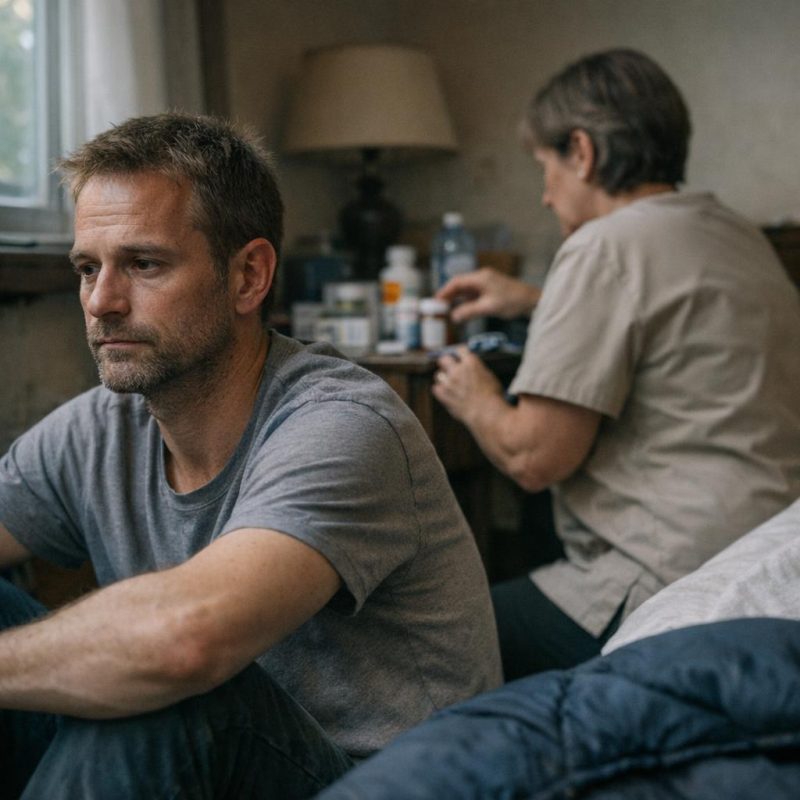 Image by RM AI
Moments of Peace
But it wasn't all horror. Between the painful episodes, there were stretches where she slept peacefully, her breathing even and calm, and in those quiet hours David would sit beside me on the worn couch and tell me stories. He told me about summer vacations to the Baltic Sea when he was seven, before the first major episode. He told me about Christmas mornings when she'd make a special breakfast and they'd open presents slowly, savoring each one. 'She taught me to read,' he said one afternoon, his voice soft. 'Not just the basics—she'd read to me every night. Poetry, novels, everything. She loved books.' I could see it then, the woman she'd been before the illness consumed her. The mother who'd loved her son, who'd tried her best before her brain betrayed her. It made everything harder and easier at the same time. Harder because I could see what had been lost. Easier because I understood why David couldn't let go, why he'd built this whole secret life to care for her. She stirred in her sleep, and David reached over to adjust her blanket. 'She used to bake bread on Saturdays,' he said, his voice distant. 'Before the illness took over completely. I can still smell it.'
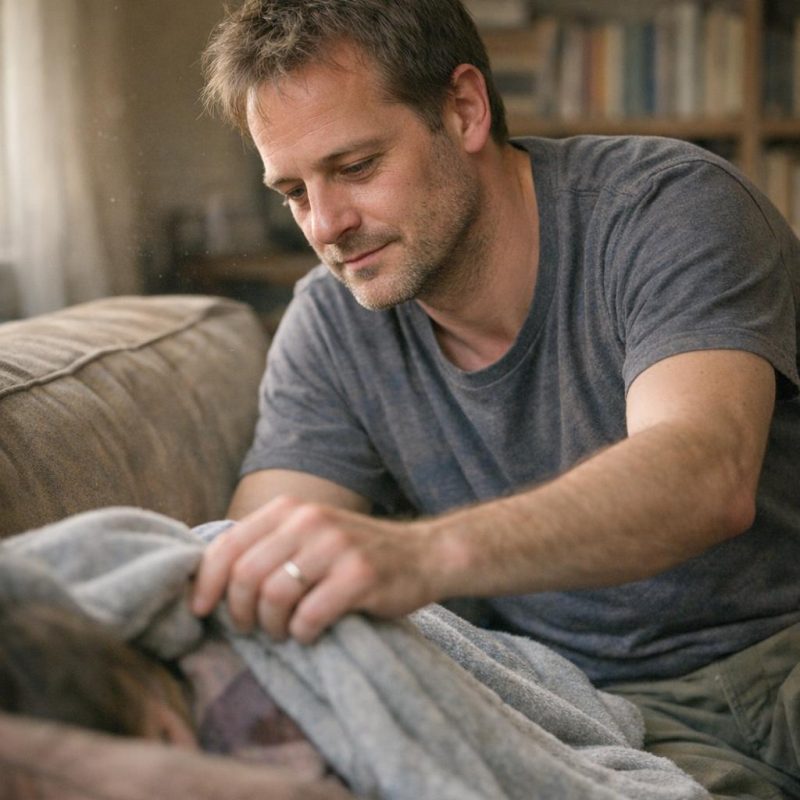 Image by RM AI
She Asks for Forgiveness
On the eighth day, she woke more lucid than she'd been in weeks. Her eyes focused on David's face, and I saw recognition there—real recognition, not the confused half-awareness we'd seen before. 'David,' she whispered, her voice barely audible. He leaned in close, taking her hand. 'I'm here, Mom.' She looked at him for a long moment, tears sliding down her hollowed cheeks. 'I'm so sorry,' she said. 'For everything. For all the years. For what I did to you.' Her breathing was labored, each word an effort. 'I couldn't stop it. I tried, but I couldn't stop it.' David's jaw clenched, and I saw him fighting to keep his composure. I squeezed his other hand, and he glanced at me briefly before turning back to his mother. The silence stretched out, heavy with decades of pain and confusion and love twisted into something unrecognizable. I could feel him wrestling with it—all the anger, all the hurt, all the years of protecting himself from her while also protecting her from the world. David's hand trembled in mine, and after a long silence, he whispered, 'I forgive you, Mom.'
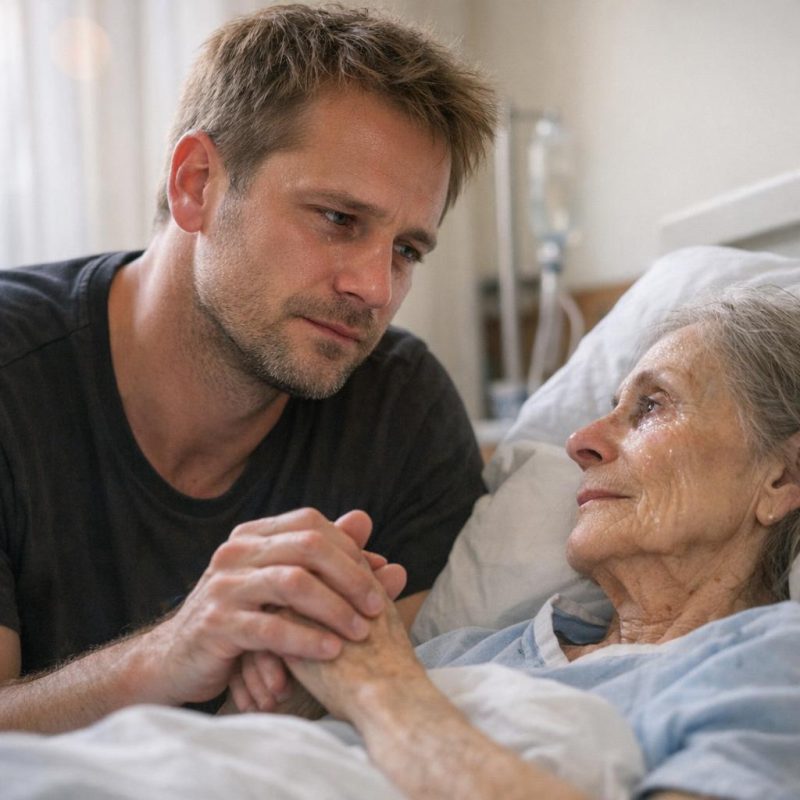 Image by RM AI
She Asks About Children
The next afternoon, she was awake again, more tired but still present. She watched us moving around the apartment, and something in her expression softened. 'Do you have children?' she asked suddenly, looking between David and me. I felt the question like a punch to the stomach. David went very still beside me. 'No,' he said quietly. 'We don't.' She nodded slowly, seeming to understand something unspoken. 'I always wanted to be a grandmother,' she said, her eyes distant. 'I used to imagine it, before everything got so bad.' I had to look away, blinking back tears. This was the wound that wouldn't heal, the loss we couldn't share with anyone because we were still processing it ourselves. David sat down on the edge of her bed, and I saw his shoulders shake slightly. 'We tried,' he said, his voice thick. 'For three years. It just never happened.' His mother's face crumpled, and she reached out with surprising strength to grasp my hand. Her fingers were cold and thin, but her grip was firm. David's voice cracked as he said no, and his mother reached for my hand, whispering, 'I'm sorry I took so much from him.'
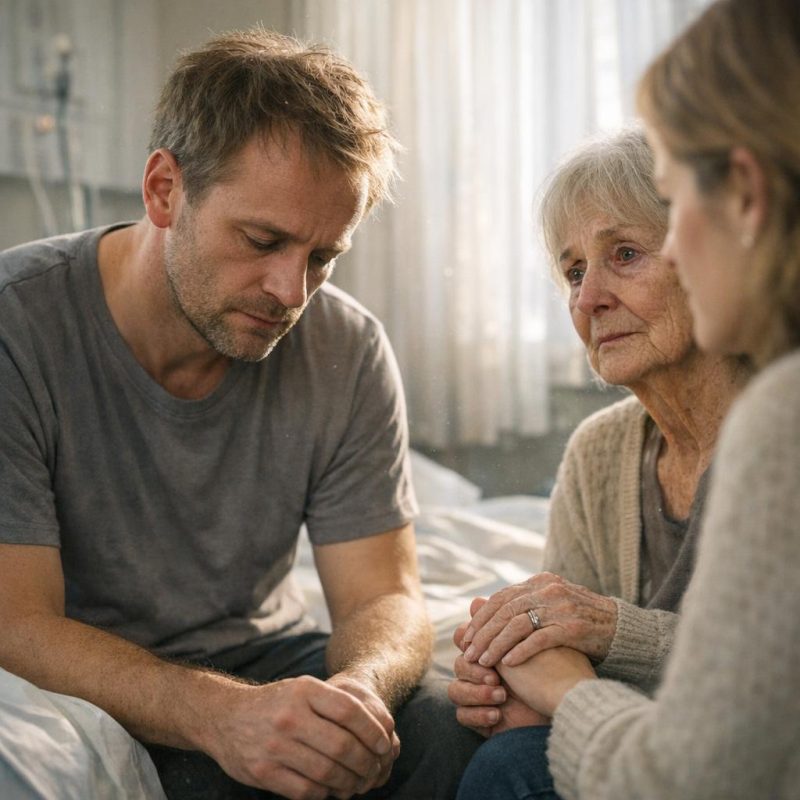 Image by RM AI
The Last Conversation
Two days later, she rallied one more time. David was reading to her from a book of poetry she'd loved when he was young, and halfway through a verse, she opened her eyes and smiled. Really smiled—the first genuine, full smile I'd seen from her. 'You turned out so good,' she said, interrupting him. 'So much better than you should have, with me as your mother.' David set the book down, his hand shaking. 'Mom, don't—' 'No, let me say it,' she insisted, her voice stronger than it had been in days. 'I ruined so many years. I hurt you in ways no child should be hurt. But look at you.' She gestured weakly toward me. 'You found someone who loves you. You built a life. You became kind.' Tears streamed down David's face. 'I had good days to learn from,' he said. 'You taught me everything good before the illness took over.' She shook her head slightly. 'The illness was always there, David. I just hid it better when you were small.' She closed her eyes, exhausted from the effort of speaking. 'You deserved better than me,' she breathed. 'But you found better—you found her.'
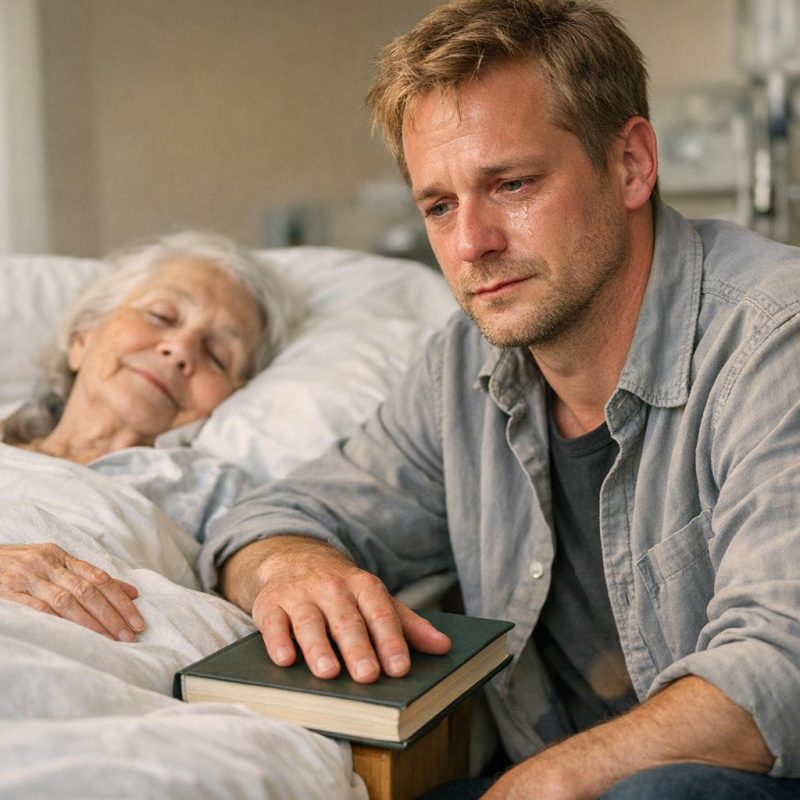 Image by RM AI
The Final Night
That night, everything changed. Her breathing shifted—becoming shallow and irregular, with long pauses that made my heart stop until the next breath came. The hospice nurse arrived around ten PM, listened with her stethoscope, checked vitals, and then pulled us aside. 'It's time,' she said gently. 'Her body is shutting down. It could be an hour, could be several hours, but it won't be long.' She adjusted the morphine drip to keep her comfortable, showed us what to watch for, and told us she'd return in a few hours to check in. After she left, the apartment felt impossibly quiet except for the ragged sound of his mother's breathing. David sat frozen, staring at her, and I realized he'd been preparing for this moment for months but still had no idea how to face it. I pulled a chair close to the bed on one side, and after a moment, David did the same on the other. We didn't speak. There was nothing left to say. I reached across and found David's hand, and together we reached for hers. David and I pulled chairs close to her bed and each took one of her hands, prepared to stay until the end.
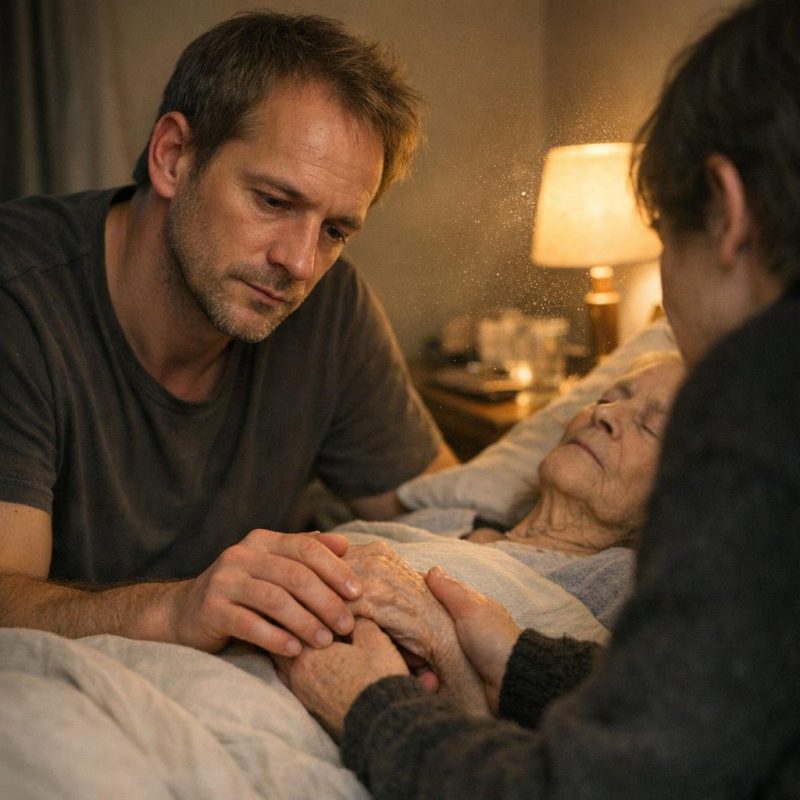 Image by RM AI
She Passes
The hours blurred together in the darkness. We sat holding her hands, listening to her breathing grow slower and more shallow. David talked to her softly, telling her it was okay to let go, that he'd be alright, that she could rest now. I don't know if she heard him, but I like to think she did. Around five-thirty in the morning, as the first gray light started seeping through the curtains, her breathing changed one final time. The pauses grew longer. Each breath seemed like it might be the last. David was crying silently, his thumb stroking the back of her hand. I was crying too, for this woman I barely knew, for the mother she'd been and the mother the illness had stolen from David. And then, so quietly I almost missed it, she simply stopped breathing. There was no dramatic final moment, no last words. She just slipped away between one breath and the next, her face finally peaceful. The hospice nurse arrived twenty minutes later and confirmed what we already knew. David collapsed against me, sobbing in a way I'd never heard before—grief and relief and exhaustion all pouring out at once. As the hospice nurse confirmed her death, David broke down completely, and I realized the secret apartment hadn't torn us apart—the truth within it had stripped away our last walls.
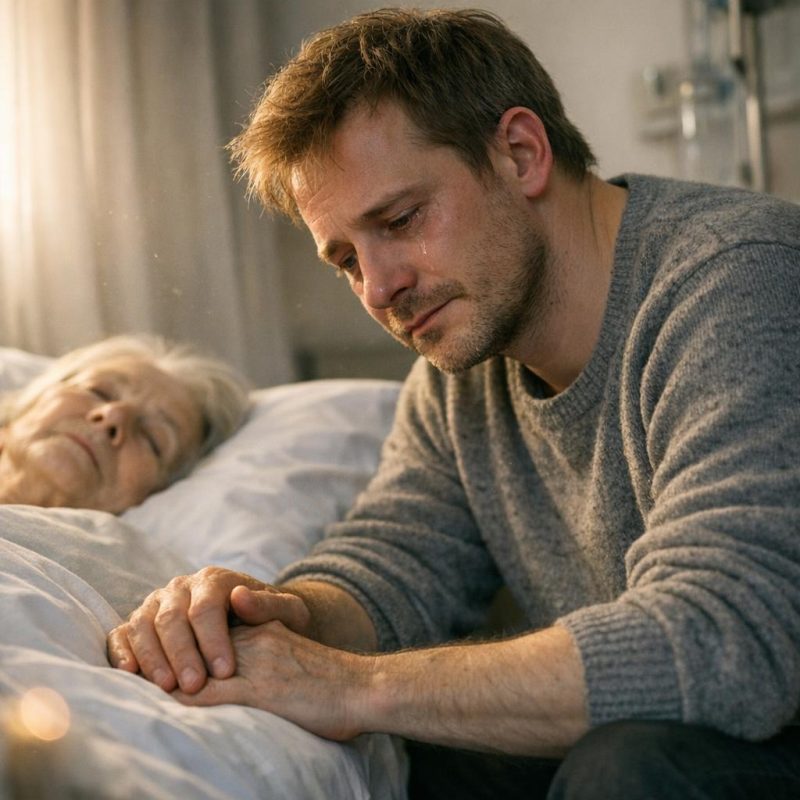 Image by RM AI
The Morning After
We sat there for over an hour after the hospice nurse left, neither of us knowing what to do next. The apartment felt different now—quieter somehow, despite it always having been quiet. David kept touching things: the edge of the hospital bed, the chair where he'd spent so many nights, the blanket that still held the impression of her body. I watched him move through the space like he was trying to memorize it, or maybe trying to understand what these past months had meant. 'I hated this place,' he said finally. 'Every single time I walked through that door, I felt like I was suffocating. But now...' He trailed off, looking around the sparse room. I understood what he couldn't say. This apartment had been his burden and his salvation, the place where he'd faced the worst parts of his past and somehow survived them. I thought about all those nights I'd imagined him here with another woman—candles and wine and tangled sheets. The reality was so much harder and sadder and more human than any affair could have been. I looked around the sparse room that I'd once imagined as a love nest and saw it for what it truly was—a deathbed sanctuary built from duty and love.
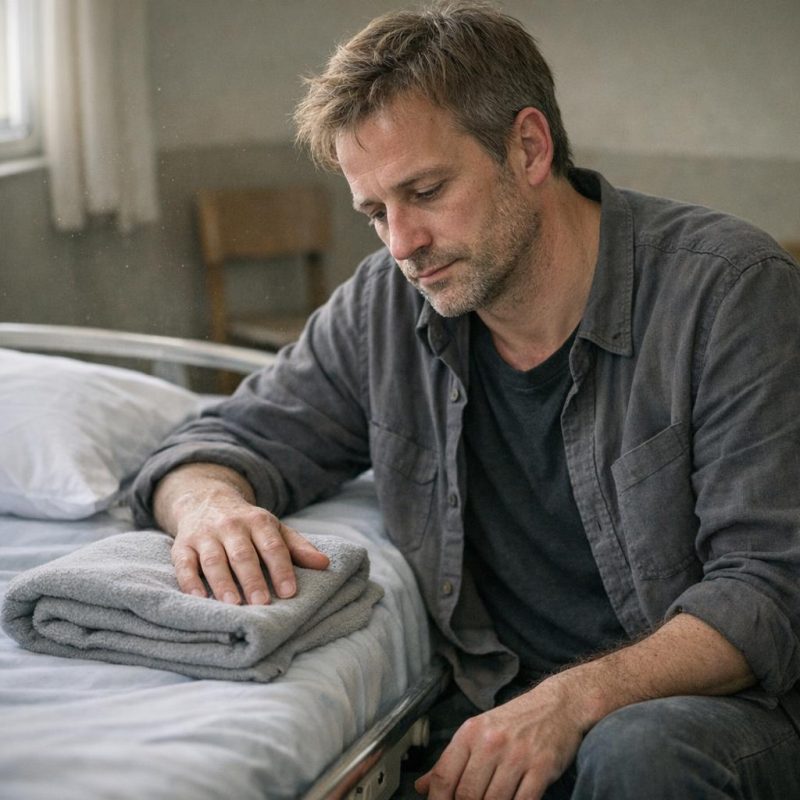 Image by RM AI
Meeting Ms. Hartley
Ms. Hartley arrived around nine that morning with paperwork and a gentle efficiency that felt both professional and kind. She was maybe fifty, with gray streaks in her dark hair and eyes that had clearly seen a lot of difficult situations. She went through the necessary forms with David, explaining each one patiently while he signed with shaking hands. I made coffee that nobody drank and tried to stay out of the way. But then Ms. Hartley paused and looked at David with something like admiration. 'I want you to know,' she said, 'that what you did for your mother was extraordinary. Most adult children in situations like this—with the kind of history you had—they choose differently. They find facilities, they distance themselves, and nobody blames them. But you showed up.' David's eyes filled with tears. 'I don't feel extraordinary,' he said. 'I feel exhausted.' 'I know,' she replied. 'But you gave her something precious at the end. You gave her your presence, even when it cost you everything.' She gathered her papers and stood to leave. 'Your mother was difficult,' Ms. Hartley said gently, 'but she died knowing she was loved. That's more than most people get.'
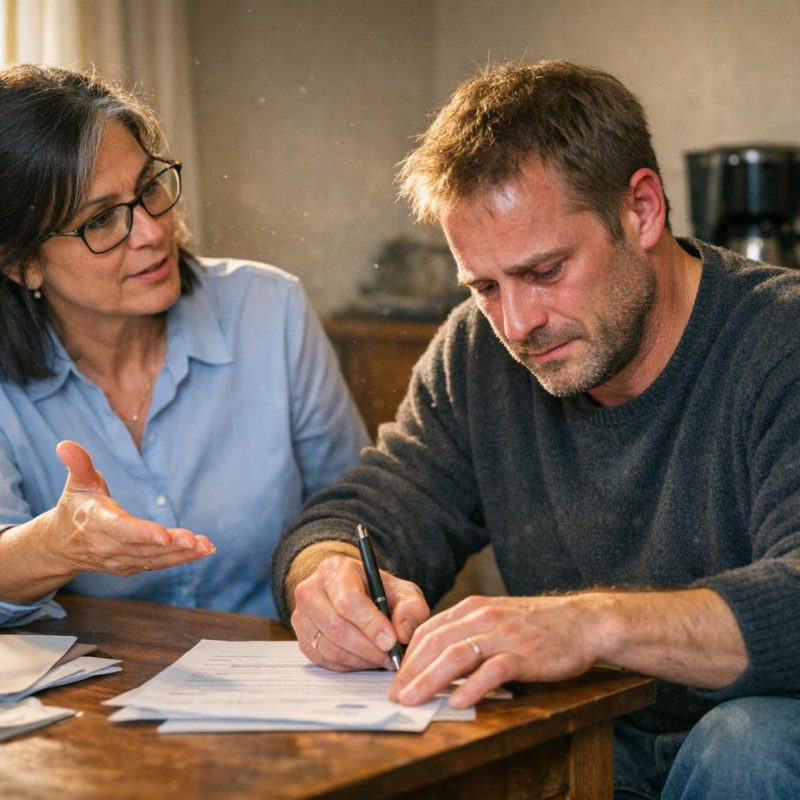 Image by RM AI
The Funeral
The funeral was three days later, just the two of us and Ellen, the night nurse who'd been with us at the end. David had no other family to notify, and his mother had long ago alienated anyone who might have cared. We stood at the graveside under a gray March sky that threatened rain but never delivered. The service was brief—a few words from the funeral director, a moment of silence, and then it was over. Ellen hugged David and told him he'd been a good son, which made him cry again. I stood beside him with my hand on his back, feeling the weight of everything we'd been through together. It wasn't the dramatic funeral you see in movies. There were no crowds of mourners, no eulogies about a life well-lived. Just the truth: a difficult woman who'd died, and a son who'd done his best despite everything she'd put him through. The simplicity of it felt right somehow—honest in a way that matched the whole painful journey. As they lowered her casket into the ground, David reached for my hand, and I felt the weight of his past finally beginning to lift.
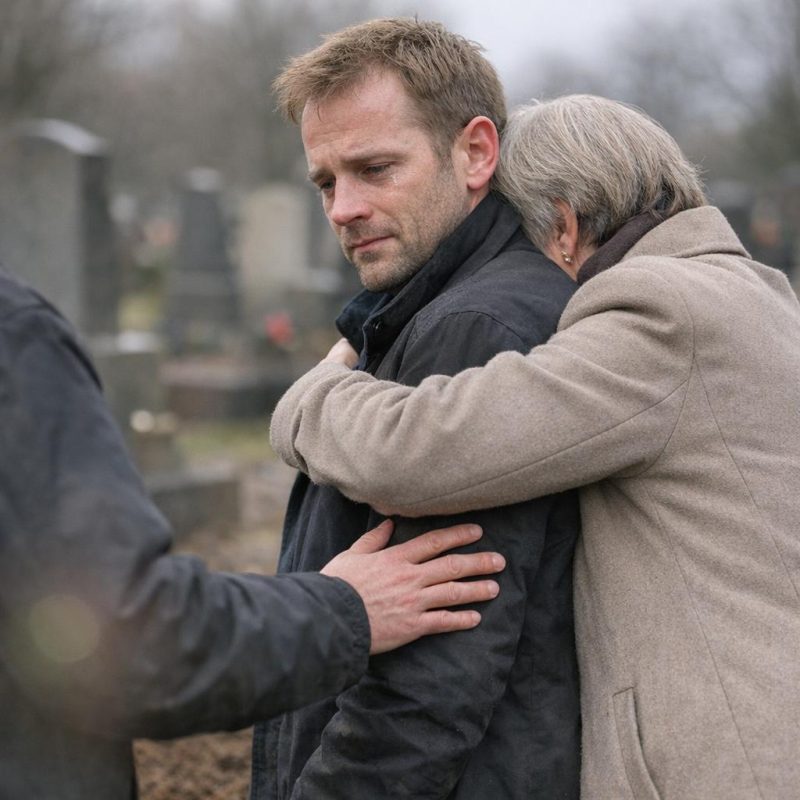 Image by RM AI
Cleaning Out the Apartment
We went back to the apartment the following weekend to pack up her things. It didn't take as long as I expected—she hadn't accumulated much during her time there. A few changes of clothes, some toiletries, the medications that were no longer needed. David moved through the task methodically, folding and sorting while I handled the kitchen supplies and linens. We didn't talk much, just worked side by side in comfortable silence. I found myself noticing little details I'd missed before: the way David had organized everything so carefully, the small touches that made the place less institutional. A soft blanket. Good pillows. A small plant on the windowsill that had somehow survived. In the drawer of the bedside table, tucked under some old magazines, I found a photograph in a cracked frame. David as a child, maybe five or six years old, on a swing at a playground. He was laughing, his face lit up with pure joy, and his mother—young and smiling—stood behind him, mid-push. I showed it to David, and he stared at it for a long moment. 'I forgot,' he whispered. 'I forgot there were days like this.' Among her things, we found a photo of David as a little boy, smiling on a swing—proof that there had been good days once.
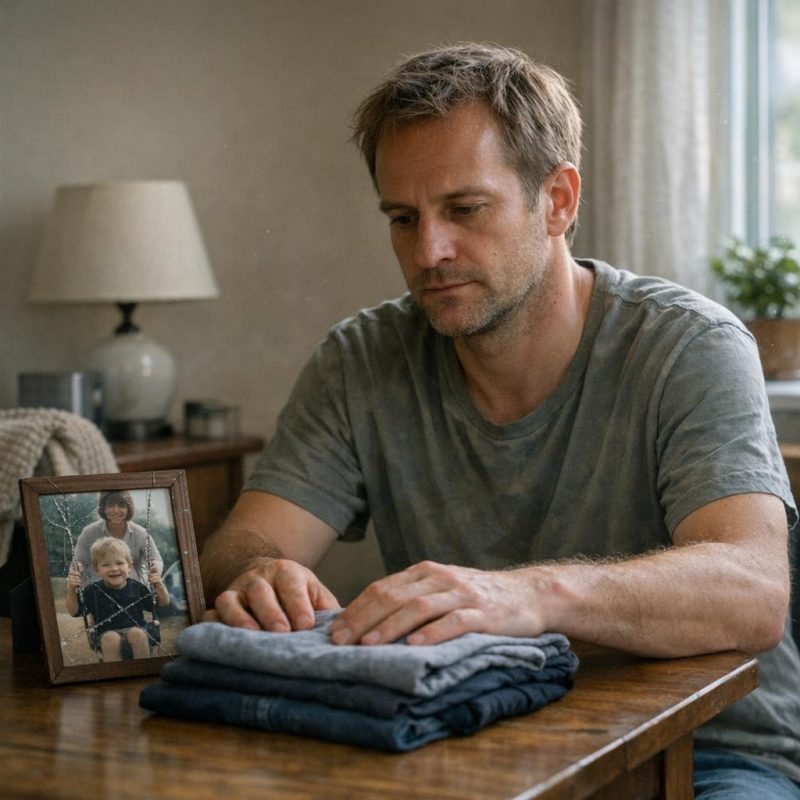 Image by RM AI
Returning the Keys
The landlord met us downstairs when we'd finished. David handed over the keys without ceremony, just a simple exchange and a receipt for the security deposit. I watched him stand there for a moment, looking up at the building that had dominated his life for months. His shoulders, which had been hunched and tense for so long, seemed different now—straighter somehow, lighter. We'd loaded the few items we were keeping into the car: the photo, a few of her books, some documents David needed. Everything else had been donated or thrown away. As we walked toward the car, David stopped and took a long breath. The kind of breath you take when you've been holding tension in your chest for so long you've forgotten what it feels like to fully exhale. 'It's over,' he said, more to himself than to me. I took his hand, and we stood there together on the sidewalk, looking at the ordinary apartment building that had held so much pain and revelation. As we walked away from the building for the last time, David said, 'I feel like I can breathe again.'
 Image by RM AI
Talking About the Future
That night, we ordered takeout and ate it on the couch like we used to do before everything happened. Before the suspicions, before the apartment, before I knew the truth. Except now everything was different in the best possible way. We weren't pretending things were fine or avoiding difficult topics. We were just... together. Really together, maybe for the first time in years. 'I've been thinking,' David said, setting down his container. 'About what we want. What I want.' I waited, my heart suddenly beating faster. 'I spent so many months just surviving,' he continued. 'Getting through each day, dealing with her care, managing the stress. I forgot to think about the future. Our future.' He turned to face me fully. 'I want us to build something good, Vanessa. I want to be the husband you deserve. And I want...' He paused, swallowing hard. 'I want to try again for a baby, if you still want to. I know I shut down before, and I'm sorry. But I'm ready now. I want a family with you.' 'I want to try again,' David said quietly. 'For a baby. If you still want to.'
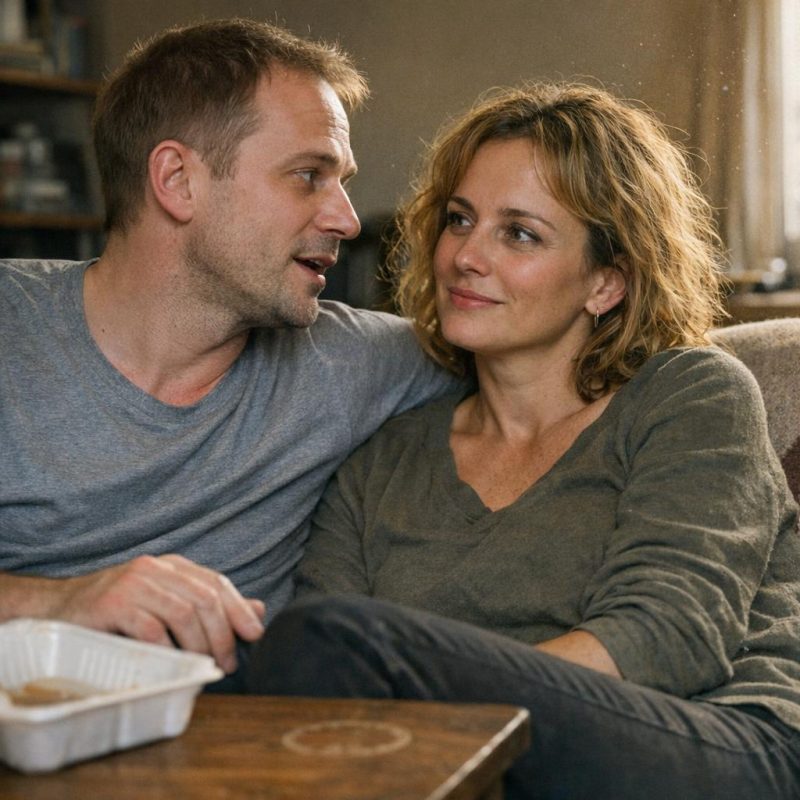 Image by RM AI
Telling Rachel Everything
I met Rachel for coffee the next morning and told her everything—from his mother's death to the funeral to David's conversation about trying for a baby again. She sat across from me, her eyes wide, occasionally interjecting with questions or gasps. When I finished, she reached across the table and squeezed my hands. 'My God, Vanessa,' she said. 'When you first told me about the apartment, I thought... I mean, we both thought it was an affair. But this? This is so much bigger than that.' 'I know,' I said. 'I keep thinking about how wrong I was, how I nearly destroyed everything by jumping to conclusions.' 'But you didn't,' Rachel pointed out. 'You found the truth. And more importantly, you stayed. You showed up for him when he needed you most.' She wiped at her eyes, getting emotional in that way Rachel does when she's moved by something. 'Most people would have run. The secrets, the lies, the burden of caring for someone who was abusive to him—that's heavy stuff. But you two fought your way through it together.' Rachel wiped away tears and said, 'Vanessa, you and David just survived something most marriages couldn't handle. You're going to be okay.'
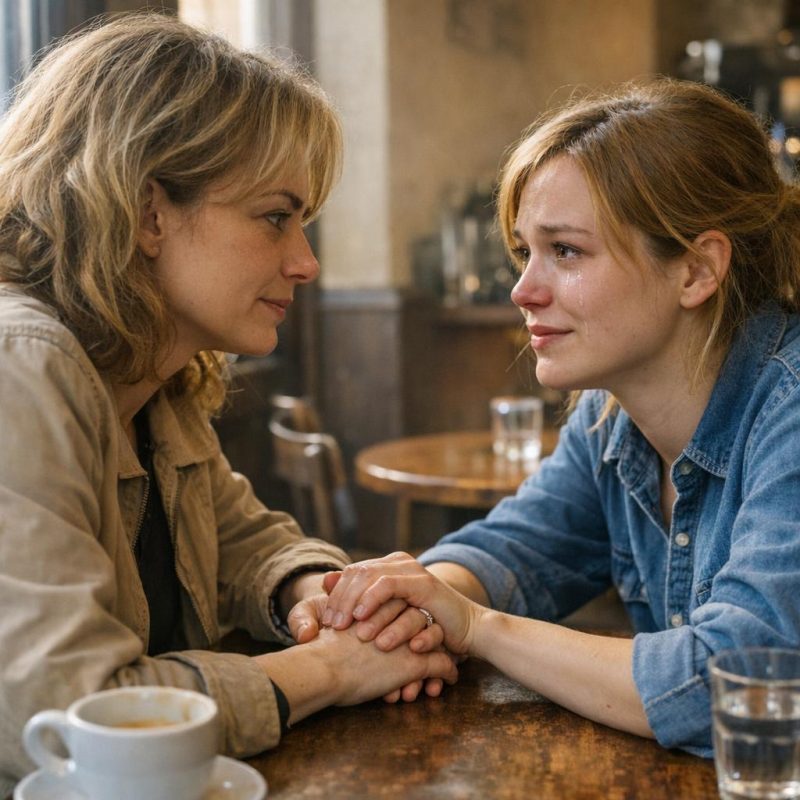 Image by RM AI
David Opens Up to a Therapist
Two weeks later, David came home and told me he'd scheduled an appointment with a therapist. I'd mentioned it gently a few times—that maybe talking to someone could help him process everything with his mother—but I'd never pushed. This was his decision, made on his own terms. 'I need to do this,' he explained. 'Not just for me, but for us. For the family we want to have.' I told him I was proud of him, which made him tear up a little. His first session was on a Thursday afternoon. I tried not to hover when he got home, but I was desperate to know how it went. He came through the door looking exhausted but somehow peaceful. We sat on the couch, and he told me bits and pieces—how hard it was to talk about his childhood, how the therapist helped him see patterns he'd never recognized. 'She said it's going to take time,' he told me. 'That trauma like mine doesn't just disappear. But she thinks I can work through it, that I can learn to let it go.' He took my hand and looked at me with clear eyes, the kind of clarity I hadn't seen in months. After his first session, he came home and told me, 'I think I'm going to be okay. I think we're going to be okay.'
 Image by RM AI
The Anniversary
Our ninth wedding anniversary fell on a crisp October evening, almost six months after David's mother died. We went back to the same restaurant where he'd proposed—he'd made reservations weeks in advance, which felt significant given how we'd barely been planning beyond the next day for so long. I wore the blue dress he'd always loved, and he wore the tie I'd bought him for our fifth anniversary. We looked like any other couple celebrating, except we both knew we'd almost lost each other. During the main course, we talked about his therapy sessions, how he was slowly unpacking years of guilt and shame. He told me his therapist had said something that stuck with him: 'You can't heal what you hide.' I squeezed his hand across the table, feeling the weight of those words settle between us. We'd both been hiding things—him his pain, me my suspicions—and it had nearly destroyed everything. But we'd survived. We'd chosen honesty over comfort, truth over pretense. When dessert arrived, David raised his glass, his eyes bright with emotion. 'To secrets that brought us closer instead of tearing us apart.'
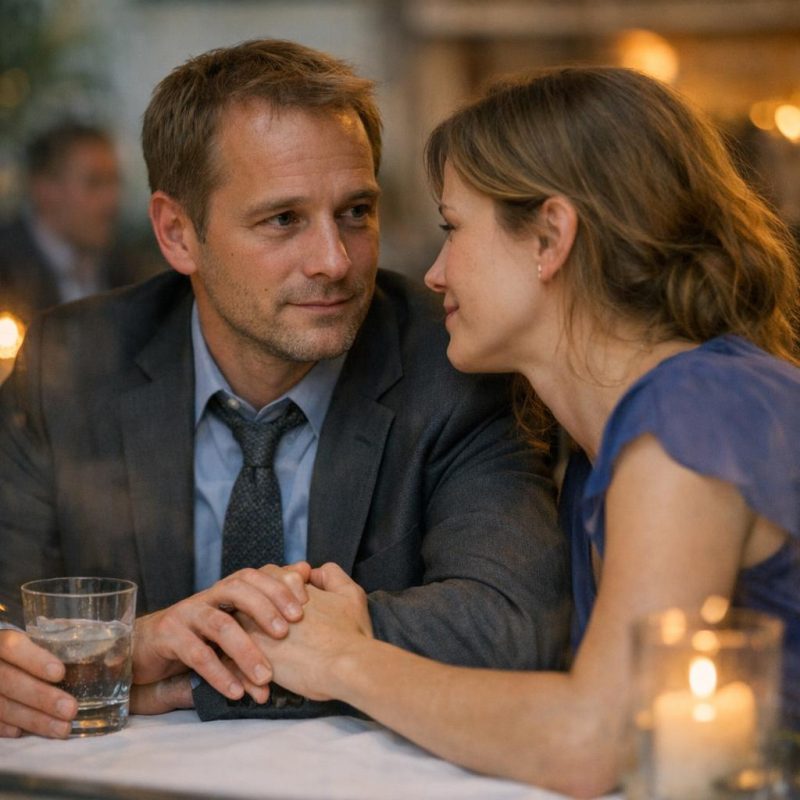 Image by RM AI
The Positive Test
Three months after his mother's death, I woke up feeling nauseous on a Tuesday morning. I'd felt off for a few days but dismissed it as stress or bad takeout. Then I realized my period was late—really late. I didn't want to get my hopes up. We'd been down this road so many times before, month after month of disappointment and silent grief. But something felt different this time. I drove to the pharmacy during my lunch break, hands shaking as I paid for the test. In our bathroom that evening, I waited the longest three minutes of my life. When I looked down and saw two pink lines—clear, unmistakable—I actually gasped out loud. After years of negatives, after all the specialists and procedures and heartbreak, there they were. Two lines. I sat on the bathroom floor and just stared at it, terrified it would disappear if I blinked. David knocked on the door asking if I was okay. I showed David the test with shaking hands, and we both cried—this time, tears of pure joy.
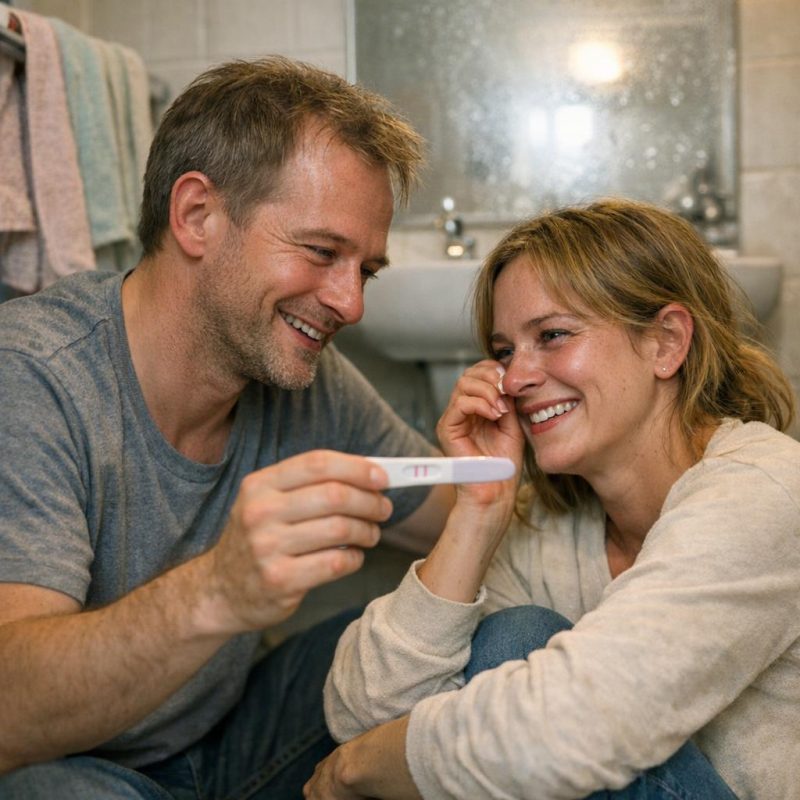 Image by RM AI
Looking Forward
The pregnancy felt surreal at first, like something that might vanish if we acknowledged it too loudly. But as weeks turned into months and my belly began to swell, we slowly allowed ourselves to believe. David came with me to every appointment, his hand gripping mine as we heard the heartbeat for the first time. We cleared out the spare room—the one he'd always avoided because it was supposed to be a nursery—and painted it a soft yellow. He assembled the crib himself, reading instructions with intense concentration, determined to get every piece perfect. One evening, as we folded tiny onesies together, he told me about a session with his therapist where they'd discussed breaking generational cycles. 'She asked me what kind of father I want to be,' he said quietly. 'And I realized I actually know. I know exactly what I don't want to repeat.' I watched him smooth his hand over a miniature blanket, his face thoughtful. We were both scared, both aware of the responsibility ahead. But we were also ready—maybe for the first time in our lives, truly ready. David placed his hand on my growing belly and said, 'I'm going to be a better parent than I had. I promise.'
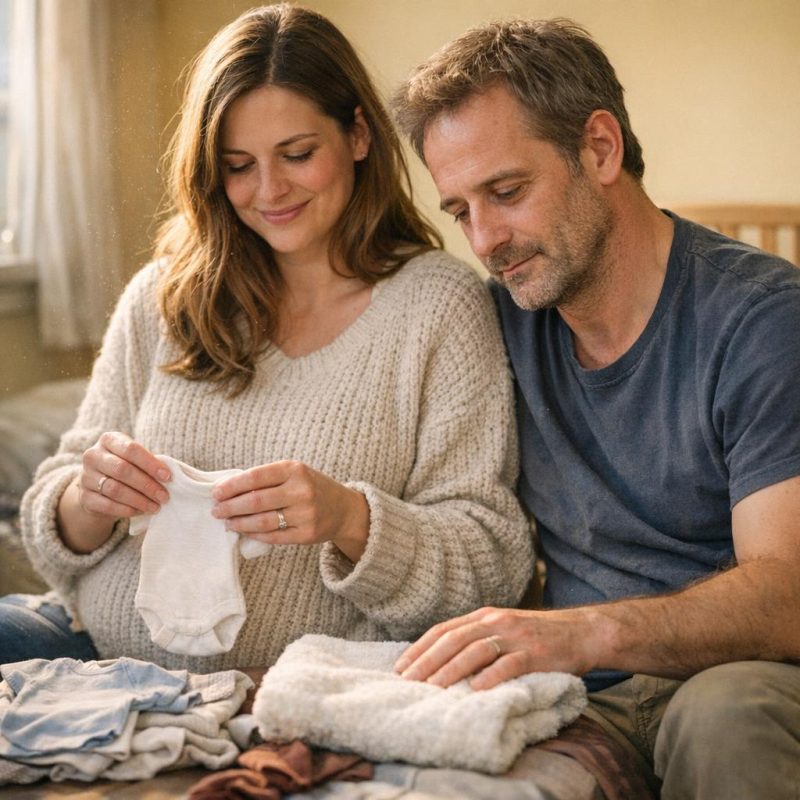 Image by RM AI
The Truth That Saved Us
Looking back now, I can see how everything had to unfold exactly as it did. The secret apartment, the surveillance photos, the confrontation in that bare living room—they were all necessary steps toward understanding who we really were. That apartment could have ended us. It should have ended us, honestly. What wife discovers her husband's been keeping a second residence and doesn't immediately file for divorce? But sometimes the things that should break us become the foundation for something stronger. David's secret wasn't about another woman or a double life—it was about survival, about a man trying to process trauma he'd never learned to name. And my response wasn't about forgiveness or naivety—it was about choosing to see the whole person, not just the parts that fit my expectations. We're not perfect now. We still have hard days. But we face them together, with honesty instead of hiding. Our daughter will grow up in a home where truth isn't something to fear, where vulnerability is strength, where love means showing up even when it's difficult. I thought I knew everything about David, but the truth was, I didn't know him at all—not until I learned his darkest secret and loved him anyway. And that's what real marriage is: choosing each other even when the truth is harder than the lie.
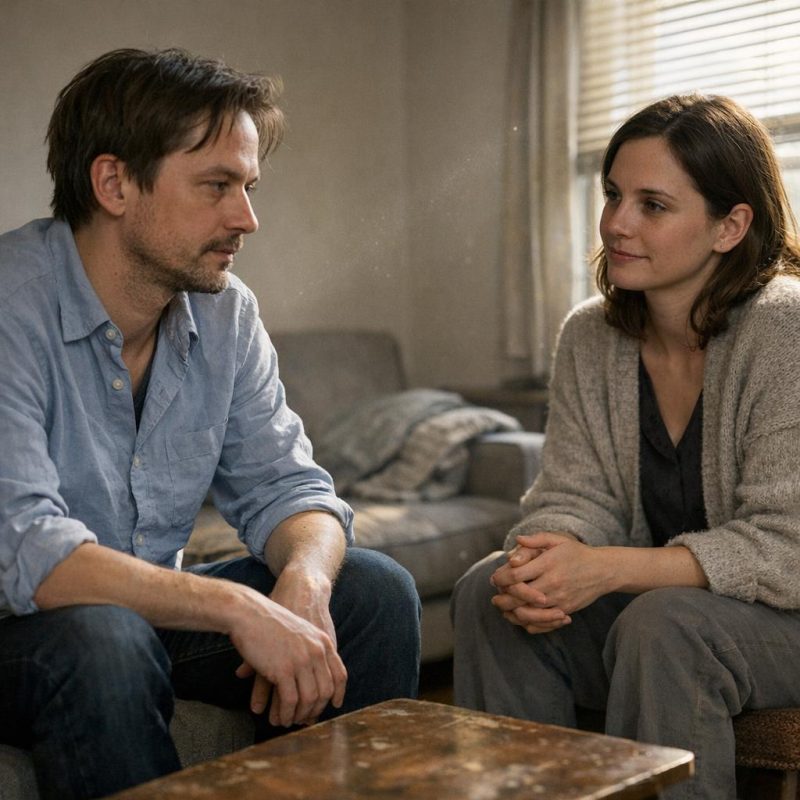 Image by RM AI
KEEP ON READING

The story of Ching Shih, the Woman Who Became the…
Unknown author on WikimediaFew figures in history are as feared…
By Emilie Richardson-Dupuis Dec 29, 2025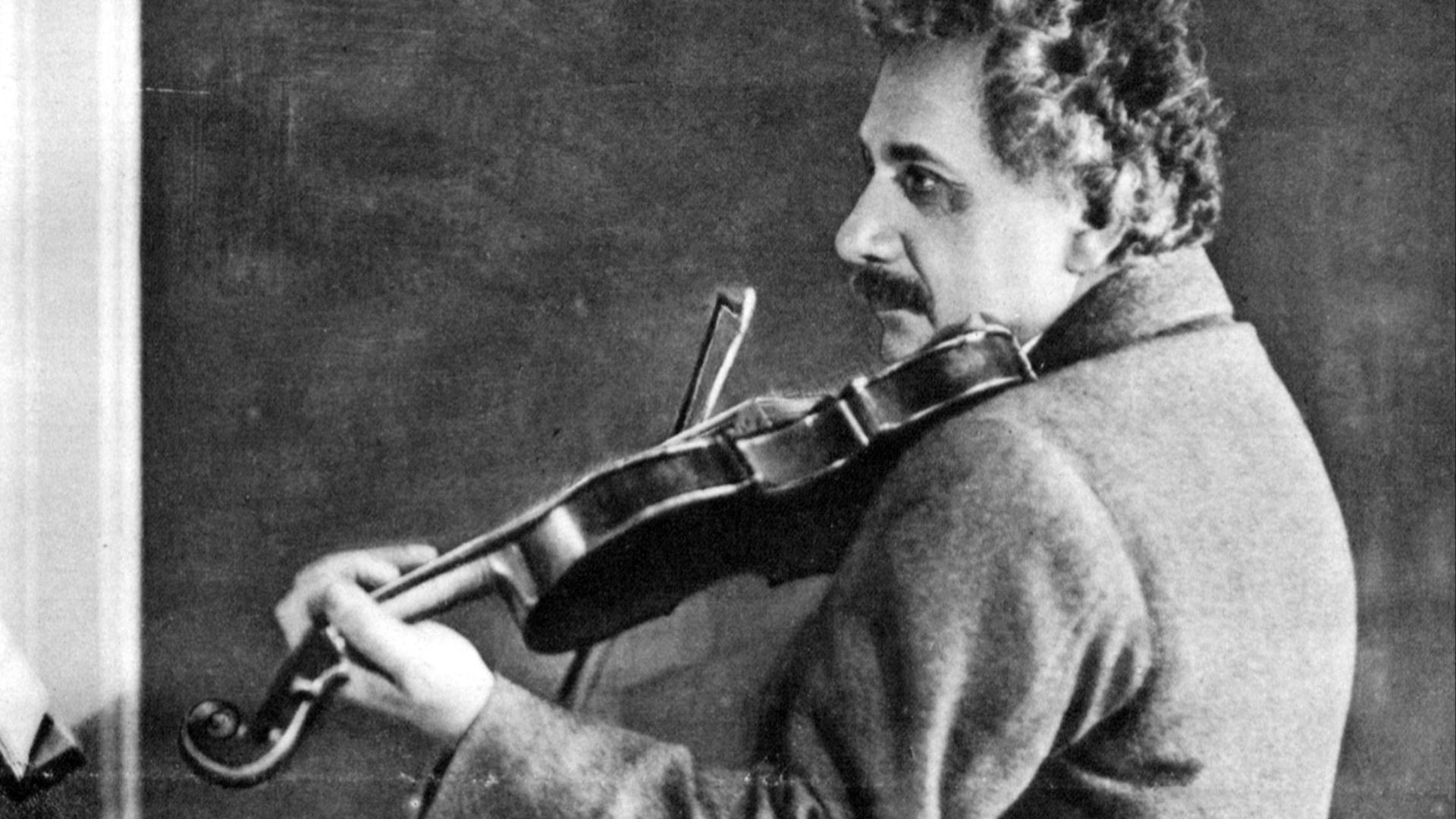
Einstein's Violin Just Sold At An Auction—And It Earned More…
A Visionary's Violin. Wanda von Debschitz-Kunowski on WikimediaWhen you hear…
By Ashley Bast Nov 3, 2025
This Infamous Ancient Greek Burned Down An Ancient Wonder Just…
History remembers kings and conquerors, but sometimes, it also remembers…
By David Davidovic Nov 12, 2025
The Mysterious "Sea People" Who Collapsed Civilization
3,200 years ago, Bronze Age civilization in the Mediterranean suddenly…
By Robbie Woods Mar 18, 2025
The Story of Marie Antoinette & Axel von Fersen’s “Forbidden…
Metro-Goldwyn-Mayer (MGM) on WikimediaVersailles didn’t just produce policy and pageantry;…
By Emilie Richardson-Dupuis Feb 19, 2026
20 Soldiers Who Defied Expectations
Changing the Rules of the Battlefield. You’ve probably heard plenty…
By Annie Byrd Feb 10, 2026