

A Woman Stole My $3,000 Resort Bed and Drank My 'Blue Cocktail.' When I Told Her What It Really Was, She Ran. Then I Discovered Who She Actually Was.
A Woman Stole My $3,000 Resort Bed and Drank My 'Blue Cocktail.' When I Told Her What It Really Was, She Ran. Then I Discovered Who She Actually Was.
Arrival at Paradise
Six months of planning, three connecting flights, and one very patient carry-on bag full of prescription bottles — and I was finally here. The Caribbean resort had looked almost too good to be true in the brochure photos, but standing at the entrance with the salt air hitting my face, I had to admit they hadn't lied. White sand so fine it looked like powdered sugar. Water so blue it seemed digitally enhanced. I'd booked this trip with the kind of desperation that only comes after a long stretch of hospital rooms and fluorescent lighting, and every step through the open-air lobby felt like proof I'd made the right call. I moved carefully — I always move carefully now — through the main pool area and followed the discreet signage toward the Diamond Tier private section. The noise dropped off almost immediately. Fewer people, more shade, the soft percussion of overhead misting fans. I found bed 14 exactly where the resort map said it would be, tucked behind a curtain of UV-blocking fabric in the most secluded corner of the enclosure. I lowered myself onto the cushions slowly, the way my discharge paperwork had instructed, and let the cool mist from the overhead fans settle over my skin like something I hadn't realized I'd been waiting for.
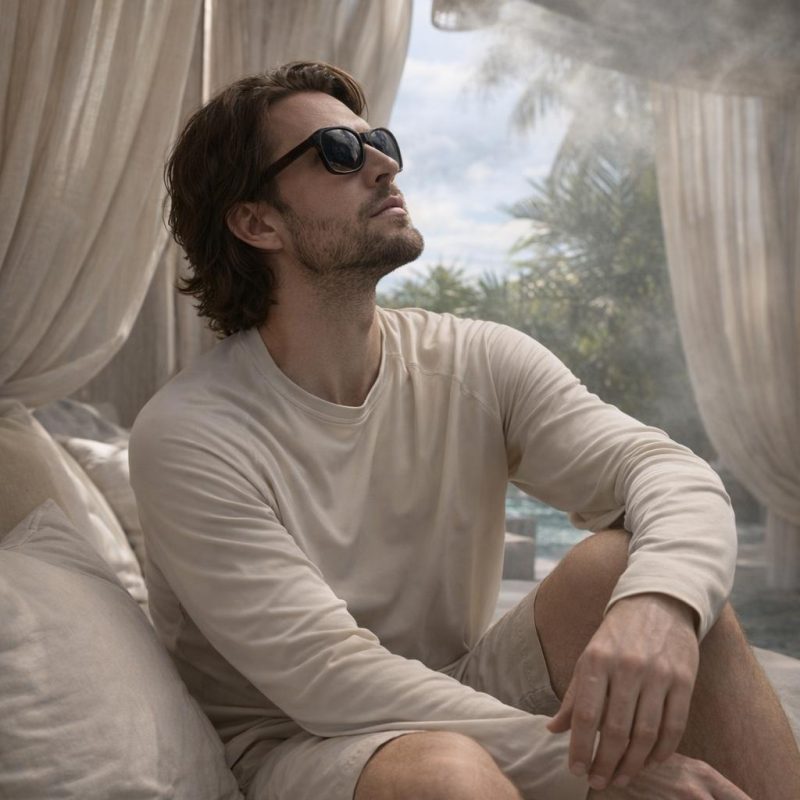 Image by RM AI
The New Normal
The first morning at the resort, I unpacked my medical supplies with the same methodical focus I'd developed over the past few months — everything in its place, everything labeled, nothing left to chance. The osmotic prep powder went on the bathroom shelf in order of dosing time. The UV-protective shirts hung in the closet by thickness. The written protocol sheet from Dr. Pierce's office got taped to the inside of the bathroom cabinet door, because I'd learned the hard way that 'I'll remember' is not a medical strategy. My days here were going to look nothing like a normal vacation. Three doses of the prep solution, timed at six-hour intervals. No direct sun exposure past fifteen minutes. Hydration logged by the hour. I'd made peace with all of it, mostly. There's a particular kind of discipline that sets in when your body stops being something you can take for granted, and I'd gotten pretty good at working within the new parameters. I laid out the powder packets in a row on the bathroom counter, counted them twice, and confirmed I had enough for the full two-week stay with four days of buffer. Then I set three alarms on my phone for the osmotic prep schedule.
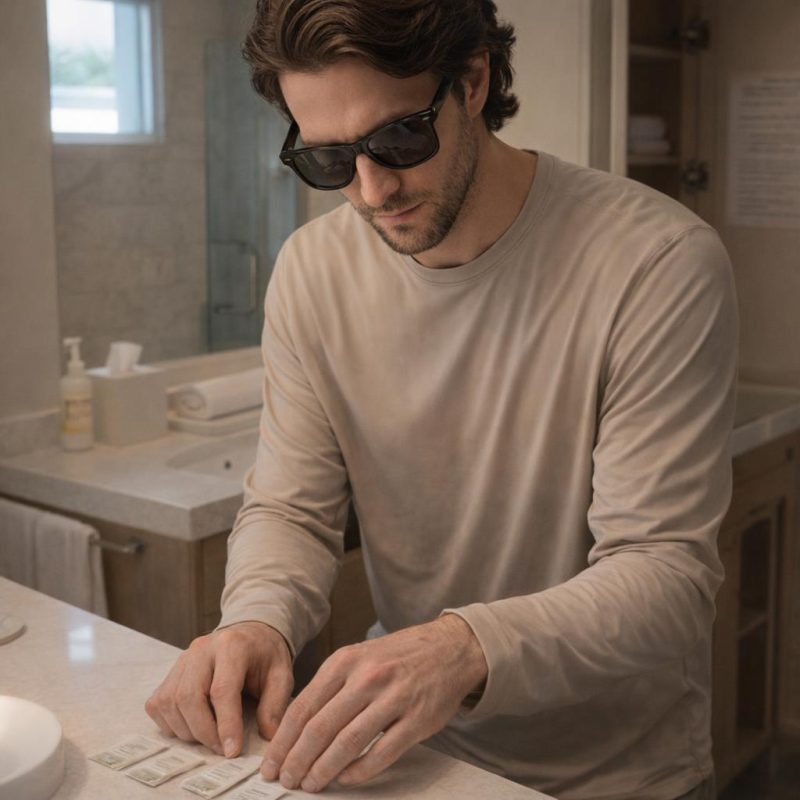 Image by RM AI
Dr. Pierce's Warning
Three weeks before the surgery, I'd sat across from Dr. Pierce in her office while she walked me through what the procedure would actually do to my body. She had a way of explaining things that was thorough without being condescending — reading glasses on, a printed diagram on the desk between us, her voice measured and precise. She told me the osmotic sensitivity was a known and permanent outcome of the procedure. Not a side effect, she was careful to say. A consequence. My body's ability to regulate fluid absorption would be altered in ways that required ongoing management. I asked her, somewhere in the middle of all that, whether I could travel during recovery. She didn't dismiss the question. She pulled up a list of resort properties that had been vetted for medical-grade accommodations — controlled environments, UV-rated shade structures, staff trained in guest privacy protocols. She circled one in the Caribbean and said the climate was actually favorable, as long as I followed the schedule without exception. I told her I understood. She looked at me over the top of her reading glasses for a moment before she said anything else. 'The surgery itself,' she said, 'will be the easy part. The recovery is where most people underestimate what they're dealing with.' Sitting on bed 14 now, watching the mist drift through the shade curtains, I could still hear her saying it.
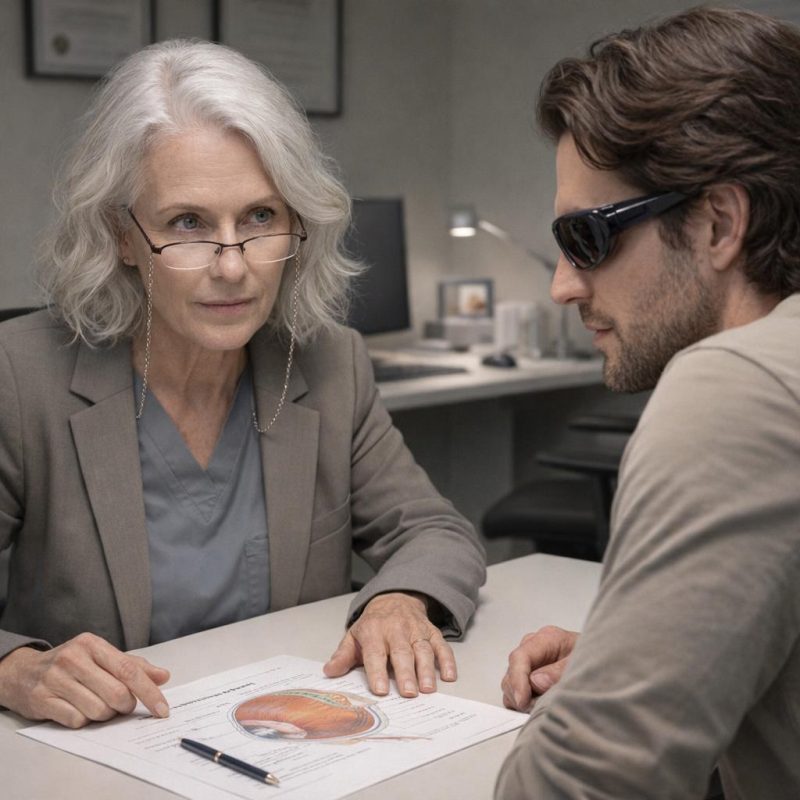 Image by RM AI
Diamond Tier Sanctuary
The Diamond Tier entrance was marked by a low wooden arch and a staff member with a tablet who checked my confirmation without making a production of it — exactly the kind of quiet efficiency I'd paid for. I walked through the main pool area, which was busy enough that I kept my sunglasses on and my pace steady, and followed the path around the far edge toward the private section. The difference was immediate. The noise softened. The crowd thinned to almost nothing. I counted six reserved beds in the enclosure, each one separated by panels of heavy shade fabric, each one positioned under its own misting unit. I found bed 14 in the far corner, the most sheltered spot in the section, and I stood there for a moment just taking stock. The cushions were thick — the kind of high-density foam that actually supports a body rather than just decorating a frame. The shade curtains on either side were adjustable, with a pull cord that let me angle them against the sun's movement. I tested the misting fan above the bed, confirmed it was working, and then began placing my things in the small side table compartments with the careful deliberateness of someone who has learned that a controlled environment doesn't stay controlled on its own. I ran my hand along the curtain fabric — dense, tightly woven, blocking the light completely where it overlapped.
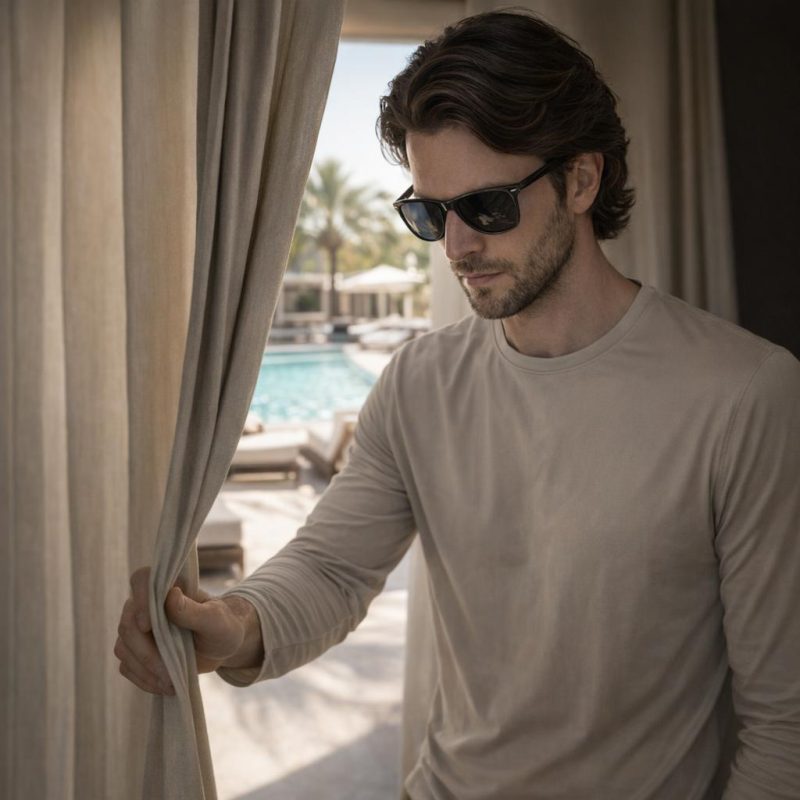 Image by RM AI
Medical Disclosure
She introduced herself as Diana, the wellness coordinator for Diamond Tier guests, and she had the particular manner of someone who had worked with medically complex guests before — calm, unhurried, no visible reaction when I started pulling prescription bottles out of my bag. I explained the light sensitivity first, then the hydration requirements, then the osmotic prep solution and its schedule. She took notes on a printed intake form without interrupting me once, which I appreciated more than I could easily explain. Partway through, a tall man in an immaculate resort uniform appeared at the edge of the cabana — Julian, the property manager, who Diana introduced with a brief nod. He reviewed the accommodation request form she handed him, asked two clarifying questions about the prep solution's storage temperature, and confirmed that the resort's system would flag my file for the relevant staff. I showed them both the prescription bottle and the individual powder packets so there would be no ambiguity later. Julian said the privacy protocols were standard for medical guests and that the pool staff would be briefed without being given specifics. It was the right answer, delivered without any of the awkward over-reassurance I'd gotten from other service staff in the past. Diana finished her notes, capped her pen, and I watched her write 'MEDICAL GUEST - SPECIAL PROTOCOLS' across the top of my file.
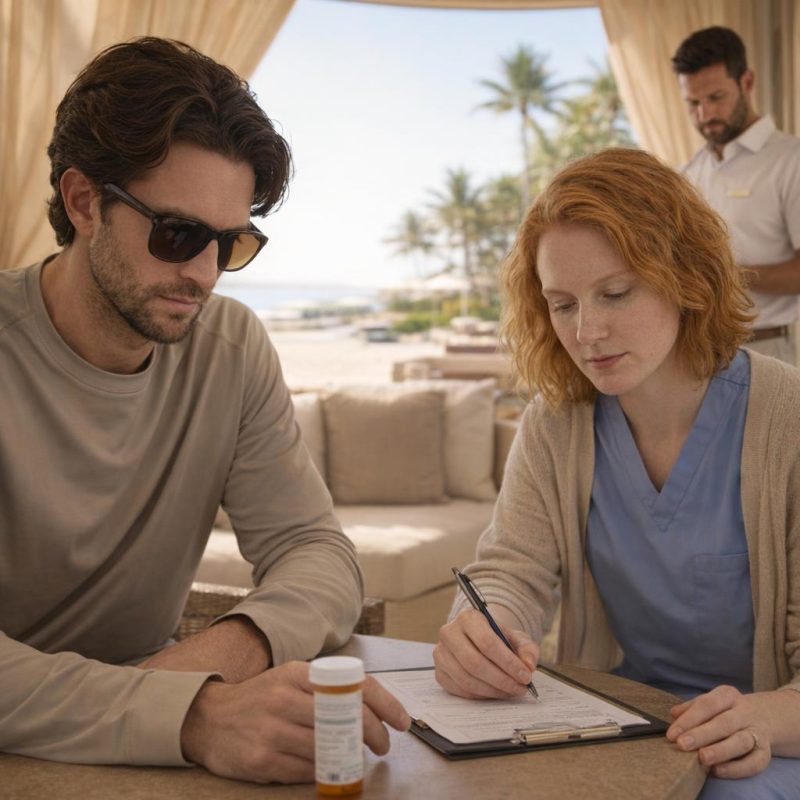 Image by RM AI
The Blue Ritual
The first time I mixed the prep solution at the resort, I did it at the small table beside bed 14 with the shade curtains drawn and my timer already set. The base was clear — just the osmotic solution measured into a tall resort glass — and on its own it looked like nothing more interesting than water. The blue electrolyte powder went in next, and that's where things got visually complicated. It dissolved into a color that sat somewhere between a swimming pool and a Blue Hawaiian cocktail, vivid enough that I'd startled myself the first time I'd made it at home. The taste was medicinal in a way that the powder only partially masked — functional, not pleasant, which was the honest summary of most things in my life at the moment. I set the timer for five minutes to let the powder fully dissolve, per Dr. Pierce's written instructions, and sat back to wait. The glass sat on the table looking genuinely festive, which struck me as absurd given what it actually was. I'd brought a small bag of paper cocktail umbrellas from home — a joke gift from a friend who thought the whole situation needed some levity — and I'd been going back and forth on whether to use them. I reached into the bag, pulled one out, and slid it into the glass. It helped, marginally. The drink still looked like medicine. It just looked like medicine at a party.
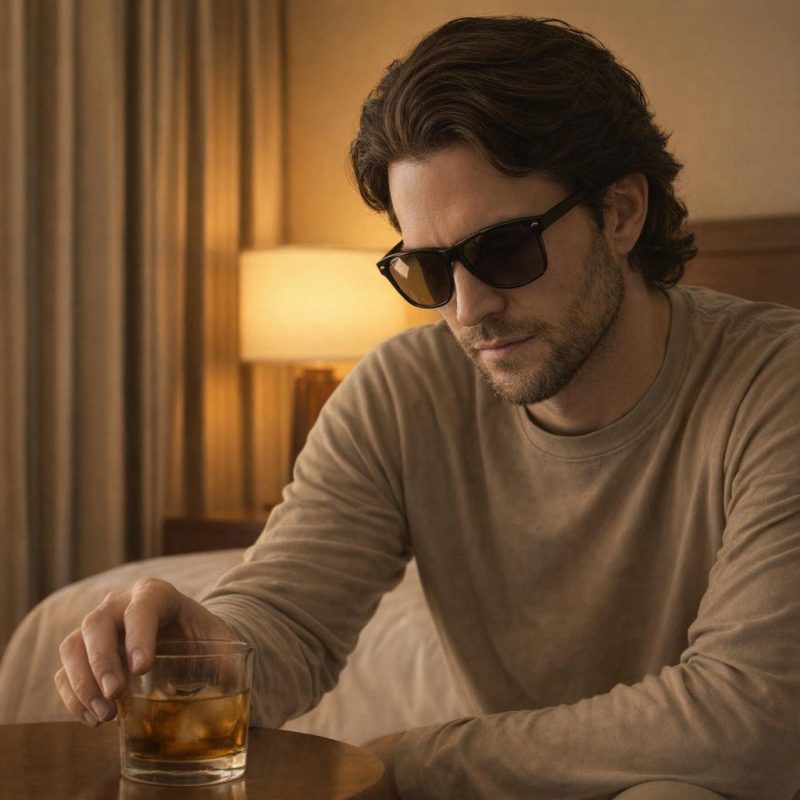 Image by RM AI
Private Paradise
On the second afternoon, I did a slow circuit of the private pool area — partly for the light exercise my discharge notes recommended, partly because I wanted to understand the layout of the space I'd be living in for the next two weeks. The cooling foot-wells near each bed cluster were a detail I hadn't noticed from the brochure, shallow basins of circulating chilled water positioned at the foot of each lounger. I tested one briefly and made a mental note to use it during the hottest part of the afternoon. The other Diamond Tier guests kept to themselves in the way that people who have paid for privacy tend to do — a nod here, a polite non-acknowledgment there, everyone maintaining the unspoken agreement that this section of the resort existed specifically so you didn't have to make conversation with strangers. I appreciated that more than I'd expected to. Near the end of my circuit, I noticed the small digital displays mounted at the foot of each bed — reservation screens, it turned out, showing the current guest's last name in clean white text on a dark background. I stopped at bed 14 and looked at the screen. 'Henderson' sat there in quiet, official letters, and something about seeing my own name on that display — documented, confirmed, belonging — settled something in me I hadn't known was still unsettled.
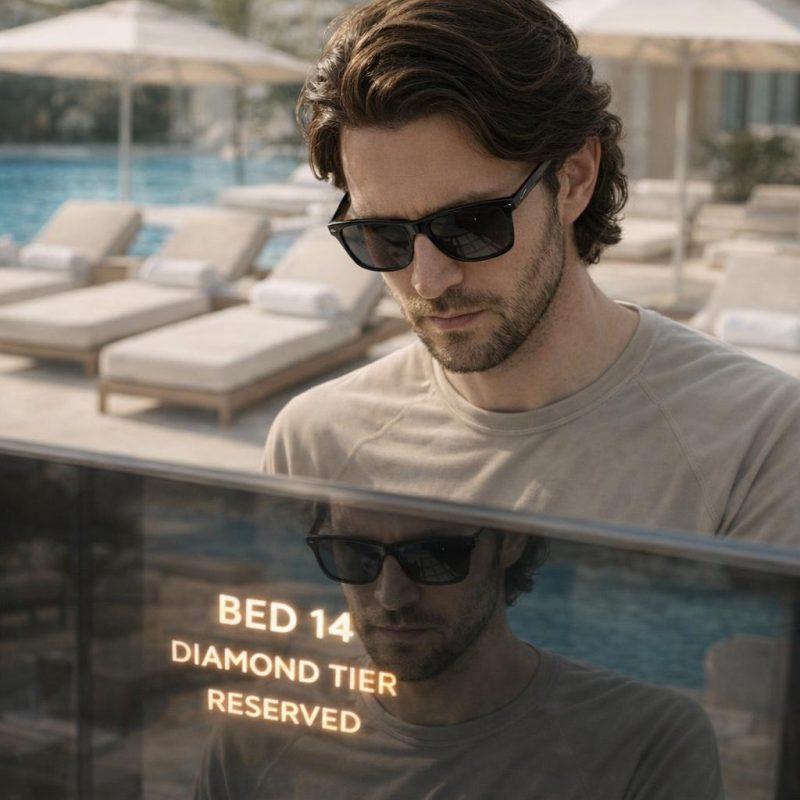 Image by RM AI
Julian's Attention
Julian came by bed 14 during the slow part of the afternoon, when the misting fans were doing most of the work and the private section had gone almost completely quiet. He didn't make an entrance of it — just appeared at the edge of the shade curtain, checked that I was awake, and asked if he could confirm a few details. He verified the misting fan temperature setting against a small notepad he carried, adjusted it by two degrees without being asked, and then asked, quietly and without any particular emphasis, whether the medication schedule was working within the resort's meal service timing. It was a practical question, not a personal one, and I answered it the same way. He mentioned, almost as an aside, that the pool staff had been briefed on the privacy protocols — no questions about the drink, no comments about the UV clothing, no well-meaning interference from anyone who might think they were being helpful. He didn't linger after that. He straightened the notepad, gave a brief nod, and moved back toward the main pool area with the unhurried efficiency of someone who had already thought through the next three things that needed doing. I watched him go, and then I settled back into the cushions. The misting fans ran their quiet cycle above me, and the afternoon held still around the edges.
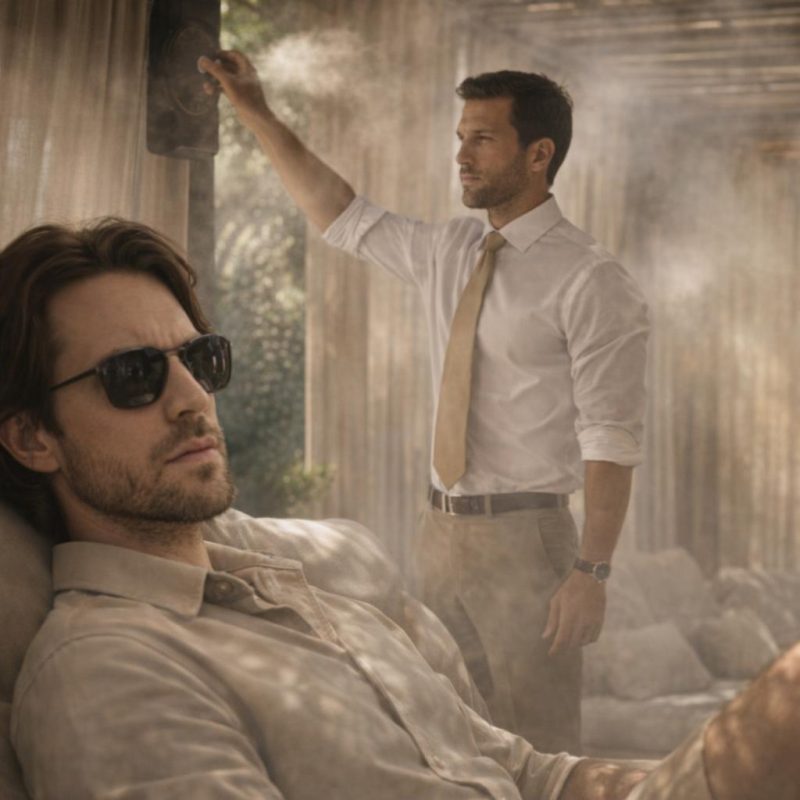 Image by RM AI
Healing Rhythm
The first morning I woke up without that particular kind of pain — the one that starts behind the eyes and radiates down into the jaw — I just lay there for a moment and didn't move, half-convinced that moving would bring it back. It didn't. I completed the morning prep solution without the usual nausea, which sounds like a small thing until you've spent six months dreading a drink the way most people dread a root canal. By nine I was settled into the shade with my Kindle, the UV curtain angled just right, and for two full hours my eyes didn't protest once. That almost never happens. In the afternoon I did a careful lap of the shallow cooling pool — slow, deliberate, nothing heroic — and came back to bed 14 feeling something I hadn't felt in a long time, which was approximately nothing. No spike, no flare, no aftermath. I ate the light meal Diana had helped me plan before I left, took my evening dose on schedule, and then opened the small leather journal I'd brought mostly out of habit. I wrote the date, a few notes about light tolerance and fluid intake, and then at the bottom of the page I wrote the number three and circled it. Three days. The pen sat quiet in my hand, and the evening settled around me like it had nowhere else to be.
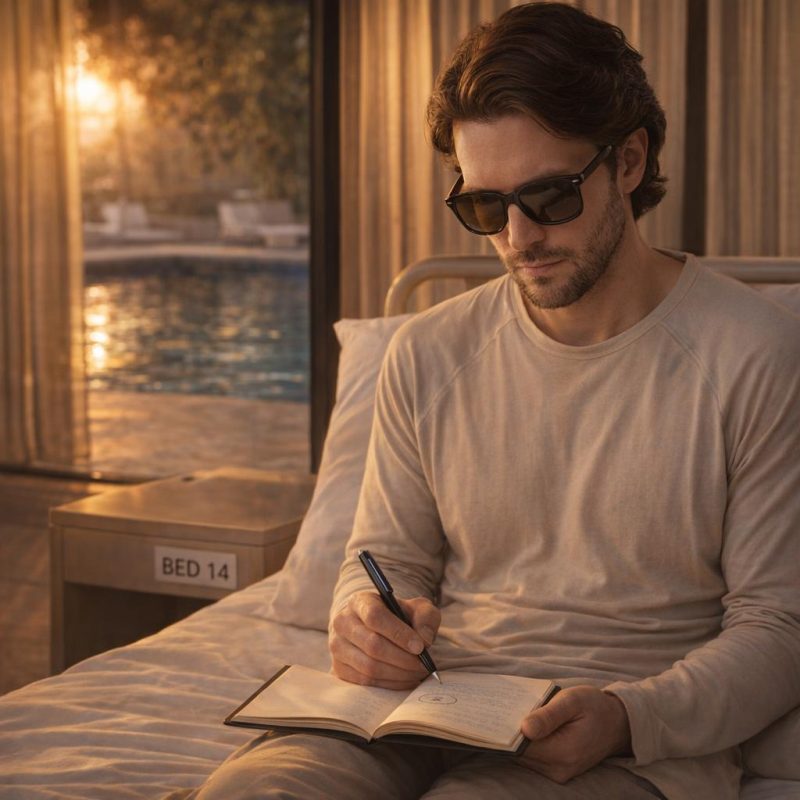 Image by RM AI
Resort Hierarchy
One thing nobody tells you about high-end resort pools is that the social architecture is just as rigid as any office hierarchy, maybe more so, because at least in an office people pretend the rules don't exist. Here, they were practically posted. The Diamond Tier section had its own entrance, its own staff ratio, its own ambient temperature setting, and an invisible but very real perimeter that certain guests tested with the focused determination of people who had never been told no and found the experience genuinely confusing. I watched a man in a Gold Member lanyard approach the private entrance three separate times over the course of an hour, each time with a slightly different angle of confidence, and each time a staff member redirected him with the kind of practiced warmth that communicates 'absolutely not' without a single impolite syllable. He eventually retreated to the main pool with the expression of someone composing a strongly worded email in real time. Most of the Diamond guests, to their credit, were fine — quiet, self-contained, absorbed in their own expensive relaxation. The territorial ones were easy to spot: they arranged their belongings in wide defensive perimeters and made eye contact with new arrivals the way cats do. Near the entrance, a couple stood close together, their voices low but their body language unmistakable — she had her hand flat on a printed reservation card, and he was pointing at the bed numbers on the wall display.
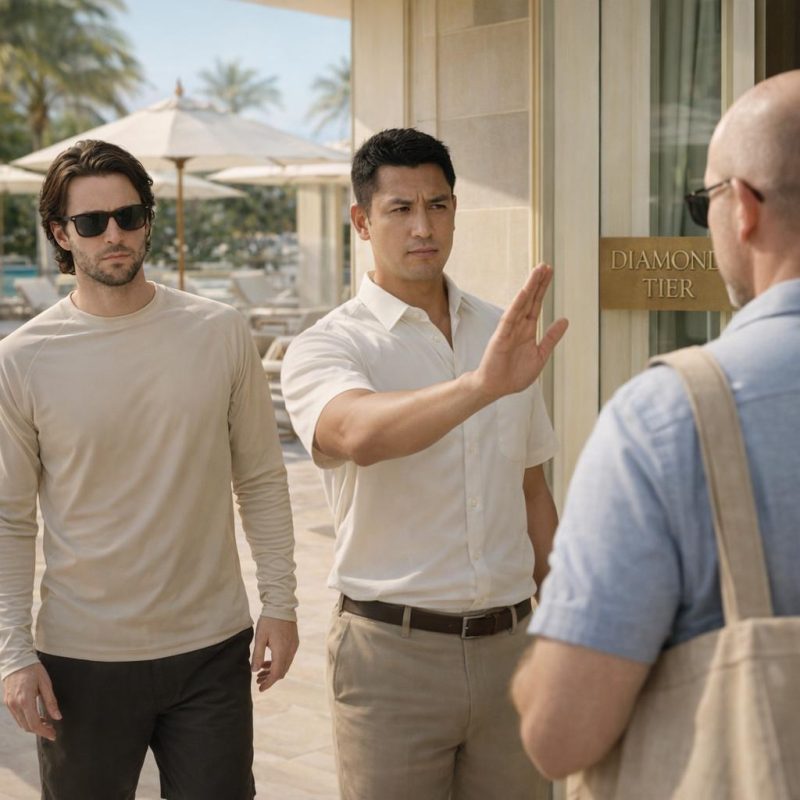 Image by RM AI
Leopard Print Arrival
She arrived just before eleven, and the pool area registered her the way a quiet room registers a door slamming open — not all at once, but in a ripple. The leopard print was aggressive even by resort standards: a full swimsuit with a matching wrap, both in a pattern that seemed to be competing with itself for attention. The hat was enormous, one of those wide-brimmed constructions that functions less as sun protection and more as a territorial claim on the surrounding airspace. She was on her phone before she'd fully cleared the entrance, her voice carrying across the water at a volume that suggested she'd never once considered that sound travels differently outdoors. Other guests glanced up, registered her, and returned to their books with the careful neutrality of people who have learned not to make eye contact with disruption. She moved through the space with the unhurried confidence of someone who had never once questioned whether she belonged somewhere, trailing her bag behind her and scanning the available beds with the expression of a person selecting produce. She settled three spots down from me, dropped her bag with a thud that rattled the side table, and resumed her phone call without missing a beat. I watched for a moment, then looked back at my page. I found my place in the paragraph, read the same sentence twice, and let the words eventually take hold.
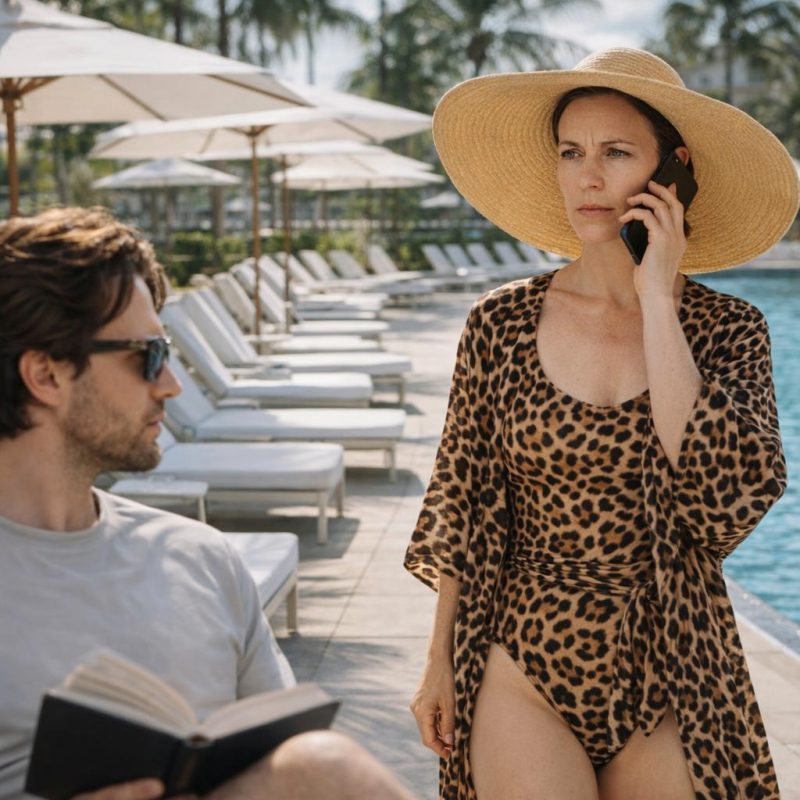 Image by RM AI
Entitled Performance
By mid-morning she had complained about the angle of her sun bed twice — once to a passing attendant and once, inexplicably, to the couple in the next row who had nothing to do with it. She wanted a specific brand of sunscreen that the resort carried but apparently not in the right SPF, which she explained at length to a young staff member who nodded with the serene patience of someone who has achieved a kind of professional enlightenment. When her towels arrived she inspected them the way a customs officer inspects a suspicious package, refolding one and setting it aside with a small sound of displeasure. Other guests had begun the quiet migration I'd noticed earlier in the week — a subtle repositioning of belongings, a casual relocation two or three beds further along — the kind of collective drift that happens when a group of people independently reach the same conclusion without discussing it. I stayed where I was. Moving felt like more effort than tolerating the ambient noise, and besides, bed 14 was mine and I'd paid for the specific microclimate. She was telling someone on her phone that she was a Gold Member and that the service here had been 'frankly inconsistent' when a waiter arrived with a fresh set of towels. She looked at them, looked at him, and asked, in a voice that carried clearly across three empty beds, whether he understood what warm meant.
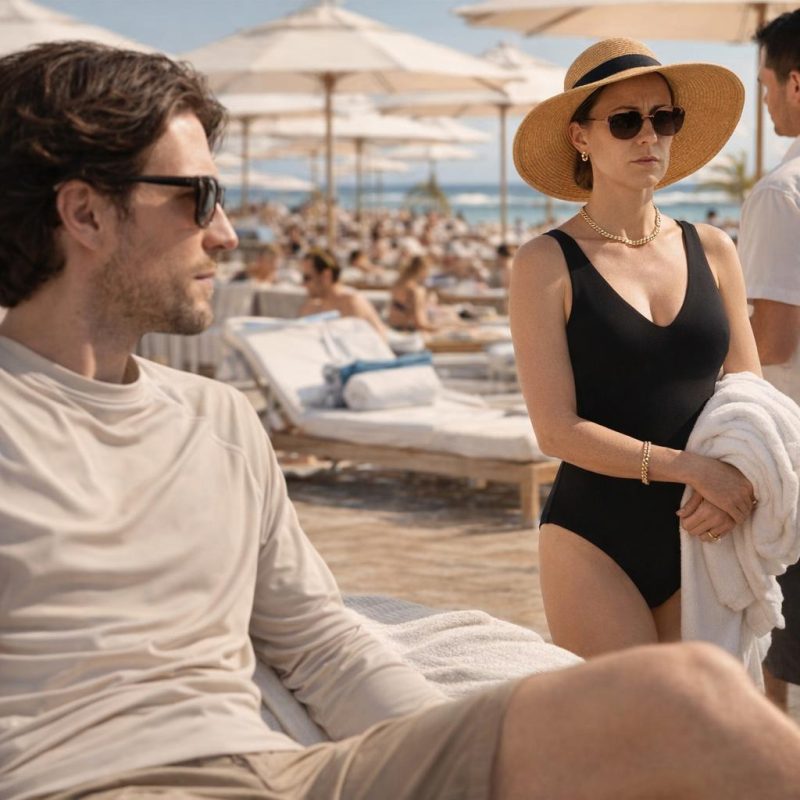 Image by RM AI
Marcus's Warning
Somewhere between her third complaint and my fourth attempt to read the same page, my mind drifted back to Marcus's office — the one on the fourteenth floor with the view of the parking structure and the framed bar association certificates arranged with the precision of someone who understood that credentials are a form of communication. It was maybe eight months ago, during one of the later sessions when the paperwork was mostly done and we were into the part of the process that felt less like law and more like archaeology. He'd leaned back in his chair and said, almost offhandedly, that the hardest part of what he did wasn't the courtroom — it was helping people recalibrate their instincts afterward. He said that people who'd spent years in high-conflict situations often lost the ability to trust their own read on a room. They'd either dismiss things that deserved attention or catastrophize things that didn't. He told me to pay attention to the pattern, not the incident. One bad moment is noise, he said. A pattern is information. I'd written it down somewhere, probably in the same journal I was now using for fluid intake logs. I remember feeling grateful that he said it plainly, without softening it into something easier to swallow. The noise from three beds over had settled into a low, continuous hum. I turned back to my book. Marcus's voice stayed with me, quiet and even: some people never change, he'd said. They just find new places to be exactly who they are.
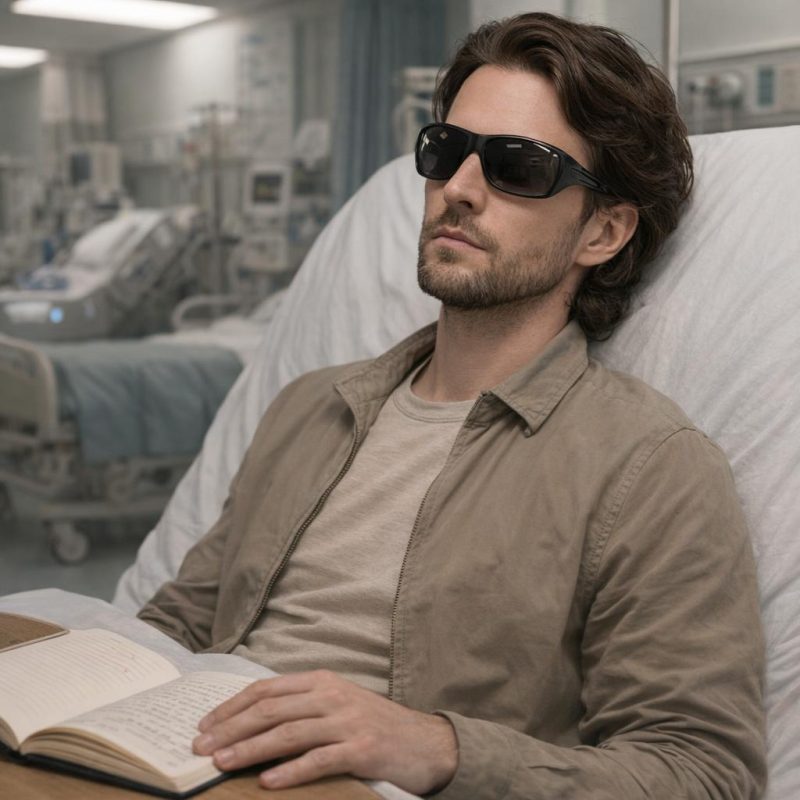 Image by RM AI
The Blue Preparation
The midday prep solution was the one I liked least — not because of the taste, which I'd long since stopped registering, but because of the timing. It had to be mixed precisely, dissolved fully, and consumed within a specific window, which meant that everything else had to arrange itself around it. I'd gotten good at this. I measured the powder into the tall resort glass, added the cold still water, and watched the blue electrolyte compound bloom and disperse the way it always did — that particular shade of cobalt that looks, I've been told, like something you'd order at a swim-up bar. I added the paper umbrella because Diana had suggested it during one of our prep sessions, half-joking, and I'd kept doing it because it made the whole ritual feel slightly less clinical. I set the glass on the side table next to my Kindle, set a five-minute timer on my phone for the mixture to fully dissolve, and decided to use the time at the cooling foot-well nearby. Three minutes, no more — Dr. Pierce had been specific about temperature exposure duration. I capped my water bottle, tucked my phone under the edge of the Kindle so it wouldn't slide, and reached for my towel. I folded it once and draped it over the foot of bed 14, the way you do when you want the world to understand that a space is occupied, and walked toward the water.
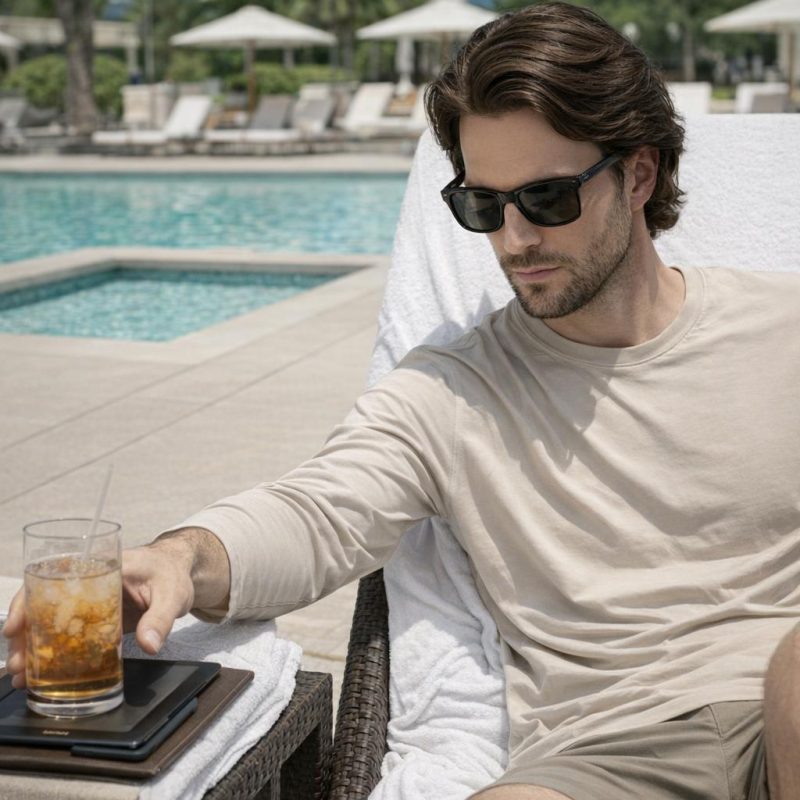 Image by RM AI
Occupied Territory
Three minutes is not a long time. I know this because I counted most of them, standing in the cool water up to my ankles, watching the light move across the surface. When the timer went off I stepped out, dried my feet on the small mat at the edge, and turned back toward bed 14. She was on it. Not near it, not leaning against it — fully on it, reclined against my cushions with her hat tilted back and her phone held above her face at the angle people use when they're watching something. My Kindle was on the ground beside the bed, face-down on the tile. She had pulled the privacy curtain around on one side, the one I'd positioned to block the afternoon glare, and repositioned it so it wrapped around her instead. My towel was gone from the foot of the bed — I spotted it a moment later, folded and set on the ground next to the Kindle like it was something she'd tidied away. I stood there, water still dripping from the hem of my UV shirt, and I didn't move. I didn't say anything. I just stood there, dripping, staring at the woman stretched across my reserved bed like she'd always been there.
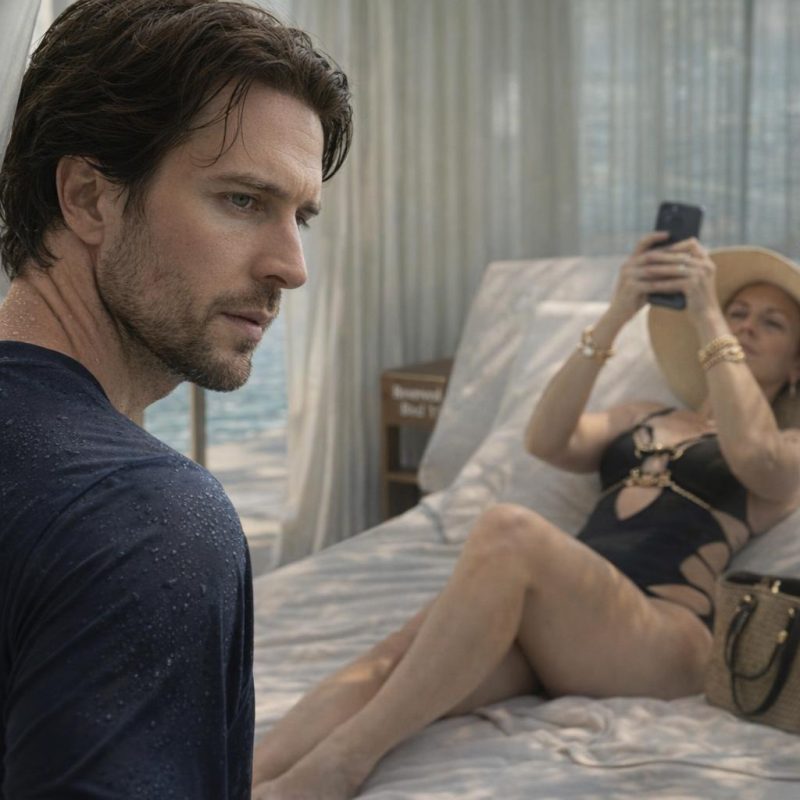 Image by RM AI
The First Confrontation
I walked over and stood at the foot of the bed. 'Excuse me,' I said. 'This is my bed.' She didn't look up from her phone. Her thumb kept moving. I waited what felt like a reasonable amount of time and tried again. 'This is bed 14. I'm assigned here for the week.' She lowered the phone about two inches, looked at me the way someone looks at a stranger who's knocked on the wrong door, and said, in an accent I couldn't quite place, 'I don't see your name on it.' I pointed out that my towel had been on the foot of the bed, that my Kindle had been on the side table, that my drink was still sitting right there on the table next to her elbow. She glanced at the blue glass, then back at me, with the expression of someone who has decided a conversation is beneath them but is willing to participate briefly out of generosity. 'I'm a Gold Member,' she said. 'These beds are available on a first-come basis.' I took a breath. I kept my voice level. I told her that Diamond Tier beds were pre-assigned by name, not first-come, and that if she checked the display at the head of the bed she'd see exactly whose name was on it. She didn't move. I reached past her and tapped the small digital panel mounted at the headboard, where the screen glowed with a single word: Henderson.
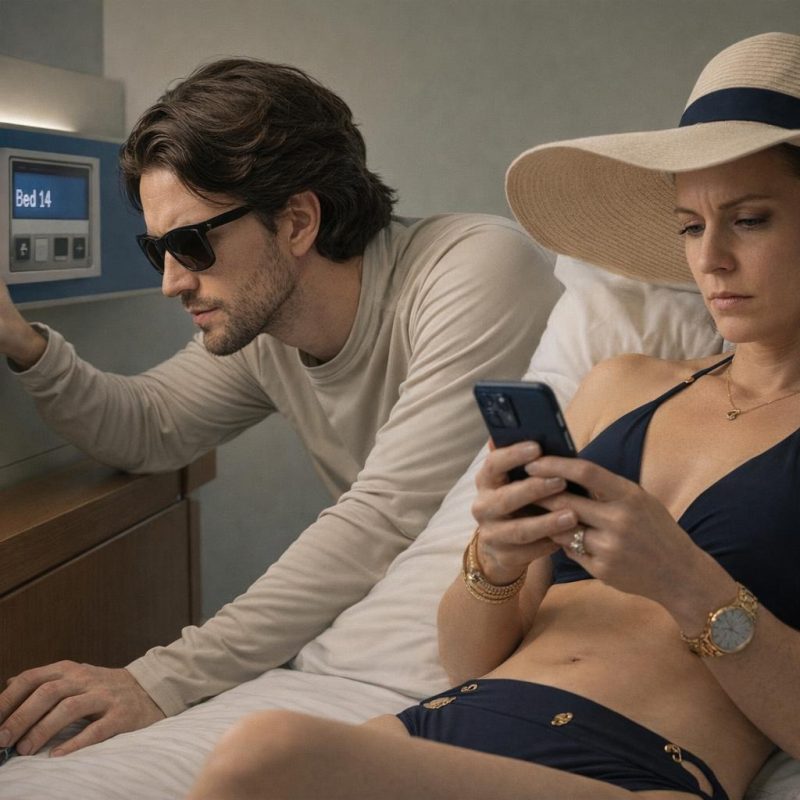 Image by RM AI
The Blue Mistake
She didn't even hesitate. She picked up the blue glass, wrapped her lips around the straw, and took a long, slow pull like she was sampling a poolside specialty. I held up one hand. 'That's not a cocktail,' I said. 'You really shouldn't drink that.' She lowered the glass just long enough to give me a look — the kind reserved for people who complain about noise levels at a hotel pool. 'Oh, relax,' she said, waving her free hand. 'You're being such a Karen. The bar service is for everyone.' I told her again, more clearly this time, that it wasn't from the bar. That it was a medical preparation. That she needed to stop. She tilted her head, considered the glass with what I can only describe as performative appreciation, and said, 'It's actually quite good. A little salty, but refreshing.' Then she finished it. All of it. Every last drop of a full liter of osmotic prep solution, prescribed to me by Dr. Pierce for post-surgical bowel management, drained through that straw while I stood there in my UV shirt watching the last of the blue liquid disappear down her throat.
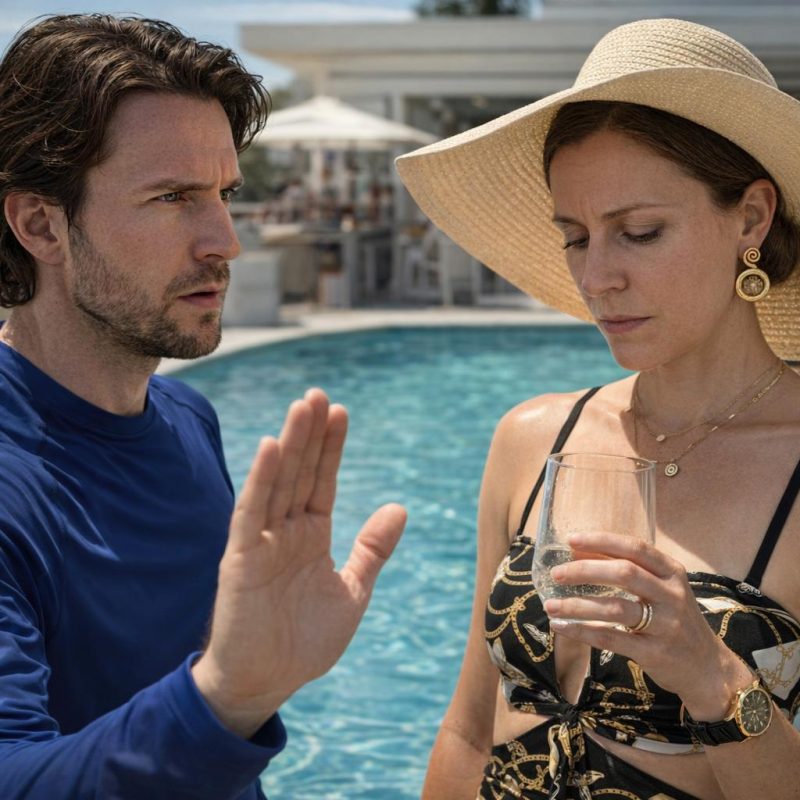 Image by RM AI
Professional Intervention
I didn't say anything right away. There wasn't much point. What was done was done, and I had a fairly precise understanding of what the next forty-five minutes were going to look like for her. I walked calmly to the lifeguard station at the far end of the pool deck and caught Julian's eye. He was back from wherever he'd been — tall, composed, that immaculate resort uniform — and he read my expression well enough to follow me back without asking questions. When we reached the bed, the woman was still there, scrolling her phone, looking entirely unbothered. Julian glanced at her, then at the empty blue glass on the side table, then back at me. I didn't say a word. I just pointed at the glass. Something shifted in Julian's face — a small, careful recalibration, the kind a professional makes when they've just understood something they very much wish they hadn't. His eyes moved from the glass to the woman, then back to the glass, and the quiet widening of them told me he'd worked it out completely.
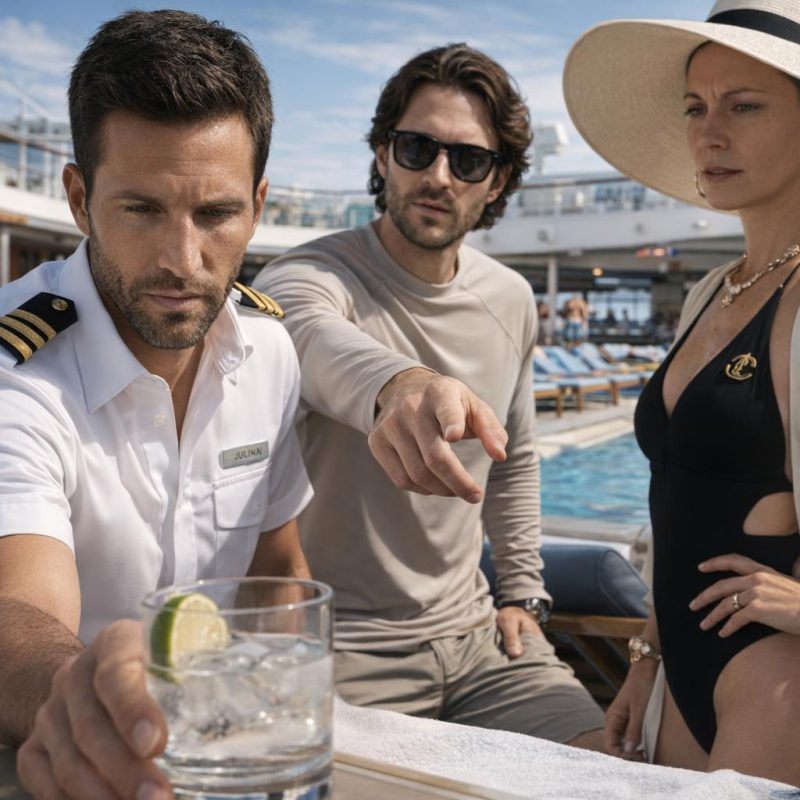 Image by RM AI
The Warning
Julian straightened his jacket, cleared his throat, and addressed her with the kind of exaggerated courtesy that only resort managers and very patient diplomats can sustain under pressure. 'Madam,' he said, 'I want to make sure you're aware of something important regarding the beverage you just consumed.' She looked up from her phone with the expression of someone who expects to be offered a complimentary upgrade. Julian explained, with admirable precision, that the blue drink was not a bar item. That it was a specialty medical preparation belonging to another guest. That it was, specifically, a high-dose osmotic laxative solution prescribed for post-surgical recovery. She stared at him. Then she looked at the empty glass. Then she looked at me. I reached into my bag and held up the prescription bottle — white label, Dr. Pierce's name, the dosage printed clearly across the front. The woman's mouth opened slightly. She looked at the bottle, then at the glass, then at Julian, as though one of them might offer a different explanation. None of us did. The color left her face in a slow, steady retreat, like a tide going out all at once.
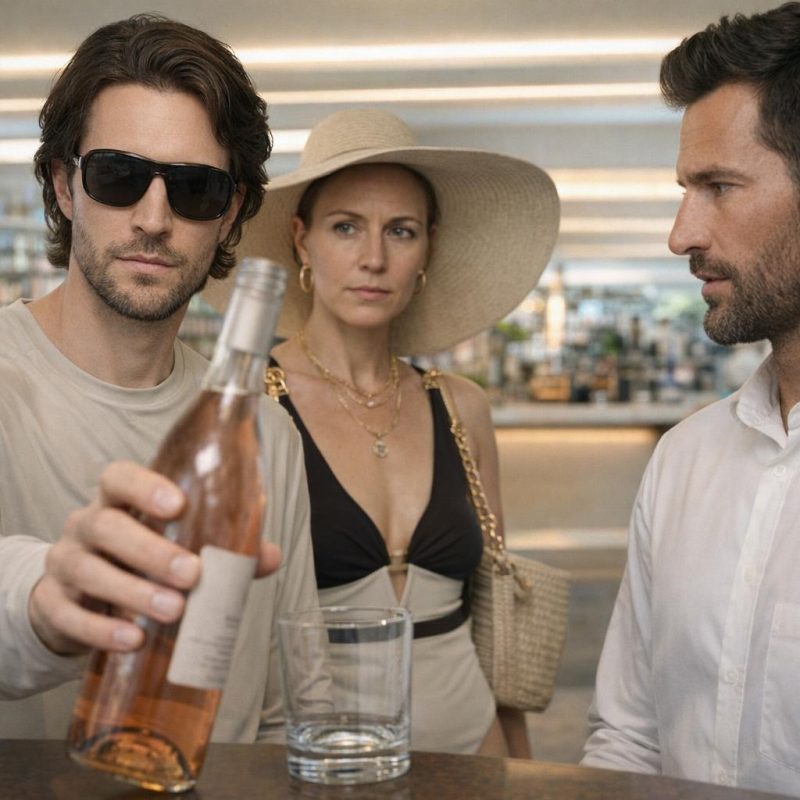 Image by RM AI
The Sprint
She tried to stand and her knees did that thing knees do when the body has received news the brain hasn't fully processed yet. 'You're joking,' she said, looking at Julian. Julian was not joking. I confirmed, helpfully, that the solution was essentially a colonoscopy-grade flush — the kind designed to clear a post-surgical digestive system with considerable efficiency and very little patience for delay. She grabbed her designer bag off the lounger in one motion, clutched it to her chest, and began moving. It started as a power-walk — the kind that preserves dignity — but dignity has a short shelf life when osmotic chemistry is involved, and by the time she hit the far edge of the pool deck she was moving at a pace that could generously be called a sprint. The oversized sun hat, which had survived the entire confrontation with architectural stability, caught a gust off the water, lifted cleanly from her head, and rolled in a slow, elegant arc directly into the pool.
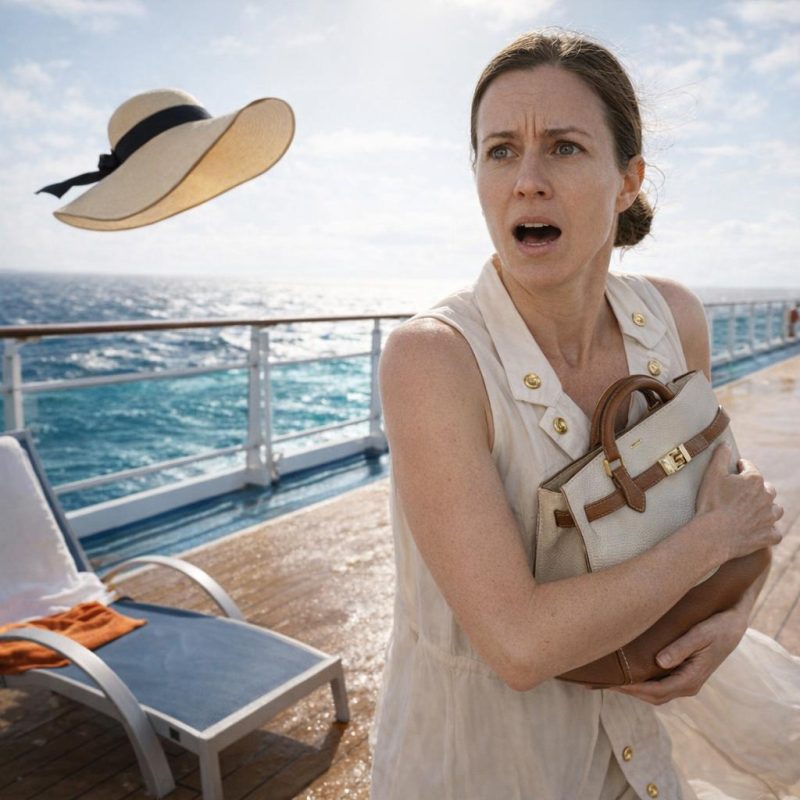 Image by RM AI
Karmic Justice
I watched the lobby doors swing shut behind her and then I sat down on my bed — my bed, with my name on the panel — and let out a breath I felt like I'd been holding since I first walked over and said 'excuse me.' Julian signaled a waiter with a small, practiced gesture, and the young man appeared with a net and began fishing the hat off the surface of the pool with the focused professionalism of someone who has retrieved stranger things. Julian turned to me and said that the woman's bed assignment would be revoked and that the cabana fee for the day would be waived, given the circumstances. I thanked him. I meant it. I settled back against the cushions and looked out at the water, which was calm and blue and entirely indifferent to what had just happened. There's a particular kind of quiet that follows when someone has made a loud, entitled mess of a situation and then been escorted out of it by their own choices. I sat in that quiet for a while, and it felt, if I'm honest, like exactly the right amount of nothing.
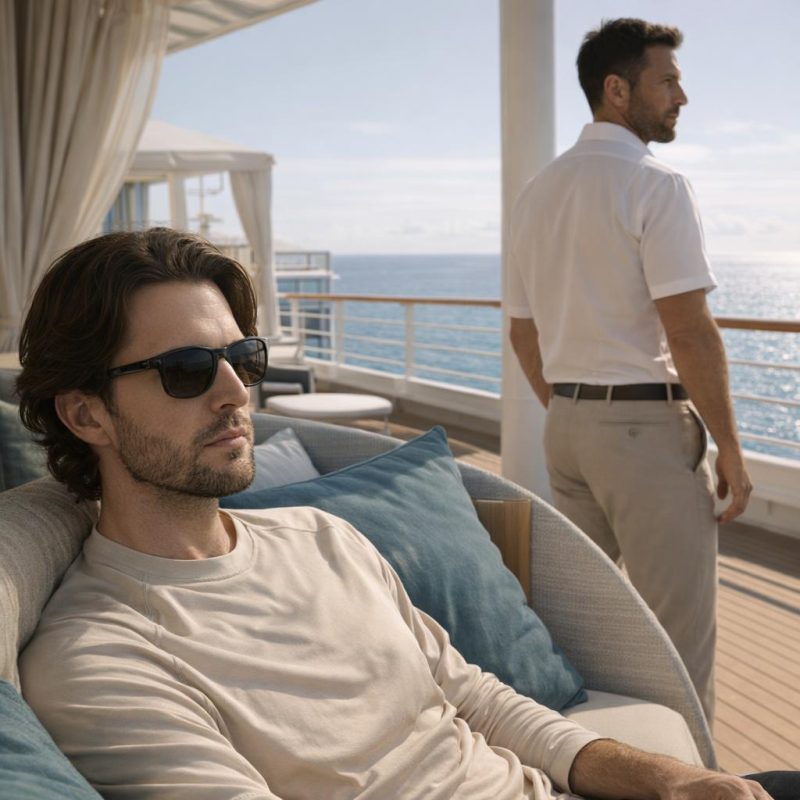 Image by RM AI
The Abandoned Hat
The waiter laid the hat on the edge of the pool deck and looked at it the way you look at something you're not sure what to do with. It was a large, structured thing — cream-colored, wide-brimmed, the kind of hat that costs more than some people's car payments. Julian picked it up by the brim, turned it over once, and set it aside. I noticed the label stitched inside — dark lettering on a pale ribbon, the kind of branding that announces itself quietly because it doesn't need to shout. Julian mentioned that the woman hadn't returned for her belongings. I glanced toward the lobby doors, half-expecting to see her reappear, but they stayed closed. I wondered, briefly, how she was getting on in whatever restroom she'd claimed as her emergency territory. The hat was carried to the lost and found near the pool entrance, placed on the shelf with the careful indifference of resort staff who have seen everything. I watched the waiter set it down, and then I noticed the label again — visible now through the open brim, dark and precise against the pale lining.
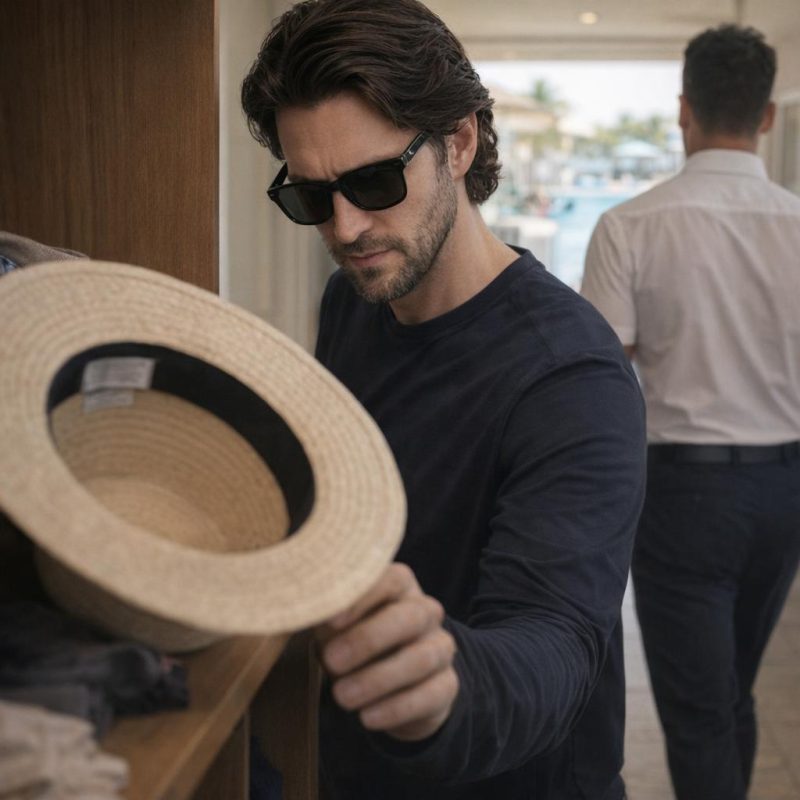 Image by RM AI
Fresh Accommodations
Julian returned about twenty minutes later carrying a fresh blue glass on a small tray, the solution mixed to the exact same ratio as the one that had just been involuntarily donated to a stranger's afternoon. He set it on the side table with the care of someone who understood that it wasn't a drink, it was a schedule. He'd also arranged for a fresh set of premium towels, a small plate of the plain crackers I'd mentioned to the front desk on check-in, and a chilled bottle of still water. I thanked him again, and he gave a small nod — the kind that means 'this is what we do here' without making a production of it. He confirmed that the woman's poolside access had been flagged and her bed assignment permanently reassigned. I told him I appreciated the discretion. He said something about the resort taking medical privacy seriously, and I believed him. I settled back, adjusted my sunglasses, and pulled my Kindle from the side table where it had been waiting patiently through the whole ordeal. The afternoon had rearranged itself back into something manageable, and the competence of the people around me made it feel almost easy to let it go.
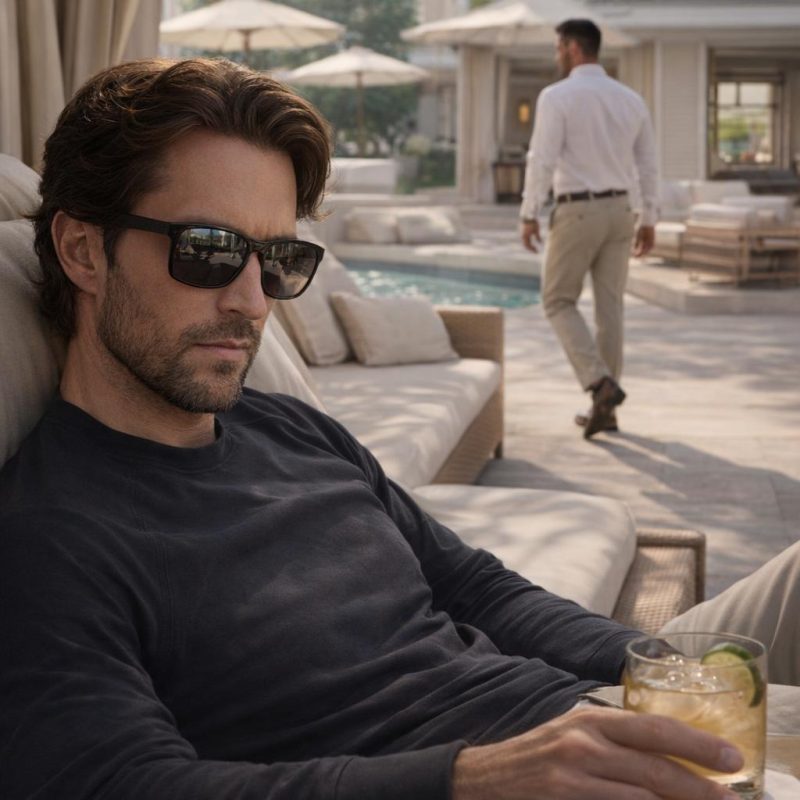 Image by RM AI
Nagging Familiarity
I read the same paragraph four times before I gave up pretending I was reading. The words were there, the story was fine, but something kept pulling my attention sideways. I set the Kindle down and looked at the water. I told myself it was residual irritation — a reasonable response to having a stranger drink your prescription medication and call you a Karen about it. That was enough to be annoyed about. That was plenty. But it wasn't the entitlement that kept snagging at me. It was something else. The way she'd dismissed me without looking up. The particular angle of her indifference, like my presence was an inconvenience she'd already accounted for. The way she'd said 'I don't see your name on it' — not as a question, but as a verdict. I'd heard that register before, somewhere. I checked my medication schedule, noted the time, took the next dose with the still water Julian had left. Practical things. Grounding things. I was probably overthinking a random encounter with a rude stranger at a pool. People like that existed everywhere. I knew that. I picked up the Kindle again and stared at the page, but the feeling didn't leave — just settled in quietly beside me, like it had nowhere else to be.
 Image by RM AI
Designer Clues
I wasn't planning to stop. I was just doing a slow loop around the pool deck before bed — the kind of aimless walk that passes for exercise when your body has opinions about actual exercise. But the lost and found basket near the towel station caught my eye, and sitting on top of it was the hat. The oversized leopard-print one. Someone had retrieved it from wherever it had landed and deposited it there, which was more courtesy than its owner had shown anyone. I picked it up, mostly out of the same impulse that makes you examine anything left behind by someone who annoyed you. The brim was stiff and structured, not the floppy mass-market kind you find in resort gift shops. The fabric had weight to it. I turned it over and looked at the label — not a printed tag, but something hand-stitched in cream thread onto a small silk panel. A custom job. The kind of thing you commission, not buy off a rack. I ran my thumb along the inner band and felt a second, smaller tag tucked into the seam. I angled it toward the nearest light. Two letters, embroidered in gold thread: V.A.
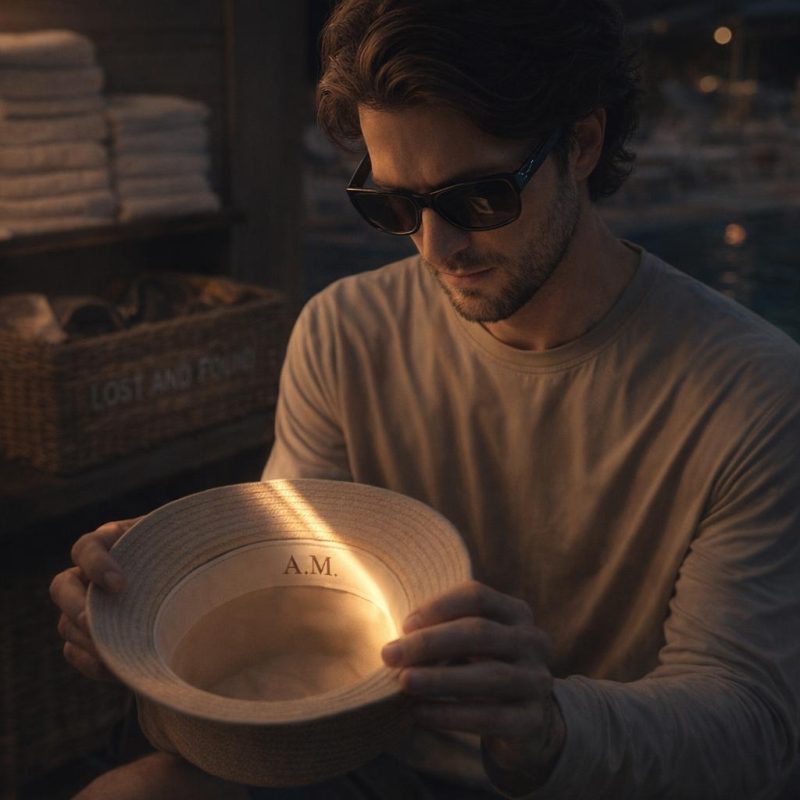 Image by RM AI
Abrupt Departure
Julian found me at breakfast the next morning, which was unusual enough that I looked up from my coffee before he'd said a word. He had the particular expression of someone delivering news they consider mildly interesting but professionally neutral. He told me the woman from the pool had checked out during the night — around two in the morning, by the system log. I asked if she'd seemed unwell when she left. He said she'd appeared agitated and in a hurry, that she'd settled her bill at the front desk without much conversation and was gone before the night staff had fully processed what was happening. She hadn't collected the hat from lost and found. She'd left a pair of sunglasses and a bottle of sunscreen on the pool deck, apparently not worth the detour. I nodded and looked back at my coffee. Whatever had driven her out at two in the morning — embarrassment, discomfort, something else entirely — it wasn't my problem anymore. The pool would be quieter. My medication schedule would proceed without an audience. I'd finish the week I'd planned and go home with a story that was, objectively, pretty good. I wrapped both hands around the warm mug and let the morning settle around me.
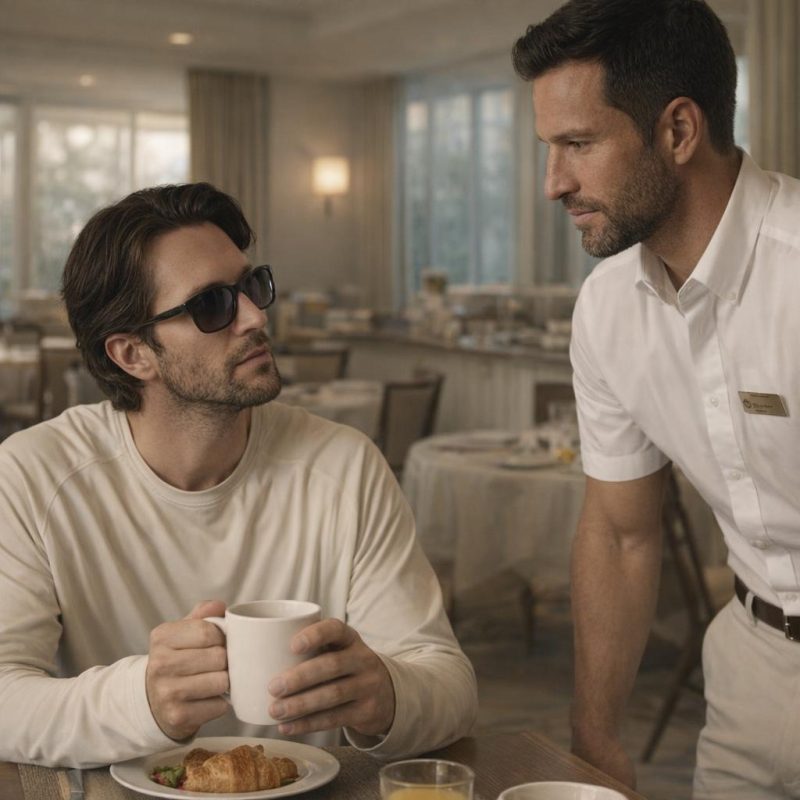 Image by RM AI
Left Behind
I went back to the pool deck after breakfast, more out of habit than intention. My usual bed was waiting, the umbrella already angled the way I'd asked Julian to set it. I was arranging my things — still water, medication case, Kindle — when I noticed the sunglasses tucked under the neighboring lounge chair. Julian had mentioned them, but seeing them in person was different. They were the kind of frames that cost more than some people's rent. I picked them up and set them on the side table next to the sunscreen bottle, which was still there, cap slightly loose. Then I saw it. On the ground between the two chairs, half-hidden under the edge of the lounge chair's frame, was a key card. A resort room key card, the kind with the magnetic strip and the small gold logo. I crouched down and picked it up. It was hers — it had to be. She'd left in such a hurry at two in the morning that she'd walked out without her sunglasses, her sunscreen, and her room key. I stacked everything together to bring to the front desk. But I stood there for a moment, holding the key card, turning it over in my hand.
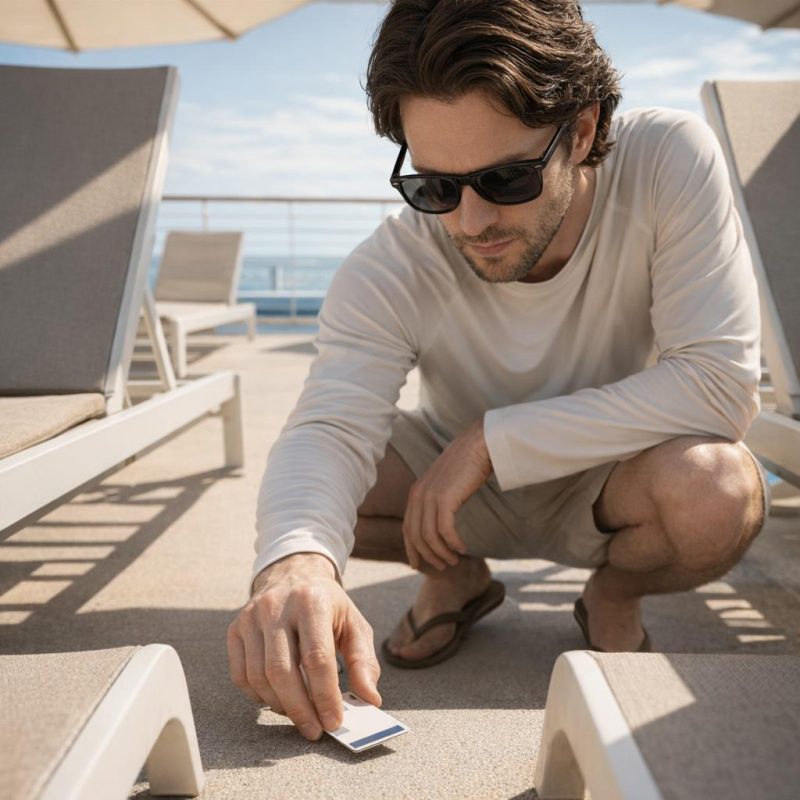 Image by RM AI
Name Recognition
The front desk clerk was efficient and pleasant in the way that good resort staff always are — she took the sunglasses, the sunscreen, and the key card without making me feel like I was inconveniencing anyone. She glanced at the items, typed something, and said she'd make sure they were logged under the guest's account in case she contacted the resort to retrieve them. I asked, mostly out of idle curiosity, whether they'd be able to reach her. The clerk said they had contact information on file and would send a message. Then she said the name. She said it the way you say any name — matter-of-factly, without emphasis, the way names sound when they're just administrative data. She said the sunglasses and the other items would be held for Victoria Ashford. I asked her to repeat it. She did, with a small polite smile, and confirmed that Ms. Ashford had checked out early that morning. I thanked her and walked away from the desk. The name sat in my chest in a way I couldn't account for. I couldn't place it — not a colleague, not a neighbor, not anyone I could put a face to. But something about the sound of it pulled at the edge of something I couldn't quite reach, and a chill moved through me before I could explain why.
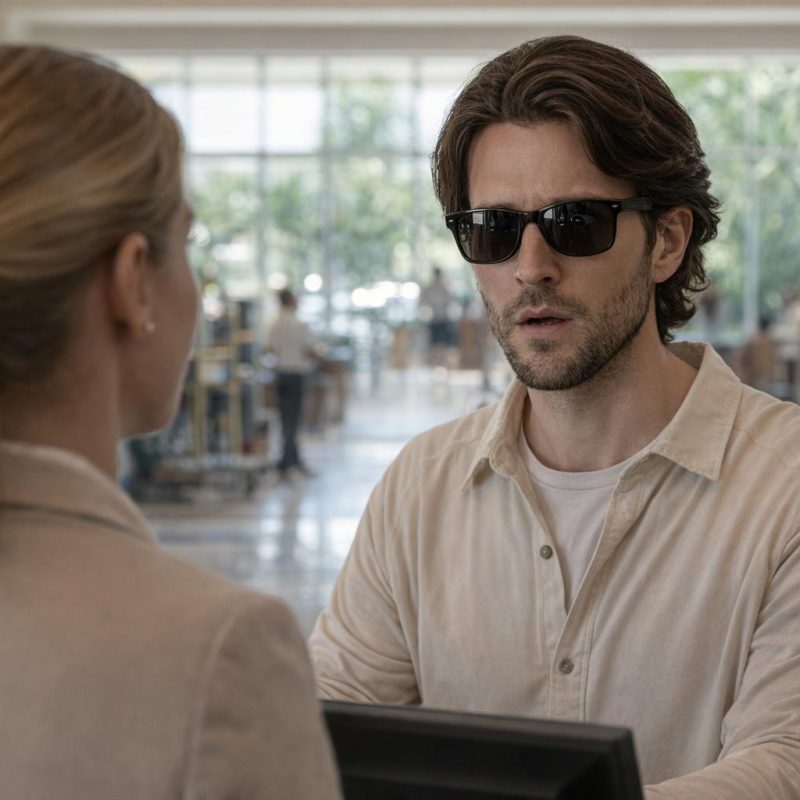 Image by RM AI
Persistent Unease
I sat on the edge of the bed in my room for a while without doing anything in particular. The name kept circling. Victoria Ashford. I tried the usual tricks — running through professional contacts, old neighbors, anyone from the years before the surgery when my life had looked different. Nothing connected cleanly. But the feeling didn't go away the way it should have if the name meant nothing. I thought about the pool deck. The way she'd said 'I don't see your name on it' without looking up. The angle of her dismissal, like my presence was something she'd already categorized and set aside. The territorial way she'd arranged herself in my space, like someone who simply didn't register that the space belonged to anyone else. I'd told myself it was generic entitlement. The kind you encountered everywhere. But the name kept snagging on something I couldn't identify, and the more I tried to let it go, the more it refused to move. I got up, walked to the window, looked at the water for a moment. Then I sat back down, picked up my phone, opened the browser, and typed Victoria Ashford into the search bar.
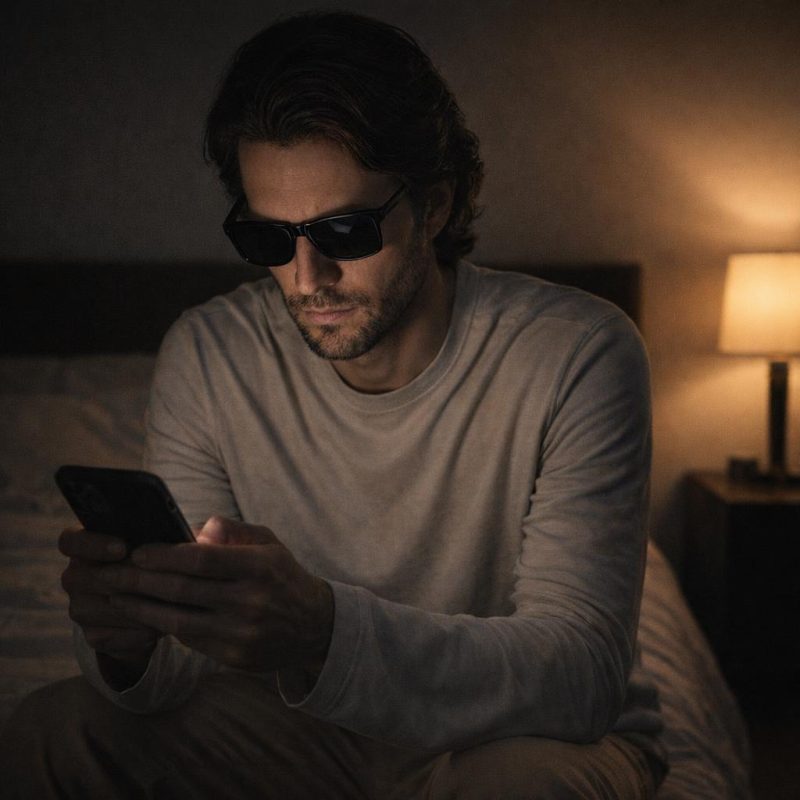 Image by RM AI
Security Footage Request
I found Julian at the pool management office just before six, which was later than I'd intended. He was reviewing something on a tablet and looked up when I knocked on the open door. I told him I wanted to ask a favor — that I was considering documenting the poolside incident for my own records, possibly for legal purposes, and I wondered if the resort's security footage from yesterday might be available for review. He set the tablet down. He looked at me for a long moment, the kind of look that takes in more than it lets on, and I had the distinct impression he was doing some quiet calculation behind his eyes. He didn't ask me to elaborate. He didn't ask what kind of legal documentation I had in mind. He just said he could arrange access to the relevant footage and suggested we meet in the security office after my evening medication, if that timing worked. I said it did. He nodded once, the way someone nods when they've already decided something before you finished asking. I thanked him and walked back toward my room. There was something in the steadiness of his expression — not surprise, not hesitation — that stayed with me as the corridor lights came on around me.
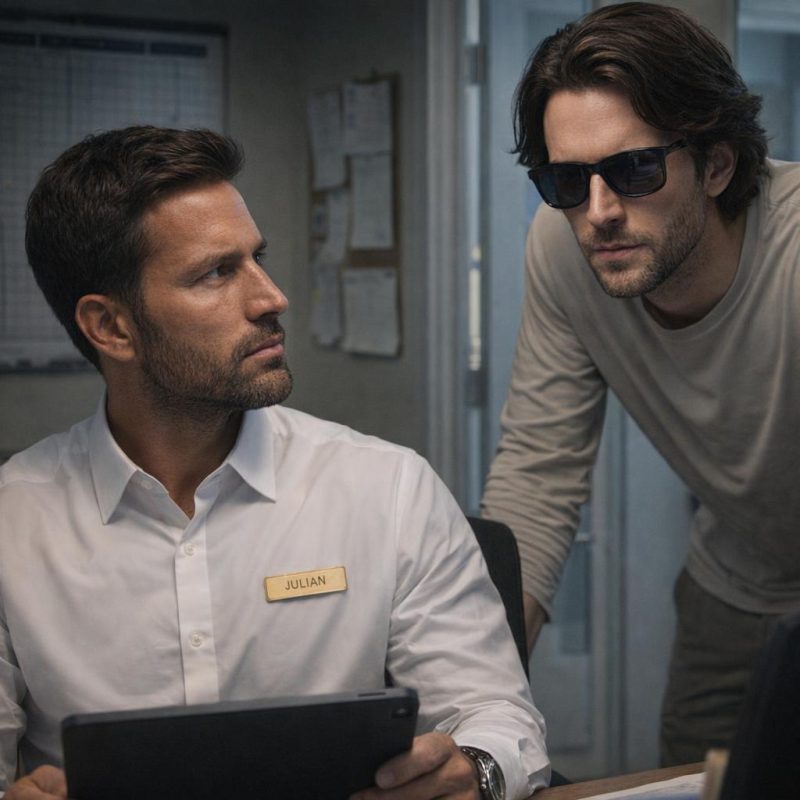 Image by RM AI
Surveillance Evidence
The security office was smaller than I'd expected, and the monitors made it feel smaller still. Julian pulled up the pool deck footage from the previous day and started it from nine in the morning, which was earlier than I'd asked for. I didn't question it. The timestamp read 9:04 when she appeared on screen. She came in from the far entrance, chose a chair with a clear sightline to my section of the deck, and settled in. I watched the footage. She didn't read. She didn't use her phone for long stretches. She sat with her face angled toward my bed area in a way that the camera caught clearly. At 9:47 she ordered a drink. At 10:15 she repositioned her chair slightly. I watched myself appear on screen at 11:52, moving through my usual setup routine — arranging the umbrella, placing the medication case, mixing the drink. She was watching that too. The footage showed her standing and moving toward my bed at 12:23, which was the moment I'd walked to the foot-well. I sat back in the chair. Julian didn't say anything. The timestamp on the screen read 9:04 again as he looped it back. Three hours sat between that number and the moment she'd moved, and I didn't have a word for what I felt looking at it.
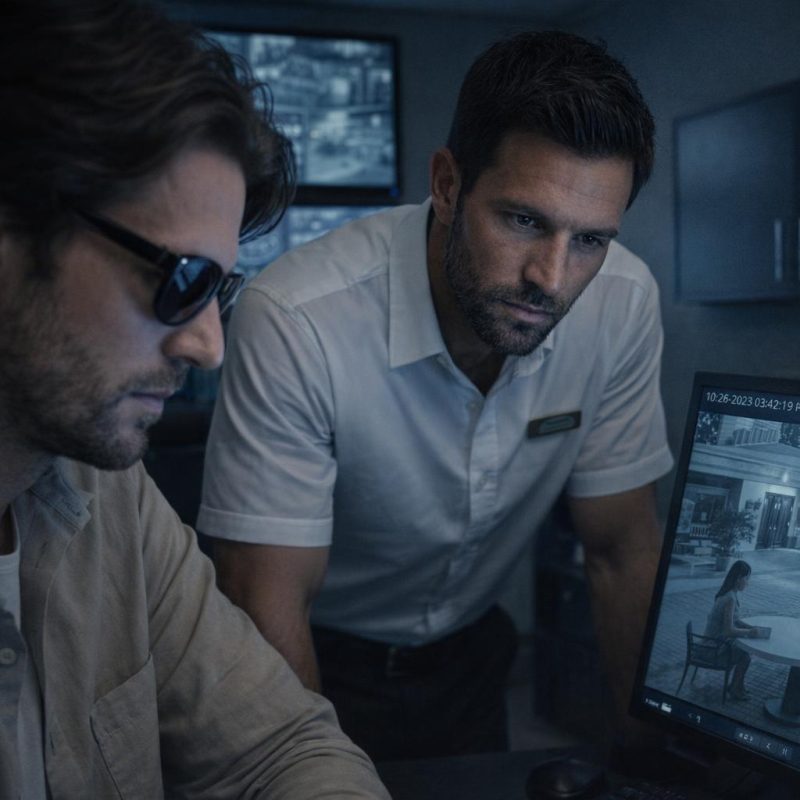 Image by RM AI
Behavioral Patterns
Julian let the footage run forward again without me asking. I watched her settle into my bed on screen — the way she pulled the privacy curtain, the particular motion of it, the angle of her wrist as she drew the fabric across. Something in my chest went still. I'd seen that movement before. Not the gesture itself, exactly, but the quality of it — the way someone handles a space they've decided belongs to them, not as a visitor but as a claimant. The way she'd dismissed me at the pool had felt familiar too, but I'd filed it under generic entitlement and moved on. This was different. This was specific. The curtain adjustment, the arrangement of the cushions, the way she'd angled her back toward the surrounding guests as though the rest of the deck had simply stopped registering. I'd been in rooms that felt like that. I recognized something in the texture of it, though I couldn't have said exactly what. I leaned forward in the chair. 'Can you pause it,' I said. Julian paused it. Her face was three-quarters to the camera, partially shadowed by the hat's brim. I stared at the frozen frame. 'Can you go back,' I said, 'to where she adjusts the curtain again.' Julian rewound it. I watched her hand move across the fabric in exactly the way I remembered from somewhere I hadn't let myself think about in years.
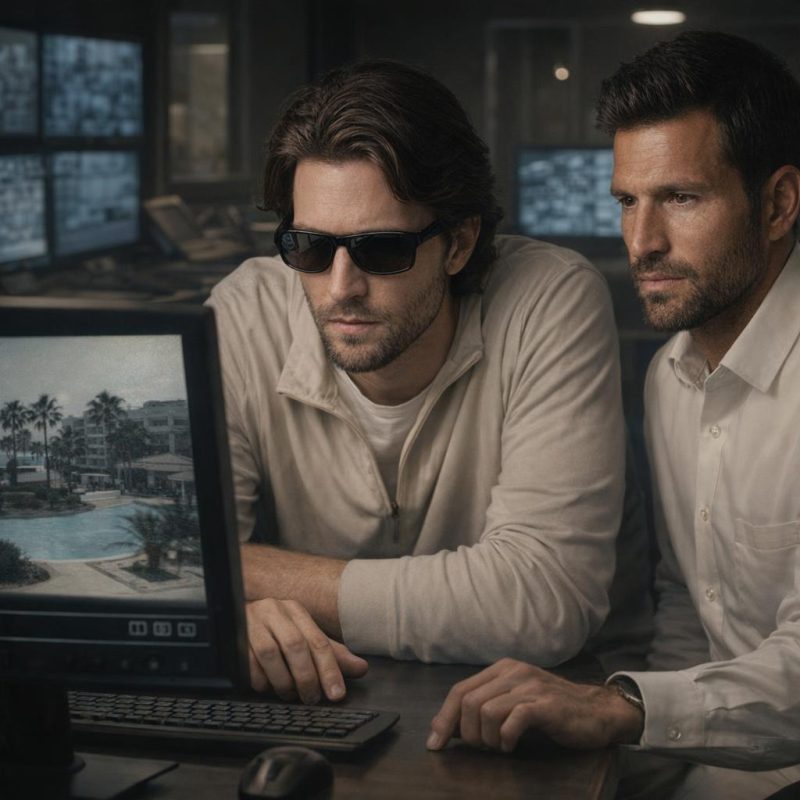 Image by RM AI
Marriage Memories
I sat there in Julian's office with the frozen frame on the screen and let my mind go somewhere I hadn't let it go in a long time. Victoria used to do that — claim a space so completely that you forgot you'd ever had a claim on it yourself. It wasn't dramatic. That was the thing people never understood when I tried to explain it later. It was quiet. She'd move a chair two inches and then look at you like you were the one who'd disrupted something. She rearranged my home office once while I was at a conference — said the old layout was inefficient, said I'd thank her. I didn't thank her. But I also didn't move anything back, because by then I'd learned that moving things back cost more than it was worth. She had a way of making your own preferences feel like an imposition. 'You're too sensitive,' she'd say, and the worst part was how long I half-believed her. When the divorce was finalized, I remember sitting in Marcus's office and feeling something I couldn't immediately name. It took me a few minutes to identify it as the simple absence of bracing for something. The weight of that — of how long I'd been carrying it without knowing — settled over me now, quiet and familiar.
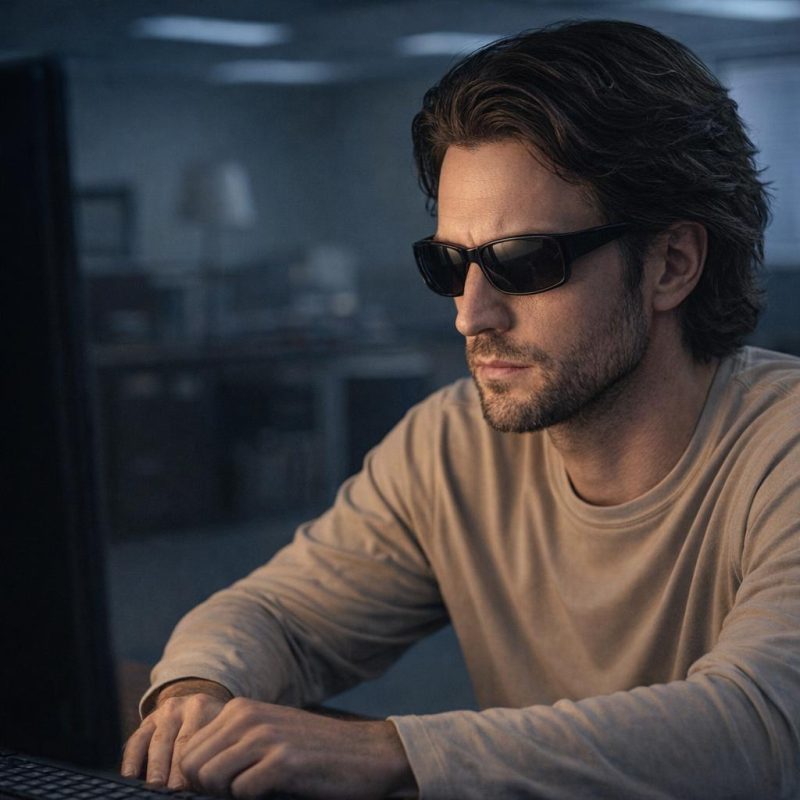 Image by RM AI
Growing Suspicion
I told myself I was being ridiculous. I sat in the chair across from Julian's desk and ran through it methodically, the way I do when I'm trying to talk myself down from something. The initials on the bag — V.A. — could stand for a hundred names. Victoria Ashford was one of them, but so was Veronica Aldridge, or Valentina Acosta, or anyone else with the misfortune of sharing those letters. The behavior at the pool was entitled, yes, but entitlement isn't rare at a resort like this. I'd seen three other guests treat the staff with the same casual dismissal in the past two days alone. And the hair — Victoria had dark hair when I knew her. The woman at the pool was bleached blonde, the kind of blonde that takes serious commitment. People change their hair. That's not evidence of anything. The curtain adjustment on the screen, the way she'd arranged herself in my bed like she was settling into something that already belonged to her — I kept coming back to that. I kept telling myself it was a posture, a habit, something a thousand people might share. But the feeling that had settled in my chest while I watched the footage wasn't moving, and I wasn't sure anymore that I wanted it to.
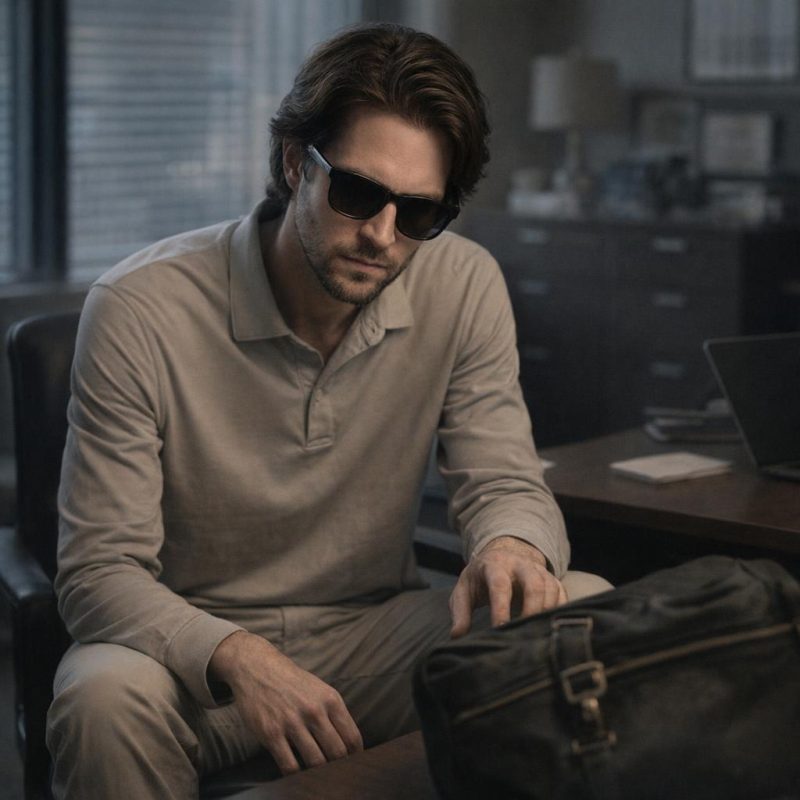 Image by RM AI
Attorney Contact
I excused myself from Julian's office and walked back to my room with my phone already in my hand. Marcus had been my attorney-client through the divorce — thorough, careful, the kind of lawyer who kept files on everything and forgot nothing. If anyone had a recent photograph of Victoria, or knew where she'd landed after the settlement, it was him. I scrolled to his contact and stared at it for a moment. I didn't want to explain the whole thing. I didn't want to say 'I think my ex-wife might be at my resort' and have it sound like what it sounded like. So I kept it simple. I typed that I was traveling and thought I'd seen someone who reminded me of Victoria — probably nothing, I wrote, probably just the kind of thing your brain does when you're somewhere unfamiliar. I asked if he had any recent contact information for her, or a photo from the past year or two, just so I could put my mind at rest. I read it back twice. It sounded reasonable. It sounded like a man being sensible rather than a man sitting in a resort room with his pulse running slightly too fast. I hit send before I could rewrite it a third time.
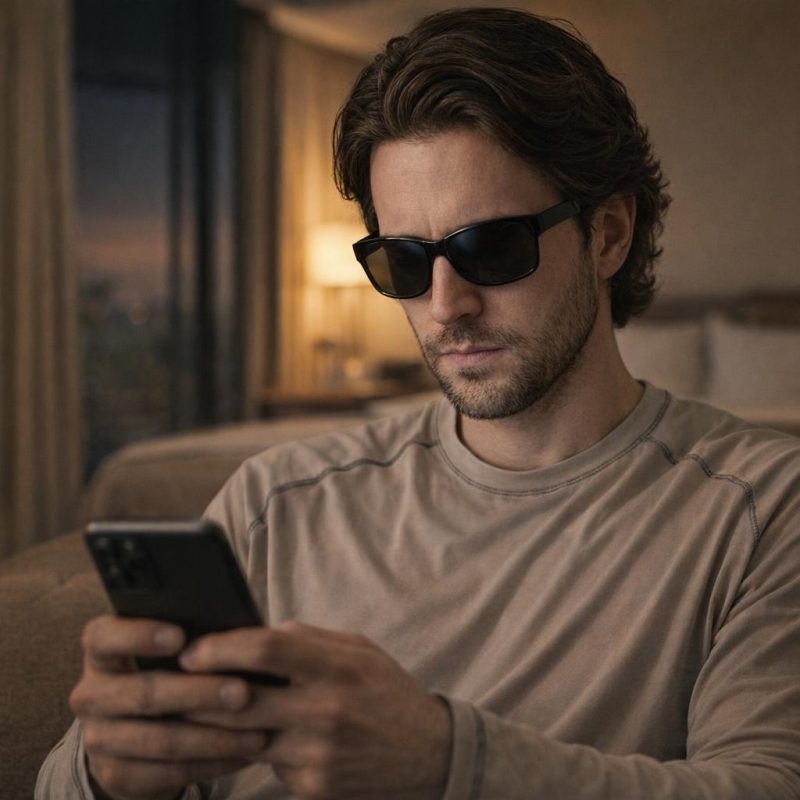 Image by RM AI
Recent Photograph
Marcus called instead of texting back, which told me he'd read something in the message I'd tried to keep out of it. I answered on the second ring. He said he was glad I reached out, said he'd actually been meaning to check in. Then he said he had something — a photo from a charity gala, six months back, that a colleague had forwarded him. He said Victoria had changed her appearance considerably since the divorce. I asked him to send it. There was a pause, and then he said he would, and to call him back after I'd looked at it. The image came through about forty seconds later. I opened it. The woman in the photo was standing at the edge of a reception table, champagne flute in hand, wearing something dark and structured. The hair was bleached blonde — the same committed, high-maintenance blonde I'd seen at the pool. The face was different in ways I couldn't immediately catalog: smoother in some places, sharper in others, the kind of work that's meant to look like nothing happened rather than something did. She was wearing oversized sunglasses pushed up on her head and a expression I recognized before I could stop myself from recognizing it.
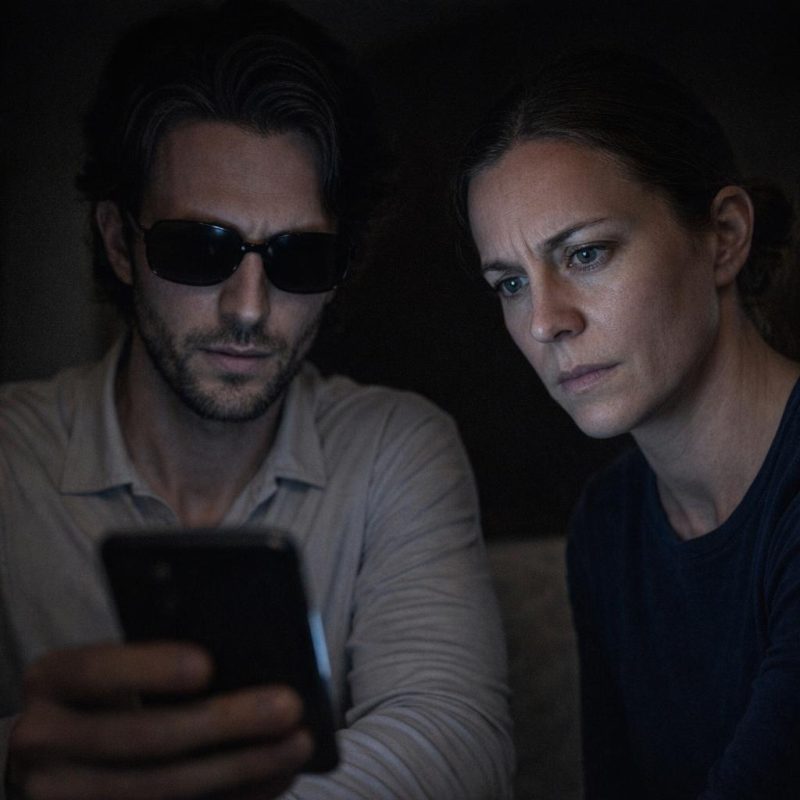 Image by RM AI
Physical Similarities
I sat on the edge of the bed and held my phone with both hands, moving between the photo Marcus had sent and the memory of the woman at the pool. The jaw was the thing. Cosmetic work can change a lot — the nose, the brow line, the fullness of the cheeks — but the underlying bone structure of the jaw is harder to alter, and hers had a particular quality to it, a slight asymmetry on the left side that I'd spent years sitting across from at dinner tables. I kept coming back to the hands, though. In the charity photo she was holding her phone in her left hand, screen angled slightly inward, thumb resting along the top edge rather than the side. I'd watched the woman at the pool hold her phone the exact same way — the same grip, the same thumb placement, the same slight inward tilt. It's not a common hold. Most people cradle from below or grip the sides. Marcus's voice came back through the speaker: 'You still there? Why are you asking about Victoria now?' I didn't answer right away. I was looking at the shape of her hands in the photograph, and they matched.
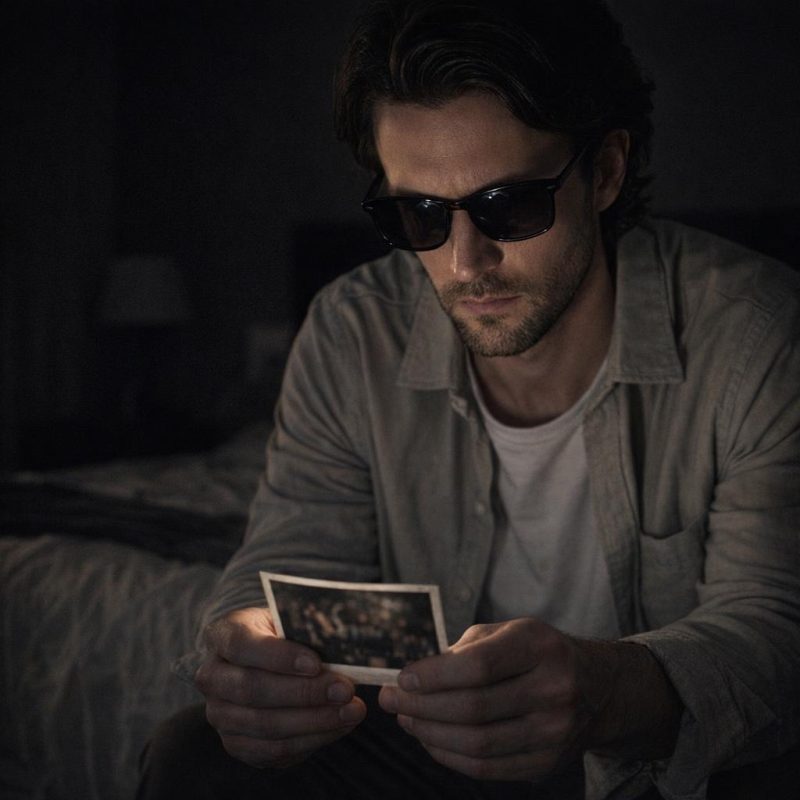 Image by RM AI
Maiden Name Discovery
I told Marcus what I'd seen — the initials on the bag, the behavior, the physical similarities, the hands. I kept my voice level. He was quiet for a moment after I finished, and then he said that Victoria had reverted to her maiden name after the divorce. Ashford. V.A. He said she'd had cosmetic procedures done within the first few months after the settlement — he'd heard it through a mutual contact, hadn't thought much of it at the time. He asked me twice if I was certain it was her, and I told him I wasn't certain of anything, that I was working from a photograph and a memory and a feeling I couldn't fully justify. He said that sounded like enough to be careful. He said he'd pull together what he had and send it over, and that I should document everything I could on my end — dates, times, any interactions. He said it in the tone he used when he was already thinking three steps ahead of the conversation. I thanked him and stayed on the line a few seconds after he'd said goodbye, the phone still warm against my ear. The name Ashford sat in my chest like something that had always been there, waiting to be found.
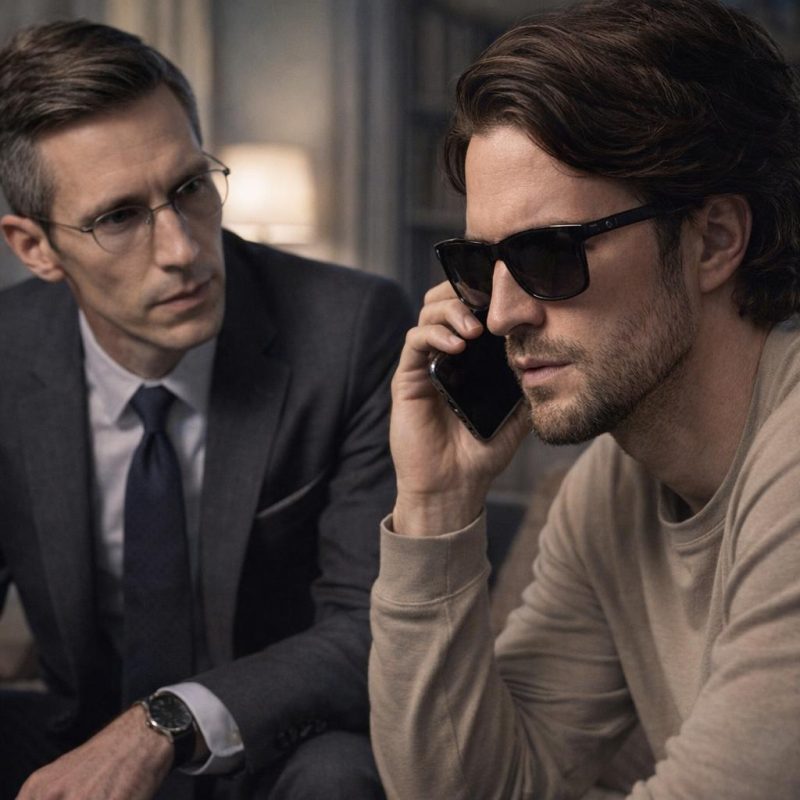 Image by RM AI
Timeline Match
I found Julian at the front desk and asked if he could confirm something for me — quietly, if possible. He nodded once and led me back toward his office without asking why. I told him I needed to know when the guest in the cabana suite had checked in. He pulled up the reservation system, took a moment, and then turned the screen slightly toward me without fully committing to showing it. Three weeks ago. I pulled up my own email on my phone and found the confirmation from when I'd booked — the timestamp read three weeks and two days before today. I stood there doing the arithmetic, which didn't take long because the arithmetic was simple. She had arrived two days after my reservation was made. Not two days after I arrived. Two days after I booked. Julian watched me work through it without saying anything. He had the particular stillness of someone who had already done the same calculation and was waiting to see if I'd land in the same place. I set my phone down on the edge of his desk. The two-day gap between my booking and her check-in sat between us in the room, and neither of us reached for an explanation that would make it smaller.
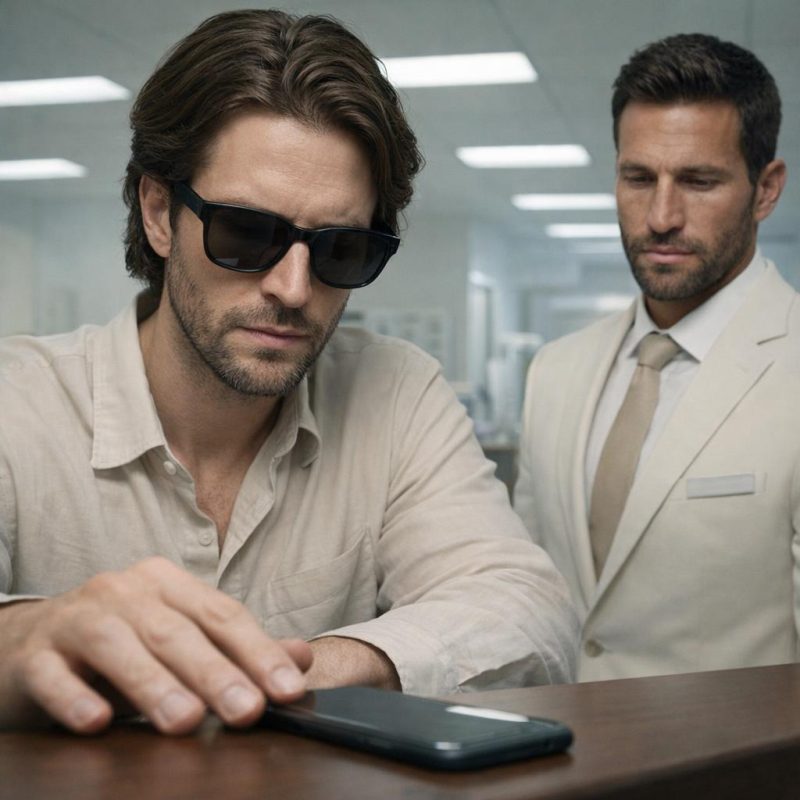 Image by RM AI
Targeted Timing
I asked Julian directly: how would someone know I'd made a reservation here before I'd told anyone I was coming? I hadn't posted about the trip. I hadn't mentioned it to neighbors or colleagues. The booking was made on a Tuesday afternoon from my apartment, and by Thursday she was checked in. Julian's expression shifted — not dramatically, but enough. He took his glasses off and set them on the desk, which I'd noticed he only did when he was about to say something he'd been holding back. He said there were privacy protocols governing guest reservation data, and that a breach of those protocols would be a serious matter. He said it carefully, the way you say something when you're confirming it without wanting to be the one who said it first. Then he said he thought we should bring resort security and management into this conversation, and that there were things he'd observed over the past three weeks that he hadn't yet had a reason to formally report. He said 'yet' with a particular weight. I looked at him across the desk and asked what things.
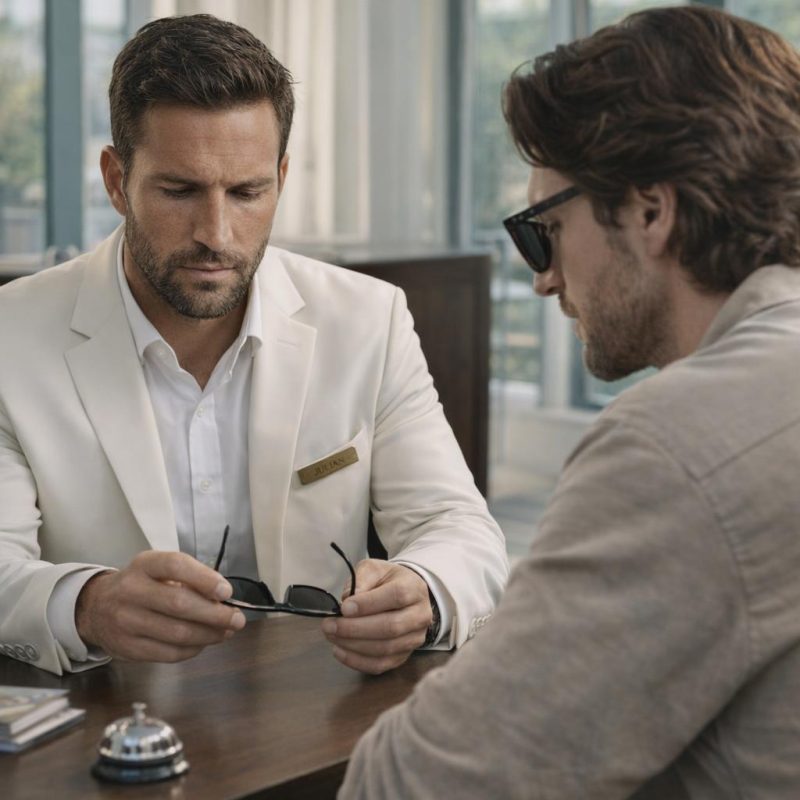 Image by RM AI
Privacy Breach
Julian didn't answer my question right away. He stood up, walked to the office door, checked the hallway in both directions, and closed it again. Then he sat back down and told me that resort security had flagged an anomaly in the guest services system three days ago — an unauthorized access event tied to a staff login credential that hadn't been used in weeks. When they traced it, the access logs pointed to the computer terminal in room 412. Her room. He slid a printed log across the desk without saying anything else. The timestamp showed two days before the poolside incident. The file accessed was mine — my full medical intake form, my surgical history, my treatment protocols, my dietary restrictions, the osmotic sensitivity notes, all of it. Everything I'd submitted in confidence when I booked the medical-accommodation package. I sat there looking at the printout and didn't say anything for a long time. I'd filled out those forms carefully, honestly, because I needed the staff to understand what I was dealing with. The idea that she had read every line of it — every clinical detail, every vulnerability I'd put on paper — settled into me like something cold and heavy that had no intention of leaving.
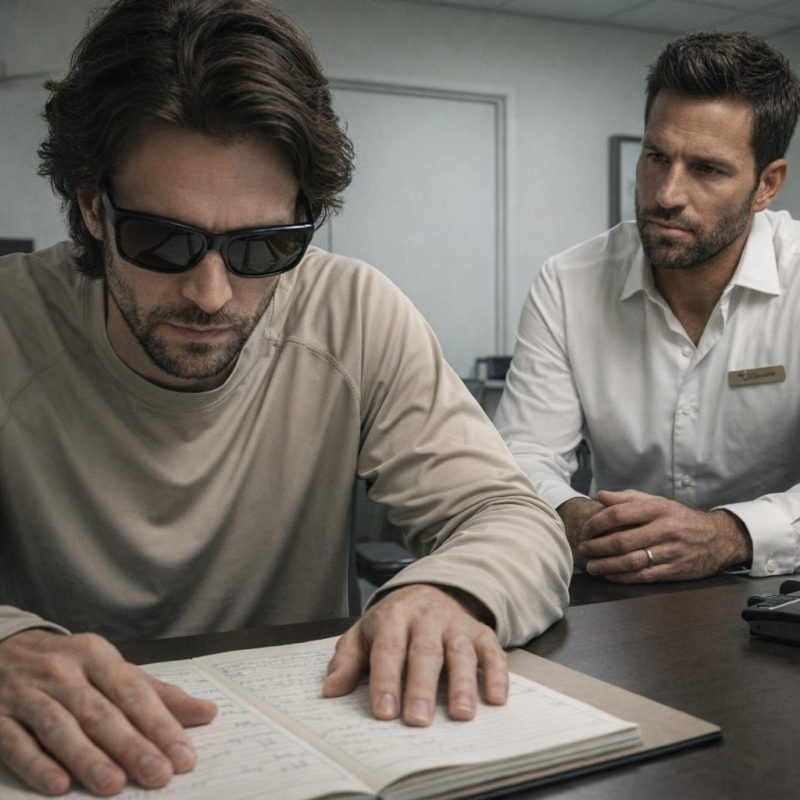 Image by RM AI
Management Confrontation
The general manager's name was Hendricks, and he had the practiced composure of someone who had handled complaints before but not quite like this one. The security director sat beside him with a laptop open and a folder of printed logs. Julian stood near the door. I laid out what I knew and asked them to confirm it. They did. The breach had occurred through a dormant staff credential — someone had obtained the login and used it from the terminal in her room. They couldn't yet say how she'd gotten the credential, but the access was unambiguous. Hendricks offered a full refund of my stay, a complimentary extended booking, and assurances that an internal investigation was already underway. I told him I didn't want a complimentary booking. I wanted the complete security logs — every access event, every file viewed, every timestamp — printed and certified, because I intended to share them with my attorney. The security director nodded and started typing. I also asked for written confirmation of exactly which records had been accessed and when. Hendricks said of course, absolutely, whatever I needed. He said he was deeply sorry. I looked at him and thought about how sorry doesn't reassemble something once it's been taken apart, and the apologies kept coming, and none of them changed a single thing.
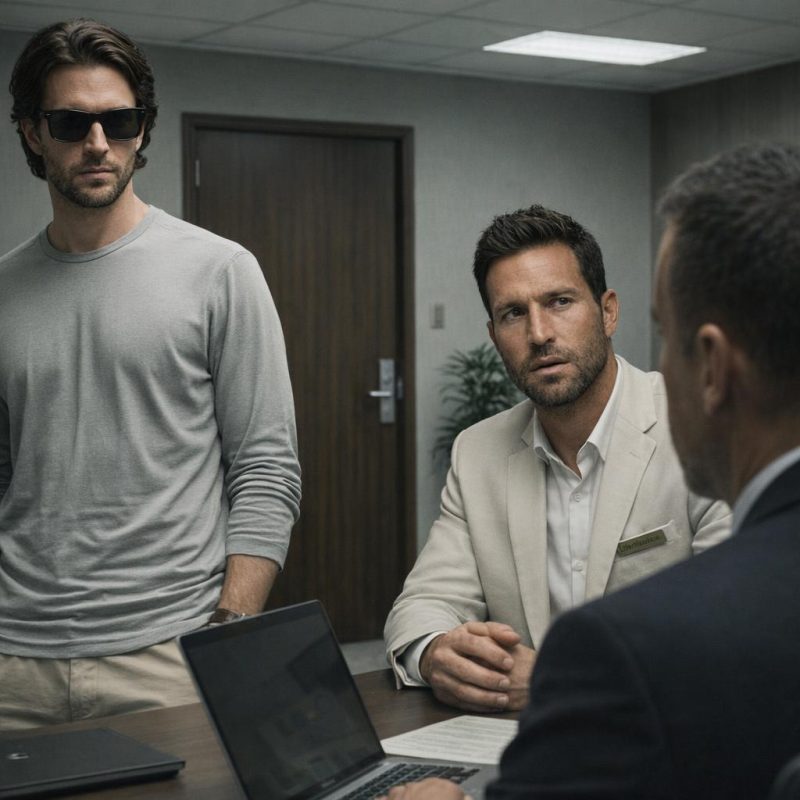 Image by RM AI
Julian's Recognition
Julian asked if he could have a few minutes with me after Hendricks and the security director left. We stayed in the conference room, and he poured water for both of us and didn't drink his. He said he needed to tell me something he probably should have said earlier, but that he'd wanted to be certain before he said it out loud. He told me he hadn't always worked at this resort. Two years ago he'd been the assistant manager at a property in Scottsdale. There had been an incident there — a guest dispute that escalated in a way that required security involvement and eventually legal documentation. He'd given a formal statement. The case had gone further than he'd expected. He said the woman at the pool — the one who'd taken my chair and my drink — he'd recognized her the moment he saw her, even with the different hair and the work she'd clearly had done. He said he'd been trying to confirm it quietly before saying anything, and that the security logs had removed his last doubt. I set my water glass down. I asked him what case he was talking about. He looked at me steadily and said he had testified against her in a divorce proceeding two years ago.
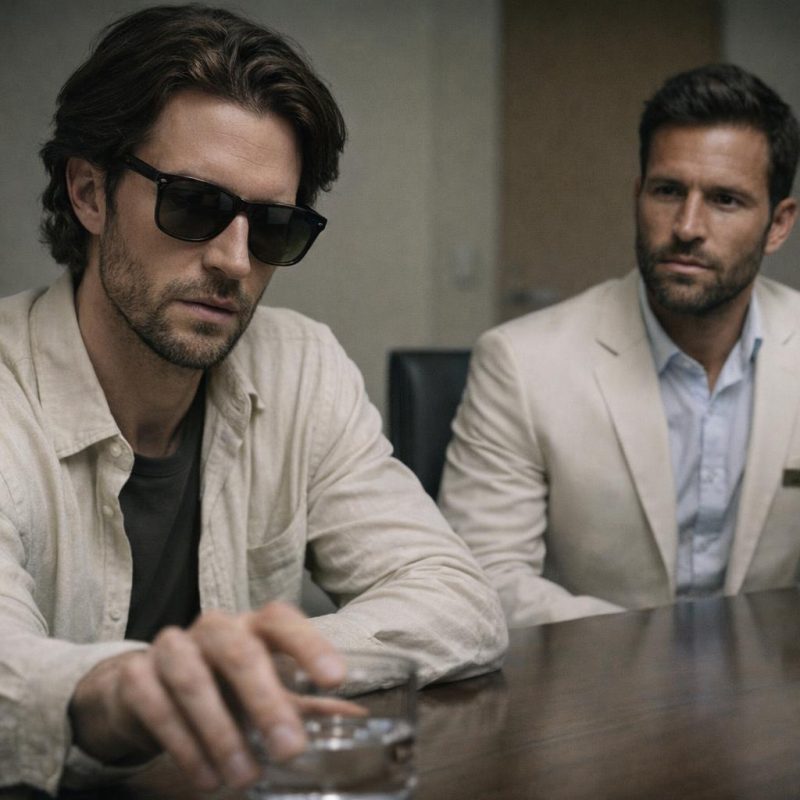 Image by RM AI
Marcus Arrives
Marcus made the drive in under four hours. I hadn't expected him until evening, but he was standing in the resort lobby by two in the afternoon with a briefcase that looked like it weighed as much as he did. Julian had arranged a private meeting room off the main corridor, away from the pool and the restaurant and anyone who might wander past. Marcus shook Julian's hand, thanked him briefly, and then set the briefcase on the table and clicked it open without any preamble. He said he'd been waiting for a reason to bring all of this to me in person, and that my call that morning had been reason enough. He spread documents across the table in a sequence that felt deliberate — credit card statements, travel records, a printed timeline with dates and locations running down the left margin. He said she hadn't stopped after the divorce was finalized. He said the documentation showed a pattern of movement that tracked closely with mine over the past several months. Julian stood near the wall and said nothing. I looked at the papers and then Marcus reached into a separate sleeve of the briefcase and pulled out a manila envelope, and when he opened it and laid the photographs on the table, I saw my own front door looking back at me from a surveillance still.
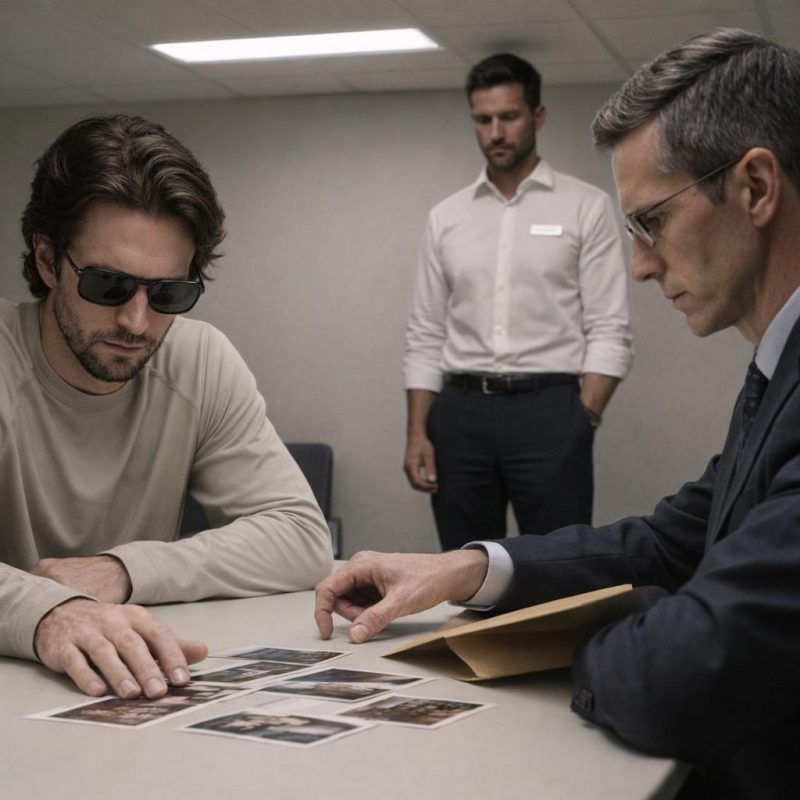 Image by RM AI
The Poisoning Truth
I recognized the angle of the photograph — the crack in the second porch step, the specific way the light hit the door in the late afternoon. Someone had been standing across the street with a long lens. Marcus let me look at it for a moment, then set three more photographs beside it. My car in the parking structure near my doctor's office. The entrance to the outpatient clinic where I'd had my pre-surgical bloodwork done. A timestamp in the corner of each one. He said her name quietly, and I looked up. He said she and I had been married. I already knew that part — I'd known her as Victoria, my ex-spouse, the woman the divorce had been about — but I hadn't connected her to the person at the pool, not completely, not until this moment. Marcus opened a second sealed envelope and removed a document on Dr. Pierce's letterhead. He said Dr. Pierce had flagged anomalies in my tissue samples during the surgical procedure and had spent the months since building a formal record. He said the findings pointed to chronic exposure over a sustained period. He said the damage to my organs hadn't been idiopathic. He put his hand flat on the table and said the words clearly and without softening them: deliberate poisoning. The room tilted sideways around me.
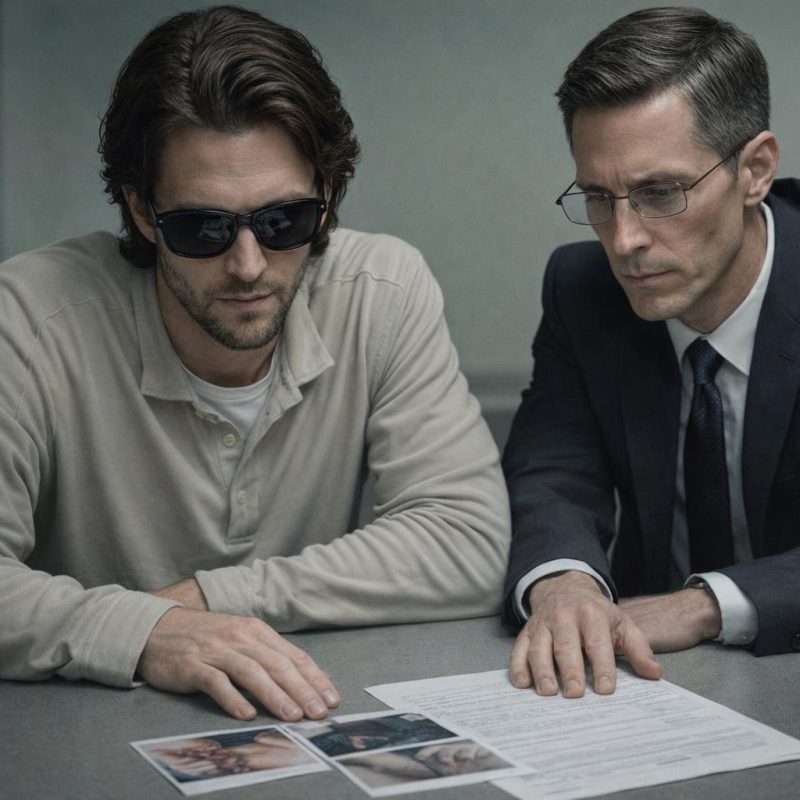 Image by RM AI
Scope of Betrayal
I don't know how long I sat there before I could hear Marcus properly again. He was still talking, moving through the documents in order, and I made myself focus on the pages in front of me rather than the space behind my eyes where everything was rearranging itself. He showed me the email records next. She had accessed my personal account — not once, not twice, but repeatedly over a period of months. The logs showed she'd read appointment confirmations from Dr. Pierce's office, prescription notifications, a booking confirmation from this resort. Marcus said the resort booking email had been opened from an IP address registered to her current residence eleven days before I arrived. Julian, who had been quiet against the wall, said that matched the timeline of her check-in. I thought about the poolside incident — the way she'd settled into my chair, the way she'd reached for my drink. Marcus turned to the next page and pointed to a column of dates: prescription refill notifications, each one accessed within hours of being sent to my inbox. She had known my medication schedule. She had known my appointment dates. She had known I was here. Marcus said the email access had been traced through a third-party application she'd installed during the marriage — and that it had never been removed from my account.
 Image by RM AI
Medical Causation
Marcus set Dr. Pierce's surgical notes on the table and walked me through them section by section. I'd read medical documentation before — I'd spent enough time in clinical settings over the past two years to understand the language — but reading it now, knowing what I knew, was a different experience entirely. The tissue damage patterns were consistent with chronic arsenic exposure over an extended period. Dr. Pierce had noted the anomalies during the procedure itself and had preserved samples for independent analysis. The osmotic sensitivity that governed everything about my recovery — the dietary restrictions, the UV protocols, the reason I was at a medical-accommodation resort in the first place — was a permanent consequence of the organ damage. Not a genetic condition. Not bad luck. A result. Marcus said Dr. Pierce had suspected the cause for some time but had needed the independent toxicology confirmation before she could formally report her findings, and that the report had been filed with the appropriate authorities the previous month. I looked at the pages. Every restriction I'd learned to navigate, every protocol Diana had walked me through, every careful calculation I'd made about what I could eat and where I could sit and how long I could be in the sun — all of it traced back to choices someone else had made in my own kitchen. I sat with that for a long time, and the weight of it didn't lift.
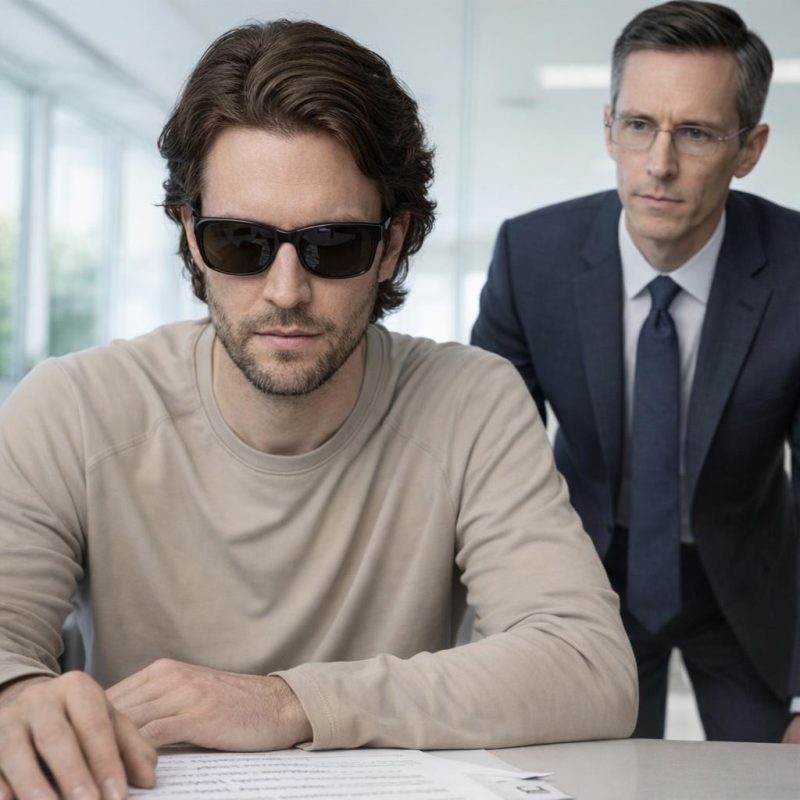 Image by RM AI
Her Return
Julian called my room at half past ten on a Thursday morning, three days after Marcus had driven back with his briefcase and his documents and his careful, measured voice. He said she had returned. She had checked in under the same name, requested a room on the opposite side of the building from her previous one, and was currently moving through the lobby with her oversized hat and her resort bag as though the previous visit had been entirely unremarkable. I thanked him, hung up, and took the elevator down. I positioned myself in one of the chairs near the corridor that opened onto the pool terrace — a spot with a clear sightline to the lobby entrance and the path beyond it. I had my water. I had my UV-protective sleeves. I had everything Marcus had given me, copied and filed and in the hands of people who knew what to do with it. She came through the lobby in the direction of the pool, moving with the easy confidence of someone who believed the room belonged to her. She didn't look toward the corridor where I was sitting. She didn't look for anything at all. I watched her pass, and I felt nothing that resembled surprise — only a stillness that had settled somewhere behind my sternum and showed no sign of moving.
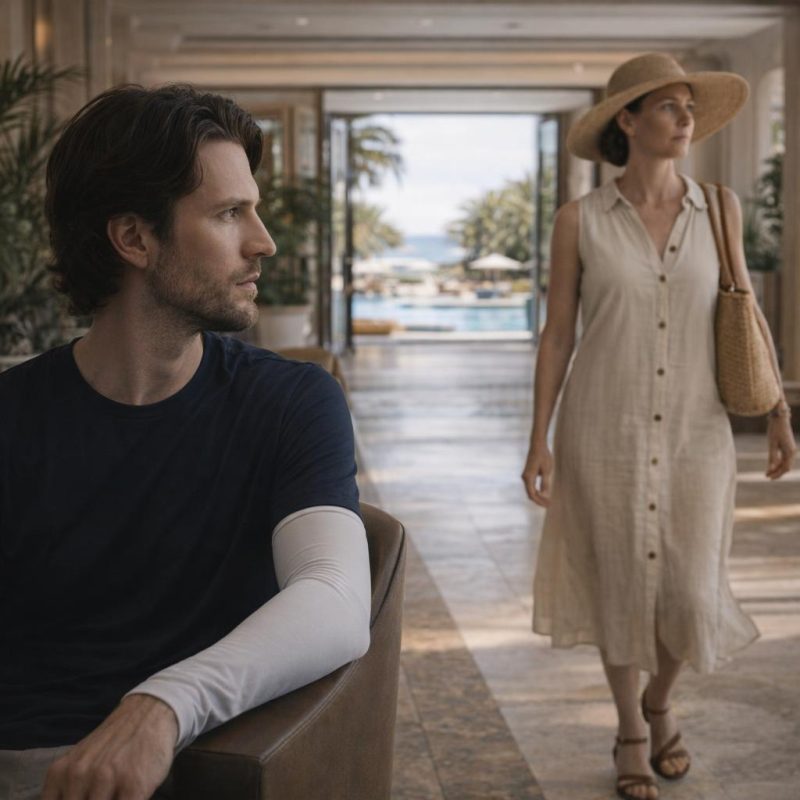 Image by RM AI
Building the Case
Marcus arrived at the resort with a second briefcase I hadn't seen before — the kind with a combination lock and reinforced corners. He spread everything across the small conference table Julian had arranged for us: Dr. Pierce's toxicology reports, the timeline he'd built from my medical records, the resort security footage on a laptop, and the divorce filings with their annotated margins. The detective — a compact man in a gray polo who introduced himself as Reyes — sat across from us and read without speaking for a long time. I answered his questions the same way I'd answered Marcus's: methodically, with dates and dosages and the names of every specialist who'd treated me over the past four years. I didn't editorialize. I didn't need to. The documents did that on their own. Reyes asked about the resort footage specifically — the timestamps, the angles, the gap between her first visit and her return. Marcus walked him through each segment with the patience of someone who had done this in courtrooms and wasn't rattled by the silence between questions. When Reyes reached the final page of Dr. Pierce's report, he set it down flat on the table, looked at it for a moment, and nodded slowly.
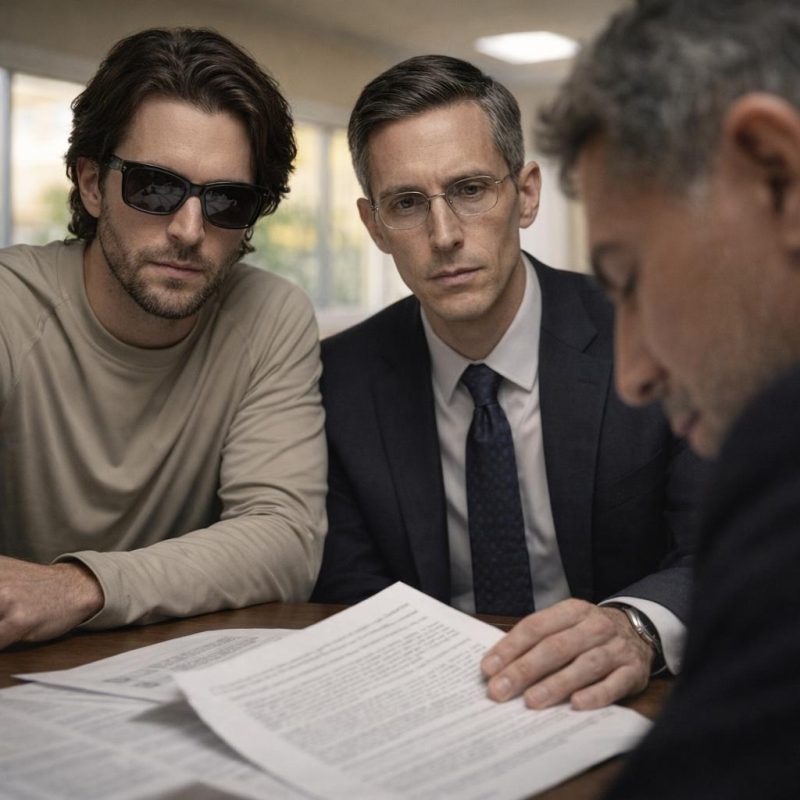 Image by RM AI
Police Coordination
Reyes briefed us the following morning in Julian's office with the door closed and the blinds angled down. Two plain-clothes officers would be positioned near the far end of the pool terrace — one at the bar, one near the towel station. A third would stay in the lobby corridor. Julian had already confirmed Victoria's location: she'd ordered a poolside drink at eleven and hadn't moved since. Marcus would stand to my left with the documentation folder. Reyes would approach from the right once I'd made initial contact. I went over what I wanted to say three times in my head while Reyes talked, trimming it down each pass until it was just the essential facts — her name, what she'd done, what I had to prove it. No speeches. No performance. Julian confirmed the pool cameras were recording and that resort management had been notified this was a criminal matter requiring their full cooperation. Marcus reviewed the folder one last time, straightened the pages, and closed it. Reyes looked at each of us in turn, then said, quietly and without ceremony, that they were ready to move.
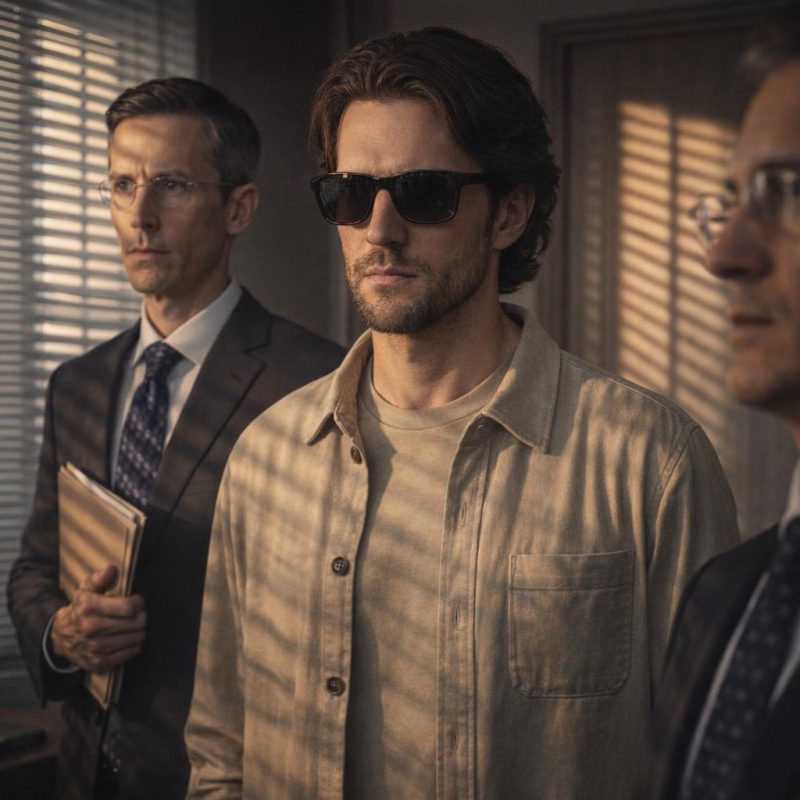 Image by RM AI
Public Confrontation
She was on the far lounger with her hat tilted forward and a fresh drink sweating on the side table. I walked across the pool deck at a pace that didn't hurry and didn't hesitate, Marcus a half-step behind me. She heard us before she saw us — I could tell by the way her chin lifted — and when she pushed the hat back and looked up, there was a half-second where her expression was still arranged for a stranger. Then it wasn't. I said her full name. Not the shortened version she'd used at check-in, not the maiden name she'd reverted to after the divorce. Her full married name, the one on the toxicology reports and the court filings and Dr. Pierce's surgical notes. I told her I knew what she'd put in my food. I told her I knew how long it had gone on. I told her I had the lab work, the timeline, and the documentation of every time she'd accessed my medical records without my knowledge. Around us, the pool deck had gone quiet in the way that happens when people stop pretending not to listen. She opened her mouth once, then closed it. The hat sat crooked on her knee where she'd knocked it, and her face had gone somewhere between recognition and something I didn't have a clean word for — and I stood there and let it settle.
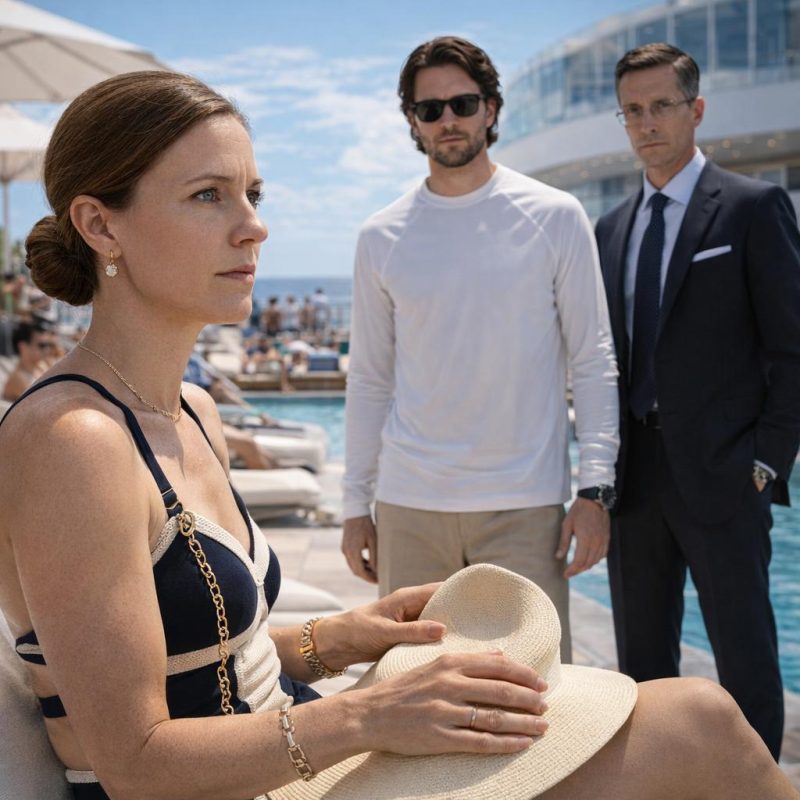 Image by RM AI
Manipulation Attempt
She recovered faster than I expected. Within thirty seconds she was on her feet, one hand raised toward the nearest cluster of guests, her voice pitched to carry. She said she didn't know what I was talking about. She said her ex-husband had a history of paranoid episodes and that she'd come here for a quiet holiday and was being harassed. She used the word 'unstable' twice. She said it was a coincidence — the resort, the timing, all of it — and that she had every right to be here. I watched her work the room the way I'd watched her work rooms for eleven years: the wide eyes, the slight tremor in the voice that suggested distress without quite committing to tears, the careful positioning of herself as the smaller, more vulnerable party. I'd seen her do it at dinner parties. I'd seen her do it with my own family. I let her finish. Marcus stepped forward, opened the folder, and set the first document on the empty lounger between us without a word. She glanced at it, then away, then back — and I recognized the exact moment she understood that performing for the audience wasn't going to be enough this time. The familiar shape of it settled over me like something I'd been carrying for years without knowing its name.
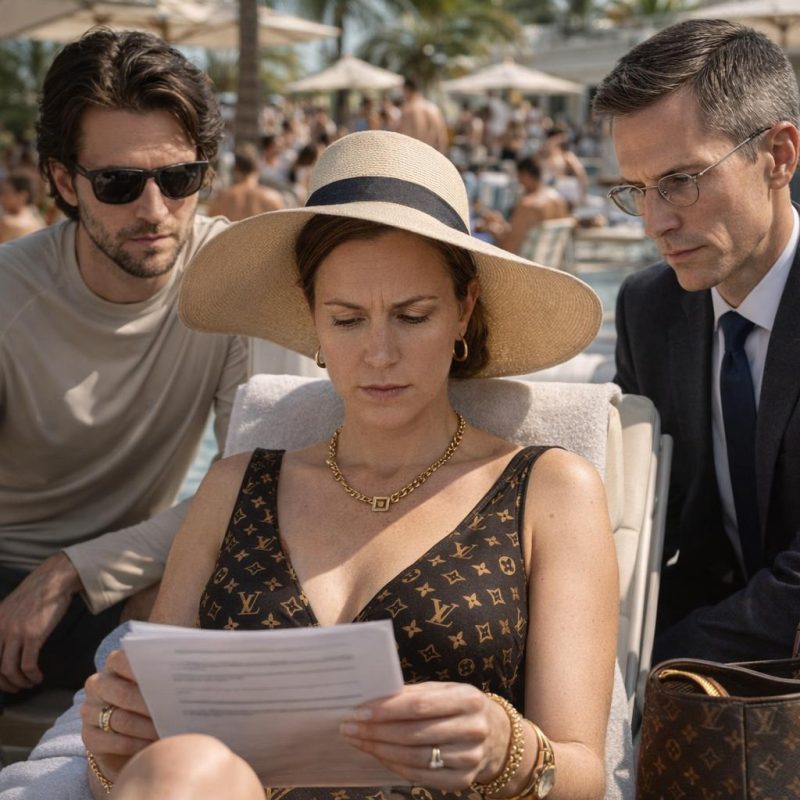 Image by RM AI
Evidence Presentation
Marcus didn't raise his voice. He didn't need to. He laid each document on the lounger in sequence, naming it as he set it down: Dr. Pierce's toxicology panel with the arsenic levels highlighted in yellow, the timeline cross-referencing my hospitalizations with her access to my calendar and kitchen, the resort's own security log showing her badge-swipe into the medical records annex, the divorce court filings with the judge's annotations, and finally the IT report confirming the unauthorized logins to my patient portal from a device registered to her home address. Julian stood to one side with a resort security officer who was photographing each page as it was presented. The guests who'd been pretending not to watch had stopped pretending entirely. Victoria stood with her arms crossed and her jaw set, but she wasn't speaking anymore — the performance had run out of material. I looked at the documents spread across the white cushion of that expensive poolside lounger, each one a thing that had existed in folders and hard drives and a surgeon's careful notes for years, and now they were just lying there in the open air and the afternoon light, plain and patient and entirely sufficient.
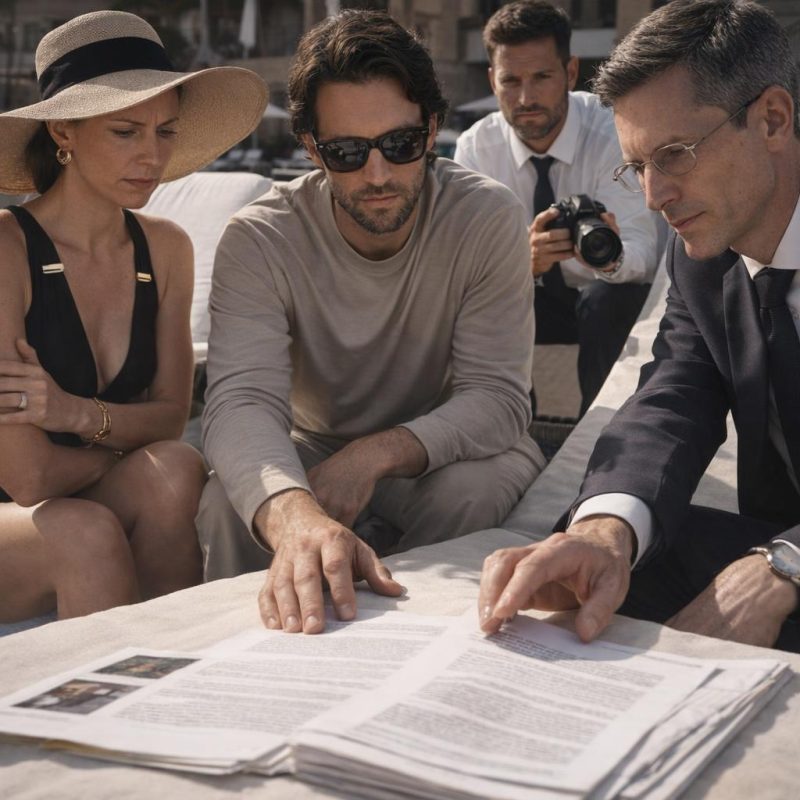 Image by RM AI
The Confession
The silence stretched long enough that I thought she might simply refuse to speak at all. Then something in her posture shifted — not a collapse exactly, more like a structure losing one load-bearing point — and she sat back down on the lounger. She looked at the documents for a moment, then at me, and her expression moved through several things I didn't try to name. When she spoke, her voice was quieter than I'd heard it in years. She said she'd never wanted to hurt me. She said she'd only wanted to make sure I needed her, that every time she thought I might leave she'd felt something she couldn't manage any other way. She said she'd tracked my recovery appointments because she needed to know I was still there, still reachable. She said the word 'love' three times in four sentences, each time with the absolute conviction of someone who had never once questioned whether what she felt entitled her to what she'd done. Reyes's audio recorder sat on the table beside the drinks, its small red light steady. Marcus didn't move. I didn't move. And then she looked up at me and said she'd done it because she loved me too much to let me leave.
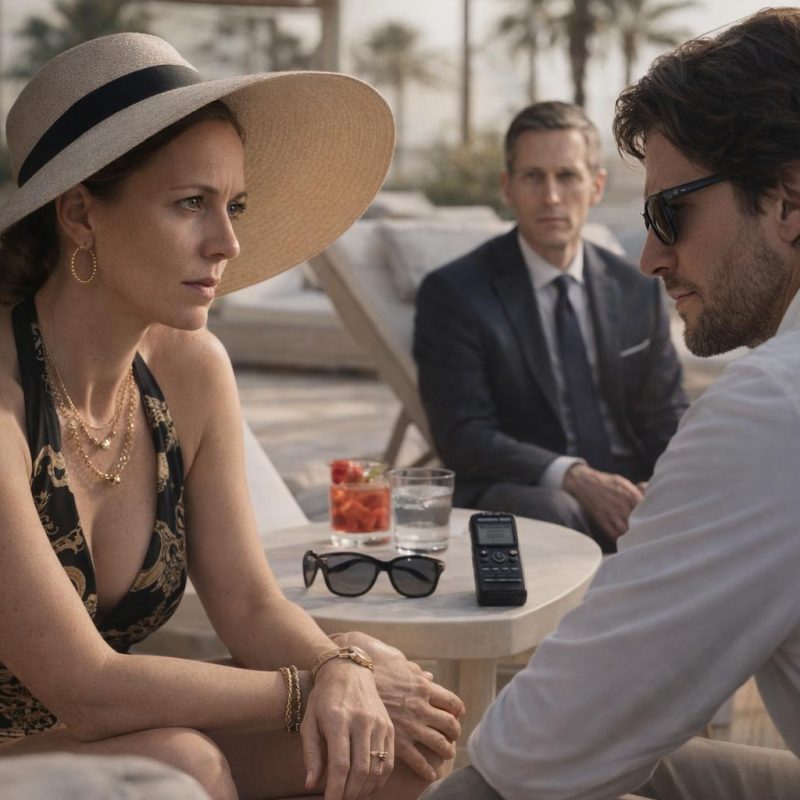 Image by RM AI
Legal Consequences
Reyes let the silence hold for exactly three seconds after she finished speaking. Then he stood, reached into his jacket pocket, and produced his badge, holding it open long enough for her to read it clearly. He introduced himself by rank and department. He told her she was being detained pending formal arrest on charges that included attempted murder in the first degree, aggravated stalking across multiple jurisdictions, unauthorized access to protected medical records, and computer fraud. He spoke in the flat, unhurried cadence of someone reading from a document he'd memorized, which I suspected he had. Marcus noted for the record — his own recorder running — that civil proceedings for medical damages and emotional distress would follow independently of the criminal case. Victoria had gone very still. She looked at Reyes, then at Marcus, then at the badge still open in his hand. She said she wanted to speak to a lawyer. Reyes said that was her right and that she'd have the opportunity. She said there had to be some arrangement, some way to address this differently. Reyes said there wasn't. The color left her face in a way that had nothing to do with the shade of her hat, and she sat there with the full weight of what was coming settling visibly across her shoulders.
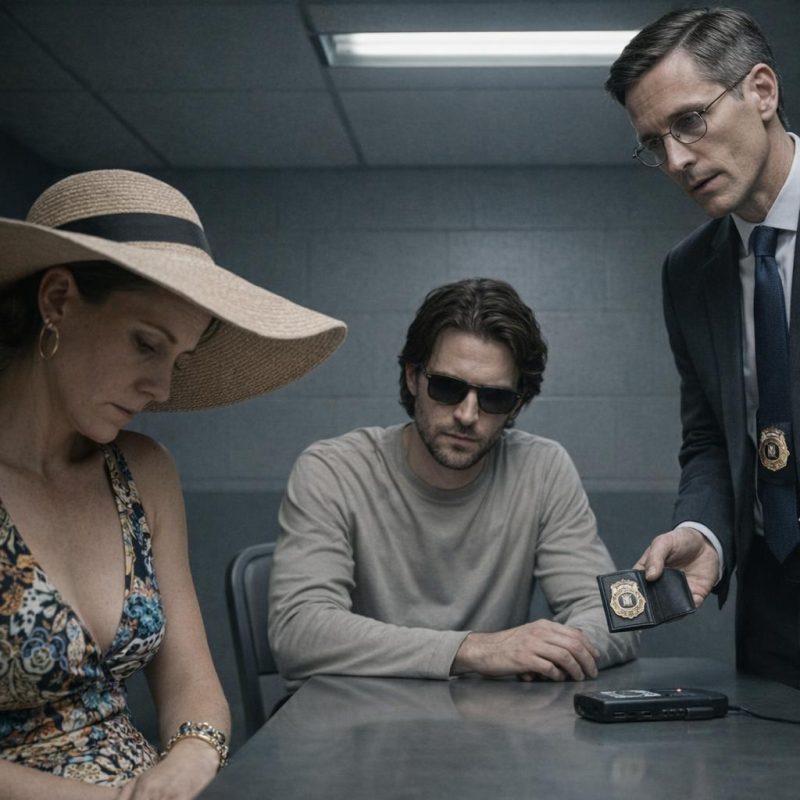 Image by RM AI
The Arrest
Two uniformed officers came through the pool gate from the lobby corridor — I'd seen them earlier and hadn't acknowledged them, which had taken more discipline than I expected. Reyes gave a small nod and they moved to either side of her. She stood when they asked her to stand. She looked at me once more and said my name — just my name, nothing attached to it — in a tone I couldn't do anything useful with. I didn't answer. The officers were professional and unhurried, and the guests around the pool had gone completely silent in the way that happens when something real intrudes on a place designed to keep reality at a comfortable distance. Julian stood near the towel station with his hands clasped, watching. Marcus was already on his phone, one finger pressed to his ear. Victoria said something to the officer on her left that I didn't catch. The officer responded briefly and guided her arm forward. I watched the pool deck, the documents still spread across the lounger, the half-finished drink sweating in the afternoon heat — and then I heard the metallic click of the handcuffs closing around her wrists.
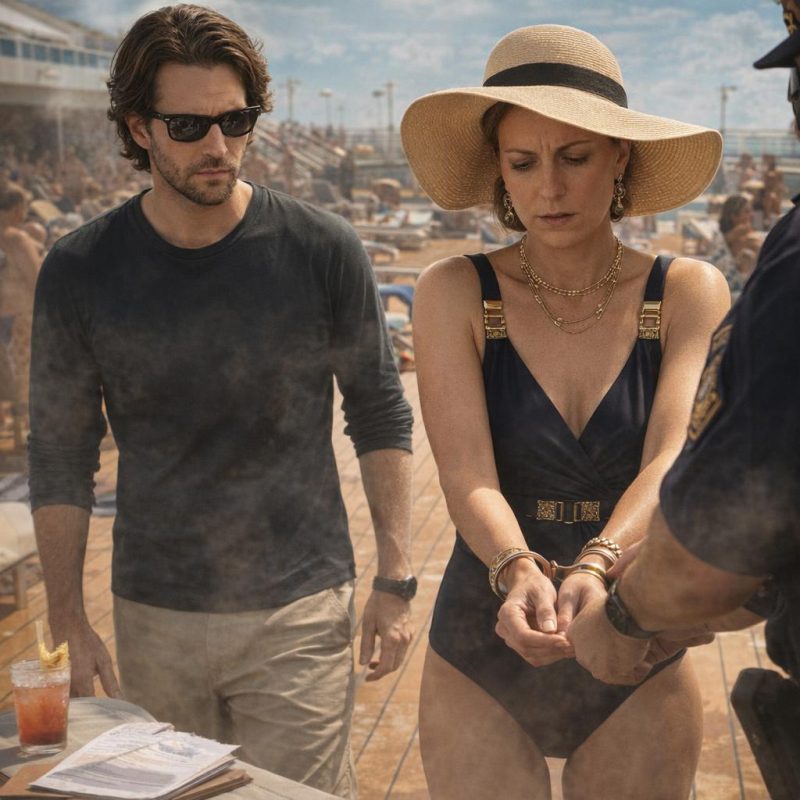 Image by RM AI
Twisted Motives Revealed
Marcus found me a quiet corner of the lobby bar about an hour after the officers walked Victoria out. Julian brought water without being asked and then gave us space. Marcus set his legal pad on the table and walked me through what had come out of her confession and the psychological evaluation the court had ordered. She had viewed the poisoning — his word, not mine, though I'd been thinking it for months — as a form of bonding. If I was sick, I couldn't leave. If I depended on her for care, for management of symptoms I didn't even know were manufactured, then the marriage was permanent by design. The stalking after the divorce wasn't rage, Marcus said. It was disbelief. She genuinely hadn't processed the legal dissolution as real. The surgery, the new face, the resort appearance — that was her testing whether the connection still existed on my end, whether I'd recognize something in her that she still recognized in me. Marcus tapped his pen against the pad. The evaluating psychologist's language was clinical and precise: she had never understood the marriage as a partnership between two people. She had understood it as ownership — and I was the thing she owned.
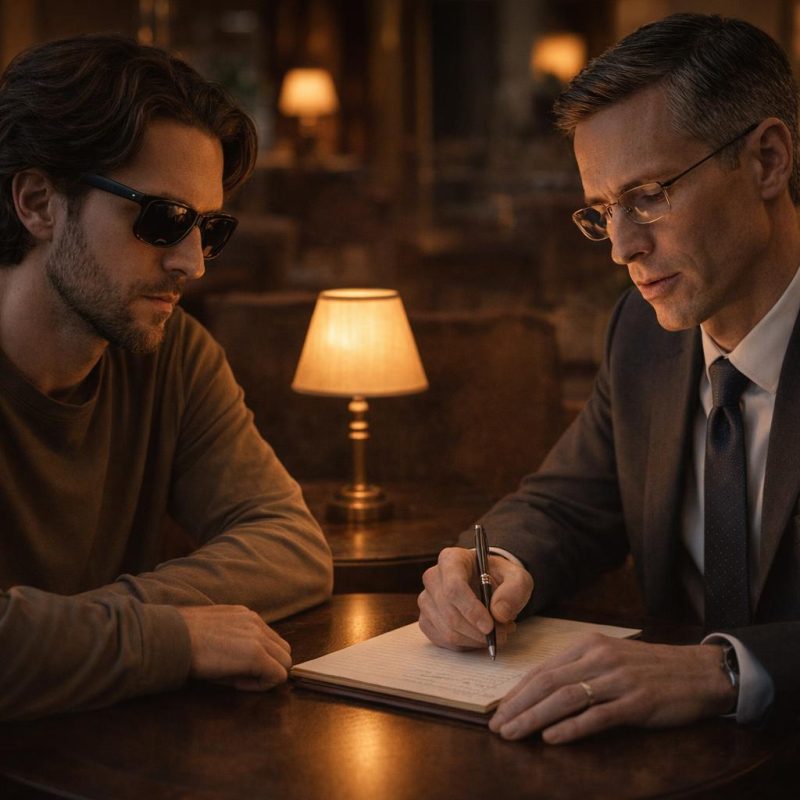 Image by RM AI
Legal Proceedings Begin
The prosecutor's office was on the fourth floor of a building that smelled like recycled air and old carpet. Marcus sat beside me. I had a folder of my own — medical records, the timeline I'd built during the worst months of my recovery, notes I'd made when I still wasn't sure what was wrong with me. I gave my statement over two sessions. I described the marriage, the symptoms that had started small and compounded, the years of being told I was fragile by the person who was making me fragile. Dr. Pierce's toxicology documentation was formally entered into the case file while I was in the room. I watched the prosecutor initial each page. Marcus filed the civil suits the same week — medical damages, emotional trauma, the full accounting. The prosecutor told me, plainly and without drama, that Victoria would be looking at significant prison time. I signed the authorization forms and slid them back across the table. There was no ceremony to it. Just ink on paper, and the quiet, settled weight of having said everything true, out loud, in a room where it was being written down and taken seriously.
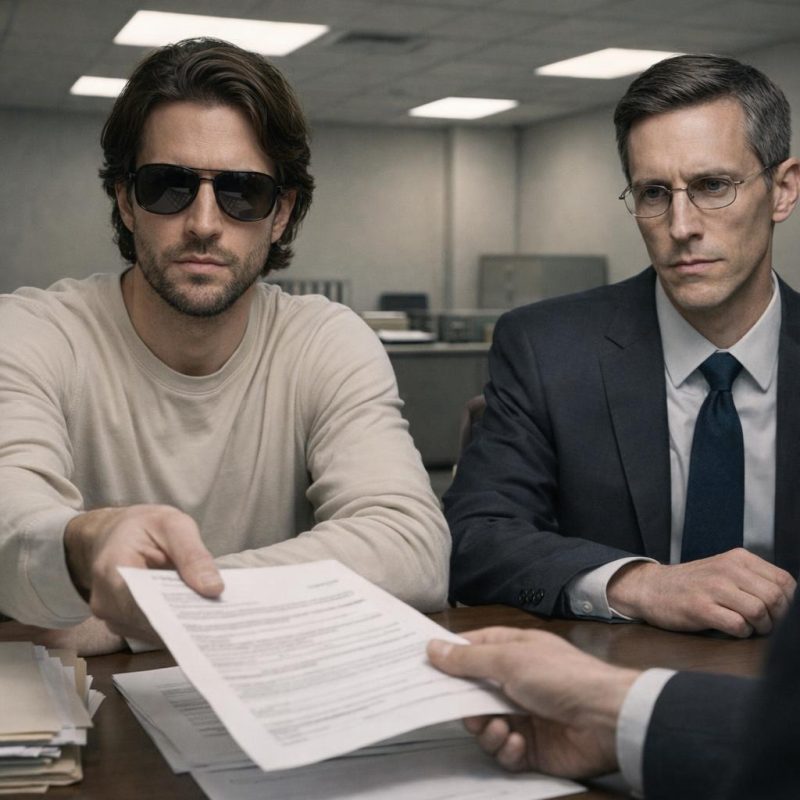 Image by RM AI
Recovery Completed
Six months later I was back in Dr. Pierce's office, sitting on the same exam table with the paper cover that crinkles every time you shift your weight. She reviewed the latest bloodwork with the focused calm I'd come to associate with good news delivered without fanfare. Organ function had stabilized completely. The osmotic sensitivity had dropped to a level she described as manageable — her word for something that no longer required me to plan my entire life around it. The medication schedule was down to two things instead of nine. She noted, in the dry clinical shorthand she favored, that the improvement tracked almost exactly with the removal of the exposure source. Almost exactly. I thanked her for the documentation — the careful, methodical record-keeping that had turned a pattern of symptoms into evidence a prosecutor could use. She said she'd only written down what was there. I believed her, and I also knew that not everyone would have looked that closely. I changed back into my clothes and stood at the window for a moment before leaving. Outside, the city moved at its ordinary pace. My body, for the first time in years, felt like it was simply mine — not a battleground, not a liability, just a thing that was quietly, steadily getting on with the work of being well.
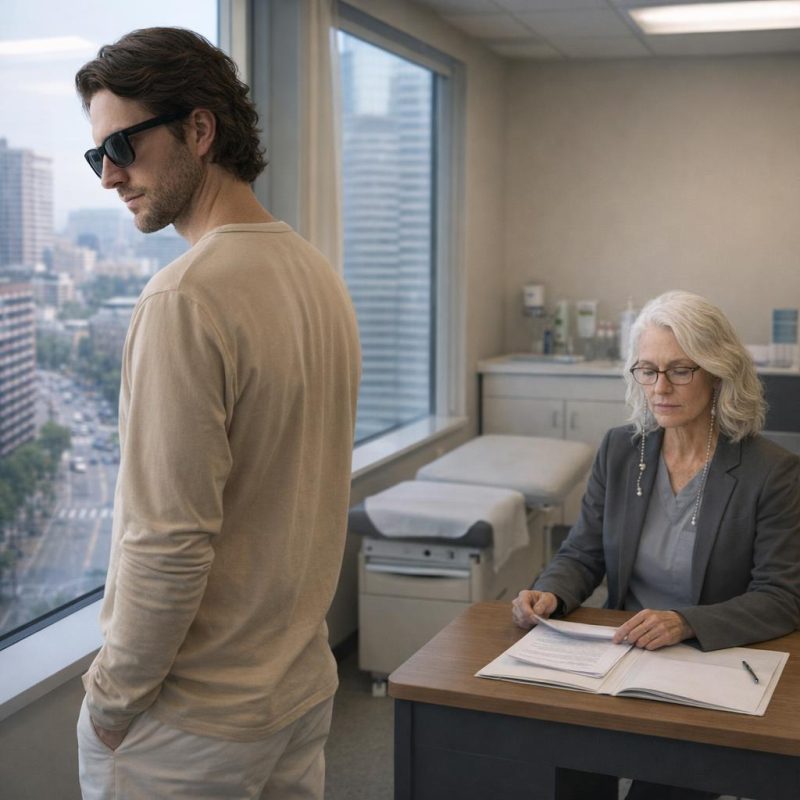 Image by RM AI
New Beginning
I booked the same Diamond Tier bed. Same resort, same pool deck, same view of the water. Julian was at the front desk when I checked in, and he looked up from his screen and smiled in a way that wasn't purely professional — there was something genuine in it, the kind of recognition that comes from having been through something together. He said I looked well. I told him I felt it. I didn't bring UV-protective layers this time. I didn't pack a medication schedule or a laminated protocol card. I ordered a Blue Hawaiian — an actual one, with rum and blue curaçao and a paper umbrella that listed slightly to the left — and I carried it out to the pool and sat down in the sun. Victoria was fourteen months into a fifteen-year sentence. I didn't think about her often, and when I did, it was with a flatness that felt like health rather than suppression. The lounger was exactly as comfortable as I remembered. The drink was cold and sweet and entirely, straightforwardly what it claimed to be. Julian passed by once, caught my eye, and gave a small nod. I raised the glass. One year ago I had come here to survive. I was back now, and the pool chair held the weight of someone who had nothing left to prove.
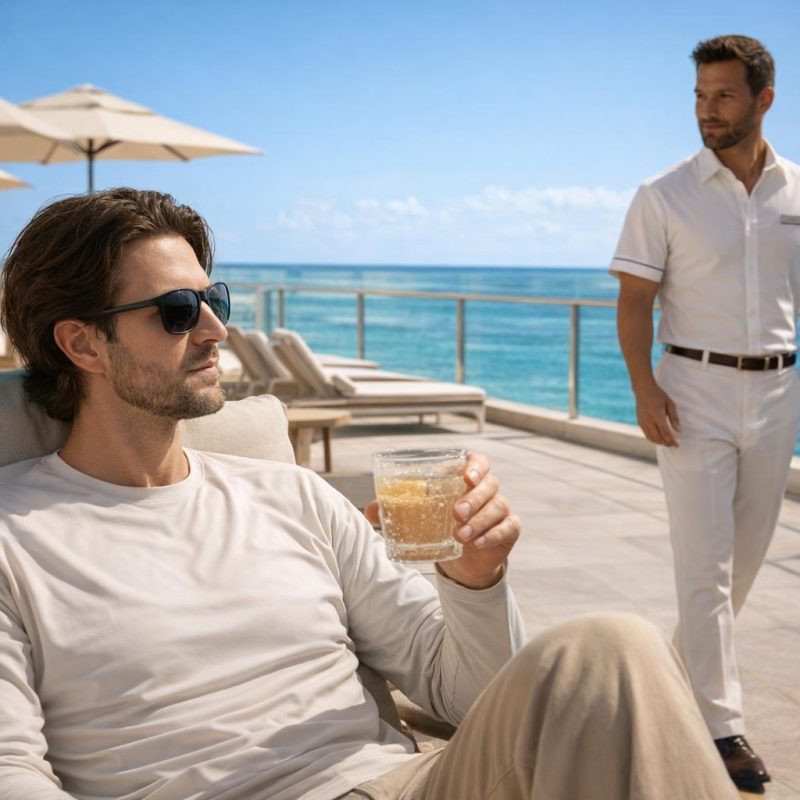 Image by RM AI
KEEP ON READING
20 Strangest Beauty Trends Throughout History
Beauty Has Always Had Strange Rules. History is full of…
By Christy Chan Jun 12, 2026
20 First Class Meals Served On The Titanic's Final Night
The Ultimate Final Feast. When the wealthiest passengers gathered in…
By Sara Springsteen Jun 12, 2026
20 Facts About The Library of Alexandria
More Than Just A Room. The Library of Alexandria has…
By Elizabeth Graham Jun 12, 2026
20 Baby Names That Became Unusable After One Historical Figure
Some Names Never Fully Escape Their Reputation. Most baby names…
By Emilie Richardson-Dupuis Jun 12, 2026
The 20 Creepiest People In History
Truly Uncomfortable. History isn’t only made by kings, reformers, and…
By Annie Byrd Jun 12, 2026
10 Historical Figures Flattered By Portraits & 10 Who Got…
History's Paintbrush Wasn't Always Honest. Before cameras, the only record…
By Cameron Dick Jun 12, 2026