The Watts Towers: One Man's Decades-Long Obsession That Became a Landmark
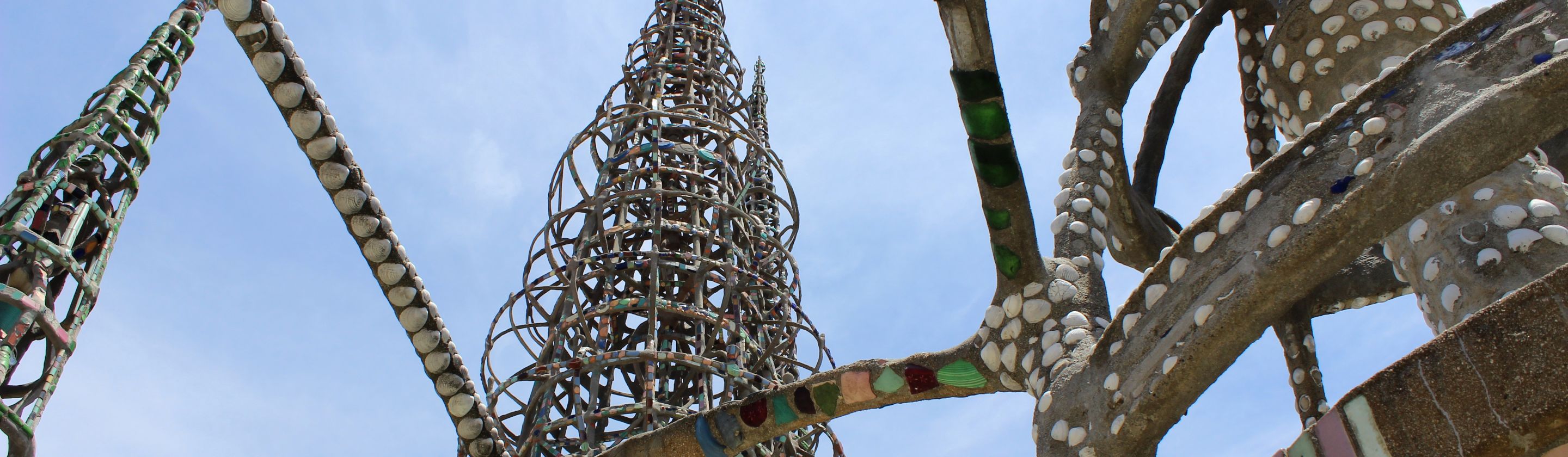
On East 107th Street in Los Angeles, a cluster of narrow towers rises above the houses in Watts. The tallest reaches 99.5 feet, roughly the height of a ten-story building. Its sides are covered in colored glass and broken dishes, packed into mortar by someone who worked there after finishing his regular job. Look closely and you can still recognize pieces of old soda bottles.
That someone was Sabato Rodia, an Italian immigrant known to his neighbors as Sam. Starting in 1921, he spent 33 years building on this small lot until the yard held 17 connected sculptures. Then he left Los Angeles and gave the place away. Within a few years, the city wanted to tear down what he had made.
A Second Job in the Backyard
Rodia was born in Italy in 1879 and arrived in the United States as a teenager. By 1921 he was living in Watts, where he bought a triangular lot beside the railroad tracks. He was 42, with years of construction work behind him and no formal art training. He knew how to handle concrete and steel. His little house remained on the lot as the structures grew around it.
After his regular shift, Rodia went back to work at home. He shaped salvaged steel into uprights and rings. He bound the pieces with wire before covering them in mesh and mortar. The original framework had no welded joints. The tallest tower stands on a foundation only 14 inches deep. Rodia kept adding height and reinforcing sections as he went, often changing work he had already completed.
Getting materials that high was a job in itself. Rodia worked without scaffolding, carrying tools and buckets upward while using a window washer's belt for support. Neighbors could watch him from the street or from passing trains. Older residents remembered collecting scraps of glass for Rodia as children and receiving small payments. He did the building himself, but some of his supplies came from people living nearby.
What Went Into the Concrete
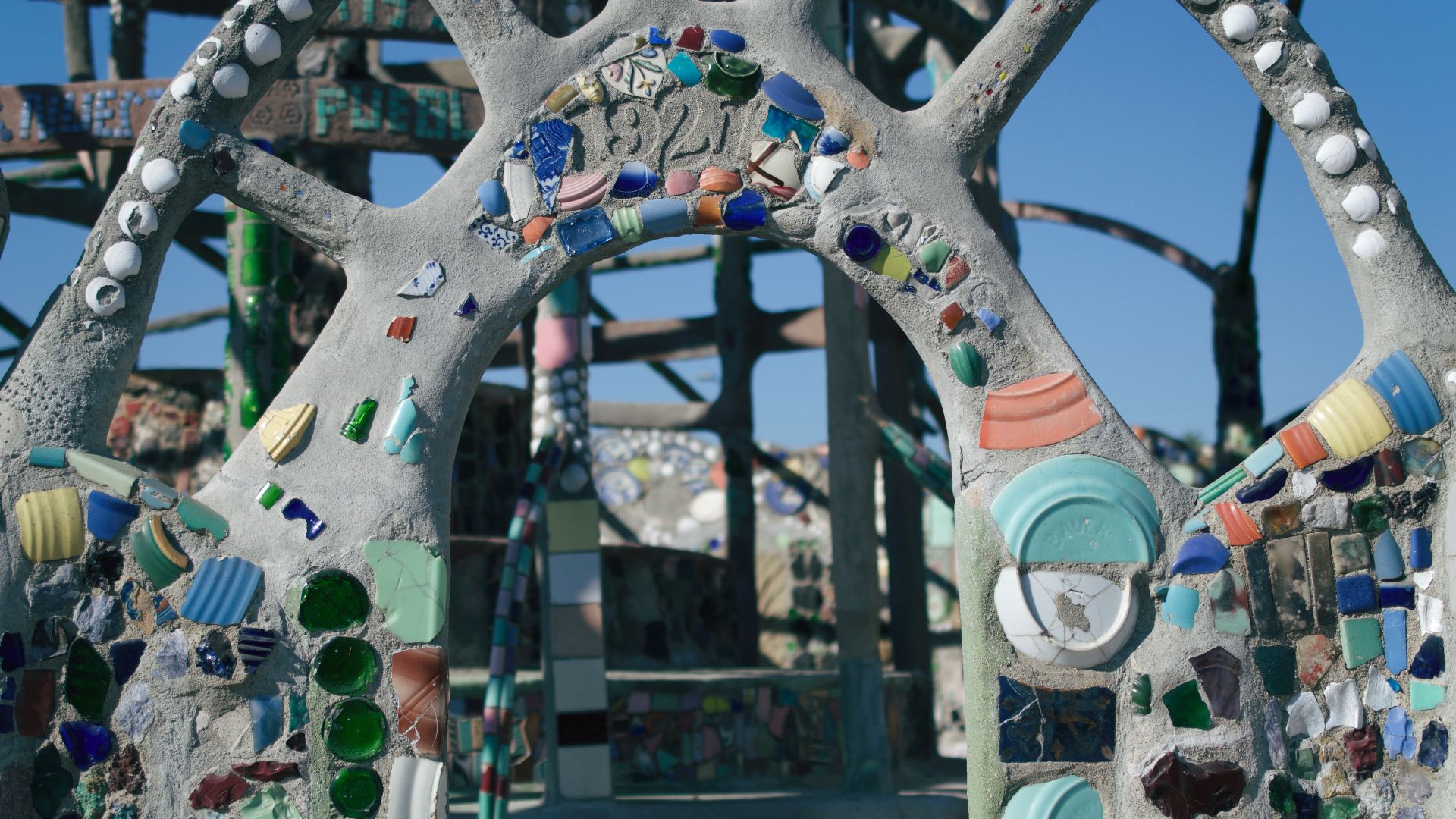
Green fragments from 7 Up bottles appear throughout the work. The blue glass came partly from Milk of Magnesia containers, while broken plates supplied many of the ceramic patterns. Rodia pressed the fragments into wet mortar, sometimes arranging pieces into bands around a column. Some of the brands have disappeared, and the original bottles are long gone.
Curved walls lead toward a gazebo, and a boat-shaped area suggests the bow of a ship. The tall spires can look like masts from certain angles. Rodia called the whole place Nuestro Pueblo, Spanish for Our Town. A Public Art in Public Places exhibition shows benches and small decorated spaces that barely register in photographs of the skyline.
There are smaller records of his work all over the walls. Rodia pressed tools into the cement, leaving recognizable marks, and scratched dates into some sections. LACMA's 1962 exhibition catalogue documented those details while the site was still relatively new to the art world. His changes over the years made later restoration harder. Conservators couldn't always know whether a particular shape represented his original plan or a repair he made along the way.
The Demolition Order
In 1954, Rodia stopped working and gave the property to his neighbor Louis Sauceda. Sauceda apparently sold it for $1,000 about six months later. Rodia moved to Northern California and never returned. His old house burned in 1956, leaving the towers around the place where he had lived. The next year, Los Angeles building officials ordered the structures demolished because they considered them unsafe.
Filmmaker William Cartwright and actor Nicholas King bought the site in 1959 and helped organize opposition to demolition. Aerospace engineer Bud Goldstone devised a test that pulled sideways on the tallest tower with a force of 10,000 pounds. According to the documented test account, it moved only about an inch before the cable snapped. The city withdrew the demolition order. Rodia was already living hundreds of miles away.
The Watts Towers Arts Center opened in 1961, holding its first classes on the remains of Rodia's former house. The towers became a National Historic Landmark in 1990. Keeping them standing still takes considerable work. LACMA conservators open cracked mortar to treat rusting steel, then fit the decorations back into place. Other specialists photograph fallen fragments and try to identify their original locations. Some pieces remain in storage until someone can work out where they belong.
KEEP ON READING