

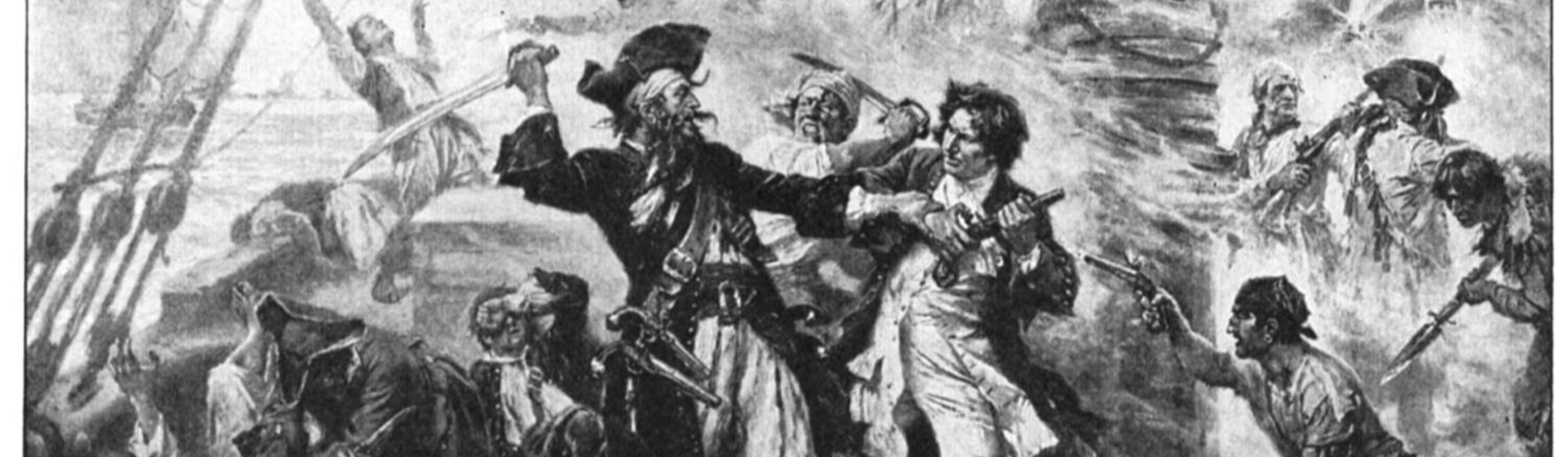
How Blackbeard Became History's Most Fearsome Pirate
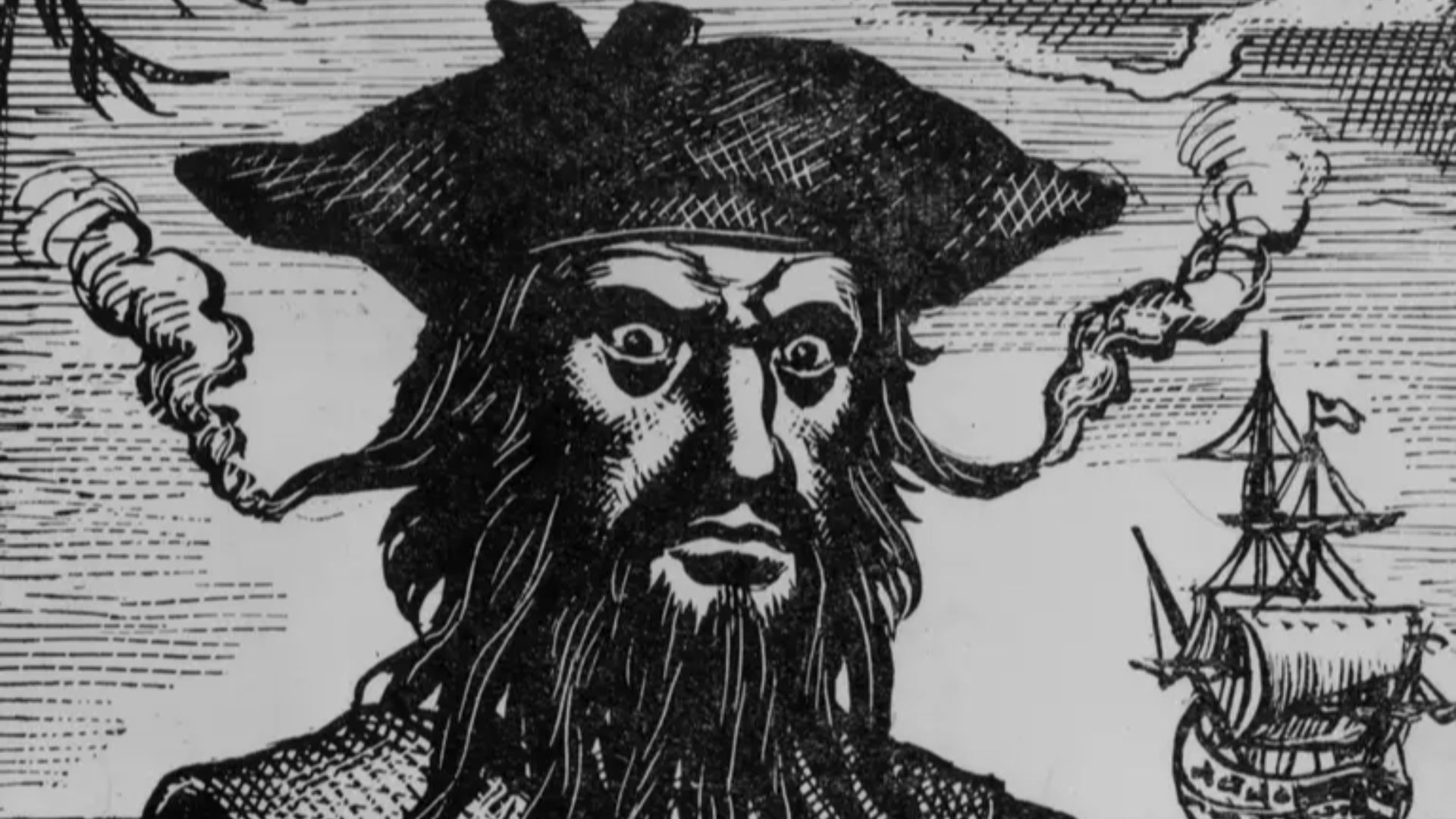 Hulton Archive/Getty Images on Wikimedia
Blackbeard’s reputation didn’t happen by accident, and it wasn’t built on nonstop bloodshed the way movies love to suggest. In real life, he operated during the chaotic “Golden Age of Piracy,” when wartime sailors, privateers, and opportunists flooded the Atlantic looking for profit. He understood something timeless: if people are scared enough, you don’t have to fight as often.
Similar to how some people have the uncanny ability to win a room with pure presence and charisma, Blackbeard combined timing, theatrics, and smart target selection into a brand so effective that his name became synonymous with pirate terror. His career was relatively short, yet it left a shadow long enough to reach modern pop culture.
He turned intimidation into a business strategy
The man behind the nickname is widely identified as Edward Teach (also spelled Thatch), and very little about his early life is firmly documented. What we do know is that he leaned hard into the “Blackbeard” persona, building an image that did a lot of work before any shots were fired. In a world where rumors traveled faster than ships, looking like trouble was half the job.
Instead of relying on constant violence, he preferred a performance that made surrender feel like the safest option. A famous early account describes him arming himself heavily and sticking lit matches under his hat during battle, creating a smoky, devilish effect around his face. No doubt, some details got embellished over time, but the fact remains that he had a knack for cultivating fear.
That psychological edge mattered because piracy is risky, expensive, and full of inconvenient surprises. When a merchant crew panics and yields quickly, you spend less time fighting and more time taking goods, which is the part pirates actually want. His “fearsome” label wasn’t just a personality trait; it was a cost-saving measure. By making people expect the worst, he often got compliance without having to prove it.
Beyond smoke and mirrors
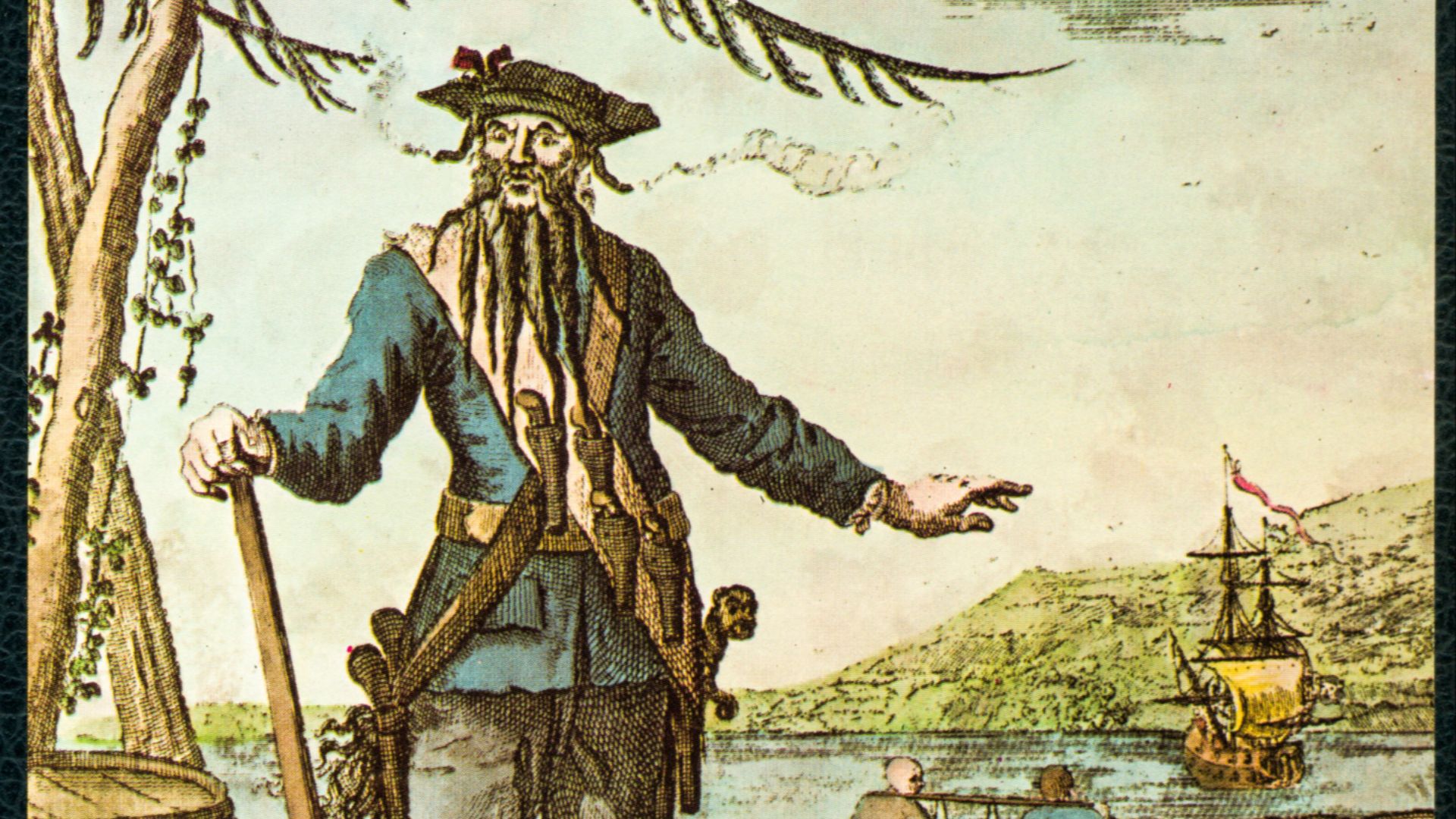
A terrifying look only gets you so far if you don’t back it up with presence, and Blackbeard’s flagship helped with that. He commanded the Queen Anne’s Revenge, formerly a French slave ship, which he captured near Martinique and filled with armaments. It became the centrepiece of his operations. In Queen Anne’s Revenge, he cruised the Caribbean and targeted merchant traffic around islands that sat on busy routes.
His most headline-friendly stunt happened in May 1718, when he blockaded Charles Town (Charleston), South Carolina for nearly a week and plundered multiple ships trying to enter or leave. He took hostages, including prominent locals, demanding ransom.
After Charleston, he headed to the North Carolina coast, and not long after, Queen Anne’s Revenge ran aground near Beaufort Inlet in 1718. This effectively ended the flagship’s short pirate career, after which Blackbeard shifted to smaller vessels. Whether it was an accident or a convenient way to slim down obligations, the practical outcome was that his operation became leaner and more mobile.
He chose bold moves that made great stories travel faster
What’s especially telling is that his legend grew in part because he understood restraint as a tool. Pirates who slaughtered indiscriminately invited relentless retaliation, while pirates who threatened convincingly could keep operating longer. Blackbeard’s ideal outcome was a frightened crew handing over cargo without forcing him into a messy battle. In practical terms, he made fear feel like the reasonable choice.
He exploited politics, then sealed the legend with a dramatic end
At his peak, he didn’t just dodge authorities; he tried to outmaneuver them through the system. In 1718, shortly after the grounding of Queen Anne's Revenge, he accepted a royal pardon in North Carolina, working with Governor Charles Eden and briefly presenting himself as reformed. That move bought breathing room, muddied legal waters, and let him operate around places where officials weren’t always eager to pick a fight.
Colonial leadership didn’t all agree on how to handle him, and that tension became part of his downfall. Virginia’s Alexander Spotswood pushed for decisive action, and a Royal Navy force led by Lieutenant Robert Maynard confronted Blackbeard at Ocracoke Inlet on November 22, 1718. Maynard used deception during the fight, and the battle ended with Blackbeard suffering twenty-five stab wounds and five gunshots before finally falling. His head was taken as proof.
After that, the man ended but the character kept working overtime. Printed accounts, especially the sensational pirate biographies that circulated soon after, helped lock his image into public imagination. He became the template: the terrifying beard, the theatrical menace, the coastal dread, the unforgettable name. If you want the simplest explanation for why he’s “history’s most fearsome pirate,” it’s this: he understood that a reputation can be its own weapon, and he wielded it expertly.
KEEP ON READING
The story of Ching Shih, the Woman Who Became the…
Unknown author on WikimediaFew figures in history are as feared…
By Emilie Richardson-Dupuis Dec 29, 2025
Einstein's Violin Just Sold At An Auction—And It Earned More…
A Visionary's Violin. Wanda von Debschitz-Kunowski on WikimediaWhen you hear…
By Ashley Bast Nov 3, 2025
This Infamous Ancient Greek Burned Down An Ancient Wonder Just…
History remembers kings and conquerors, but sometimes, it also remembers…
By David Davidovic Nov 12, 2025
The Mysterious "Sea People" Who Collapsed Civilization
3,200 years ago, Bronze Age civilization in the Mediterranean suddenly…
By Robbie Woods Mar 18, 2025
The Love Story Behind the Taj Mahal Was Also a…
Koushik Chowdavarapu on UnsplashThe Taj Mahal is often introduced as…
By Emilie Richardson-Dupuis Apr 2, 2026
20 Soldiers Who Defied Expectations
Changing the Rules of the Battlefield. You’ve probably heard plenty…
By Annie Byrd Feb 10, 2026