
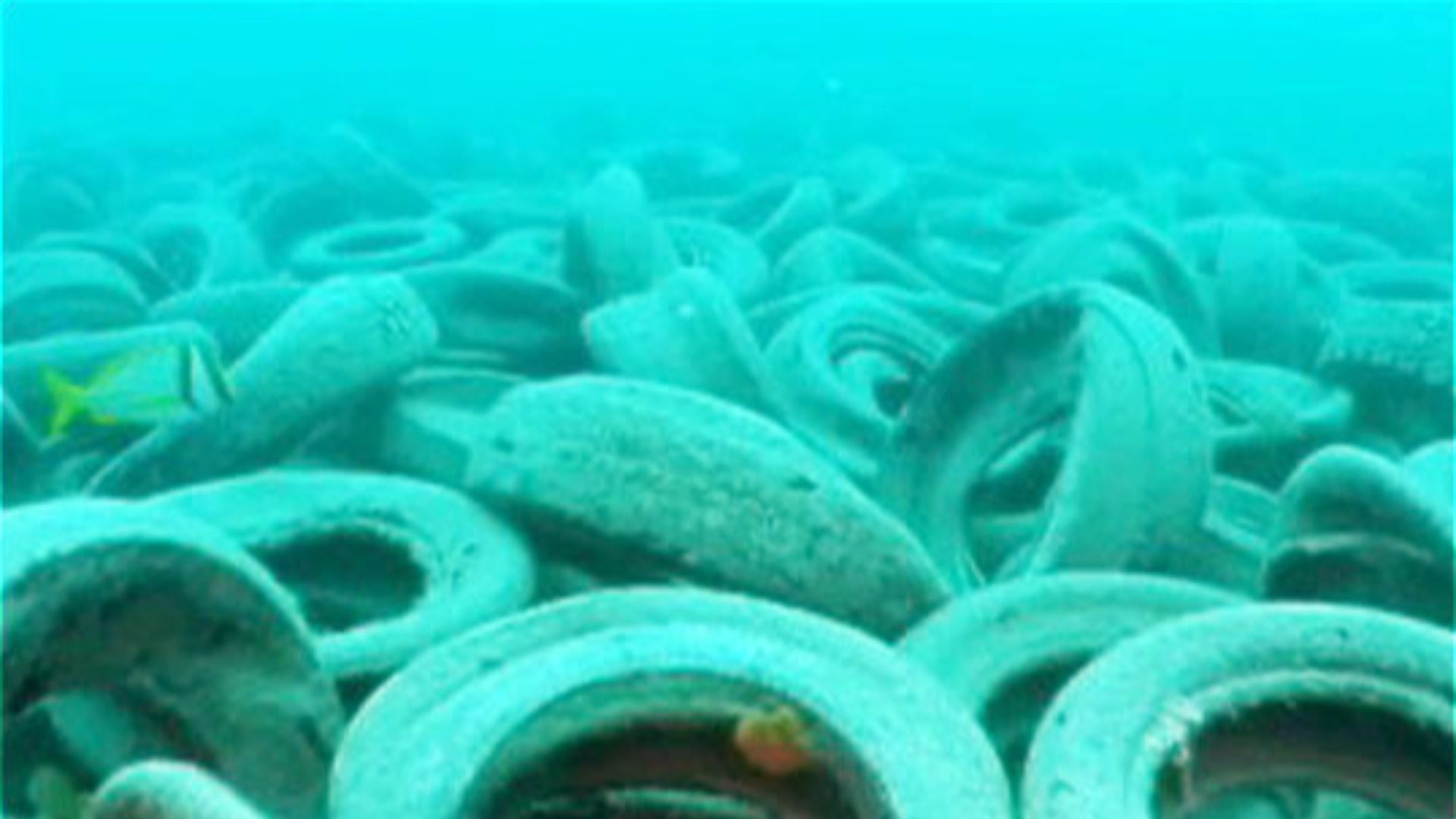
 Navy Combat Camera Dive Ex-East on Wikimedia
In 1972, off the coast of Fort Lauderdale, Florida, a project launched with genuine optimism and the full backing of the United States Army Corps of Engineers. The idea was to sink approximately two million used tires into the Atlantic Ocean, creating an artificial reef that would expand marine habitat and relieve pressure on nearby natural reefs. Goodyear donated tires. The Navy assisted with logistics. Volunteers participated. It was covered as a conservation success story before a single fish had moved in.
The project was called Osborne Reef, named for the contractor who organized it. The tires were bundled together with steel clips and nylon rope and dropped roughly a mile offshore in about 70 feet of water. The theory was sound enough on its surface: artificial reefs made from concrete and steel had worked elsewhere, and tires were durable, abundant, and free. What the planners did not fully reckon with was what tires actually are and how the ocean would treat them over decades.
Why the Tires Never Became a Reef
Coral needs a stable, hard substrate to attach and grow. Tires are not stable in ocean conditions. They are buoyant, they shift with currents and storm surge, and they don't provide the chemical environment that coral polyps need to colonize a surface. Researchers who studied Osborne Reef in subsequent decades found almost no coral growth on the tires themselves. The reef never materialized in any meaningful ecological sense. What happened instead was considerably worse.
The steel clips and nylon rope that held the tire bundles together corroded and degraded over time. Once the bundling failed, individual tires began to scatter across the seafloor. Hurricanes accelerated the process. Hurricane Frances and Hurricane Jeanne, both in 2004, sent tires tumbling across adjacent natural reef systems and onto beaches. The tires abraded and smothered the living coral they made contact with, causing damage that decades of coral growth would struggle to recover from.
By the early 2000s, surveys estimated that the two million tires had spread across roughly 36 acres of seafloor. Broward County officials, marine biologists, and environmental advocates began calling for removal. The scale of the problem was unlike anything that had been attempted in ocean cleanup before. Getting tires off the seafloor one at a time, in open water, with divers, was slow, expensive, and physically grueling work.
The Long Effort to Undo the Damage
Removal efforts began in earnest in the mid-2000s. Broward County partnered with the U.S. Army Corps of Engineers, again, this time to reverse what the agency had helped create. The British military contributed dive teams under a training exercise arrangement. Volunteer divers from organizations like the Reef Environmental Education Foundation spent hundreds of hours underwater hauling tires to the surface. By 2007, approximately 73,000 tires had been removed, which sounds significant until you remember the total was two million.
Funding was the persistent obstacle. Federal money came in waves and then stopped. Volunteer efforts were heroic but couldn't scale to the problem. A 2009 Florida Department of Environmental Protection report estimated that full removal would cost somewhere between $30 and $40 million and take years of sustained effort. That money was never consistently allocated. As of the early 2020s, the majority of the tires remained on the seafloor, and the project had become a standard case study in environmental engineering failure and the difficulty of reversing large-scale ecological mistakes.
The scientific literature on Osborne Reef has been fairly unsparing. A 2002 paper by researchers at Nova Southeastern University found that fish density near the tire site was significantly lower than at comparable natural and artificial reef sites made from hard substrate. The tires had not just failed to attract marine life. In some measurable ways, they had displaced it.
What Osborne Reef Taught Us
The tire reef disaster sits in a longer history of well-intentioned environmental interventions that failed to account for what happens when materials meet natural systems at scale and over time. The lesson that emerged most clearly from Osborne Reef was about substrate chemistry and physical stability, two factors that concrete and steel artificial reefs handle far better than rubber. Subsequent artificial reef programs largely abandoned tire use and moved toward purpose-built concrete structures, decommissioned ships, and other materials with demonstrated colonization records.
There is also a regulatory lesson. The 1972 project happened before the Marine Protection, Research, and Sanctuaries Act had been fully implemented and before the Environmental Protection Agency had developed rigorous standards for ocean disposal. Those frameworks exist now in part because of exactly this kind of outcome. The permitting process for artificial reef projects is considerably more demanding than it was when volunteers cheerfully clipped tires together on a Fort Lauderdale dock and dropped them into the sea.
What happened off the coast of Broward County is worth remembering not because the people involved were reckless, but because they weren't. They were working with the best available understanding of marine habitat, moving with genuine conservation intent, and operating within the norms of their era. The disaster came from what they didn't know, and from the particular cruelty of a problem that took thirty years to fully reveal itself.
KEEP ON READING