

My 70-Year-Old Dad Was Kicked Out of a Luxury Car Dealership for His Dirty Boots—Then the Manager Read His Business Card
My 70-Year-Old Dad Was Kicked Out of a Luxury Car Dealership for His Dirty Boots—Then the Manager Read His Business Card
The Boots That Built Everything
My dad has worn the same style of work boots for as long as I can remember. Scuffed brown leather, steel-toed, with concrete dust settled so deep into the cracks that no amount of brushing ever fully cleared it. He'd pull them on every morning the same way — left boot first, two firm tugs on the laces, a quick stamp of each foot on the floor. Done. He never owned a pair of dress shoes that lasted more than one occasion before the work boots came back out. People who didn't know him sometimes looked at those boots and saw a man who couldn't afford better. What they were actually seeing was a man who never needed to prove anything to anyone. His hands told the same story — wide palms, knuckles that had been split and healed so many times the skin had its own topography. Kind eyes set in a weathered face that had squinted into the sun on a thousand job sites. The boots weren't a fashion choice or an oversight. They were just him — the most honest thing about a man who never learned how to be anything other than exactly what he was. I've spent a lot of years being proud of those boots, even when I was too young and too foolish to say so out loud.
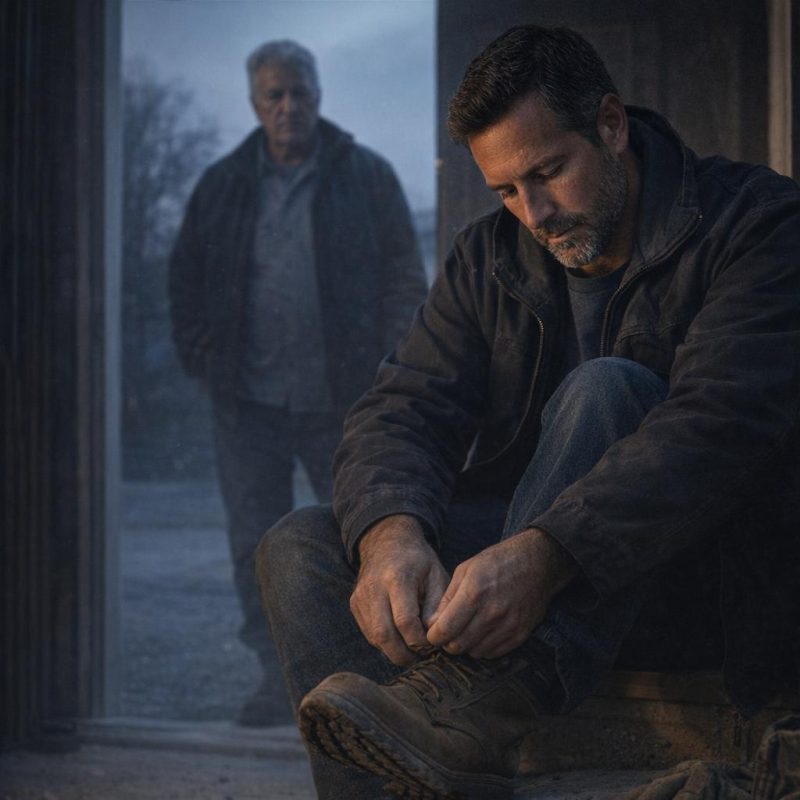 Image by RM AI
Foundations and Frameworks
Growing up, I never once saw my dad sleep past five in the morning. Not on weekdays, not on weekends, not on holidays. The alarm would go off in the dark and he'd be up and moving before the rest of the house had even registered the sound. By the time I stumbled into the kitchen as a kid, his coffee cup would already be rinsed and sitting in the drying rack. He'd be gone. Out the door and onto whatever site needed him that day. I used to fall back asleep to the sound of his truck pulling out of the driveway. That smell — sawdust and concrete and something metallic I could never quite name — would linger on his jacket long after he got home. It was just the smell of Dad. Over the years, I started to understand what all those early mornings had added up to. He built office buildings downtown that I still drive past. He built three elementary schools in our county. He built the shopping center where my mom used to take me for back-to-school clothes. He built a hospital wing, two parking structures, and more commercial developments than I could count on both hands. I found an old folder once, stuffed with project photos and contract summaries going back to the early seventies, and I just stood there in his office doorway staring at the list of everything his hands had made.
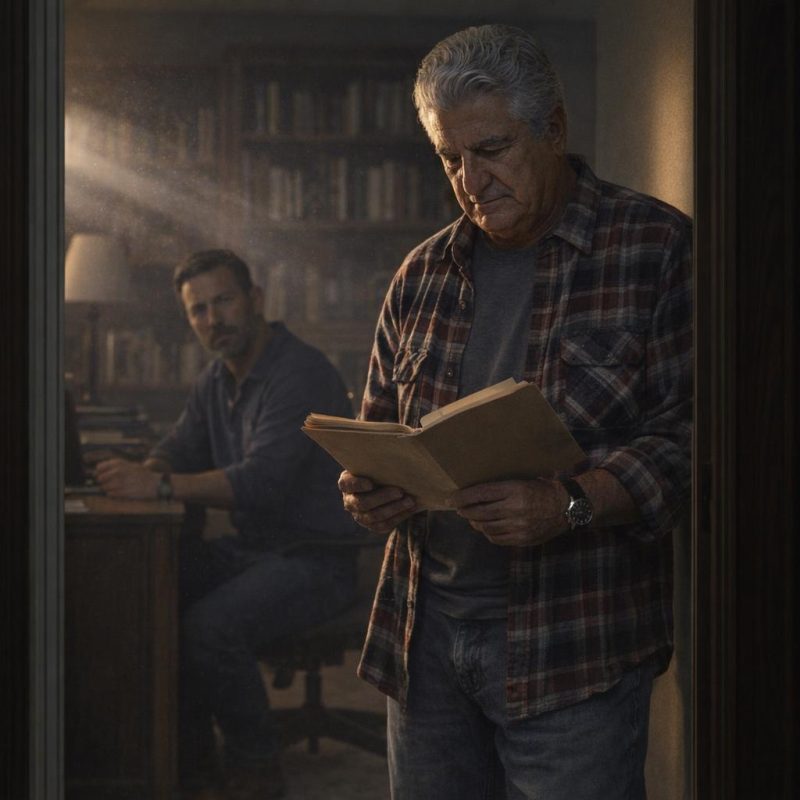 Image by RM AI
Function Over Flash
Dad built luxury homes for other people his entire career. Custom kitchens with imported stone countertops, master suites bigger than our whole first floor, garages designed to hold cars that cost more than most people's mortgages. He'd come home from those sites, kick off his boots at the door, and sit down to dinner at the same scratched table we'd had since before I was born. It never seemed to bother him. He drove the same pickup truck for fifteen years — a faded red Ford with a cracked dashboard and a heater that only worked on one setting. When the transmission finally gave out, he had it rebuilt instead of replaced. He wore his work boots to my cousin's wedding. He wore them to my grandfather's funeral. My mom used to tease him about it and he'd just shrug and say the boots were already broken in. That was his whole philosophy, really. If something worked, you kept it. You didn't trade it in for something shinier just because you could. He wasn't indifferent to quality — he understood quality better than almost anyone I've ever met. He just never felt the need to wear it on the outside. The gap between what he built for other people and what he kept for himself was something I thought about more as I got older. He gave his best work to the world and asked for almost nothing back.
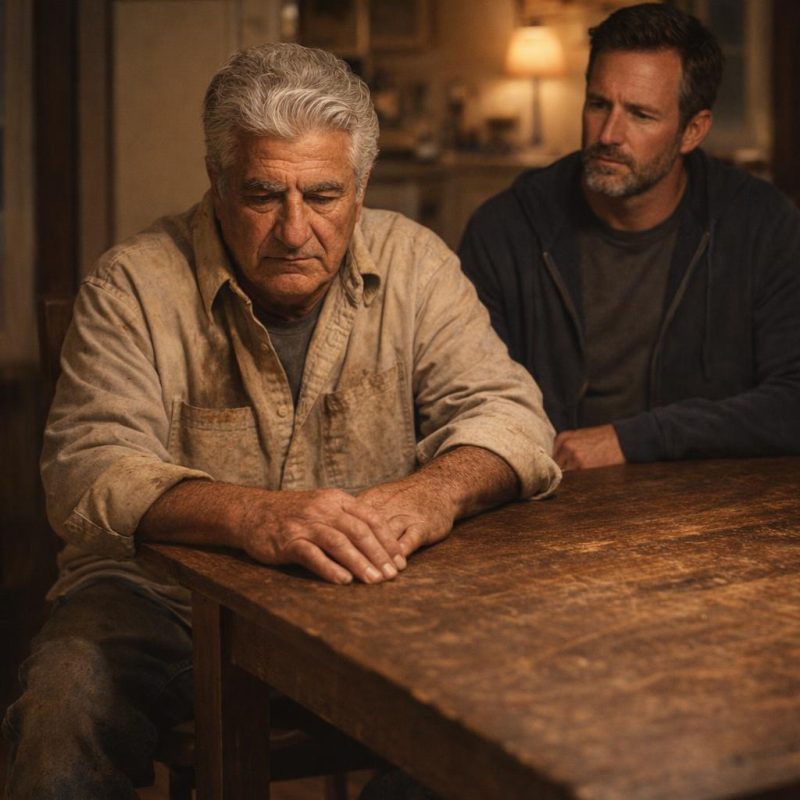 Image by RM AI
The Company That Stayed Humble
Henderson Construction didn't stay small. By the time I was in high school, my dad had a full crew, a real office with an actual receptionist, and a reputation in the region that opened doors other contractors couldn't get through. Commercial developers called him directly. Architects requested him by name. The company won contracts for high-end retail developments, corporate campuses, and mixed-use projects that showed up in the business section of the local paper. I remember being at a job site once as a teenager and watching my dad work alongside his crew — not supervising from a distance, but actually working, hands in it, covered in the same dust as everyone else. His guys respected him for that. They'd been with him for years, some of them for decades. But none of that growth ever seemed to change the man himself. He still drove to the office in the same kind of beat-up truck. He still wore the same flannel shirts and the same boots. He still ate lunch out of a cooler he packed himself. The company's name carried weight in this region in ways that would have surprised anyone who met my dad on the street without context. That was always the strange thing about him — the business had a presence that his appearance never reflected, and he seemed completely unbothered by that gap.
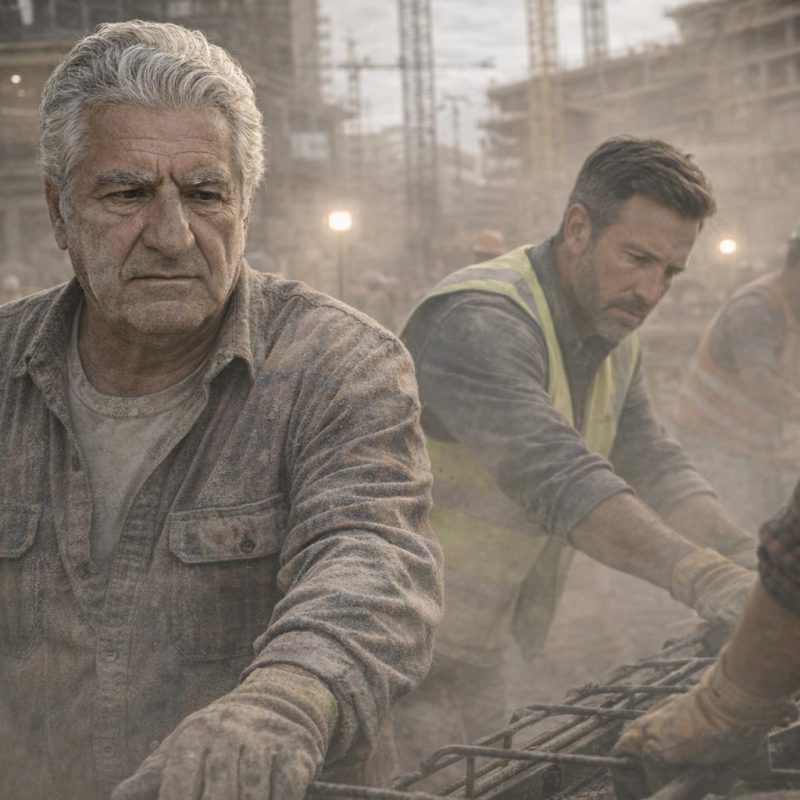 Image by RM AI
Seventy Years and One Request
Dad turned seventy in October, and for the first time in my adult life, I genuinely didn't know what to get him. The man had never once asked for anything. Not for birthdays, not for Christmas, not for Father's Day. Every year I'd ask and every year he'd say the same thing — that he didn't need anything, that I should save my money. He meant it, too. He wasn't being polite. He just truly didn't place much value on receiving things. So when he called me one evening about three weeks before his birthday and said he wanted to talk about something, I figured it was about the business or one of his properties. We sat at his kitchen table with coffee and he was quiet for a moment in that way he gets when he's choosing his words carefully. He said the old truck was done. Not worth fixing anymore, he said. And then he paused and looked at his coffee cup and said something I had genuinely never heard him say before in seventy years of living. He said he thought, just this once, he'd like something nice. Not practical. Not the cheapest option that would get the job done. He looked up at me with those kind eyes and said he thought he'd earned it. I sat there for a second not entirely sure I'd heard him right.
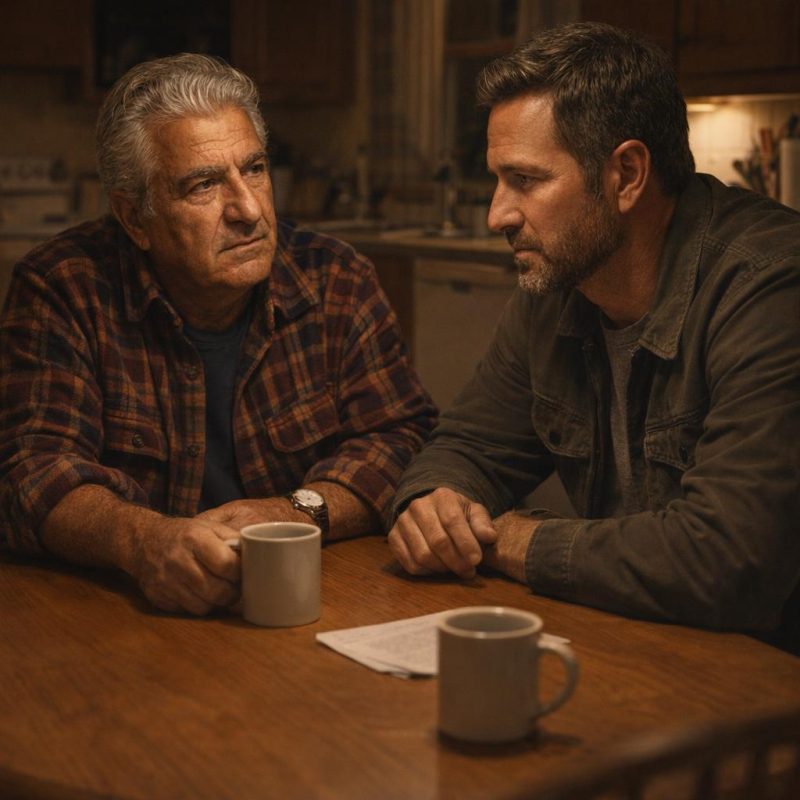 Image by RM AI
The SUV Dad Deserved
I asked him what he had in mind, half expecting him to say a slightly newer used truck, maybe something with a working heater and fewer rust spots. Instead he got up from the table and came back with a folder. Not a brochure he'd grabbed off a rack somewhere — a folder. Printed spec sheets, comparison charts, magazine reviews he'd cut out, notes in his handwriting in the margins. He'd been at this for months. He set it down in front of me and I flipped through it slowly. He wanted a luxury SUV — a full-size, top-tier model from one of the German brands, the kind with the heated seats and the air suspension and the driver assistance package. He'd researched the safety ratings, the reliability data, the long-term ownership costs. He'd compared trim levels. He'd looked into certified pre-owned versus new. He had a preferred color. I looked up at him across the table and he had this expression that was almost sheepish, like he was waiting for me to tell him it was too much. I told him it wasn't too much. It wasn't even close to too much. The folder in my hands was dated back to February — he'd been quietly building this case for himself for the better part of a year before he said a word about it.
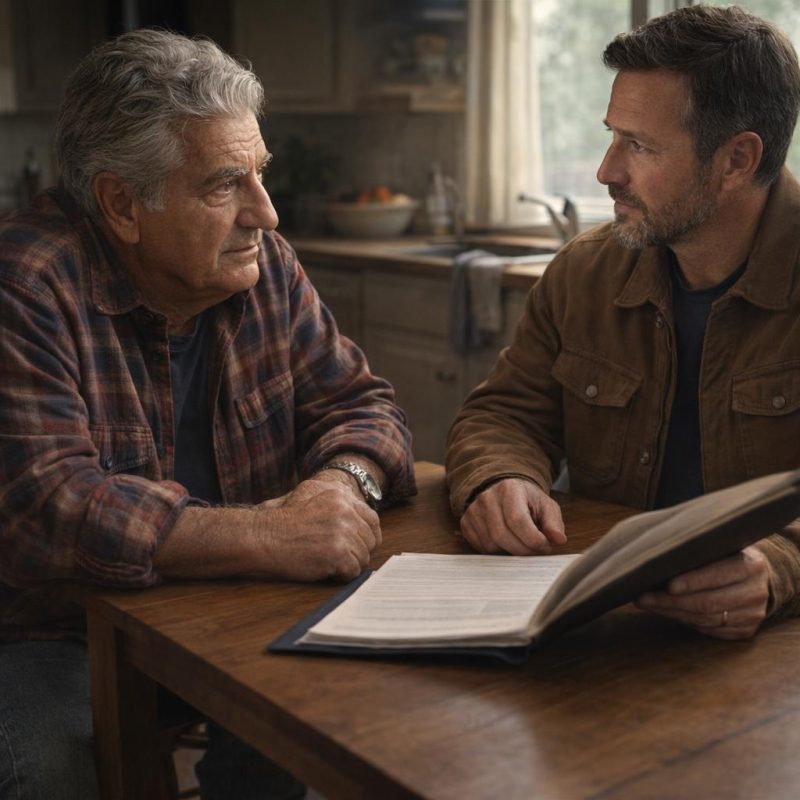 Image by RM AI
Earned, Not Given
I thought about what it had taken to get to that folder on the kitchen table. Fifty years of pre-dawn alarms. Fifty years of packed lunches and cracked knuckles and boots that never came off the job. He'd built things in this region that would still be standing long after both of us were gone — schools where kids were learning right now, buildings where people went to work every morning without a single thought about who poured the foundation beneath their feet. He'd put my sister and me through college without loans. He'd kept his crew employed through two recessions. He'd never taken a real vacation that I could remember. And in all that time, he had never once walked into a store and said give me the best one. Not for himself. This was the first time. I wasn't going to let him do it alone. Part of it was wanting to share the moment — watching my dad finally choose something just for himself felt like something I needed to witness. But there was another part of it too, something quieter. My dad in his work boots and his flannel shirt didn't always read the way he deserved to be read by strangers. I wanted to be there. I decided that morning that I was going with him, and that was the end of it.
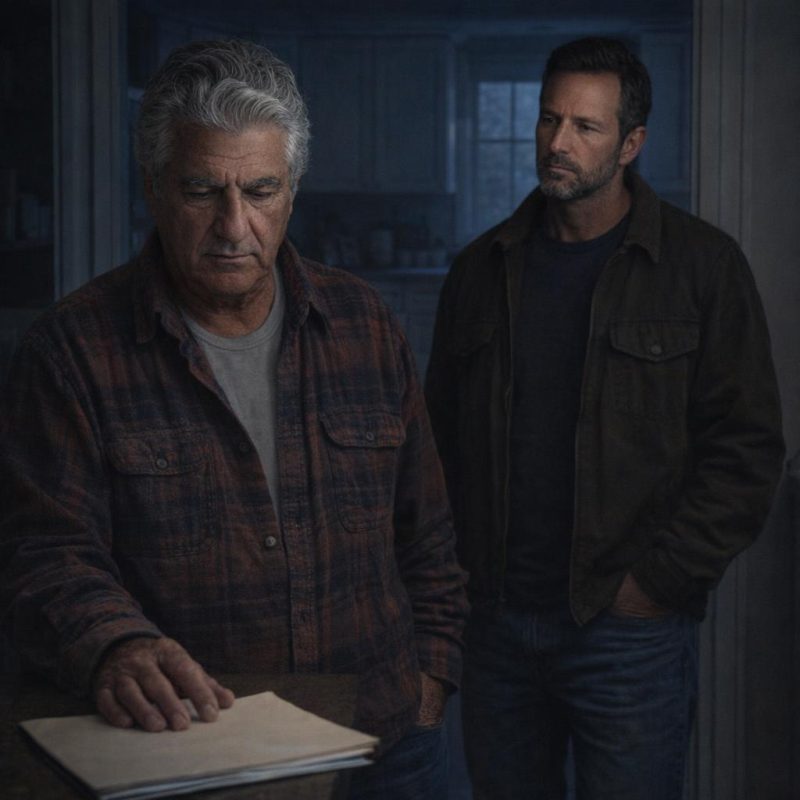 Image by RM AI
Research and Resolve
We didn't just walk into the first dealership we found. That wasn't how either of us operated. I spent a couple of evenings going through authorized dealers in the region, reading reviews, checking inventory listings, looking at how each location handled their customer service reputation online. One showroom kept coming up above the rest — a flagship location in the premium district on the west side of the city, the kind of address that had valet parking and a glass facade and its own dedicated service center. Their reviews were almost uniformly excellent. Multiple customer service awards listed on their website. Full inventory of the model Dad wanted, including the specific trim level and color he'd circled in his folder. I showed Dad the listing and he leaned over my shoulder and looked at the screen for a long moment and then nodded once, the way he does when something meets his standard. We agreed that was the place. I remember reading through their about page that night — the dealership had been open for several years, built from the ground up as a flagship location, designed to set the standard for the ownership experience in the region. It was exactly the kind of place where a man who had spent fifty years building things right deserved to walk in and be treated well. That reputation sat in my mind like a promise.
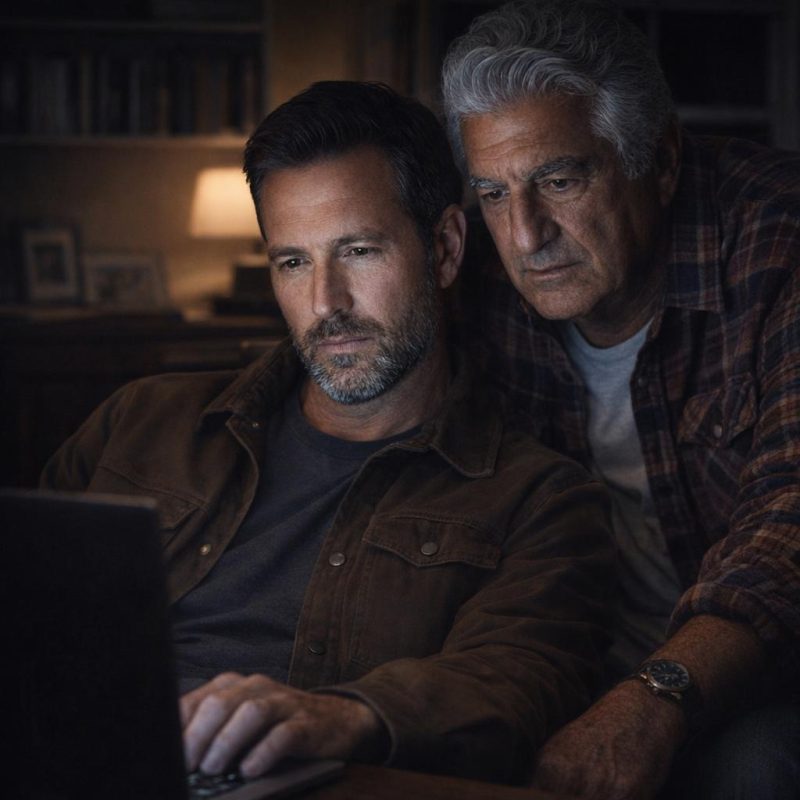 Image by RM AI
Cash Ready
The night before we went, Dad and I were sitting at his kitchen table going over the listing one more time. He had the folder open — the one with the printouts and the circled trim level — and he was running his finger along the options list the way he does when he's making sure he hasn't missed anything. I asked him if he wanted to look at financing options, just to have the numbers ready. He looked up at me with that expression he gets, the one that's not quite a smile but close. He said he didn't need financing. I figured he meant he'd put down a large down payment, maybe had a chunk saved. Then he got up, went to the back bedroom, and came back with a plain white envelope. He set it on the table between us without any ceremony at all. Inside was eighty-five thousand dollars in cash — banded, counted, ready. He told me he'd been putting money aside for years, a little at a time, the way he did everything. No debt, no interest, no dealership financing games. Just a man who had worked hard and saved carefully and decided this was the thing worth spending it on. I sat there looking at that envelope for a long time after he went to bed.
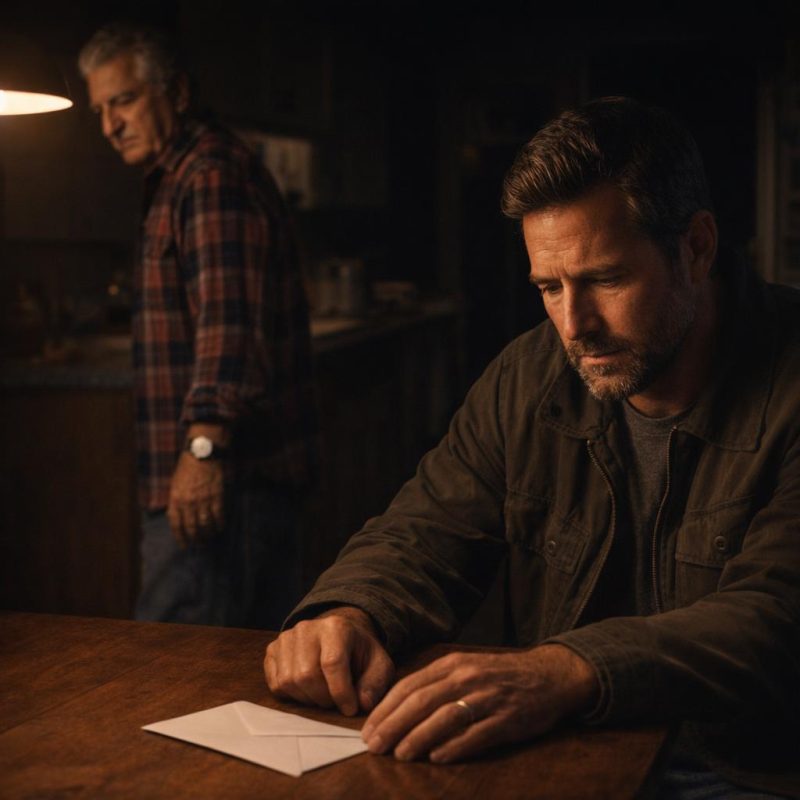 Image by RM AI
Saturday Morning
Saturday morning came in clear and cold, the kind of fall day where the sky looks freshly washed. I picked Dad up at seven-thirty. He was already on the porch when I pulled up, wearing his usual flannel shirt and his work boots, the same ones he wore every day regardless of where he was going. I didn't say anything about it. That was just Dad. We talked on the drive about the color — he'd been going back and forth between the dark navy and a deep charcoal gray, and he kept saying the gray was more practical but the navy was sharper. I told him he'd earned sharp. He laughed a little at that. The premium boulevard came into view about twenty minutes in, all wide sidewalks and polished storefronts, and then the dealership appeared ahead of us — glass facade catching the morning light, the brand logo mounted high and clean above the entrance, the lot full of vehicles that looked like they'd never seen a dirt road. I pulled into the parking lot and we both sat there for a second, taking it in.
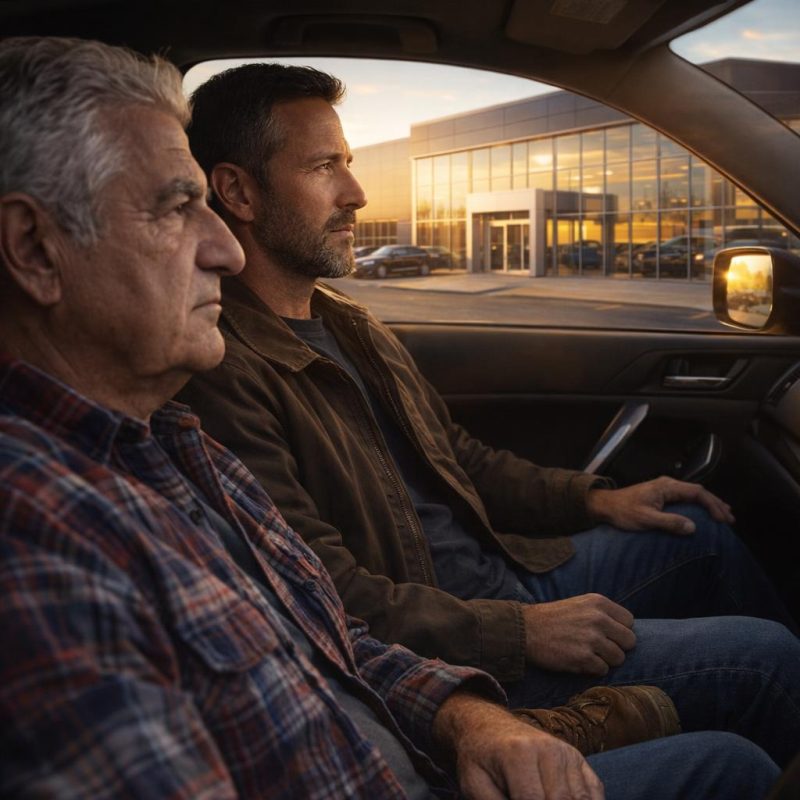 Image by RM AI
Cathedral of Chrome
Walking through those front doors was something else. The showroom was enormous — ceilings that had to be thirty feet high, all glass and steel and recessed lighting that hit every surface at exactly the right angle. The floors were polished to a mirror finish, and the vehicles were spaced out like sculptures in a gallery, each one on its own platform with a little spotlight overhead. It smelled like leather and something faintly chemical, the kind of clean that doesn't happen by accident. There was soft music playing, low enough that you felt it more than heard it. I looked over at Dad and he was standing just inside the entrance, turning his head slowly, taking it all in. He didn't say anything for a moment. Neither did I. It was the kind of space that made you feel like you should lower your voice, like you'd walked into somewhere that had rules you hadn't been told yet. I'd been in nice places before, but this was different — this was a room that had been designed specifically to make you feel the weight of what was being sold here. Dad finally let out a slow breath through his nose and took a step forward, and I followed him in.
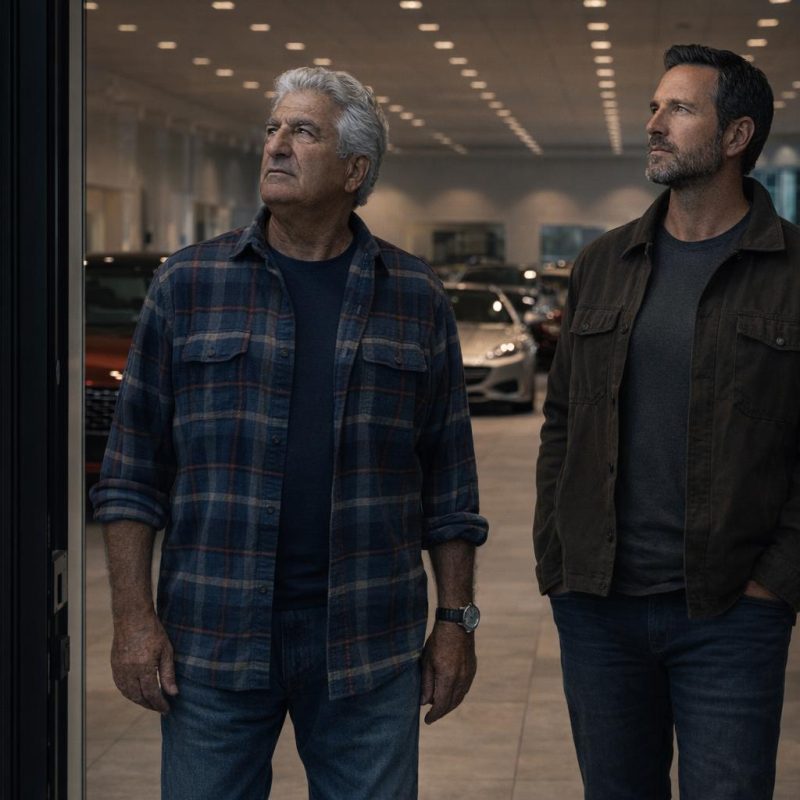 Image by RM AI
The Inventory
We moved through the showroom slowly, passing a couple of sedans and a low-slung coupe that probably cost more than most people's houses. Dad wasn't rushing. He looked at each vehicle as he passed, not stopping, just noting. Then we came around a curved display wall and I stopped walking. There it was — the full-size luxury SUV he'd been researching for the better part of a year, positioned dead center in the showroom under a bank of overhead lights that made the paint look like it was lit from inside. Dark navy. The exact trim level he'd circled in his folder.
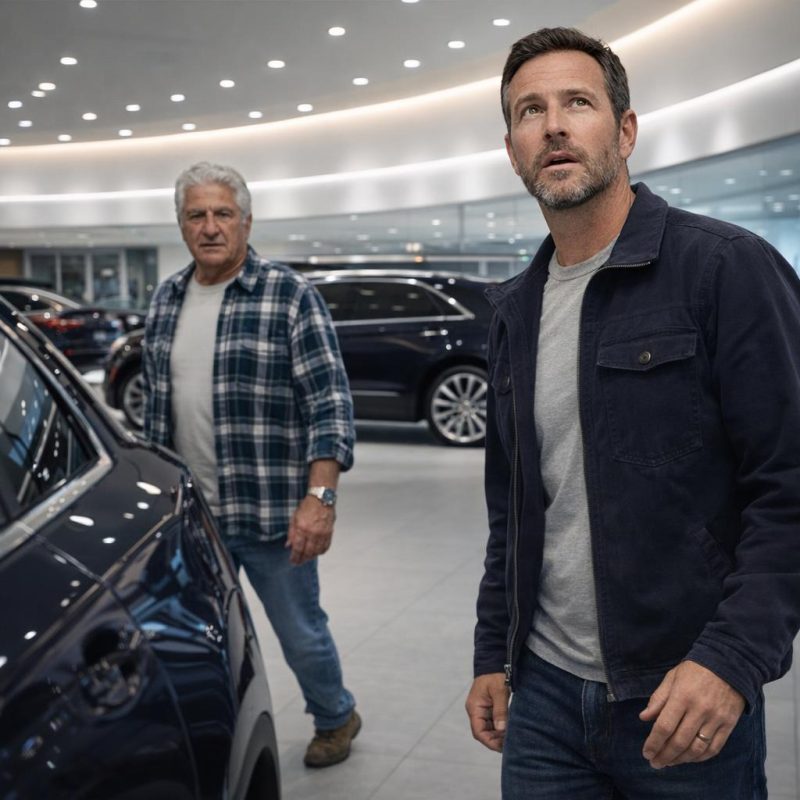 Image by RM AI
Standing and Waiting
We stood there beside the SUV for a while, and I kept expecting someone to appear. That's how these places work, right — you walk in, you show interest in a vehicle, and within sixty seconds someone in a good suit materializes with a business card and a handshake. I'd read enough about the dealership's customer service reputation to expect exactly that. Dad wasn't fidgeting or looking around impatiently. He was still studying the vehicle, moving slowly around the front end, crouching slightly to look at the wheel design. I straightened up and scanned the floor. There were staff members visible — I could see a couple of salespeople near the far end of the showroom, another one by a desk along the side wall. Nobody was with a customer. The floor wasn't busy. I figured someone would break away and head our direction any moment. I checked the entrance behind us in case we'd somehow missed a greeter. We hadn't. Dad came back around to the driver's side and looked through the window at the interior, and I stood beside him, and the showroom hummed quietly around us with that low music and that careful light, and nobody came.
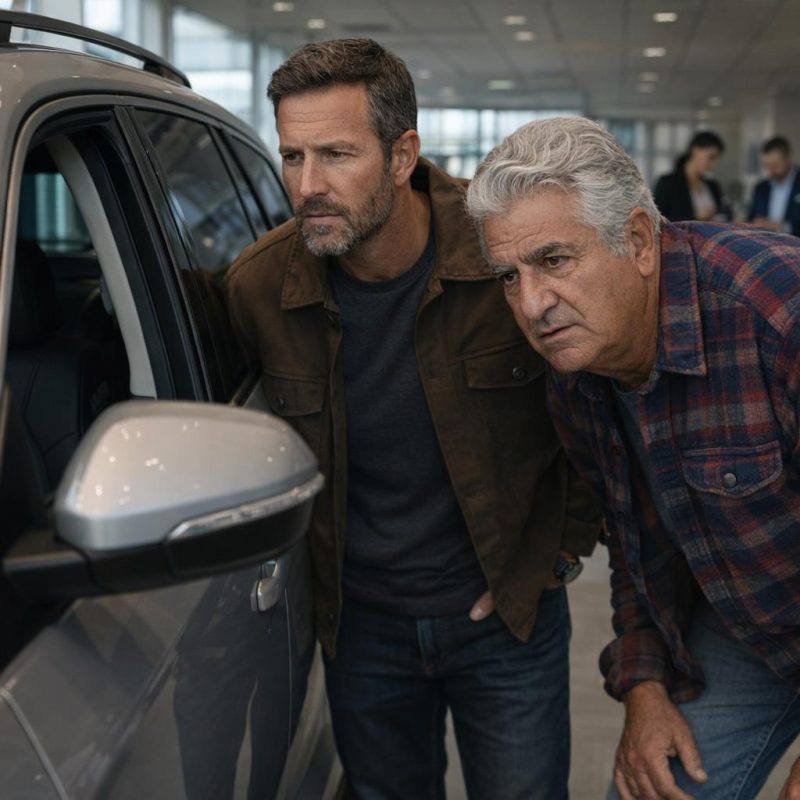 Image by RM AI
Visible and Ignored
A few more minutes went by. I started doing the thing where you try to make yourself more visible without actually doing anything — standing a little straighter, shifting position, making it obvious we were there and interested. Dad didn't bother with any of that. He just kept looking at the vehicle, unhurried, like he had all the time in the world. At some point a senior salesman in a well-fitted suit crossed the floor maybe twenty feet from us. He was moving with purpose, carrying a folder, and I thought for a second he was heading our way. He glanced in our direction — a quick look, nothing lingering — and then continued past toward the far side of the showroom. I watched him go. I told myself he was probably finishing something up, that he'd circle back. Dad had moved around to look at the rear cargo area, and I followed him, and we stood there together at the back of the vehicle while the showroom carried on around us, staff moving here and there, the soft music playing, the lights doing their careful work on all that polished metal and glass. Nobody stopped. Nobody said hello. The floor kept moving around us, and we remained where we were.
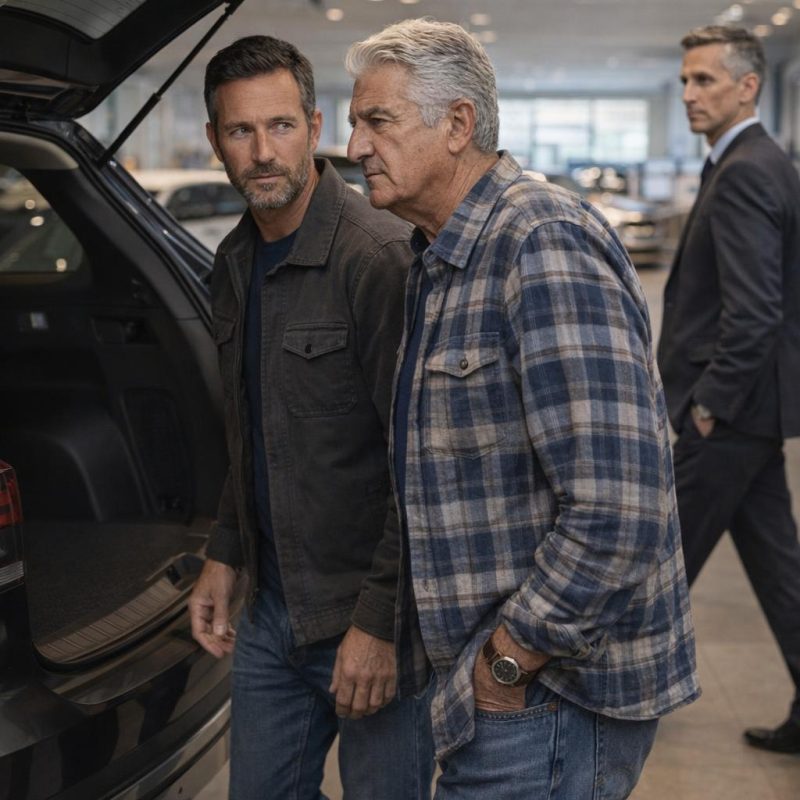 Image by RM AI
Ten Minutes
At some point I pulled out my phone to check something — I don't even remember what — and the timestamp caught my eye. We had been standing in that showroom for ten minutes. I stood there and did the math again because it didn't feel right. Ten minutes in a dealership where the reviews talked about attentive service and award-winning customer experience, and not one person had said a word to us. I looked around the floor. The senior salesman I'd noticed earlier was over by the side wall now, talking to a colleague. Neither of them was with a customer. There was another salesperson near the entrance who had been there when we walked in, also unoccupied. Dad was still at the back of the SUV, reading something on the rear panel, completely unbothered. I didn't say anything to him. I didn't want to get ahead of myself, because I wasn't sure what to make of it yet, and I didn't want to be the person who jumped to conclusions in a place like this. Maybe there was a protocol. Maybe we were supposed to approach someone. Maybe I was overthinking it. I slid my phone back into my pocket and looked up — ten minutes, no greeting, no acknowledgment, nothing.
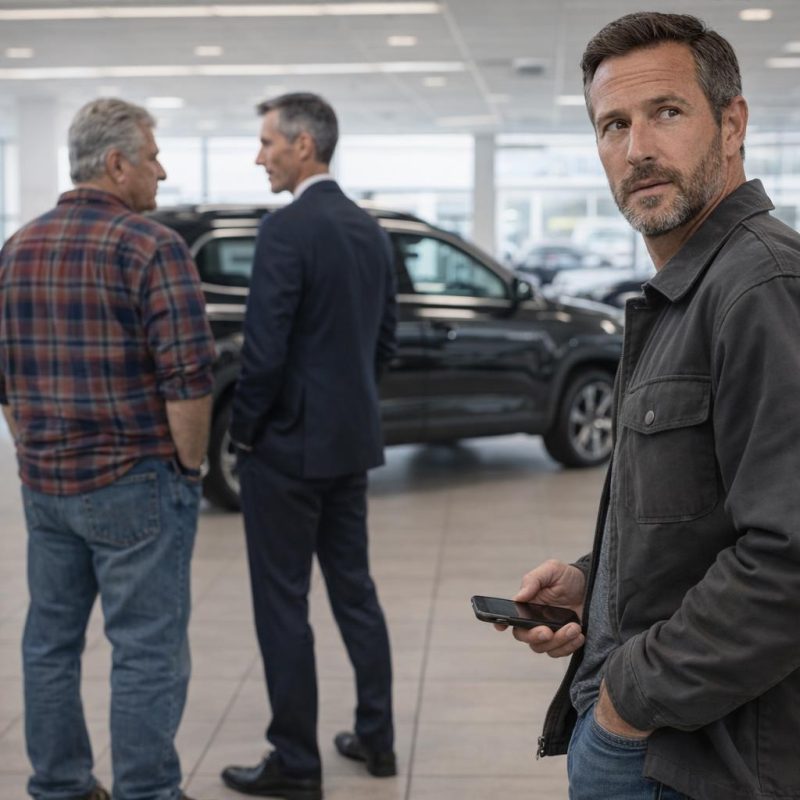 Image by RM AI
The Glance
Then the senior salesman started moving again, and this time he was coming in our direction. I felt the small lift of relief — finally, here we go. He was maybe thirty feet away, closing the distance at an easy pace, and I made eye contact with him. He held it for a second, the kind of look that says I see you. Then his gaze moved to Dad, just briefly, a flicker — Dad in his flannel shirt and his worn work boots, standing at the back of an eighty-five-thousand-dollar SUV. The salesman's pace didn't change. He didn't slow down, didn't angle toward us, didn't open his mouth. He walked past the display, turned left at the corridor that led toward the back offices, and was gone. I stood there with my hands in my pockets, watching the empty space where he'd been a moment before.
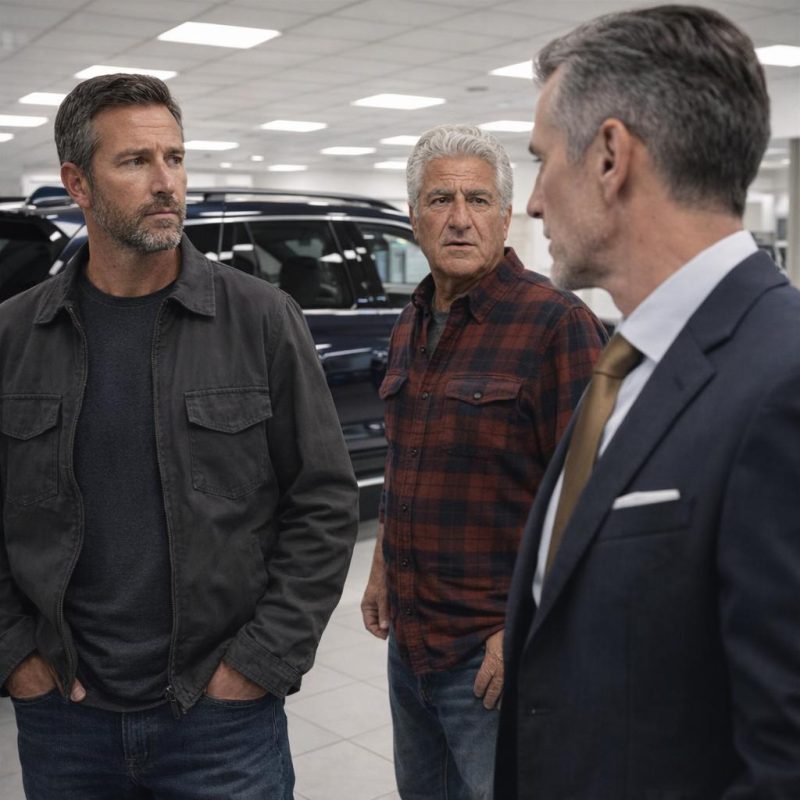 Image by RM AI
The Younger Customer
I checked my watch. Twelve minutes. We'd been standing next to that SUV for twelve full minutes, and not one person had come over. I was starting to feel the slow burn of it — not rage yet, just that low, uncomfortable awareness that something wasn't adding up. Dad was still reading the window sticker, running his thumb along the edge of it like he was checking the print quality on a job site. Then the front doors opened. A guy walked in — maybe mid-thirties, wearing what I can only describe as expensive casual. Dark jeans that probably cost more than my car payment, a fitted jacket, sunglasses pushed up on his head. He had the easy posture of someone who'd never once worried about a price tag. He paused just inside the entrance, barely a full second, and I watched what happened next. The senior salesman who'd walked right past us appeared from somewhere near the back. Then a second salesman materialized from the left side of the floor. Then a third came out from behind a display near the window. All three of them converged on this guy within maybe fifteen seconds of him walking through the door.
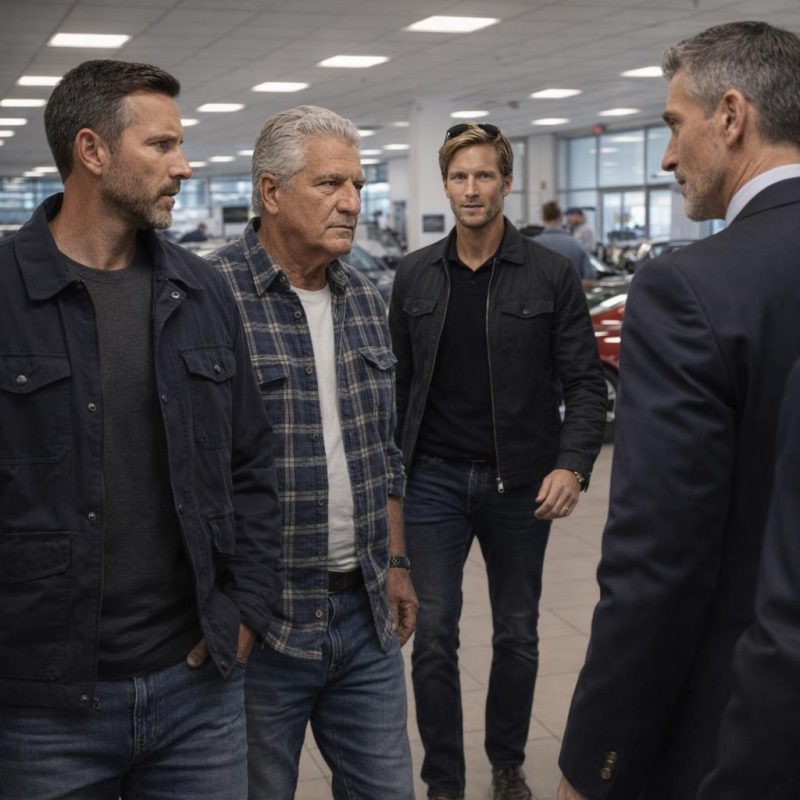 Image by RM AI
The Pattern
I stood there and watched it unfold. The three of them were all smiles and open body language, gesturing toward the sports car display near the far wall. The guy in the designer jacket laughed at something one of them said, and they all laughed with him, this easy, comfortable cluster of people who had apparently found each other at exactly the right moment. The senior salesman — the one who had looked right at me and kept walking — was right in the middle of it. He had his hand out, pointing toward a red convertible, nodding like whatever the guy was saying was the most interesting thing he'd heard all week. I glanced at Dad. He hadn't looked up from the SUV specs. He was still reading, still calm, one hand resting on the side mirror like he was just taking his time. I looked back across the showroom at the group near the sports car. Then I looked at the space around us — the wide, empty, well-lit space where we'd been standing for going on thirteen minutes without a single word from anyone. The contrast just sat there, plain as anything, and I didn't have a word for what I was feeling yet.
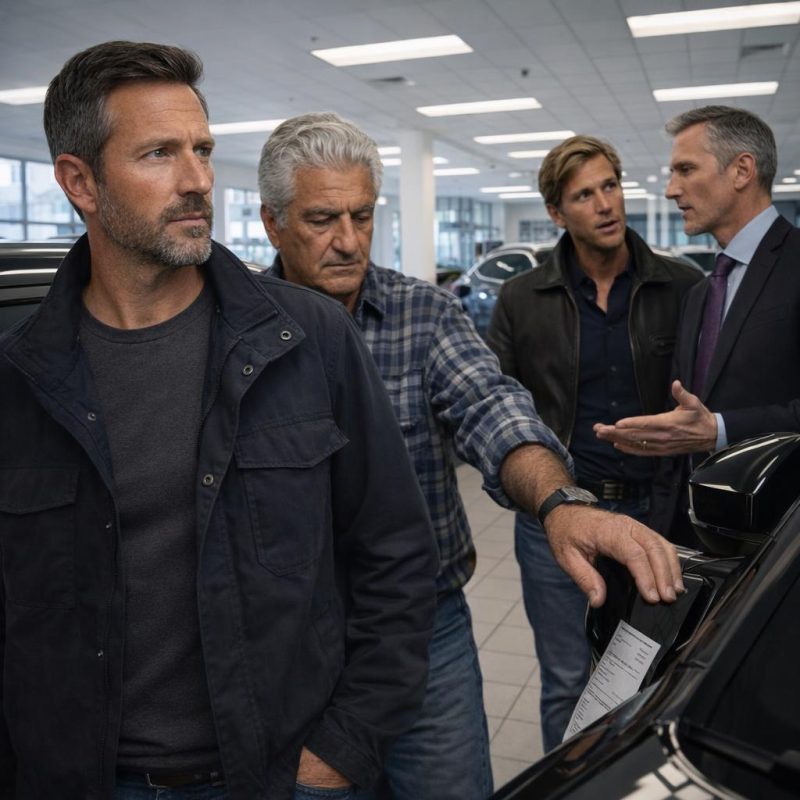 Image by RM AI
Fifteen Minutes
Fifteen minutes. I know because I checked my watch twice and did the math. Fifteen minutes inside a dealership that had soft lighting and leather furniture and a guy whose whole job was apparently to offer people bottled water — I'd seen him hand one to the designer-jacket customer without being asked. Nobody had offered us anything. Nobody had made eye contact. Dad had moved from the window sticker to crouching down and looking at the wheel well, the way he always does when he's evaluating something seriously. He wasn't performing patience. He just genuinely had it. I didn't. I kept running through the same loop in my head — should we just go? Should I flag someone down? I didn't want to do either. I didn't want to flag someone down because it felt like begging for something we shouldn't have to ask for. And I didn't want to leave because Dad had driven forty minutes to be here, and he deserved to be treated like any other customer who walked through that door. The showroom was beautiful. Polished floors, climate-controlled air, not a fingerprint on anything. And somehow, standing in the middle of all of it, I felt like we were taking up space that wasn't meant for us.
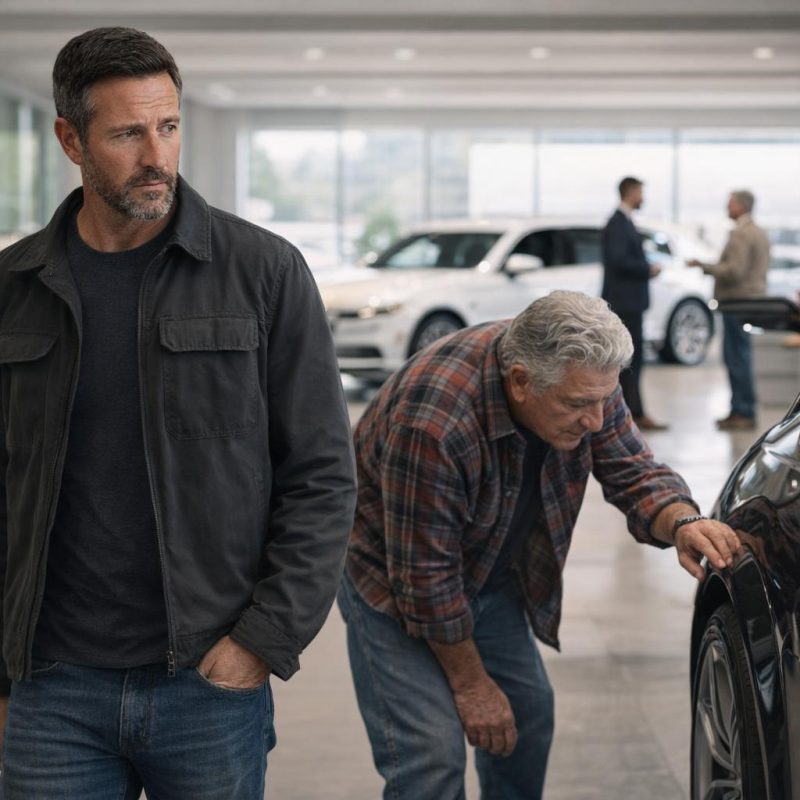 Image by RM AI
Tyler Approaches
Then I saw movement on the far side of the floor. A younger guy in a tailored suit was finally heading our way. I felt the tension in my shoulders ease just slightly — okay, here we go, someone's coming. He was maybe twenty-eight, clean-cut, hair slicked back, the kind of practiced smile that gets turned on when it's needed. He walked toward us at a pace that said he wasn't in any particular hurry, which I noticed but let go. I nudged Dad lightly with my elbow and Dad straightened up from where he'd been crouching by the wheel well. The salesman got within about ten feet of us and I could see him doing that quick scan people do when they're sizing up a situation. His eyes moved to me first, then to Dad, and then — and I watched this happen — they dropped. Down past Dad's flannel shirt, past his belt, all the way down to the floor. And they stayed there, fixed on Dad's work boots.
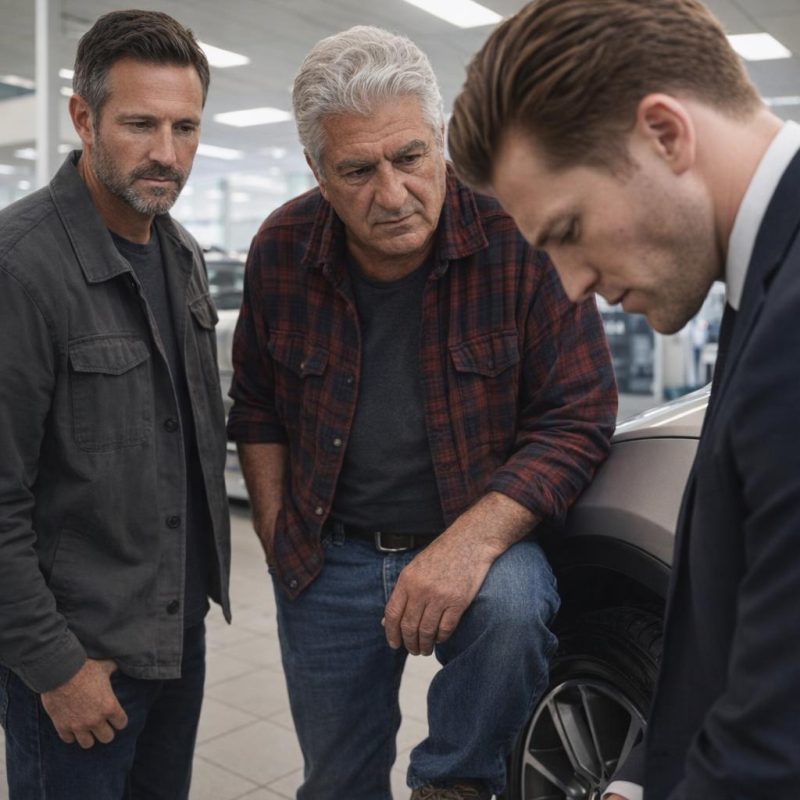 Image by RM AI
Fifteen Minutes of Nothing
I want to be honest about what those fifteen minutes felt like, because it wasn't dramatic. Nobody said anything cruel. Nobody pointed. It was quieter than that, and somehow that made it worse. It was the water bottle that went to the other customer and not to us. It was the senior salesman's eyes sliding past mine like I wasn't there. It was the way the whole floor seemed to orbit around the guy in the designer jacket while we stood in our little pocket of nothing, untouched by any of it. Dad never complained. Not once. He moved from the SUV's window sticker to the rear cargo area, opened it, measured the depth with his hands the way he does — thumbs out, fingers spread — like he was estimating a load. He was doing what he came to do. I was the one standing there feeling it on his behalf, this low, grinding awareness that we were being looked through. I kept my face neutral. I didn't want Dad to see it on me. But the feeling had settled in somewhere behind my sternum, heavy and still, and it wasn't going anywhere.
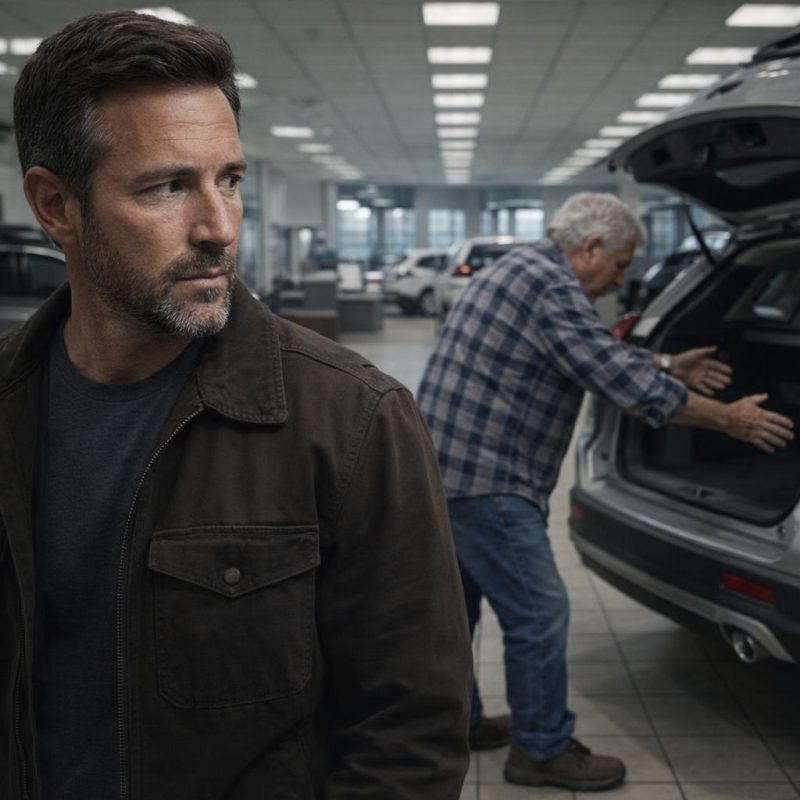 Image by RM AI
What Dad Deserved
I watched Dad's hands as he ran them along the edge of the cargo door. They're not pretty hands. They're wide and calloused, with old scars across the knuckles from decades of work — concrete work, framing work, the kind of labor that leaves a permanent record on your skin. He's seventy years old and those hands have built things that are still standing. I thought about that while I stood there watching the salespeople on the other side of the showroom laugh at something the designer-jacket guy said. Dad wasn't performing anything. He wasn't trying to prove he belonged here. He just did. He'd earned the right to walk into any room he wanted and take his time, and the fact that nobody in this building seemed to understand that was making something tighten in my chest that I was working hard to keep quiet. He looked up at me and said, "Good towing capacity on this one." Just that. Calm as anything. And I nodded and said, "Yeah, looks like it," and I meant it, and I also wanted to put my fist through the nearest wall. But I kept that to myself, because that's not what Dad needed from me right then.
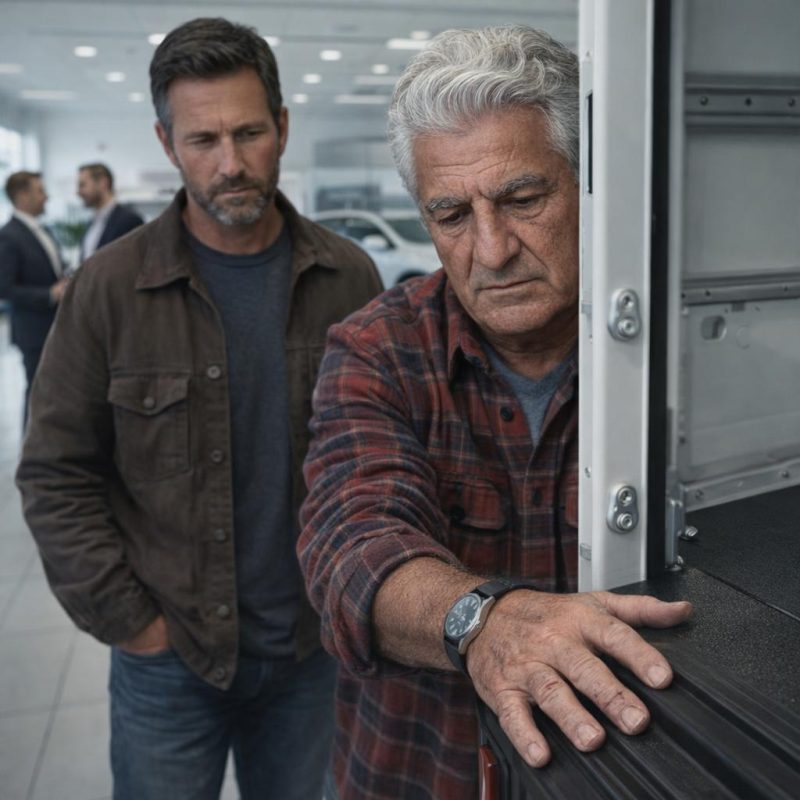 Image by RM AI
Tyler's Approach
He appeared from somewhere near the back of the floor — the younger salesman I'd noticed earlier, the one in the tailored suit with the slicked hair. He was walking toward us now with the energy of someone who'd been told to go handle something rather than someone who wanted to. There was no urgency in it, no warmth. He covered the distance at a pace that said this was an obligation being fulfilled, not a customer being welcomed. I felt the relief anyway, because at this point sixteen minutes in, I would have taken anything. Dad closed the cargo door quietly and turned to face him. The salesman stopped about three feet away, close enough to be professional, far enough to keep some distance, and he said, "Hey. I'm Tyler." Two words. No last name, no handshake offered yet, no "welcome in" or "what brings you in today." Just his name, delivered flat, like he was checking a box.
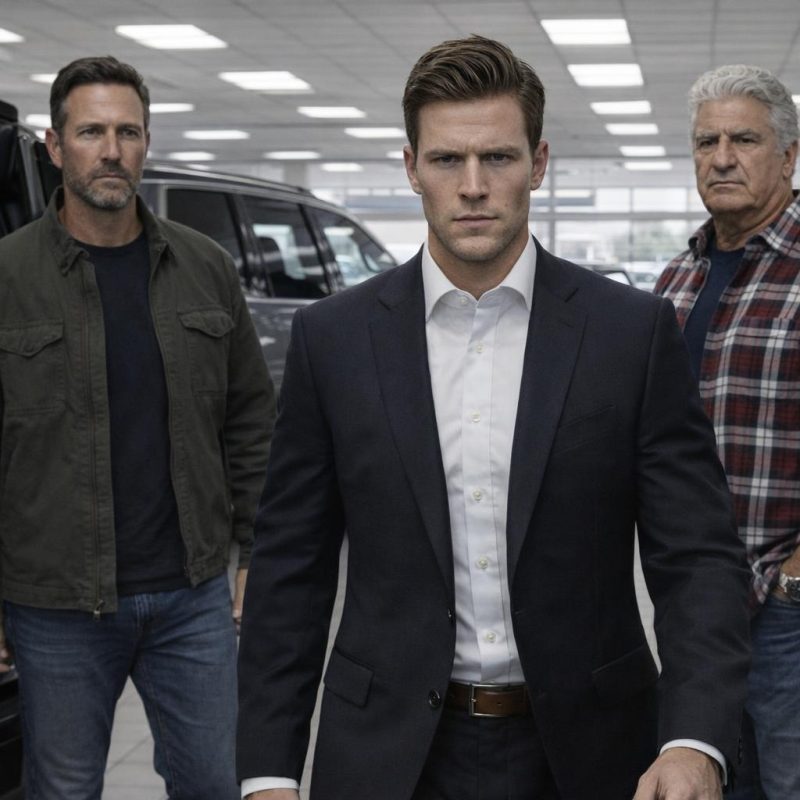 Image by RM AI
The Boots, Not the Face
Tyler's eyes moved the way eyes do when someone's doing a quick assessment and not bothering to hide it. They went to me first, then to Dad, and then they dropped. I watched them go down past Dad's flannel, past his belt, and land on his boots. And they stayed there. Dad's work boots are beat up in the specific way that working boots get beat up — the leather scuffed and creased, the laces replaced at least twice, and in the deep cracks along the toe box, a pale gray dust that I recognized as concrete. Tyler looked at those boots the way you look at something that's telling you something. Dad, for his part, extended his right hand toward Tyler with the easy confidence of a man who has introduced himself ten thousand times. Tyler's gaze came up slowly, and he took the hand, and the shake was brief — two pumps, no grip, the kind of handshake that ends before it starts. Then Tyler's eyes went back down to the boots, the concrete dust sitting pale and dry in the cracks.
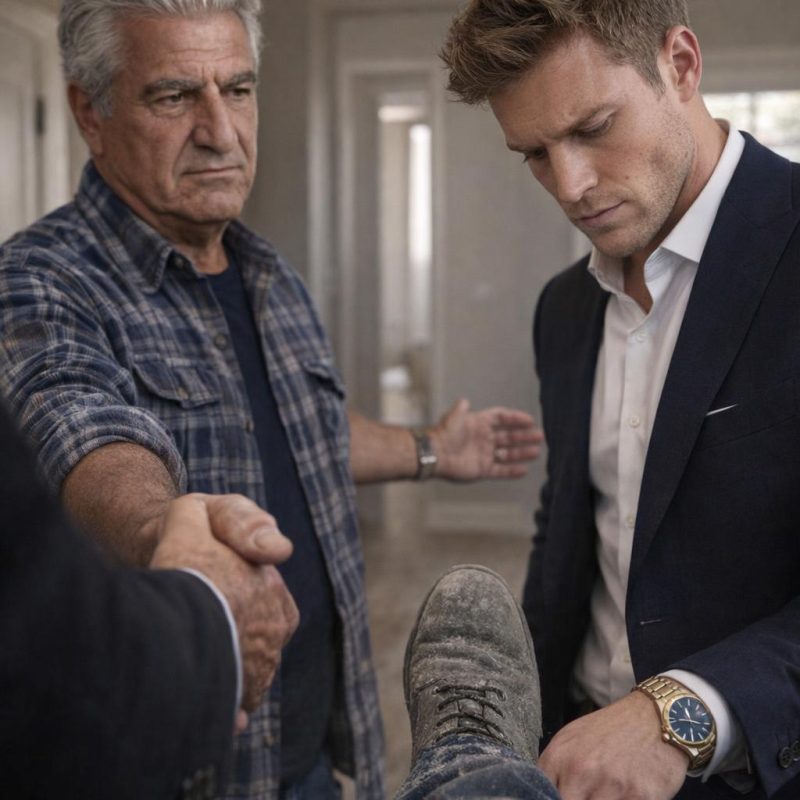 Image by RM AI
The Top Model Request
Dad cleared his throat and said it plainly, the way he says most things. He told Tyler he was looking at the Meridian Premier — the top-of-the-line trim, the one with the third-row seating and the towing package. He even said the model number, which I knew he'd looked up because he'd mentioned it twice on the drive over. That's Dad. He doesn't walk into a room unprepared. Tyler had been standing with his hands loosely clasped in front of him, that practiced showroom posture, and for a second he didn't say anything. I watched him glance at Dad's flannel shirt — just a flick of the eyes, quick enough that you might miss it if you weren't already watching him. Then his gaze moved to the boots again. It was brief. He recovered fast, smoothed his expression back into something neutral, and when he looked up at Dad his face had rearranged itself into a smile. But something had shifted in his posture. His shoulders had pulled back slightly, and the easy looseness he'd had a moment before was gone.
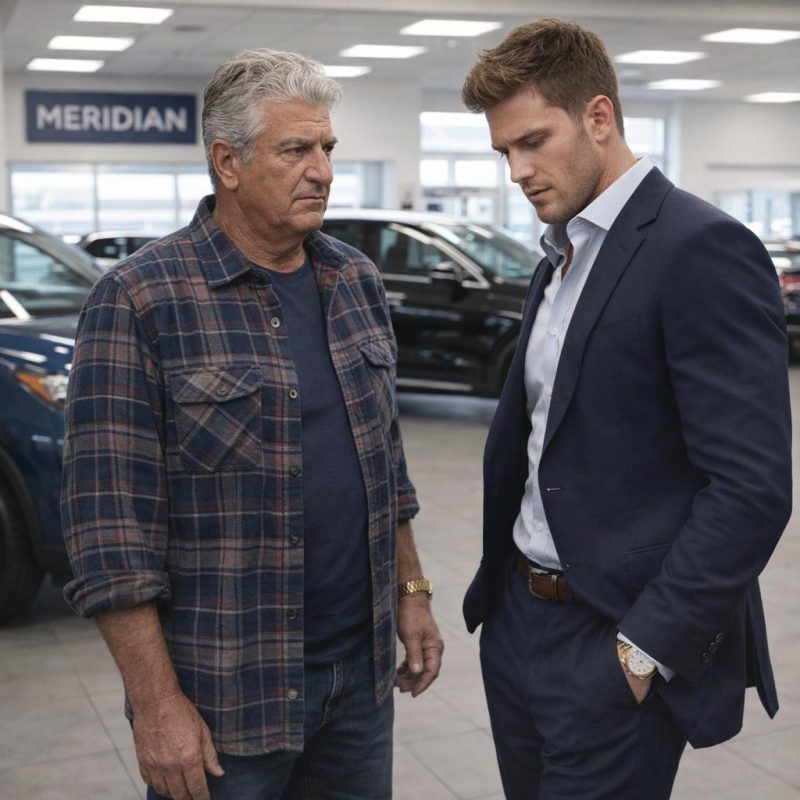 Image by RM AI
Eighty-Five Thousand
Tyler quoted the price the way some people deliver news they expect to land hard. He said the Meridian Premier started at eighty-five thousand dollars. He didn't rush it. He let the number sit there, and the word he put the most weight on was 'starting.' He drew it out just slightly — not enough that you could call it anything, not enough to point at — but enough that I heard it. I glanced at Dad. Dad nodded once, the way he nods when someone tells him something he already knows. He didn't blink. He didn't shift his weight. He just said, 'Yes, I know,' and left it at that. Tyler's eyes stayed on Dad's face for a beat longer than felt natural, like he was waiting for something that hadn't come. I couldn't tell you exactly what he was looking for. But the way that number had hung in the air between them — heavy and deliberate in its delivery — stayed with me longer than it should have.
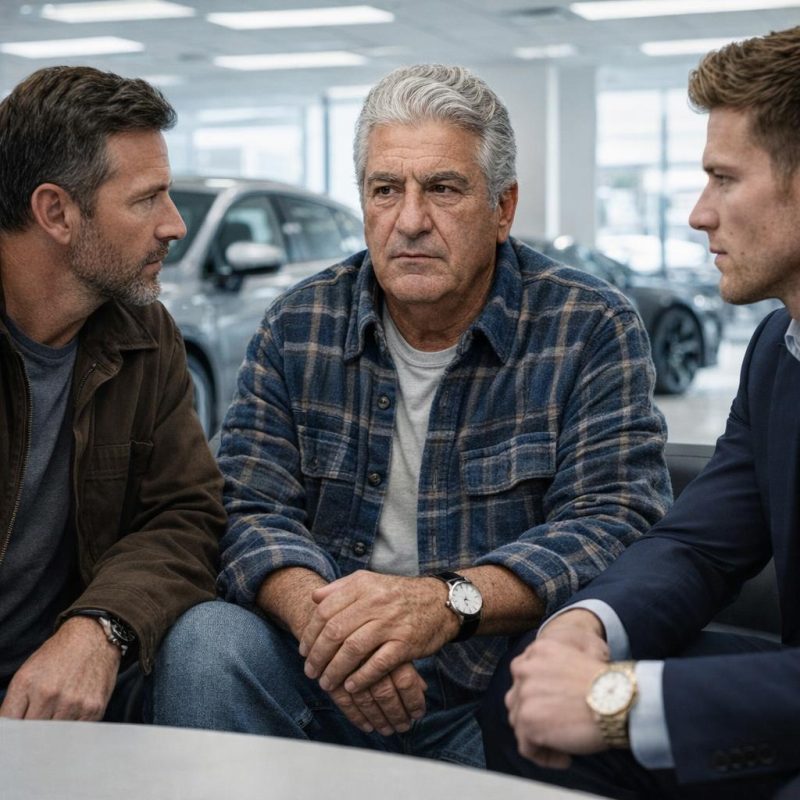 Image by RM AI
Sir
Tyler said 'sir' a lot. I noticed it because of the way he said it — not the word itself, which is technically respectful, but the particular note it landed on each time. There's a version of 'sir' that means something. You hear it from people who mean it, and it sounds like what it is. What Tyler was doing with it was different. It came out clipped, almost impatient, like a period at the end of a sentence that was already finished. He said it when Dad asked a question about the cargo space. He said it again when Dad mentioned the towing capacity. Each time, the word arrived just a half-beat too fast, too flat, too much like a door being closed politely. Dad didn't react. He just kept asking his questions in that steady, unhurried way of his, like he was reading from a list he'd prepared. I felt my hands tighten at my sides. I didn't say anything. But I kept hearing that word, the way Tyler shaped it, and something about it sat wrong in my chest.
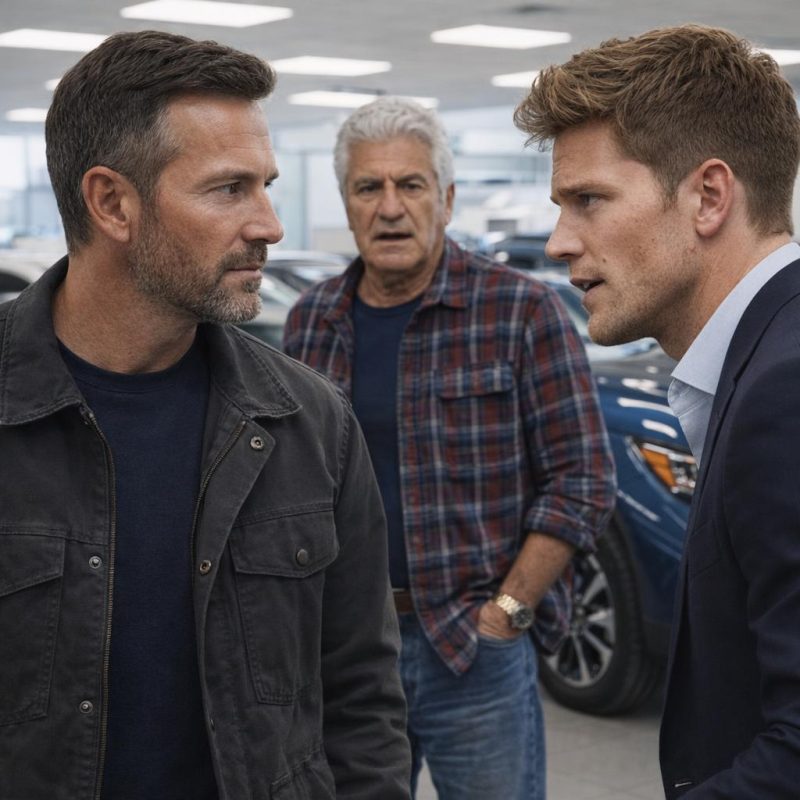 Image by RM AI
The Used Lot Suggestion
I thought I'd misheard him at first. Tyler had been talking about the dealership's inventory, gesturing vaguely toward the showroom floor, and then he said it — almost casually, like it was a helpful afterthought. He mentioned there was a used car lot about a mile down the road. Said they had a good selection, that a lot of people found what they were looking for over there. He even gave it a name, like he'd sent people there before. I looked at Dad. Dad's expression didn't change. He stood there with his hands in his jacket pockets, listening, the way he listens to everything — fully, without interrupting. Tyler gestured toward the exit as he said it, a loose wave of his hand in that direction, like he was pointing out a shortcut on a map. I felt something cold move through me. We had walked into a luxury dealership. Dad had named the exact model he wanted. He had said the model number out loud. And Tyler was pointing us toward the door.
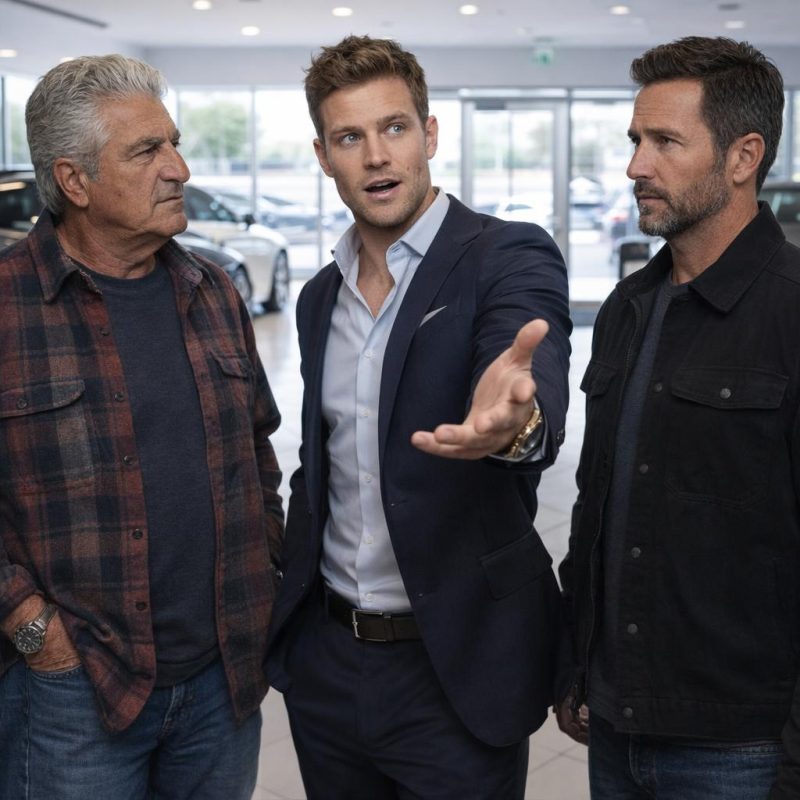 Image by RM AI
Dad's Calm Request
I wanted to say something. I had the words right there, lined up and ready, and I was about half a second from using them. But then Dad spoke first. He didn't raise his voice. He didn't acknowledge the suggestion about the used lot, didn't address it at all, just let it pass like it hadn't been said. He asked Tyler, politely and directly, if he could sit inside the display model on the floor — the Meridian Premier, the one parked closest to the window with the showroom lighting on it. He said please. He said it the way he says please when he means it, which is every time. I stood there and watched him do it and felt something I don't have a clean word for. It wasn't just admiration, though it was that too. It was something closer to the feeling you get when you realize someone has more self-possession than you do, and that their way of handling a thing is better than yours would have been. The showroom hummed quietly around us.
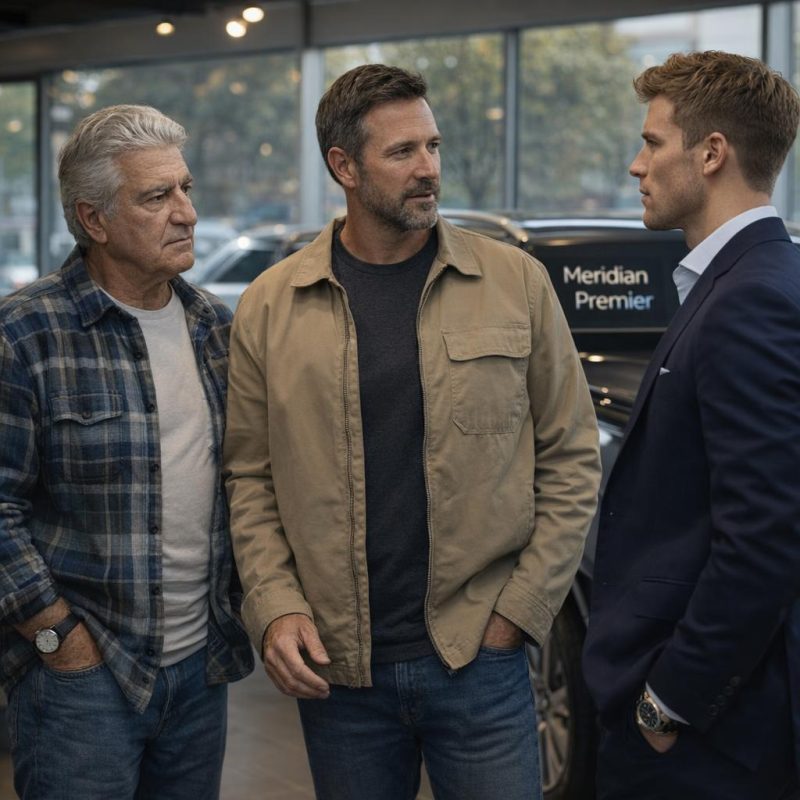 Image by RM AI
Tyler's Hesitation
Tyler didn't answer right away. That was the thing that caught me. In every dealership I've ever been in, when a customer asks to sit in a car on the showroom floor, the salesman is already moving toward it before the sentence is finished. That's the job. That's the whole point of having a car sitting there with the interior lit up and the door handles polished. But Tyler just stood there. He looked at the Meridian Premier, then back at Dad, then at the car again. It was a few seconds at most, but it was long enough to be strange. Dad waited. He didn't fill the silence, didn't repeat himself, just stood there with his hands in his pockets and let the question hang. Tyler's jaw shifted slightly. His weight moved from one foot to the other. I watched him look at Dad's boots one more time — a quick drop of the eyes, then back up — and then he pressed his lips together in a thin, flat line.
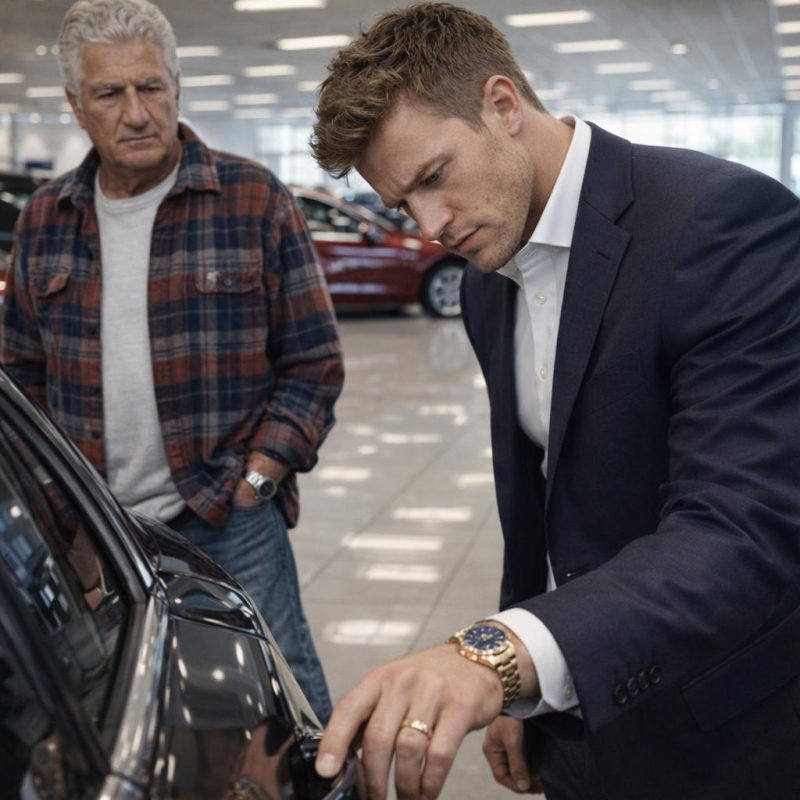 Image by RM AI
The Second Mention
Then Tyler brought up the used lot again. He didn't frame it as a redirect this time — he leaned into it, like he was doing us a favor we hadn't appreciated the first time. He used the phrase 'budget-friendly options,' and he said it slowly, with a kind of careful emphasis, the way you talk to someone you've decided isn't following along. Dad was still standing in the same spot, patient as a fence post, and I watched his chin come up just slightly when he heard it. Not a flinch. Not anger. Just a small, quiet adjustment, like something had registered and been filed away. I had both hands in my jacket pockets by then and I was pressing them flat against my thighs because it was the only thing I could think to do with them. Tyler's voice had taken on a new edge — still polished, still technically courteous, but pointed in a way that hadn't been there before. The word 'budget-friendly' hung in the air of that showroom like something that didn't belong there.
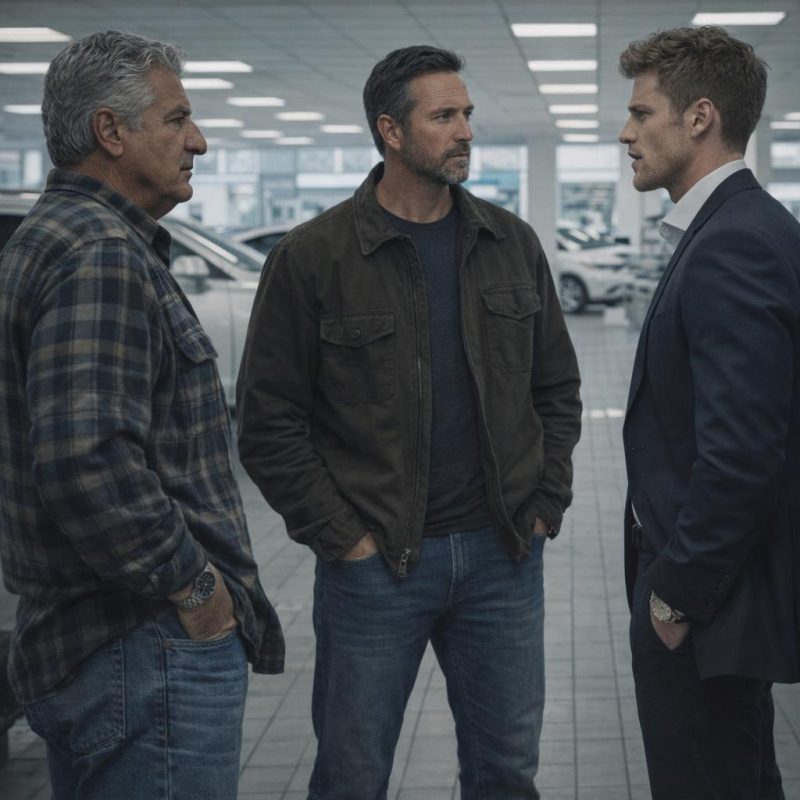 Image by RM AI
Dad's Insistence
Dad looked at Tyler for a moment without saying anything. Then he said it again. He said he would like to sit inside the display model, please. Same words, near enough. Same even tone. But there was something underneath it now that hadn't been there before — not anger, not confrontation, just a kind of settled weight, the way a door sounds different when it's closed with intention. Tyler's expression shifted. Something moved across his face that I couldn't fully read, but it pulled at the corners of his mouth and tightened the skin around his eyes. The showroom felt very still. The other salesman near the back had stopped pretending to look at his tablet. A couple browsing near the far wall had gone quiet. Dad stood in the middle of all of it in his flannel shirt and his work boots, not moving, not explaining himself, just waiting — and the room had no choice but to wait with him.
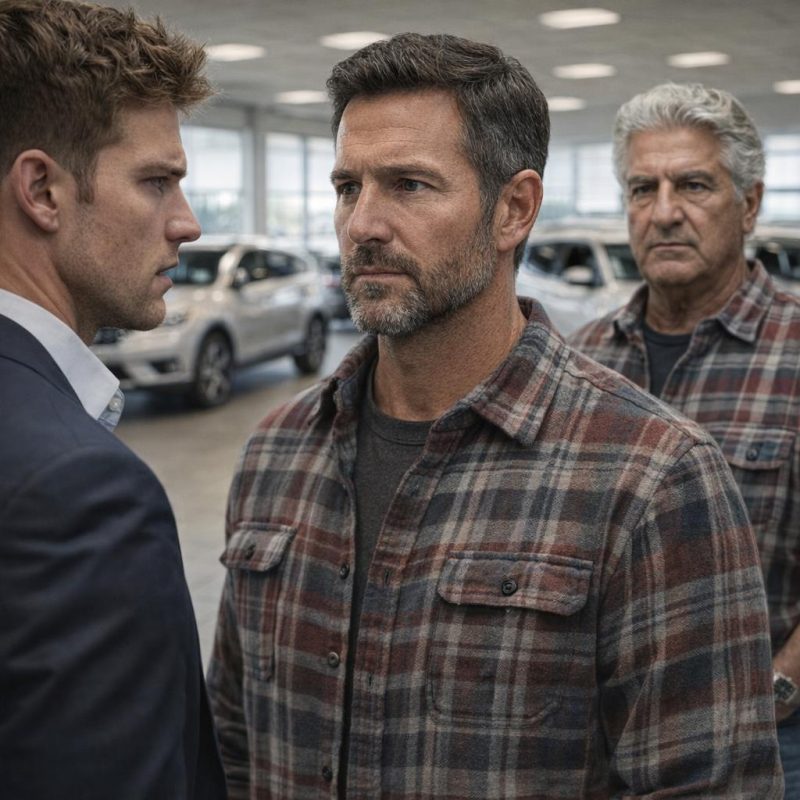 Image by RM AI
The Dramatic Sigh
The stillness in the showroom held for another beat or two. Then Tyler let out a breath — long, slow, and loud enough that I was pretty sure it was meant to be heard. He reached into his jacket pocket with the kind of deliberate slowness that made the whole thing feel like a performance, like he was doing us an enormous favor and wanted everyone in the room to know it. His hand came out holding a key fob. He held it loosely, almost carelessly, the way you'd hold something you didn't much care about dropping. Dad didn't react. He just stood there in his flannel and his boots, hands at his sides, waiting with the same quiet patience he'd had from the start. I watched Tyler's jaw shift slightly, like the lack of reaction annoyed him more than any argument would have. The other salesman near the back had gone very still. The couple by the far wall hadn't moved. The whole room felt like it was holding its breath along with me. I wasn't sure what came next — I just knew the keys were out, and Tyler was holding them like they cost him something.
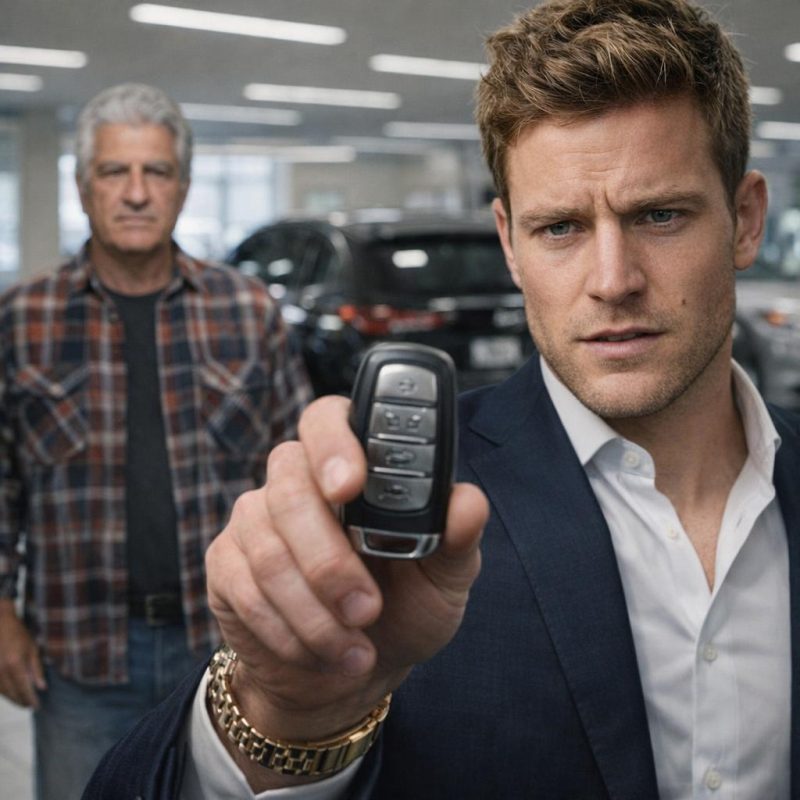 Image by RM AI
Precision Instruments
Tyler walked to the driver's side door and unlocked it with a short press of the fob. The locks clicked open. He pulled the door handle and swung it wide, then turned to my dad with an expression that had settled into something I can only describe as patient condescension — the look of someone explaining something obvious to someone they've already decided won't understand. He said it was a precision instrument. Those were his exact words. He said the vehicle was a precision instrument and that Dad would want to be careful. The way he said it, slow and deliberate, with a slight pause before the word careful, made it land less like a safety reminder and more like a question about whether Dad belonged anywhere near it. I felt something tighten in my chest. Dad just nodded once, the way he always does when he's heard something and chosen not to respond to it. He put his hand on the door frame and looked at the seat. Tyler stood back with his arms loose at his sides, watching. I kept my mouth shut, but the words sat in the air between all of us — and they didn't feel like a warning about the car.
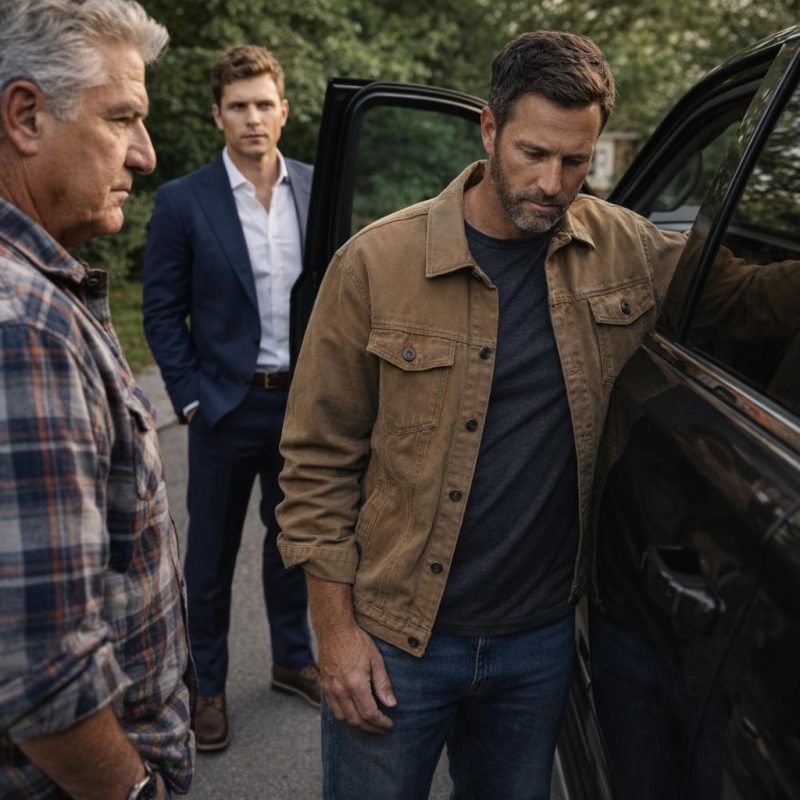 Image by RM AI
Dad Climbs In
Dad took his time. He put one hand on the door frame and one on the roof, and he lowered himself into the seat the way a man does when he's been on his feet since before sunrise — carefully, with full attention to what his body was doing. There was nothing clumsy about it. He settled in, adjusted his position once, and then just sat there for a moment with his hands resting on his thighs, taking it in. Then he reached out and put both hands on the steering wheel. Not gripping it, just resting them there, like he was getting acquainted. He looked at the dashboard — the gauges, the display, the layout of the controls — and his eyes moved slowly and deliberately across all of it. I'd watched him study the brochures at the kitchen table for months. He knew what every button did before he ever walked through that door. Tyler stood a few feet back with his arms crossed, not saying anything, just watching. I watched too, from a different angle, with a different feeling entirely. Dad's face had gone quiet and focused, the way it does when he's working through something that matters to him — and he settled back into that seat like he'd been waiting a long time to sit in it.
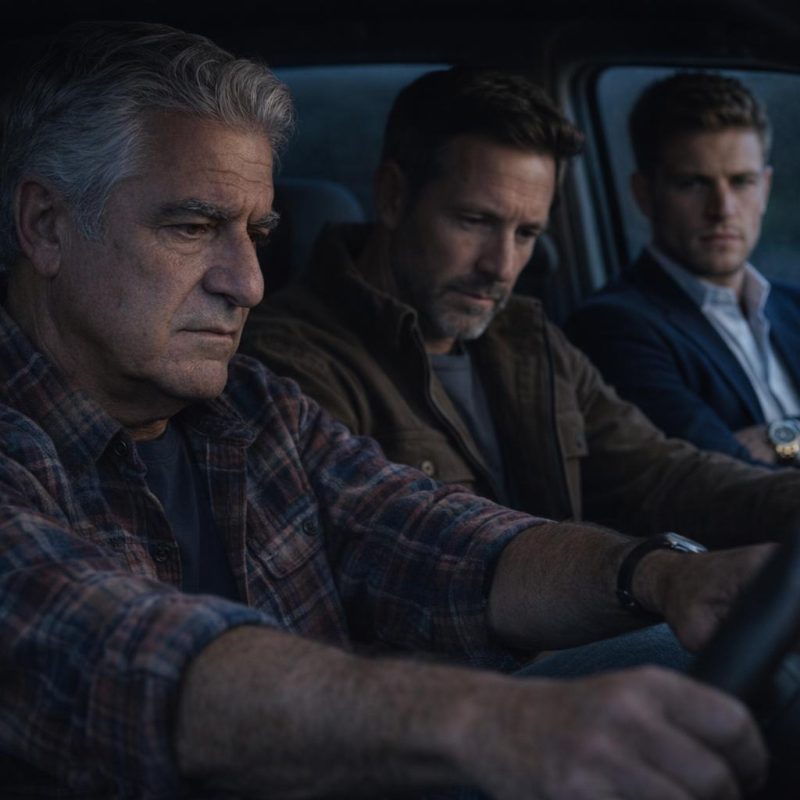 Image by RM AI
The Tiny Smudge
I don't know exactly when it happened. Somewhere between Dad reaching for the dashboard controls and running his thumb along the edge of the center console, I caught a small movement near his left foot. A piece of dried mud — barely the size of a thumbnail, maybe smaller — broke loose from the edge of his boot and dropped onto the floor mat. It didn't make a sound. It just landed there, pale against the dark mat, almost nothing. I saw it immediately. I don't know why my eyes went straight to it, but they did. My stomach dropped a little. I looked up at Tyler. He was still watching Dad's hands on the dashboard. I looked back at the mat. The piece of mud sat there, still and small, the kind of thing you'd wipe away without thinking twice on any other floor in any other building. Dad hadn't noticed. He was still moving through the interior with the same quiet focus, unhurried, careful. I told myself it was nothing. I told myself Tyler hadn't seen it. The mat was dark and the piece was small and the light in the showroom was bright enough to wash out details like that. I almost believed it. That small pale mark sat on the mat, barely there at all.
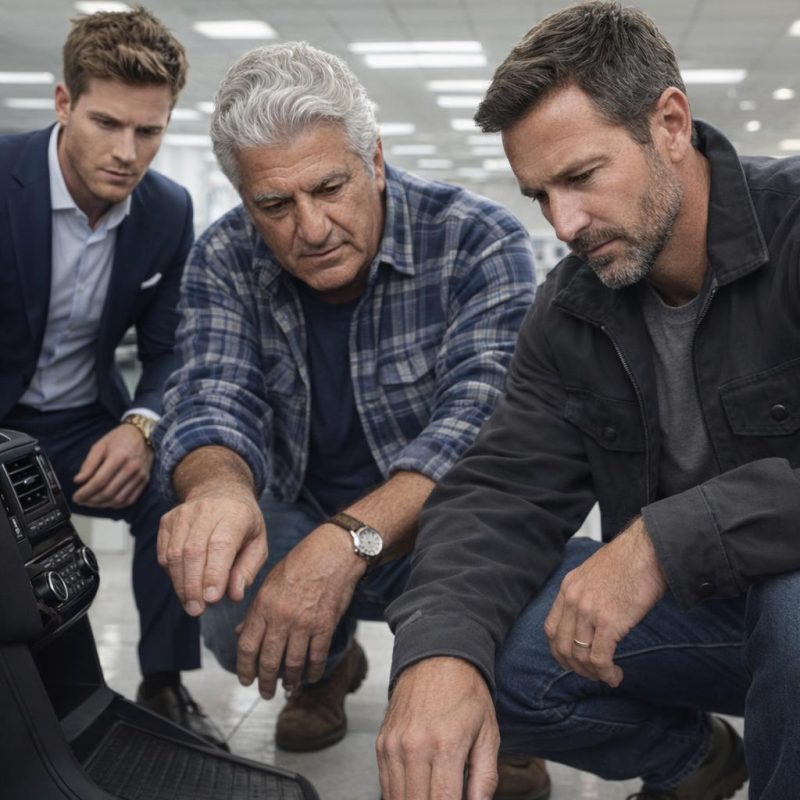 Image by RM AI
Tyler Spots It
I was still watching Dad's hands when I caught Tyler move in my peripheral vision. His weight shifted forward, just slightly, and his chin dropped. I turned to look at him. His eyes had gone to the floor mat. He'd seen it. I could tell by the way his body changed — not dramatically, not a big reaction, just a tightening that started somewhere around his jaw and moved through his shoulders. His arms, already crossed, pulled in a little closer. His mouth went flat. He stared at that small piece of dried mud, his gaze fixed and unmoving, the way you stare at something you can't look away from. Dad was still in the driver's seat, still running his hand along the door panel, still absorbed in the interior the way he'd been since he sat down. He had no idea. I wanted to say something — to Dad, to Tyler, to anyone — but I didn't know what to say, and the moment felt too fragile to touch. Tyler's eyes stayed fixed on that mat. Whatever had been in his expression before — the performance, the reluctant tolerance — had gone somewhere else entirely, replaced by something quieter and harder that I didn't like the look of at all.
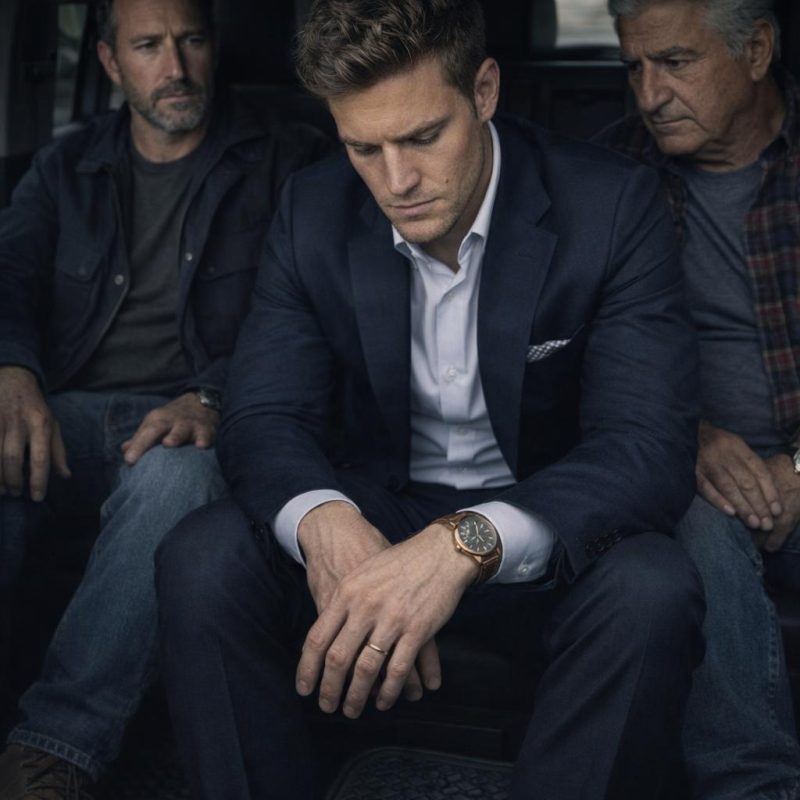 Image by RM AI
Get Out
Tyler uncrossed his arms. He took one step toward the open car door and his voice came out sharp and loud, loud enough that it cut right through the ambient noise of the showroom. He told my dad to get out of the vehicle. Just like that. Not a question, not a suggestion — a flat, hard directive delivered at a volume that had no business being used with a seventy-year-old man who hadn't raised his voice once since we walked through the door. I felt it like a physical thing, that sound. My dad's hand stopped moving on the door panel. The couple near the far wall turned. The salesman at the back looked up from whatever he'd been pretending to do. A woman near the entrance paused mid-step. The whole showroom seemed to recalibrate around those four words, everyone suddenly aware that something had shifted. Dad turned his head slowly and looked at Tyler. His expression didn't break. He didn't flinch, didn't startle, didn't react the way Tyler probably expected him to. He just looked at him, steady and still, the way my dad has always looked at things that don't deserve the satisfaction of a reaction. I stood there with my hands at my sides, and Tyler said it again — louder this time.
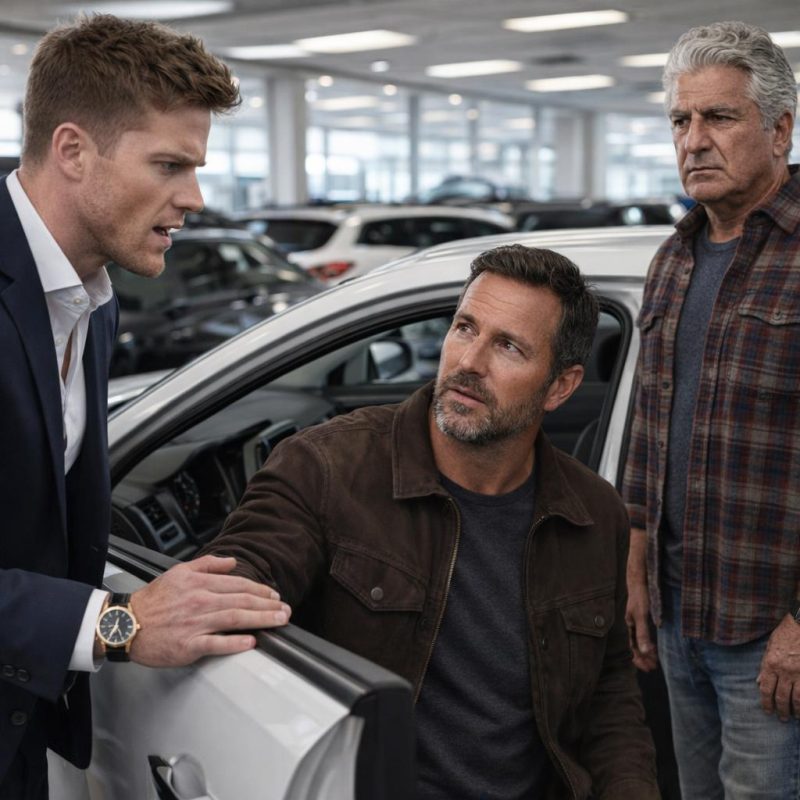 Image by RM AI
Serious Establishment
The second time Tyler said it, he added more. His voice had that clipped, over-enunciated quality that people use when they want to make sure every syllable lands. He said this was a serious establishment. He said it like the words themselves were a verdict, like the flannel shirt and the work boots had already been weighed and found wanting and this was just the formal announcement. A few people nearby had stopped pretending not to watch. A young woman near the sports car display had her hand over her mouth. The salesman at the back had gone completely still. I could feel my face getting hot. Dad was still in the driver's seat, one hand resting on the steering wheel, and he was looking at Tyler with an expression I recognized — not anger, not embarrassment, just a kind of patient, unblinking attention, the same look he gives a problem on a job site that needs to be assessed before it can be addressed. He didn't say anything. He didn't move. Tyler stood in the open doorway of that car with his arms at his sides and his chin up, and the words he'd just said hung in the air of that showroom in front of everyone who'd heard them, and there was no taking them back.
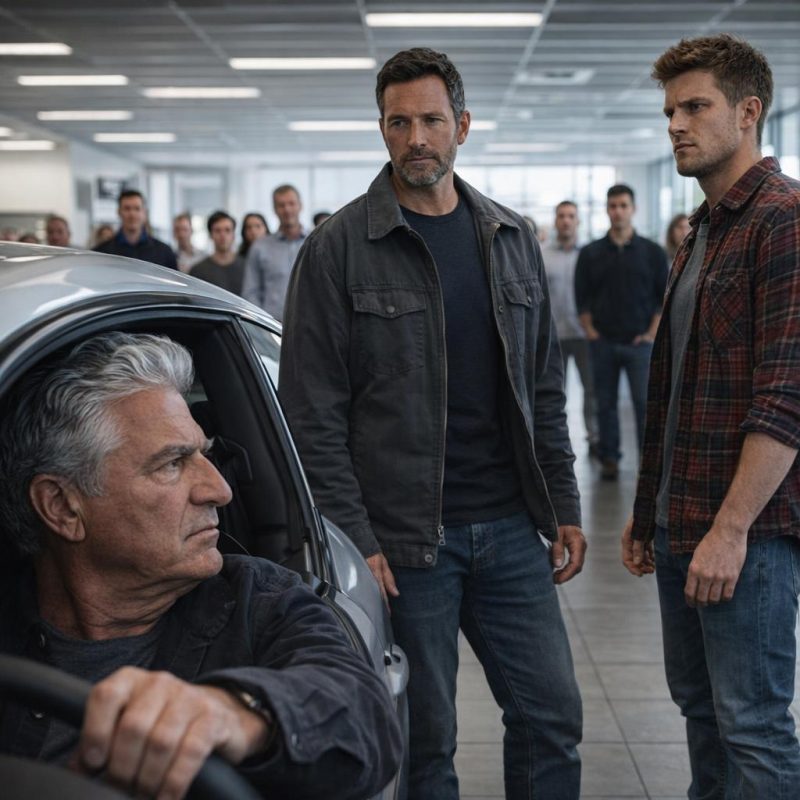 Image by RM AI
Budget Dealer
Tyler wasn't done. He took a half step back from the car door and gestured — a short, dismissive motion with one hand, the kind you'd use to wave off something that had already taken up too much of your time. He told my dad there was a budget dealer about two miles down the road. Said it might be more his speed. The showroom had gone completely quiet by then. Not the polite, ambient quiet of people minding their own business — the held-breath quiet of people who had heard something they weren't sure they'd heard correctly. I could see it on their faces, the recalibration, the slight lean-in. I stood there with my hands balled at my sides and something burning in my chest that I didn't trust myself to open my mouth around. I wanted to say something. I wanted to say a lot of things. But I'd watched my dad long enough to know that the moment you raise your voice, you hand the other person something they can use. So I stayed still. Dad reached up and put his hand on the door frame. He moved with the same unhurried care he'd used getting in — no rush, no performance, just a man taking his time. The weight of every eye in that room pressed down on all of us.
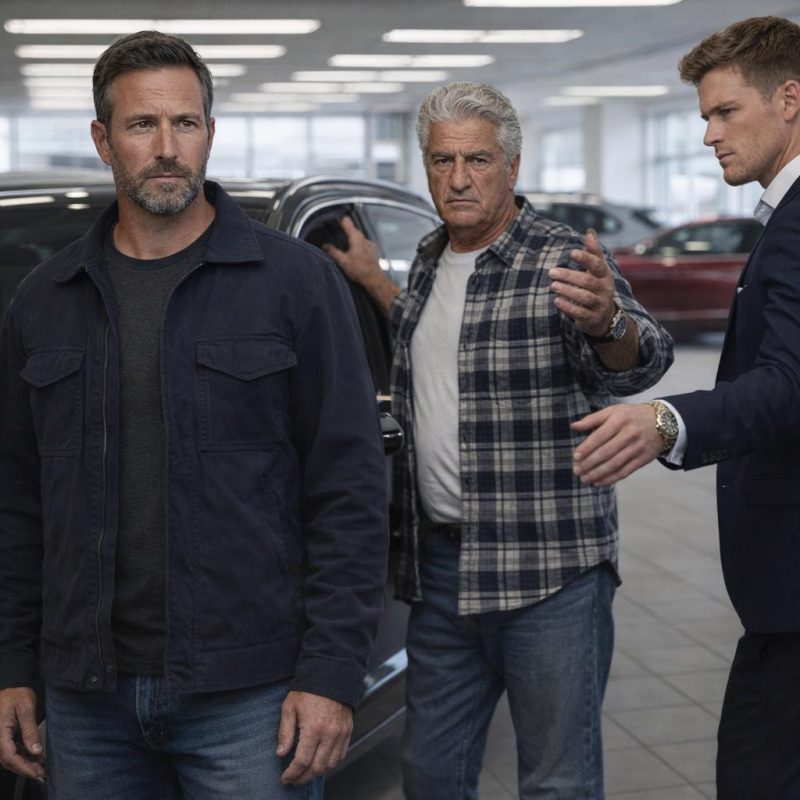 Image by RM AI
The Silent Showroom
The showroom had gone completely quiet by then — not the polite, ambient quiet of people minding their own business, but the held-breath kind, the kind where you can hear the ventilation system humming overhead. Every salesperson had stopped moving. A couple near a silver sedan had turned fully around. Even the Sports Car Guy had gone still, his phone halfway to his pocket. Tyler stood there with his arms loosely at his sides, looking like a man who had just said something he considered perfectly reasonable. And maybe in his world, it was. My dad stood beside the door of that SUV, one hand still resting on the frame, and I watched the room watch him. There's something about being stared at in a moment like that — not with sympathy, not with outrage, just with the flat curiosity of strangers who want to see what happens next. I felt it on his behalf in a way I couldn't shake. He was seventy years old. He had worked his whole life. And he was standing in a glass showroom full of people who had just watched a man in a tailored suit tell him he didn't belong there.
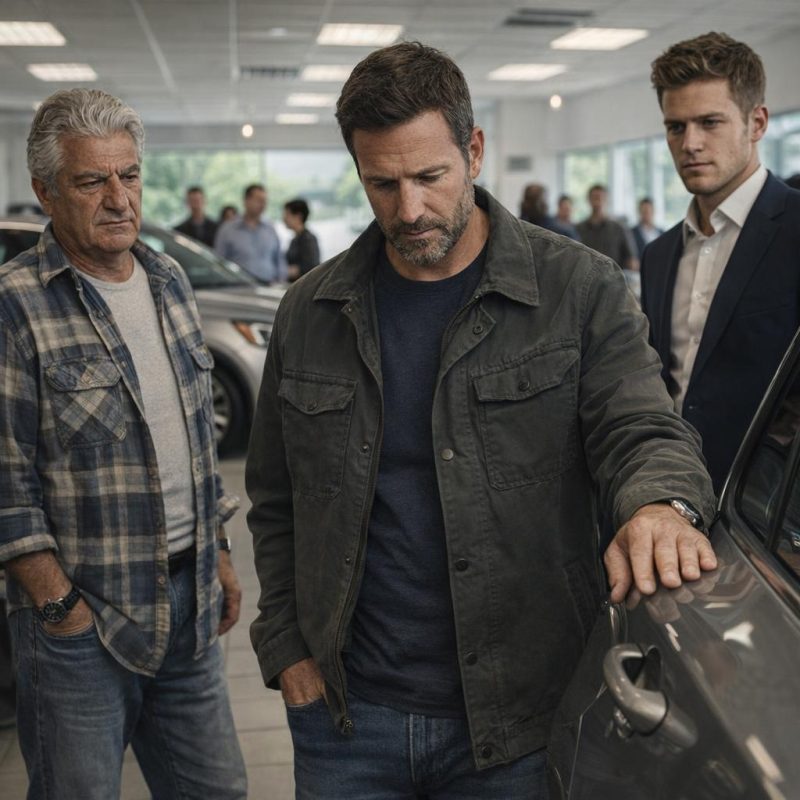 Image by RM AI
Dad Straightens His Flannel
Dad let go of the door frame. He stepped back from the SUV the same way he'd done everything else that morning — slowly, deliberately, without any visible hurry. He got both feet on the floor and straightened up, and then he did something I didn't expect. He reached up with both hands and smoothed the front of his flannel shirt. Just ran his palms down the fabric, like he was getting ready for something. Not nervous. Not flustered. The way a man adjusts his collar before walking into a room he owns. I had no idea what he was doing. Tyler was still standing a few feet away with his arms crossed, weight shifted to one hip, the posture of someone waiting for an inconvenience to resolve itself. The other customers had gone back to pretending they weren't watching, which meant they were absolutely still watching. Dad looked at Tyler. His expression hadn't changed — same calm, same unhurried steadiness he'd carried through the whole thing. Whatever was going through his head, none of it showed on his face.
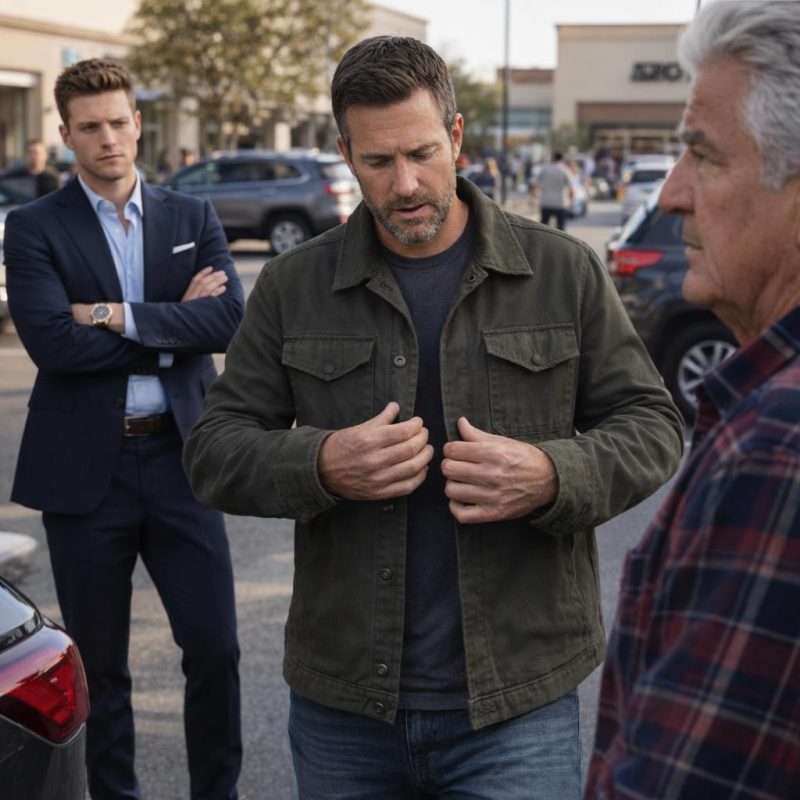 Image by RM AI
The Crumpled Card
Then Dad reached into the breast pocket of his flannel shirt. It was a slow, unhurried movement — the kind that made Tyler shift his weight and the nearest salesperson glance over. Dad's fingers came out holding a business card. It was worn at the edges, the kind of card that had been in a pocket for a while, handled more than once. He held it between his index finger and middle finger, not offering it yet, just holding it. I had no idea what he was doing. I genuinely could not read the situation. Part of me thought he was going to ask to speak to a manager, which felt like it would only make things worse. Part of me thought he was going to write down a complaint number or something. Tyler looked at the card the way you look at something you don't think is going to matter. His expression hadn't softened. He was still doing the slow blink of a man who considered this whole interaction already over. I looked at my dad's face, then back at the card between his fingers, and I still had no idea what was about to happen.
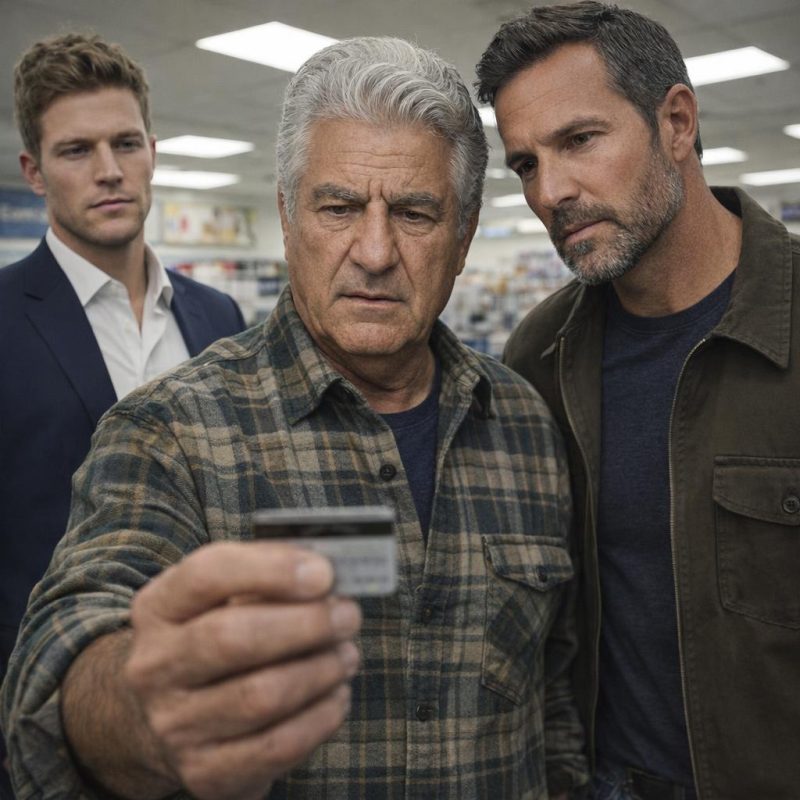 Image by RM AI
Call the Owner
Dad held the card out toward Tyler. Tyler took it the way you take something from a person you've already decided doesn't matter — two fingers, barely, like he was doing Dad a favor by accepting it at all. Dad watched him take it and then said, quietly, that Tyler should go ahead and call the owner. Said to tell him Henderson was here. That was it. No raised voice. No edge in it. Just a plain sentence delivered the way you'd give someone directions to the highway. I watched Tyler's face as he looked down at the card. Something moved across it — not quite recognition, not quite confusion, somewhere in between. He looked up at my dad, then back down at the card. His jaw shifted slightly. He didn't say anything for a second, which was the first time since we'd walked in that Tyler had been at a loss for words. Then he turned and walked toward the back offices, card in hand, and I stood there next to my dad with absolutely no idea what had just been set in motion.
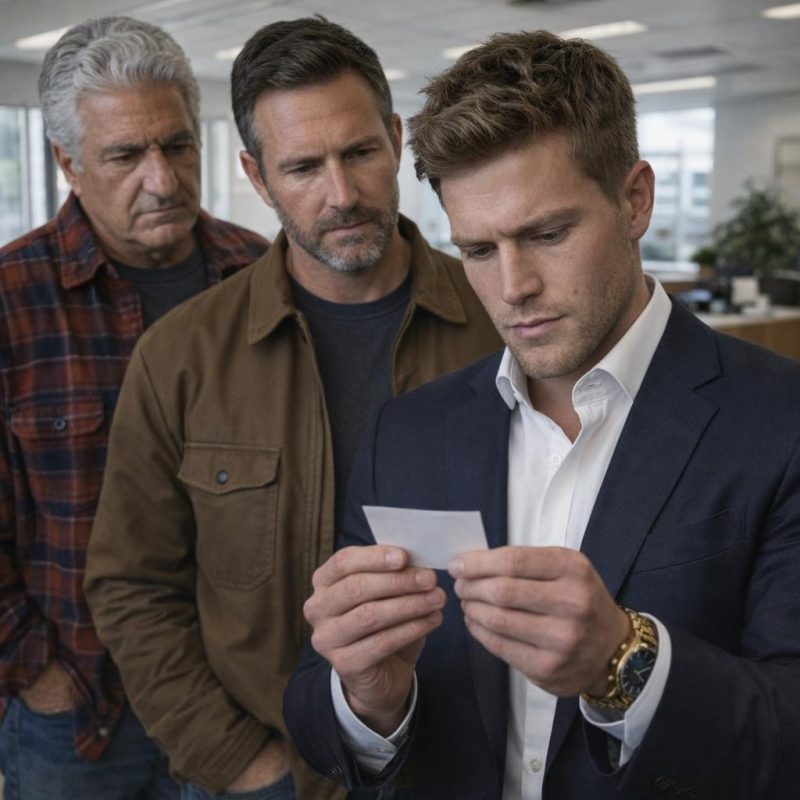 Image by RM AI
Henderson Construction
It didn't take long. Maybe two minutes, maybe less. A man in a dark suit came out of the back offices moving fast — not quite running, but close. He was older than Tyler, graying at the temples, the kind of polished that comes from years of managing expensive things. He had the business card in his hand and he was reading it as he walked. He reached us and stopped, and for a second he just looked at my dad. Then he looked at the card again. Then he said it out loud — Henderson Construction — like he was confirming something he couldn't quite believe. His face had gone a shade lighter. He looked around the showroom, then back at my dad, and he said that Mr. Henderson had built this entire dealership. Said it almost to himself, like he was working through the math. I heard the words. I understood them individually. But it took me a full beat to put them together, because what Grant was saying was that my dad — the man Tyler had just pointed toward the budget lot down the road — had built the building we were all standing in.
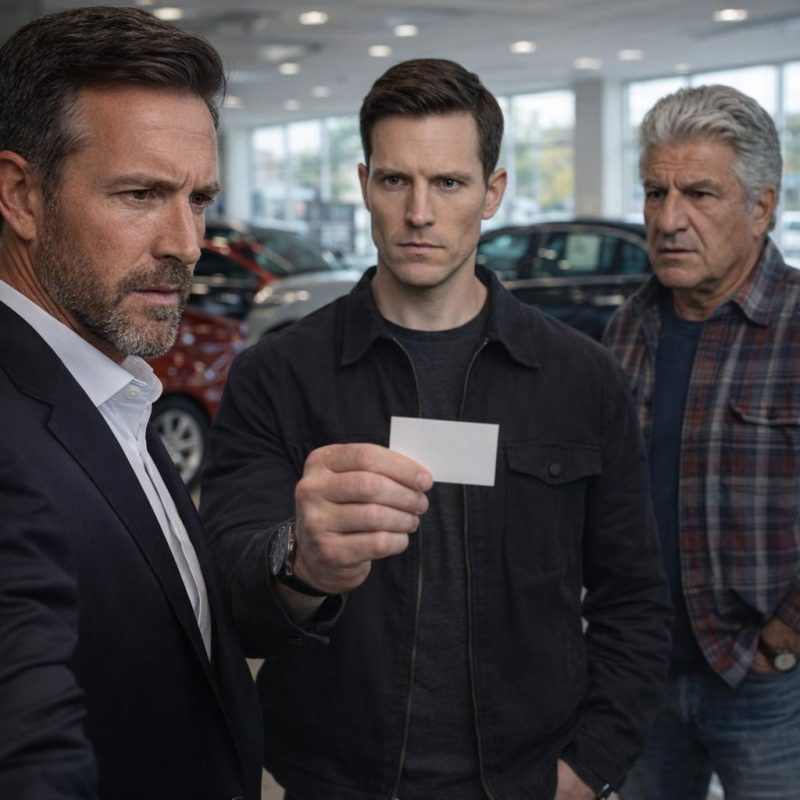 Image by RM AI
The Foundation He Laid
I stood there and let it land. The floors. The glass walls. The high ceilings with the recessed lighting that made every car look like it was on a stage. My dad had built all of it. I thought about his boots — the concrete dust ground into the leather, the scuffs along the toe, the kind of wear that doesn't come from one job but from decades of them. I'd seen those boots my whole life and never thought twice about what they meant. He'd walked into this showroom carrying the evidence of his work on his feet, and the first thing Tyler had done was use it against him. Dad hadn't said a word about any of it. He'd just smoothed his flannel and pulled out a card. He already knew where he was. He'd known the whole time. I looked at the floor beneath me — polished concrete, clean lines, exactly the kind of finish my dad's crews were known for — and something settled in my chest that I didn't have a clean word for, something between pride and grief and a kind of quiet that felt earned.
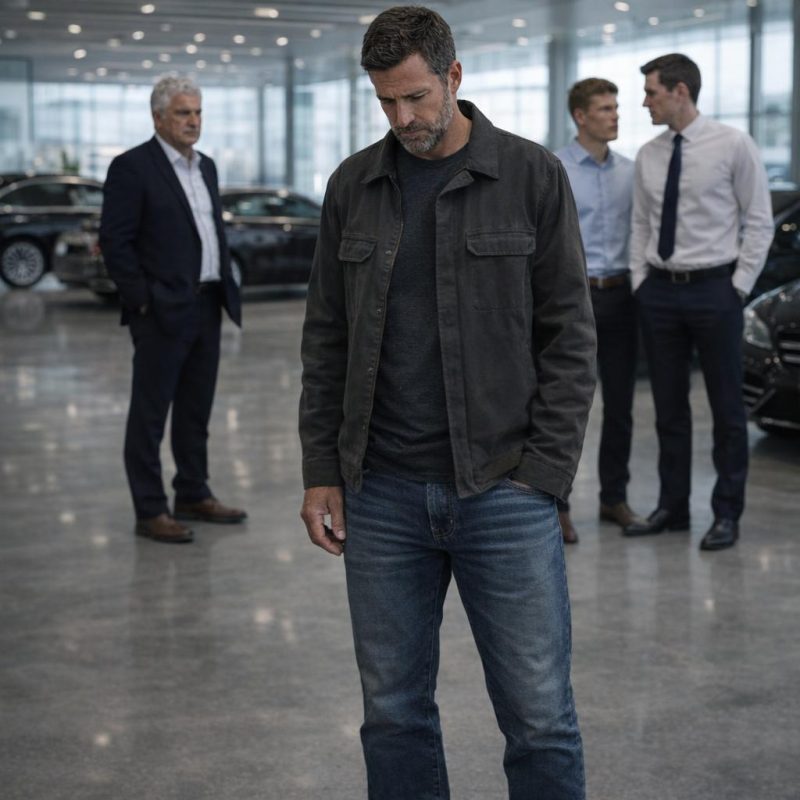 Image by RM AI
Tyler's Smirk Dies
I looked over at Tyler. I couldn't help it. He was still standing a few feet away, and the transformation was something I won't forget. The smirk was gone. Not faded — gone, like it had never been there. His mouth had gone slightly slack and his eyes were moving fast, from Grant to my dad to the card and back again, doing the same math I'd just done and arriving at the same answer. His hands, which had been so comfortable crossed over his chest all morning, were now at his sides, and one of them was trembling slightly at the fingers. Grant hadn't looked at him yet, not directly, but the set of Grant's shoulders said everything that needed saying. Tyler opened his mouth once and closed it. He looked like a man who had just understood, all at once, the full weight of what he'd done — not the moral weight, maybe, but the professional kind, the kind that has consequences attached to it. The practiced smile was nowhere. The easy confidence had drained out completely. What was left on his face was something much smaller and much less certain.
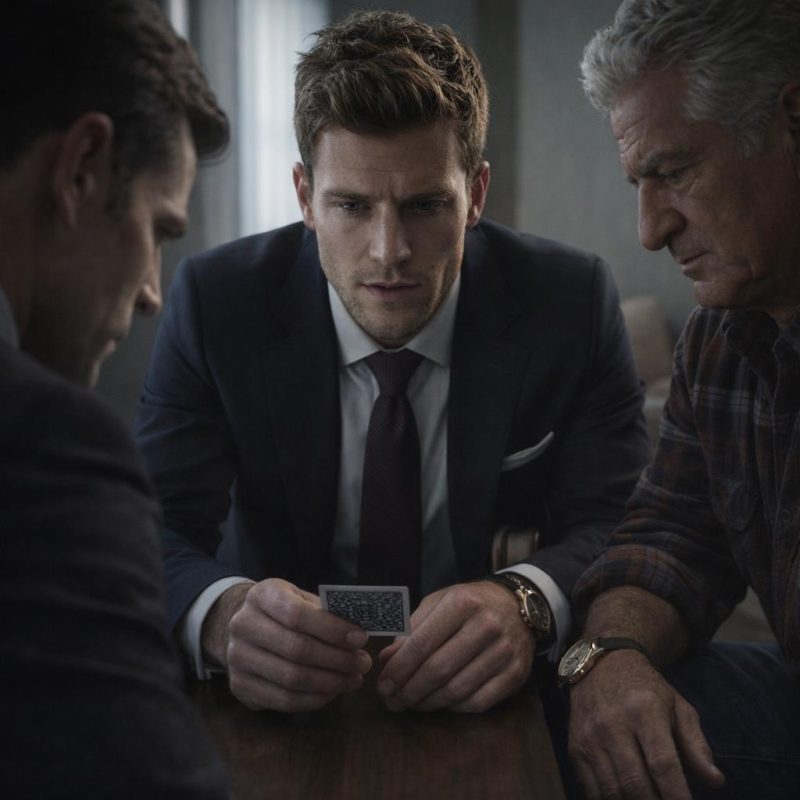 Image by RM AI
Three Years Ago
Grant turned back to my dad and started talking, and the words came out a little unsteady, like he was still catching up to the situation. He said Henderson Construction had been contracted for the full build — the structure, the foundation, the interior finishing. Said my dad had overseen the project personally. Said the building had opened three years ago and that the owner, Robert, had spoken highly of the work ever since. He said it all in the clipped, factual way of someone trying to demonstrate competence while quietly panicking. I listened and I thought about my dad driving over here this morning, pulling into the lot in his truck, walking through those glass doors in his work boots. He hadn't stumbled into this place by accident. He'd known the address. He'd known the layout. He'd probably known the name of every contractor who'd touched the electrical and the plumbing. And then I thought about the business card — worn at the edges, soft from handling — sitting in his breast pocket the whole time, and I understood that my dad had walked in here knowing exactly what he was carrying.
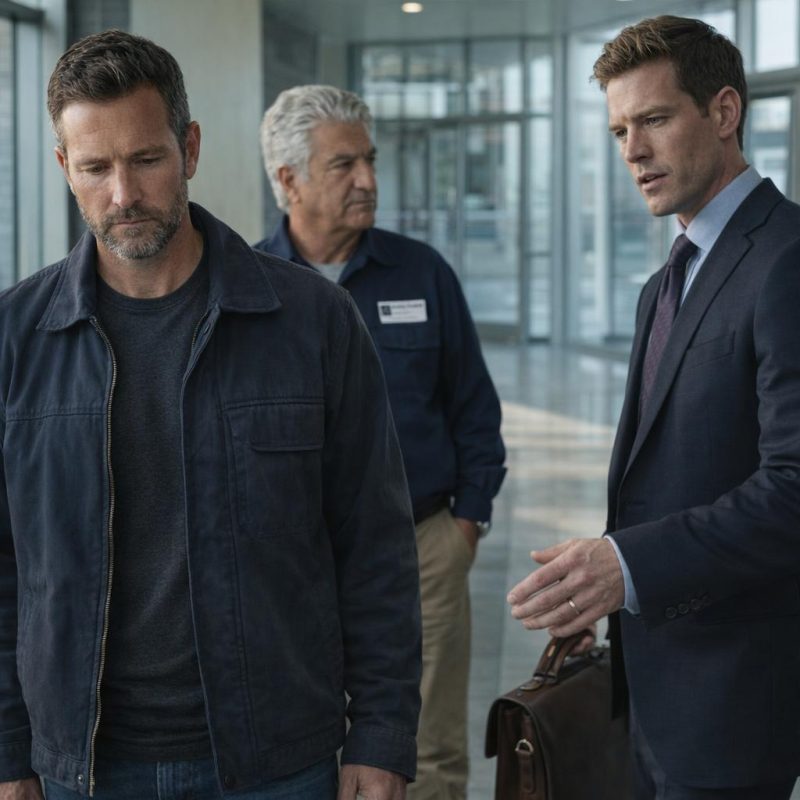 Image by RM AI
Grant's Apology
Grant kept talking, and the apology came out in waves — not the polished, rehearsed kind you'd expect from a dealership manager, but something rawer than that. He said he was deeply sorry. He said it more than once. He said what happened today was completely unacceptable and did not reflect the standards of this dealership. His voice had a tremor in it that he couldn't quite smooth out, and I could see him working to hold his composure while the ground kept shifting under him. My dad stood there and listened. He didn't nod. He didn't say it was fine. He didn't offer Grant any of the small social gestures people use to let someone off the hook. He just stood there in his work boots and his flannel, hands at his sides, and let Grant's words land wherever they were going to land. Tyler hadn't moved. He was still a few feet back, and I could see from the corner of my eye that he was watching my dad's face the way you watch something you're afraid of. Grant apologized again — a third time, maybe a fourth — and each one sounded a little more desperate than the last.
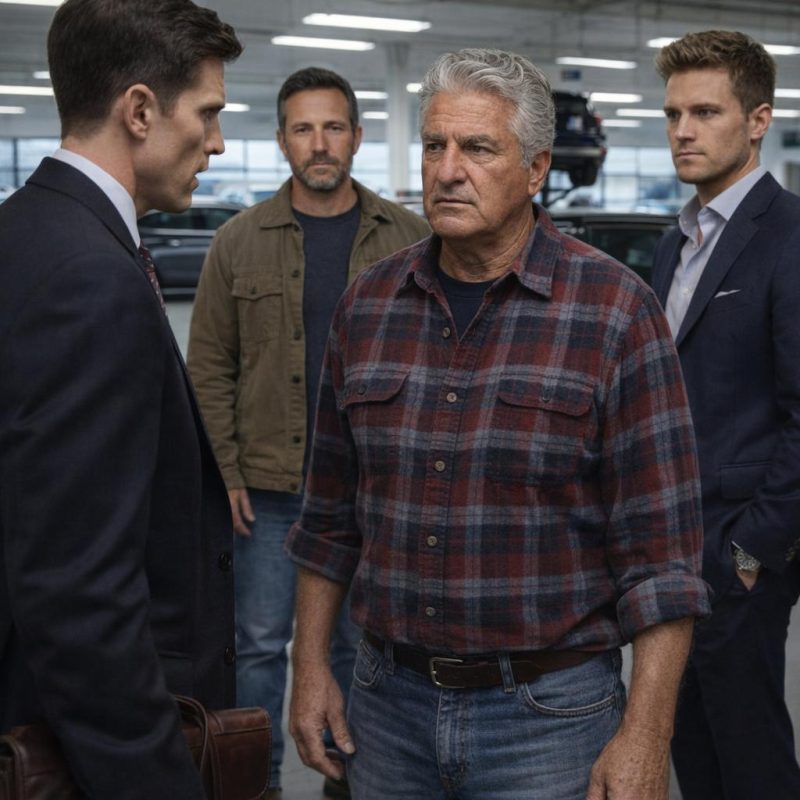 Image by RM AI
Tyler Tries to Speak
Then Tyler stepped forward. I don't know what made him do it — maybe Grant's apologies had shamed him into it, or maybe he thought he could still salvage something. He opened his mouth and said he was sorry, that he hadn't meant any disrespect, that he was just doing his job. His voice cracked on the last word. He tried again. Said he hoped my dad understood. Said it came out wrong. The words kept arriving in pieces, none of them connecting to the next, like he was building a sentence out of parts that didn't fit. My dad looked at him. Not through him, not past him — directly at him, the way you look at something you've already made up your mind about. He didn't speak. He didn't shift his weight or cross his arms or do anything that would have given Tyler a foothold. He just looked. And Tyler, who had walked through this showroom all morning like he owned the air in it, stood there with his mouth open and nothing left to say. The practiced smile was gone. What was left underneath it wasn't much.
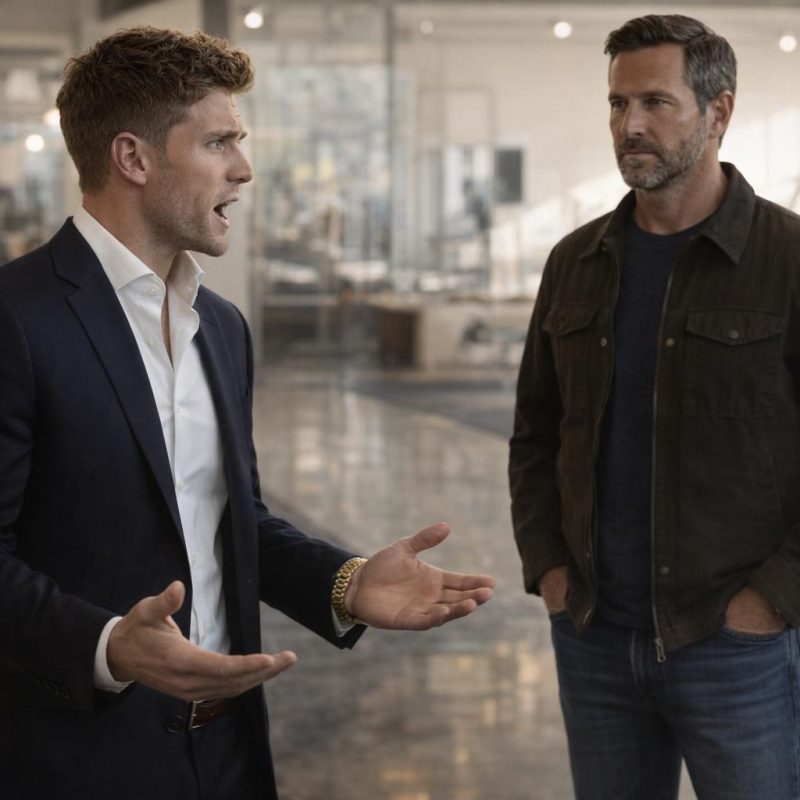 Image by RM AI
The Coffee Offer
Grant pivoted fast, the way people do when silence gets too heavy to carry. He said they had a private lounge, said they'd just had a fresh pot of their best single-origin brewed, said he'd personally bring my dad a cup right now if he'd like to sit down. He gestured toward the back of the showroom. Said they had water, espresso, whatever he wanted. Said please. I heard the word please come out of a dealership manager in a tailored suit, directed at a seventy-year-old man in work boots, and I had to look away for a second just to keep my face neutral. My dad let Grant finish. He waited until the offer was fully out on the table, every word of it, and then he shook his head once. Not rudely. Not with any edge to it. Just a single, quiet no. No thank you. He didn't explain it. He didn't soften it with a smile or a reason. He just declined, the same way he'd probably declined a hundred things in his life that weren't worth his time. That one small shake of his head carried more dignity than anything else that had happened in that building all morning.
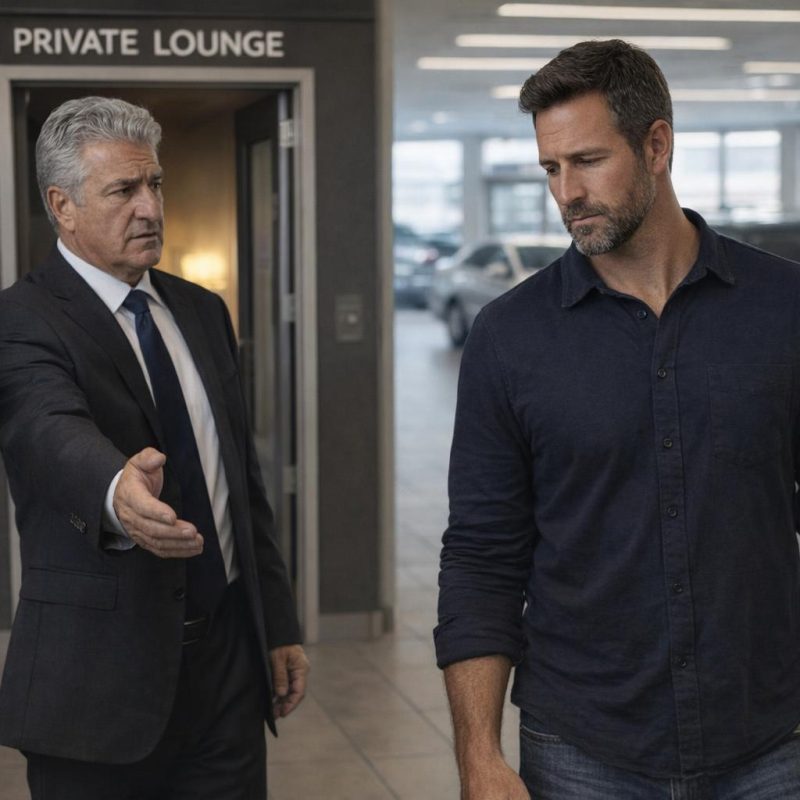 Image by RM AI
The Owner Appears
I heard the side door open before I saw him. Robert came through it moving fast — not running, but close, the kind of controlled urgency that expensive suits are designed to contain. He was exactly what you'd expect the owner of a place like this to look like: tailored jacket, no tie, a watch on his wrist that probably cost more than my first car. His hair was perfect. His face was composed, mostly, except around the eyes, where something tighter was working. He crossed the showroom floor in a straight line toward my dad, and I noticed he didn't look at Tyler or Grant on the way — just locked in and moved. He extended his hand and said William, like they'd met before, like this was a reunion that had gone sideways. My dad shook it. Robert said he'd just heard what happened and that he was personally mortified. He said the word mortified like he meant it, and maybe he did. He was good at this — the recovery, the damage control, the practiced warmth deployed at exactly the right moment. I watched him work and thought about the building around us, and about who had actually built it.
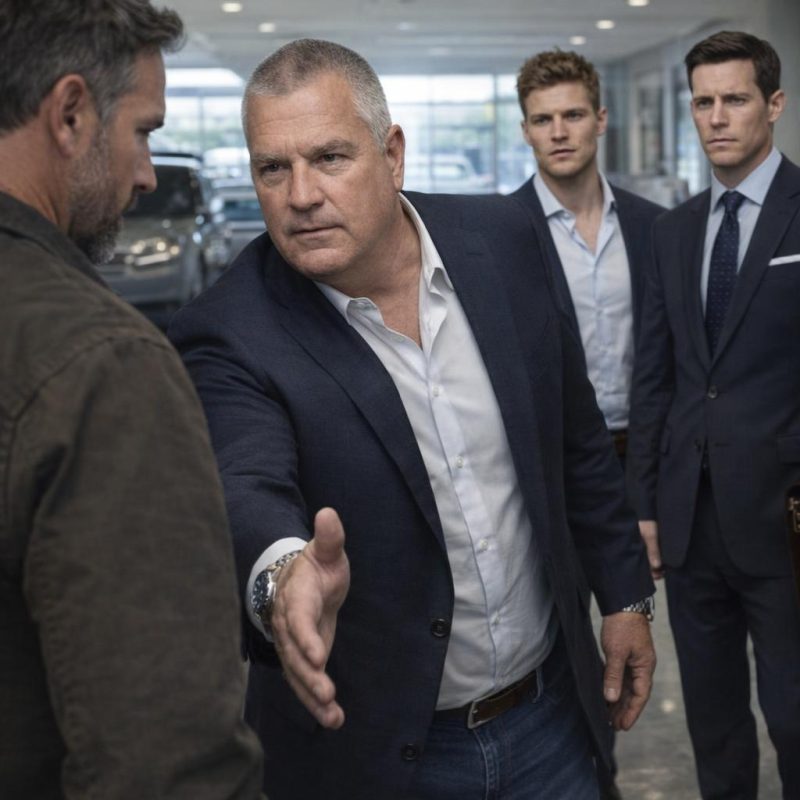 Image by RM AI
Free Upgrades
Robert didn't stop at sorry. He moved straight into offers, and they came fast. He said my dad could have any vehicle on the floor at cost — no markup, no dealer fees, nothing. He said he'd personally oversee the delivery. He said he'd throw in the full premium package, extended warranty, complimentary service for the life of the vehicle. He said if my dad wanted to bring the whole family in, they'd take care of everyone. He kept going. Each offer landed and when my dad didn't respond, Robert added another one on top of it, like he was building a structure he hoped would eventually be tall enough to matter. My dad stood there with his hands in his pockets and his face completely still. He wasn't weighing the offers. He wasn't doing the math. I could see it clearly — none of this was reaching him, not because he was being stubborn, but because the thing that had been taken from him this morning wasn't something Robert could put a price on and hand back. Robert paused, finally, and looked at my dad, and then added one more thing — a personal apology from him, as the owner, for everything that had happened under his roof.
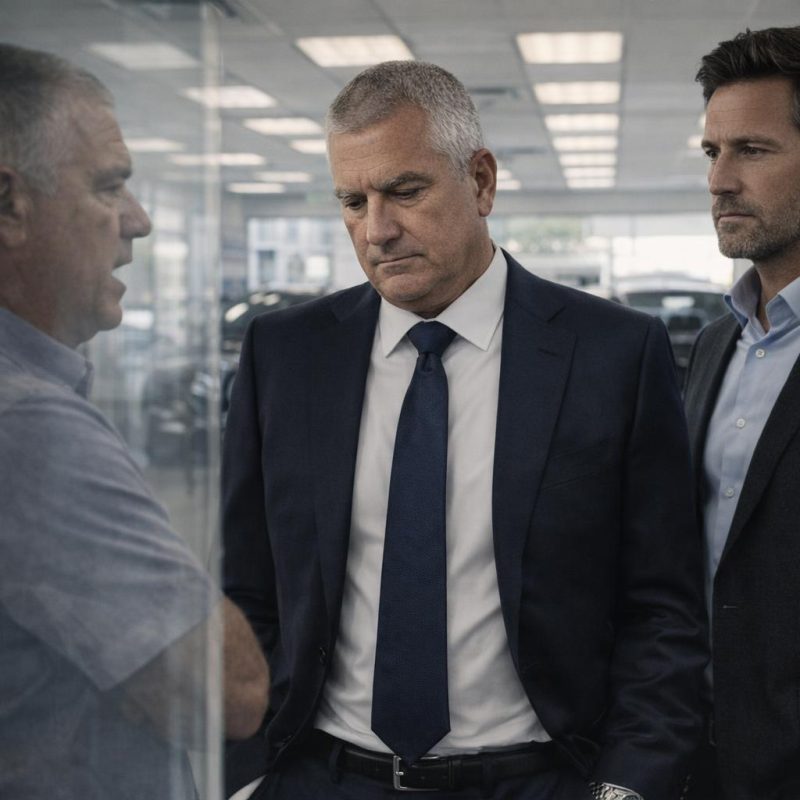 Image by RM AI
The Showroom He Built
My dad didn't answer Robert right away. Instead he turned, slowly, and looked at the showroom. Not at Robert, not at Tyler, not at any of us. He just looked at the room. His eyes moved across the glass walls — floor to ceiling, the kind of installation that takes a crew three days to get level — and then down to the polished concrete floors, and then up to the high ceiling with its recessed lighting and the steel beam work running the length of the space. I'd been in enough job sites with him growing up to know what that look meant. He was reading the building the way other people read a page. He could probably tell you which pour had been done on which day, which subcontractor had finished the ceiling joints, where they'd had to adjust the framing to account for the grade of the lot. Robert stood quietly. Grant stood quietly. Even Tyler didn't move. The whole showroom went still while my dad took his time with it, and nobody seemed willing to interrupt whatever was happening. His gaze moved slowly from one end of the space to the other, unhurried, like a man checking on something he'd left in someone else's care.
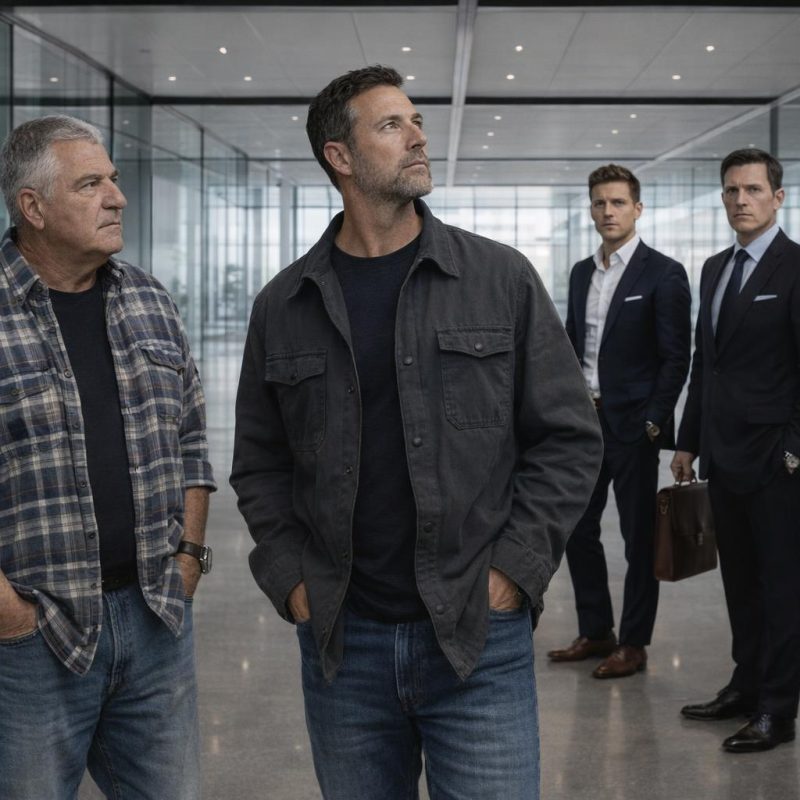 Image by RM AI
The Walk Away
My dad finished looking at the room. He brought his eyes back level, and for just a moment he looked at Tyler — not long, maybe two seconds, but direct and clear. Tyler's jaw tightened. He looked like he wanted to say something and couldn't find the nerve. My dad's expression didn't carry anger. It didn't carry satisfaction either. It was something quieter than both of those things, something that had already moved past this moment and left it behind. Then my dad turned toward the exit. Not toward Robert, not toward Grant, not toward the cars or the offers or any of it. He just turned and started walking toward the glass doors at the front of the showroom, the same doors he'd walked through this morning in his work boots while Tyler watched and decided what kind of man he was looking at. I fell in beside him without thinking about it. Behind us, I heard Robert say William, just once, and then nothing after that. My dad pushed through the door and the morning air came in, and I followed him out into the parking lot without looking back.
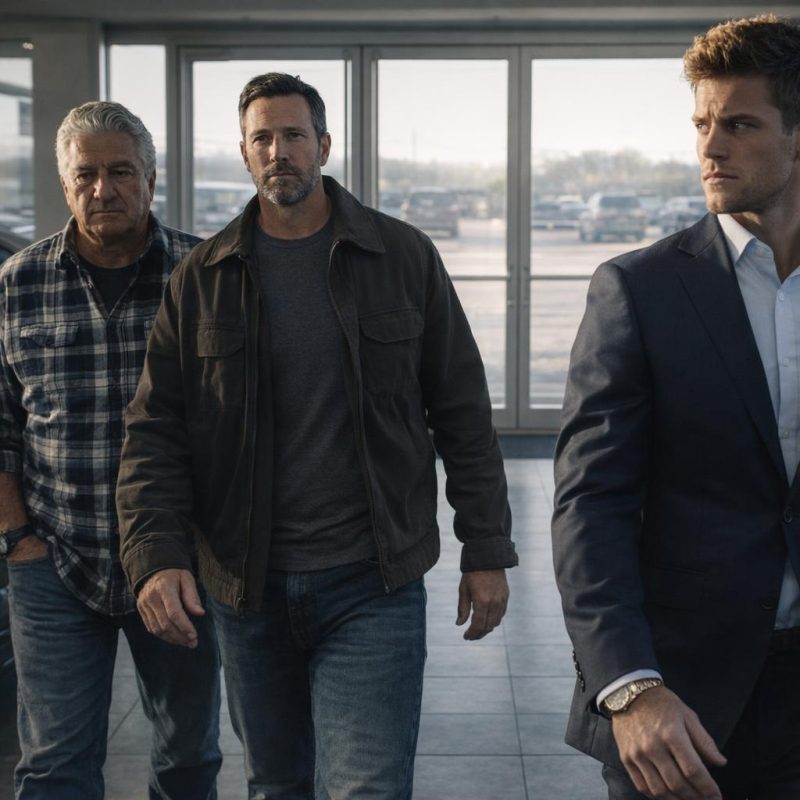 Image by RM AI
No Anger, No Gloating
We walked to his truck without talking. My dad didn't look back at the building. He didn't check over his shoulder or slow down or give any sign that what was behind us was still worth his attention. He just walked — the same steady pace he'd always had, the one I remembered from job sites when I was a kid trailing behind him trying to keep up. When we got to the truck he pulled out his keys and stood there for a second, and I looked at his face in the full morning light. There was nothing on it that looked like anger. Nothing that looked like triumph either. He'd walked into that showroom, been told he didn't belong there, and walked back out again without raising his voice or making a scene or taking a single thing they'd offered him. He hadn't needed to. The building was still standing behind us — his work, his crew, his name on the contract — and that wasn't going to change regardless of what anyone in there thought of his boots. He unlocked the truck and got in, and the quiet that settled between us felt like something he'd been carrying his whole life and had finally set down.
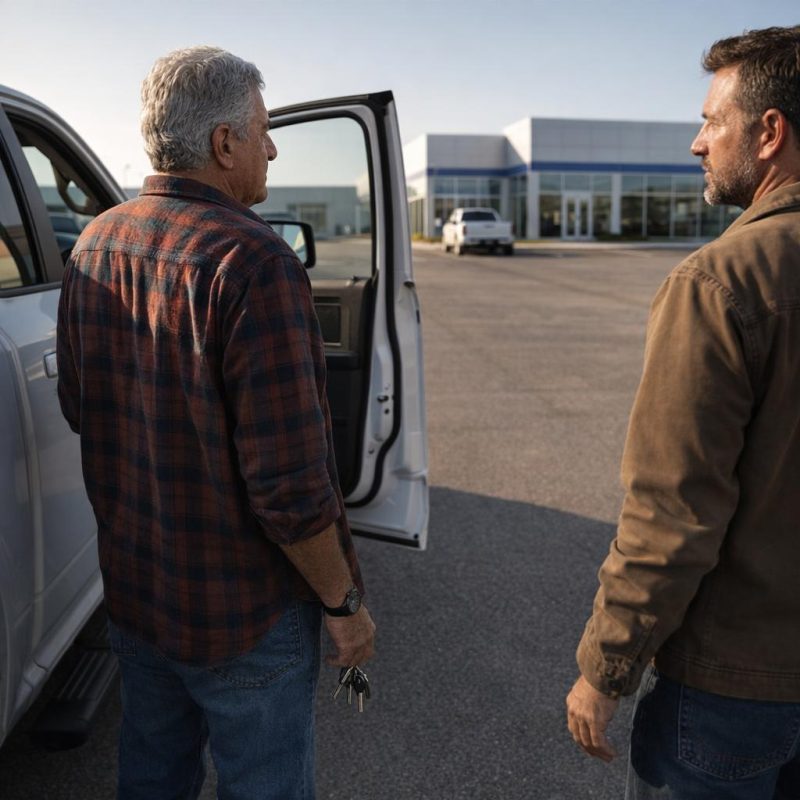 Image by RM AI
The Choice
I stood next to his truck and let that sink in for a minute. He could have had the SUV. That was the part I kept turning over. Grant had made it clear — whatever my dad wanted, it was his. The keys, the paperwork, the whole thing. My dad had been looking at that model for months. I knew because he'd sent me a link to it back in the spring with a one-line message that just said 'thinking about it.' He'd done the research. He'd compared the trim levels. He'd wanted it. And then he'd walked away from it without a second's hesitation, because the people selling it had treated him like he didn't belong in the same room as it. He didn't say anything about it on the way to the truck. He didn't look back at the showroom or pause at the door or give any sign that leaving something behind was costing him anything. He just walked. I thought about all the times he'd told me that how you're treated matters more than what you're offered. I'd heard it so many times I'd stopped really listening. Standing there beside that old pickup, watching him get in like it was any other morning, I understood he hadn't just said it — he'd lived it, right in front of me.
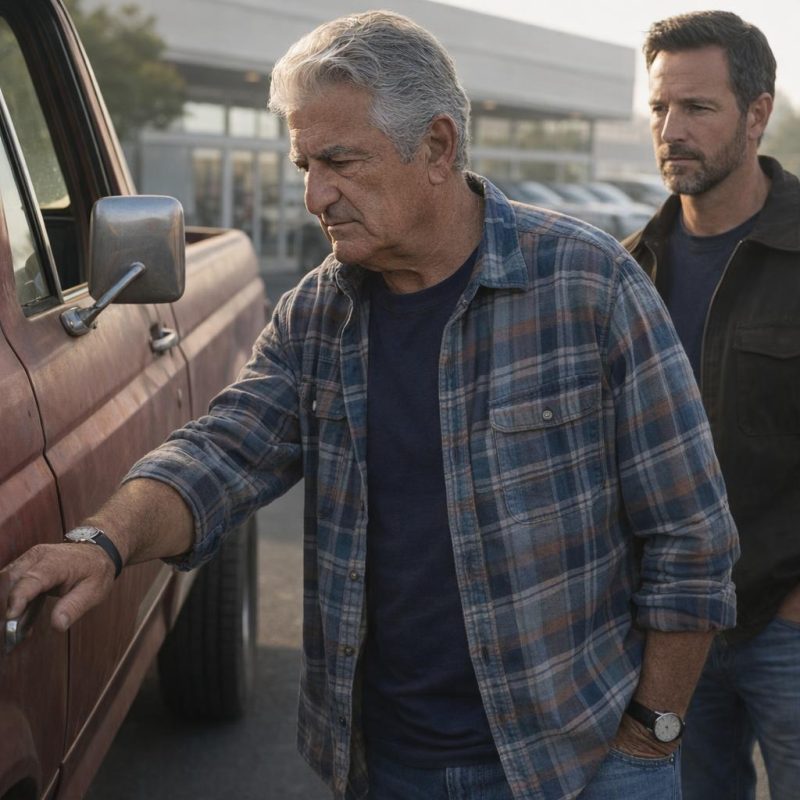 Image by RM AI
What the Boots Meant
We didn't talk much on the drive back. My dad had the radio on low, some AM station he always had on, and I watched the road and thought about his boots. They were work boots — the kind with the steel toe and the worn-down heel and the concrete dust ground into the leather so deep it wasn't coming out no matter what you did. Tyler had looked at those boots and made a decision. He'd looked at the boots and the flannel and the old truck in the lot and put my dad in a category and acted accordingly. What he hadn't known — what he hadn't bothered to find out — was that those boots had been on the ground when the foundation of his workplace was poured. The dust on them wasn't poverty. It wasn't failure. It was the residue of actual work, the kind that produces something that stands up and lasts. My dad had built things with those boots on that would still be standing long after Tyler had moved on to some other showroom floor somewhere. I didn't say any of that out loud. I just sat with it. There's a version of a person that lives in their clothes and their car and their watch, and there's a version that lives in what they've actually built. My dad had spent fifty years being the second kind, and it had never once required anyone's approval.
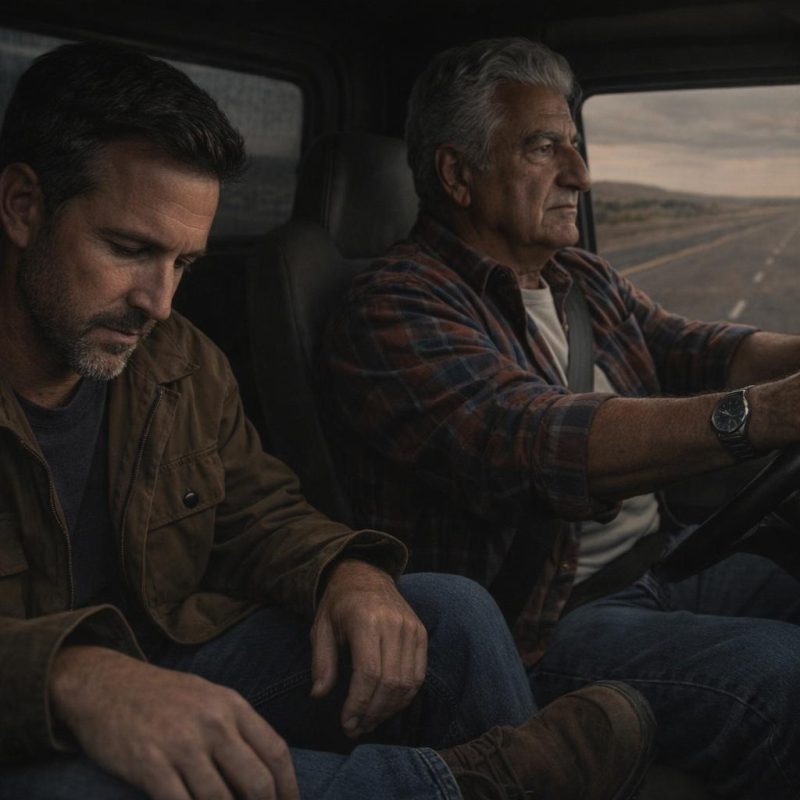 Image by RM AI
The Lesson Dad Taught
I've had people try to teach me things my whole life. Teachers, coaches, managers — people who sat me down and explained how the world worked and what I needed to do to get ahead in it. Some of it stuck. Most of it didn't. But I don't think any of it landed the way that morning did. My dad hadn't given me a speech. He hadn't pulled me aside in the parking lot and explained what his choices meant or what I was supposed to take from them. He'd just been himself, the same way he'd always been himself, and I'd been standing close enough to watch it happen in real time. He never raised his voice when Tyler dismissed him. He never tried to prove anything when Grant started backpedaling. He didn't use the moment to make anyone feel small, even when he had every right to. His dignity wasn't something he turned on because the situation called for it. It was just there, the same as it had always been, the same as it would be tomorrow. I thought about how many times I'd gotten loud when I should have gotten quiet, how many times I'd pushed back when I should have just stood still and let the truth do the work. My dad had been showing me a different way for as long as I could remember. I just hadn't been paying close enough attention until now.
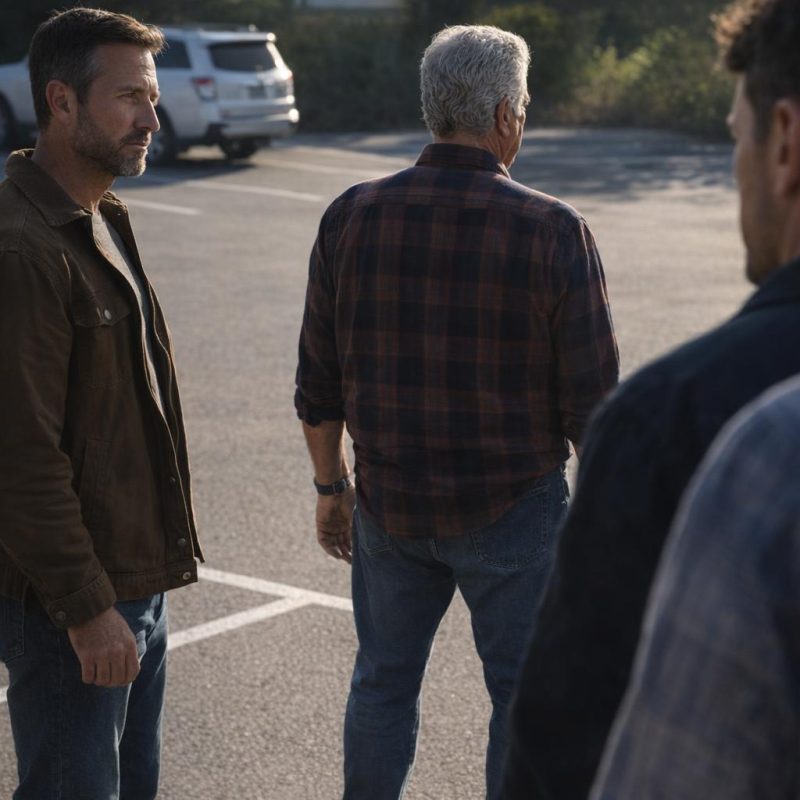 Image by RM AI
Never Judge by Appearance
I think about that morning more than I expected to. Not the part where Grant panicked, not the look on Tyler's face when the business card came out — those parts have faded. What stays with me is my dad walking to his truck. The steadiness of it. The complete absence of performance. He didn't need the room to know who he was, and he didn't need to take anything from it to prove it. I've caught myself in situations since then where I was about to size someone up based on what they were wearing or what they were driving, and I've stopped. Not because I made some grand resolution about it, but because I keep seeing those boots. Concrete dust and worn leather and fifty years of work that's still standing. You can't always see what someone has built by looking at them. You can't always see what they know, or what they've earned, or what they've survived. Tyler thought he could, and he was wrong in a way that cost him. I don't want to be wrong that way. My dad never was. He treated the guy sweeping the lot the same way he treated the guy signing the contract, and I never once heard him explain why — it was just how he moved through the world. That's the thing I'm carrying forward. Not the story. The standard.
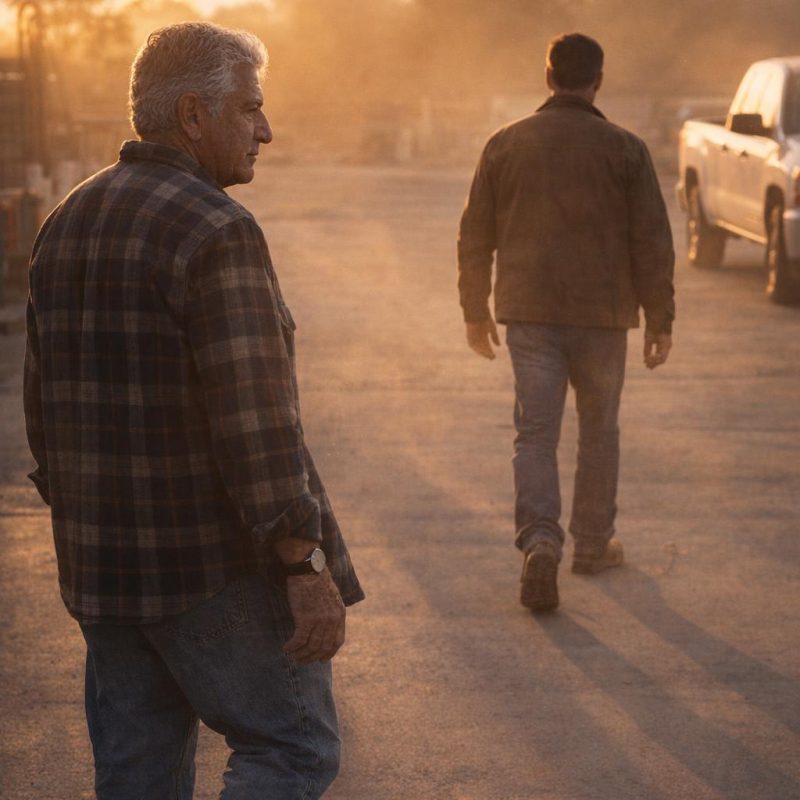 Image by RM AI
KEEP ON READING
20 Historical Figures Who Lived Much Longer Than You Think
Some Famous Lives Stretched Far. History has a way of…
By Christy Chan May 22, 2026
20 LGBTQ+ People from History Who Changed the World
History Is Full Of Queer Icons . LGBTQ+ people have always…
By Emilie Richardson-Dupuis May 22, 2026
20 Historical Poisons That Changed Politics, War, And Royal Families
Power In A Cup. Poison has always had a strange…
By Cameron Dick May 22, 2026
20 Man-Eaters That Terrified Entire Regions
When Fear Had Teeth. History has a way of turning…
By Cameron Dick May 22, 2026
20 Mistresses Who Had More Power Than the Queens Beside…
Power Wasn’t Always on the Throne. Royal history loves a…
By Annie Byrd May 22, 2026
20 Rare Artifacts That Changed Scholars’ Understanding of the Past
Discoveries That Forced Historians to Rethink What They Knew. Archaeology…
By Rob Shapiro May 22, 2026