

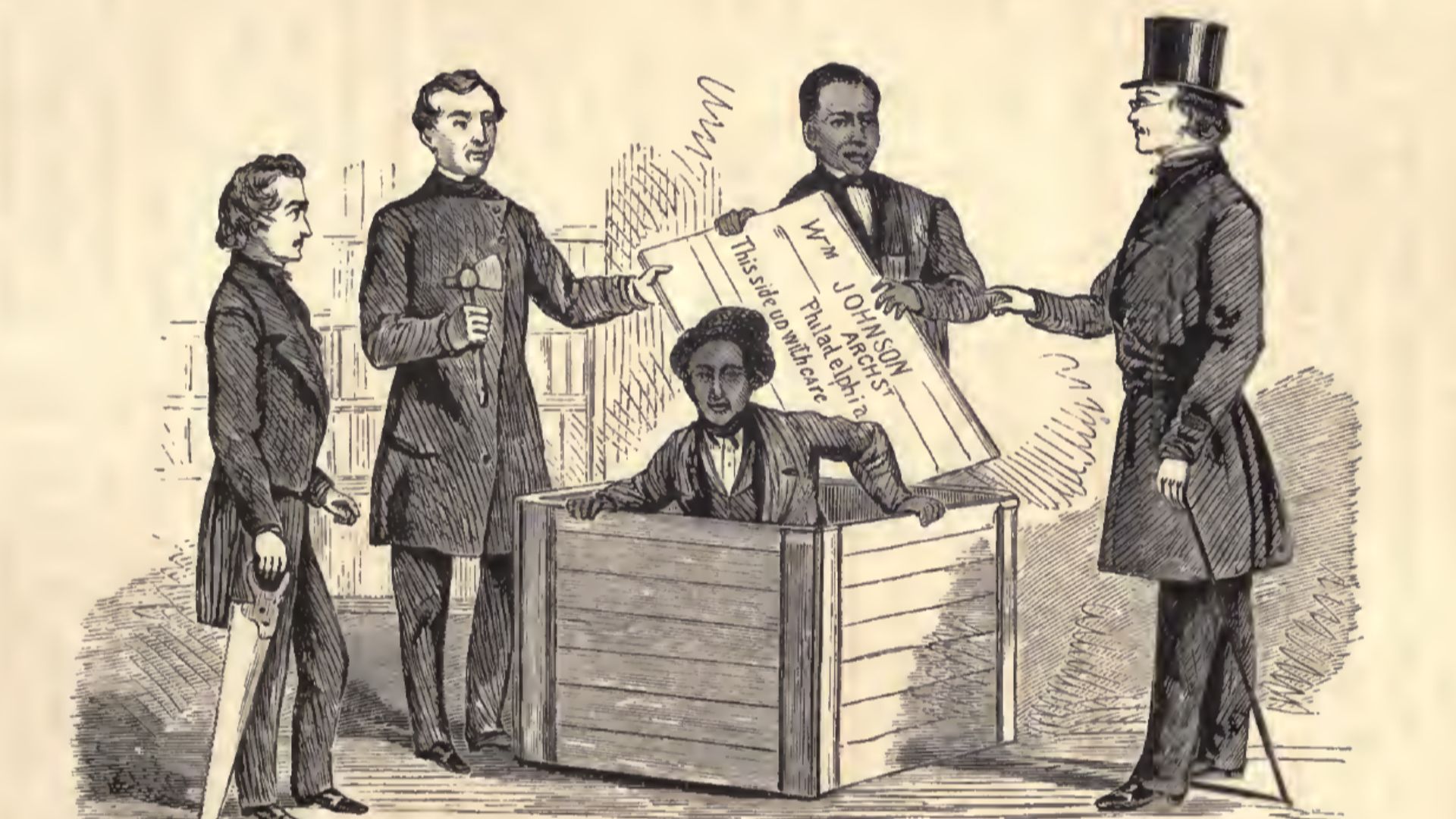
On March 29, 1849, a wooden crate was loaded onto a train in Richmond, Virginia. The crate was three feet one inch long, two feet wide, and two feet six inches deep. It was addressed to a Philadelphia abolitionist named James Miller McKim and marked with instructions to keep it upright. Inside was a man named Henry Brown, who had packed himself with a small bladder of water, a few biscuits, and a tool to bore holes for air, and who had paid a white shoe merchant named Samuel Alexander Smith $86 to arrange his shipment north.
Henry Brown was born around 1815 in Louisa County, Virginia, and had spent his entire life enslaved on a tobacco plantation. The specific act that pushed him toward the crate was watching his wife and three children sold to a plantation owner in North Carolina in 1848, marched away in a coffle while Brown stood on the street unable to intervene. He later wrote in his 1851 autobiography, Narrative of the Life of Henry Box Brown, that the sight broke something in him permanently, and from that moment he began working out how to leave.
The Box Itself
The crate was built to Brown's specifications and lined with coarse woolen cloth. He drilled a small hole in one side for air, though the opening was barely adequate for a journey of any length. The dimensions were calculated not for comfort but for the smallest possible package that could contain a human being in a folded position, because freight rates were charged by size and every inch mattered when the goal was avoiding detection. Brown was a large man, and the fit was by all contemporary accounts extremely tight.
Samuel Alexander Smith coordinated the shipment through the Adams Express Company, one of the major commercial freight carriers of the era. Smith had help from James Caesar Anthony Smith, a free Black man and conductor at a local tobacco factory who had been part of planning the escape from the beginning. The crate was addressed to the Philadelphia Anti-Slavery Society office where McKim would be waiting. Brown had no say in any of the logistics once the lid was nailed shut.
The plan was audacious in ways that become clearer the longer you look at it. Adams Express operated on schedules and transferred cargo between trains, wagons, and steamboats using workers at every junction who could have opened, dropped, or inspected the crate at any point. Brown had given himself over entirely to a freight system that had no idea he was inside it, and there was nothing he could do except stay still and breathe through a hole the width of two fingers.
Twenty-Seven Hours In The Dark
The journey from Richmond to Philadelphia covered roughly 350 miles and took 27 hours. For portions of the trip, Brown was transported with the label face down, meaning he spent stretches of time completely inverted, with blood pooling in his head. He later described those stretches as a sensation where he felt his eyes were about to burst from the pressure. He managed to shift himself once by pressing against the walls of the crate, though any significant movement risked making noise that could draw attention at a transfer point.
At one juncture during the journey, two men sat on the crate while waiting for a connection. Brown stayed motionless. The route included wagon segments, multiple rail sections, and a leg by steamboat along the Potomac River, with each handoff representing another moment where the crate could have been opened, misrouted, or simply left somewhere without ventilation for hours.
He arrived at the Anti-Slavery Society office in Philadelphia on the morning of March 30, 1849. McKim, along with several colleagues including William Still, who documented the escape in meticulous detail in his 1872 book The Underground Railroad, was present when the crate was opened. Brown sat up, said he had been traveling long enough, and then sang a psalm he had chosen before the journey began as the first thing he would do upon arriving free.
The Life He Built After The Box
Brown became a celebrated figure on the abolitionist lecture circuit almost immediately. He adopted the middle name Box as a permanent record of what he had done, and his story spread through newspapers and anti-slavery meetings across the North. He commissioned a massive painted panorama called the Mirror of Slavery, a series of large moving panels illustrating the brutality of the institution, which he toured through the United States before taking it to England in 1850.
He spent most of the following decades in England, performing and lecturing to audiences who were drawn to both his story and his considerable showmanship. Samuel Alexander Smith, the man who had shipped him, was arrested shortly after Brown's escape when he attempted to mail two other enslaved people north using the same method, and served several years in prison. Brown understood the power of the crate as symbol and regularly staged re-enactments of his emergence from the box as part of his performances.
He died around 1897, the exact date unrecorded, having spent nearly five decades as a free man after 33 years enslaved. The box was three feet long, lined with wool, and drilled through once for air. What came out of it outlasted almost everyone who witnessed it.
KEEP ON READING
Why the Titanic Didn’t Have Enough Lifeboats
Willy Stöwer on WikimediaThe Titanic disaster is often remembered as…
By Emilie Richardson-Dupuis May 21, 2026
20 Facts About The Animals We Sent To Space
We Thank Them For Their Service. Before astronauts became household…
By Breanna Schnurr May 21, 2026
The Man Who Mailed Himself Out of Slavery
William Still /On March 29, 1849, a wooden crate was…
By Cameron Dick May 21, 2026
The Long History Of "Familiars," The Witch's Animal Companion
kevin turcios on UnsplashA witch with a black cat is…
By Breanna Schnurr May 21, 2026
The Ghoulish Secret King Louis XIV Was Hiding
Hyacinthe Rigaud on WikimediaKing Louis XIV of France is famously…
By Sara Springsteen May 21, 2026
20 Historical Figures Who Passed In Unfortunately Embarrassing Ways
When Destiny Lacks Dignity. History books love to remember world…
By Sara Springsteen May 21, 2026