

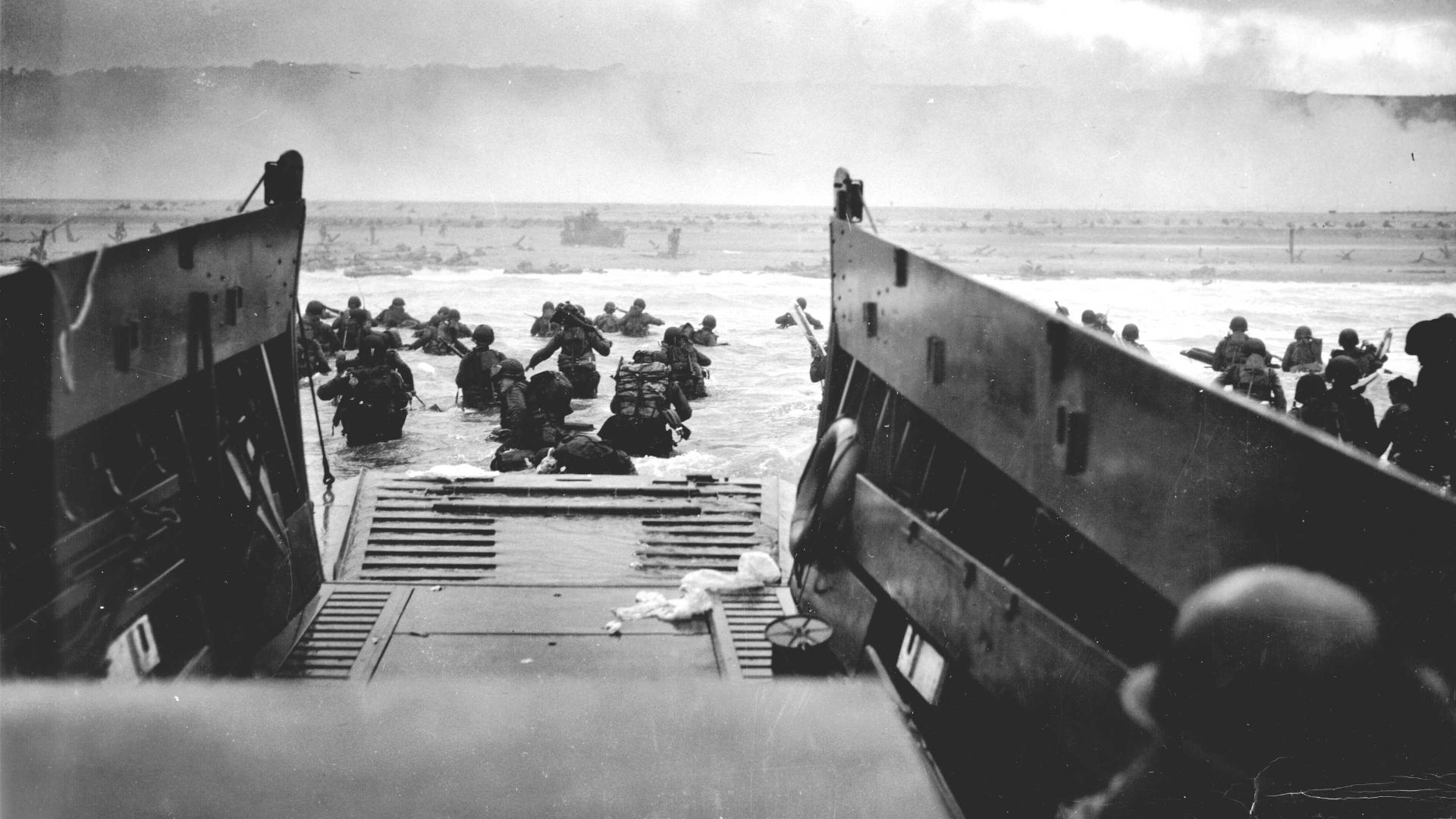
 Chief Photographer's Mate (CPHOM) Robert F. Sargent, U.S. Coast Guard on Wikimedia
On the evening of June 4, 1944, Group Captain James Martin Stagg walked into a room at Southwick House, the Allied command headquarters near Portsmouth, and told General Dwight Eisenhower something nobody wanted to hear: the weather was wrong and it was going to get worse. The invasion had been set for June 5. Thousands of ships were already at sea. More than 150,000 men were staged and waiting. Postponing could expose the entire plan. Stagg made his case anyway.
Eisenhower postponed. Then, just hours later, Stagg came back with news that changed everything: there would be a narrow break in the storms, brief enough to miss on the wrong day, just long enough to launch the largest seaborne invasion in history. Eisenhower gave the order for June 6. What followed was not only the turning point of World War II but one of the most consequential acts of meteorology ever performed.
The Window Nobody Could Guarantee
Stagg was a Scottish geophysicist appointed chief meteorologist to the Supreme Headquarters Allied Expeditionary Force in November 1943. Described by contemporaries as dour but meticulous, he understood that the honest answer was often the most dangerous one to give a general. His job was to synthesize forecasts from three separate meteorological teams in different locations across England, a deliberately redundant arrangement in case one site was bombed.
The three teams did not agree. The British forecasters, including Norwegian meteorologist Sverre Petterssen, analyzed surface pressure maps and predicted a violent Atlantic storm sweeping through the Channel on June 5, with conditions unlikely to improve before the next tidal window roughly two weeks away. The American team, led by Colonel Irving Krick, used pattern-matching against historical weather analogs to argue the June 5 date was viable. The two schools were genuinely opposed, and Stagg sat between them.
The operation required a specific combination of conditions. Eisenhower needed a full moon for parachute drops the night before, low tide at dawn so landing craft could see and avoid mined beach obstacles, light winds, minimal cloud cover for aerial bombardment, and calm enough seas that men could reach shore. In June 1944, the moon and tide aligned on June 5, 6, and 7. After that, any delay forced a two-week wait, with all the secrecy risks that implied.
The Forecast That Tilted The War
On June 3, weather observers on the coast of County Mayo in western Ireland, positioned at the edge of the Atlantic, reported worsening conditions moving in from the west. The observations confirmed what the British team had feared. Stagg presented the forecast to Eisenhower on June 4, recommending postponement. The invasion was put back one day as an interim measure, and June 5 was exactly as predicted: lashing rain, high winds, seas too rough for an amphibious assault.
Then, late on June 4, Stagg spotted something in the data. A transient ridge of high pressure was moving in behind the storm system. It would be brief and imperfect. In his assessment to Eisenhower that evening, Stagg said conditions on June 6 would be workable, not ideal, but sufficient. Eisenhower asked each of his senior commanders in turn. Then he gave the order.
Conditions on June 6 were still far from comfortable. Rough seas made the crossing punishing and brought the tide in faster than anticipated, complicating navigation around the beach obstacles. The air and naval support could function. Troops could reach the shore.
Across the Channel, the German command drew the opposite conclusion. The Luftwaffe's chief meteorologist predicted rough weather persisting until at least mid-June. Field Marshal Erwin Rommel, responsible for defending the Atlantic Wall, left France on June 5 to travel to Germany for his wife's birthday and a meeting with Hitler. Many German officers abandoned coastal posts for a war games exercise in Rennes. When the Allied forces landed, the German high command was scattered and unprepared.
What Would Have Happened Instead
The stakes of Stagg's forecast come into focus when you look at what happened two weeks later. On June 19, the worst storm the English Channel had seen in decades struck the Normandy coast. It destroyed the American Mulberry artificial harbour at Omaha Beach, wrecking the portable concrete infrastructure designed to supply the invasion force before a permanent port could be captured. The British Mulberry at Arromanches was severely damaged but survived. That June 19 storm would have fallen directly on the two-week delay window, and a postponed D-Day would have met the worst Channel conditions in a generation at the moment of crossing.
Stagg noted in his official report to Eisenhower that had the invasion been delayed to the next suitable tides, the troops would have met the worst Channel weather in 20 years. Eisenhower sent a handwritten reply: "Stagg. Thanks. And thank the gods of war we went when we did."
There were no satellites in 1944, no radar imagery, no numerical weather models. The forecast Stagg presented on June 4 was built from surface pressure charts, hand-drawn isobars, and readings from ships, land stations, and lighthouse keepers on the Mayo coast doing hourly observations they had been given no explanation for. The brief window he identified was real. The catastrophe waiting two weeks later was real too.
KEEP ON READING
20 Historical Figures Who Died Of A Broken Heart
Grief Became Too Much. The phrase “died of a broken…
By Annie Byrd Jun 9, 2026
The Weather Forecast That Decided D-Day
Chief Photographer's Mate (CPHOM) Robert F. Sargent, U.S. Coast Guard…
By Cameron Dick Jun 9, 2026
10 Civilizations Built On Rivers & 10 That Vanished Into…
Where Water Meant Survival. For most of human history, rivers…
By Rob Shapiro Jun 9, 2026
20 Historical Figures Who Were the Ultimate Cheapskates
When Wealth Didn't Mean Spending. History is packed with powerful…
By Sara Springsteen Jun 8, 2026
20 Deaths That Changed Who Got The Throne
One Funeral Could Rewrite a Dynasty. Royal succession can look…
By Emilie Richardson-Dupuis Jun 8, 2026
20 Historical Figures Who Did Terrible Things To Their Children
Family Drama . History often remembers famous figures for their victories,…
By Annie Byrd Jun 8, 2026