
 Unknown authorUnknown author on Wikimedia
Around twenty thousand people gathered on Atlantic City's Steel Pier in the summer of 1930 to stare at a man on a flagpole 225 feet above them. His name was Alvin Kelly and everyone called him Shipwreck. He stayed there for 49 days and one hour, a run of 1,177 hours. He shaved and smoked while reporters on the boardwalk below shouted questions up at him.
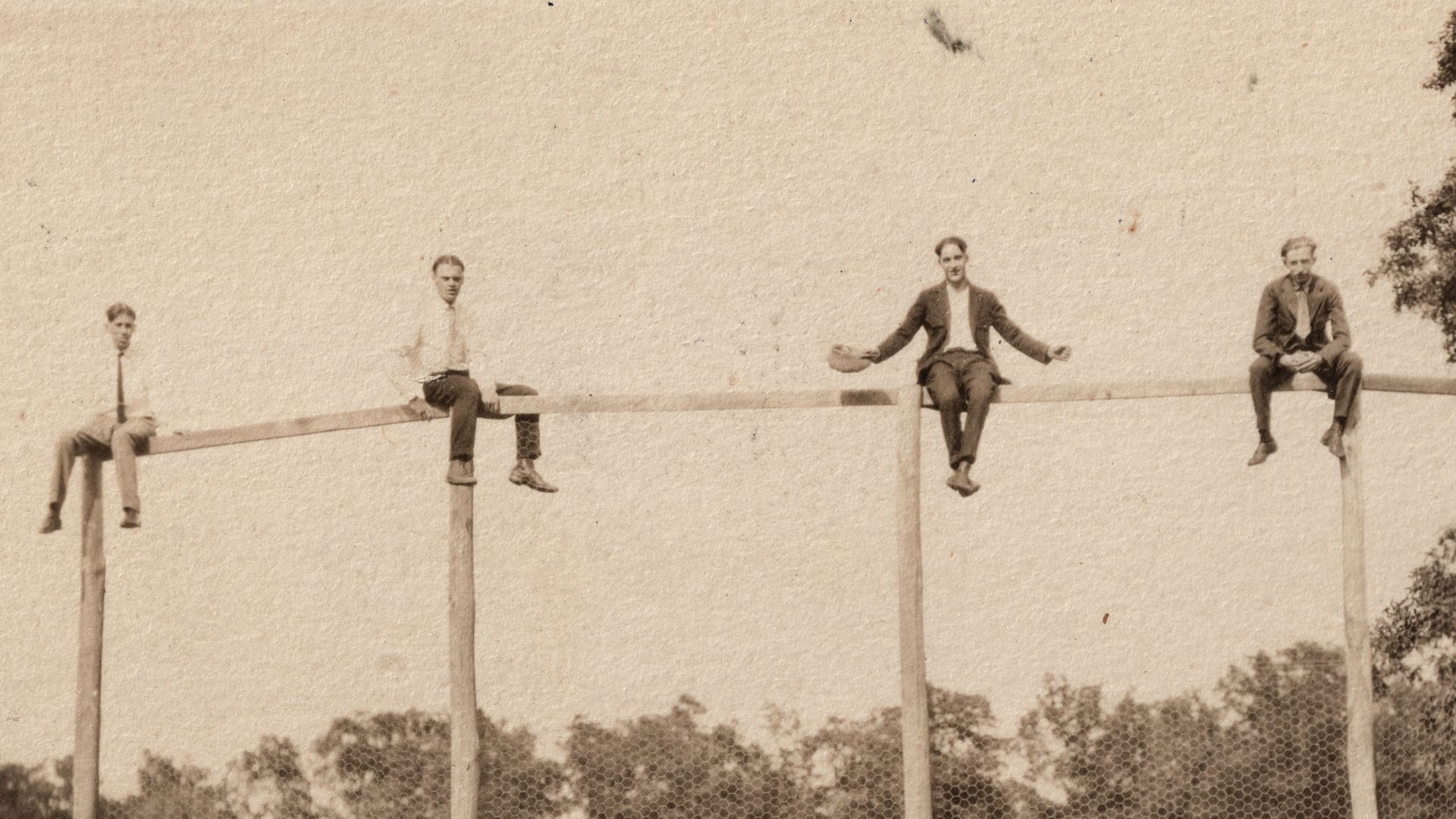
Pole sitting might look like one of the stranger ways people entertained themselves in the 1920s, but it was also a form of advertising. Theaters and department stores paid people to perch high above the street because the spectacle drew crowds in ways ordinary signs couldn't. The craze faded when the businesses paying for all that attention could no longer afford it.
The Pole Came With A Price List
Kelly's first sit lasted 13 hours and 13 minutes in 1924, and the accounts of how he got up there disagree. One version credits a friend's dare, another a Hollywood theater manager who wanted a crowd for a new picture. Kelly handled his own publicity. He also claimed to have survived the Titanic, a story that supplied the nickname and convinced almost nobody.
Kelly kept breaking his own records, spending seven days on a pole in St. Louis in 1926, then twelve days in Newark the following year. He went on to last 22 days above a Madison Square Garden dance marathon and 23 days on a 60-foot pole in Baltimore. Each new record made him more valuable to promoters, and at his peak, he was reportedly earning the modern equivalent of thousands of dollars a day.
A profitable trade attracts rivals, and Kelly got them. Bobbie Mack went up for three weeks, and Bill Penfield sat fifty-one days and twenty hours at Strawberry Point, Iowa, before a thunderstorm forced him down. The era's longest documented sit belongs to Penfield, not to the man who got famous for it. A Miami Herald reporter had already dismissed the trade in 1927 as "about the laziest occupation known to man."
How A Person Stays Up For Seven Weeks
Sleeping on top of a pole required some clever adjustments. Kelly used a narrow platform attached to the top, along with rope stirrups that supported his weight while he rested. He also tied his legs to the pole to keep himself from falling asleep and slipping off. A specially rigged tube allowed him to use the bathroom without climbing down.
His cleverest trick, by his own telling, was a pair of holes bored into the shaft, each the size of a bowling ball's finger hole. He slept with his thumbs hooked inside them. Swaying too far sent a twinge through the thumb that righted his posture before it woke him, and allowed short naps without the slackness of real sleep. Whether it worked that neatly cannot be checked now.
Kelly ate very little during his stunts, relying mostly on coffee and cigarettes. Asked how he passed the time, he said he "drank coffee and smoked cigarettes mostly." Drinks were hauled up by rope, and during one stunt, he even requested a telephone. He also shaved in full view of photographers, giving newspapers another picture of a man going about his daily routine high above the street.
The Summer The Children Took Over
Kelly's 1929 stunt in Baltimore inspired children to try pole sitting themselves. In just one week, the city counted 20 young sitters, including 17 boys and three girls, perched on backyard poles and garage roofs. One teenager, Avon "Azey" Foreman, claimed the junior championship after lasting ten days, ten hours, ten minutes, and ten seconds. The matching numbers made for a particularly good newspaper headline.
Grown Baltimore responded with civic pride rather than alarm. Mayor William F. Broening publicly congratulated Foreman and called the epidemic a display of the old pioneer spirit and the grit life demands. Cosmopolitan, less charmed, described the business as "competitive imbecility." William Ruppert, fourteen years old, spent twenty-three days on an eighteen-foot pole, a match for Kelly's Baltimore figure at a fraction of the height.
The 1929 stock market crash brought the pole-sitting craze to an end as businesses slashed their advertising budgets. Kelly tried to revive his act in the Bronx in 1935, but was arrested within a day for being a public nuisance. By his own count, he had spent 20,613 hours sitting on poles throughout his career. He died in 1952 on a New York sidewalk, carrying scrapbooks documenting his years of fame.
KEEP ON READING