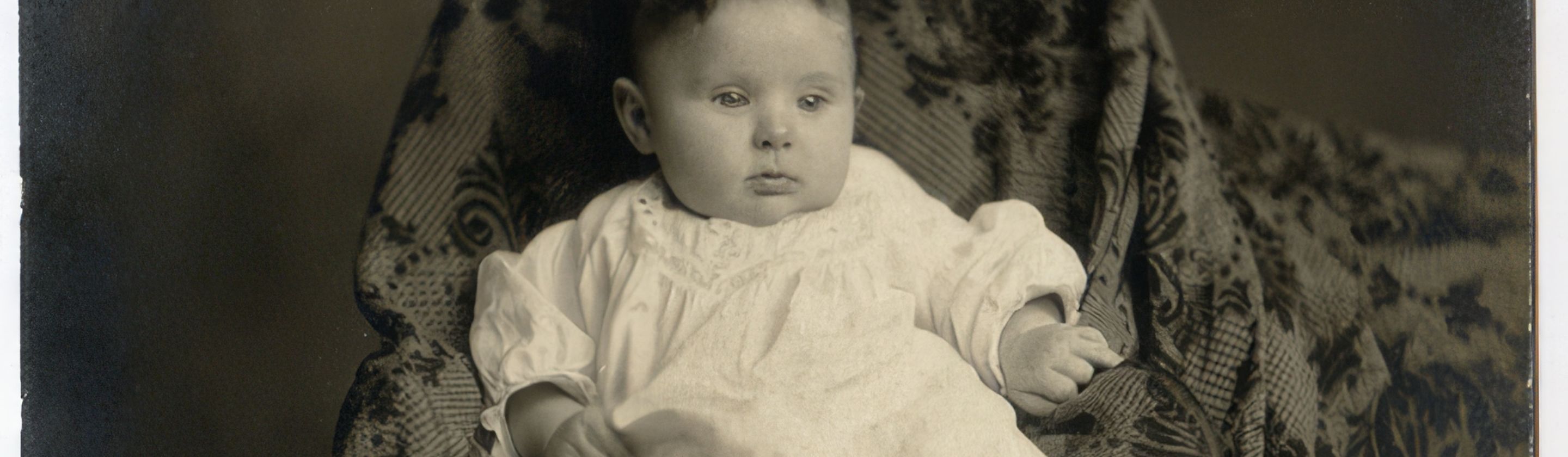
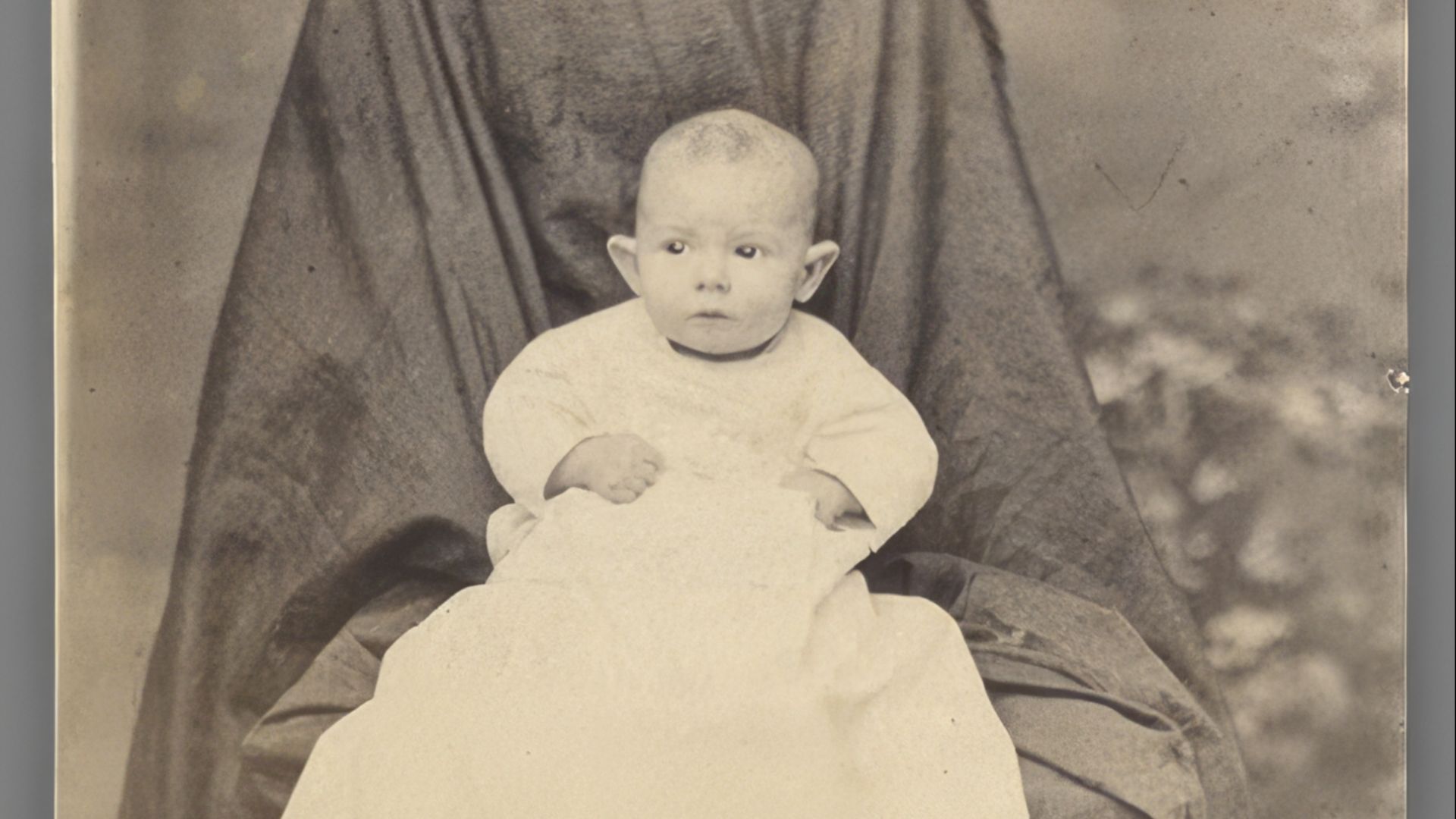
 Unknown Victorian Photography, Vincent Kelly on Wikimedia
A baby sits upright on what appears to be an upholstered chair, and the chair has a hand. Elsewhere in the frame there is a draped shape with the unmistakable slope of a shoulder under it, or a sleeve emerging from behind a curtain. The infant is sharp and whatever is holding the infant is a soft gray mass under a blanket.
These pictures circulate now under the name hidden mother photographs, and the name is a recent invention rather than a Victorian trade term. Both halves of it give the wrong impression. The figures were not reliably mothers, and most of them were not hidden with anything like real conviction.
Twenty To Sixty Seconds
Getting a portrait taken in the 1850s or 1860s meant holding still for 20 to 60 seconds, depending on the lighting and equipment. That was harder than it sounds, which is why studios used head braces and posing stands to keep customers steady. Early photographic plates were extremely slow to capture an image, especially skin tones, so photographers relied heavily on natural light. Even a slight movement could blur the picture, making a relaxed smile difficult to maintain.
Children were the hard case. The historian Robert Taft described the problem as one where "there could be no twenty second exposure". The remedy involved full light, the widest aperture available, candy, and the combined effort of the photographer and the whole family. Even then a toddler tended to come out blurred, which is why photographs of young children were scarce in the middle of the century.
To keep babies still, photographers often had an adult hold them during the exposure. The adult would hide beneath a blanket or behind a chair, acting as a human support while the camera captured the child. The arrangement wasn't meant to look mysterious. The photographer simply needed a clear picture of the baby, and nobody expected people 150 years later to be studying the photographs for signs of whoever was hiding underneath.
The Women Are Not Identified
None of the hidden adults have been identified. These were ordinary family portraits, and the people who bought them already knew who was under the blanket, so there was little reason to record their names. The museum holding Nagler's collection catalogs them as anonymous photographs. Over time, the pictures passed through estate sales and auctions, losing whatever family history might have explained who was hiding in them.
Some of them are not women at all. Fathers and nursemaids turn up among the shrouded shapes, as do studio assistants. The ones that are indisputably male still get filed under the same label. The word mother is doing work the pictures cannot support, which is part of why the genre reads as a comment on motherhood when it may be about whoever was standing nearby. One scholarly reading treats the supporting adult as a prop in the literal sense, a body present in order to be obscured.
The adults weren't always hidden particularly well because the goal was simply to keep attention on the child. A hand or the outline of a body might still show through the fabric, but that didn't necessarily matter to the customer. Photographers could also crop the image or use oval paper frames to conceal stray arms and shoulders. What mattered was getting a clear portrait of the baby, preferably one that appeared to be sitting alone.
A Genre Assembled After The Fact
The category was built retroactively, and mostly online. The Italian artist Linda Fregni Nagler started buying these images in 2006 after an eBay seller advertised one as a "Funny baby with hidden mother", and she went on to assemble roughly a thousand of them spanning the 1850s to the 1930s. The thousand-odd images run across daguerreotypes, tintypes, cartes de visite, and cabinet cards. The practice outlasted several generations of camera technology. Cataloging them is what produced the genre, rather than the genre producing the collection.
The other major collections arrived at the same material by different routes. The photographer Laura Larson came to the pictures through an interest in Victorian spirit photography and published a book on them in 2017. She also organized what the Guggenheim Foundation describes as the first American exhibition devoted to the subject. The collectors Lee Marks and John DePrez built a holding large enough that museums and writers borrow from it.
Modern viewers tend to read the shrouded figure as ghostly, and the pictures get recirculated as evidence of some Victorian preoccupation with death. A Victorian viewer may have read it the opposite way. With infant mortality high and posthumous portraits common, the publisher of Nagler's collection argues the visible supporting adult told the viewer the child was alive.
KEEP ON READING