
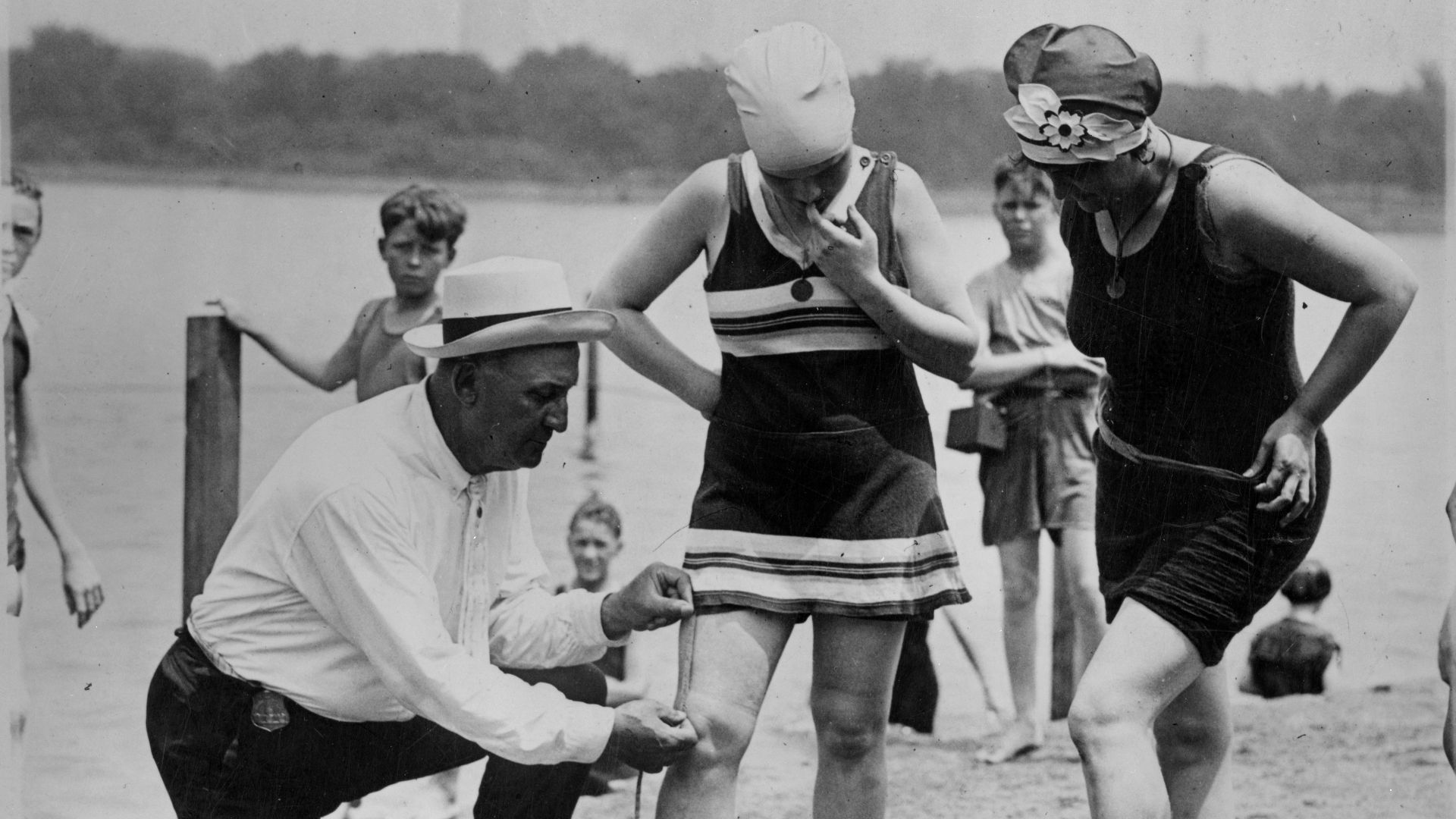
 National Photo Company Collection. on Wikimedia
There's a photograph from 1922 of a man in uniform crouched on the sand with a tape measure, holding it against a woman's bare leg. His name was Bill Norton and this was his appointed job. The beach was in Washington, and the order he enforced said a woman's bathing suit could not sit more than six inches above the knee. The catalog records his name. It doesn't record hers.
The picture circulates now as a curiosity. Rules like that one were ordinary across American beach towns for the better part of three decades. They were written into municipal code and backed by men with tape measures and the authority to make an arrest.
The Rule Was a Number
In Washington, the order came from the superintendent of public buildings and grounds. The Library of Congress still holds a photograph of Norton enforcing it, preserved in the National Photo Company collection. The rule specified an exact measurement, leaving little room for personal judgment. Nobody had to agree on what counted as decent. They only had to measure how far the hem fell above the knee.
Atlantic City landed on the same figure. In 1931 the city's public safety director announced that swim suits must not be shorter than six inches above the knee, and the same statement warned men that their trunks could not be too tight. That second clause rarely gets quoted. Codes frequently mentioned both sexes, and the surviving record suggests women were held to them a good deal more closely.
The measurement had no scientific basis; it was a compromise between how respectable resort towns wanted to appear and how much restriction visitors would tolerate. As attitudes changed, so did the rules. Earlier regulations had required swimsuits to cover the shoulders and reach the knees, with ordinary clothes worn again once swimmers left the water. Even in the 1890s, etiquette columns were warning readers against swimwear that attracted too much attention.
Where You Stood Mattered More
In Southern California the argument was about geography as much as fabric. Venice drew a boundary in 1915, and a bather in a suit could go no more than twenty feet inland from the high tide line. Santa Monica police were explicit that nobody was being arrested over the type of suit worn. What they wanted was beachwear kept on the beach, and a suit became a problem the moment it came into town.
A line drawn in sand is difficult to see. Signs went up and bathers were confused anyway, and one reporter pointed out that the boundary wasn't marked with a rope. Officers decided each case on the spot, leaving a great deal to whoever happened to be on duty that afternoon. The same outfit could be lawful or not depending on a few steps in either direction.
The arrests sound almost comic until you notice who kept turning up in them. A woman boarding a streetcar in her suit was let off with a reprimand, and so was a teenage boy who walked into a store. Groceries proved to be a step too far. A woman buying them in the business district, in a suit and a coat that stopped above her knees, was arrested for it.
How It Came Apart
Santa Monica made no bather arrests at all in 1918. The following July an officer arrested Alta Johnson while she was out buying bread for a beach picnic, and the reaction ran hot enough that the council repealed the ordinance. Local business had wanted it gone for years, since tourists were more or less the point of the town. Decency and the tourist trade had been pulling against each other the entire time.
The rest went the same way, unevenly and with no particular ceremony. Clergy pushed for strict enforcement while resort economies pushed back, and the resorts tended to win. By 1939 Hammond, Indiana had given up on suit rules altogether, saying it would specify no type at all provided bathers turned up dressed in some fashion. That last phrase was doing a lot of work.
One part of the standard story doesn't hold up. Accounts of beach policing usually open with Annette Kellerman, the Australian swimmer said to have been arrested at a Boston beach in 1907 for wearing a one-piece. The archive that holds her suit calls the arrest a myth and notes that no evidence supports it. Her effect on what women swam in was real and is well documented. The arrest she's remembered for seems never to have happened.
KEEP ON READING