 Dr. Lee Lowery, Jr., P.E. on Wikimedia
On July 17, 1981, the Hyatt Regency Hotel in Kansas City, Missouri, became the site of one of the deadliest structural failures in American history. Two suspended walkways crashed down onto a crowded lobby during a weekly tea dance, and the disaster claimed 114 lives while injuring more than 200 others. It's the kind of tragedy that still unsettles you once you understand how it happened, because the cause wasn't some freak accident; it traced back to a single, poorly reviewed change made months before the hotel opened its doors.
What makes this collapse so haunting is how ordinary the evening had been up until that moment. Guests were dancing, watching from above, and enjoying a summer night out when the fourth-floor walkway gave way without warning, dropping onto the second-floor walkway beneath it. Both structures then crashed onto the packed atrium floor below, and you can imagine how quickly a festive gathering turned into a scene of chaos and devastation. The events that followed would reshape how engineers in the United States review and approve their own work.
The Design Flaw That Started It All
The original plans for the Hyatt's atrium called for a single continuous rod system, with steel rods running from the ceiling through the fourth-floor walkway and continuing down to anchor the second-floor walkway beneath it. Under that design, each walkway would have carried only its own weight, and the connection points would have faced a load they were actually built to handle. It's a straightforward setup on paper, but it turned out to be difficult to execute in practice, since threading a single rod through two separate levels of box beams presented real construction challenges.
Havens Steel Company, the fabricator responsible for the atrium's steel, proposed a change to make the job easier. Instead of one continuous rod, the company suggested using two separate rods: one running from the ceiling to the fourth-floor walkway, and a second connecting the fourth-floor walkway down to the second-floor walkway. On the surface, this seemed like a minor adjustment that wouldn't affect the building's safety, and the structural engineer of record reportedly gave verbal approval over the phone before a formal written request was ever submitted.
That seemingly small switch had massive consequences that nobody caught in time. The new configuration meant the nut and washer connecting the fourth-floor box beam now had to support the combined weight of both walkways rather than just its own, effectively doubling the load on that single connection point. Investigators later determined that even the original single-rod design would have barely met the required safety margins, so doubling the stress on an already marginal connection made failure almost inevitable once the walkways carried a full crowd.
How the Collapse Unfolded
By the evening of July 17, 1981, roughly 2,000 people had packed into the hotel's atrium for the tea dance, a popular recurring event that drew locals from around the city. Some guests danced on the lobby floor while others gathered on the elevated walkways to watch the festivities from above, unaware that the connections holding those walkways in place had been under constant strain since construction.
Then, the inevitable happened. Shortly after seven that evening, witnesses reported hearing loud popping sounds moments before the structure gave way.
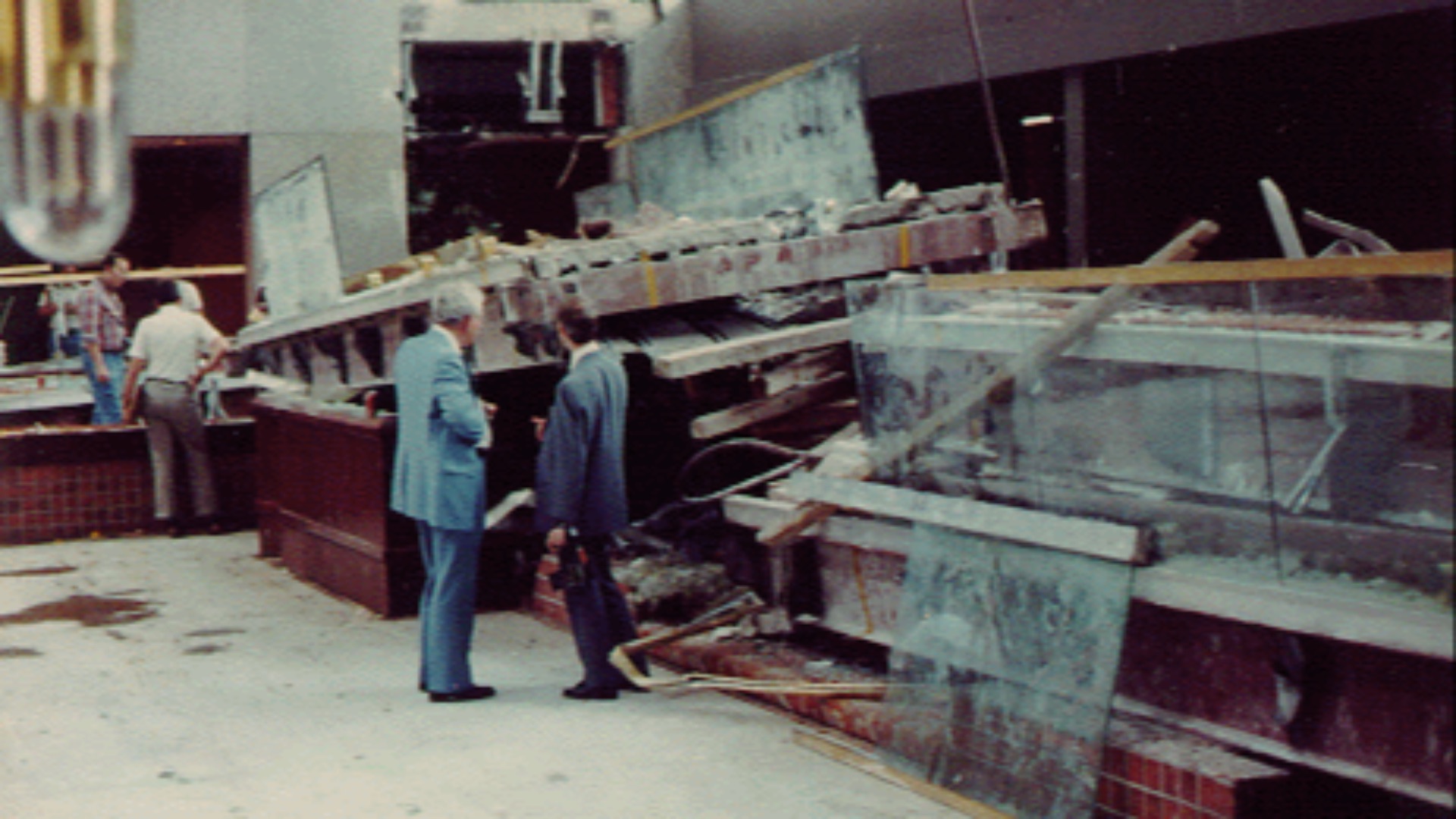
The fourth-floor walkway separated from its ceiling rods first, and its full weight dropped directly onto the second-floor walkway positioned beneath it. Neither structure could withstand the sudden impact, and both plunged to the lobby floor where dozens of partygoers were dancing and mingling below. The offset third-floor walkway remained intact throughout the disaster, since it wasn't stacked above the other two and therefore bore none of the falling weight.
First responders from across Kansas City arrived quickly and began a rescue effort that would stretch on for roughly 14 hours. Rescuers worked to free survivors trapped beneath tons of concrete and steel debris while setting up triage centers to treat the wounded as they were pulled from the wreckage. More than 30 bodies were found crushed under the giant slabs, and though a total of 29 people were rescued alive from the scattered rubble, the final death toll would ultimately reach 114.
The Aftermath and Lasting Impact
In the wake of the tragedy, investigators from the National Institute of Standards and Technology launched a thorough examination to determine exactly what had gone wrong. Their findings confirmed that the shift from a single-rod to a double-rod system was the direct cause of the failure, and they noted that this change had never been properly recalculated or verified before construction moved forward. The engineering firm responsible for the original design, along with its principal engineers, faced intense scrutiny once these findings became public.
The consequences for those involved were severe, even though criminal charges never materialized. A federal grand jury declined to indict the engineers, citing insufficient evidence, but the Missouri Board of Architects, Professional Engineers and Land Surveyors revoked the licenses of both Jack D. Gillum and Daniel M. Duncan, the engineers of record on the project. The hotel's owner also paid out $140 million in damages to victims and their families, a settlement that reflected the sheer scale of loss the community had endured.
Beyond the legal fallout, the disaster fundamentally changed how engineers in the United States approach shop drawing reviews and design oversight. Before 1981, it was common practice for engineers to delegate detailed fabrication decisions to contractors, only checking submissions for general conformance rather than verifying every calculation themselves. That approach changed dramatically afterward, and civil engineering programs still teach the Hyatt Regency collapse today as a cautionary example of what can happen when a seemingly small revision moves through too many hands without anyone verifying the numbers.
The Hyatt Regency walkway collapse remains a sobering reminder of how much responsibility rests on the shoulders of engineers and the systems meant to check their work. A single change altered the trajectory of hundreds of lives, and the ripple effects of that decision are still felt in how structural engineering is practiced today. What happened in Kansas City that summer evening was a preventable failure born from a breakdown in communication and oversight. Four decades later, the collapse continues to serve as one of the most cited case studies in engineering ethics, standing as proof that even the smallest unchecked detail can carry devastating weight.
KEEP ON READING