

My Granddaughter Begged Me to Let Her Change Her Name—When I Found Out Why, I Uncovered a Family Secret That Changed Everything
My Granddaughter Begged Me to Let Her Change Her Name—When I Found Out Why, I Uncovered a Family Secret That Changed Everything
The Afternoon Everything Changed
It was a Tuesday afternoon when Lily showed up at my door, mascara streaked down her cheeks like someone had painted grief across her face. She was clutching her backpack straps so tight her knuckles had gone white, and when I pulled her inside, she just collapsed into me the way she used to when she was small. I didn't ask questions right away—I just held her and let her sob into my cardigan while I stroked her hair. When she finally pulled back, her voice came out all choked and desperate: 'Grandma, I need to change my name. Please. I can't keep it anymore.' I remember my heart just dropping because this wasn't about hating her middle name or wanting something prettier. This was raw panic. She kept saying the kids at school had found something online about her dad, about Daniel, and now everyone knew. She wouldn't look at me when she said it, just stared at her shoes like they held all the answers she couldn't give me. I asked her what they found, but she just shook her head and started crying again. As I held her trembling hands, I realized I had no idea what those children had found—or if I wanted to know.
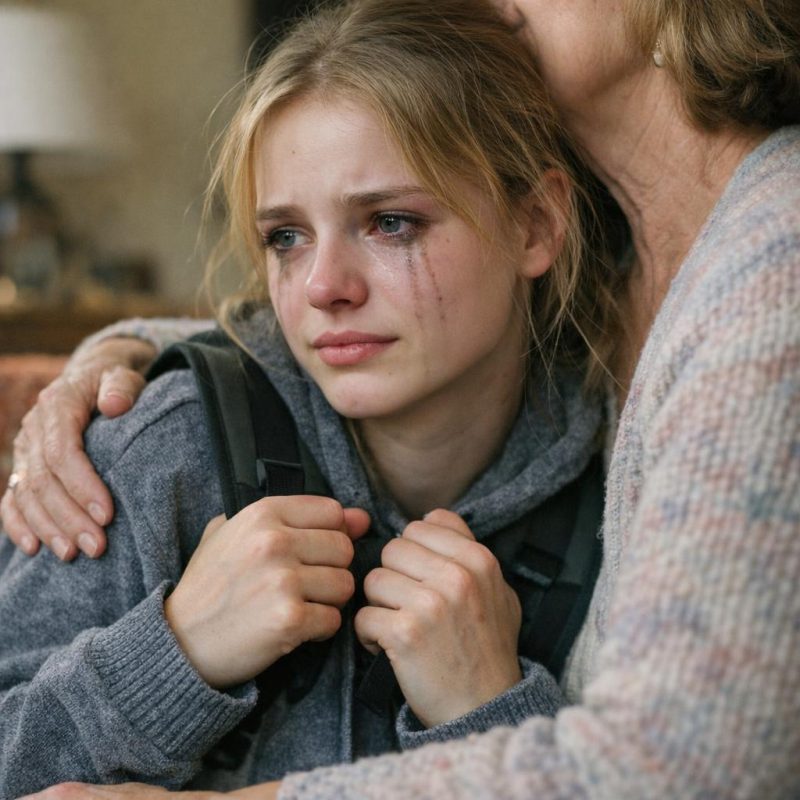 Image by RM AI
A Name's Weight
I made her chamomile tea and we sat at the kitchen table, the one Harold built thirty years ago, and I tried to piece together what was happening. Lily wrapped both hands around the mug like she was trying to draw warmth from it, but she was still shaking. 'It's not fair,' she kept saying. 'I didn't do anything. Why should I have to carry his name?' I wanted to defend Daniel, wanted to say he'd made mistakes but he'd changed, that people deserved second chances. But looking at her face, I couldn't find the words. She'd always been such a bright kid, my Lily, full of music and laughter, and now she looked hollowed out. When I suggested maybe things would blow over, she just looked at me with these ancient, tired eyes that didn't belong on a fourteen-year-old. 'You don't understand, Grandma,' she said quietly. 'Everyone knows now. They're calling me names. They won't sit with me at lunch.' My chest felt tight, that protective grandmother instinct kicking in hard. Lily whispered that she couldn't even say his name anymore, and I felt something cold settle in my chest.
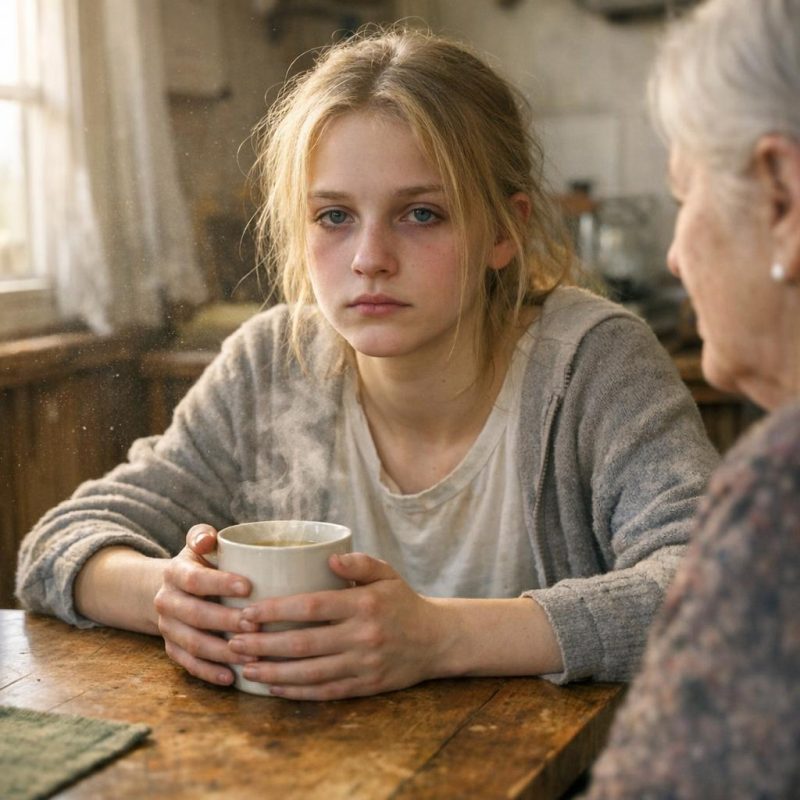 Image by RM AI
The Distance Between Father and Daughter
After Lily left—her mother picked her up around seven—I sat in the living room thinking about Daniel and his relationship with his daughter. Or lack of one, really. He'd always kept his distance, seeing her maybe once every few months, brief visits that felt more like obligations than joy. When I'd ask him about it over the years, he'd give me that sad smile and say he wanted to protect her, that it was better if he wasn't too involved in her life. At the time, it seemed noble in a heartbreaking way, like he was making some kind of sacrifice. He'd had troubles in his past, made poor choices in his twenties, and I'd thought maybe he just didn't want to drag her down with his baggage. Harold used to get so frustrated with him about it before he passed, but I'd always defended Daniel's choice. 'He's trying to do right by her,' I'd say. 'He doesn't want to burden her with his mistakes.' Now, sitting there in the dim lamplight with the house so quiet it echoed, those explanations felt thinner somehow. I had accepted his reasoning for years, but now I wondered if I had been too willing to believe him.
 Image by RM AI
The Search Begins
That night, I couldn't sleep. I kept seeing Lily's face, that desperate look when she begged me to help her shed her father's name like it was a poisoned coat. Around midnight, I got up and went to the study, turned on the old desktop computer Harold had bought years ago that I barely knew how to use. My hands felt clumsy on the keyboard as I typed Daniel's full name into the search bar, something I hadn't done in probably a decade. Why would I? He was my son. I knew his story—or thought I did. The page loaded slowly, and I sat there in the blue glow of the monitor, my reading glasses sliding down my nose. Links started appearing, more than I expected. News articles from twenty years back, forum discussions, even a few blog posts with his photo. My mouth went dry as I scrolled, seeing headlines that used words like 'scheme' and 'victims' and 'fraud.' I clicked on the first article, my heart pounding so hard I could feel it in my throat. The screen filled with results—old articles, message boards, news clips—and my hands went still on the keyboard.
 Image by RM AI
Rachel's Silence
The next morning, I called Rachel before I could talk myself out of it. She picked up on the fourth ring, her voice cautious the moment she heard it was me. 'Evelyn, hi,' she said, and I could hear traffic in the background. I asked her straight out what had happened at school, what the kids had found, what was going on with Daniel that I didn't know about. The silence stretched so long I thought she'd hung up. 'Rachel?' I pressed. 'Lily came to me in tears. She wants to change her name. I need to understand what's happening.' Rachel sighed, one of those heavy, exhausted sounds. 'It's complicated, Evelyn. It's old history. Kids just... they found some stuff online and they're being cruel about it.' But she wouldn't give me details, kept deflecting every question I asked. I could hear the discomfort in her voice, the way she kept trying to change the subject or minimize what Lily was going through. It only made me more determined to get to the bottom of this. Before hanging up, Rachel said something that stayed with me: 'Some things are better left alone, Evelyn.'
 Image by RM AI
Twenty Years Ago
I spent the next two days reading everything I could find online about what happened twenty years ago. The articles painted a picture of a financial scheme that had hurt several families in our community, people losing their savings, their homes in some cases. The details were vague, deliberately so it seemed, but Daniel's name kept appearing—always as someone involved, always painted as guilty, always described as having taken advantage of people's trust. What struck me most was how one-sided it all felt. There were accusations, testimonies from people who'd lost money, angry quotes about betrayal. But there was no trial coverage, no statements from Daniel's side, no resolution to any of it. The articles just... stopped. Like everyone had moved on or forgotten about it, except the internet never forgets anything. I kept searching for follow-up pieces, for something that would explain what actually happened or how it ended, but found nothing. Just these frozen moments of accusation preserved forever online for Lily's classmates to discover. Daniel's name appeared again and again, but there was something odd about the reporting—no resolution, no follow-up, just accusations.
 Image by RM AI
The Phone Call
I called Daniel on Thursday evening. My hand shook as I dialed, which annoyed me—this was my son, for God's sake, and I just wanted the truth. He answered cheerfully enough until I told him what I'd been reading, what Lily was going through at school. Then his whole tone changed, went flat and defensive. 'Mom, that's ancient history,' he said. 'I can't believe people are still digging that up. It's been two decades.' I asked him directly if he'd done what they said, if he'd really hurt all those people. The pause that followed felt like it lasted an hour. 'It was complicated,' he finally said, which wasn't an answer at all. 'Look, it's in the past. Lily doesn't need to get dragged into it. I'll talk to Rachel about handling the school situation.' But I wasn't letting him off that easy. 'Your daughter wants to erase your name from her identity, Daniel. That's not just a school situation.' I heard him exhale, sharp and frustrated. He said it was all in the past and Lily didn't need to get dragged into it, but then he went quiet in a way that made my stomach drop.
 Image by RM AI
Harold's Memory
That night, I couldn't stop thinking about Harold. He'd been gone five years now, and I still reached for him in moments like these, when I needed his steady presence and clear moral compass. Harold had always been the one who could cut through family drama and see things plainly, who'd call us all out when we were being foolish or dishonest with ourselves. When Daniel's troubles first surfaced twenty years ago, Harold had been so disappointed. I remembered him pacing in this very living room, his face tight with frustration and hurt. They'd had terrible arguments back then, father and son barely speaking for months. Harold had wanted Daniel to face whatever he'd done head-on, to make it right somehow, but Daniel had insisted there was nothing to make right. Eventually, they'd reached some kind of truce, though things were never quite the same between them. Harold had taken that disappointment to his grave, I'd always thought. But now, sitting with everything I'd learned, everything Rachel wouldn't say and Daniel wouldn't explain, a new thought crept in. Harold had been so disappointed in Daniel back then, I remembered, but now I wondered if there was more to the story.
 Image by RM AI
The Decision to Dig Deeper
I sat at my kitchen table the next morning with a cup of coffee that had gone cold hours ago. Harold's old address book was open in front of me, the pages yellowed and soft from use, his handwriting still so familiar it made my chest ache. I'd told myself I was just going to flip through it, maybe find one or two people to call, but now I had a whole list started on a legal pad. Names I hadn't thought about in years—neighbors from our old street, people from church, Daniel's old boss at the hardware store. These were doors I'd kept firmly closed since Harold died, partly because talking to them hurt too much, and partly because, honestly, I'd been happy to let the past stay buried. But Lily's face kept appearing in my mind—the way she'd looked when she asked about changing her name, the quiet desperation in her voice. I owed her more than my comfortable ignorance. I owed her the truth, whatever that turned out to be. I picked up my pen and added three more names to the list, people who'd been around during those months when Daniel's scandal had first broken. I made a list of names—people who had been around back then—and realized I was about to open doors I'd kept closed for decades.
 Image by RM AI
Lily's Pain
Lily showed up at my door three days later without calling first, and I could tell immediately that something had happened. Her eyes were red, and she had that hollow look kids get when they've been crying but are trying to hold it together. We sat on the porch with lemonade, and she told me about school—how a teacher had made a comment about 'integrity in families' during a lesson, how the other kids had stared at her, how someone had written 'thief's daughter' on her locker. Her voice was so small when she spoke, so defeated, and I wanted to gather her up the way I had when she was little and tell her everything would be fine. But she was fourteen now, old enough to know when adults were lying to make her feel better. 'Grandma,' she said, looking down at her hands, 'is my dad a bad person? Like, really bad?' I opened my mouth to defend Daniel, to say of course not, to explain that people make mistakes and the past was complicated. But the words stuck in my throat. Because honestly, I didn't know anymore. I'd spent twenty years accepting his story without question, and now I was realizing I'd never actually heard the full truth. She asked me if her father was a bad person, and I couldn't answer as easily as I thought I would.
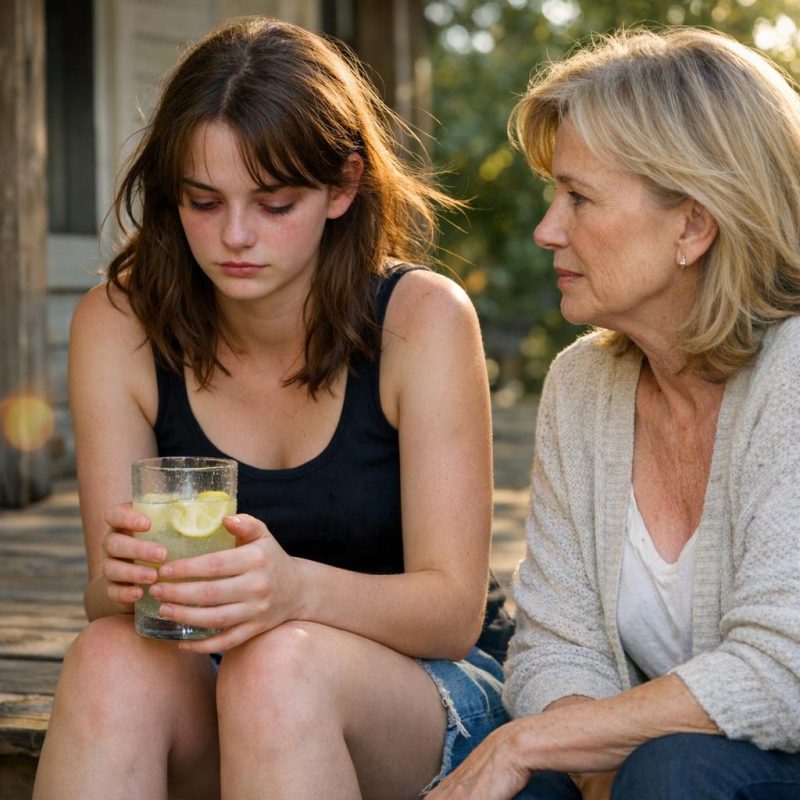 Image by RM AI
The First Dead End
I started making calls that week, working through my list with what I thought was a straightforward approach. Just wanted to catch up, I'd say, and maybe talk about the old days. But people were strange about it. Mrs. Henderson from down the street claimed she didn't remember any scandal at all, which was ridiculous because she'd been the biggest gossip in the neighborhood. Tom Garrett, who'd been on the church board, suddenly had a bad connection and had to go. Linda Morrison said she'd moved past all that unpleasantness and didn't see the point in dredging it up now. The worst was Michael Chen, who'd been Harold's golf buddy for years—he actually told me it was 'best to let sleeping dogs lie' and hung up before I could ask what he meant by that. Each conversation left me more frustrated and more convinced that I was missing something important. These weren't people protecting their own privacy or simply having poor memories. They were uncomfortable, evasive, sometimes almost frightened when I brought up Daniel's name. Their reluctance told me more than their words ever could—something about this whole situation made people uncomfortable.
 Image by RM AI
Old Church Records
I drove to St. Mark's on a Thursday morning when I knew the office would be quiet. Father Rodriguez wasn't around anymore—he'd retired to Florida years ago—but the current priest, Father James, was kind enough to let me dig through the old archives. They had boxes of newsletters and bulletins going back thirty years, all filed away in a storage room that smelled like dust and old paper. I sat there for hours, going through issue after issue from twenty years ago, looking for any mention of the scandal. Most of what I found was vague—references to 'community challenges' and 'faith during difficult times'—nothing concrete. But then I found it, tucked into a newsletter from late September that year. There was a small notice about a 'community healing initiative' following a 'financial misunderstanding that had affected several families.' The notice praised the mediation efforts of several church members who'd helped find a resolution. And there, in the list of mediators, was Harold's name. My heart actually lifted when I saw it. Of course Harold had helped—that was exactly the kind of thing he would do. In one newsletter, I found a brief mention of a 'community healing initiative' after a 'financial misunderstanding'—and Harold's name listed as a mediator.
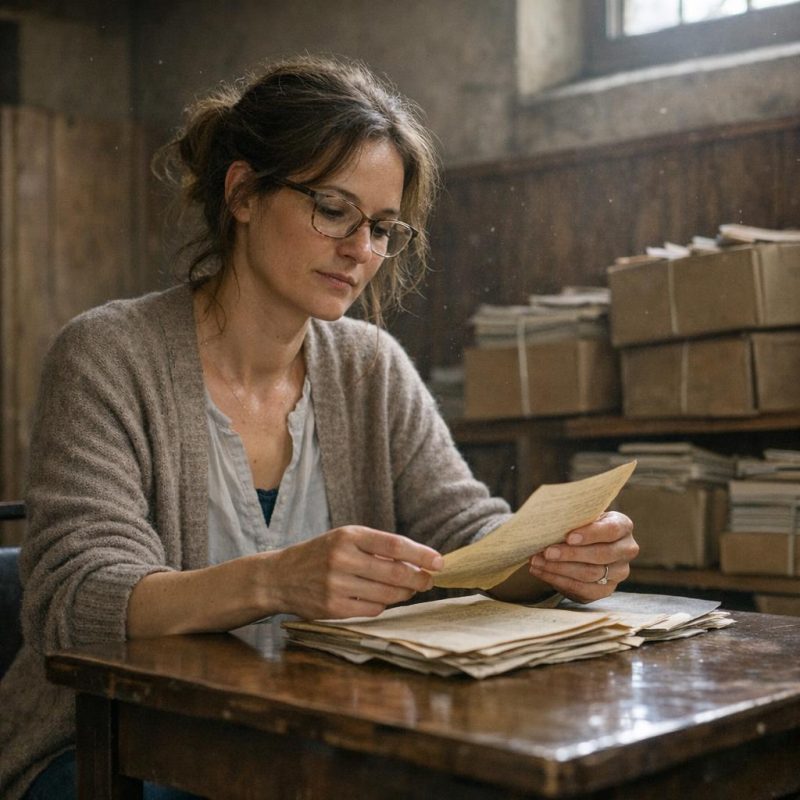 Image by RM AI
Susan's Hesitation
Susan Brenner finally returned my call after I'd left three messages. We'd been friendly back in the day, though never close, and I could hear the hesitation in her voice when she agreed to meet me at the park near her house. She sat on the bench with her arms crossed, looking everywhere but at me, and I had to work hard to keep the conversation going. 'I just want to understand what really happened,' I told her. 'For Lily's sake. She's suffering because of all this.' Susan's face softened at that, and she nodded slowly. 'That poor girl,' she said. 'It's not fair, what she's going through. None of it was really her father's fault, you know.' I leaned forward. 'What do you mean?' She twisted her hands together, clearly uncomfortable. 'I just remember that Daniel was so young back then. He was what, twenty-three? Twenty-four? Barely more than a kid himself, really eager to please, always trying to prove himself.' She paused, choosing her words carefully. 'He seemed like he was trying to please his father, actually. Always talking about making Harold proud.' Susan said she remembered Daniel being so young back then, 'barely more than a kid trying to please his father,' and my breath caught.
 Image by RM AI
The Missing Pieces
That night I spread everything out on my dining room table—the old newsletters, the notes I'd taken from my conversations, printouts of the few news articles I'd found online. I was trying to piece together a timeline, to understand exactly what had happened and when, but there were holes everywhere. The newspaper articles never named the victims, just said 'several local families.' The church newsletter mentioned a financial misunderstanding but gave no details about what kind or how much money was involved. Susan had talked about Daniel trying to please Harold, but she hadn't explained what that meant in the context of the scheme. Even the dates were fuzzy—some sources said it all happened in the spring, others suggested it dragged on through the summer. And the strangest thing was that while Daniel's name appeared in a few places, there was never any real description of what he'd actually done. It was all passive voice and vague language—'funds were misappropriated,' 'trust was broken,' 'the community was affected.' Nothing concrete, nothing specific. It felt less like incomplete journalism and more like something had been deliberately scrubbed clean.
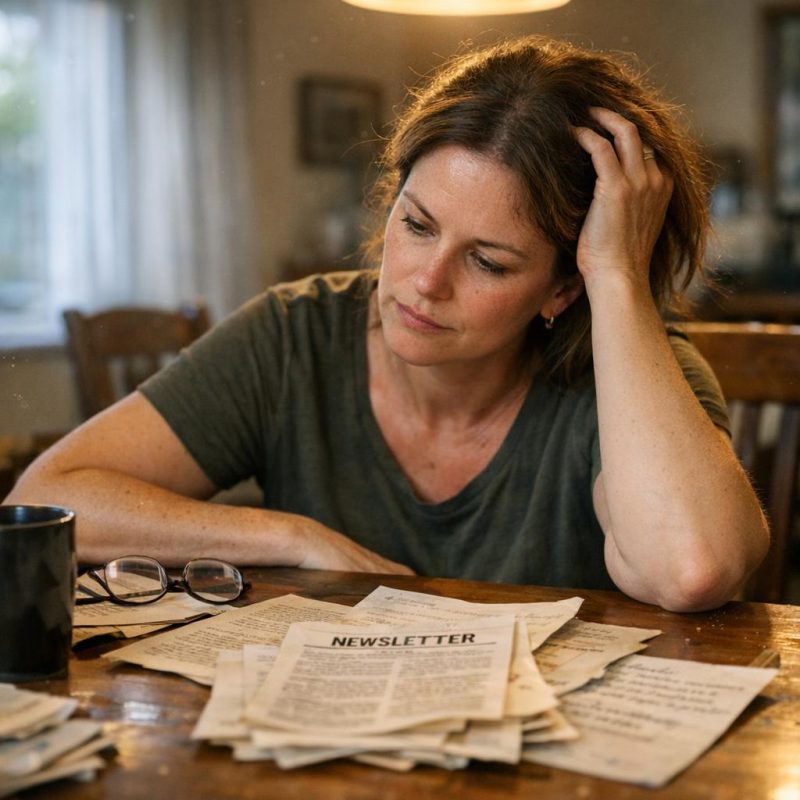 Image by RM AI
Coffee with Patricia
Patricia Chen had been my closest friend for years before Harold died. We'd drifted apart after that, mostly because seeing her reminded me too much of the life Harold and I had shared—the dinner parties, the couples' trips, all of it. When she finally agreed to meet me for coffee, I felt a surge of hope. If anyone would be honest with me, it would be Patricia. But when she walked into the café, she looked ten years older than I remembered, and her smile didn't reach her eyes. We made small talk for a few minutes, but I could see she was bracing herself for something. 'Patricia,' I finally said, 'I need to know what really happened twenty years ago. With Daniel. Everyone keeps dodging my questions, and I'm starting to feel like I'm going crazy.' She stared into her coffee cup, her jaw tight. 'Evelyn, why are you digging into this now? It's been two decades. What good will it do?' 'My granddaughter is being bullied because of it,' I said. 'She wants to change her name. I need to know what I'm defending—or if I should even be defending it at all.' When I said Daniel's name, Patricia's face changed, and she asked me if I was sure I wanted to know the truth.
 Image by RM AI
The Other Name
Patricia took a long breath and set down her cup. 'Okay,' she said quietly. 'But you're not going to like this.' She told me that Daniel had been involved in the scheme, that much was true, but he hadn't been running it. He'd been working under someone else, someone who'd convinced him that what they were doing was legitimate, that it was just creative financing or something like that. Daniel had been the face of it, the one meeting with people and collecting money, but he hadn't been the one designing the whole operation. 'He was young and trusting,' Patricia said. 'And the person he was working for was someone everyone in the community respected. Someone whose reputation was so solid that when things fell apart, they managed to redirect all the blame onto Daniel.' My mouth went dry. 'Who?' I asked. 'Who was he working for?' Patricia looked away, out the window at the parking lot, and I could see her struggling with whether to continue. 'Someone whose name never made it into any report,' she finally said. I asked who, and Patricia looked away, saying, 'Someone whose name never made it into any report.'
 Image by RM AI
The Quick Resolution
Patricia rubbed her temples like she had a headache coming on. 'There was pressure,' she said. 'Pressure to wrap things up quickly, to keep the story contained. A bunch of local businesses were involved, and the church had funds invested—people were terrified the whole thing would blow up into something that would take down half the community.' I stared at her. 'So they just picked Daniel?' She nodded slowly. 'He was young, he'd been the visible one doing the collections, and he didn't have the connections or resources to fight back. The people who actually designed the scheme, they had lawyers, they had relationships with everyone who mattered. They knew how to protect themselves.' My coffee had gone cold in my hands. I set it down before I dropped it. 'They threw him to the wolves to save their own reputations.' 'That's exactly what happened,' Patricia said quietly. 'And by the time anyone realized how wrong it was, the narrative was already set. Daniel was the villain, and everyone else got to walk away clean.' She told me Daniel had been 'the easiest person to point to,' and I felt sick thinking about what that meant.
 Image by RM AI
The Unwilling Scapegoat
I drove home in a fog, barely remembering the route. Everything I'd believed about Daniel for twenty years was crumbling, and I didn't know how to process it. I'd thought he'd been reckless, maybe even greedy—that he'd made terrible choices and destroyed lives including his own. But what Patricia described wasn't recklessness. It was a young man being used, being manipulated by people who should have protected him. People who let him take the fall to save themselves. When I got home, I sat in my car in the driveway for fifteen minutes, just staring at the house. Harold and I had lived here together for forty years. We'd raised our son here. And the whole time, had I been blind to something fundamental? Had I accepted the easiest story because questioning it would have been too uncomfortable, too complicated? I'd been so angry at Daniel for embarrassing us, for tarnishing our family name. But maybe the real tarnish had come from somewhere else entirely. For the first time in twenty years, I wondered if I had failed my son in the worst possible way—by believing what everyone else wanted me to believe.
 Image by RM AI
Searching for Documents
The next morning, I went into Harold's old office. I hadn't touched most of his things since he died—it felt wrong somehow, like disturbing a shrine. But now I needed to know if there was anything that could help me understand what really happened twenty years ago. I started with the filing cabinet, pulling out folders of old tax returns and bank statements. Nothing unusual jumped out at me. Then I moved to his desk, going through each drawer methodically. Most of it was exactly what you'd expect—pens, old glasses, receipts, a calculator. But the bottom drawer on the right side had a false back. I only noticed it because a folder got stuck, and when I pulled harder, the whole back panel shifted slightly. My heart started pounding. I reached behind it, feeling around, and my fingers touched something solid. It was a small metal box, maybe eight inches long, with a keyhole on the front. I pulled it out carefully and set it on the desk. I found a locked box in the back of his desk drawer—one I'd never noticed before.
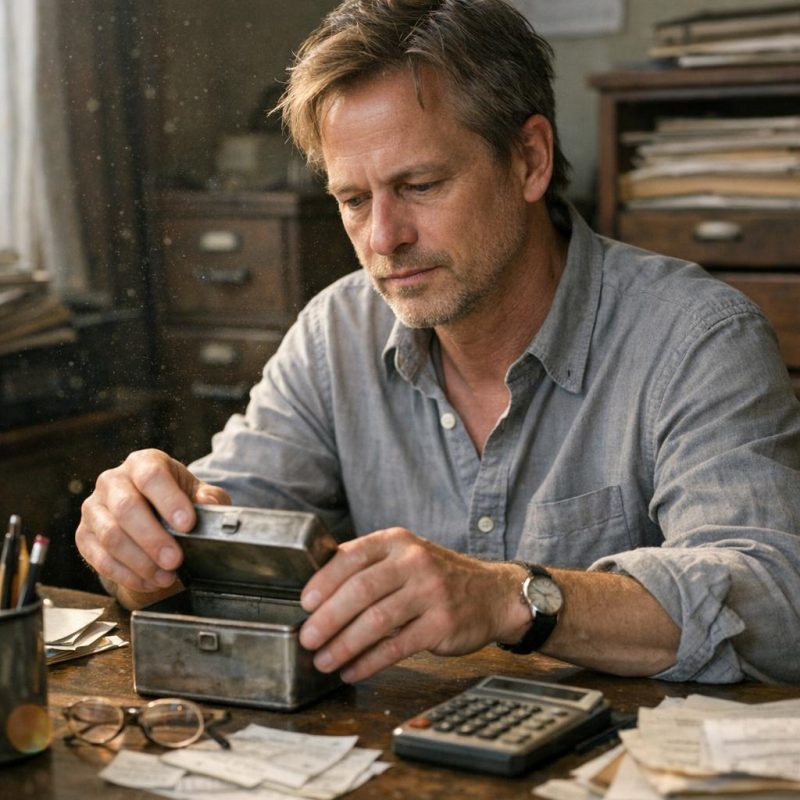 Image by RM AI
The Locked Box
I tried the obvious places first—checked Harold's old key ring, looked in the jar on his dresser where he used to empty his pockets. Nothing fit. The box sat on his desk for two days while I searched, becoming more obsessed with opening it every hour that passed. Why would Harold hide something so carefully? What had he needed to keep locked away even from me? Finally, I went through our photo albums, thinking maybe he'd tucked a key inside one of them. That's where I found it—in the album from Daniel's childhood, slipped into the sleeve behind a picture of Harold teaching Daniel to ride a bike. They both looked so happy in that photo. The key was small and brass, tarnished with age. My hands shook as I carried it back to Harold's office. I put it in the lock and it fit perfectly. But I couldn't turn it yet. I just stood there, staring at that box, feeling like I was standing at the edge of something I couldn't come back from. As I turned the key, my hands were shaking—part of me didn't want to know what Harold had kept locked away.
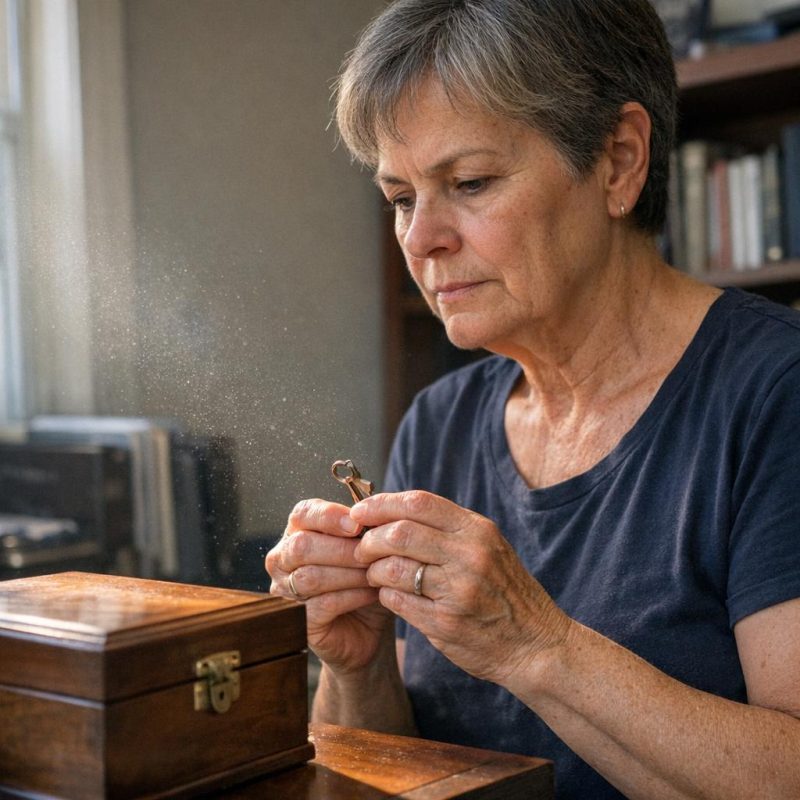 Image by RM AI
Father Gregory's Memory
Before I opened that box, I needed context. I needed to talk to someone who'd been there during the scandal, someone who might remember details that had been forgotten or buried. So I called Father Gregory. He'd been at St. Catherine's for thirty years and had known our family well. We met at the church on a Tuesday afternoon. He looked older than I remembered, his hair completely white now, but his eyes were still sharp. 'I'm trying to understand what happened back then,' I told him. 'With Daniel and the investment scheme. I've learned some things recently that don't match what I thought I knew.' Father Gregory folded his hands carefully. 'It was a difficult time for everyone,' he said. 'For the families who lost money, for the community, for the church. We all had to make hard decisions about how to move forward.' 'But what about Daniel specifically?' I pressed. 'Do you remember him being involved with anyone else in the scheme?' He hesitated, choosing his words carefully. 'Your husband was very concerned about protecting people during that time,' he finally said. He told me Harold had been 'instrumental in protecting the church's reputation during difficult times,' and something in his tone made me uncomfortable.
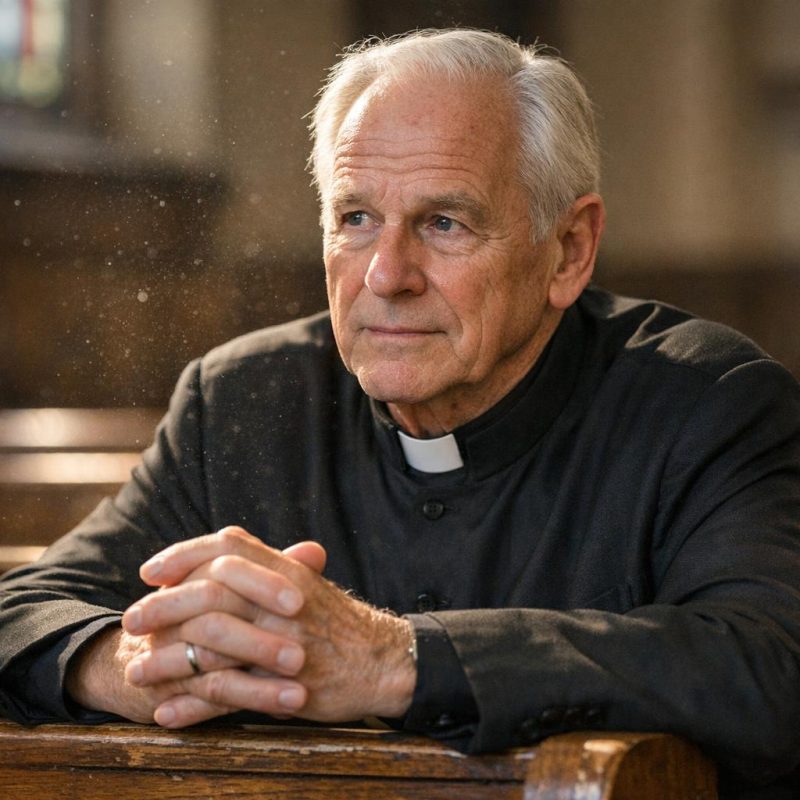 Image by RM AI
Inside the Box
That night, I finally opened Harold's box. Inside were papers—old financial ledgers, contracts, letters. My hands trembled as I lifted them out. The ledgers were from twenty years ago, detailed records of transactions and investments. I recognized some of the names—people from church, local business owners, families I'd known for years. The contracts were agreements for investments, promising returns that seemed impossibly high even to my untrained eye. And then there were the letters. Most were business correspondence, formal and dry. But one envelope caught my attention because it was different—newer paper, Harold's handwriting on the outside. It was addressed to Daniel but had never been sealed, never sent. I unfolded it with shaking hands. The date at the top was from just before everything fell apart, right before the scandal broke. My eyes scanned the page, and I felt the room spin around me. One letter was addressed to Daniel, and the first line read: 'You'll do this because you're my son, and you'll understand why someday.'
 Image by RM AI
The Ledgers
I read the letter three times, then forced myself to look at the ledgers more carefully. The entries were in Harold's handwriting—I'd seen his writing on grocery lists and birthday cards for decades, I knew every loop and slant. The transactions weren't just records of what had happened. They were instructions, calculations, plans. Harold's notes filled the margins: 'Move this to offshore account,' 'Daniel collects Friday,' 'Keep church funds separate—appearance matters.' The dates lined up perfectly with the scandal timeline. Every meeting Daniel had apparently conducted, Harold had notes about. Every collection, every promise made to investors—Harold had documented it all. But not like someone observing from the outside. Like someone orchestrating every move. I found myself making excuses even as I read. Maybe he'd been trying to help Daniel fix things. Maybe he'd been investigating on his own. But those explanations crumbled as I kept reading. The dates matched the scandal perfectly, and Harold's handwriting was all over the margins, making notes, giving instructions.
 Image by RM AI
Denial and Doubt
I spent the next day trying to convince myself there was an innocent explanation. Maybe Harold had been documenting evidence to help Daniel. Maybe he'd been trying to track down the real culprits. Maybe the letter was taken out of context. I went through every rationalization I could think of, every possible alternative interpretation of what I'd found in that box. Harold had been a good man. He'd been a devoted husband, a respected member of the community, active in church. He wouldn't have done what these documents suggested. He couldn't have. But the evidence was right there in black and white. The instructions, the planning, the careful notes about keeping his own name out of everything while Daniel took meetings and collected money. The letter that sounded less like a father asking for help and more like someone ordering his son to take a fall. I kept trying to reshape the facts into something less awful, something I could live with. But the more I tried to explain it away, the clearer it became—I was doing exactly what I'd done twenty years ago.
 Image by RM AI
The Connections
I started making a list. All the names from Harold's documents—the people he'd met with, the ones who'd signed off on various decisions, the business owners who'd donated to the church building fund that year. Then I pulled up Patricia's old interviews from the archived newspaper articles. The overlap was staggering. Every single person Patricia had mentioned as being unusually eager to bury the story appeared somewhere in Harold's notes. The church elder who'd pushed for 'forgiveness and moving forward' had his name on three different meeting schedules. The business association president who'd called Daniel's case 'a distraction from community progress' was listed as someone Harold needed to 'keep updated.' Even the reporter who'd written the most damaging article about Daniel had a notation beside his name: 'receptive to guidance.' I sat there staring at my two lists, feeling sick. This wasn't Harold being peripherally involved or trying to help from the sidelines. This was coordination. This was orchestration. He'd been connected to everyone who'd wanted the scandal buried, everyone who'd had influence over how the story was told. Harold hadn't just been involved—he'd been at the center of it all, the hub connecting everyone who'd helped destroy our son's reputation.
 Image by RM AI
Rachel's Warning
My phone rang that evening, and Rachel's name appeared on the screen. We hadn't spoken since that awkward conversation at her house. 'Evelyn,' she said, her voice tight. 'I heard you've been asking questions around town. About the old business scandal.' I hadn't been asking around town—I'd been researching alone in my house—which meant someone had noticed something. Or Rachel was more plugged into the community than I'd realized. 'I'm just trying to understand what happened,' I said carefully. 'I need you to stop,' she said, and there was something desperate in her voice. 'I know you're hurting, I know you want answers, but digging all this up won't change anything. It'll only hurt more people.' 'What people?' I asked. 'The ones who are already hurt? Or the ones who did the hurting?' The line went quiet for a moment. Then I asked the question I'd been holding back: 'Rachel, did you know about Harold's involvement?' The silence that stretched between us was deafening, and in that moment of her not speaking, not denying, not defending, I got my answer more clearly than any words could have given me.
 Image by RM AI
The Daughter-in-Law's Burden
Rachel's voice, when she finally spoke, was barely above a whisper. 'Daniel made me promise. He made me swear I'd never tell you.' My hand tightened around the phone. 'Tell me what?' 'That Harold was behind everything,' she said, and I could hear her crying now. 'Daniel figured it out about a year after the scandal. He found documents, just like you did. He confronted your husband, and Harold admitted it all—said he'd done it to protect his own business interests, that he'd panicked when investigators started looking too closely.' I felt like the floor had disappeared beneath me. 'And Daniel never told me?' 'He loved you, Evelyn. He didn't want you to lose both your husband and your memories of your marriage. Harold was dying by then anyway. Daniel said there was no point in destroying your last months with him, no point in making you carry that betrayal.' She took a shaky breath. 'So he carried it himself. He let you believe his father had been innocent, let you grieve the man you thought Harold was. He protected you from the truth.' She said Daniel had carried that secret alone for years, protecting me even as it ate away at him, and hearing that broke something inside me.
 Image by RM AI
The Blogger
I couldn't sleep that night. Around three in the morning, I started searching online for any recent mentions of Daniel's name, trying to understand how Lily had encountered this old story. That's when I found Marcus Fitzgerald's blog—'Riverside Revisited: The Stories We Forgot.' He'd posted a series about unsolved local scandals from the past two decades, and three weeks ago, he'd published a piece titled 'The Morrison Investment Scandal: What Really Happened?' I clicked through with shaking hands. Marcus had compiled everything from the public record—the allegations, the investigation, Daniel's resignation, the missing money that was never found. He'd interviewed a few people who remembered the case. But he didn't have the full story, didn't know about Harold's role or the coordinated cover-up. His piece made Daniel look exactly like what everyone had believed twenty years ago: a con artist who'd gotten away with it. The comments section was brutal. 'These rich guys never face consequences.' 'Probably living off that stolen money somewhere.' 'His family should be ashamed.' And there, buried in the comments, I saw someone had mentioned Lily by name, saying Daniel's granddaughter went to Jefferson High. I looked at Marcus's blog and saw dozens of comments—people calling my son a thief, a con artist, a failure—and no one knew the truth.
 Image by RM AI
Contacting Marcus
Marcus Fitzgerald had a contact form on his blog. I filled it out at four-thirty in the morning, asking if we could speak about his article on the Morrison case. I expected it might take days to hear back, but he replied within two hours: 'Would love to discuss. Can we meet today?' We arranged to meet at a coffee shop across town, somewhere I wouldn't run into anyone I knew. Marcus was younger than I'd expected, maybe thirty-five, with the kind of eager energy that reminded me of journalism students I'd known decades ago. He had a worn messenger bag stuffed with folders and a laptop covered in stickers. 'Thank you for reaching out,' he said, pulling out a notebook. 'I've been hoping someone connected to the case would talk to me. The public record has so many gaps.' 'Why did you decide to write about it now?' I asked. He looked genuinely enthusiastic about his answer. 'I'm doing a whole series on unsolved local scandals—cases where the official story never quite added up, where people ask questions twenty years later. The Morrison case kept coming up in my research.' He paused, choosing his words carefully. 'And your husband's name kept appearing in my research—but not the way I expected.'
 Image by RM AI
Marcus's Research
Marcus opened his laptop and pulled up a folder thick with scanned documents. 'Here's what doesn't make sense,' he said, turning the screen toward me. 'The initial news coverage named several people as being under investigation—Harold Morrison, Daniel Morrison, three business partners, two church board members. But within two weeks, every follow-up article only mentioned Daniel.' He showed me the articles, highlighting the names. 'Everyone else just... disappeared from the story. No explanation, no mention of them being cleared. They just vanished from the narrative.' I stared at the highlighted names. They matched the ones from Harold's documents. 'I started pulling property records, business filings, tax documents,' Marcus continued. 'Trying to understand the relationships between everyone involved. And there are connections everywhere—financial ties, shared business ventures, church committee memberships. But they all lead back to one person.' He pulled out a hand-drawn chart showing lines connecting various names. It looked like a spider web. 'Most of these people are still prominent in the community. They're not hiding. But they've never talked about this case, never explained their connection to it.' He tapped the center of the chart. 'The one name that ties everyone together? Harold Morrison.' He had a list of questions about people whose names disappeared from follow-up articles, and Harold's name was on that list—but in the center, not the margins.
 Image by RM AI
The Identity Reveal
I sat there looking at Marcus's chart, at my husband's name connecting all those dots, and I realized he didn't know. He'd been researching this story for months and had no idea he was showing me evidence of my own husband's crimes. 'Marcus,' I said quietly. 'Harold Morrison was my husband. He died three years ago.' I watched his face change—the eager researcher expression shifting to shock, then concern, then something more complicated. He closed his laptop slowly. 'Mrs. Morrison... I'm so sorry. I had no idea you'd be the one to contact me. I should have—' 'No,' I interrupted. 'I contacted you because I needed to know. I've been finding evidence myself, in his old files. I needed to understand.' I told him about the box, about the documents I'd found, about Patricia's account. He listened without interrupting, occasionally jotting notes. When I finished, he looked at me with this expression I couldn't quite read—like he felt sorry for me but was also excited by what I'd told him. 'Mrs. Morrison,' he said carefully, 'based on everything I've found, and what you're telling me now, I think your husband didn't just participate in covering up the scandal. I think your husband orchestrated the entire thing.'
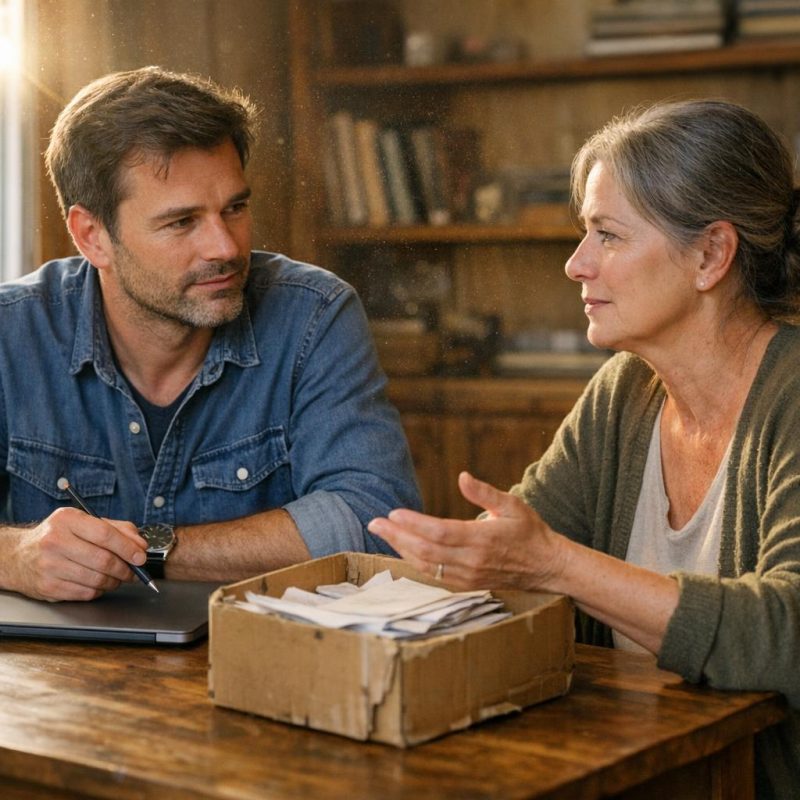 Image by RM AI
The Evidence Wall
Marcus asked if I wanted to see his full research. Part of me wanted to say no, wanted to walk out of that coffee shop and go back to my careful denial. But I nodded. He drove us to his apartment, a small place with papers covering nearly every surface. One entire wall of his living room had been converted into a research display—documents pinned up, photographs, newspaper clippings, with colored string connecting various elements. 'I've been working on this for eight months,' he said. 'It started as just another piece for my blog, but the more I dug, the more I realized this was bigger.' I stood in front of his wall, taking it all in. The timeline stretched from left to right, starting with the formation of the investment group and ending with Daniel's death. Every major player had a section—their photo, their role, their connections. Marcus had mapped out money flows, meeting schedules, property transfers. It was overwhelming and meticulous and damning. And there, in the center of everything, was a photo I recognized—Harold at a church fundraiser, smiling in his good suit, surrounded by the same people whose names appeared throughout the scandal. In the center of Marcus's wall was a photo of Harold from that church fundraiser, surrounded by the names of everyone who'd been hurt—and everyone who'd stayed silent.
 Image by RM AI
The Pattern Emerges
Marcus and I spent hours that day going through everything he'd compiled. At first, I looked at each piece of evidence separately—a phone call here, a meeting there, a statement to the press. But Marcus kept drawing connections, showing me how one thing led to another. 'Look at the timeline,' he said, pointing to his wall. 'Harold met with the church board three days before the public statement. He met with the investment group the day after. Then he gave that interview saying Daniel had acted alone.' I felt sick watching the pattern emerge. Harold had positioned himself as the voice of reason, the concerned father trying to help investigators. He'd encouraged people to come forward with information—but only certain information. He'd offered to mediate discussions between victims and the investment group. He'd been everywhere, involved in everything, his fingerprints all over the narrative. Each individual action looked helpful, even noble. A father trying to ensure justice was served. But when you stepped back and saw them all together, saw the sequence and the timing, it looked like something else entirely. Every move Harold had made looked innocent at the time, but together they formed something calculated and cruel.
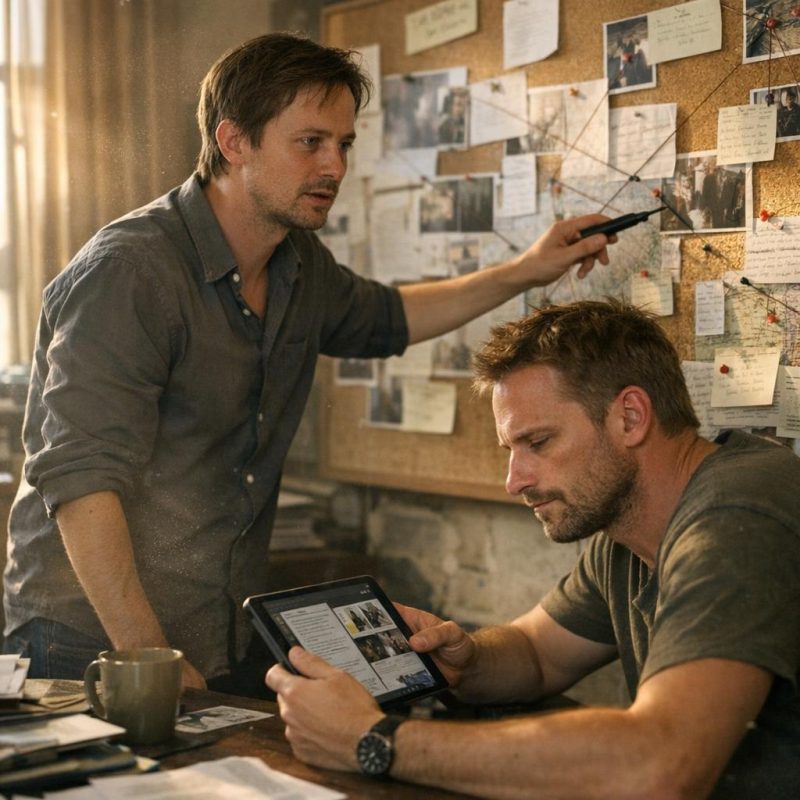 Image by RM AI
Daniel's First Defense
That night, I went through boxes in my attic that I hadn't opened in years. I wasn't sure what I was looking for—maybe just something that would prove Marcus wrong, prove that my husband had been a good man trying his best. Instead, I found a letter tucked inside an old tax folder, written in Daniel's handwriting. The date was from twenty years ago, about three months before everything became public. 'Dad,' it began, 'I know you're worried about your reputation, but this isn't just about us anymore. People were hurt. Real people lost real money. I made mistakes, yes, but I wasn't the only one making decisions. You know that. You were there for half those meetings.' My hands shook as I kept reading. Daniel had laid it all out—who had done what, when Harold had been present, how the decisions had been made collectively. He hadn't been accusatory, just factual. The letter ended with a plea that broke my heart all over again. 'Please, Dad. I can't carry this alone.' And Harold had never responded.
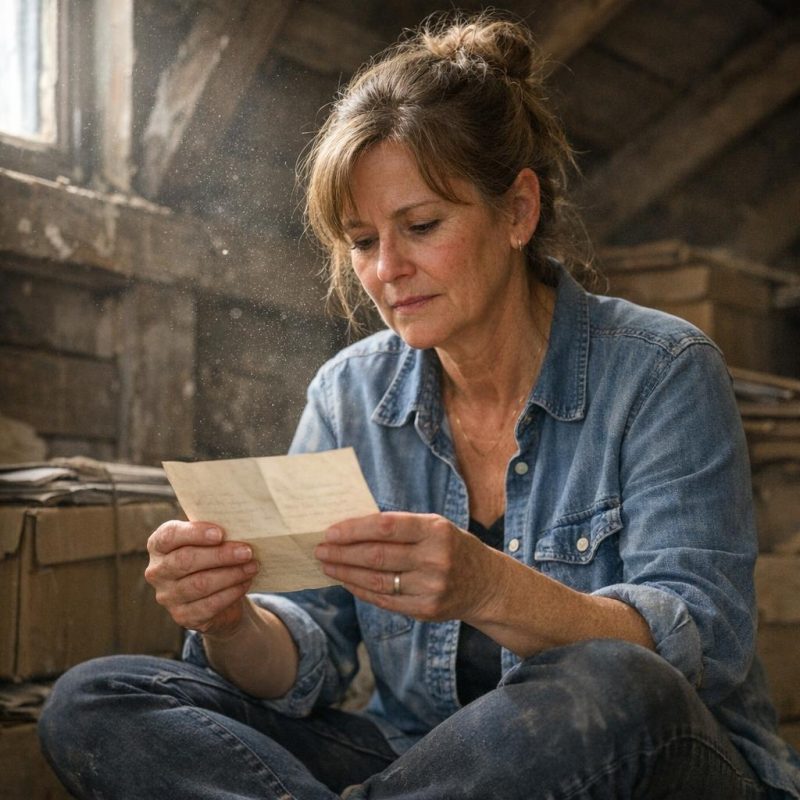 Image by RM AI
The Church's Role
I went to the church next—the same church where Harold had been an elder for thirty years. I asked to see records from twenty years ago, saying I was doing research on my husband's charitable work. The current pastor, who'd only been there five years, was happy to help. What I found in those dusty file boxes made me understand why Harold had been so involved with the church board during that time. There were settlement agreements. Seven of them. The church had quietly paid out funds to people who'd lost money in the investment scheme, using a discretionary assistance fund. Each settlement included a confidentiality clause. Each one was for a different amount, seemingly random, but all substantial enough to make someone feel heard. The payments had been described as 'charitable assistance during difficult times,' not as legal settlements. And attached to each file were notes in Harold's handwriting, outlining the negotiation strategy. The settlements had been generous enough to buy silence but small enough not to attract attention—and Harold had negotiated every one.
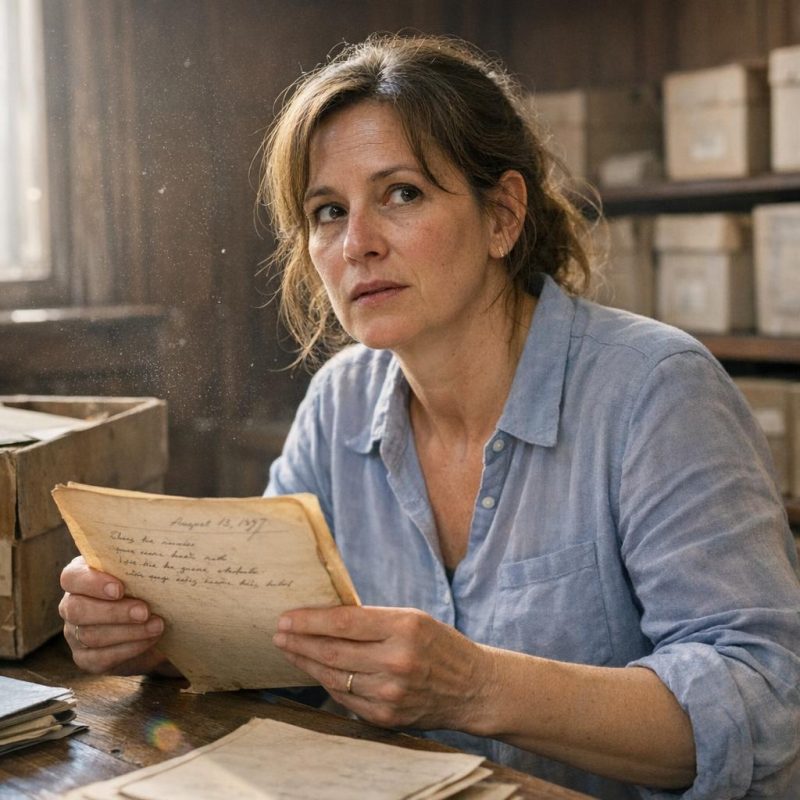 Image by RM AI
Lily Asks Questions
Lily showed up at my door on a Tuesday afternoon, still in her school uniform. I hadn't expected her, and I probably looked as exhausted as I felt. 'Grandma, can we talk?' she asked. We sat in the kitchen with tea, and she was quiet for a long time before speaking. 'I've been reading things online,' she finally said. 'About Dad. About what people say he did. But nothing makes sense. Some articles say one thing, some say another. Everyone seems really angry, but I don't understand why it's all focused on him.' I wanted to tell her she shouldn't be reading those things, that she should just focus on being fourteen. But she had a right to understand her own history. 'What have you found?' I asked. She pulled out her phone, showing me forum threads and old news articles she'd bookmarked. 'I just want to know the truth,' she said. 'Did my dad really do something that bad? Or did people just need someone to blame?' I looked at my granddaughter and realized I was about to tell her something that would change how she saw her entire family.
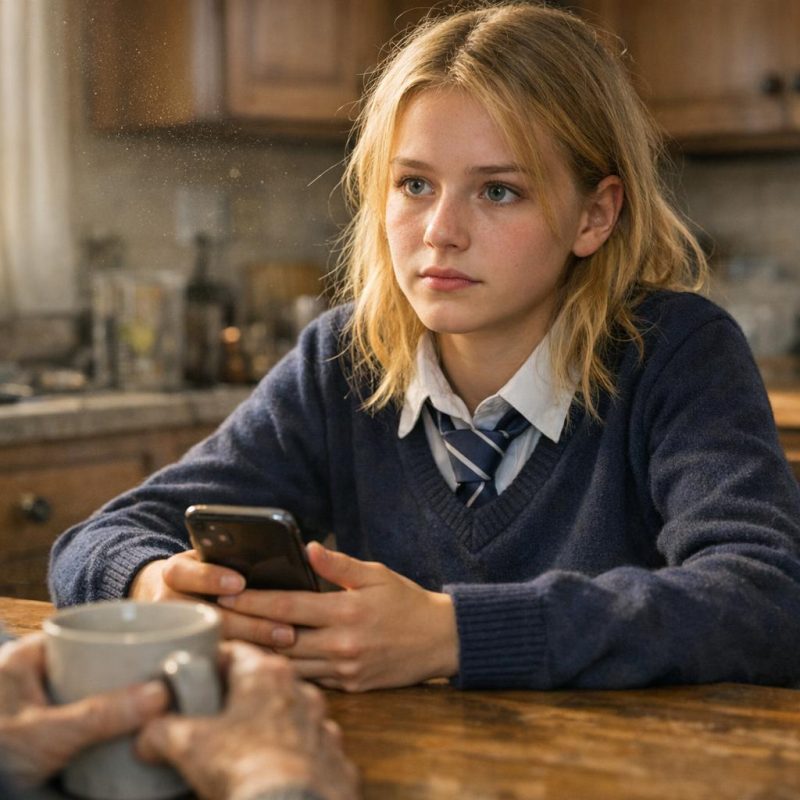 Image by RM AI
Patricia's Full Story
I called Patricia and asked if we could meet again. This time, she invited me to her house—a small cottage filled with books and plants. We sat in her sunroom, and I told her I knew about the church settlements, about the timeline Marcus had constructed. 'I need to know everything,' I said. 'Whatever you've been holding back.' She was quiet for a long time, staring out at her garden. 'Harold came to my house,' she finally said. 'The night before I gave my statement to the investigators. He brought wine and acted like it was just a friendly visit, checking on how I was handling everything.' Her voice got quieter. 'He said the community needed to heal, that the best way to do that was to make sure the facts were clear. He walked me through what I should say—not in an obvious way, just by reminding me of certain details and letting others fade. He never explicitly told me to lie, but he shaped what I remembered.' I felt cold. 'What did he want you to remember?' I asked. She told me Harold had come to her house the night before Daniel was blamed, asking her to 'remember things correctly' for the good of the community.
 Image by RM AI
The Business Partners
Marcus helped me track down one of Harold's former business partners—a man named Richard who'd moved to Arizona years ago. I called him, explained who I was, and asked if we could talk about what happened twenty years ago. He was reluctant at first, but something in my voice must have convinced him I wasn't looking to cause trouble. 'Your husband was very persuasive,' Richard told me over the phone. 'When everything started unraveling, he called a meeting with the core partners. He laid out two scenarios—either we all went down together, or we could contain the damage by being strategic about who took responsibility.' I gripped the phone tighter. 'What did that mean?' Richard sighed. 'He convinced us that Daniel had been the face of the investment group, that people associated the scheme with him anyway, and that if we redirected questions toward Daniel's decisions, the rest of us might salvage our reputations and businesses. He made it sound logical, necessary.' My voice came out flat. 'And you agreed?' 'We all did,' Richard admitted. He said, 'Harold convinced me that if we didn't act fast, everyone would lose everything. I didn't realize until later that he meant himself.'
 Image by RM AI
The Financial Trail
Marcus came to my house with his laptop, saying he'd found something I needed to see. He'd been digging through financial records—public filings, property transfers, business registrations. 'Follow this,' he said, showing me a spreadsheet he'd built. Two months before the investment scheme became public, Harold had quietly transferred several assets into a trust with my name on it. The house, his car, shares in three separate businesses. On paper, it looked like standard estate planning. But the timing was suspicious. Meanwhile, Daniel's accounts showed the opposite pattern. As money went missing from the investment fund, Daniel had liquidated personal assets trying to cover shortfalls. He'd remortgaged his house, cashed out retirement accounts, even borrowed from friends. The contrast was stark and damning. Harold had been protecting himself while his son scrambled to fix things. 'There's more,' Marcus said, pulling up bank statements he'd somehow obtained. 'Harold closed two business accounts the week before the scandal broke, moving the funds offshore.' The accounts showed Harold had quietly transferred assets just before the scandal broke, protecting himself while Daniel was left exposed.
 Image by RM AI
The Night Before
I couldn't sleep that night, so I went back to the attic looking for anything else I might have missed. Buried in a box of old calendars and appointment books, I found my diary from twenty years ago. I used to keep one religiously back then, though I'd stopped after Daniel died. I flipped to the entries from late March, early April—the weeks leading up to when everything exploded. My handwriting documented ordinary days, but reading them now, certain details jumped out. 'Harold up late again,' I'd written on a Tuesday. 'Heard him on the phone in his office past midnight, voice low and urgent. Hope everything's okay with Daniel.' Three days later: 'Harold met with Pastor Jim for two hours this morning, came home looking exhausted but relieved.' The entry from the night before the first news article came out was what broke me. 'Harold barely ate dinner, said he had calls to make. Found him in the study at 11 PM still on the phone. Asked if he was okay, he said he was trying to help Daniel through a difficult situation. Didn't want to worry me with details.' I had written about Harold being up late on the phone, his voice low and urgent, and I'd thought he was trying to help Daniel—but he'd been protecting himself.
 Image by RM AI
The Last Conversation
I kept thinking about the last real conversation I'd had with Harold before he died. It was an ordinary Tuesday morning, and we'd been sitting at the kitchen table drinking coffee. He'd mentioned something about Daniel—about how some people never take responsibility for their mistakes—and I'd nodded along like I always did. I'd believed him. God, I'd believed every word. He'd looked at me with those calm eyes, the ones I'd trusted for four decades, and talked about integrity and character. He'd had years to tell me the truth. Hundreds of mornings just like that one, thousands of quiet moments when he could have said 'Evelyn, I need to tell you something.' But he never did. Not when Daniel left and didn't come back for Christmas. Not when I cried myself to sleep wondering where we'd gone wrong as parents. Not even when he was dying and knew he'd never get another chance. I kept replaying that last conversation, searching for some hint that he wanted to confess, some crack in the facade. But there was nothing. Just coffee and small talk and lies wrapped in the comfortable routine of our life together. He'd had years to tell me the truth, hundreds of chances to set things right, and he'd chosen silence every single time.
 Image by RM AI
Marcus's Article Draft
Marcus showed up at my door two days later with a laptop and a nervous expression. He said he'd written a draft of the article—the full truth about the embezzlement, the cover-up, everything. He sat at my kitchen table and turned the screen toward me. The headline read: 'How a Respected Pastor Destroyed His Son to Save His Reputation.' I read through it slowly, my hands trembling. Marcus had documented everything: Harold's access to the church accounts, the timeline of the transfers, the way he'd positioned Daniel to take the fall. He'd included statements from Janet and Pastor Jim, financial records, all of it. The article didn't just clear Daniel's name—it demolished Harold's. Every paragraph felt like a hammer blow to the life I'd known. Marcus watched me read, his jaw tight. When I finished, he said, 'I won't publish without your permission. This is your family.' I stared at the screen, at my husband's name printed there like an accusation. Marcus had given me the power to decide. He asked for my permission to publish, and I realized this decision wasn't just about clearing Daniel's name—it was about destroying my husband's.
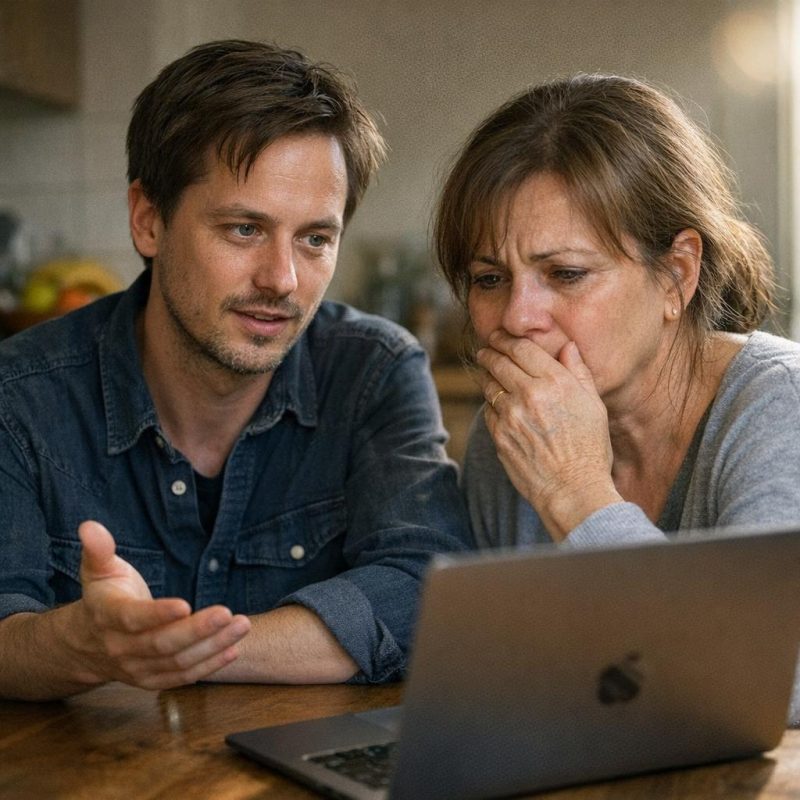 Image by RM AI
The Weight of Legacy
I spent that whole night pacing my bedroom, trying to figure out who I'd be after the truth came out. For twenty years, I'd been Harold Morrison's widow. People respected me at church, in the community, because of him. They trusted my judgment because I'd been married to a man of God. Everything I was—or thought I was—had been built on his reputation. But that reputation was a lie. If Marcus published that article, everyone would know. They'd see me differently. Maybe they'd pity me, maybe they'd wonder how I could have been so blind. Some would probably assume I'd known all along, that I'd been complicit somehow. I'd have to face Janet and the church board and explain that I'd lived with a stranger for forty years. My identity would shatter along with Harold's legacy. But the alternative was letting Daniel continue to carry the shame for something he didn't do. It meant choosing my comfort over my son's freedom. I sat on the edge of my bed as the sun came up, exhausted and terrified. I had spent decades as Harold Morrison's widow, respected and trusted—but that woman had lived in a lie, and I didn't know who I was without it.
 Image by RM AI
Calling Daniel
I called Daniel that afternoon, my whole body shaking as I dialed. He answered on the third ring, cautious like always. 'Mom?' I'd rehearsed what to say a hundred times, but when I opened my mouth, everything came out raw and unfiltered. 'I know what your father did to you,' I said. 'I know he took that money. I know he made you take the blame. I know he lied to me, to everyone, and I know you've been protecting him all these years.' My voice cracked on the last words. 'Daniel, I'm so sorry. I should have believed you. I should have fought harder to understand.' The line went completely quiet. No background noise, no breathing, nothing. For a second I thought he'd hung up, and I wouldn't have blamed him. Then I heard it—a small, choked sound that grew into a sob. My son, who'd kept his composure through everything, who'd walked away from his family with his head high, was crying. I pressed the phone to my ear and cried with him, both of us finally grieving what we'd lost. The silence stretched so long I thought the line had gone dead, and then I heard my son crying for the first time in twenty years.
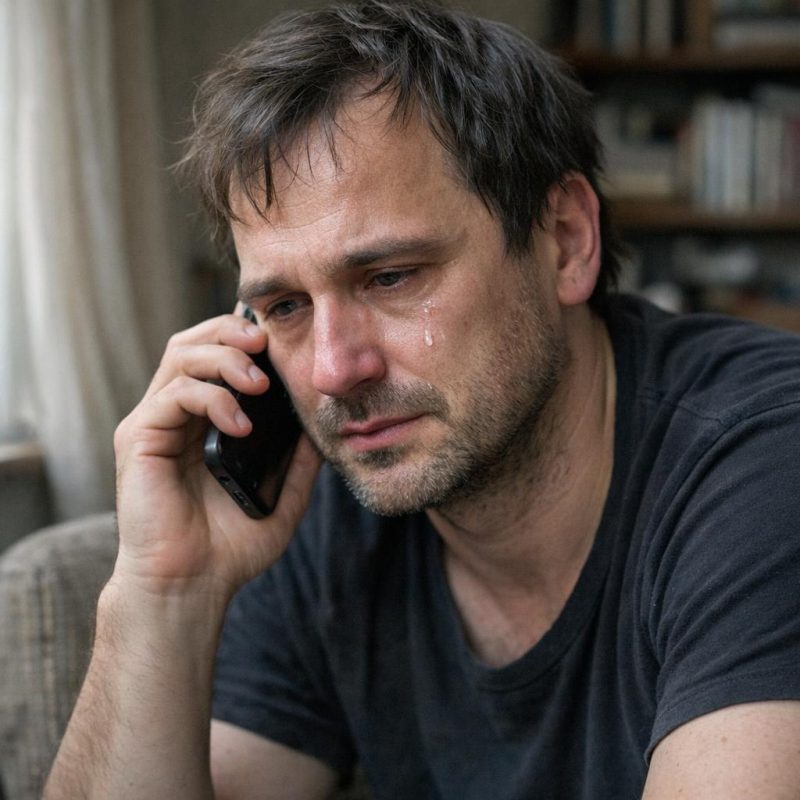 Image by RM AI
Daniel's Confession
Daniel stayed on the phone for almost two hours. Once he started talking, everything poured out—twenty years of silence breaking all at once. He told me how Harold had called him into his office three days before the news broke. How he'd laid out the 'situation,' as he called it, explaining that someone had noticed discrepancies in the accounts. Harold said he'd made some 'borrowing mistakes' but had always intended to pay it back. He told Daniel the church board was investigating, and if the truth came out, it would destroy everything—the church, our family, Harold's ministry. 'He said I was young enough to recover from a scandal,' Daniel said, his voice hollow. 'That I didn't have a wife and kids depending on me like he did. He made it sound like taking the blame was the noble thing to do.' Harold had promised to quietly pay everything back, to make it right. He said it would blow over in a few years and Daniel could rebuild his life. But the real knife was what came next. 'Dad told me you'd never forgive me if the truth came out, that it would kill you,' Daniel said. 'He said, 'Your mother thinks I walk on water, son. This would destroy her.' So I let everyone think I was guilty.'
 Image by RM AI
The Unanswered Question
There was something I needed to understand, so I asked Daniel the question that had been burning in my mind. 'Did you ever think about fighting back? About telling the truth anyway?' The pause before he answered felt like forever. When he finally spoke, his voice was tired but steady. 'Every single day,' he said. 'Especially at first. I'd wake up angry, ready to call a lawyer, ready to burn it all down. But then I'd think about you sitting in church while everyone whispered about Dad. I'd imagine Lily trying to understand why her grandfather was a thief and a liar.' He took a shaky breath. 'And I kept remembering what Dad said—that you couldn't handle it, that the stress might actually kill you. I don't know if that was true or just another manipulation, but I couldn't risk it.' I heard him shift the phone. 'He was already sick by then, even though we didn't know it yet. I figured I'd wait until after he was gone, until you were stronger. But then he died, and you were grieving so hard. How could I take that away from you too?' Daniel said, 'I thought about it every day. But then I looked at you and Lily, and I couldn't destroy the only family we had left.'
 Image by RM AI
The Final Document
After I hung up with Daniel, I went back to the attic. I don't even know what I was looking for anymore—maybe just some space where I could think without feeling Harold's presence in every room. I was moving boxes around when I noticed something wedged behind an old filing cabinet. It was a large manila envelope, the kind lawyers use, sealed with tape that had yellowed with age. My name was written across the front in Harold's handwriting: 'For Evelyn—To Be Opened After My Death.' My heart stopped. This wasn't with his will or his other papers. It had been hidden, deliberately placed somewhere I might never find it. I pulled it free and carried it downstairs, my hands shaking so badly I could barely hold it. The envelope was thick—multiple pages inside. I sat at the kitchen table under the bright overhead light, staring at Harold's handwriting. Part of me didn't want to open it. Whatever was inside would be his final word, his last chance to explain or justify or confess. Once I read it, there'd be no more mystery, no more hoping I'd gotten something wrong. My hands shook as I opened it, and the first line read: 'Evelyn, by the time you read this, you'll hate me, and you'll be right to.'
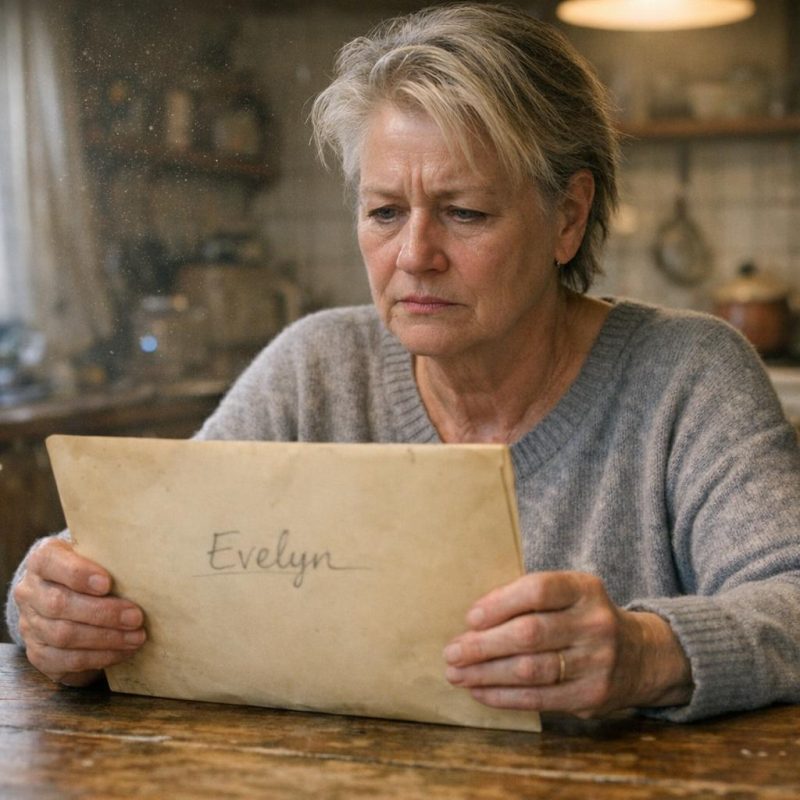 Image by RM AI
Harold's Confession
Harold's letter was five pages long, handwritten in his neat, careful script. He must have written it shortly before he died, when he knew he was out of time. The confession was complete and methodical, like he was presenting evidence at trial. He explained how he'd 'borrowed' from the church building fund over eighteen months—never huge amounts, but enough that it added up. He'd planned to pay it back before anyone noticed, but the church hired an outside accountant who caught the discrepancies. That's when Harold made his choice. 'I knew I could either confess and lose everything—my position, our security, the respect of everyone we knew—or I could find another way out,' he wrote. 'Daniel was young, unmarried, with a future ahead of him. I convinced myself he could recover from this in a way I couldn't. I told myself I was protecting you, protecting our life together, but the truth is I was just a coward.' He described exactly how he'd manipulated Daniel into taking the blame, using me as leverage. 'I knew our son loved you more than anything. I used that love as a weapon.' The letter ended with: 'I chose my legacy over our son. I knew what I was doing, and I did it anyway. Forgive me if you can, but I wouldn't blame you if you can't.'
 Image by RM AI
The Aftermath of Truth
I sat in my living room with Harold's letter spread across the coffee table, reading it for the third time. Each pass brought new details into focus—the calculated phrasing, the self-justification wrapped in confession. He'd written it knowing he was dying, but he'd hidden it where I might never find it. That wasn't confession. That was insurance. Harold had been betting I wouldn't go through his things thoroughly enough, or that if I did, years would have passed and it wouldn't matter anymore. Even in his final act, he was managing the narrative. I thought about the man I'd married, the one I thought I knew for forty years. Had there been signs I'd ignored? Moments where his character showed through but I'd looked away? The truth was, I'd built my life around a version of Harold that made sense to me—the respected pastor, the dignified husband, the moral authority. I'd invested everything in that version. Looking at his handwriting now, I could see what I'd refused to acknowledge before. I realized Harold had written the letter knowing I might never find it, which meant even his confession was a calculated risk he was willing to take.
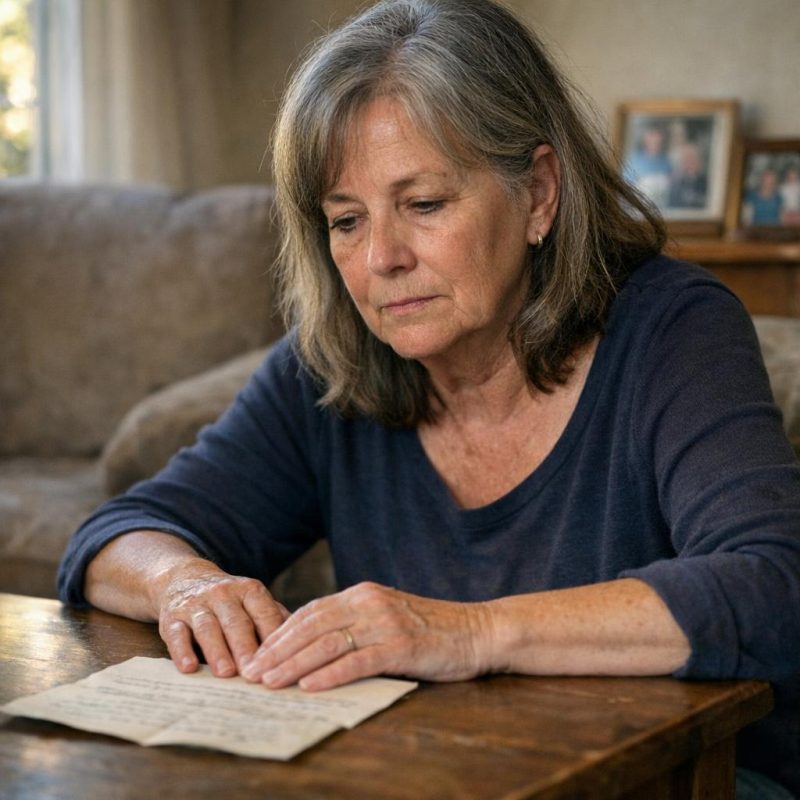 Image by RM AI
Sharing the Letter
I drove to Daniel's apartment the next morning with Harold's letter in my purse. My hands shook the entire way. When he opened the door, I just handed it to him without saying anything. We sat at his small kitchen table while he read, and I watched his face change—anger, then pain, then something that looked almost like relief. 'He admits it,' Daniel said quietly, his voice breaking. 'He actually admits what he did.' I reached across the table and took his hand. 'I'm so sorry,' I said. 'I should have believed you. I should have fought for you.' He shook his head, tears streaming down his face. 'You believed him because you trusted him. That's what he counted on.' We sat there for a long time, both of us crying, both of us grieving different losses. I was grieving the man I thought I'd married. Daniel was grieving twenty years of his life that my husband had stolen. When he finally looked up at me, his eyes were red but clearer than I'd seen them in years. Daniel looked at me and said, 'At least now you know I wasn't crazy. At least now you know I was telling you the truth.'
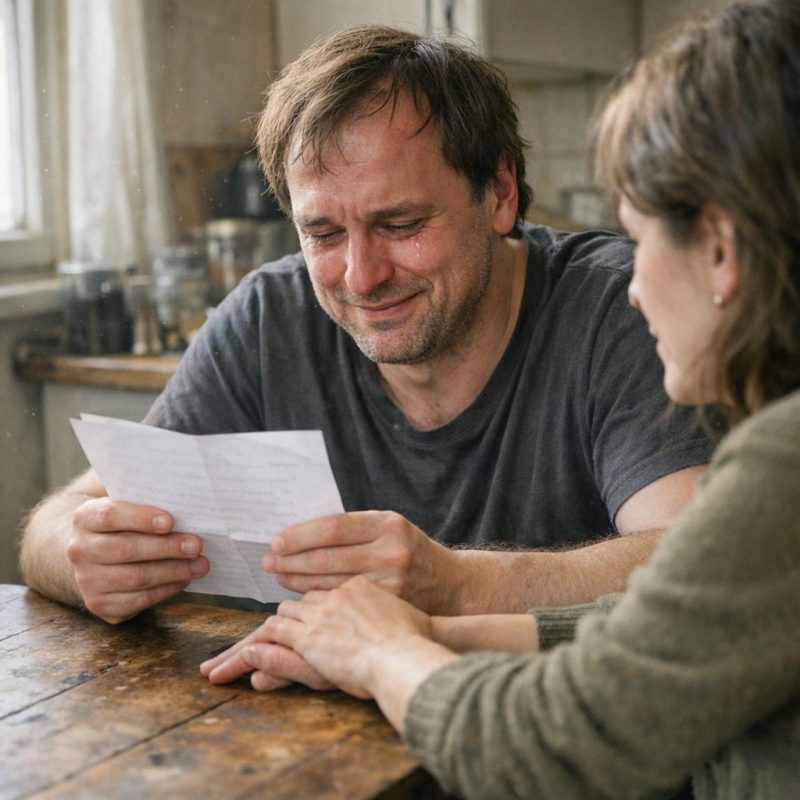 Image by RM AI
The Decision to Act
I spent that night thinking about what came next. Harold's letter was proof, but it was private. Daniel had been vindicated in my eyes, but the rest of the world still believed the lie. Our community still saw him as the pastor's son who'd betrayed his father's trust. Lily was still being bullied because of a reputation built on Harold's deception. I could keep the letter private, let sleeping dogs lie, preserve what remained of Harold's legacy and my own standing in the community. That would be the easy path, the safe path. Or I could do what I should have done twenty years ago—I could fight for my son. At sixty-three years old, I could finally choose truth over comfort. The decision, once I really looked at it, wasn't difficult at all. I picked up my phone and called Marcus. He answered on the second ring. 'I have something for you,' I said. 'Harold's confession. Everything he did, in his own handwriting.' Marcus was quiet for a moment. 'Are you sure about this, Evelyn? Once it's out there—' 'I'm sure,' I interrupted. I called Marcus and told him to publish everything—Harold's name, his role, his confession—and finally clear Daniel's name after twenty years.
 Image by RM AI
Preparing Lily
Before Marcus published anything, I needed to talk to Lily. She deserved to know the truth before the rest of the world did. I asked her to come over after school, and we sat in the same living room where this whole thing had started weeks ago. 'I need to tell you about your grandfather,' I said. 'The real story.' I told her everything—how Harold had stolen from the church, how he'd manipulated Daniel into taking the blame, how he'd used his position and my trust to destroy his own son's life. Lily listened without interrupting, her expression growing more serious with each detail. When I finished, she was quiet for a long time. 'So Dad was innocent,' she finally said. 'The whole time.' 'The whole time,' I confirmed. 'And everyone believed Grandpa because he was the pastor.' I nodded. 'And because I believed him too. Because I chose to believe him instead of your father.' Lily's eyes filled with tears. 'Is that why you're going to publish Grandpa Harold's letter? So everyone knows the truth?' 'Yes,' I said. 'Your father deserves that. You deserve that.' Lily asked me if she should be ashamed of her grandfather, and I told her no—we should be ashamed we didn't see it sooner.
 Image by RM AI
The Article Publishes
Marcus's article went live at 6 AM on a Tuesday. I'd read the draft the night before—it was thorough, fair, and devastating. He'd included excerpts from Harold's letter, Daniel's original statement from twenty years ago, and interviews with several church members who'd noticed inconsistencies at the time but hadn't spoken up. The headline was simple: 'Pastor's Confession Reveals Twenty-Year Coverup, Exonerates Wrongly Accused Son.' I sat at my computer and watched it publish, my coffee growing cold beside me. By 7 AM, I had twelve emails. By 8 AM, thirty-seven. My phone started ringing before nine and didn't stop. The local TV news called asking for an interview. People I hadn't spoken to in years were messaging me on Facebook. Some were supportive, shocked, apologetic. Others were angry—how dare I tarnish Harold's memory, how could I betray my own husband, didn't I care about his legacy? Someone left a comment saying I was a bitter old woman trying to rewrite history. Another said Daniel had clearly manipulated me. But mostly, people were sharing the article, reading Harold's own words, finally seeing the truth. Within hours, the article was everywhere—local news picked it up, social media exploded, and suddenly everyone knew the truth.
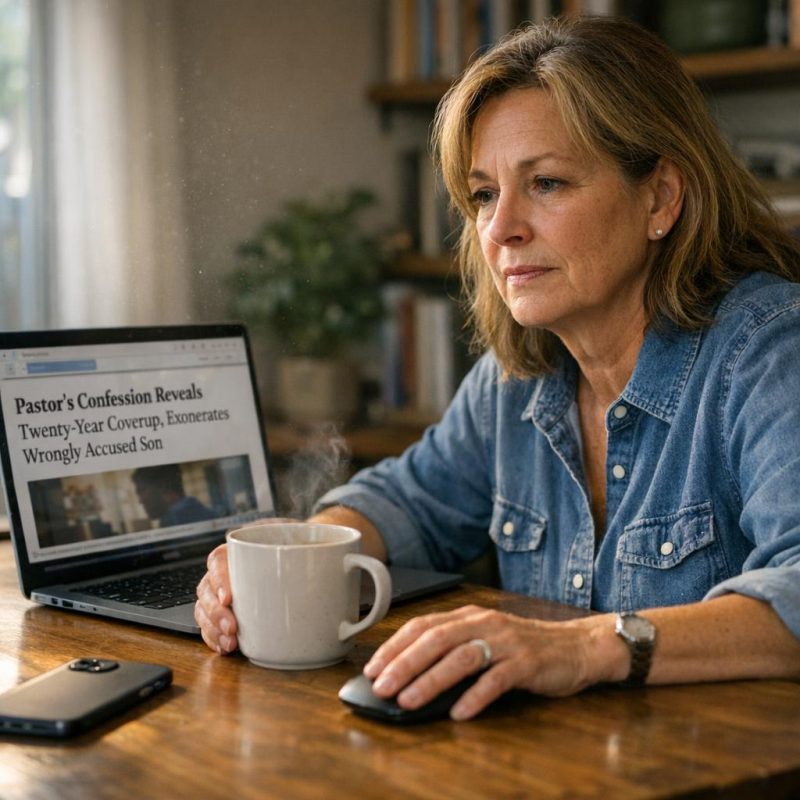 Image by RM AI
The Community Reacts
The phone calls were relentless. Some people called to apologize—for not supporting Daniel, for believing the worst, for staying silent when they should have questioned. Those calls were hard but necessary. Then there were the other calls. Margaret from the church council called me a disgrace. 'Harold was a good man who made one mistake,' she said. 'You're destroying everything he built.' I reminded her that Harold had destroyed Daniel's life deliberately, systematically, and she hung up on me. Pastor Jim called, his voice tight with barely controlled anger. 'You've divided this entire community,' he said. 'Was that really necessary?' 'The community was already divided,' I told him. 'Half of them were just living a comfortable lie.' He told me I should think about finding a new church. Sarah, who I'd considered one of my closest friends for thirty years, sent a text instead of calling: 'I can't believe you'd do this to Harold's memory. He's not here to defend himself. This is cruel.' I deleted it without responding. By evening, I was exhausted and shaken, but I wasn't backing down. One former friend called me a traitor to Harold's memory, and I realized that for some people, maintaining the lie was more important than facing the truth.
 Image by RM AI
Daniel in Public
Daniel issued a public statement three days after the article published. He didn't have to—the confession letter spoke for itself—but he wanted to. Marcus helped him draft it, and they posted it on the newspaper's website. I read it with tears streaming down my face. 'For twenty years, I've carried the weight of something I didn't do,' it began. 'I've lost relationships, opportunities, and most painful of all, years with my daughter because of a lie my father told to save himself. I'm grateful the truth has finally come to light, not because I need vindication, but because truth matters. To those who believed in me despite everything—thank you. To those who didn't—I understand why. My father was convincing because he had decades of credibility to draw on. That's what made his betrayal so effective.' The statement was graceful, measured, and more forgiving than Harold deserved. Daniel thanked me specifically for 'choosing courage over comfort,' which made me cry all over again. He ended by saying, 'I don't need people to apologize. I just need them to know the truth.' And I had never been more proud of my son.
 Image by RM AI
Lily's Classmates
Lily called me the Friday after the article published, and I could hear the smile in her voice before she even spoke. 'Grandma,' she said, 'something happened at school today.' My stomach clenched—I'd been so focused on the adult reactions that I hadn't fully considered how Lily's classmates would respond. 'What happened?' I asked carefully. 'Everyone read the article,' she said. 'Like, everyone. And Emma—you know, the girl who started the whole nickname thing?—she came up to me at lunch and apologized. Like, really apologized. She said she felt terrible and didn't know the real story.' Other kids had approached her too, Lily said. Some apologized. Others just treated her normally for the first time in weeks. The whispers had stopped. The looks had changed. 'No one called me Sticky Fingers,' Lily said, and I could hear the relief in her voice. 'And Mr. Peterson mentioned the article in history class—not about me specifically, but about how important it is to question narratives and look for evidence.' Then she told me the best part. She told me one girl said, 'Your dad is actually kind of a hero,' and Lily smiled for the first time in weeks.
 Image by RM AI
The Church's Apology
Father Gregory called Daniel two weeks after the article ran, and I went with my son to the church for the first time in months. The sanctuary felt different somehow—smaller, less imposing than I remembered. Father Gregory wasn't alone. He'd brought three deacons and the church board president, all men who'd been there twenty years ago, all men who'd participated in what happened to Daniel. They sat across from us in the meeting room where the church council once convened to discuss my son's 'discipline.' Father Gregory spoke first, his voice steady but strained. 'We failed you,' he said, looking directly at Daniel. 'We protected a powerful man and destroyed an innocent boy's reputation, and there is no excuse for that. We're issuing a formal apology in this Sunday's bulletin.' He slid a printed copy across the table. I watched Daniel's hands shake as he picked it up. It was there on page two, right where the original accusations had appeared twenty years ago, right where they'd told the congregation about the 'troubled young man' who'd been caught stealing. The apology used Daniel's name, acknowledged Harold's crimes, and took full responsibility for what they'd done. Daniel read it twice, then pressed the bulletin to his chest, and the tears came—not tears of pain this time, but something that looked like release.
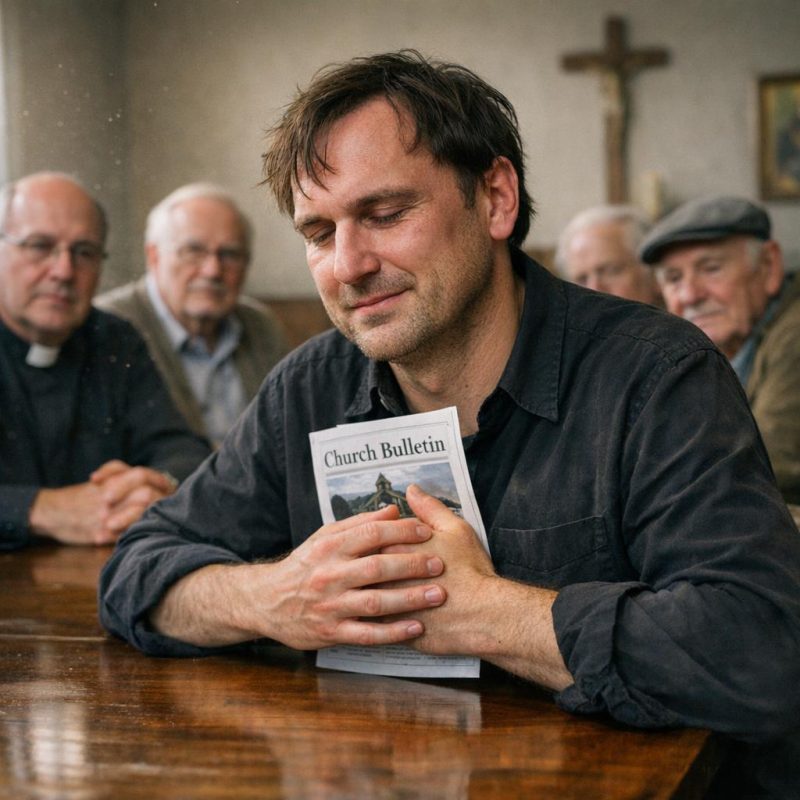 Image by RM AI
Lily's Decision
Lily came over for dinner three days after the church's apology, and I could tell from the set of her shoulders that she had something important to say. We were clearing the table when she looked at her father and said, 'Dad, I need to tell you something.' Daniel froze, dish towel in hand. 'I've been thinking about the name thing,' Lily continued. 'About changing it, I mean. And I've decided I'm not going to.' The relief on Daniel's face was immediate, but Lily wasn't finished. 'I'm not keeping it because I'm scared to change it or because it's easier,' she said. 'I'm keeping it because I know the truth now. I know who you really are, and I know what Grandpa did, and I know which one of those things matters.' She stepped closer to her father. 'When people hear the name Morrison at school now, they think about the guy who got screwed over and didn't deserve it. They think about someone who survived something terrible. And yeah, some people still don't believe it, but that's their problem, not mine.' Daniel's eyes were wet. 'I want people to know that being Daniel Morrison's daughter is something to be proud of,' Lily said, and I watched my son's face transform into something I hadn't seen in twenty years—pure, unguarded joy.
 Image by RM AI
The Price of Truth
The social fallout took months to fully materialize, and I won't pretend it didn't hurt. Three women from my book club stopped returning my calls. The historical society removed me from the spring gala planning committee—they didn't say why, but I knew. People I'd considered friends crossed the street to avoid speaking to me. I'd destroyed the reputation of a beloved community figure, and some people would never forgive that, no matter what evidence I'd presented. My own memories had been rewritten too. Every dinner party Harold and I hosted, every charity event, every Sunday at church—all of it now carried the shadow of what I hadn't seen, what I hadn't wanted to see. I'd spent forty-one years building a life with a man who didn't exist, not in the way I'd believed. The grief for that loss was real, even knowing what he'd done. But here's what I gained: Daniel started coming to Sunday dinners again. He laughed at my kitchen table. He called just to talk. Lily spent weekends with me, asking questions about her father's childhood, wanting to know the good parts I'd almost forgotten myself. I had lost the man I thought I married, but I had found my son again, and that was a trade I would make every time.
 Image by RM AI
What Names Really Carry
I've been thinking a lot about names lately, about what they carry and what they mean. Harold Morrison was a name that commanded respect in this town for decades. Daniel Morrison was a name people whispered about, a cautionary tale, a reputation destroyed before it could begin. And Lily Morrison was a name that almost got changed because a fourteen-year-old girl couldn't bear the weight of what people thought it meant. But here's what I've learned through all of this: names are just words until we attach stories to them, and stories can be true or false, fair or cruel, built on evidence or gossip or the convenient lies of powerful men. The Morrison name carries a different story now. Some people still believe the old version—they always will. But my granddaughter walks through her school hallways with her head up, and my son answers his phone without that edge of defensive tension in his voice, and I look at old photographs of Harold without feeling like I'm losing my mind. We can't control what names we're born with, but we can control whether we're brave enough to face the truth behind them. I learned that family names don't define us—the truths we're brave enough to face do, and that's a legacy worth passing down.
 Image by RM AI
KEEP ON READING
The 20 Most Recognized Historical Figures Of All Time
The Biggest Names In History. Although the Earth has been…
By Cathy Liu Oct 4, 2024
10 of the Shortest Wars in History & 10 of…
Wars: Longest and Shortest. Throughout history, wars have varied dramatically…
By Emilie Richardson-Dupuis Oct 7, 2024
10 Fascinating Facts About Ancient Greece You Can Appreciate &…
Once Upon A Time Lived Some Ancient Weirdos.... Greece is…
By Megan Wickens Oct 7, 2024
20 Lesser-Known Facts About Christopher Columbus You Don't Learn In…
In 1492, He Sailed The Ocean Blue. Christopher Columbus is…
By Emilie Richardson-Dupuis Oct 9, 2024
20 Historical Landmarks That Have The Craziest Conspiracy Theories
Unsolved Mysteries Of Ancient Places . When there's not enough evidence…
By Megan Wickens Oct 9, 2024
The 20 Craziest Inventions & Discoveries Made During Ancient Times
Crazy Ancient Inventions . While we're busy making big advancements in…
By Cathy Liu Oct 9, 2024