

I Installed Solar Panels To Save Money, But My HOA President Hit Me With a $500 Fine—Then I Uncovered His Massive Fraud Scheme
I Installed Solar Panels To Save Money, But My HOA President Hit Me With a $500 Fine—Then I Uncovered His Massive Fraud Scheme
The Decision to Go Green
I'd been staring at my electricity bill for about ten minutes straight when I finally said out loud, to nobody in particular, 'This is ridiculous.' It wasn't just the number — though three hundred and forty dollars in August was genuinely painful — it was the feeling that I was throwing money into a hole every single month with nothing to show for it. I'd been reading about solar for a while, bookmarking articles, watching YouTube videos at midnight, running rough numbers on the back of envelopes. The math kept coming back the same way: panels would pay for themselves within six or seven years, and after that, the savings were real. But it wasn't only about the money. I'd been thinking a lot about my footprint, about what kind of choices I was actually making versus the ones I told myself I cared about. Installing solar felt like the moment those two things finally lined up — the practical and the principled. I called three different installers that week, got quotes, asked every question I could think of, and signed the contract on a Thursday afternoon. When I put the pen down, I sat there for a moment in the quiet of my kitchen, and something in my chest just settled. It felt like the right thing. It felt, honestly, like enough.
 Image by RM AI
Installation Day
The crew showed up at six-fifty in the morning, which I respected immediately. Four guys in matching shirts, a truck loaded with equipment, and a project manager named — well, I never caught his name, but he had a clipboard and a calm, efficient manner that made me feel like everything was going to be fine. They walked the roof first, took measurements, talked among themselves in low voices, and then got to work. I made coffee and tried not to hover, but I'll be honest — I spent most of the day watching from the backyard. There's something almost meditative about watching people who are genuinely good at their job. They moved with a kind of quiet confidence, each person knowing exactly what they were doing without anyone having to say much. The project manager came down around noon to walk me through the inverter setup and explain how the system would connect to the grid. He showed me the monitoring app on his phone and told me I'd be able to track production in real time. By four in the afternoon, the scaffolding was coming down. I walked out to the front of the house and looked up, shading my eyes against the low sun, and watched the last panel lock into place on the roof.
 Image by RM AI
First Night with Solar
I set an alarm for sunrise, which is not something I do under normal circumstances. But the installer had told me the system would activate automatically at first light, and I wanted to see it happen. I was standing in the backyard with my coffee when the app on my phone lit up — a small green icon, a number ticking upward, and then a little animated sun that I found genuinely charming. The panels were producing. It was working. I spent an embarrassing amount of time that day refreshing the app. I tracked the production curve as the sun moved across the sky, watched the numbers climb through the morning and plateau in the early afternoon, then ease back down as the light softened. By evening I'd done the math three different ways and kept arriving at the same rough figure: at this rate, I'd offset somewhere between sixty and seventy percent of my monthly usage. The environmental side of it hit me differently than I expected. It wasn't abstract anymore — it was a number on a screen, energy I was generating myself, cleanly, from my own roof. I sat on the back porch as it got dark, the app still open in my hand, and the house felt quieter somehow, steadier, like something had shifted in a way I couldn't quite name but didn't need to.
 Image by RM AI
The Letter
The next morning I went out to grab the mail before work, the way I always do — coffee in one hand, still half-asleep, not expecting anything in particular. There were two bills, a catalog I hadn't asked for, and a white envelope with the HOA's return address printed in the upper left corner. I almost set it aside to open later. Something made me stop on the front step and open it right there. The letter was a single page, printed on official HOA letterhead, dense with formal language about community standards and aesthetic guidelines and the importance of maintaining neighborhood cohesion. It referenced my property address specifically. It referenced the installation that had been completed the previous day — which meant someone had been watching, or had been told. The tone was cold in the way that bureaucratic letters are cold: not personal, not cruel, just utterly indifferent to the fact that I was a person who had made a careful, considered decision. At the bottom, above the signature line, was a name I recognized from the welcome packet I'd received when I moved in: Marcus, HOA president. I stood there on my front step in the early morning light, the letter open in my hands, looking at my name printed at the top of that page in a way that made the whole morning feel suddenly different.
 Image by RM AI
Five Hundred Dollars
I read the letter twice, slowly, because the first time through I genuinely thought I must be misunderstanding something. I wasn't. The fine was five hundred dollars, assessed immediately for what the letter called 'an unapproved exterior modification inconsistent with community aesthetic standards.' There was no bylaw number cited, no specific regulation referenced — just a broad appeal to the board's authority over the appearance of the neighborhood. And then there was the removal clause. The letter stated, in plain language, that I was required to have the panels removed within seven days of receipt or face further fines and potential legal action. Legal action. For solar panels on my own roof. I set the letter down on the kitchen counter and stood there for a moment, trying to decide what I was feeling. It moved through me in stages — disbelief first, then something hot and sharp that I recognized as anger, and then, underneath both of those, something steadier. I wasn't going to pay five hundred dollars for a decision I'd made carefully and legally. I wasn't going to take the panels down. I was going to figure out exactly what my rights were, and I was going to push back. I picked the letter back up and read it one more time. The removal deadline was printed near the bottom of the page: seven days from receipt.
 Image by RM AI
Checking the Bylaws
I pulled the HOA bylaws out of my filing cabinet that same evening. I'd actually read through them once before — back when I was first researching the solar installation, before I'd signed anything. I remembered thinking at the time that there was nothing in there that would stop me. But now I needed to be sure, and I needed to be thorough. I spread the documents out on the kitchen table and went through them section by section, with a highlighter and a notepad. I checked every heading that could plausibly relate to exterior modifications, property appearance, or structural changes. I read the sections on landscaping, on fencing, on paint colors, on satellite dishes. I read the general aesthetic standards clause twice. There was language about maintaining the visual harmony of the community, language about keeping properties in good repair, language about not making changes that would negatively impact neighboring property values. It was all vague, the kind of language that sounds authoritative without actually saying much. But solar panels? Renewable energy? Not a word. Not a single specific mention anywhere in the document. I'd checked before I hired anyone, and I was right then, and I was right now. I leaned back in my chair and looked at the pages spread across the table, and the longer I sat with the silence, the more certain I felt.
 Image by RM AI
No Explicit Ban
I went through the bylaws a second time the next morning, more carefully, with a fresh set of eyes and a cup of coffee I actually remembered to drink while it was hot. I made a list of every section that touched on exterior changes — there were four of them, and I wrote out the relevant language word for word so I'd have it in front of me. None of them mentioned solar panels. None of them mentioned renewable energy systems, rooftop installations, or anything that could be reasonably read as a specific prohibition. The aesthetic standards language was genuinely vague: phrases like 'visual harmony' and 'community character' that could mean almost anything depending on who was interpreting them. I felt good about my position. I felt like I had something concrete to stand on. I was already thinking about how I'd frame the conversation with Marcus — calm, factual, grounded in the actual text of the documents. And then I turned to section twelve. It was near the back, tucked between a section on parking regulations and one on common area maintenance. I almost skimmed past it. The phrase that stopped me was buried in the second paragraph: 'exterior modifications subject to board approval.'
 Image by RM AI
The Phone Call
I found the HOA contact number on the letter Marcus had sent and called it the next morning. He picked up on the third ring with a formal 'Marcus speaking,' the kind of greeting that signals immediately that this person takes themselves very seriously. I introduced myself, gave my address, and told him I was calling about the fine. I kept my voice even. I explained that I had reviewed the HOA bylaws thoroughly before hiring the installation company, that I had found no explicit prohibition on solar panels anywhere in the governing documents, and that I believed the fine had been issued without a clear regulatory basis. He let me finish. There was a brief pause, and then he said, in a tone that was measured and entirely unmoved, that the specific language of the bylaws was less relevant than the board's authority to interpret them. I asked him to point me to the section that explicitly prohibited solar installations. He said that wasn't how it worked. He said the board had discretionary oversight over all exterior modifications, and that my installation had not received prior approval. I asked what the approval process looked like. Another pause. 'The board exercises discretionary oversight,' he said again, the same words, the same flat delivery.
 Image by RM AI
An Eyesore
I pushed back one more time, asking him to at least point me to the specific bylaw language that gave the board authority to fine me retroactively for an installation that was already complete. He didn't engage with the question. He said the panels were, and I'm quoting him directly here, 'an eyesore to the neighborhood,' and that the board's decision was final. Just like that. No appeal process mentioned, no next steps offered, no acknowledgment that I had any rights in this situation whatsoever. I told him I wasn't going to pay a fine that had no clear legal basis. He said that was my choice to make, and that the board would proceed accordingly. I asked what 'accordingly' meant. He didn't answer. I asked again. There was a pause, and then the line went dead.
 Image by RM AI
Digging Deeper
I stood there for a moment with the phone still in my hand, staring at the wall. Then I set it down on the counter and took a breath. Getting angry wasn't going to help me. Arguing with Marcus on the phone clearly wasn't going to help me either. What I needed was information — real information, not his circular non-answers. I spent the next hour online, reading up on homeowner rights in HOA disputes. Turns out, in most states, homeowners have a legal right to inspect HOA records, including meeting minutes, financial statements, and board decisions. I pulled up my state's statutes and confirmed it. I drafted a formal written request that evening, citing the relevant statute by number, asking for all meeting minutes and exterior modification approvals going back five years. I kept the language precise and unemotional. I wasn't going to give Marcus anything to dismiss. I printed two copies, addressed one to the HOA's registered address, and kept one for my files. Whatever he was hiding behind that 'discretionary oversight' language, I intended to find it. I sealed the envelope and set it by my bag for the morning, and something in me settled — quiet and certain, like a decision that had already been made.
 Image by RM AI
The Dusty Binder
The HOA office turned out to be a small room attached to the back of the neighborhood clubhouse, the kind of space that smelled like old carpet and recycled air. Patricia was already there when I arrived, seated behind a desk that was too large for the room. She looked up when I came in, and something shifted in her expression — not unfriendly exactly, but careful. I handed her my written request. She read it slowly, more slowly than it warranted, and then set it down and folded her hands on top of it. She said she'd need to check with Marcus before releasing anything. I told her, politely but clearly, that the state statute I'd cited didn't require board approval for a records inspection — it was a homeowner right. She looked at the paper again. Then she stood without another word and disappeared through a door behind her. She was gone for several minutes. When she came back, she was carrying a binder — thick, dark blue, the spine cracked and the cover filmed with a fine layer of dust, like it hadn't been pulled from the shelf in a long time. She set it on the counter between us and confirmed it contained meeting minutes and exterior modification approvals going back six years. She didn't make eye contact when she said it. I picked it up with both hands, feeling the weight of all those years of decisions pressed between the covers.
 Image by RM AI
Years of Minutes
I spread everything out across my dining table that evening — the binder open, a legal pad beside it, a pen in my hand. I started at the beginning and worked forward, page by page, creating a running timeline of board decisions on exterior modifications. Most of it was routine: fence replacements, paint color approvals, a dispute about a basketball hoop. The records were disorganized in the way that suggested no one had ever expected anyone to actually read them — minutes stapled to the wrong month, approvals filed out of sequence, handwritten notes tucked between typed pages. I kept going. I was looking for any prior decision involving solar panels, anything that would tell me whether the board had a consistent policy or whether my situation was unique. About two-thirds of the way through, I found it — a formal application, submitted by a homeowner on Birchwood Lane, requesting approval for a rooftop solar installation. The date was two years ago. I smoothed the page flat and read the board's response, and there, in the denial letter clipped to the back, was the word 'aesthetic' used three times in four sentences.
 Image by RM AI
A Pattern Emerges
I kept going through the binder after that, but now I was looking for something specific. I flagged every solar-related application I came across and set those pages aside in a separate stack. By the time I reached the last page, I had five of them — five different homeowners, five different streets, applications spread across four years. I laid them out side by side on the table and read through each denial in order. The names were different. The addresses were different. The dates were spread out enough that these weren't neighbors comparing notes or submitting together. But the outcomes were identical. Every single one had been denied. And the reasons given — 'inconsistent with neighborhood character,' 'adverse visual impact on surrounding properties,' 'not in keeping with community aesthetic standards' — were close enough in phrasing that I wrote them all down in a column just to see them together. I sat back and looked at what I'd written. Five applications. Five denials. All citing aesthetics. I didn't know what to make of it yet, but something about the consistency of it sat uneasily with me, like a chord that was almost right but not quite.
 Image by RM AI
The Aesthetic Standard
I went back through the five denial letters more carefully the next morning, this time with a highlighter. I marked every phrase that appeared in more than one letter. 'Visual impact' showed up in four of them. 'Neighborhood character' in all five. 'Community aesthetic standards' in three. Marcus had signed every single one — not just as a board member, but as the sole signatory. No co-signatures, no indication that the full board had voted on any of them. I noted that down. I also noted the dates: the denials spanned three different board compositions, meaning different people had technically been serving alongside Marcus during each one, but his name was the only one on the paperwork. I sat with that for a while. I wasn't sure what it meant. Maybe he just handled all the correspondence. Maybe the board voted and he signed on their behalf. I genuinely didn't know. But I kept coming back to the question of why aesthetics mattered so much to him specifically — why solar panels, of all things, seemed to draw this particular and consistent response. I didn't have an answer. The repetition of those phrases across four years of documents just sat there on the table in front of me, not quite adding up to anything I could name.
 Image by RM AI
Searching for Marcus
The next logical step felt almost too obvious once I thought of it. I'd been reading through everyone else's records — why hadn't I looked for Marcus's own property? If he'd ever applied for any kind of exterior modification himself, it would be in this binder. I went back to the beginning and this time sorted the pages by street address rather than date, grouping everything I could find by location. It took about twenty minutes of careful sorting before I found the section that corresponded to his street. There were a handful of routine entries — a fence permit, a paint approval — and then, near the back of that cluster, a single document that looked different from the others. It was more formal, printed on what looked like a slightly different template, and it was dated three years ago. The address at the top matched his house number. My pulse picked up as I pulled it free from the stack and set it on the table in front of me. It was a property modification approval, filed under his address, signed and stamped.
 Image by RM AI
The Question of Fairness
I sat with the document for a moment before I started reading it properly. The header confirmed the address. The date was three years back — well before any of the solar denials I'd found, and well before my own installation. Marcus's name appeared at the bottom as both the applicant and the approving signatory, which already struck me as worth noting. I'd never seen that in any of the other paperwork — every other approval had different names in those two fields. Here, he had signed off on his own request. I didn't know if that was technically allowed under the HOA's rules, but it felt like something I should flag. The document was longer than the denial letters — two full pages where the denials had been half a page each. Whatever had been approved here, it had required more documentation than a fence or a paint color. I turned the page to see what modification Marcus had approved for himself.
 Image by RM AI
His Own Panels
The second page stopped me cold. I read it twice, then a third time, because I was sure I was misreading something. Marcus hadn't just approved a minor modification for himself — the document described a full solar panel array, sixteen panels across the south-facing slope of his roof. Sixteen. I had four, and he'd hit me with a five-hundred-dollar fine and a cease-and-desist letter. I sat there at my kitchen table with the papers spread out in front of me, trying to keep my breathing steady. The approval was dated three years ago, which meant he'd been living under solar panels the entire time he was denying every other homeowner who applied. Every single one. I flipped back to the first page and looked at his signature again — applicant and approving authority, same name, same hand. I didn't know if the HOA bylaws technically allowed that, but it felt like something a lawyer would want to see. I was about to set the document down when I noticed a smaller page clipped behind the second sheet. It was labeled as an attachment, and the header used language I hadn't seen in any of the other files. I pulled it free and read the title: a waiver clause, exempting the HOA president from the standard review committee process.
 Image by RM AI
The Hidden Waiver
I set the waiver page flat on the table and read it through twice more, slowly. The language was thick with legal phrasing — terms like 'executive administrative discretion' and 'board officer exemption protocol' — and I couldn't work out exactly what it permitted without reading each sentence two or three times. Something in the wording seemed to carve out a separate process for certain modifications, though the precise scope of it wasn't clear to me yet. What I couldn't find anywhere in that document was a date it had been disclosed to the neighborhood. I pulled out the stack of meeting minutes Patricia had given me and went through them month by month, starting from three years ago and working forward. I checked every agenda, every set of notes, every recorded vote. There was nothing. No mention of Marcus's installation. No mention of the waiver. No vote authorizing it. No announcement to residents. The waiver had been filed in the executive records folder — the one tucked behind the main binder, the one I almost hadn't opened. Everyone else in the neighborhood had been submitting applications, waiting for decisions, getting denied, and not one of them had ever been told this document existed. I closed the meeting minutes and sat back in my chair. The anger I'd felt reading his name on that approval had sharpened into something quieter and steadier, and I let it settle there.
 Image by RM AI
Double Standard
I spread everything out across the dining room table so I could see it all at once. Marcus's approval on the left. The waiver behind it. Then the denial letters fanned out to the right — seven of them, each one citing aesthetic concerns or structural review requirements or neighborhood character standards. I lined them up in the order they'd been issued. The first denial came four months after Marcus's own installation was approved. Every homeowner who applied after that got the same answer: no. I wrote out a simple timeline on a legal pad, just dates and outcomes. Marcus: approved, sixteen panels, self-signed. Everyone else: denied, denied, denied, denied. Looking at it written out in plain language, with the documents right there to back it up, I felt something settle in my chest — not certainty exactly, more like the particular steadiness that comes when you stop wondering if you're imagining something and the paper in front of you seems to confirm you're not. I made a note to myself to keep the originals safe and work only from copies going forward. I wasn't going to walk into any conversation with Marcus without having backups stored somewhere he couldn't touch. The evidence was right there, organized and hard to ignore, and I sat with the weight of it for a long time before I finally got up from the table.
 Image by RM AI
Making Copies
I drove to the copy shop the next morning before it was even fully light out. I made three sets of everything — Marcus's approval, the waiver, all seven denial letters, and the timeline I'd written by hand. I kept the originals in a manila envelope that I tucked into the back of my filing cabinet at home, and I put one full copy set in a presentation folder I'd picked up at the office supply aisle. The second backup set went into a zip-lock bag in my car's glove compartment. I wasn't taking any chances. Back at the table, I went through the folder copy one more time, using a yellow highlighter on the sections I wanted him to look at directly — his signature on the approval, the waiver's filing date, the denial letters with their dates clearly visible. I tabbed the pages with sticky flags so nothing would get lost in the shuffle of a tense conversation. I rehearsed what I was going to say, just the opening, just enough to get him looking at the documents before he had a chance to redirect. I felt ready in a way I hadn't felt since this whole thing started. I closed the folder, slid it onto the counter, and decided I would go to his house first thing tomorrow morning.
 Image by RM AI
Never Disclosed
I couldn't sleep, so I went back to the meeting minutes one more time around midnight. I told myself I just wanted to be thorough — that if Marcus tried to claim the waiver had been disclosed at some point, I needed to be able to say with certainty that it hadn't. I went through every set of minutes from the month the waiver was dated, then six months forward, then a full year. I checked the agenda items, the old business sections, the new business sections, the treasurer's reports. I even read through the adjournment notes, which were usually just a timestamp and a signature. Nothing. His installation never came up. The waiver was never mentioned. There was no vote, no discussion, no announcement, not even a passing reference. The only place that document existed in the HOA's records was in the executive file folder that most homeowners would never think to ask for and probably didn't know existed. I thought about Thomas, who'd told me he'd applied twice and been denied both times. I thought about the other names on those denial letters — people who'd gone through the process in good faith, paid their application fees, waited for a decision, and been turned away. None of them had known. The silence in those meeting minutes left me sitting in the quiet of my kitchen, turning the same question over and over long after I should have gone to bed.
 Image by RM AI
Clear Evidence
By the next afternoon I had everything laid out in the order I wanted to present it. I'd created a one-page written summary at the top — just bullet points, plain language, no legal jargon — that walked through the timeline from Marcus's approval to the first denial to the most recent one. Below that sat the documents themselves, tabbed and highlighted, in the exact sequence the summary referenced. I read through my opening statement one more time, standing at the kitchen counter, speaking it out loud at a normal conversational volume so I could hear how it landed. I adjusted a few phrases where I'd been too hedging — I didn't need to soften anything. The documents were right there, laid out in sequence, and I was going to walk in with a folder full of his own paperwork and let him explain it. I went through the whole stack one final time, checking that every tab was in place, every highlighted section was legible, every page was in the right order. Then I set the folder on the counter and stepped back. There was no gap in the timeline, no missing document, no section I couldn't account for. The calm that had settled over me felt different from confidence — it was quieter than that, more like the stillness of having done everything that could be done.
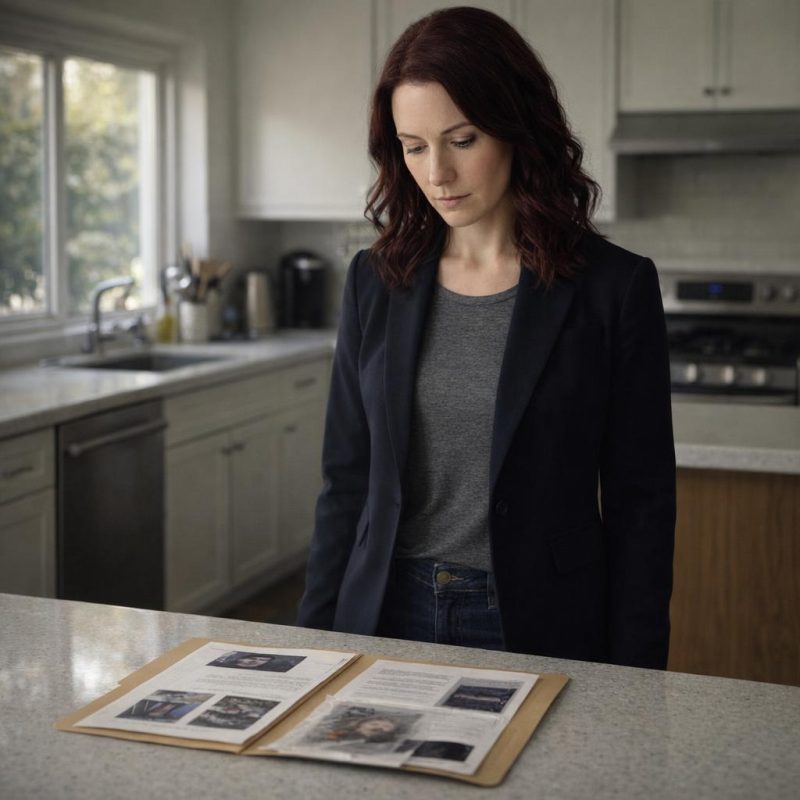 Image by RM AI
The Trap I Thought I'd Set
I'd gone back and forth on whether to show up unannounced or call ahead. Showing up felt more dramatic, but I didn't want to give him grounds to dismiss me for being erratic or confrontational. Calling ahead meant he'd have time to prepare, but I had the documents — preparation wasn't going to change what was in them. I decided calling was the right move. I found his number on the HOA letterhead from the fine notice and dialed before I could second-guess myself. He picked up on the third ring. I told him I had some questions about HOA records I'd reviewed and that I'd like to meet in person to discuss them. I kept my voice level and my phrasing neutral. He was quiet for a moment after I finished, and then he said that would be fine, that I could come by his house the next morning at ten. No pushback. No demand to know what records I meant. No suggestion that I go through Patricia or submit something in writing. Just a calm, almost accommodating agreement, like I'd asked to borrow a cup of sugar. I thanked him and said I'd be there. After I hung up, I stood in the kitchen holding the phone, and something about how easy that had been sat with me in a way I couldn't quite name. I picked up the phone to check the time, confirmed ten o'clock in my calendar, and set it back down.
 Image by RM AI
Photocopies and Proof
I was up early, earlier than I needed to be. I made coffee and sat with it at the table, the presentation folder open in front of me. I went through the documents one last time — not because I thought I'd missed anything, but because the act of going through them steadied me. Marcus's approval on top, then the waiver, then the denial letters in chronological order, then my handwritten timeline, then the one-page summary I'd typed up the night before. Three copies of everything, one set in the folder, two sets in a sealed envelope in my bag as backup. I tabbed the waiver page and the approval signature one more time with fresh sticky flags, because the old ones had started to curl at the edges. I highlighted one additional line in the denial letters that I'd underlined but not marked in yellow — the phrase 'inconsistent with neighborhood aesthetic standards,' which appeared word for word in five of the seven letters, like it had been copied from a template. I closed the folder and pressed my palm flat against the cover for a moment. Then I slid it into my leather bag, buckled the clasp, and set it by the front door.
 Image by RM AI
The Morning Drive
I left the house while the neighborhood was still quiet, the folder buckled into my leather bag on the passenger seat like a second person riding along. The drive to Marcus's house was only about eight minutes, and I used every one of them. I ran through my opening line twice, then a third time, smoothing out the places where my voice had a tendency to rush. I wasn't going to lead with anger. I was going to lead with the document — calm, factual, impossible to dismiss. I'd say I found the waiver in the HOA records during a routine review. I'd say I noticed his signature. I'd say I thought we should talk before this went any further. Clean. Measured. The kind of thing you couldn't argue with because it wasn't an argument — it was just evidence. I turned onto his street and felt the familiar grid of the subdivision open up around me, the wide lots and matching mailboxes and the particular quiet of a neighborhood that takes itself very seriously. His house was at the far end of the cul-de-sac, set back from the road with a long paved driveway. I slowed as I approached. His car was parked right there in the driveway.
 Image by RM AI
Imagining His Reaction
I pulled in behind his car and cut the engine but didn't get out right away. I sat there for a minute with my hands still on the wheel, letting the silence settle. I wasn't nervous — that surprised me a little. What I felt was more like the stillness before you lift something heavy, that moment where you've already committed and your body is just catching up. I went through the key points one more time in my head. The waiver. His signature. The date. The fact that my panels were installed under the same general approval framework he'd used for his own. I pictured his face when I set the document in front of him — that controlled, authoritative expression he always wore — and I imagined it shifting. Not collapsing, not dramatically. Just a small crack. The kind that happens when someone realizes the ground they were standing on isn't as solid as they thought. Maybe he'd say there had been a misunderstanding. Maybe he'd offer to drop the fine without making it a whole thing. I wasn't going to push for an apology, but I wasn't going to let him off without acknowledging what he'd done either. I reached for my bag, unclipped the clasp, and felt the folder solid and real beneath my fingers. That steadiness was enough.
 Image by RM AI
Walking to His Door
I got out of the car and walked up the driveway slowly, not because I was hesitating but because I wanted to take it in. The pavers were the kind that get professionally sealed every couple of years — no moss, no cracking at the edges, just a clean uniform surface that probably cost more than my entire back patio. The hedges along the front of the house were trimmed into tight geometric shapes, and the flower beds were mulched in that dark, expensive-looking way that signals someone either has a landscaper or a lot of free time. The house itself was noticeably larger than mine — two stories, a three-car garage, a covered front porch with stone columns. The kind of house that was designed to communicate something. I kept my pace even and my bag close against my side. By the time I reached the front porch, I'd counted four exterior cameras, two on the garage and two mounted above the porch. I noted that without letting it slow me down. I climbed the two steps to the front door, shifted the bag strap on my shoulder, and raised my hand to knock. The folder was right there inside the bag, tabbed and ready. The weight of it felt like the right kind of preparation.
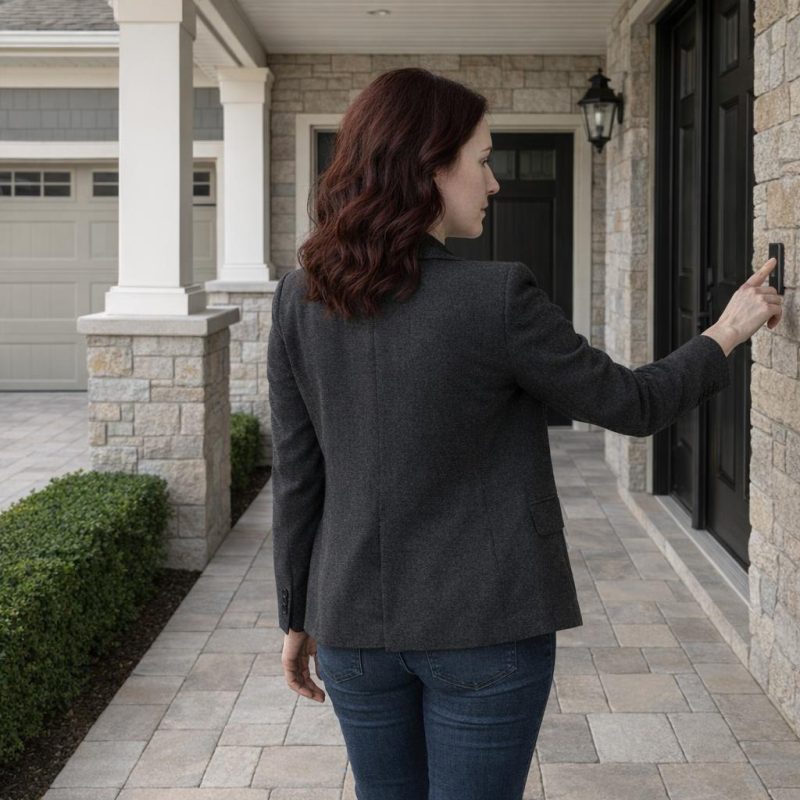 Image by RM AI
The Backyard Array
I paused with my hand raised, and something made me glance to the left before I knocked — just a reflex, the way you check both ways even on a quiet street. There was a gap in the wooden fence that ran along the side of the house, maybe four inches wide where two panels didn't quite meet. I don't know why I looked through it. I just did. The backyard opened up beyond the fence, and behind the main house there was a large flat-roofed structure — a garage or workshop, I couldn't tell from the angle — and covering it completely was a solar array. Not a modest one. Not a few panels tucked discreetly out of sight. This was a full installation, row after row of panels running the entire length of the roof, dark and orderly and unmistakably extensive. I stood there with my hand still half-raised and just stared. I'd known about the panels from the records, from the waiver, from the approval he'd signed for himself while denying everyone else. But seeing them there — physical, real, catching the morning light — was something different entirely. The folder in my bag suddenly felt less like preparation and more like a verdict. I turned back to the front door and knocked.
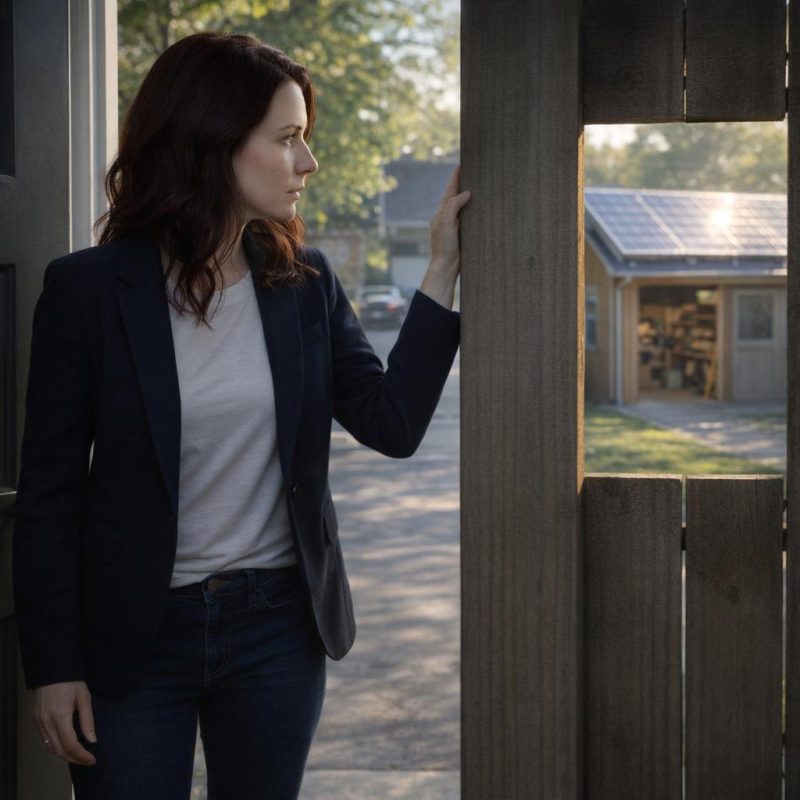 Image by RM AI
Visual Confirmation
I stepped back from the door and let my eyes drift toward the fence gap one more time while I waited. I tried to count the panels I could see from that angle — I got to fourteen before the roofline cut off my view, and that was only a partial section. The array was bigger than mine by a significant margin. Mine was six panels on a south-facing slope, approved through a county permit and installed by a licensed contractor. What I was looking at through that fence was at least twice that, maybe more, sitting on a structure in his backyard where no neighbor walking past would ever think to look. The weight of it settled in my chest — the five-hundred-dollar fine, the formal letter citing aesthetic standards, the feeling that I'd done something wrong by trying to lower my electricity bill and reduce my footprint — and here was this, right behind his fence the whole time. I wasn't angry in a hot, reactive way. It was colder than that, more settled. The kind of feeling that doesn't make you want to shout — it makes you want to be very, very precise. I turned back to the front door and stood straight, folder in my bag, ready.
 Image by RM AI
Marcus Answers
The door opened faster than I expected — maybe ten seconds after I knocked, like he'd already been near the front of the house. Marcus filled the doorway in a collared shirt and pressed slacks, which struck me because it was barely eight in the morning on a weekday. He looked at me without any visible surprise. 'Chloe,' he said, the way you'd greet someone you'd been expecting. Not warmly, but not with hostility either — just a flat acknowledgment, like I was a scheduled appointment he'd already mentally prepared for. He said we could talk outside and stepped through the door before I had a chance to respond, pulling it shut behind him. He moved to the edge of the porch and turned to face me with his hands loose at his sides, waiting. I'd expected him to be defensive, or at least guarded. Instead he just stood there in the morning light looking like a man who had nowhere else to be and nothing in particular to worry about. Whatever I'd imagined on the drive over — the crack in his expression, the small moment of recalibration — none of that was visible. His voice, when he'd said my name, had been level and unhurried, like still water.
 Image by RM AI
The Confrontation Begins
I didn't waste time on small talk. I unzipped my bag, pulled out the folder, and opened it to the tabbed page — the photocopied waiver with his signature at the bottom, the date clearly visible. I told him I'd been reviewing the HOA records and found the approval he'd filed for his own solar installation. I kept my voice even. I said I thought it was worth discussing, given that my installation had been denied and fined under the same HOA guidelines. I held the document out toward him. He looked at it for a moment before he took it — not a long pause, just enough that I noticed it — and then he accepted it from my hand without a word. He held it at a slight angle, the way you hold something in bright light when you want to read it carefully, and his eyes moved across the page in a slow, methodical way. He didn't react. No sharp intake of breath, no shift in his posture, no quick glance up at me to gauge my expression. He just read. I stood there with the open folder still in my hands and watched him work through every line of the document, and I waited for him to reach the part where his own name appeared.
 Image by RM AI
His Calm Examination
He took his time with it. He read the whole thing through once, then went back to the top and read it again — not skimming, actually reading, his eyes tracking each line with a patience that I hadn't anticipated. I'd expected him to get to his signature and stop. To look up. To say something. Instead he kept going, and the longer he read, the more the silence between us started to feel less like a pause and more like something with its own shape. I shifted my weight slightly and kept my expression neutral. I wasn't going to fill the quiet for him. When he finally looked up, he didn't hand the document back. He held it at his side, loosely, like he'd already decided what it was and what it wasn't. He looked at me for a moment without speaking. And then something moved across his face — not surprise, not guilt, not the crack I'd been waiting for. It was something else, something I couldn't quite name. His jaw settled. The line of his mouth changed by a fraction. It wasn't the expression of a man who'd been caught.
 Image by RM AI
The Smirk
He handed the document back to me. Not dropped it, not pushed it across — handed it, with a kind of deliberate ease that made my stomach tighten. I took it without thinking, my fingers closing around the edge of the paper, and I stood there holding it like I'd just been returned something I no longer understood. His expression had shifted. The tension I'd expected — the defensiveness, the bluster — none of it was there. Instead there was something almost relaxed in the set of his shoulders, something that looked uncomfortably close to relief. I kept my face still. I told myself it was a performance, that he was trying to throw me off. But the smile that followed wasn't the smile of a man scrambling. It was slow and settled, like he'd been waiting for this exact moment and was glad it had finally arrived. He looked at the document in my hands, then back at me, and the smile didn't waver. I wanted to say something — push back, hold my ground — but the words weren't forming the way I needed them to. And then he said he was glad I'd found that particular document.
 Image by RM AI
Something Wrong
I stood there holding the waiver and tried to make sense of what I'd just heard. Glad. He'd said he was glad. I turned the word over in my head and it didn't fit any version of this conversation I'd prepared for. I'd walked in here with evidence. I'd been so certain of what it meant — that his own approval waiver proved the double standard, proved the hypocrisy, proved that the fine against me was arbitrary and unfair. And now he was standing there with his arms loose at his sides, looking at me the way someone looks at a situation they've already accounted for. I glanced down at the document. The same pages I'd read three times at home, the same language I'd highlighted and cross-referenced. Nothing had changed on the paper. But something had shifted in the room, and I couldn't locate exactly where. I searched his face for the crack I'd been expecting — some flicker of discomfort, some sign that I'd landed a blow. There was nothing. He just waited, patient and unhurried, like a man who already knew how the next few minutes were going to go. The dread settled into my stomach quietly, the way cold does when you've been standing in it too long.
 Image by RM AI
He Begins to Explain
He asked me if I'd read the entire waiver. Not in a challenging way — in the tone of someone asking a clarifying question they already knew the answer to. I said yes. Of course I had. He nodded, slowly, like that confirmed something he'd suspected. Then he asked if I'd paid attention to the specifications section. I said I had. I'd focused on the approval itself, on the fact that he'd signed off on solar panels for his own property while fining me for mine. That was the point. That was what I'd come here to show him. He nodded again, and there was something in that nod that I didn't like — a kind of patience that felt less like listening and more like waiting. He said there was something important I should understand about that waiver. His voice was even and unhurried, each word placed carefully, and I found myself watching his mouth instead of his eyes, trying to get ahead of whatever was coming. I couldn't. He hadn't said anything yet that I could push back against, and that was the part that was starting to unsettle me — the sinking feeling that whatever he was about to say, I wasn't going to be ready for it.
 Image by RM AI
Flat Roofs
He asked to see the waiver again. I handed it back without thinking — a reflex, the same way you hand something to a doctor when they reach for it. He took it and turned to the last two pages, moving through them with the ease of someone who knew exactly where he was going. He didn't scan. He went straight to a paragraph near the bottom of the third page, one I'd read but hadn't stopped on, and he turned the document toward me so I could see it. He read the relevant section aloud. His voice was flat and factual, no emphasis, no drama — just the words as written. I followed along, my eyes tracking the lines as he spoke. The language was dense the way HOA documents always are, full of qualifiers and subclauses, and I'd moved through it quickly when I'd reviewed it at home because the approval itself had seemed like the important part. I heard the phrase before I fully processed it. He kept reading for another sentence or two, then stopped and looked up at me. He said the waiver, as written, applied only to flat roof structures.
 Image by RM AI
His Roof, My Roof
He set the document down on the table between us and explained it plainly, like he was walking me through something obvious. His backyard structure — the one with the panels — had a flat roof. A detached garage, he said, set back from the property line, not visible from the main street. The waiver had been written specifically for that configuration. He then pointed out, with the same unhurried calm, that my house had a pitched roof. Angled, street-facing, visible from the front of the neighborhood. He said those were two different situations under the language of the document, and the waiver addressed one of them. I looked down at the paragraph he'd indicated. The words were right there. Flat roof structures only. I'd read it. I'd read the whole thing. But I'd been so focused on the approval — on the fact that he'd gotten one and I hadn't — that I'd moved past the specification without letting it register. I read the line again. Then again. The waiver I'd carried in here like a piece of evidence, the document I'd been so sure would change everything, had a boundary written into it that I hadn't seen until this moment, and the weight of that sat on me without moving.
 Image by RM AI
The Distinction
I read the paragraph a third time, slower, and the meaning didn't change. Flat roof structures. That was the scope of the waiver. That was all it had ever covered. My house had a pitched roof — anyone standing on the sidewalk out front could see that. The panels on my roof were visible from the street in a way his garage installation simply wasn't. I'd built my entire argument on the assumption that his approval and my situation were equivalent, that the same standard should apply to both. But the document in my hands said otherwise, in plain language, in a paragraph I had read and not absorbed. I thought about the hours I'd spent on this. The records request, the binder, the cross-referencing, the careful notes. I thought about how certain I'd felt walking up to his door. I'd been so sure I had him. I'd been so sure the waiver was the thing that would make everything fall into place. Marcus stood across from me, relaxed, saying nothing, letting the silence do the work. He didn't need to gloat. The document was doing it for him. I set it down on the table and looked at it lying there, and the sick feeling of understanding my mistake settled over me like something I couldn't shake off.
 Image by RM AI
Restricted Files
I was still looking at the document when he spoke again. He said he had another question. His tone hadn't changed — still measured, still unhurried — but something in the shift of subject made me look up. He asked about my records request. How I'd gone about it, specifically. I told him I'd submitted a written request to the HOA office and Patricia had provided me with a binder of documents. He listened, nodded. Then he asked whether there had been a board vote authorizing my access. I didn't answer right away. I thought back to the afternoon I'd sat across from Patricia, the binder she'd slid across the desk, the way she'd looked uncomfortable as she handed it over. I hadn't asked about authorization. It hadn't occurred to me to ask. I'd submitted a request, she'd provided materials, and I'd assumed that was how the process worked. Marcus let the silence stretch for a moment. Then he said that certain files within the HOA records system were classified as executive documents. He said access to those files wasn't automatic — it required a formal vote by the board. He looked at me steadily and asked whether the board had voted to grant me access to restricted files.
 Image by RM AI
Privacy Bylaws
I didn't have an answer and he could see that. He didn't wait for one. He said the waiver I'd obtained was housed in the executive file category — documents restricted under the community's privacy bylaws, not available through a standard records request. He cited the bylaw number from memory, the way someone does when they've had reason to know it for a long time. He explained that Patricia, as HOA secretary, did not have the authority to release those files unilaterally. A board vote was required. Without one, the release was unauthorized. He said it quietly, without any particular heat, which somehow made it worse. I stood there trying to think of something — any procedural detail, any exception, anything I might have missed that would change the shape of what he was describing. There was nothing. I'd walked in here thinking I was the one holding the evidence. I hadn't considered that the way I'd obtained it might matter as much as what it said. Marcus straightened slightly and said that unauthorized access to restricted HOA files carried its own penalties under the community bylaws — a fine of up to one thousand dollars per violation.
 Image by RM AI
The Violation
I stood there trying to process what he was saying. The bylaw number he'd cited — I hadn't even known that section existed. I'd gone through the HOA rules document twice before any of this started, and I'd missed it entirely. Marcus kept his voice even, almost patient, explaining that the executive file category existed specifically to protect sensitive board deliberations from general member access. Patricia, he said, had been a secretary long enough to know that. The fact that she'd handed those documents over without a board vote didn't transfer the violation to her — it transferred it to me, the person who'd requested them and used them. He said the privacy bylaw was unambiguous. He said the penalties were written clearly in section nine. He said the HOA had full legal authority to enforce them. I asked what that meant, practically. He looked at me the way someone looks at a person who already knows the answer but needs to hear it out loud. He said it meant the HOA could pursue collection through whatever mechanisms the law allowed. Then he said the words slowly, like he wanted each one to land separately — foreclosure lien.
 Image by RM AI
The Foreclosure Threat
I heard the words but my brain kept sliding off them. Foreclosure lien. He explained it the way someone explains a bus schedule — calmly, without any particular feeling. The HOA had the legal authority, under state statute and the community's governing documents, to place a lien on a property when fines and penalties went unpaid. If the lien remained unresolved, the HOA could initiate foreclosure proceedings. He said this had happened before in other communities. He said it was not a threat, it was simply how the enforcement mechanism worked. I thought about my mortgage. I thought about the equity I'd spent six years building. I thought about the solar panels sitting on my roof that I'd installed to save money, to do something right, and how that single decision had somehow led me to this moment, standing in Marcus's living room while he explained how I might lose my house. The original five-hundred-dollar fine felt almost laughable now. I hadn't come here with leverage. I'd come here and handed him something far worse than anything he'd had before. The weight of that settled into my chest and didn't move.
 Image by RM AI
Years in the Making
I asked him why. It came out smaller than I intended. Why go to all this trouble — the bylaw, the executive file category, the penalty structure. He tilted his head slightly, like the question amused him. He said the HOA's governing documents had been structured carefully over many years to protect the board's ability to manage the community without interference from members who didn't understand the full picture. I said that wasn't what I was asking. He looked at me for a moment, and something shifted in his expression — not quite a smile, but close. He said the waiver had been filed in the executive category from the beginning. He said anyone who went looking for it and pulled it without authorization would find themselves in exactly the position I was in now. He said the flat roof specification had always been part of the document. He said the privacy bylaw had always carried that penalty. He said none of this was new. Then he said, in the same unhurried tone he'd used for everything else, that I wasn't the first person to come to his door with a folder full of documents — and that he'd been waiting for someone exactly like me.
 Image by RM AI
Completely Trapped
I don't remember saying goodbye. I don't remember walking down his front steps. I remember the folder in my hand and the way the afternoon light felt wrong — too bright, too ordinary for what had just happened inside that house. I got to my car and sat down and put the folder on the passenger seat. I didn't start the engine. I just sat there. I kept going back over the conversation, trying to find the moment where I could have done something differently, said something that would have changed the shape of it. There wasn't one. He'd known exactly what I was going to say before I said it. He'd known what I was going to bring. The waiver I'd thought was my evidence — it had never been evidence. It had been the mechanism. And Patricia handing it over, me walking through his door with it — that was the whole point. The folder sat on the seat beside me, useless. Every page in it, useless. I stared through the windshield at nothing in particular, and the quiet of the car pressed in around me from every direction.
 Image by RM AI
The Full Reveal
I sat in that car for a long time before I let myself go through it all the way. The waiver — I'd found it and thought I'd found proof of hypocrisy. But the waiver only applied to flat roof structures. My roof was pitched. It had always been pitched. The exemption had never covered my installation at all, which meant the original fine was still valid, and everything I'd done since had only made my situation worse. Accessing those executive files without a board vote was a clear bylaw violation. The penalty for that violation was real and enforceable. The HOA had legal authority to place a lien on my property. If I didn't resolve it, they could foreclose. Marcus had filed that waiver in the restricted category years ago. He'd made sure the flat roof specification was in there. He'd made sure the penalty structure was written into the bylaws. He'd waited. He'd told me himself — I wasn't the first. He'd built a system where anyone who went looking for ammunition would hand him something far more powerful in return. The full scope of what he'd constructed sat over me like something with real weight, and I finally understood exactly how deep it went.
 Image by RM AI
Driving Home Defeated
I drove home on autopilot. I don't remember most of the route — just the feel of my hands on the wheel and the traffic lights changing and the radio playing something I didn't hear. I kept thinking about the lien. About what foreclosure actually meant in practical terms — the timeline, the notices, the point at which it stopped being theoretical. I'd bought my house on my own. Saved for four years for the down payment. The solar panels were supposed to be the next smart decision, the responsible one. Now they might be the thing that cost me everything. But underneath the fear, something else kept surfacing. Why would someone go to this much trouble over solar panels? The fine, the trap, the years of preparation — it was too elaborate for a man who just didn't like the look of panels on a roof. There had to be something else underneath it. I didn't know what it was yet. I pulled into my driveway and sat for a moment before going inside. The house was quiet in the way empty houses are quiet, and I stood in the kitchen not turning on any lights, just letting the stillness hold me where I was.
 Image by RM AI
The Foreclosure Fear
I spent most of that evening at my kitchen table with my laptop open, reading everything I could find about HOA foreclosure liens. The cases were real. The timelines varied by state, but the mechanism was consistent — unpaid fines, escalating penalties, lien placement, and then, if nothing was resolved, foreclosure proceedings. People had lost homes over amounts that started small. I read three separate case summaries and felt sick each time. I ran the numbers on my own situation twice, trying to figure out how long I had before any of this became irreversible. The answer wasn't comforting. I closed the browser tabs and sat back and stared at the ceiling. Marcus had the fine, the privacy violation, and the penalty structure all lined up. I had nothing. Except — I kept coming back to the same question I couldn't shake on the drive home. A man doesn't build a trap this elaborate just to enforce aesthetic standards. He doesn't spend years structuring bylaws and filing documents in restricted categories because he cares about roof lines. I pushed the laptop aside and pulled up the folder I'd scanned before any of this started — Marcus's own solar installation approval — and I decided I needed to understand why solar panels mattered so much to him.
 Image by RM AI
A New Investigation
I went back to the beginning. Marcus's approval documents — the ones that had started all of this — were still in a folder on my desktop. I opened them and read through more carefully this time, not looking for hypocrisy, looking for details. The installation had been approved three years ago. The paperwork listed the contractor. I'd glanced at the company name before without thinking much of it. Now I wrote it down. I searched for it. The website was minimal — a logo, a phone number, a contact form, no staff listed, no physical address beyond a P.O. box. I searched the business name in the state's corporate registry. The registration was there, filed about four years ago. I noted the registered agent's name and kept going. I pulled up the county property records next, then a business license database I'd used once for something else. I wrote everything down in a notebook, one column of facts next to another. I didn't know yet what I was looking at. But the fear that had been sitting in my chest all evening had shifted into something quieter and steadier, and I kept writing.
 Image by RM AI
The Company Search
I typed the company name into the search bar and waited. The results were thin — a basic business listing on one of those auto-generated directory sites, a single entry in a local contractor database, and that was about it. No Yelp page. No Google reviews. No Facebook business profile with photos of happy customers and finished installations. I tried variations of the name, added the city, added the state. Nothing changed. For a company that had supposedly been operating for four years, there was almost no footprint. Most legitimate solar installers have at least a handful of reviews — people love to talk about their energy savings, their payback period, how the crew treated their lawn. This company had none of that. I searched for the phone number listed on the website and got zero results. I searched the P.O. box address and found it connected to a mail forwarding service. I sat back and looked at what I had in front of me. A company with a registration, a logo, and a phone number — and nothing else. No history. No customers willing to say they'd been served. The silence where a real business's reputation should have been sat there on my screen, and I couldn't look away from it.
 Image by RM AI
Corporate Records
I navigated to the state's business registry portal and typed in the company name. The search returned one result. I clicked through to the full filing and started reading. The registration date, the business type, the registered agent — I wrote it all down. Then I got to the ownership section. Most small LLCs list a managing member or a registered agent's firm. This one listed a sole proprietor. A woman's name. Diane Hartwell. I read it twice. The name didn't mean anything to me immediately — I'd never heard Marcus mention anyone by that name, and it wasn't a name I recognized from any HOA correspondence. But something about it made me stop. A solar company with no reviews, no visible history, approved to work in our neighborhood by the HOA president himself — and the sole proprietor was a woman I'd never heard of. I wrote the name down in my notebook and circled it. Then I opened a new browser tab. The name Diane Hartwell sat in the search bar, cursor blinking.
 Image by RM AI
The Shell Corporation
The first result was a Facebook profile. I clicked it. The profile photo showed a woman in her mid-forties, polished and smiling, standing next to Marcus at what looked like a neighborhood association event. I recognized the community center in the background. I scrolled down. More photos — a holiday party, a backyard barbecue, a formal dinner. Marcus in every one of them. I went back to the search results and found a LinkedIn profile that listed her full name as Diane Hartwell-Reeves. Hartwell was her maiden name. I sat very still for a moment. Marcus's wife. The solar company was registered under his wife's maiden name. That was why I couldn't find any connection to him in the corporate records — her maiden name created just enough distance to make it look unrelated. And then the whole shape of it came into focus. Every solar application he rejected sent residents back to square one. The only path to approval ran through his company. His wife's company. The one with no reviews because the customers weren't choosing it freely — they were being funneled into it. I sat there with the full weight of what he'd built pressing down on me, and I didn't move for a long time.
 Image by RM AI
The Inflated Prices
I went back into the HOA records and pulled every approved solar installation from the past three years. There were six of them. All six listed the same contractor. I already knew what I'd find, but seeing it laid out like that still made my jaw tighten. I started cross-referencing the approval files with any attached documentation. Two of the files had invoices scanned in as supporting materials — I wasn't sure if that was standard practice or if someone had submitted them as part of the approval packet, but they were there. I opened the first one. A four-panel residential installation, standard equipment, nothing unusual about the scope of work. I pulled up three different solar cost estimator tools and ran the same system size through each one. The average came back around $11,000. Then I looked at the total at the bottom of the invoice: $34,800. I opened the second file, and the number at the bottom of that invoice stopped me cold.
 Image by RM AI
Thomas's Story
I found Thomas's name in the approval records and looked him up in the neighborhood directory. I called him that evening, half-expecting to leave a voicemail. He picked up on the second ring. I introduced myself and told him I'd been looking into the HOA's solar approval process. There was a pause, and then he said, 'You too, huh.' I asked him to walk me through what happened. He told me his first application was rejected — Marcus had cited a vague aesthetic concern about panel placement. Thomas said he'd revised the plans twice and gotten the same result both times. Then, at the third rejection, Marcus had mentioned — casually, like he was doing Thomas a favor — that there was one contractor who seemed to understand the neighborhood's standards. Thomas said he'd felt like he had no other choice. He paid $31,500 for a system he later found out should have cost around $10,000. He still had every email, every rejection letter, and the original invoice. His voice was steady when he said it, but I could hear the anger underneath. 'I've been waiting for someone to put this together,' he said. 'I'll send you everything tonight.'
 Image by RM AI
Gathering Evidence
Thomas sent the files within the hour — rejection letters, the contractor correspondence, and the invoice, all organized into a single folder. I printed everything and laid it out on my kitchen table next to what I already had: the corporate registration showing Diane Hartwell as sole proprietor, the two invoices from the HOA approval files, and the board minutes Patricia had given me. Two other neighbors had responded to the quiet inquiries I'd sent through the neighborhood email list — both had similar stories, both still had their paperwork. I added their invoices to the pile. The table looked like a case file. I stood there looking at all of it — the pattern was undeniable, documented, and traceable. Thomas called while I was still organizing. 'So what do we do with this?' he asked. I told him I'd been thinking about that. A formal complaint could get buried. A letter to the board would go straight to Marcus. There was only one way to make sure this couldn't be quietly managed away. I was going to call an emergency neighborhood meeting and put every piece of this in front of everyone at once.
 Image by RM AI
The Emergency Meeting
I drafted the meeting invitation that night and sent it to the full neighborhood email list the next morning. I kept the subject line simple: Emergency HOA Meeting — Important Information for All Residents. Within two hours, thirty-four people had responded. Most were asking what it was about. A few said they'd be there no matter what. One email stood out — it was from Rachel, a woman I'd seen at previous HOA meetings but never spoken to directly. She wrote that she'd had her own frustrations with the solar approval process and asked if she could help organize. I wrote back immediately and said yes. Rachel and I spent the next two days coordinating — she handled the logistics, I handled the evidence. I printed copies of everything: the corporate registration, the inflated invoices, the rejection letters, the board minutes. I rented a small PA system for the outdoor space at the park. I rehearsed what I was going to say, standing in my living room with my notes, until the sequence felt solid and clear. The night before the meeting, I sat at my kitchen table with the stacked folders in front of me, the house quiet around me, and felt something I hadn't felt in weeks — a stillness that wasn't dread.
 Image by RM AI
The Public Exposure
Saturday morning, the park filled up faster than I expected. I counted over sixty people by the time I stepped up with the PA system microphone. Rachel stood to my left with a box of printed packets — one for every household. I started from the beginning: the solar panel fine, the rejection letters, the company name in the approval records. I walked them through the corporate registration, Diane Hartwell's name as sole proprietor, and the connection to Marcus. I held up the invoices — Thomas's $31,500 charge, the others — and read the numbers out loud. I heard people in the crowd start talking to each other before I'd even finished the sentence. Marcus arrived about fifteen minutes in, Diane a step behind him. He moved toward the front like he was going to take the microphone, and the crowd shifted to block him — not dramatically, just people stepping into the space between us. Rachel moved through the rows handing out the packets, and I watched people open them and go quiet as they read. Then the quiet broke. Someone near the back said, loudly, that he'd paid that company too. Another voice followed. Then another. Marcus stood at the edge of the crowd, and the anger in the air around him was something you could feel without looking directly at it.
 Image by RM AI
The Vote
Rachel didn't wait for a pause. She stepped forward, raised her voice over the crowd, and called for an immediate vote to remove Marcus from the HOA presidency. No committee review, no tabled motion — just a straight show of hands, right there in the park. She asked who was in favor. Every hand went up. I counted without meaning to, the way you do when you can't quite believe what you're seeing. Sixty-plus hands, all of them up, not a single one held back. Marcus stood at the edge of the crowd and didn't move. Diane was a step behind him, her face composed in that careful way she had, but her eyes were somewhere else entirely. Rachel moved quickly after that — she asked for three volunteers to form a temporary board, and hands shot up again. Thomas was one of the first. The new board's stated first order of business was a full review of every decision Marcus had made during his tenure. Someone in the crowd started clapping, and it spread fast. I looked over at Marcus. He didn't speak. He didn't argue. He turned, and Diane followed, and they walked out of the park together — and just like that, the authority he'd spent years building over this neighborhood was gone.
 Image by RM AI
Fines Dropped
The new board held their first official meeting three days later at Rachel's house. I sat at her kitchen table with my folder of documents — the fines, the rejection letters, the foreclosure notice — and for the first time since this whole thing started, I wasn't bracing for a fight. Rachel had been voted in as interim president, and she ran the meeting with the kind of efficiency that made me think she'd been waiting a long time for exactly this. They reviewed my case first. It took less than ten minutes. The vote to drop all fines was unanimous, and the motion to grant full approval for my solar panels passed without a single objection. Rachel slid a printed copy of the approval across the table to me — official letterhead, board signatures, the whole thing. The foreclosure threat was gone. Officially, formally, permanently gone. I sat there holding the paper and thought about the months of letters and meetings and sleepless nights, the way my hands used to shake every time I opened my mailbox. Rachel said, quietly, that the neighborhood owed me an apology, and she meant it. I didn't need the apology. But I was glad someone said it. The paper sat in my hands, and for the first time in months, the weight I'd been carrying felt like it had finally set itself down.
 Image by RM AI
Criminal Investigation
Rachel and I drove to the county sheriff's office on a Tuesday morning with a bankers box full of documents — the corporate registration, the invoices, the HOA approval records, the financial statements, all of it organized and labeled. I'd spent the weekend making sure everything was in order, cross-referencing dates, flagging the most damning pages with sticky notes. The detective who met with us was methodical and unhurried, which I appreciated. He asked good questions. He went through the invoices one by one, asked about the corporate registration timeline, asked how we'd connected Diane's company to the HOA approval process. When I explained the markup structure — what residents had paid versus what the panels actually cost — he stopped writing and looked up. He said the word fraud without any hesitation, and then he said they'd be opening a formal investigation. He told us Marcus and Diane would be contacted by investigators. Rachel and I gave full statements, signed everything, and answered every follow-up question he had. By the time we were done, it was past noon. The detective thanked us, picked up the bankers box, and carried it through the door at the back of the room.
 Image by RM AI
Panels Running
A few weeks later, I was standing in my backyard with my phone open to the solar monitoring app, watching the numbers tick upward in real time. The panels were running at full efficiency — better than the installer had projected, actually. I did the math on what I'd saved since they went live, and then I did the math on what I'd spent fighting to keep them, and the second number was smaller than I expected. Worth it either way. I'd heard through Rachel that investigators had contacted Marcus and Diane, that attorneys were involved, that the process was moving the way these things move — slowly, but forward. The neighborhood had new leadership, honest leadership, people who answered emails and held transparent meetings and didn't run side businesses off the back of the community they were supposed to serve. I thought about the version of me who almost backed down — who almost paid the fine, pulled the panels, and let it go. I was glad I hadn't. The app showed 847 kilowatt-hours generated since installation, the number still climbing, and the morning light was hitting the panels at exactly the right angle.
 Image by RM AI
KEEP ON READING

20 Powerful Ancient Egyptian Gods That Were Worshipped
Unique Religious Figures in Ancient Egypt. While most people are…
By Cathy Liu Nov 27, 2024
The 10 Scariest Dinosaurs From The Mesozoic Era & The…
The Largest Creatures To Roam The Earth. It can be…
By Cathy Liu Nov 28, 2024
The 20 Most Stunning Ancient Greek Landmarks
Ancient Greek Sites To Witness With Your Own Eyes. For…
By Cathy Liu Dec 2, 2024
10 Historical Villains Who Weren't THAT Bad
Sometimes people end up getting a worse reputation than they…
By Robbie Woods Dec 3, 2024
One Tiny Mistake Exposed A $3 Billion Heist
While still in college, Jimmy Zhong discovered a loophole that…
By Robbie Woods Dec 3, 2024
30 Lost Treasures That Vanished From History
Buried treasure, missing artefacts, legends of ancient gold in them…
By Robbie Woods Dec 3, 2024