The Most Famous Media Interpretations of Dante's Inferno
Dante Alighieri’s Inferno has lasted partly because it gives later artists such a clear structure to work with. Britannica’s overview of Inferno describes it as the first section of The Divine Comedy, written around 1308 to 1321, and follows Dante as the Roman poet Virgil guides him through Hell. That journey moves through nine circles, with each circle tied to specific sins and punishments. The poem is medieval, but its shape has proved surprisingly easy to carry into new media.
A few interpretations stand out because they come from very different eras and use very different tools. Botticelli turned Dante’s Hell into a Renaissance visual plan. Rodin turned it into a massive sculptural world of bodies and suffering. Over the Garden Wall, a more modern rendition, reworked the idea of a strange journey through a dark, morally uneasy place for animated television.
Botticelli’s Chart of Hell
 Sandro Botticelli on Wikimedia
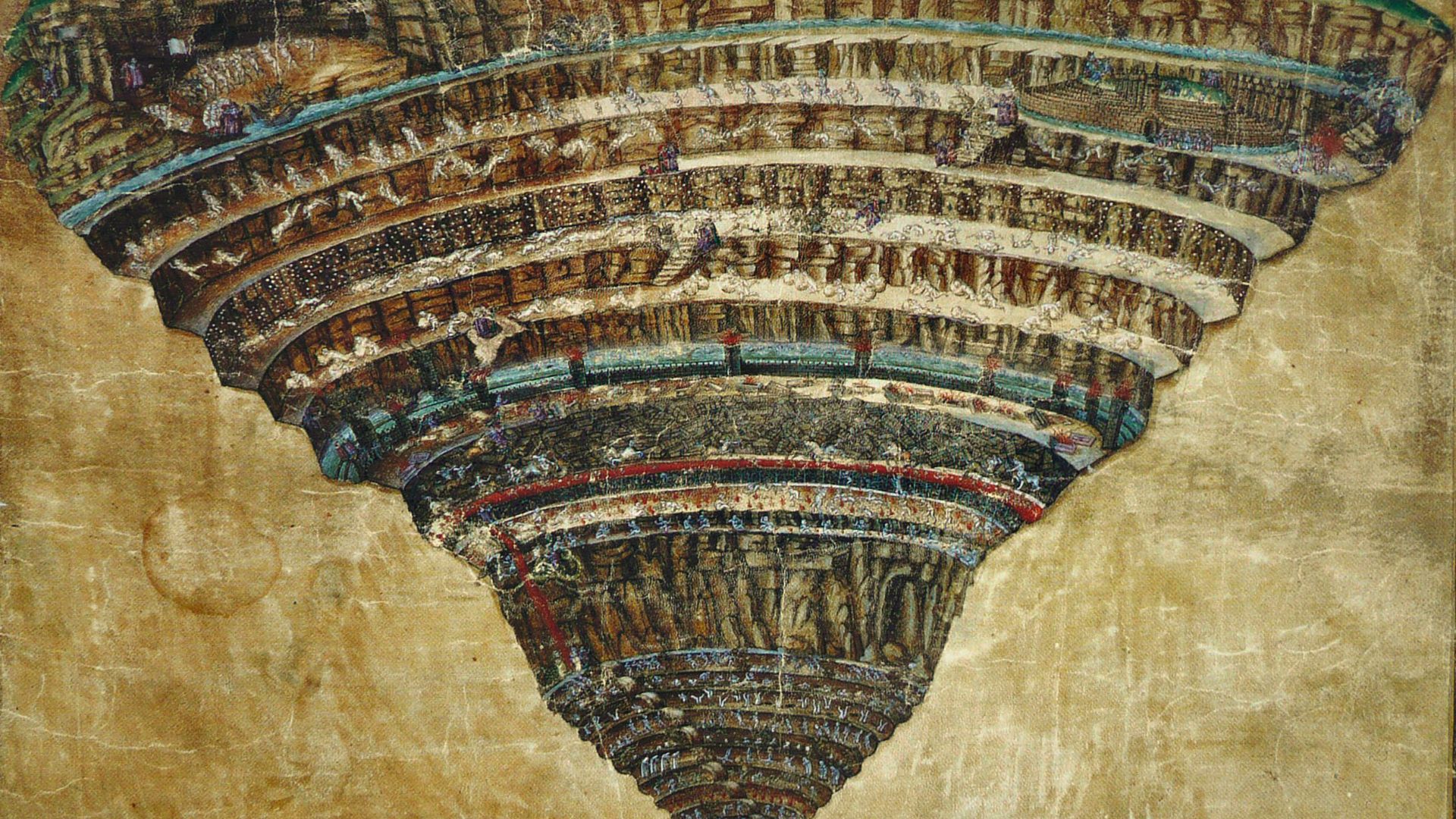
Sandro Botticelli’s Chart of Hell, also known as La Mappa dell’Inferno, is one of the clearest early visual interpretations of Dante’s underworld. The University of Virginia’s World of Dante identifies the work as Botticelli’s Chart of Hell, dated around 1480 to 1495, and connected to the Vatican manuscript Vat. Lat. 1896. The image turns Hell into a descending funnel, with each level arranged so viewers can follow the path downward.
Dante’s Hell is structured, and Britannica’s entry on The Map of Hell describes Botticelli’s version as a funnel made up of nine major levels, each corresponding to one of Dante’s circles. Botticelli gives the reader a way to understand the poem all at once. It’s careful, compact, and unsettling.
The drawing also shows how early and naturally Dante moved beyond the written page. Botticelli wasn’t simplifying the poem so much as making its geography easier to see. A reader could look at the chart and understand that Dante’s Hell has a moral order.
Rodin’s The Gates of Hell
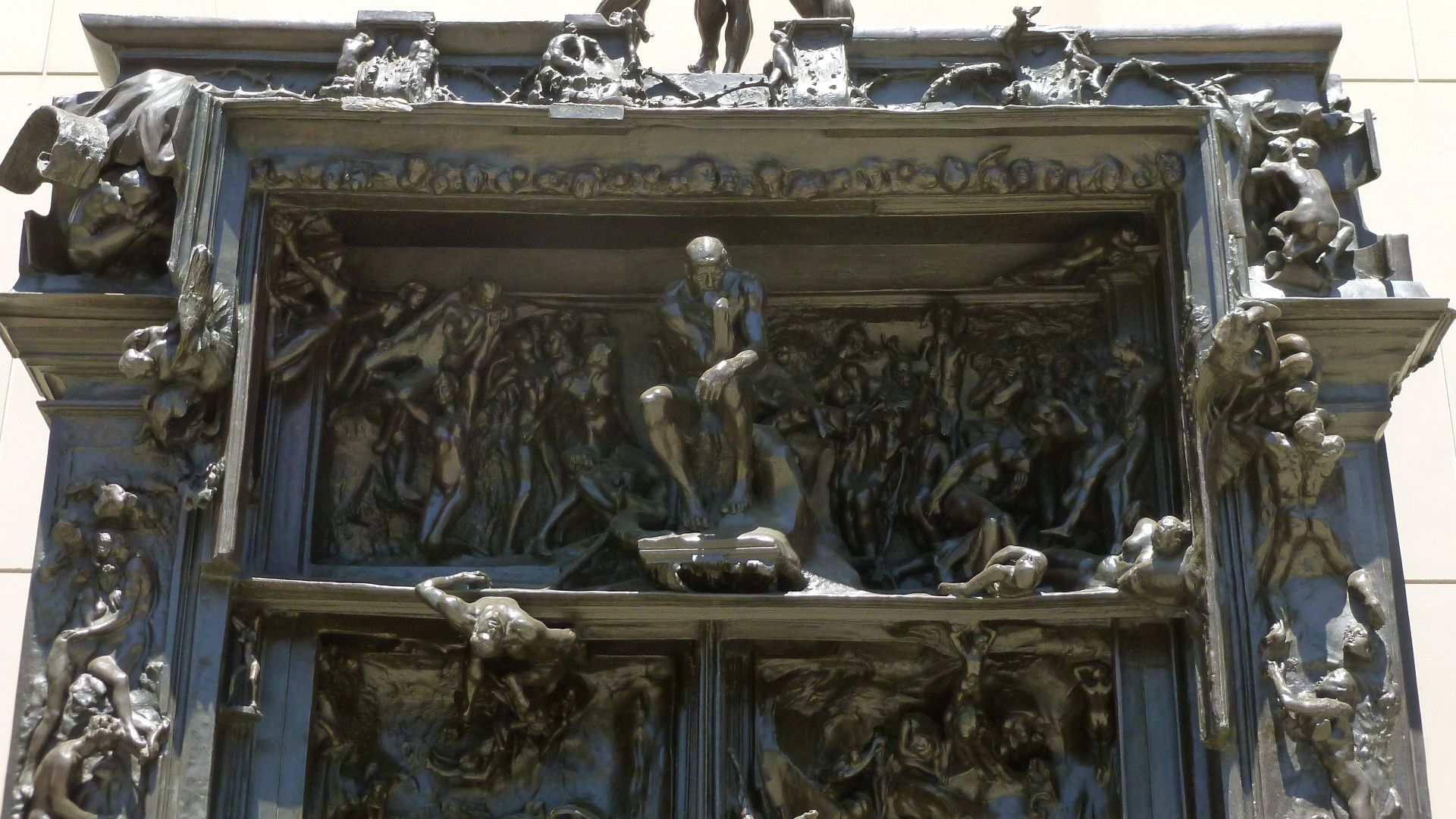
Auguste Rodin’s The Gates of Hell takes Dante in a completely different direction. The Musée Rodin dates the conception of the work from around 1880 to around 1890 and describes it as a project that held a unique place in Rodin’s career. The museum also says Rodin created more than 200 figures and groups for it.
Rodin’s interpretation doesn’t walk viewers neatly through the nine circles. It feels more physical than geographic. Figures twist, lean, fall, and crowd one another, so the viewer meets Dante’s Hell through movement and strain rather than through an ordered map.
The Gates of Hell is also famous because it produced The Thinker. The Musée Rodin’s page on The Thinker explains that the figure was conceived in 1880 as the crowning element of The Gates of Hell and was originally called The Poet. The museum says the figure represented Dante leaning forward to observe the circles of Hell while meditating on his work.
Over the Garden Wall
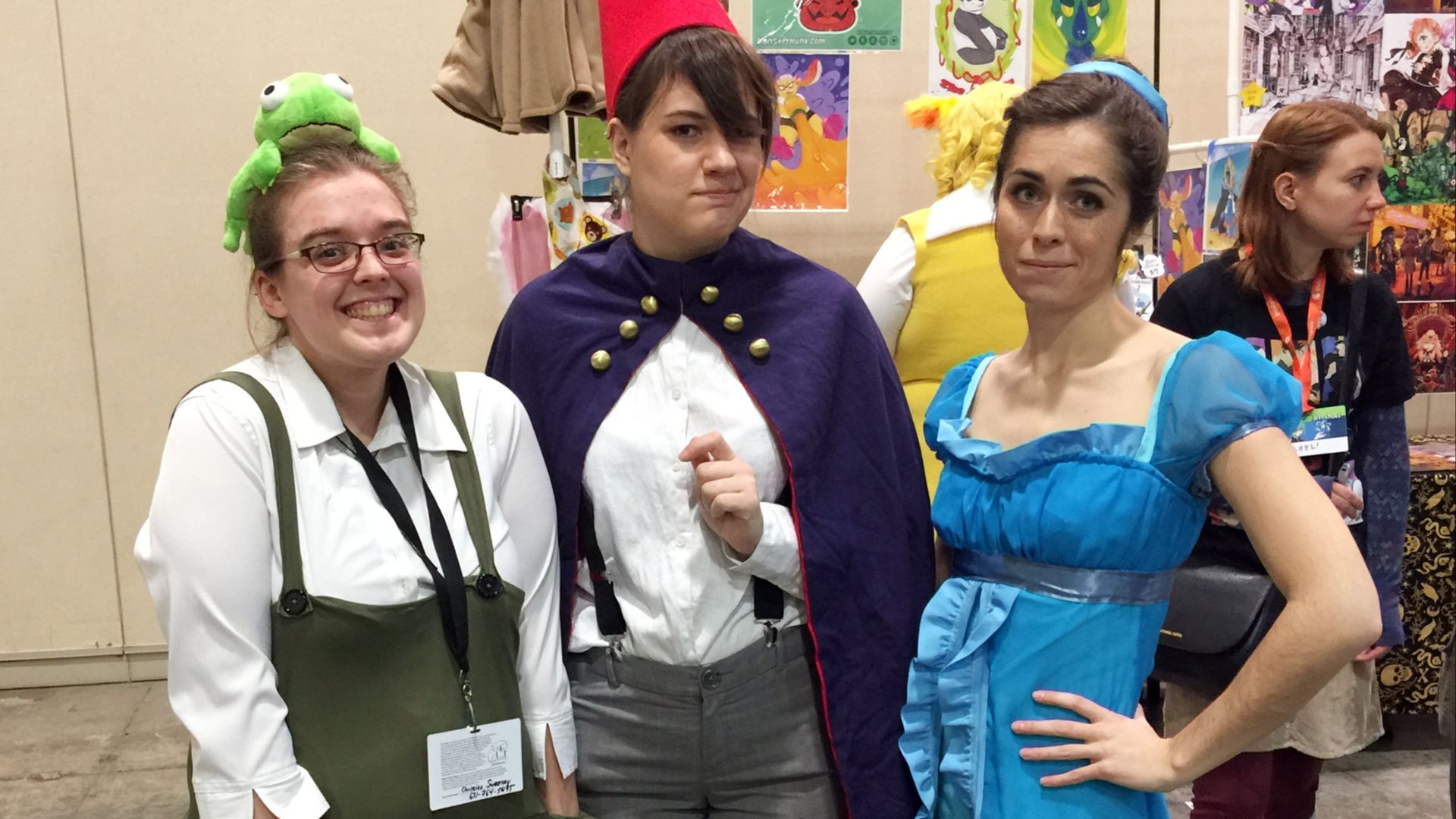
Over the Garden Wall brings Dante into a much newer kind of media, though in a less literal way. The 2014 Cartoon Network miniseries was created by Patrick McHale. It follows Wirt and Greg, two brothers lost in the woods and trying to find their way home through a strange place called the Unknown.
Over the Garden Wall is not a straight adaptation in the way Botticelli’s chart or Rodin’s gates are. Even so, it has become one of the most interesting modern works to discuss, as scholars have treated it as a meaningful echo of The Divine Comedy. A 2021 article listed by the Universidad Complutense de Madrid, A Shift in Storytelling: Over the Garden Wall as a Literary Reconstruction of Dante’s Divine Comedy, reads Wirt’s journey as a replication of Dante’s descent through Hell.
The show’s strongest Dantean link may be mood rather than plot. In a 2016 article in Humanities, Kristiana Willsey writes that the brothers begin their journey by finding themselves in a dark wood. A bluebird, named Beatrice, is a recurring character in the show, and plays as a direct parallel to Beatrice Portinari in The Divine Comedy. The same article describes Wirt and Greg’s struggle to return home from the Unknown as a spiritual journey back to the land of the living.
Over the Garden Wall also has enough cultural weight to belong beside older, more established examples. The Television Academy lists the miniseries as the 2015 Emmy winner for Outstanding Animated Program and also records its win for Outstanding Individual Achievement in Animation.
Placed beside Botticelli and Rodin, Over the Garden Wall shows how far Dante’s afterlife has traveled. Botticelli provided audiences with a visual interpretation, Rodin added a more human element, and McHale's series provided the story with a fresh, modern twist. Their value is that each one shows a different era finding a new use for Dante’s old journey through the dark.
KEEP ON READING