

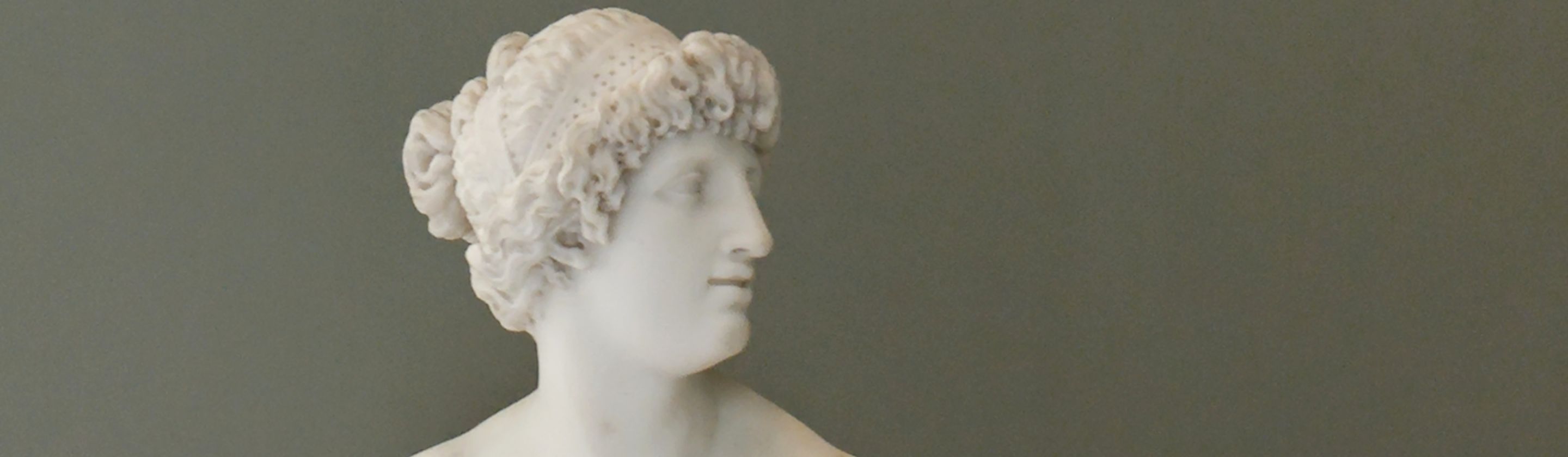
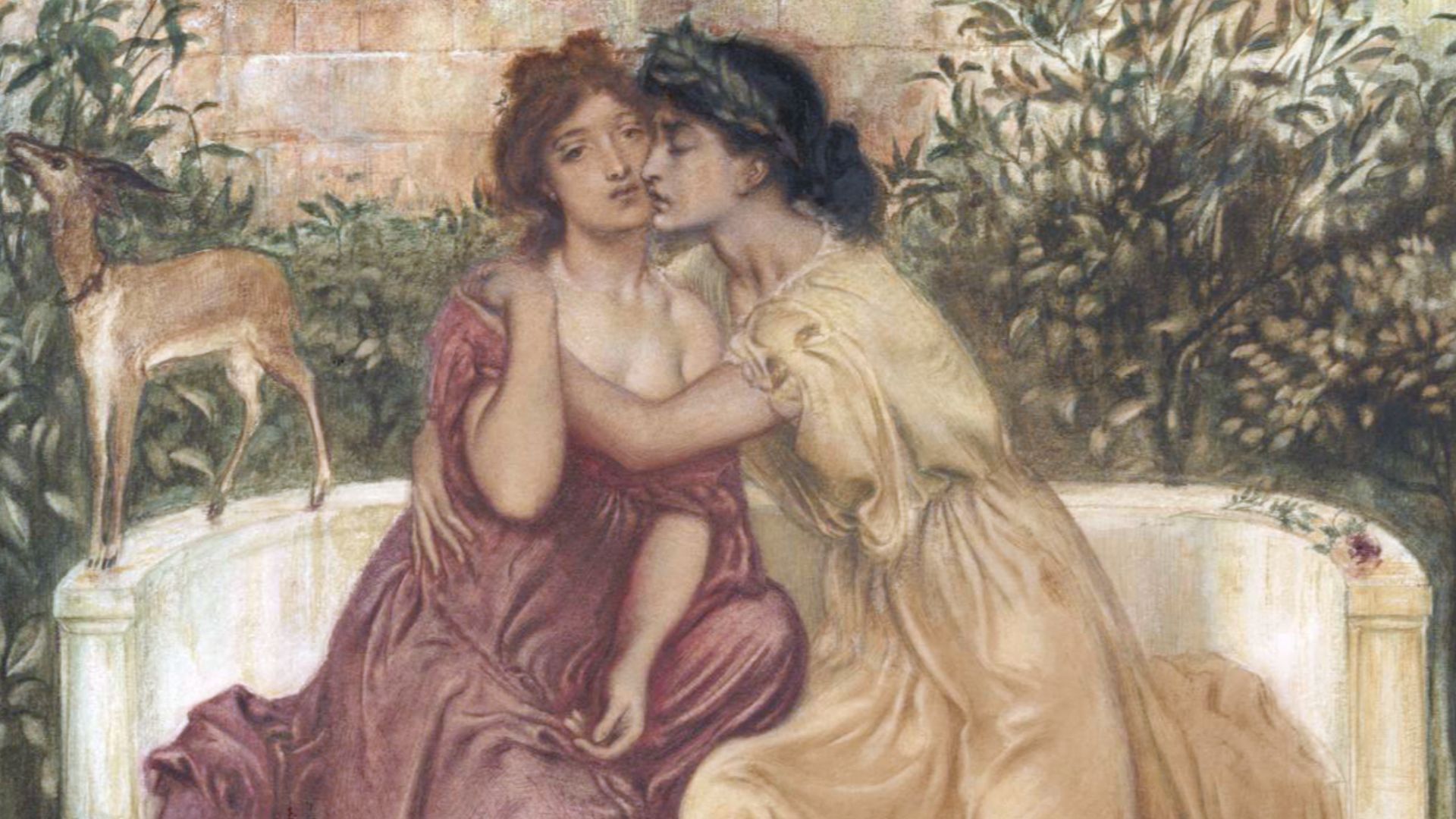
The icon known as Sappho was an ancient Greek powerhouse, well-known and well-loved for her lyric poems during the seventh and sixth centuries BCE. While it is said that she likely composed around 10,000 lines during her life, all we currently have left of her is one complete poem, alongside bits and pieces of her life’s work.
But why has she been the focus of so much scholarly debate? That’s what we’re here to find out.
A Synopsis
While much of her life is lost to history, we do know a little about who Sappho was. She was born on the island of Lesbos, likely to an upper-class family. Some sources also say that she had three brothers: Charaxos, Larichos, and Eurygios, who were only discovered in 2014.
It is believed that Sappho also had a daughter, known as Cleïs in some of her works, but we don’t know much more than that.
Sappho likely died around 570, after being exiled to Sicily around 600 BCE. As the legend goes, Sappho jumped from the Leucadian cliffs after being rejected by Phaon, a mythical boatman who was blessed by Aphrodite’s beauty.
Her Poetry
Sappho is most well-known for her love poems, but was generally highly praised for her use of language, vivid imagery, and her ability to explore the depth of human emotion. She’s considered one of the Nine Lyric Poets of Hellenistic Alexandria, leading modern scholars to believe she had an educational, religious, or entertainment-based role among the Greek elite.
Her only surviving completed poem is called Ode to Aphrodite, written as a form of a prayer to the goddess of beauty.
While it’s unclear if the poem was intended to be humorous, satirical, or entirely serious is unclear what is clear, however, is very distinctive pronoun usage that sets Sappho apart from the other ancient Greek poets.
Why She Matters Today

Aside from studying her in a literary sense, one line in Ode to Aphrodite makes Sappho a person of interest across multiple disciplines. In the fifth and sixth stanzas, Sappho writes:
What my frenzied heart craved in utter yearning,
Whom its wild desire would persuade to passion?
What disdainful charms, madly worshipped, slight thee?
Who wrongs thee, Sappho?"
"She that fain would fly, she shall quickly follow,
She that now rejects, yet with gifts shall woo thee,
She that heeds thee not, soon shall love to madness,
Love thee, the loth one!
Here, Sappho is speaking of a woman she’s fallen in love with. Her poetry, while beautiful and deserving to be studied in its own right, provides historians, anthropologists, sociologists, and other disciplines with a tiny peek into homosexuality, and particularly female same-sex attraction, in the ancient world.
This discovery, which was first proposed in 1835 but not widely accepted until the 1960s, found its way into the queer zeitgeist in the late 19th century. It’s no surprise that the term sapphic, relating to attraction between women, derives from this ancient poet. The same goes for lesbian, coming from Sappho’s home island, Lesbos.
All this to say, we should care about Sappho not only because of her poetry, of which we still hope to find more of, but because of her long-standing identity as a woman who loved other women. Her existence, and her proclamation of love to another, proves that homosexuality is not only a “modern” invention, but was welcomed or at the very least, tolerated, in ancient civilizations.
KEEP ON READING

20 People in History Who Faked Their Own Deaths
Disappearing Wasn’t Always the End of the Story. Ever wanted…
By Christy Chan Jun 15, 2026
20 Discoveries That Proved History Wrong
How Fresh Finds Keep Rewriting the Textbooks. We like to…
By Sara Springsteen Jun 15, 2026
20 Things Every American Home Had in the 1920s
The 1920s Home Was Practical, Busy, & Changing Fast. American…
By Emilie Richardson-Dupuis Jun 15, 2026
20 Historical Figures Who Took Secrets to the Grave
Questions Left Behind. History gives us a lot of things:…
By Annie Byrd Jun 15, 2026
20 Engineers Who Built The Impossible
Building What Others Said Couldn't Be Built. Throughout history, engineers…
By Rob Shapiro Jun 15, 2026
20 People Whose Lives Inspired Religious Movements
One Life, Millions of Followers. History is full of people…
By Cameron Dick Jun 15, 2026