


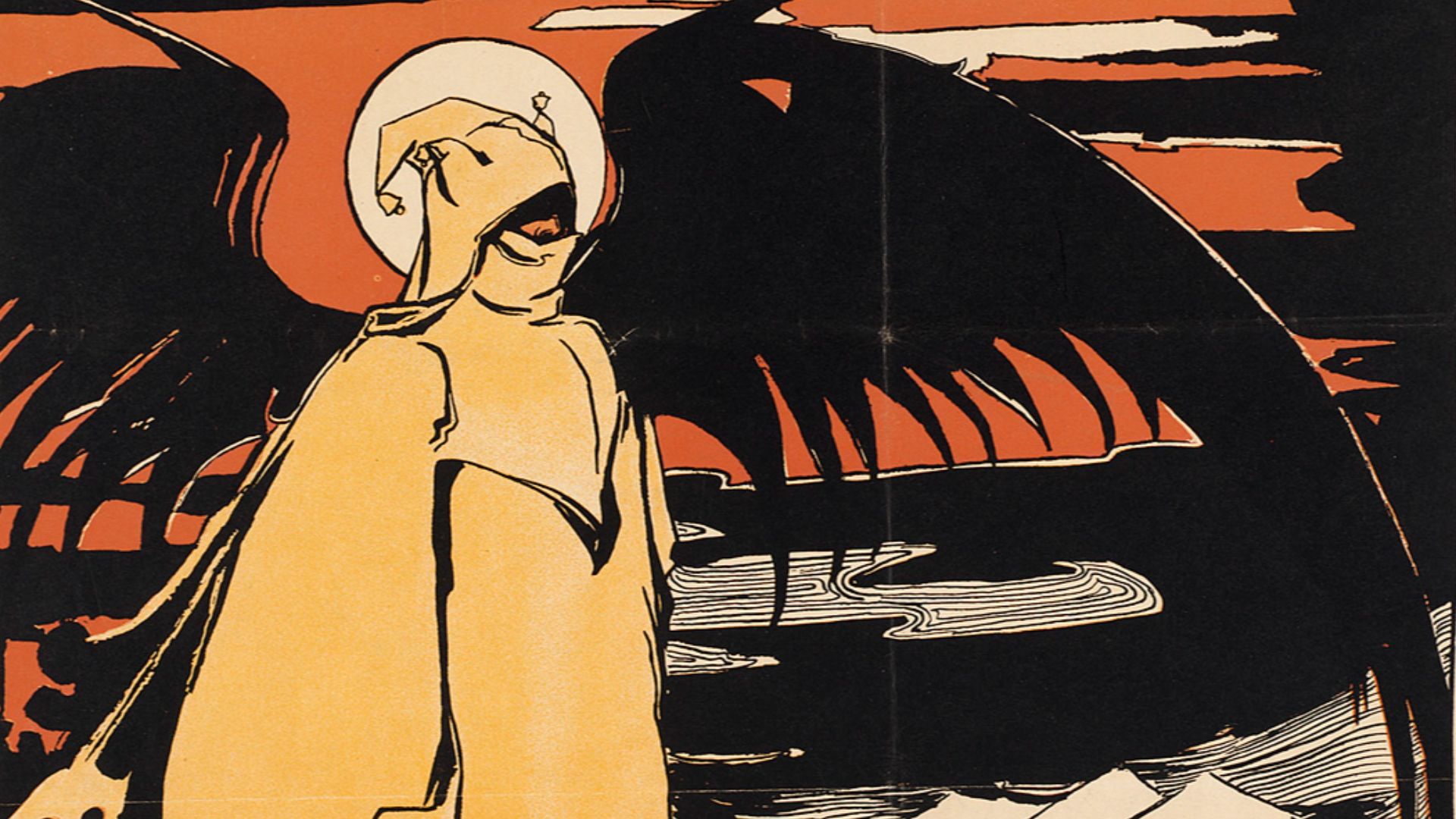
 Boston Public Library on Wikimedia
There's a play that doesn't exist, yet its reputation precedes it like a sinister fog rolling through literary history. You won't find it staged at your local theater or tucked away in dusty library archives. This forbidden drama exists only in the pages of fiction, but its influence has seeped into our culture with an unsettling permanence.
The King in Yellow—a play so dangerous that merely reading its second act supposedly strips away your sanity like layers of paint peeling from a cursed canvas. Created by American writer Robert W. Chambers in 1895, this fictional theatrical work has become one of literature's most enduring symbols of forbidden knowledge, inspiring everyone from H.P. Lovecraft to the creators of HBO's True Detective. But what makes a play that never existed so terrifyingly memorable?
The Birth Of Literary Madness
Robert W. Chambers was a successful artist and writer living in New York when he published The King in Yellow, a collection of short stories connected by references to this mysterious, mind-destroying play. Chambers himself never wrote the actual play—he only described its devastating effects. The stories mention a cast of characters, including the titular King, a figure named Cassilda, and strange places like the city of Carcosa and Lake of Hali.
According to the tales, the first act appears innocent enough, lulling readers into false security. But the second act? That's where the horror begins. Characters who read it descend into madness, unable to distinguish reality from the play's twisted narrative. Chambers borrowed some names from Ambrose Bierce's earlier short stories, but he turned them into something far more ominous. The genius lay in what Chambers didn't reveal by keeping the actual content hidden; he created a void that readers' imaginations eagerly filled with their own worst fears.
A Yellow Shadow Across Pop Culture
 Julius Jääskeläinen on Wikimedia
The influence of The King in Yellow spread like an infection through the veins of horror and weird fiction. H.P. Lovecraft, the head of cosmic horror himself, was profoundly inspired by Chambers' creation, weaving references to Carcosa and the King into his own mythology. The play's central theme, that certain knowledge can shatter the human mind, became a cornerstone of Lovecraft's work.
Fast-forward to 2014, and the first season of True Detective brought the King in Yellow to mainstream television, with cryptic references woven throughout Rust Cohle's philosophical monologues and the Louisiana bayou's Gothic atmosphere. The play has appeared in role-playing games, particularly in Call of Cthulhu, where it serves as a dangerous artifact players might encounter. Musicians, visual artists, and video game designers continue drawing from this well of existential dread.
What makes the King in Yellow so adaptable is its fundamental ambiguity—it's a canvas for exploring how stories can consume us, how art can become dangerous, and how the line between fiction and reality might be thinner than we'd like to believe. Chambers created something paradoxical: a work of art about art's power to destroy, which itself has never existed except in our collective imagination.
KEEP ON READING

Remembering Pope Stephen VI, The Guy Who Made A Cadaver…
A Godly Man With A Grudge. Jean-Paul Laurens on WikimediaYou…
By Ashley Bast Oct 31, 2025
From School Plays To Starting A Cult: 20 Of The…
The Books That Made Us. Many people will tell you…
By Farva Ivkovic Jan 31, 2025
20 Facts About Jane Grey, The Forgotten Queen Of England
A Quick, Messy, and Tragic Reign. Lady Jane Grey never…
By Maria Cruz Jan 31, 2025
20 Most Significant Cars In American History
Driving Into the Past. The car has defined America as…
By Farva Ivkovic Dec 31, 2025
10 Times The Lakers Made History & 10 Moments That…
Let’s Talk About the Lakers. Few teams have brought highs…
By Farva Ivkovic Dec 31, 2025
10 Historical Royals Known For Their Intelligence & 10 For…
The Weirdest Kings. Intelligent royals brought us innovative and progressive…
By Farva Ivkovic Dec 31, 2025