Humans Have Been Staring at Their Own Reflection for Thousands of Years, And It’s Never Been Just About Vanity
Humans Have Been Staring at Their Own Reflection for Thousands of Years, And It’s Never Been Just About Vanity

Looking in a mirror is a normal part of everyday life, whether we like it or not. Aside from decorative elements, we use them primarily for personal grooming habits. Checking our teeth, our hair, our makeup, our outfit, that sort of thing. But there was a time before the mirror.
Long before these glass panes showed up over bathroom sinks, people were finding other ways to see themselves. A still pool of water could do it, and later, polished stone and metal made reflection something you could hold in your hand. Mirrors became tied to grooming, beauty, ritual, status, myth, and self-knowledge. They were never only about vanity, even if that’s what we most closely associate it with.
The First Mirrors
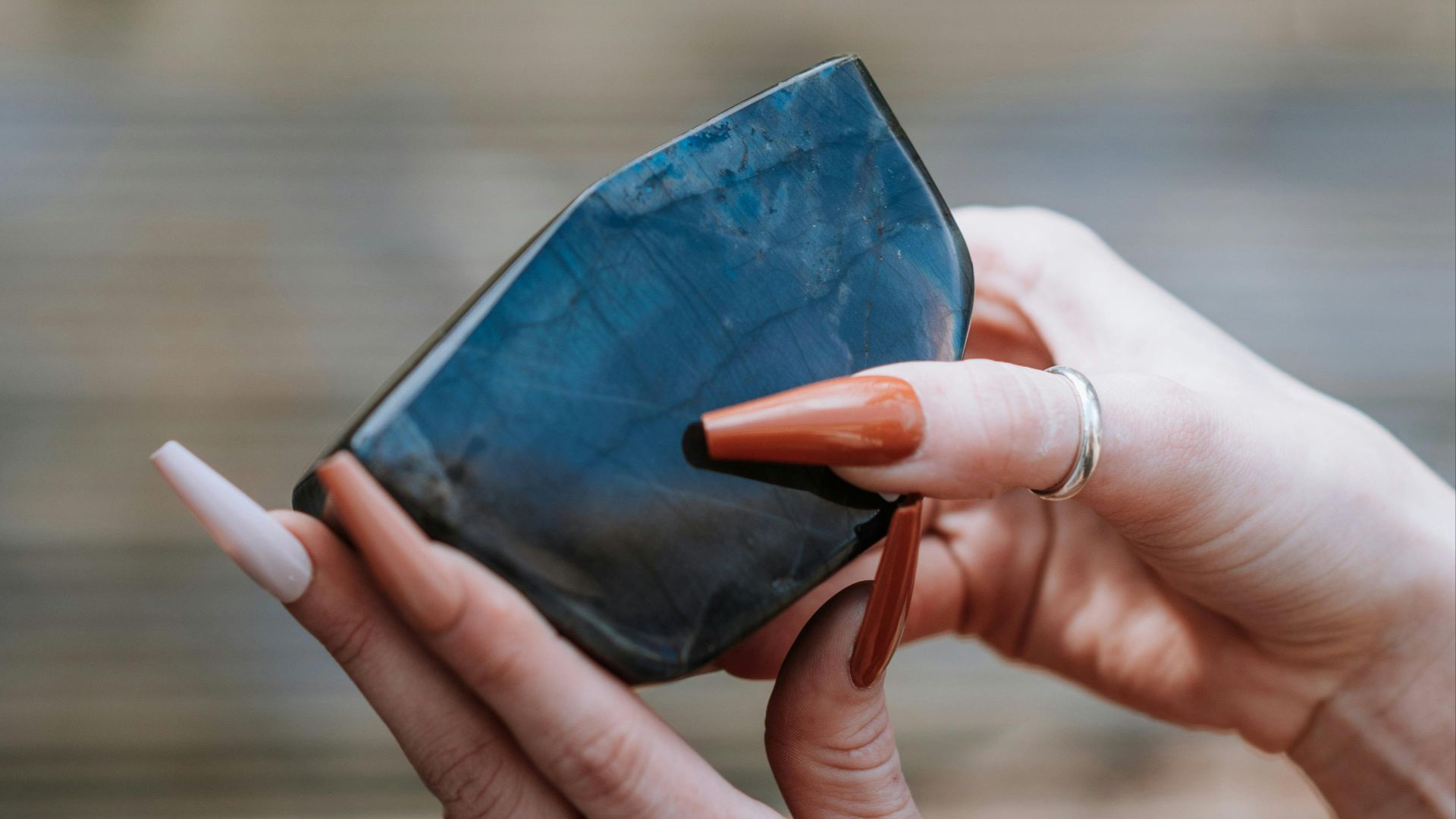
Some of the earliest well-documented manufactured mirrors were made from polished obsidian in Neolithic Anatolia. A 2025 study in the Journal of Archaeological Science says obsidian was used in Anatolia from the eighth millennium BCE for non-utilitarian objects, including ornaments and mirrors. The obsidian mirrors were circular, slightly convex objects with highly reflective surfaces.
These mirrors weren’t everyday household objects. Only 56 known obsidian mirrors were discovered in the Near East, spread across six sites in Central Anatolia and nearby regions. Çatalhöyük, the famous Neolithic site in central Anatolia, is one of the places connected with obsidian mirrors, with the Çatalhöyük research project identifying one of these in the site’s northern area.
It’s clear to scholars that these items were rare, and it’s clear to us that they aren’t the mirrors we see today. A polished obsidian mirror likely reflected a darker image to our ancient counterparts. Even so, it offered something powerful: a made object that returned a version of the person holding it.
Over time, other materials entered the story. In the ancient Mediterranean world, mirrors were often made from highly polished metal, usually copper, according to the Fitzwilliam Museum. Glass mirrors came later, while metal mirrors remained important objects in Greek, Roman, Etruscan, and other ancient settings.
Associated Symbolism
Once humans had mirrors that could be held, decorated, exchanged, and placed in graves, they became more than handy reflective surfaces. They could carry ideas about beauty, luxury, gender, ritual, and status. A mirror could be practical and symbolic simultaneously.
Ancient Greek mirrors are an excellent example of this duality. A chapter from Dress and Adornment in Ancient Greece notes that the polished bronze mirrors of antiquity were closely tied to women’s grooming and self-presentation. These mirrors were tools that could let women engage with their own image and shape how they appeared within a society that often judged them through appearance.
Museum collections also show that mirrors could carry stories, not just reflections. The Fitzwilliam Museum describes an Etruscan mirror from the fourth century BCE decorated with a scene from Homer’s Odyssey. Not only was this particular mirror a tool for self-image, but it could also be a medium for mythology and art.
Mirrors also have a connection to the ancient Greek command “Know thyself,” associated with Apollo at Delphi. It also points to the companion warning, “Nothing in excess.” These two statements refer to much larger conversations about the fine line between wisdom and narcissism.
Mirror Mythology
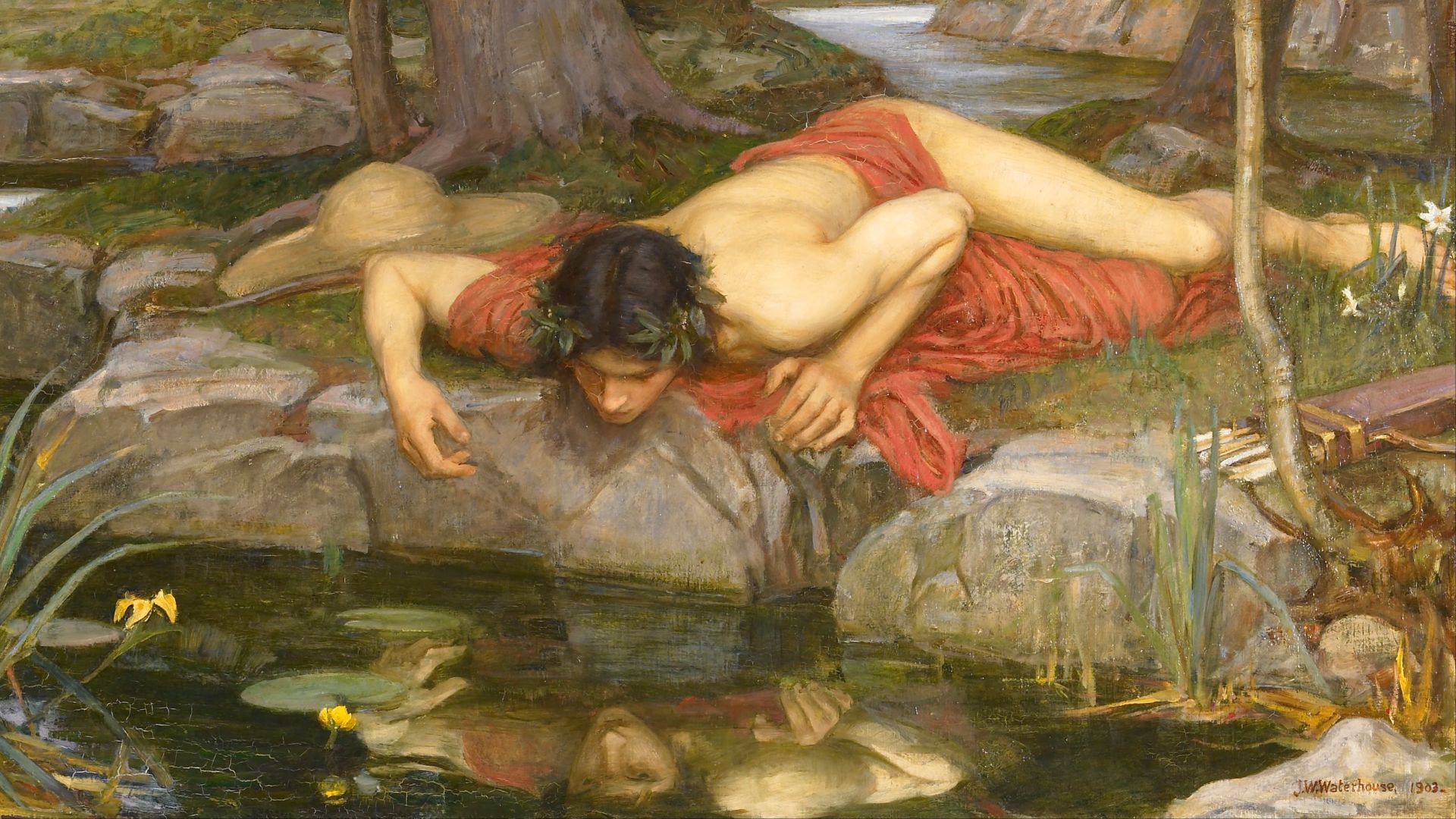 John William Waterhouse on Wikimedia
Speaking of narcissism, the best-known warning about reflection is still the myth of Narcissus. Originally published in Ovid’s Metamorphoses, Narcissus is the son of the river god Cephissus and the nymph Liriope. He was said to be so beautiful that he fell in love with his own reflection. He was so infatuated with himself that he ended up wasting away and dying at the edge of the water, eventually transforming into the narcissus flower.
What you may not know, or remember, about this myth is the prophetic element. Before Narcissus finds his own reflection, he’s told by the seer Tiresias that he would live a long life, so long as he “never knows himself.”
What makes this story so interesting is how well it applies to the modern era. Our reflection, our vanity, is clearly important to us. The problem arises when it becomes so important that we fail to notice or want other aspects of life.
Mirror Psychology
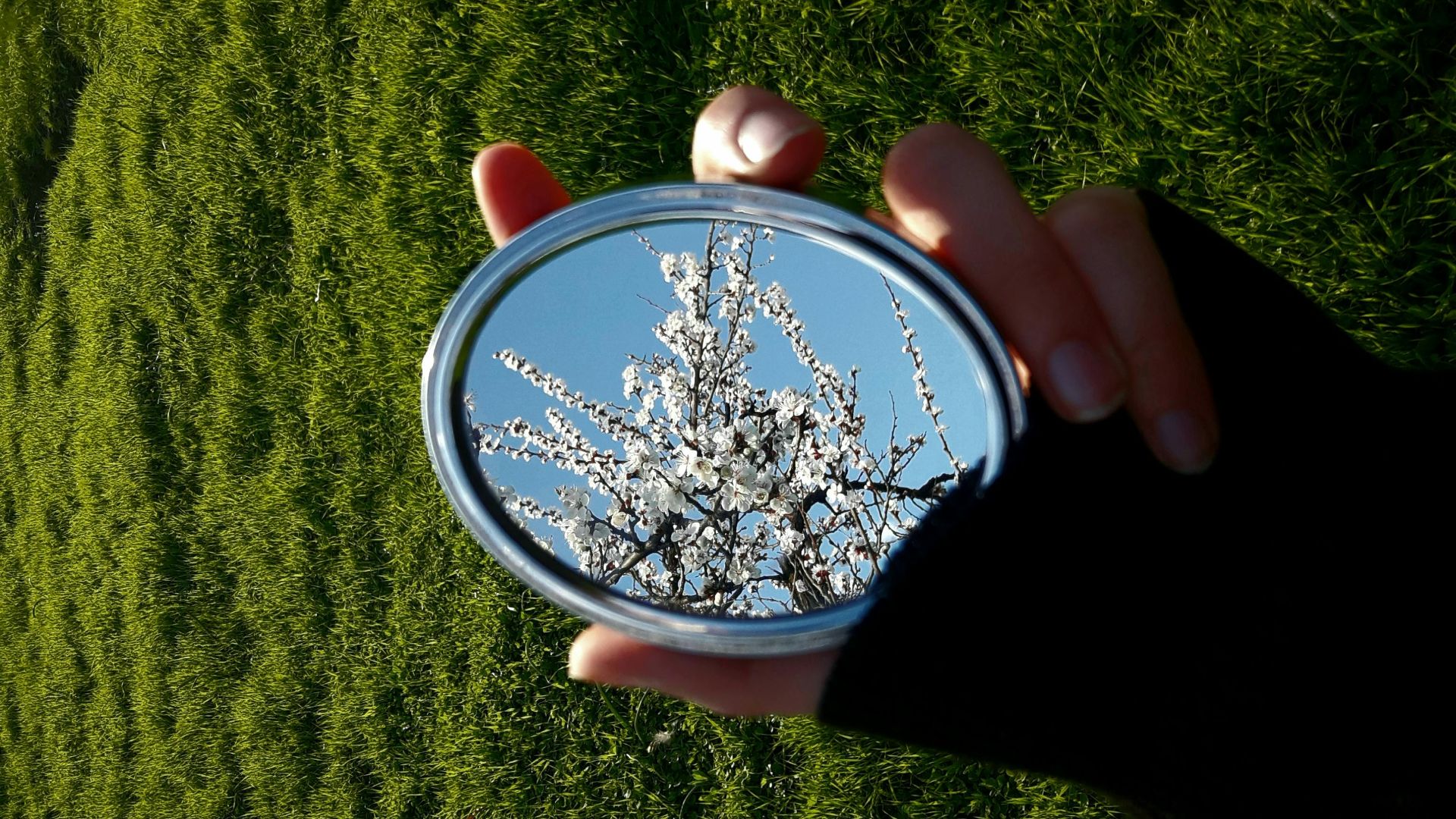
Modern thought continued to expand on the mirror’s ancient origins. In Human Nature and the Social Order, published in 1902, sociologist Charles Horton Cooley described the “looking-glass self,” or the way our sense of self is shaped partly by how we imagine others see and judge us.
More recent scholarship has also treated mirrors as part of the history of self-recognition and identity. George C. Vollrath’s article Cultural Techniques of Mirroring from Lecanomancy to Lacan looks at mirrors as material technologies that shape how people encounter themselves. In plain terms, a mirror isn’t only a symbol, but also a tool that changes what self-recognition can feel like.
This is why mirrors and reflection continue to fascinate us. Today, the reflective surface might be a bathroom mirror, a selfie camera, a laptop screen during a video call, or a social media profile edited for public view. The tools have become faster, brighter, and more public. The old habit is still there: we look, judge, adjust, wonder, and sometimes look again.
So no, mirrors have never been only about vanity. They’ve been rare objects, ritual objects, beauty tools, wisdom symbols, warnings about obsession, and aids to self-understanding. From Neolithic Anatolia to the ancient Mediterranean to the glowing black screen of a phone, reflection keeps pulling people back to the same mystery. We look at ourselves because we can, and because the face looking back at us tells us so much more.
KEEP ON READING