

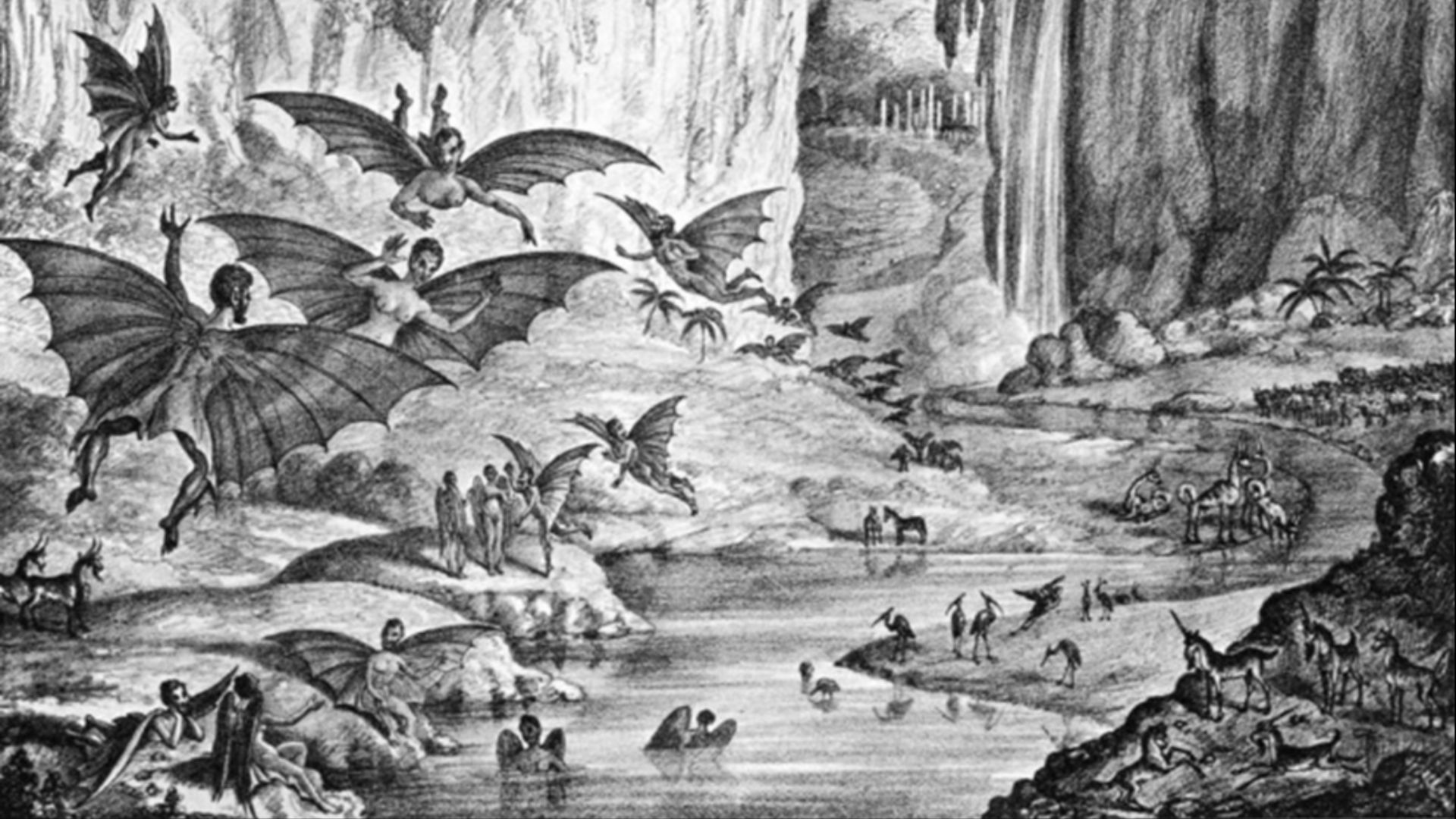
In August of 1835, the New York Sun published a series of articles claiming that a British astronomer had discovered life on the moon. Not microbial life, not the theoretical possibility of life, but actual living creatures: bison-like animals grazing on lunar plains, blue-skinned bipeds with wings, and vast forests of crimson vegetation visible through a powerful new telescope at the Cape of Good Hope. The articles ran across six consecutive issues and were written with the confidence and specificity of genuine scientific reporting. The series was a complete fabrication.
It was written by Richard Adams Locke, a Cambridge-educated journalist working for the Sun, and it had nothing to do with the real astronomer it claimed as its source, Sir John Herschel, who was conducting legitimate astronomical observations in South Africa at the time and had no idea any of this was happening. What followed was one of the more remarkable media episodes of the nineteenth century, and one that says something useful about the relationship between scientific authority, public appetite, and the economics of attention.
How the Hoax Actually Worked
The articles were attributed to the Edinburgh Journal of Science, a publication that had ceased printing in 1833. Locke borrowed the name with apparent confidence that most American readers would not know or check this. The supposed telescope was described in elaborate technical detail, with a lens weighing nearly 15,000 pounds and capable of magnifying objects 42,000 times, figures detailed in the Sun's original August 25, 1835 installment, archived by the Library of Congress. Readers were given enough technical scaffolding to feel like they were encountering real science rather than invention.
The Sun's circulation reportedly jumped from around 8,000 to over 19,000 during the run of the series, a figure documented in Matthew Goodman's The Sun and the Moon (Basic Books, 2008), making it briefly the highest-circulation newspaper in the world. Other New York papers initially reprinted the articles as genuine news before growing suspicious. A delegation from the Yale science faculty reportedly traveled to New York to examine the original Edinburgh papers, only to be sent back and forth between the Sun's offices until they gave up. The paper neither confirmed nor denied the hoax during its run, which kept the story alive longer than a direct admission would have.
What Herschel Actually Thought
John Herschel had traveled to the Cape of Good Hope in 1834 to catalogue the stars of the southern hemisphere, work eventually published as Results of Astronomical Observations Made at the Cape of Good Hope in 1847 and held today by the Biodiversity Heritage Library. It was serious, consequential science. He learned about the Moon Hoax through letters and was reportedly amused at first, then increasingly irritated as strangers continued asking him about lunar bison for years afterward.
Locke eventually acknowledged his authorship in 1840 in a piece for the New World magazine, though accounts differ on how forthcoming that acknowledgment was. The Sun itself never issued a formal retraction. The hoax has since been compared to Orson Welles' 1938 radio broadcast of The War of the Worlds, though historian Michael Socolow argued in a 2008 piece for Slate that the panic from that broadcast has been significantly overstated. The Moon Hoax is a cleaner case. A newspaper needed readers, a writer understood how scientific authority worked, and the combination produced something people wanted to believe.
Why It Still Matters
Locke understood something that media critics have been relearning ever since, which is that the form of credibility is often more persuasive than its substance. The articles looked like science reporting. They used the right names, the right institutions, the right vocabulary. In the absence of any easy way to verify claims, appearance carried most of the weight.
Edgar Allan Poe, who had published his own moon hoax story earlier that year in the Southern Literary Messenger, claimed that Locke had plagiarized him. Poe's grievance is documented in his collected letters held at the Library of Congress, and while the plagiarism charge was disputed, his reaction points to something true about the moment. There was a ready market for stories about the moon in 1835, a public primed by recent advances in astronomy and hungry for the possibility that the universe contained more than anyone had confirmed.
That hunger has not gone anywhere. The specific content changes, the telescopes get better, the fabrications get more sophisticated, but the underlying dynamic between institutional credibility, public appetite, and the economics of capturing attention remains consistent. The Sun sold papers. That part worked exactly as intended.
KEEP ON READING
The Great Moon Hoax of 1835
JasonAQuest on WikimediaIn August of 1835, the New York Sun…
By Cameron Dick Jun 22, 2026
20 Major Architectural Upgrades That Brought Us To The Modern…
Centuries of Practical Solutions. The modern house didn’t come about…
By Elizabeth Graham Jun 22, 2026
20 Tech Innovations That Used to Require a Full Staff…
From Staff to Software. Living like royalty a century ago…
By Sara Springsteen Jun 22, 2026
20 Historical Widows Who Rebuilt Their Lives All On Their…
Transforming Loss Into Authority. For some women, widowhood has brought…
By Elizabeth Graham Jun 22, 2026
10 Women Who Used Marriage for Power & 10 Who…
Marriage Was Often a Strategy, Not Just a Romance. For…
By Emilie Richardson-Dupuis Jun 22, 2026
20 Marriage Laws From History That Ruined Women’s Lives
Marriage Took More Than a Name. For much of history,…
By Annie Byrd Jun 22, 2026