


On the afternoon of October 17, 1814, a storehouse clerk named George Crick walked through the Meux and Company Horse Shoe Brewery in London and noticed that one of the heavy iron hoops around a large fermentation vat had slipped. The vat stood 22 feet tall and held 3,555 barrels of ten-month-old porter, a dark, malt-heavy beer popular at the time. Crick flagged the problem to his supervisor. His supervisor told him not to worry. Iron hoops slipped off vats two or three times a year and nothing had ever come of it. Crick wrote a note requesting the hoop be fixed later and went back to work.
About an hour later, the vat exploded. The force ruptured neighboring vats, blew out the brewery's back wall, and sent somewhere between 128,000 and 323,000 imperial gallons of hot fermenting beer into the streets of St. Giles, one of London's most densely populated and desperately poor neighborhoods. Eight people died. The brewery was taken to court and the disaster was ruled an Act of God. No one was held responsible.
The Neighborhood That Got Hit
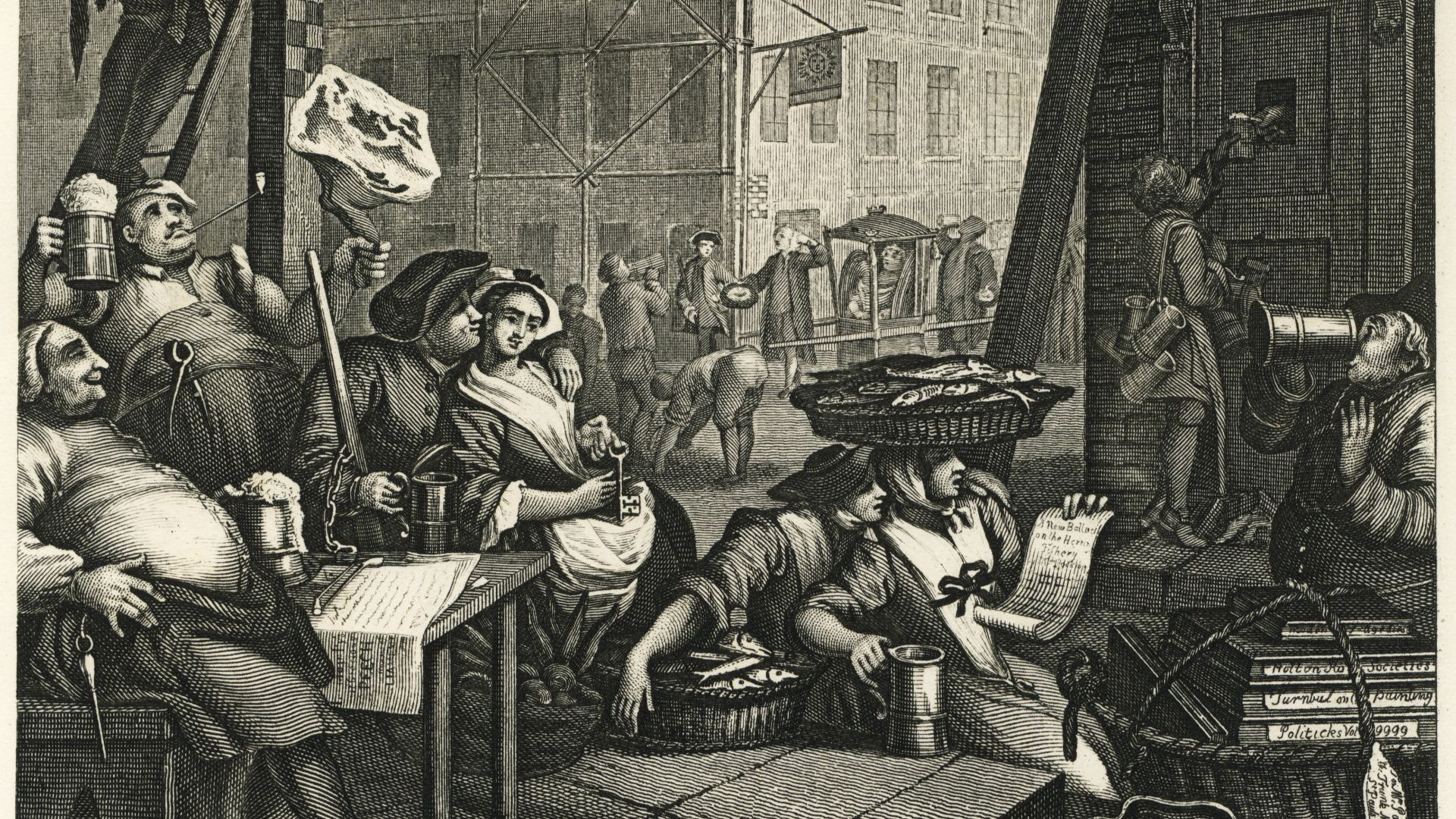
St. Giles Rookery was the kind of place Victorian London preferred not to think about. Covering about eight acres just north of what is now Covent Garden, it was a maze of narrow lanes, crumbling tenements, and overcrowded cellars where the city's poorest residents, many of them Irish immigrants, lived stacked on top of one another. The area had been so notorious for poverty and vice that William Hogarth had used it as the setting for his 1751 print Gin Lane.
It was precisely the wrong kind of neighborhood for a flood of any kind. The streets had almost no drainage. The wave, which reportedly reached around 15 feet at its peak, had nowhere to go but into basements and ground-floor rooms. Two houses collapsed almost immediately. The back wall of the nearby Tavistock Arms pub came down, killing fourteen-year-old Eleanor Cooper, a servant who had been washing pots at an outdoor pump behind the wall.
In one of the collapsed houses, Mary Banfield and her four-year-old daughter Hannah had just sat down for tea. Both were killed. In the cellar of another building, an Irish wake was being held for a two-year-old boy named John Saville who had died the previous day. Five mourners, including the child's mother Anne Saville, died when the flood hit. The eight victims ranged in age from three to sixty-five, and their names were read aloud at the coroner's inquest two days later: Eleanor Cooper, Mary Mulvey, Thomas Murray, Hannah Banfield, Sarah Bates, Ann Saville, Elizabeth Smith, and Catherine Butler.
The Trial And The Verdict
The inquest was held at the St. Giles parish workhouse on October 19, presided over by the coroner for Middlesex, George Hodgson. The jury visited the brewery, viewed the bodies, and heard testimony from witnesses including George Crick, who explained that hoop failures were routine and that he had followed procedure. The jury returned a verdict that the eight had died "casually, accidentally, and by misfortune." The brewery bore no liability.
The financial reckoning was more complicated. The flood cost Meux and Company roughly £23,000, a sum that threatened to bankrupt the company. The beer had already been taxed before it flooded the street, however, and the brewery successfully petitioned Parliament to reclaim the excise duty. They were granted £7,250 in compensation for the lost beer, which saved the business. The victims' families received nothing.
One detail that circulates widely is that the flood triggered mass drunkenness in St. Giles, with residents scooping beer from the streets and at least one person dying of alcohol poisoning days later. Brewing historian Martyn Cornell has examined the contemporary newspaper coverage and found no evidence for any of this. The papers, which would have had no reluctance to report badly on an Irish immigrant community, instead described orderly crowds. What is documented is stranger: some families charged visitors a fee to view the bodies of the dead, and in at least one house, so many people crowded in to look that the floor collapsed under their weight, dumping everyone into a beer-soaked cellar.
What Changed, And What Didn't
The Horse Shoe Brewery went back into production relatively quickly. The stench of beer reportedly clung to the St. Giles streets for months. In the longer term, the disaster contributed to the gradual phasing out of enormous wooden fermentation vats in favor of lined concrete tanks, though this transition happened slowly and was driven as much by economics as by safety.
The legal outcome was the more revealing part. Ruling industrial accidents as Acts of God was a convenient mechanism for insulating manufacturers from the consequences of their negligence. Crick had seen the problem. His supervisor had dismissed it. The people who died had no connection to the brewery whatsoever. None of that entered the legal equation. It would take decades of industrial disasters, labor organizing, and legislative pressure before British law began to hold factory owners accountable in any meaningful way.
The Horse Shoe Brewery closed in 1921 and was demolished the following year. The site is now occupied by the Dominion Theatre on Tottenham Court Road. A pub called the Holborn Whippet, not far from where the flood ran, has marked the anniversary each year since 2012 by brewing a special porter in memory of the event. It is, under the circumstances, probably the most fitting tribute available.
KEEP ON READING

From Heroes To Zeroes 20 Historical Figures Whose Heroism Was…
History is full of legends, but not every hero lived…
By Noone Feb 25, 2026
The Clueless Crush: How I Accidentally Invited a Hacker Into…
Fluorescent Lights and First Impressions. My name is Tessa, I'm…
By Ali Hassan Nov 4, 2025
This Infamous Ancient Greek Burned Down An Ancient Wonder Just…
History remembers kings and conquerors, but sometimes, it also remembers…
By David Davidovic Nov 12, 2025
Einstein's Violin Just Sold At An Auction—And It Earned More…
A Visionary's Violin. Wanda von Debschitz-Kunowski on WikimediaWhen you hear…
By Ashley Bast Nov 3, 2025
The Mysterious "Sea People" Who Collapsed Civilization
3,200 years ago, Bronze Age civilization in the Mediterranean suddenly…
By Robbie Woods Mar 18, 2025
The 20 Smartest Women in History
Intelligence Has Always Had More Than One Form. Calling anyone…
By Emilie Richardson-Dupuis Jun 16, 2026