


The First Day Facade
I'm Laura Mitchell, and after eleven years of teaching third grade at Oakwood Elementary, I thought I'd seen it all. The first day of school always has that magical quality—the smell of fresh crayons, backpacks still pristine, and twenty-three little faces looking up at me with that mix of terror and excitement that only eight-year-olds can perfect. I moved between the desks, straightening name tags that kids had already managed to make crooked, smiling as Sophie whispered to her friend about her unicorn pencil case. 'Good morning, everyone!' I called out, clipboard in hand for attendance. They all settled down, eyes wide and attentive—all except for one. In the third row, second seat from the window, sat Evan Cole. While the other children fidgeted with nervous energy, Evan lounged in his chair with a confidence that felt out of place. When I called his name, he flashed me what I can only describe as a practiced smile—the kind that stops at the lips and never reaches the eyes. Something in my teacher instincts flickered a warning, but I pushed it aside. After all, it was just the first day, and everyone deserves a clean slate. I had no idea that smile would become the first page in what would be the most challenging chapter of my teaching career.
 Image by RM AI
Red Flags and Rationalizations
By Friday of that first week, I started noticing patterns in Evan's behavior that made my skin prickle. Unlike the impulsive outbursts typical of eight-year-olds, his disruptions seemed calculated, almost strategic. He'd wait until I was helping another student before whispering something that made Lily's eyes well up with tears. When I'd ask what happened, he'd blink those innocent eyes and say, "I was just telling her I liked her drawing." During our building block challenge on Thursday, I watched from across the room as he casually extended his foot under the table, toppling Marcus's nearly-completed tower. Before I could even react, Evan was already on his knees, helping pick up the scattered blocks, his voice dripping with manufactured concern: "Don't worry, I'll help you fix it!" Marcus just sat there, defeated, as Evan played the hero. That night, I made my first entry in what would become my "Evan documentation" notebook. Something told me I'd need receipts for what was coming. What I couldn't possibly know then was how that little notebook would eventually save my career.
 Image by RM AI
The First Call Home
After two weeks of documenting Evan's behavior, I finally had enough evidence to make that first call home. Maya's torn artwork—a watercolor family portrait she'd spent all of free time creating—was the last straw. I rehearsed my talking points while the phone rang, arranging incident reports on my desk like exhibits for a jury. When Denise Cole answered, I introduced myself professionally, explaining the pattern of concerning behaviors and specifically mentioning today's incident. I expected the usual parent response—perhaps embarrassment, concern, or even defensive questioning. What I wasn't prepared for was the light, dismissive laughter that floated through the receiver. "That doesn't sound like my Evan at all," she said, her voice honey-sweet but with an edge that made my teacher-sense tingle. "Are you sure the other children aren't provoking him? He's always been so sensitive." I felt my grip tighten on the phone as she continued, suggesting that perhaps Maya had been careless with her artwork, or maybe I hadn't been supervising properly. By the time I hung up, my documentation notebook had a new entry, and a sinking feeling had settled in my stomach. Something told me this wouldn't be our last conversation, and that Denise Cole might be a bigger obstacle than her son.
 Image by RM AI
Documentation Begins
That night, I started what would become my lifeline—a detailed documentation notebook dedicated to Evan's behaviors. As a veteran teacher, I'd learned the hard way that patterns speak louder than isolated incidents, and memory is no match for written records. Each entry included the date, time, witnesses, and exactly what happened. The next morning during circle time, while discussing our weekend activities, I noticed Tyler flinch. From my angle, I could see Evan's fingers pinching Tyler's arm behind the cover of our reading carpet. Tyler's eyes watered, but he said nothing. I made a mental note and added it to my log during lunch break. Later that afternoon, while the class worked on math worksheets, I heard Zoe gasp. Evan had 'accidentally' knocked over his water bottle, sending water cascading across her desk, destroying her nearly-completed assignment. 'Oops, sorry!' he said with that same practiced smile that never reached his eyes. I handed Zoe paper towels and a fresh worksheet, watching Evan's face for any sign of genuine remorse. There was none. By the end of that week, my notebook had five full pages of incidents—each seemingly minor on its own, but together forming a disturbing pattern that was becoming impossible to ignore. What I didn't realize then was that this notebook would soon become the most important document I'd ever kept.
 Image by RM AI
Classroom Management Challenges
After three weeks of Evan's escalating behavior, I decided to implement a behavior chart system for the entire class. Each student had their own colorful chart with spaces for gold stars (for positive behaviors) and red dots (for rule-breaking). The system was simple—five gold stars earned a small prize from the treasure box, while three red dots meant missing five minutes of recess. The other students embraced it enthusiastically, proudly showing each other their growing collection of stars. Even shy Marcus beamed when he earned his first reward. But Evan? He turned it into another opportunity for disruption. On Wednesday, I noticed his chart suddenly had three gold stars that I definitely hadn't awarded. When I quietly asked him about it after lunch, he shrugged and said, "The chart fell down, Ms. Mitchell. Someone else must have put those there." The next day, I watched him casually erase a red dot when he thought no one was looking. I documented each incident, adding it to my growing file. What bothered me most wasn't the manipulation itself—it was the calculated way he maintained eye contact while lying, as if daring me to challenge him. I realized then that my classroom management strategies weren't just failing with Evan; they were becoming another battlefield where he could demonstrate his immunity to consequences.
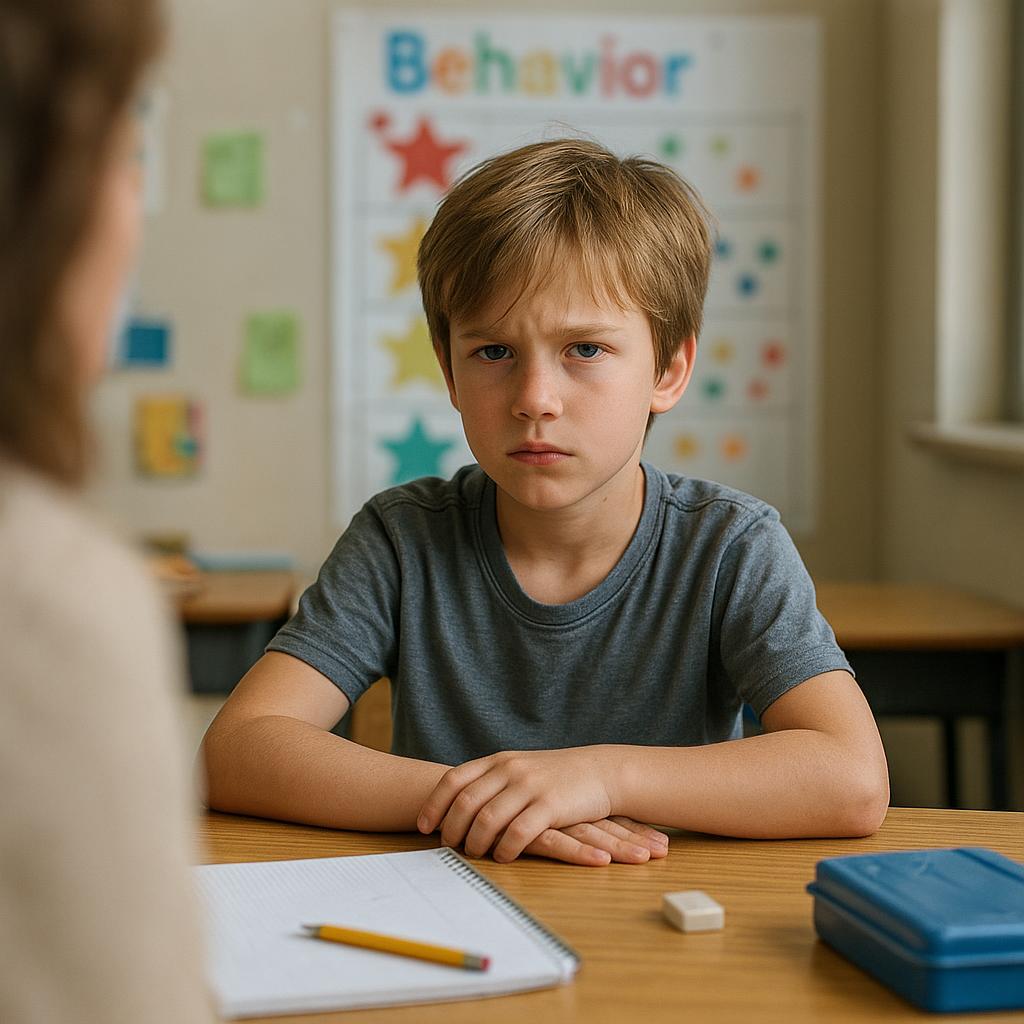 Image by RM AI
The Pencil Incident
Tuesday's quiet reading time shattered with a cry that made my blood run cold. I looked up to see Aiden clutching his arm, tears streaming down his face, while Evan sat beside him, pencil still in hand, wearing that familiar blank expression. The angry red mark on Aiden's arm told the story Evan wouldn't. "He stabbed me with his pencil!" Aiden sobbed as I rushed over. Evan immediately launched into his defense: "It was an accident, Ms. Mitchell. He bumped my arm while I was writing." The calculated calmness in his voice made my skin crawl. I sent Evan to the hallway while I checked Aiden's arm—thankfully no broken skin, but an angry welt was forming. That afternoon, I called Denise with our school counselor, Mrs. Patel, present. I detailed the incident, emphasizing the intentional nature of what had happened. Denise's response was immediate and predictable: "Why is my son always being targeted? Boys will be boys, Ms. Mitchell. Have you considered that Aiden might have provoked him?" I watched Mrs. Patel's eyebrows rise as Denise continued her defense. When I mentioned the documentation of previous incidents, Denise's voice hardened. "It sounds like you've already decided my son is the problem." After hanging up, Mrs. Patel looked at me with concern. "This isn't just about Evan anymore, is it?" she asked quietly. Little did I know, the pencil incident was just the beginning of a dangerous escalation that would soon threaten my entire classroom.
 Image by RM AI
Principal's Perspective
I scheduled a meeting with Principal Harmon the following morning, armed with my documentation notebook and a determination that bordered on desperation. His office always smelled like coffee and that weird pine air freshener that reminded me of my grandmother's bathroom. 'Laura, I appreciate your thoroughness,' he said, flipping through my meticulously documented incidents without really reading them. 'But we need to focus on building rapport with Evan and his mother.' He leaned back in his chair, steepling his fingers. 'Parent satisfaction is critical to our district ratings. Have you tried positive reinforcement strategies?' I felt my face flush. 'With all due respect, sir, I've tried everything in my teaching playbook. This isn't about teaching strategies anymore—it's about safety.' He smiled that administrator smile that never quite reaches the eyes—not unlike Evan's, I realized with a chill. 'Just be patient. These things usually work themselves out.' As I left his office, deflated, something caught my eye on the wall outside—the PTA donor recognition plaque. There, in gold lettering under 'Platinum Contributors,' was 'Denise Cole - $5,000.' Suddenly, Principal Harmon's lukewarm response made perfect sense, and I realized I was fighting this battle on two fronts now.
 Image by RM AI
Classroom Dynamics Shift
By mid-October, my classroom had transformed in ways that broke my heart. The vibrant community we'd built in September was unraveling before my eyes. Children who once waved their hands so eagerly they practically levitated from their seats now stared at their desks when I asked questions, especially if Evan was nearby. During our morning meeting, I noticed Maya—who used to share stories so animated she could barely stay seated—now spoke in whispers, her eyes constantly darting to track Evan's location like prey monitoring a predator. "Ms. Mitchell," Zoe whispered during center rotations, "can I please not be in Evan's group again? Please?" It was the third such request that week. During library time, I watched as Tyler deliberately chose a spot on the floor far from where he usually sat, leaving an empty circle around Evan. Most disturbing was when little Aiden, who'd never missed a day of school, suddenly developed mysterious stomach aches every morning. His mother confided that he'd started crying before school. "He won't tell me why," she said, concern etching her face. "Just keeps saying he doesn't feel safe." That word—safe—hit me like a physical blow. I realized then that the problem wasn't just Evan anymore; it was the toxic environment created when accountability vanishes and fear takes root. What I couldn't possibly know was how much worse things would get before anyone in authority would finally believe me.
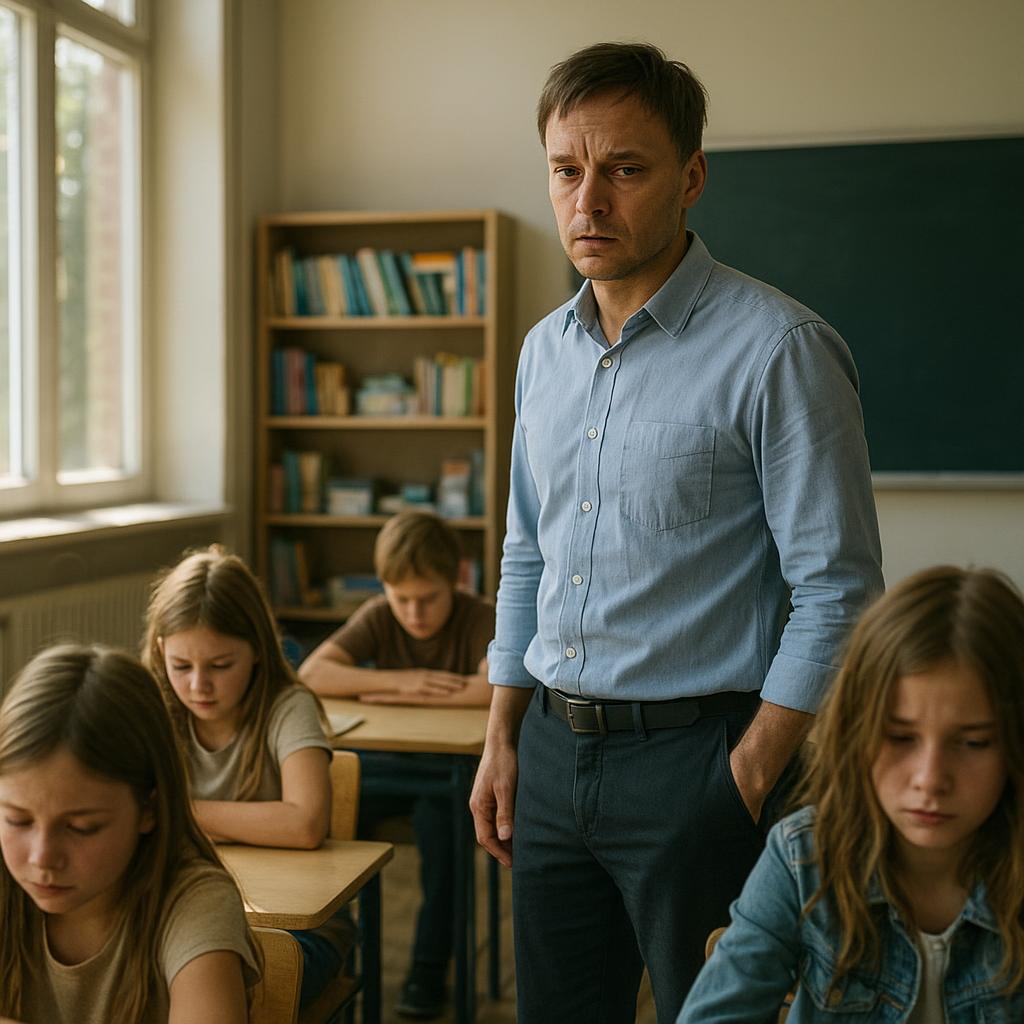 Image by RM AI
The Morning Tears
Monday morning brought a new heartbreak to my classroom. Emma Chen, my little math whiz who normally bounced through the door with excitement about the day ahead, stood frozen at the threshold, tears streaming down her face as she clung to her father's leg. 'I don't want to go,' she sobbed, her small body shaking. Mr. Chen looked at me helplessly, confusion etched across his face. This was the third consecutive morning of Emma's tears, and my teacher alarm bells were ringing at full volume. When her father finally managed to leave, I knelt beside Emma's desk and gently asked what was wrong. She looked around frantically, making sure no one could hear, before leaning in close. 'Evan said he's going to cut off my braids with scissors if I answer any more questions in class,' she whispered, her fingers protectively touching her long black braids. 'He said I'm a show-off and nobody likes me.' My stomach dropped as I documented her exact words in my notebook, adding it to the growing evidence of Evan's targeted intimidation. I immediately emailed both Mrs. Patel and Principal Harmon, marking it urgent and requesting an emergency meeting. As I watched Emma sit silently through morning math—her hand, which would normally shoot up for every question, now firmly in her lap—I realized we had crossed a dangerous line. What I couldn't have known then was that Emma's tears would become the catalyst that finally forced the administration to face what they'd been desperately trying to ignore.
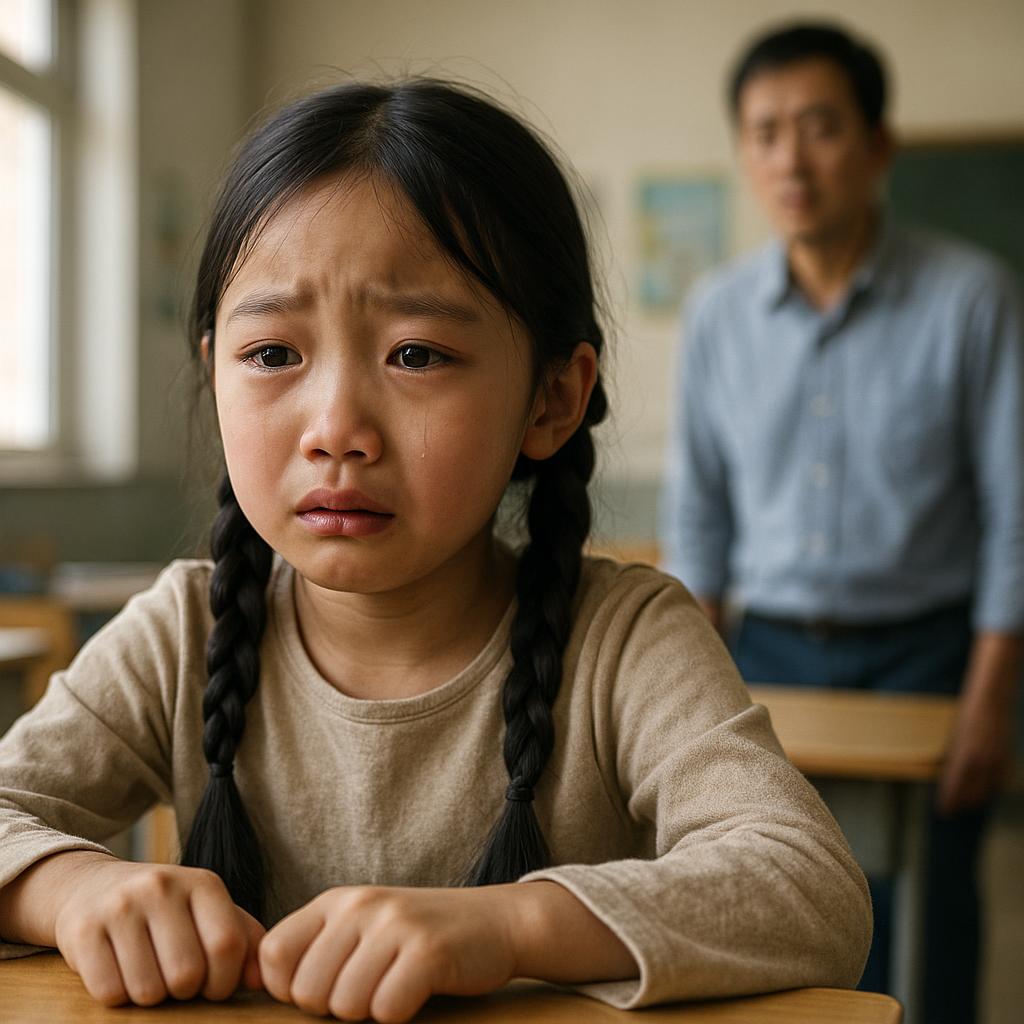 Image by RM AI
The Bathroom 'Joke'
Thursday's bathroom break turned into yet another incident I'd have to document. When the girls returned from the restroom, I noticed Zoe was missing. After five minutes, concern mounting, I asked Maya to check on her. Maya returned wide-eyed, pulling me aside to whisper that Evan had pushed Zoe into the girls' bathroom and was holding the door shut, laughing while Zoe cried inside. I immediately sent Maya back to her seat and marched to the bathroom, where I found Evan leaning against the door with that familiar calculated smile. "We're just playing, Ms. Mitchell," he said before I could speak. "It's a joke." When I opened the door, Zoe emerged with red eyes and trembling hands. Back in the classroom, I pulled Evan aside while the others worked on their science worksheets. His story changed instantly: "Zoe asked me to guard the door because the lock was broken." The lie was so smooth, so practiced, I almost questioned myself—until I saw Zoe flinch when he walked past her desk. That afternoon, I made my fourth call to Denise Cole in two weeks. As expected, she dismissed it as "kids being kids" and suggested Zoe was "probably being dramatic." What Denise couldn't dismiss, however, was the email I received later that evening from Zoe's mother, demanding to know why her daughter was now afraid to use the school bathroom.
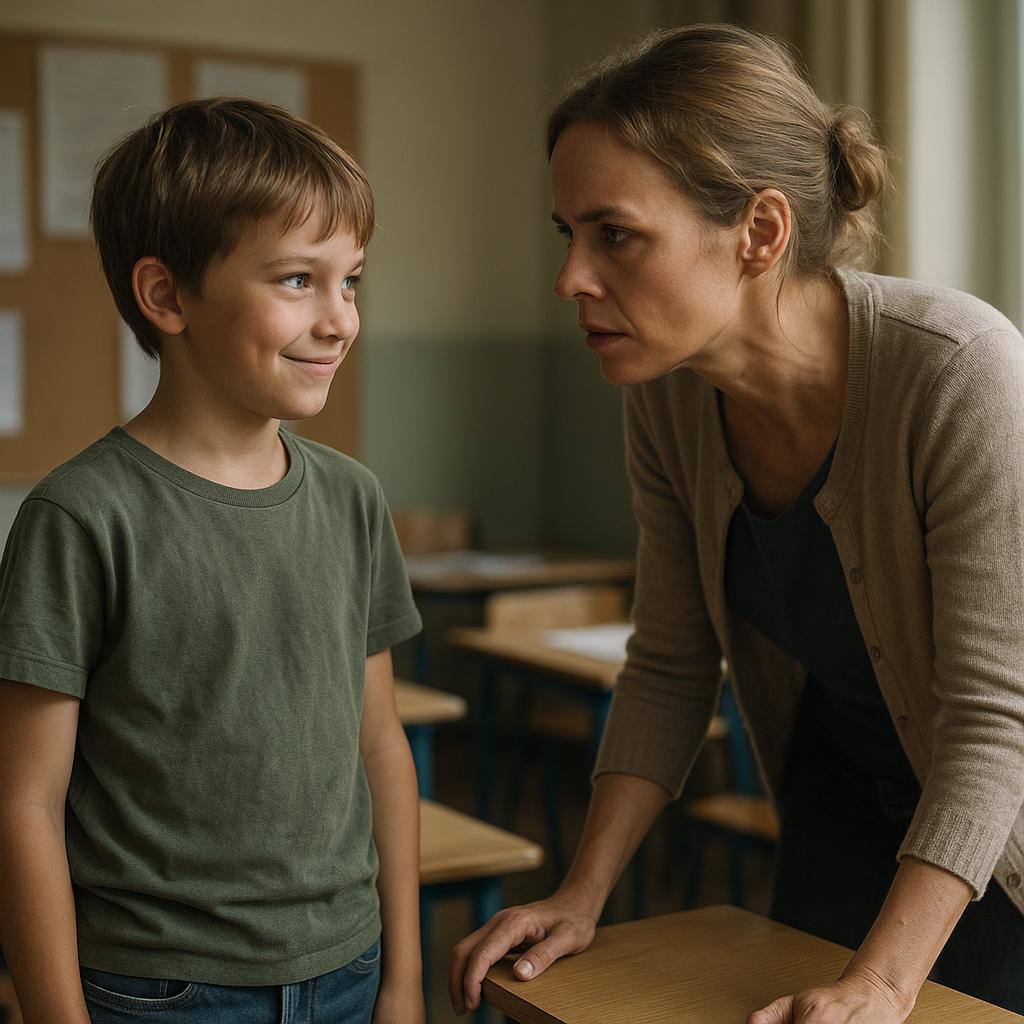 Image by RM AI
The Third Call Home
I dialed Denise's number that evening, my documentation notebook open beside me like a shield. When she answered, I kept my voice steady and professional as I explained the bathroom incident. 'Ms. Mitchell,' she interrupted with that honey-sweet voice that now made my skin crawl, 'don't you think Zoe might be making up stories? Some children do that for attention, you know.' I gripped the phone tighter. 'This isn't an isolated incident, Mrs. Cole. We've discussed several concerning behaviors over the past few weeks.' Denise sighed dramatically. 'Have you considered that maybe you just don't understand boys? They're naturally more physical, more... spirited.' I bit my tongue as she continued. 'Perhaps your teaching approach is too feminine for someone like Evan. Boys need structure, competition.' The implication hung in the air like a bad smell—that somehow my gender made me incapable of managing her son. 'I've been teaching for eleven years, Mrs. Cole,' I replied, my professional tone straining at the seams. 'This isn't about understanding boys. It's about behavior that's making other students feel unsafe.' As I hung up, I stared at my reflection in my darkened computer screen and wondered if Principal Harmon would have received the same response, or if Denise reserved her special brand of dismissal just for female teachers who dared to challenge her perfect son.
 Image by RM AI
Teacher's Lounge Confidential
I needed a sanity check, so I escaped to the teacher's lounge during lunch, where I found Marianne Reynolds grading papers. After eleven years of teaching fifth grade, Marianne had seen it all—or so I thought. 'You've got the Cole situation, don't you?' she asked before I'd even finished explaining. My fork froze midway to my mouth. 'How did you know?' Marianne set down her red pen with a sigh that carried the weight of institutional memory. 'Denise did the same thing with Mrs. Winters in first grade and Mr. Patel in second. Both of them eventually just... stopped reporting issues.' She lowered her voice, though we were alone. 'After Denise went straight to the superintendent, claiming discrimination against her son, they both backed off. Path of least resistance, you know?' I felt a chill despite the overheated room. 'What happened to them?' Marianne's eyes met mine. 'Winters transferred to another district. Patel was denied tenure after Denise's campaign against him.' She reached across the table and tapped my documentation notebook. 'Keep that thing updated like your career depends on it, Laura. Because with Denise Cole, it absolutely does.' As the bell rang, signaling the end of lunch, I realized I wasn't just fighting for my classroom anymore—I was fighting for my professional survival.
 Image by RM AI
Parent-Teacher Conference Preparation
Parent-teacher conferences were approaching, and I spent hours preparing for my meeting with Denise Cole. This wasn't going to be your typical 'your child is doing great' conversation. I organized my documentation chronologically, creating a timeline that even the most skeptical administrator couldn't ignore. Each incident was meticulously dated, with witness statements and my detailed observations. I made three identical copies—one for Denise, one for Principal Harmon, and one for my records. I even practiced what I'd say in front of my bathroom mirror, determined to remain professional despite the knot of anxiety in my stomach. Then, at 9:47 PM the night before our scheduled meeting, my phone pinged with an email notification. Denise had requested that Principal Harmon attend our conference 'to ensure fairness and objective discussion regarding Evan's educational experience.' The superintendent's email address sat prominently in the CC field—a power move that wasn't lost on me. My hands trembled slightly as I forwarded the email to Harmon with a simple note: 'I'll bring extra documentation.' What Denise didn't realize was that having the principal there might actually work in my favor—he could no longer pretend he wasn't aware of what was happening in my classroom.
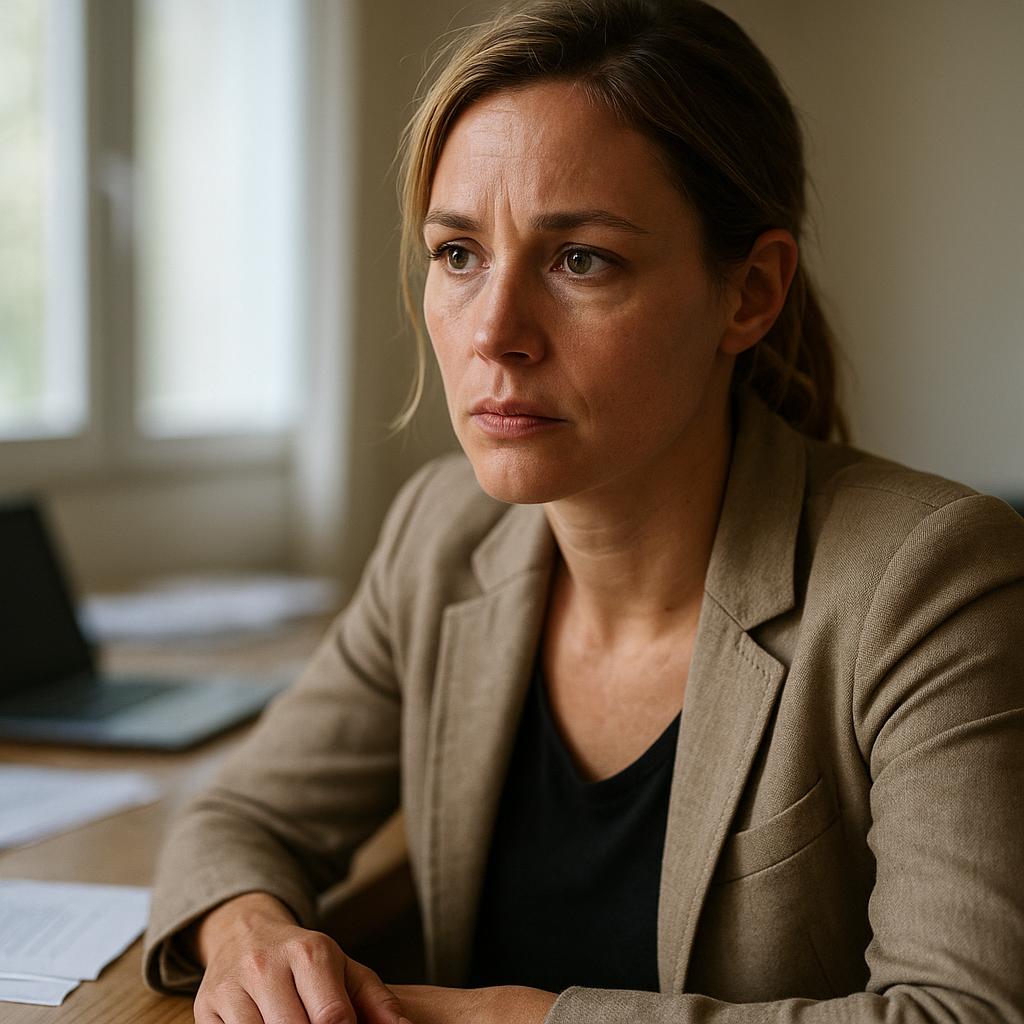 Image by RM AI
The Conference Confrontation
The conference room felt smaller than usual as Denise Cole strode in wearing a crisp navy pantsuit that screamed 'I'm more important than you.' Principal Harmon greeted her with that deferential smile reserved for major donors. I clutched my documentation binder like a shield. 'Evan is absolutely thriving academically,' Denise began before even sitting down, effectively hijacking the meeting. 'His previous school identified him as gifted, you know.' For fifteen excruciating minutes, she extolled Evan's virtues while I waited for my turn. When I finally opened my binder and began reviewing the documented incidents, Denise's smile hardened. 'Ms. Mitchell, with all due respect, I think you're misinterpreting normal boy behavior,' she interrupted, her voice dripping with condescension. 'Boys this age are naturally physical. They test boundaries.' I noticed Principal Harmon shifting uncomfortably as Denise leaned forward. 'Perhaps,' she said, eyebrows raised, 'this is a question of classroom management? How much experience do you actually have with boys this age?' The implication hung in the air like a toxic cloud – that somehow my eleven years of teaching counted for nothing because I couldn't 'handle' her precious son. I felt my cheeks burning but kept my voice steady as I turned to the page documenting the bathroom incident. What happened next would change everything about this power struggle.
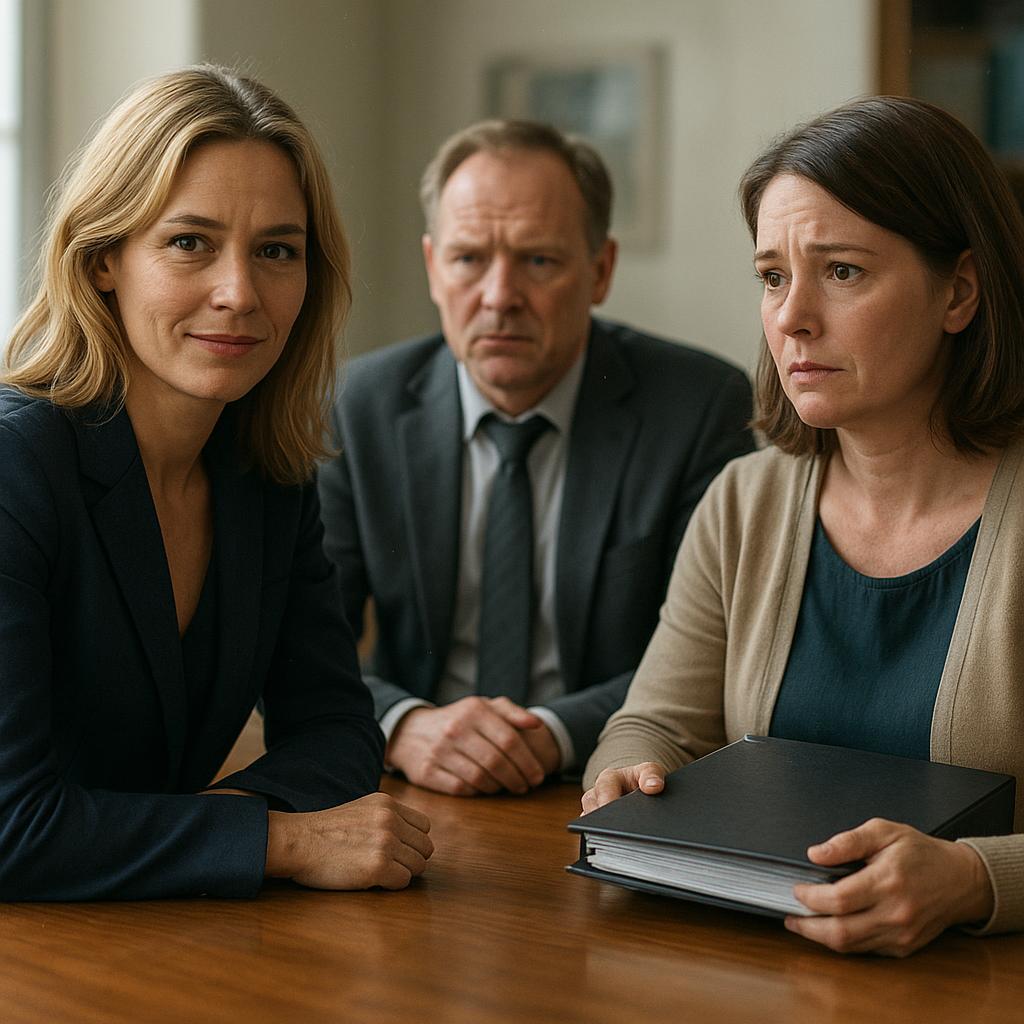 Image by RM AI
The Aftermath of Accusations
The morning after our conference, I found a terse email from Principal Harmon requesting my presence in his office during my planning period. When I arrived, his demeanor was noticeably cooler than usual. 'Laura, we need to discuss your approach with the Cole situation,' he began, leaning back in his chair. 'Denise called me last night, quite upset.' I opened my mouth to respond, but he held up his hand. 'I think we need to pivot to a more positive strategy. Perhaps a personalized reinforcement plan for Evan? Something that highlights his strengths rather than...' he gestured vaguely at my documentation binder, '...all this negative documentation that's only escalating tensions.' When I mentioned my concerns about the other students' safety, Harmon's expression hardened. 'Look, the district is facing significant budget cuts this year. We simply cannot afford parent dissatisfaction, especially from families like the Coles.' The implication was crystal clear – Denise's donations mattered more than my students' wellbeing. As I left his office, clutching my binder of ignored evidence, I realized I was now facing an impossible choice: protect my career by staying silent, or protect my students by fighting a system designed to silence me.
 Image by RM AI
Classroom Intervention Attempts
After the disastrous parent-teacher conference, I decided to try a different approach with Evan. I rearranged the classroom seating chart, placing him near my desk where I could maintain eye contact. I created a private signal system—a gentle tap on his desk as a warning—and implemented a positive reinforcement chart just for him. For two glorious days, the tension in our classroom eased slightly. The children's shoulders relaxed, and a few tentative hands began to raise again during question time. I allowed myself a sliver of hope. Then came Wednesday. As we lined up for lunch, Evan casually stuck out his foot as Tyler walked past. The sickening thud of Tyler's head hitting the corner of my desk echoed through the suddenly silent classroom. While other students rushed to help Tyler, who was clutching his forehead where a bump was already forming, I grabbed my documentation notebook. That's when Evan looked directly at me, his eyes cold and calculating beyond his eight years. "My mom says you're not allowed to write things down about me anymore," he announced loudly, his lips curving into that familiar smile that never reached his eyes. In that moment, I realized Denise had done something far worse than enable her son's behavior—she had weaponized him against me.
 Image by RM AI
The Parent Allies
The day after Tyler's injury, I was erasing the whiteboard when I heard a gentle knock. Tyler's mother, Mrs. Abernathy, stood in the doorway, her face etched with concern. 'Ms. Mitchell, Tyler's been having nightmares,' she said, settling into a student chair that made her look comically large. 'He's making up stomach aches to avoid school.' I chose my words carefully, explaining the classroom dynamics without mentioning Evan by name. Professional boundaries were important, but so was this mother's right to understand why her son was suffering. To my surprise, Mrs. Abernathy nodded knowingly. 'We've been talking, you know. Six of us parents.' My hand froze mid-note. 'Emma's dad, Zoe's mom, Aiden's parents... we've all noticed changes in our kids.' She leaned forward, lowering her voice. 'We know your hands are tied here. The politics.' The way she said 'politics' made it clear she understood more than I'd realized. 'We're meeting with Principal Harmon tomorrow as a group. Not to complain about you—to support you.' For the first time in weeks, I felt something dangerous bloom in my chest: hope. What I didn't know then was that Denise Cole had allies of her own, and they were already mobilizing against me.
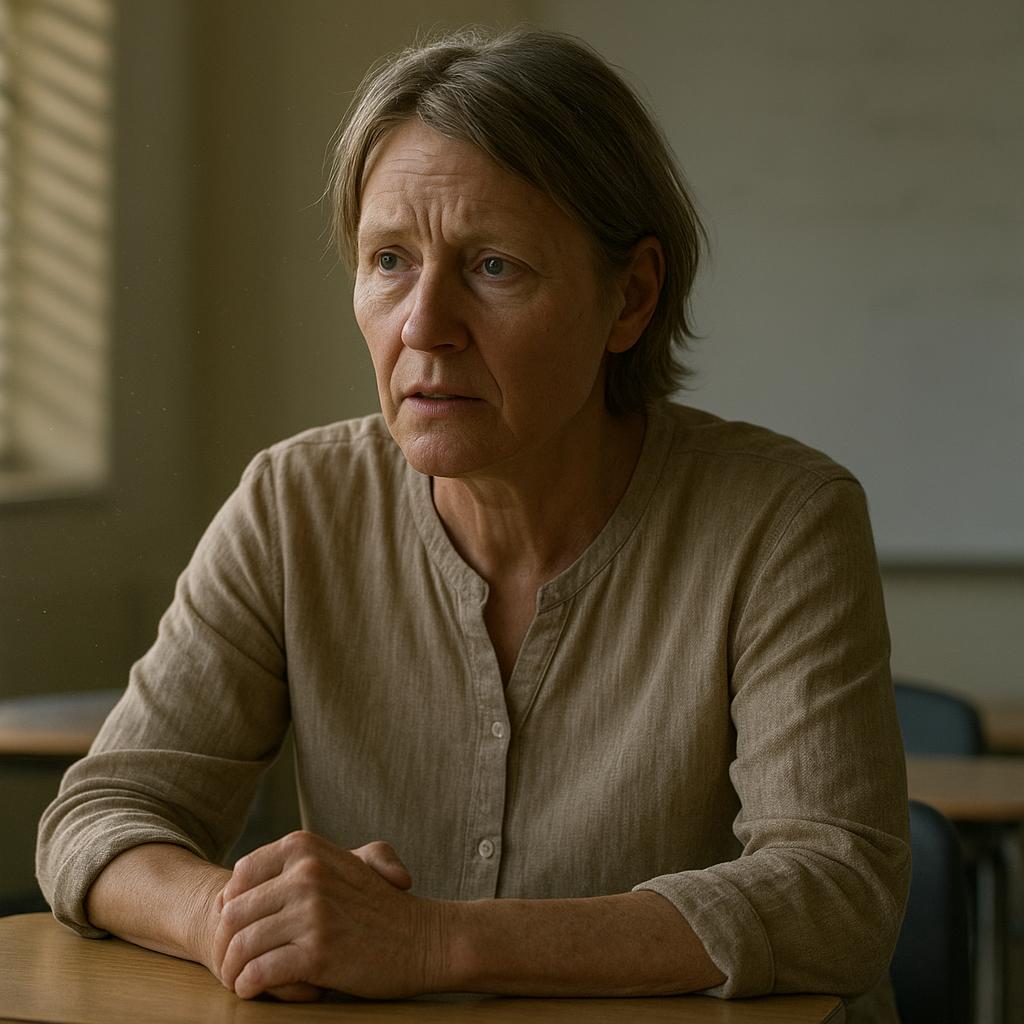 Image by RM AI
The Parents' Meeting
Principal Harmon's 'community discussion' was a masterclass in administrative deflection. The conference room filled with concerned parents—Mrs. Abernathy, the Chens, Zoe's mom, and others—all wearing identical expressions of determination. I sat quietly in the corner, both hopeful and terrified. 'We're here to discuss positive classroom dynamics,' Harmon began, carefully avoiding the word 'bullying' like it might summon a lawsuit. When Mrs. Washington directly mentioned her concerns about intimidation, Harmon pivoted so smoothly he could have been a politician. 'Let's focus on constructive communication strategies,' he redirected, sliding glossy handouts across the table about 'positive peer interactions.' I watched the parents exchange glances, their frustration palpable as their specific concerns were systematically diluted into vague platitudes. After forty-five minutes of carefully orchestrated nothing, parents filed out, shoulders slumped. Mr. Chen lingered behind, waiting until we were alone. 'Ms. Mitchell,' he said quietly, his voice breaking slightly, 'Emma woke up screaming again last night. She dreamed someone was locking her in a dark closet at school.' The defeat in his eyes mirrored my own. 'She used to love school.' As he left, I realized something chilling—this carefully choreographed meeting hadn't been about finding solutions; it had been about creating the appearance of action while ensuring nothing actually changed.
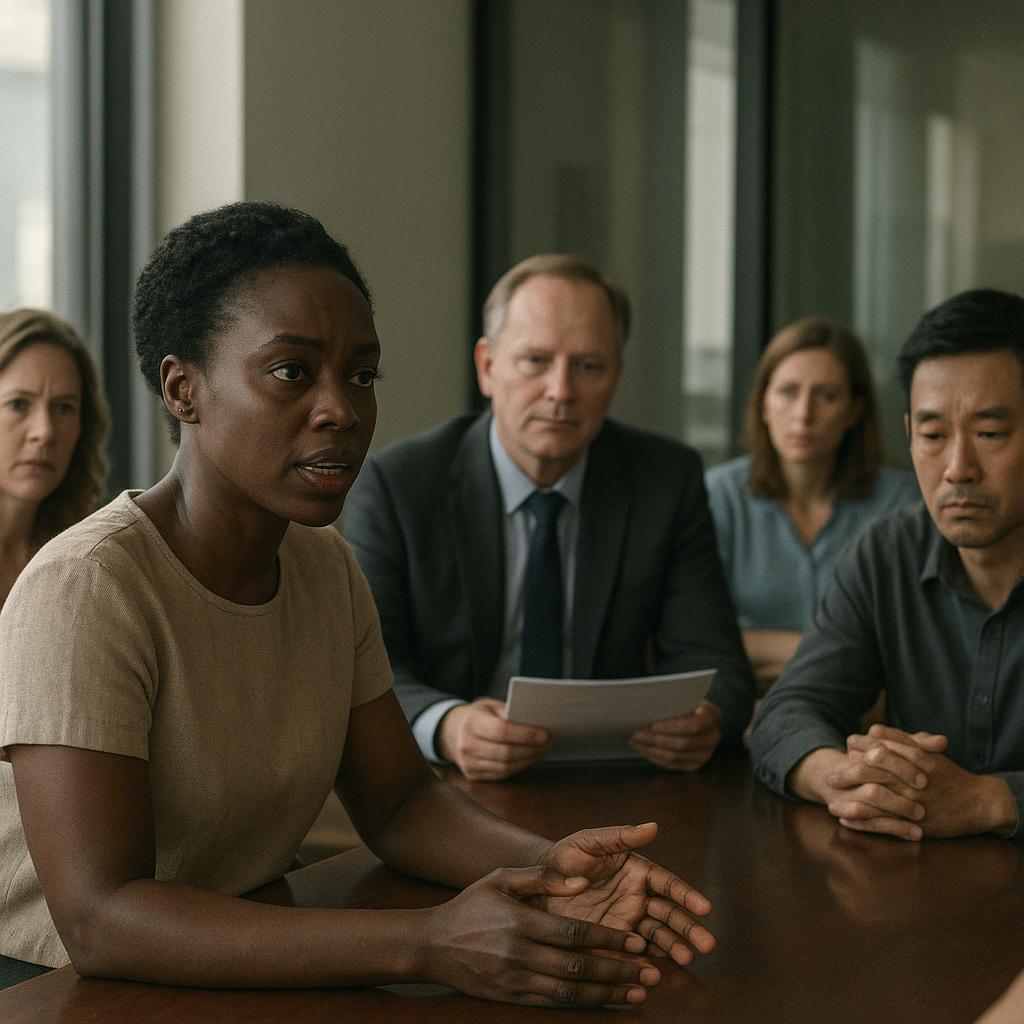 Image by RM AI
The Anonymous Complaint
The email from HR arrived during my lunch break, the subject line 'Urgent: Meeting Request' causing my stomach to drop before I even opened it. 'This email serves to inform you that an anonymous complaint has been filed regarding your teaching practices...' I read the words twice, my turkey sandwich forgotten. According to the complaint, I had been 'targeting and discriminating against a male student' and 'creating a hostile learning environment.' Though no names were mentioned, I didn't need to be a detective to figure out who was behind this. My hands trembled slightly as I closed my laptop, just as Marianne poked her head in. 'You okay? You look like you've seen a ghost.' I couldn't bring myself to explain. Later, while gathering my things to leave, I glanced out the window and froze. There in the parking lot stood Denise Cole, designer sunglasses perched on her head, engaged in what appeared to be an intense conversation with Principal Harmon. His body language—nodding vigorously, hands gesturing reassuringly—told me everything I needed to know. This wasn't just a parent complaint anymore; this was a calculated attack on my career, and Harmon had clearly picked his side. As I watched them, a cold realization settled over me: in the court of school politics, evidence and truth might not be enough to save me.
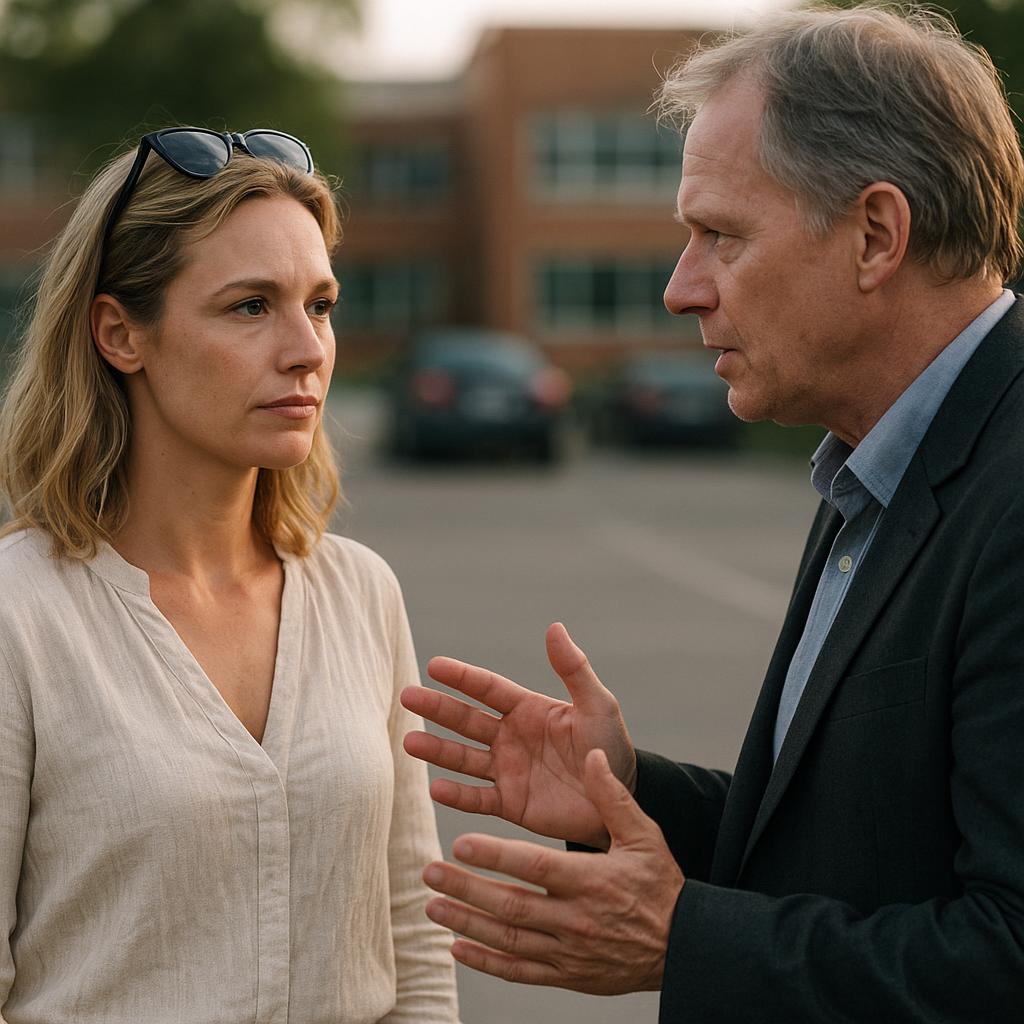 Image by RM AI
The HR Interrogation
The HR office felt like an interrogation room—too bright, too sterile, with a desk between us like a barrier. Ms. Simmons, the HR Director, peered at me over reading glasses that seemed designed specifically for intimidation purposes. 'Ms. Mitchell, we need to discuss your... documentation practices,' she began, emphasizing the word as if it were a criminal activity. 'There's concern you may be singling out certain students.' I'd anticipated this, so I calmly opened my binder—not just the one for Evan, but the comprehensive one containing records for every student. 'I document all classroom incidents,' I explained, sliding the meticulously organized records across her desk. 'For every student.' Her eyebrows rose slightly as she flipped through the pages, clearly not expecting this level of thoroughness. 'Well,' she said finally, removing her glasses, 'this is... comprehensive. But Laura, we need to discuss perception issues. Documentation can sometimes be interpreted as targeting.' As I gathered my things to leave, she delivered the blow I'd been dreading: 'The superintendent has taken a personal interest in this case.' Translation: Denise Cole had escalated this all the way to the top, and my carefully documented evidence might not matter at all in a system where money spoke louder than truth.
 Image by RM AI
The Union Representative
After the HR meeting, I felt like I was drowning in a system designed to protect everyone but the truth. With shaking hands, I called Victor Ramirez, our union representative. 'I need help,' I admitted, my voice cracking slightly. Victor agreed to meet me at a coffee shop off campus—neutral territory where we wouldn't be seen together. The next afternoon, I watched him methodically review my documentation, his expression growing increasingly grim. 'This is textbook,' he finally said, closing my binder. 'Influential parent leveraging connections to shield their child from consequences.' He explained that he'd seen this pattern in three different districts—wealthy parents who viewed teachers as service providers rather than professionals. 'Keep documenting everything,' Victor advised, stirring his untouched coffee. 'Every email, every meeting, every conversation with Harmon. Forward copies to me directly.' He paused, choosing his words carefully. 'I'm going to investigate whether proper protocols are being followed. The district has procedures they're required to follow, even for donors.' As I gathered my papers, Victor placed his hand on my binder. 'Laura, you're not crazy, and you're not alone. What I can tell you is that Denise Cole isn't the first parent to try this playbook—but she might be surprised to learn we've studied it too.'
 Image by RM AI
The Science Project Preparation
The annual science fair was approaching, and I hoped it might be a fresh start for our classroom dynamics. I carefully arranged the groups, placing Evan with Tyler (yes, the same Tyler whose head had met my desk corner) and Aiden, two boys whose enthusiasm for science was infectious. 'Ms. Mitchell, can we make our volcano EXPLODE for real?' Aiden asked, eyes wide with possibility. For the first hour, I watched in cautious amazement as Evan actually participated, suggesting they add red food coloring to the 'lava' mixture. My heart lifted slightly—was this the breakthrough I'd been hoping for? But then came the vote on final design. When Tyler and Aiden chose a different approach than Evan's suggestion, I saw it happen in slow motion: that familiar darkness clouding his eyes, his fingers tapping methodically against the table as he watched the boys work. I moved closer to their table, pretending to check their progress while actually positioning myself between Evan and their half-constructed volcano. 'Everything okay here?' I asked, making deliberate eye contact with Evan. He smiled back at me, all charm and innocence, but I'd seen that smile before. It was the calm before the storm, and I suddenly realized I'd made a terrible mistake putting him in a group with the very student he'd already targeted once.
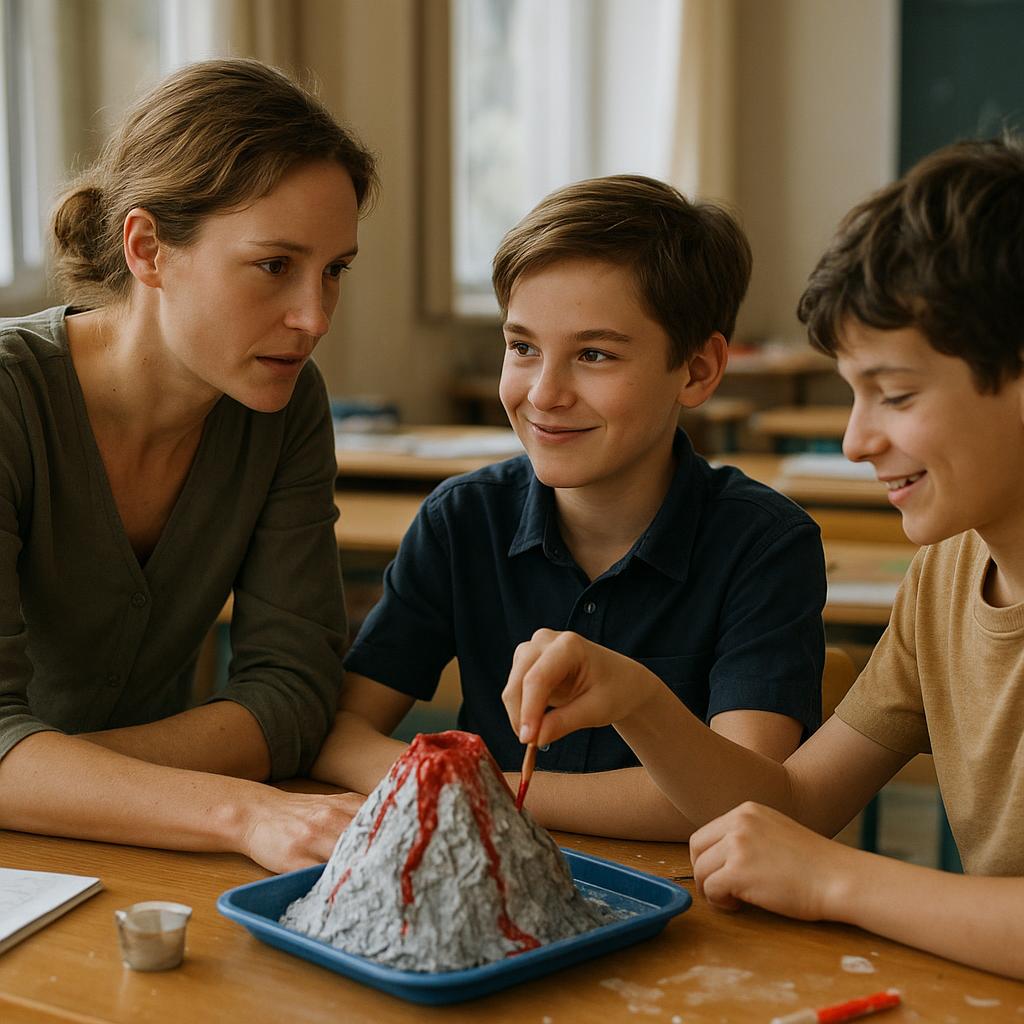 Image by RM AI
The Volcano Incident
Science Fair day arrived with the usual parade of proud parents clutching coffee cups and phone cameras. The classroom buzzed with nervous energy as each group prepared to present. When it was Tyler's group's turn, I noticed Evan's posture change—that subtle shift I'd come to recognize as danger. Tyler stood tall beside their volcano, his voice only slightly trembling as he began explaining their project. I was moving toward them when it happened—Evan's hand shot out, deliberately shoving the volcano off the table. The crash silenced the room instantly. Baking soda foam spread across the floor like slow-motion lava while Tyler stood frozen, his months of work destroyed in seconds. What haunts me still was Evan's laugh—not embarrassed or nervous, but genuinely delighted by the destruction he'd caused. Parents exchanged uncomfortable glances; Mrs. Abernathy's hand flew to her mouth. Tyler's eyes welled with tears he desperately fought to contain, his small shoulders rigid with the effort. I placed my hand on Tyler's back, feeling it shake beneath my palm, and made a decision I knew would change everything. 'Evan,' I said, my voice carrying in the silent room, 'please go to the principal's office immediately.' As he sauntered out, smirking, I already knew what would happen next—Denise Cole would arrive like a hurricane, and this time, there would be witnesses she couldn't dismiss.
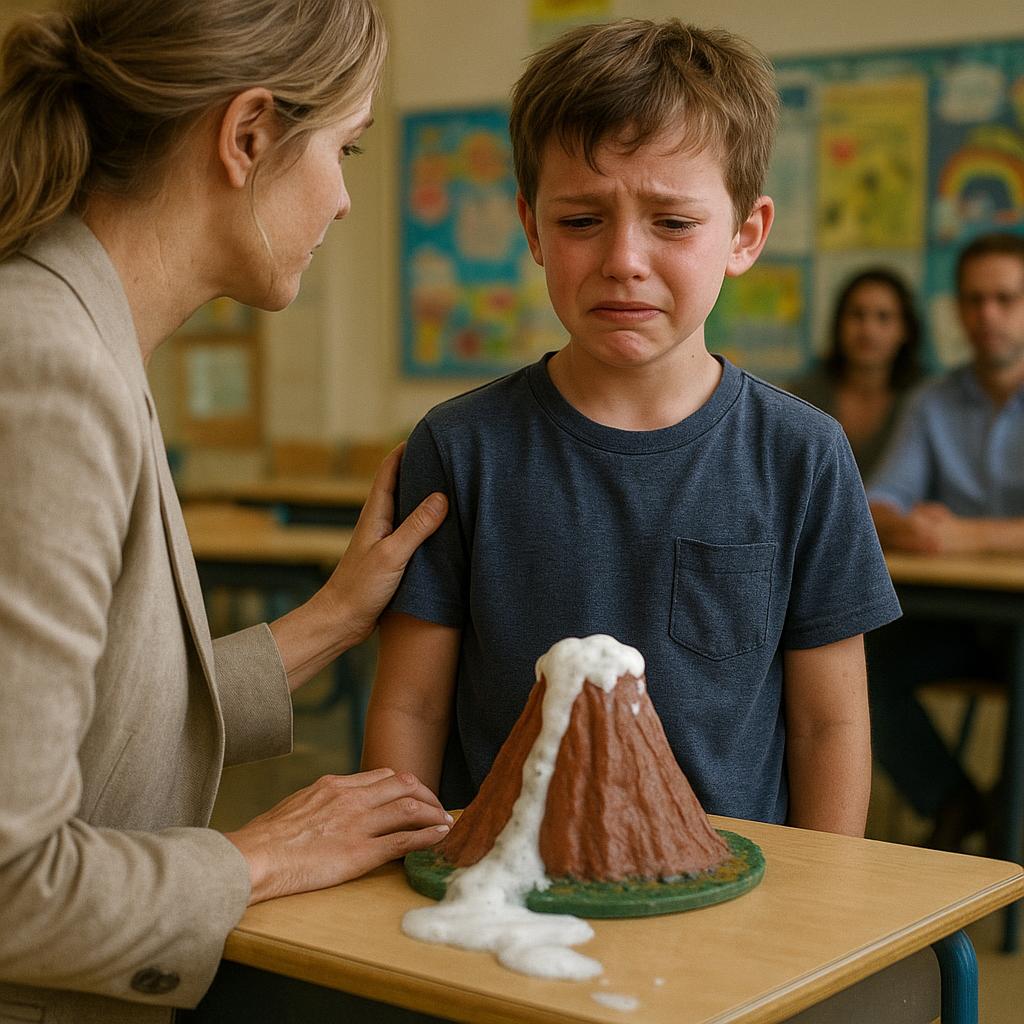 Image by RM AI
The Breaking Point
I watched Principal Harmon's face as Denise Cole stormed into his office thirty minutes after my call, her designer handbag swinging like a weapon. 'How DARE you humiliate my son in front of the entire class?' she demanded, not even acknowledging the destruction her child had caused. I sat straight-backed, clutching my documentation binder as she turned to Harmon. 'This teacher has been targeting Evan for months. This ends today.' Several parents from the science fair had lingered in the hallway, pretending to examine artwork while clearly eavesdropping. Mrs. Abernathy caught my eye through the glass partition, giving me a subtle nod of support. 'Ms. Cole,' I began calmly, 'Evan deliberately destroyed another student's project—' 'He TRIPPED!' she interrupted, her voice rising. 'It was an accident that this... this woman is weaponizing against an eight-year-old boy!' Harmon's eyes darted between us, then to the parents outside, clearly calculating the political fallout. When Denise demanded a formal complaint be filed against me for creating a 'hostile learning environment,' I watched him cave in real time, his spine visibly dissolving as he assured her he would 'address this situation immediately.' As they discussed my professional fate as if I weren't even in the room, something inside me hardened into resolve. They could try to silence me, but they hadn't seen my final move yet.
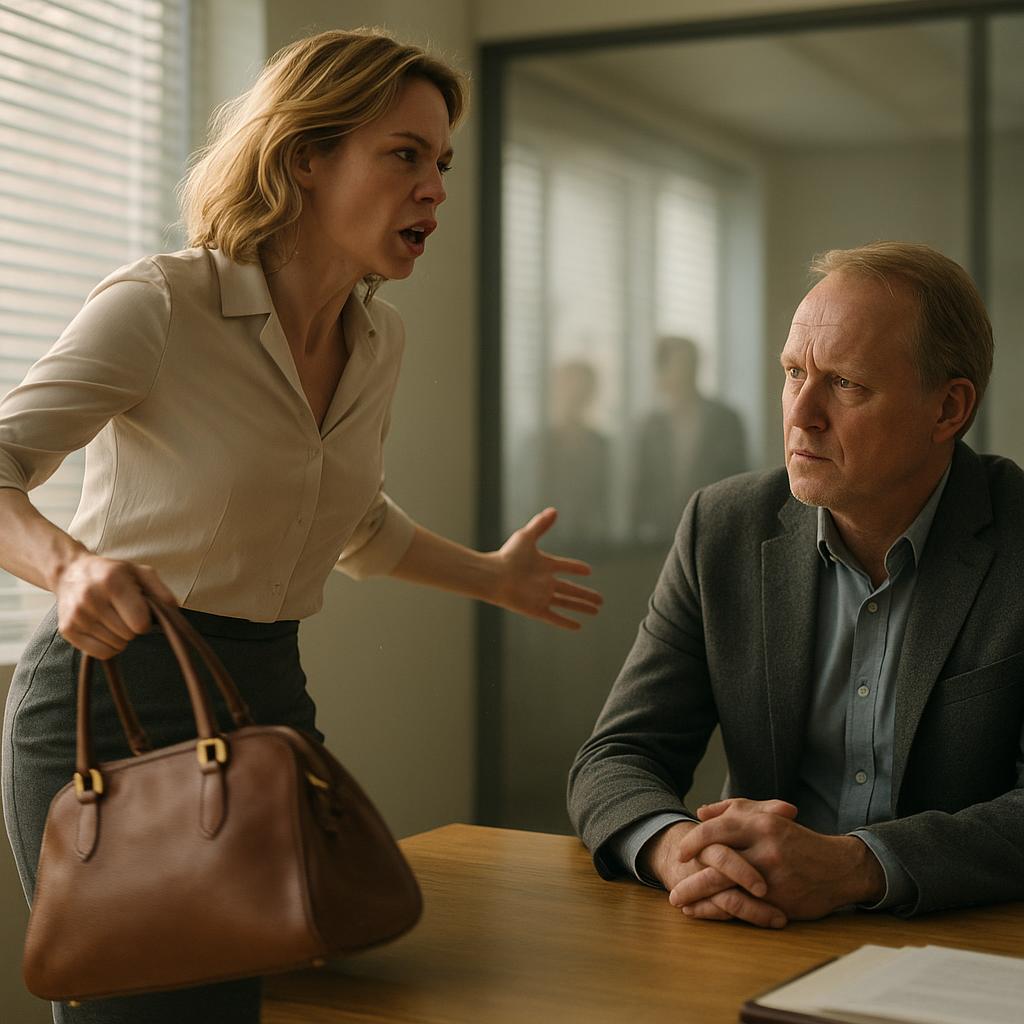 Image by RM AI
The Formal Complaint
The HR email arrived at 4:37 PM, just as I was packing up for the day. 'A formal complaint has been filed against you by a parent,' it read, the bureaucratic language failing to disguise the gravity of the situation. I sank into my chair, scanning the allegations: 'emotional abuse,' 'discrimination,' and 'retaliation' against Evan. My hands trembled as I read the requirement to attend a disciplinary hearing next Tuesday. Eleven years of dedicated teaching, and now my career hung in the balance because I'd refused to let one child terrorize twenty others. I drove home in a daze, wondering how protecting my students had somehow become a punishable offense. That evening, as I sat staring blankly at a glass of wine I couldn't bring myself to drink, my phone began buzzing with notifications. Mrs. Abernathy had texted: 'We saw everything. This isn't right.' Then Mr. Chen: 'Emma told us what really happened. We're with you.' One by one, parents who had witnessed the volcano incident reached out, offering to speak on my behalf at the hearing. Their support brought tears to my eyes—finally, I wasn't fighting this battle alone. As I compiled their messages into a folder labeled 'Witness Statements,' I realized Denise Cole had made a critical miscalculation: she thought I was isolated, but she hadn't counted on the power of parents who were tired of watching their children come home afraid.
 Image by RM AI
The Substitute Teacher
Principal Harmon called me into his office Friday afternoon, his face a mask of administrative concern that didn't quite reach his eyes. 'Laura, given the... sensitivity of the situation, we think it's best if you take some administrative leave while we investigate the complaint.' The way he said 'investigate' made it clear this was less about finding truth and more about appeasing Denise Cole. I wanted to argue but found myself nodding instead, suddenly bone-tired from the weeks of battle. The next morning, I arrived early to pack up my personal items—family photos, the mug my first class had given me, eleven years of teaching life condensed into a cardboard box. The classroom felt eerily quiet without the children, like a theater after the audience has gone. As I removed my inspirational posters, I heard a small shuffle at the door. Emma Chen stood there, clutching something in her hands, her eyes wide with uncertainty. 'Ms. Mitchell? Are you leaving us?' she whispered. Before I could formulate a gentle explanation, she rushed forward, pressing a folded construction paper card into my hands. 'Please come back,' it read in wobbly letters, surrounded by drawings of sad faces and one particularly detailed volcano. As Emma hugged me fiercely before running back to the hallway, I realized what terrified me most wasn't losing my job—it was what would happen to these children in my absence.
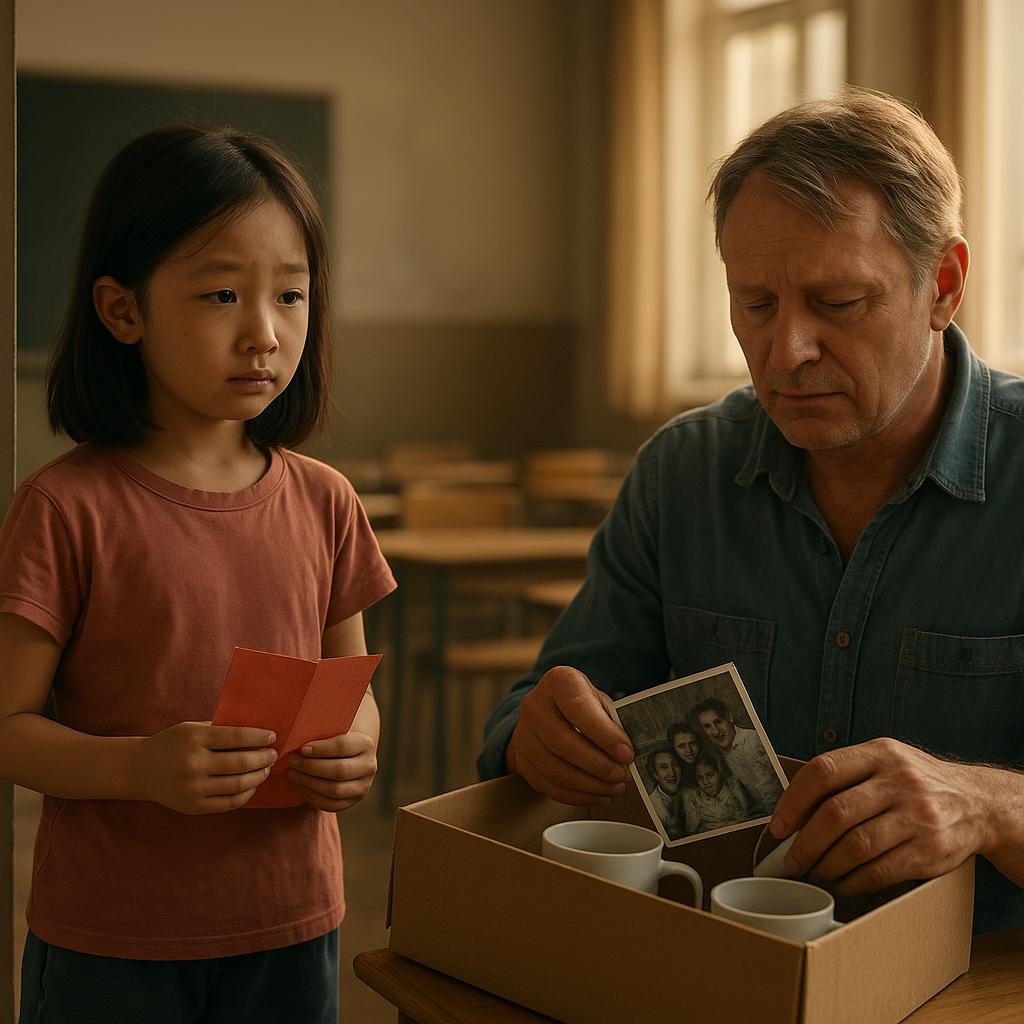 Image by RM AI
The Evidence Compilation
My dining room table disappeared under a sea of papers as I organized everything chronologically—incident reports, behavior charts, parent communications, and the growing collection of witness statements. Victor sat across from me, nursing a cup of coffee that had long gone cold. 'Focus on patterns, not isolated incidents,' he advised, helping me arrange the timeline. 'Show how each intervention was met with denial, and how the behavior escalated despite your efforts.' I nodded, paper-clipping another set of documents together, my eyes burning from hours of sorting. Around midnight, my laptop chimed with a new email. It was from Ms. Reynolds, the substitute teacher who'd taken over my class. 'Ms. Mitchell,' she wrote, 'I wanted to check if Evan's behavior is typical? He's locked another student in the supply closet and torn up three assignments already. The principal suggested I might be "misinterpreting playful behavior," but this doesn't seem playful to me.' I stared at the screen, a strange mix of validation and heartbreak washing over me. Even with me gone, the pattern continued—only now there was another witness to the truth, one the administration hadn't thought to silence yet.
 Image by RM AI
The Parent Coalition
Mrs. Washington's living room felt like a war room by the time I arrived. Eight sets of parents sat in a tight circle, some clutching coffee mugs like lifelines, others with notepads already filled with bullet points. Victor had encouraged me to attend, saying 'documentation from multiple sources strengthens your case exponentially.' I hadn't expected such a turnout. 'We've been waiting for someone to finally stand up to her,' Mrs. Washington said, squeezing my hand. One by one, parents shared stories that made my stomach twist – incidents I'd never even known about. Emma Chen's bathroom 'accident' after Evan refused to let her use the restroom. Zoe's missing lunch money. The threatening notes Tyler had hidden in his backpack for weeks. Mr. Chen, an IT professional with a quiet intensity, set up his camera in the corner. 'I'm recording video statements from everyone,' he explained. 'Written statements can be dismissed, but seeing a parent's face when they describe their child crying every morning before school? That hits differently.' As each parent spoke directly into the camera, describing in painful detail what their children had endured, I realized something powerful was happening – the isolation Denise had weaponized against me was crumbling as these families found their collective voice. What none of us realized was how quickly Denise would move to silence them too.
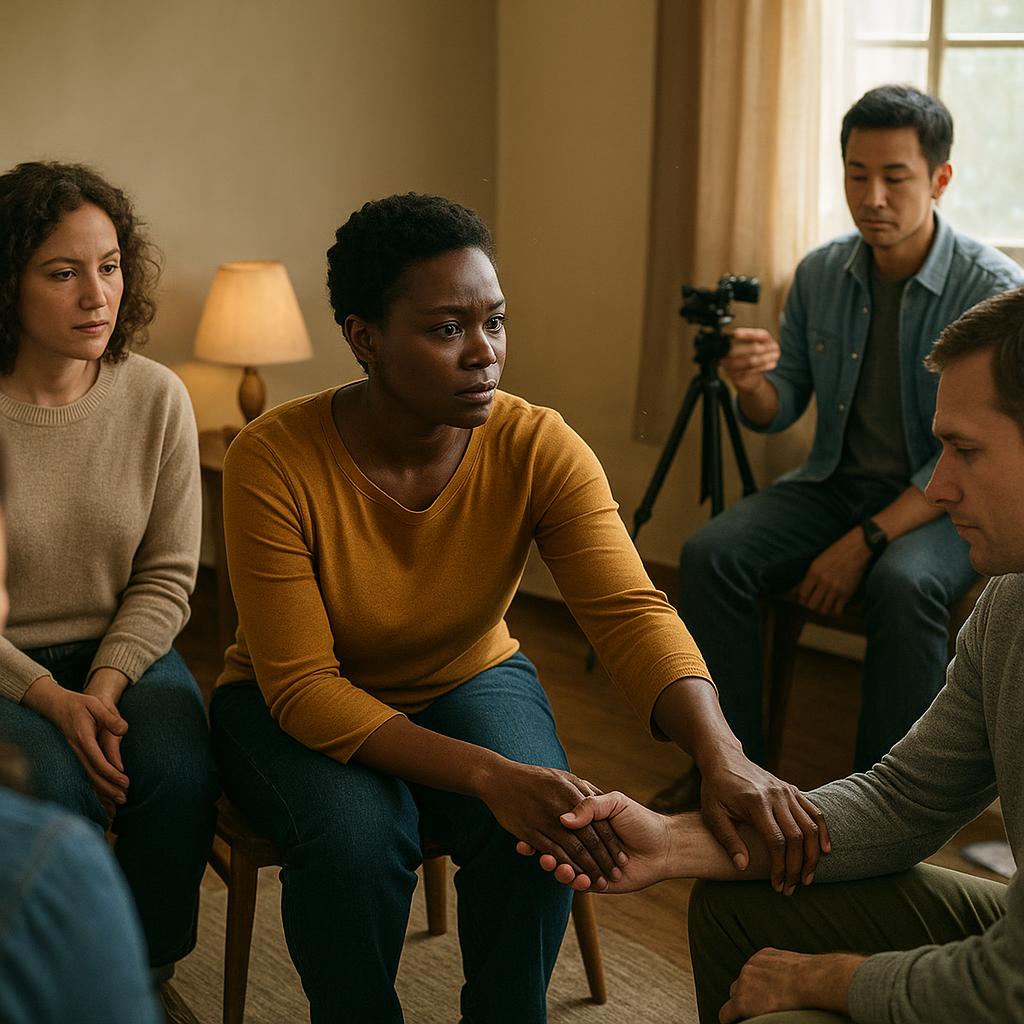 Image by RM AI
The Escalating Emails
The morning after the parent coalition meeting, I woke to find my inbox flooded with notifications. Denise had launched what Victor later called her 'email carpet bombing campaign.' Every district administrator, board member, and even the superintendent had been copied on a five-page manifesto detailing my alleged 'psychological warfare' against her son. 'He cries every night,' she wrote, 'traumatized by Ms. Mitchell's vendetta.' By afternoon, another email arrived, this one claiming I'd deliberately isolated Evan from his peers. By the next day, she was demanding my teaching license be revoked. 'Don't engage,' Victor warned when I called him, panic rising in my throat. 'This is exactly what she wants—to provoke you into responding emotionally.' Instead, he methodically forwarded each message to our legal team, creating what he called 'Exhibit A in harassment.' The emails grew increasingly unhinged as days passed. One accused me of 'discriminating against boys who show leadership qualities.' Another suggested I needed psychological evaluation. What Denise didn't realize was that with each rambling, accusatory message, she was actually strengthening my case—revealing the very pattern of denial and deflection I'd been documenting all along. But when her Thursday email arrived with the subject line 'FORMAL NOTICE OF INTENT TO SUE,' even Victor's calm demeanor cracked slightly.
 Image by RM AI
The Staircase Incident
I was at home grading papers when my phone rang. It was Ms. Reynolds, her voice shaking. 'Laura, something terrible happened today.' She described how during recess, she'd witnessed Evan deliberately push Maya Patel down the concrete staircase by the playground. Maya's wrist had snapped on impact—a clean break according to the paramedics. 'The whole thing is on the security camera,' Ms. Reynolds explained. 'Clear as day. He waited until no teachers were looking, then just... shoved her.' My stomach knotted as she described Principal Harmon's reaction—first suggesting Maya might have 'lost her balance' until Ms. Reynolds mentioned the footage. 'His whole demeanor changed when I said there was video,' she said. 'Suddenly he was all action, calling parents, filing reports.' I sat in stunned silence, picturing sweet Maya—the girl who brought extra pencils for classmates who forgot theirs—lying hurt and frightened on cold concrete. When Ms. Reynolds added that Denise was already claiming Maya 'fell on her own,' something inside me snapped. This wasn't just about my job anymore. A child was physically harmed, and I had the evidence to prove this wasn't an isolated incident. What happened next would change everything—not just for Evan, but for every child in that classroom.
 Image by RM AI
The Undeniable Evidence
Victor arrived at my apartment the next morning, his face grim but determined. 'I got it,' he said, placing a USB drive on my kitchen table like it contained nuclear launch codes. 'The security footage and Ms. Reynolds' full incident report.' We watched in silence as the video played on my laptop. There was no ambiguity, no gray area – just Evan deliberately looking around to ensure no teachers were watching before shoving Maya down the concrete stairs. I felt physically ill. When Principal Harmon finally showed the footage to Denise in his office (with me present at Victor's insistence), I expected shock, horror, maybe even tears. Instead, she doubled down. 'Maya clearly lost her balance,' she insisted, her voice eerily calm despite the evidence literally playing before her eyes. 'Evan was just standing near her.' When Harmon announced Evan would be suspended pending a full review, Denise's composure shattered. 'This is OUTRAGEOUS!' she screamed, jabbing a finger at me. 'She's poisoned everyone against my son!' For the first time, I watched Harmon's spine visibly straighten as he stood his ground. 'Ms. Cole, the video speaks for itself,' he said firmly. As Denise stormed out, threatening lawsuits and media exposure, I realized we'd finally reached the moment where denial could no longer protect Evan – but I had no idea how dangerous a cornered Denise Cole could be.
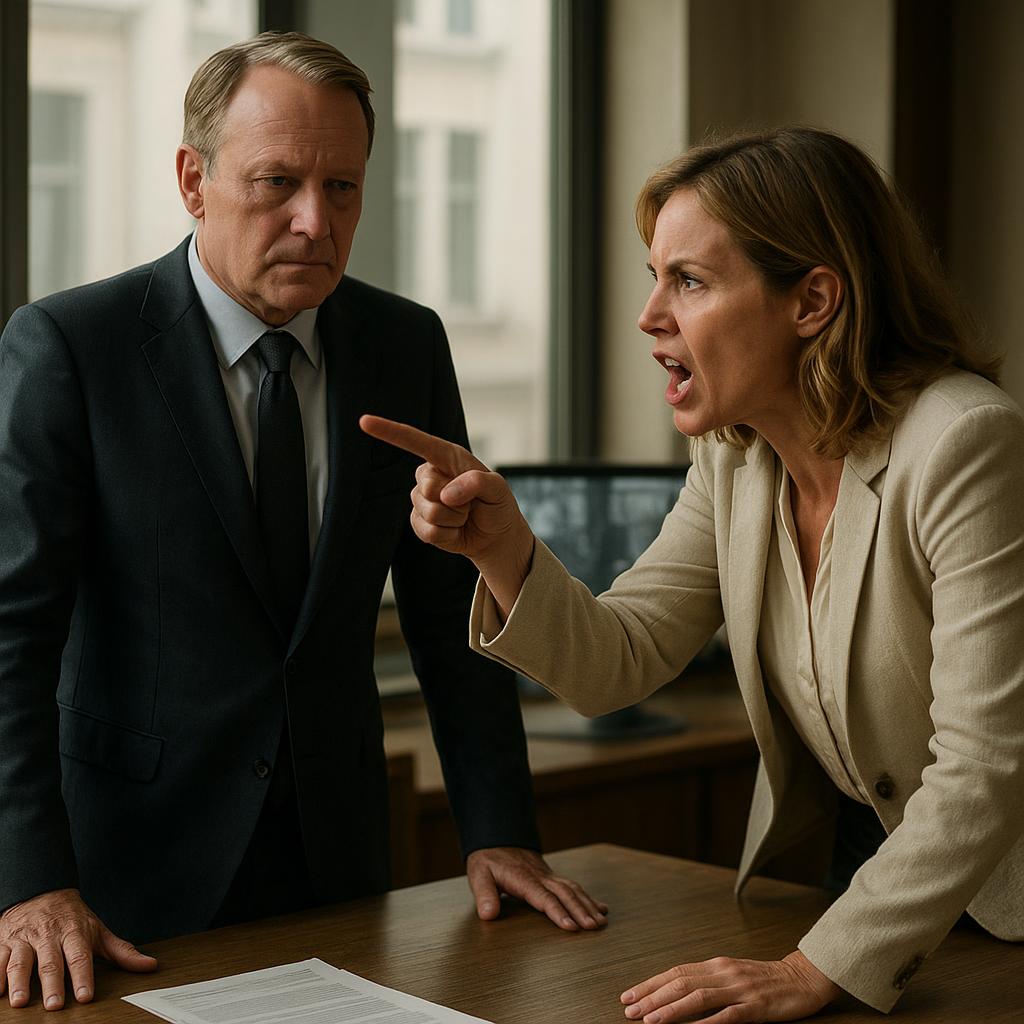 Image by RM AI
The Turning Point
The call from Superintendent Wallace came on a Tuesday evening as I was sorting through my evidence binder for the hundredth time. 'Ms. Mitchell,' he said, his voice carrying a weight I hadn't heard before, 'I owe you an apology.' I nearly dropped the phone. After weeks of being treated like I was the problem, the sudden validation left me speechless. Wallace explained that Maya's parents had contacted their attorney and were considering legal action against the district—not just for the injury, but for the 'pattern of negligence' that led to it. 'We need you back in the classroom,' he said, the irony not lost on either of us. 'And we need your complete documentation. All of it.' I sat down at my kitchen table, surrounded by the very papers that had been dismissed as 'excessive' just weeks earlier. 'So now my documentation matters?' I couldn't help asking. There was a long pause before Wallace responded, 'It always mattered, Laura. We just... we made the wrong calculation about which parent to appease.' As I hung up, I felt no triumph, only a hollow ache for what it had taken to be heard—a child's broken bone, captured on camera, where denial could no longer twist reality. What I didn't know then was that Denise Cole had one final, desperate move that would shock even those of us who thought we'd seen her worst.
 Image by RM AI
The Disciplinary Hearing
The district office boardroom felt like a courtroom when I arrived for the hearing. Rows of chairs had been arranged facing a long table where five board members sat with expressions that ranged from uncomfortable to openly hostile. I clutched my evidence binder—now nearly two inches thick—as parents from our classroom coalition filed in behind me, their presence a silent wall of support. When Denise Cole swept in with a man in an expensive suit, her eyes widened at the crowd. 'This hearing is supposed to be private,' she hissed to her lawyer, loud enough for everyone to hear. The board chair, Dr. Winters, cleared her throat. 'Ms. Cole, given that multiple families are involved in this situation, we've determined this is a matter of community concern.' Denise's lawyer immediately stood, his voice dripping with practiced indignation. 'My client's son is being subjected to character assassination. We demand all of Ms. Mitchell's so-called documentation be excluded as prejudicial and unverified.' The room erupted in murmurs as Maya Patel's father stood up, his voice shaking with barely controlled anger. 'My daughter's wrist is in a cast because of that "prejudicial" evidence,' he said, making air quotes. As the lawyer attempted to interrupt, Dr. Winters banged her gavel, and I realized this was the moment everything would either fall apart or finally change.
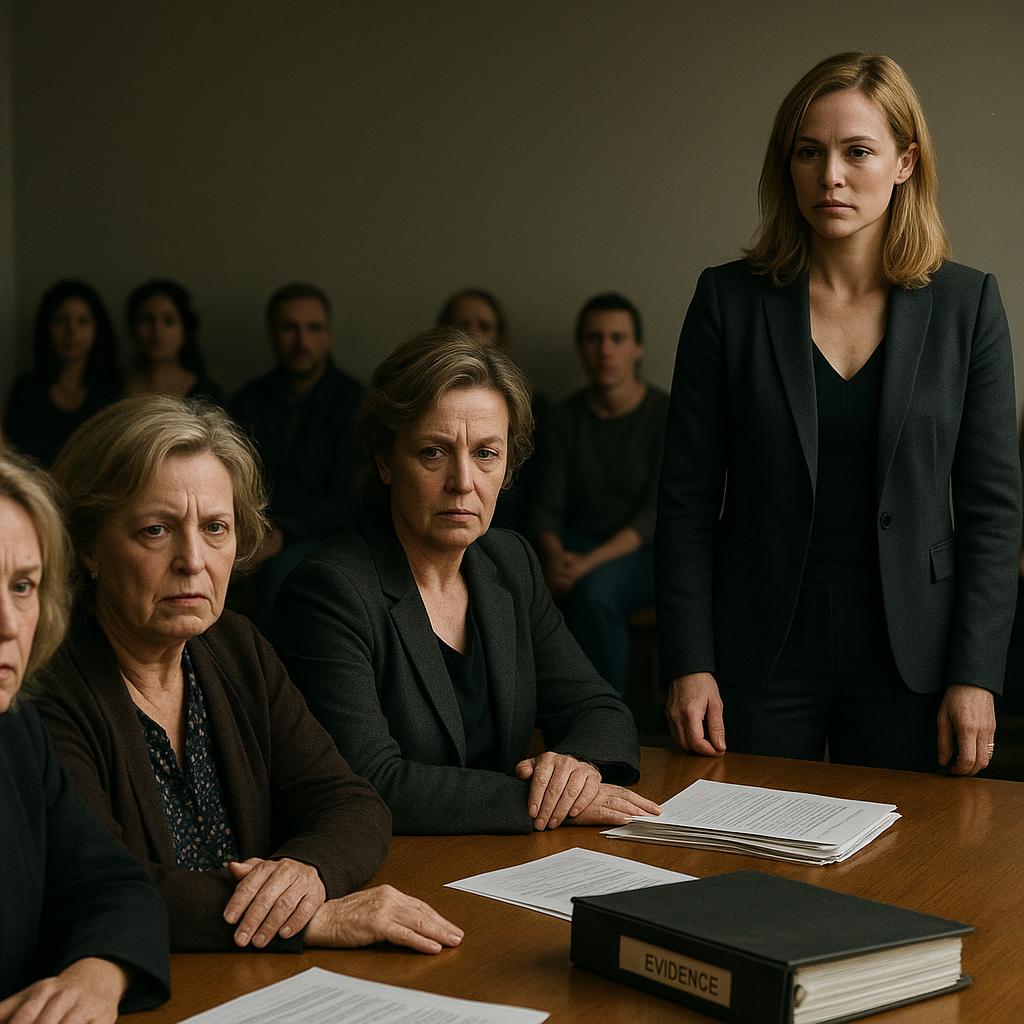 Image by RM AI
My Testimony
When Dr. Winters called my name, I rose slowly, feeling twenty-two pairs of eyes on me. 'I'm not here to vilify Evan,' I began, my voice steadier than I expected. 'I'm here to show you a pattern.' I opened my binder and methodically walked through the timeline—the torn assignments in September, the whispered insults in October, the bathroom incident in November. With each example, I showed Denise's corresponding email denying it happened. 'Notice how the behaviors escalate after each denial,' I said, pointing to my color-coded chart. The room fell completely silent when I described how Emma had stopped raising her hand, how Tyler began feigning illness every morning, how Maya—before her broken wrist—had asked three times to move her desk. 'This isn't about one difficult child,' I explained, my voice catching. 'It's about what happens when accountability disappears.' I looked directly at Denise, whose face had hardened into stone. 'My classroom used to be filled with laughter and curiosity. Now it's filled with fear.' As I finished speaking, Mrs. Abernathy wiped away tears, and even one board member cleared his throat uncomfortably. What happened next would change everything—not just for my career, but for every child who'd been silenced by Denise's denials.
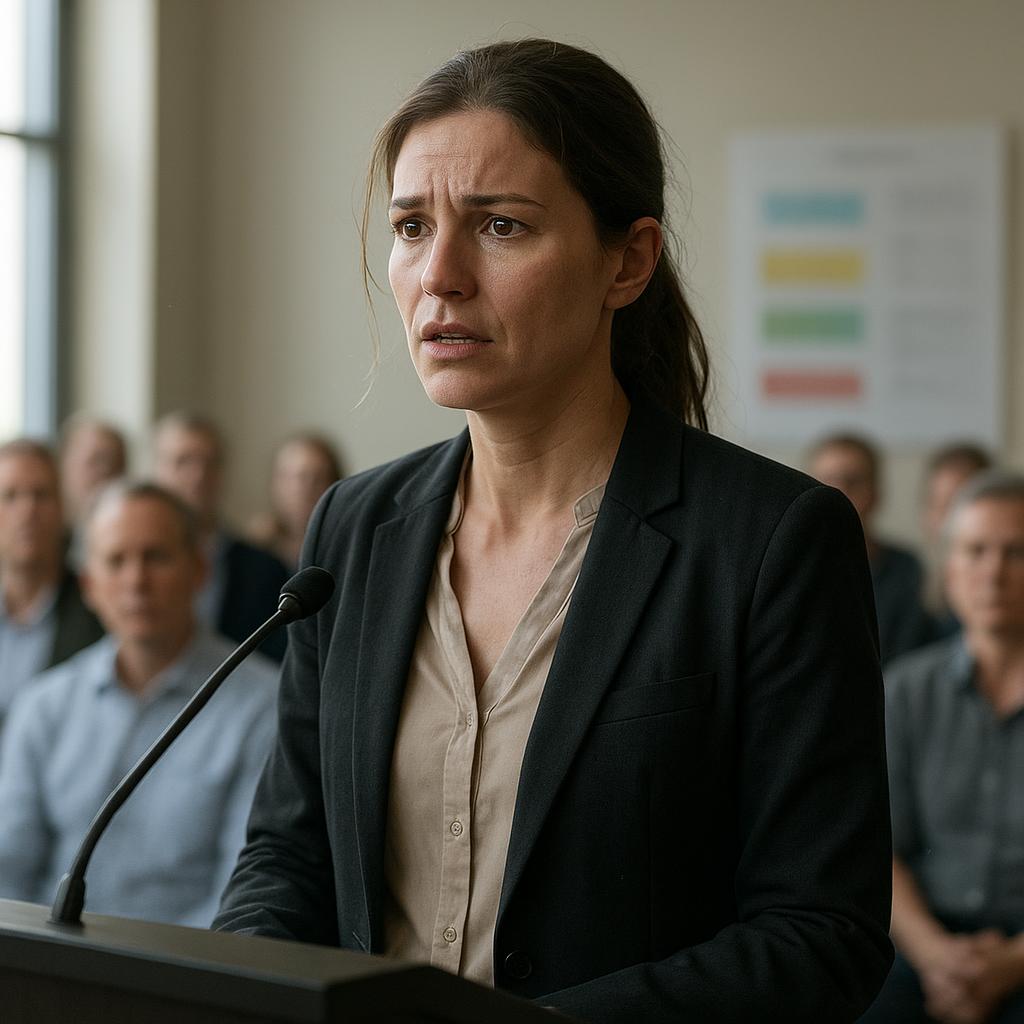 Image by RM AI
The Parent Testimonies
Mrs. Washington stood first, her hands trembling slightly as she unfolded a crumpled paper. 'This is Tyler's journal from last month,' she said, her voice breaking. 'He wrote that he has nightmares about school now.' She turned the page toward the board, revealing a child's drawing of stick figures with one larger figure looming menacingly over the others. 'He used to love school.' One by one, parents approached the table – some angry, others fighting tears. Mr. Chen didn't speak at all; he simply played an audio recording from his phone. Emma's sobs filled the room, her little voice pleading, 'Please don't make me go today, Daddy.' The recording lasted only twenty seconds, but it felt eternal. Denise's lawyer jumped to his feet, adjusting his expensive tie. 'This is all clearly hearsay and emotional manipulation,' he declared with practiced indignation. 'None of this proves my client's son did anything wrong.' Dr. Winters leaned forward, removing her glasses. 'Counselor,' she said with quiet authority, 'these are not court proceedings, and I will hear these parents out.' I watched Denise's face harden as Mrs. Patel approached next, holding up her daughter's cast for everyone to see. What happened next would forever change how I understood the power of collective truth.
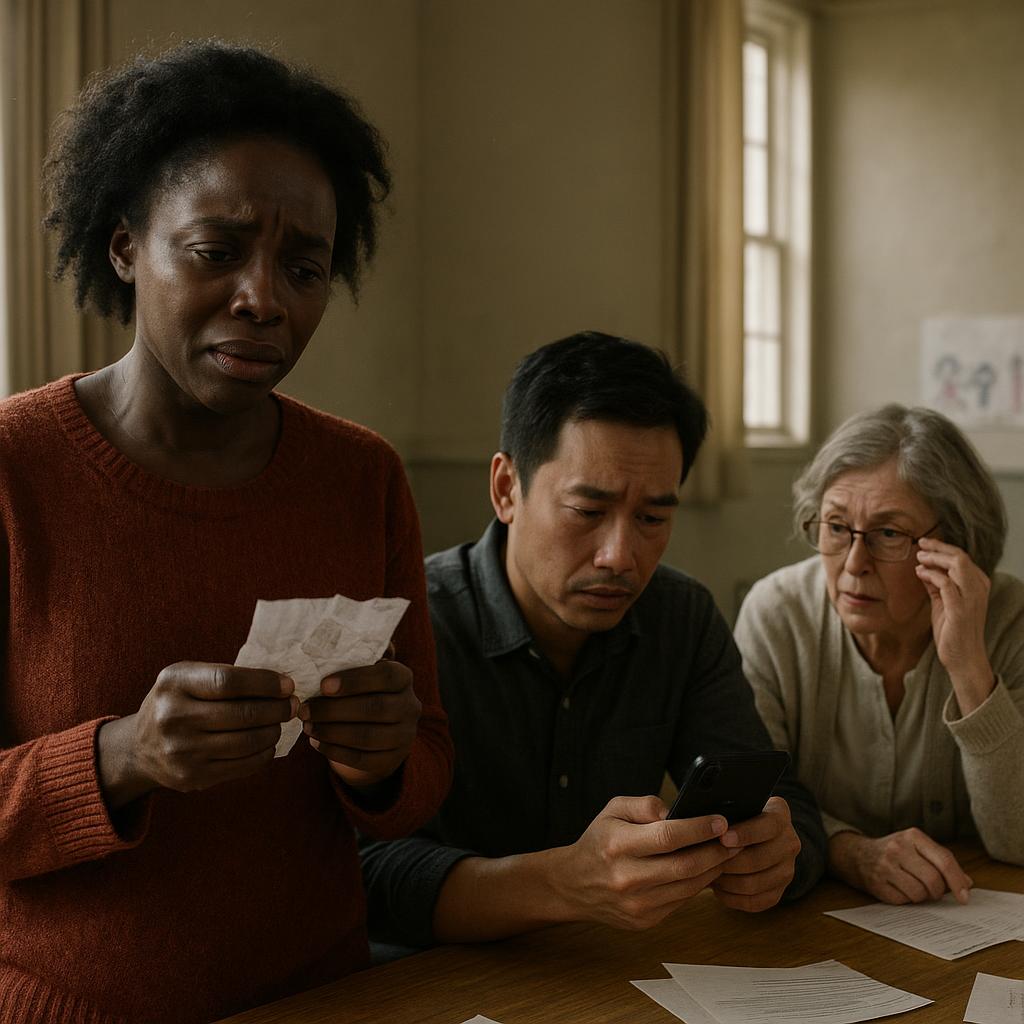 Image by RM AI
The Video Evidence
The boardroom fell into a heavy silence as the lights dimmed and the projector flickered to life. The security footage began to play on the wall, the grainy black and white image showing the playground staircase where Maya's injury occurred. I held my breath, watching as Evan appeared in the frame, his movements deliberate as he scanned the area. The timestamp in the corner matched exactly with the incident report. There was no mistaking what happened next – Evan clearly looked around to ensure no teachers were watching, then deliberately placed both hands on Maya's back and shoved her down the concrete stairs. The sickening moment of impact made several board members flinch visibly. I couldn't bring myself to watch Maya fall again, instead focusing on Denise's face as she saw, perhaps for the first time without her protective filter of denial, what her son had actually done. She gasped audibly, her hand flying to her mouth. Her lawyer immediately leaned in, whispering urgently in her ear, but the damage was done. The video didn't lie. It didn't exaggerate. It simply showed the truth that I'd been trying to communicate for months. As the lights came back on, Dr. Winters cleared her throat and asked, "Ms. Cole, would you like to revise your earlier statement that Maya 'fell on her own'?" What happened next would reveal just how far Denise would go to protect the fiction she'd created about her son.
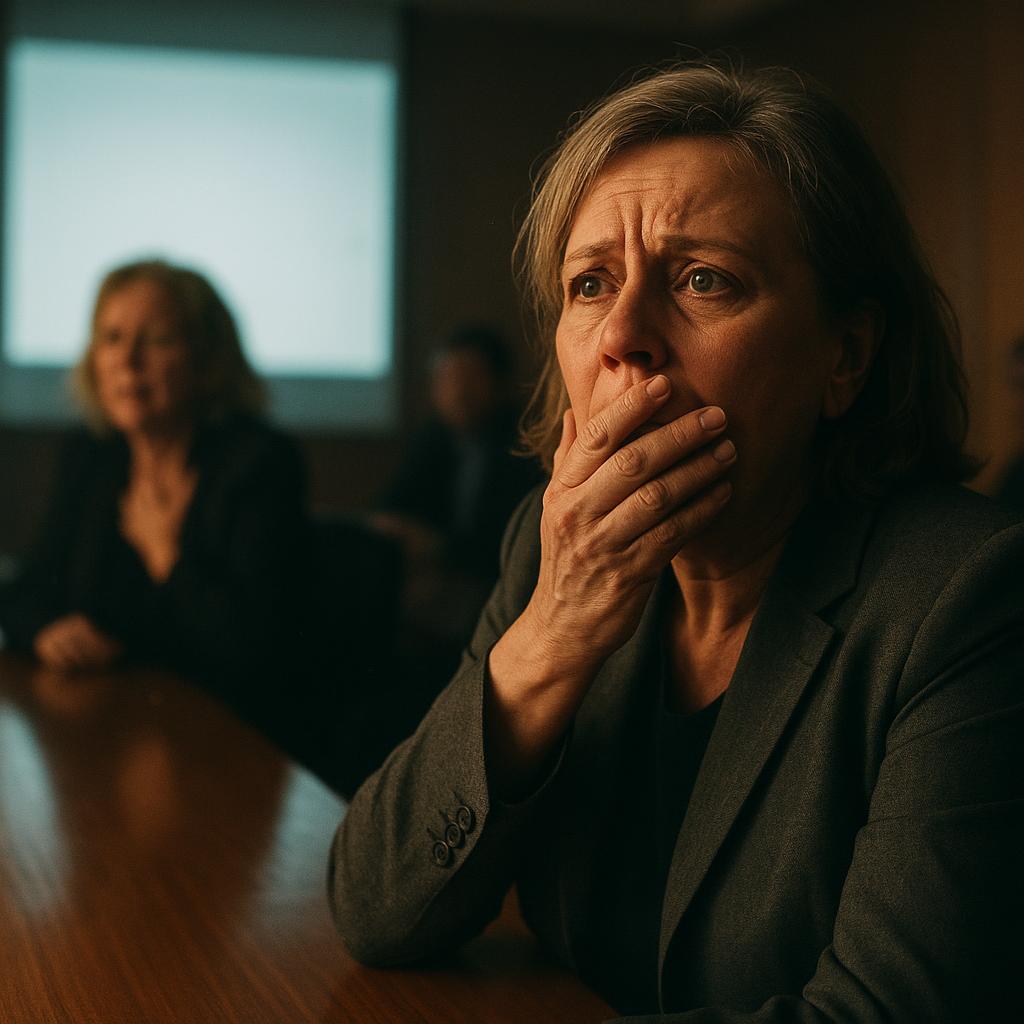 Image by RM AI
Denise's Defense Crumbles
The boardroom fell silent as Denise stood, smoothing her designer blazer with trembling hands. I watched her unfold a typed statement, her eyes darting nervously around the room. 'Ms. Mitchell has orchestrated a systematic campaign against my son,' she began, her voice lacking its usual confidence. The words that had probably sounded powerful in her kitchen now fell flat in this room of witnesses and evidence. Her lawyer, sensing the shift, placed a hand on her arm and whispered something. Denise nodded, changing tactics. 'What Evan needs is support, not punishment,' the lawyer interjected smoothly. 'Perhaps a specialized learning plan—' Dr. Winters held up her hand, cutting him off mid-sentence. 'Ms. Cole,' she said, her voice firm but not unkind, 'I need you to answer one question directly. Do you acknowledge that the child in this video, your son, deliberately pushed Maya down those stairs?' The room seemed to hold its collective breath. Denise stared at the freeze-frame still projected on the wall – her son's hands clearly extended in a pushing motion. After what felt like an eternity, she whispered words that sent chills down my spine: 'That could be anyone's child.' The collective gasp from the parents behind me told me everything I needed to know – Denise's wall of denial was finally beginning to crumble, but what would emerge from the rubble?
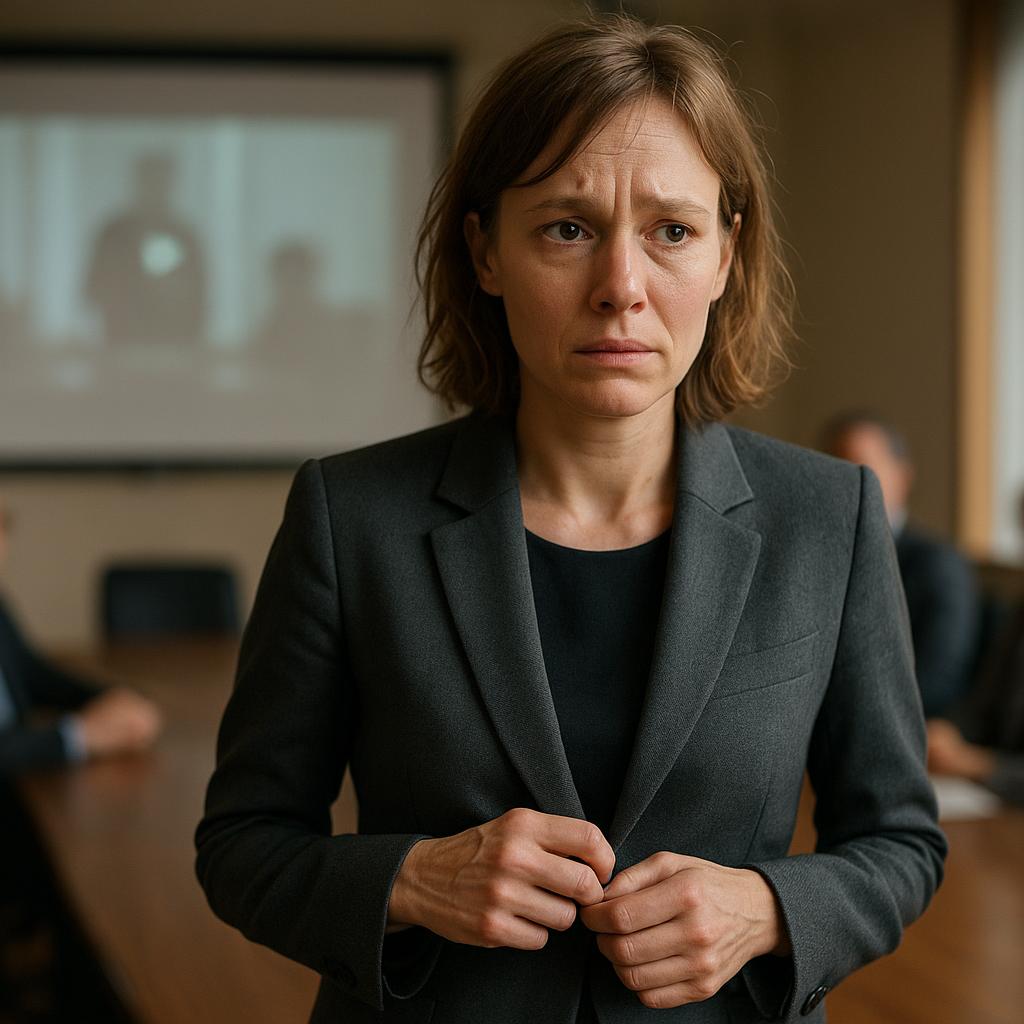 Image by RM AI
The Board's Decision
The boardroom clock ticked loudly as we filed back in after their deliberation. Two hours had felt like twenty. I clutched Victor's hand under the table, my knuckles white. Dr. Winters adjusted her glasses, her face unreadable as she opened a folder. "After reviewing all evidence presented today," she began, her voice steady, "the board unanimously dismisses all complaints against Ms. Mitchell. She will be reinstated to her teaching position effective immediately." A collective exhale rippled through the parent coalition. I felt tears threatening but blinked them back. "Furthermore," Dr. Winters continued, looking directly at Denise, "Evan Cole will be removed from Ms. Mitchell's classroom pending comprehensive behavioral assessment." Denise's lawyer immediately began whispering to her, but Dr. Winters wasn't finished. "Ms. Cole, you will be required to participate in parent counseling sessions as part of this intervention. Failure to comply will result in truancy consequences." The room fell silent. For the first time since this ordeal began, I felt the weight lifting from my shoulders. As we gathered our things to leave, Maya's father approached me, his eyes glistening. "Thank you for fighting for our kids when no one else would," he whispered. What none of us realized then was that Denise's compliance would be short-lived, and her next move would test the limits of the district's resolve.
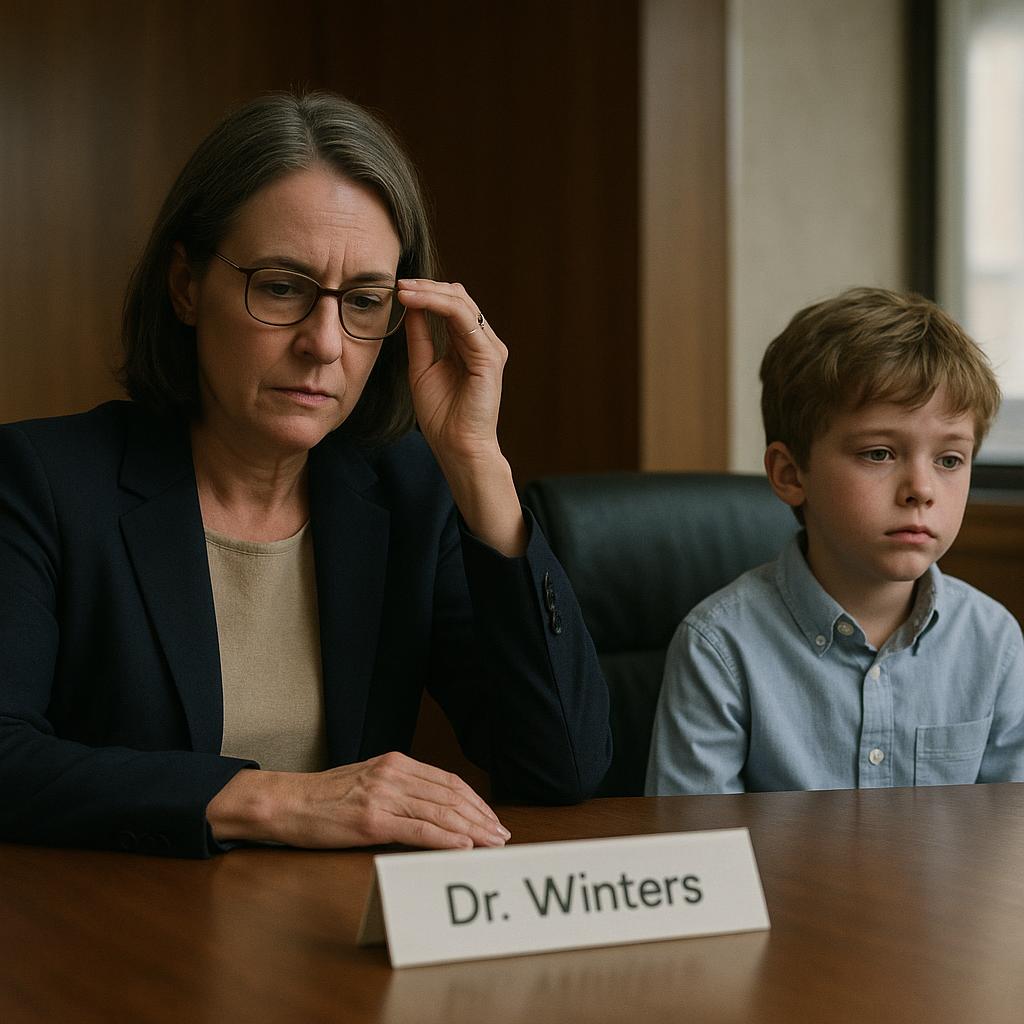 Image by RM AI
The Aftermath
The heavy boardroom door slammed behind Denise as she stormed out, her parting words hanging in the air like poison: 'This isn't over—I'll sue this entire district into bankruptcy!' I stood frozen, clutching my evidence binder to my chest like armor. One by one, parents approached me in the hallway, their eyes brimming with tears. 'My daughter slept through the night for the first time in months when I told her what happened,' Mrs. Washington whispered, squeezing my hand. Principal Harmon awkwardly shuffled toward me, offering congratulations that felt as hollow as his support had been. 'Well done, Laura,' he said, not quite meeting my eyes. 'I knew you'd handle this professionally.' I bit back the words that threatened to spill out—where was this confidence when I needed it? Victor appeared at my side, his steady presence grounding me as always. 'Don't let the victory party last too long,' he murmured. 'The real work starts tomorrow.' He was right. Winning the hearing was just the beginning. Now came the harder part: rebuilding a classroom where trust had been shattered, where children had learned to be silent, where fear had replaced curiosity. What none of us realized then was that Denise Cole wasn't just making empty threats—she was already drafting emails to every news outlet in the county.
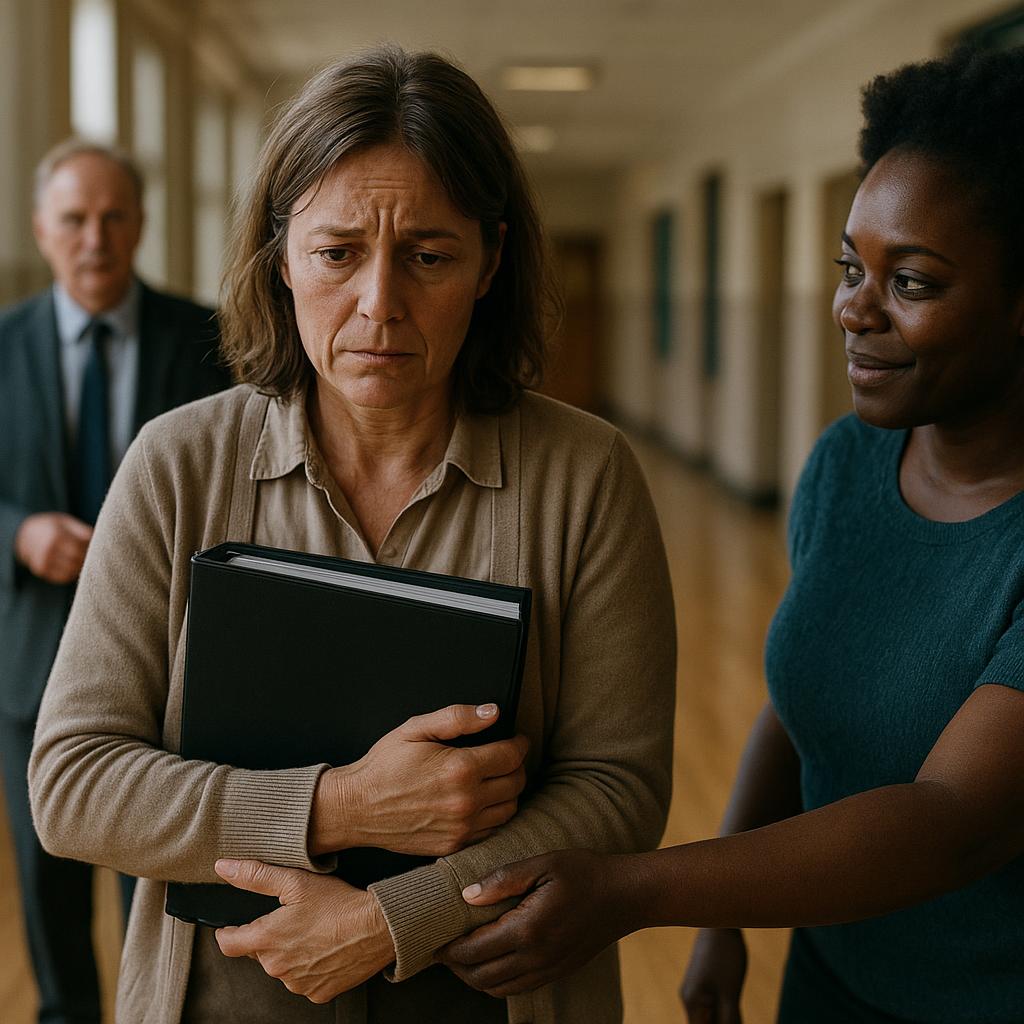 Image by RM AI
Return to the Classroom
Monday morning arrived with a knot in my stomach that had nothing to do with caffeine. Walking into my classroom after weeks of absence felt like returning to a battlefield where I'd both lost and won. Ms. Reynolds had left a coffee and a thick folder on my desk with meticulous notes about each child's progress. 'Emma's starting to participate again,' she'd written with a smiley face. I barely had time to set down my bag when the first bell rang and they came flooding in. Tyler spotted me first, his eyes widening before he shouted, 'Ms. Mitchell is back!' What followed was a tsunami of eight-year-olds surrounding me with hugs and questions. 'Did you beat the bad guys?' one whispered, making me bite my lip to keep from laughing. Throughout morning circle, I couldn't help but notice the empty desk where Evan once sat—a void that somehow made the room feel fuller, safer. When I asked who remembered where we left off in Charlotte's Web, Emma's hand shot up tentatively, like a flower testing whether it's safe to bloom after winter. Her voice was quiet but clear as she answered correctly. The other children applauded spontaneously, and I saw her smile for the first time in months. What none of us realized was that this fragile new beginning would soon be tested by Denise Cole's most desperate move yet.
 Image by RM AI
Healing Begins
The next morning, I arrived early to rearrange our classroom into small circles instead of rows. 'Operation Rebuild,' as I'd labeled it in my lesson plans, would start today. 'We're going to do things a little differently,' I explained as twenty-two pairs of eyes watched me cautiously. I introduced our 'worry box' – a simple shoebox decorated with question marks where kids could slip notes about anything bothering them. 'Sometimes our worries feel too big to say out loud,' I told them. During our first sharing circle, the silence stretched uncomfortably until Tyler raised his hand, his voice barely audible. 'I didn't want to come to school before... because I was scared.' Several children nodded, Emma among them. 'Me too,' she whispered. Something shifted in the room – like ice cracking on a frozen pond. By lunchtime, kids were laughing again during partner projects, their shoulders visibly relaxed. When the final bell rang, I checked the worry box – three folded papers inside. As I read them alone in my classroom, tears pricked my eyes. 'Will he come back?' one asked simply. I realized then that healing our classroom wouldn't be as simple as removing Evan – these children needed to believe they were finally safe. What I didn't know was that Denise's next move would test that fragile sense of security in ways none of us could have anticipated.
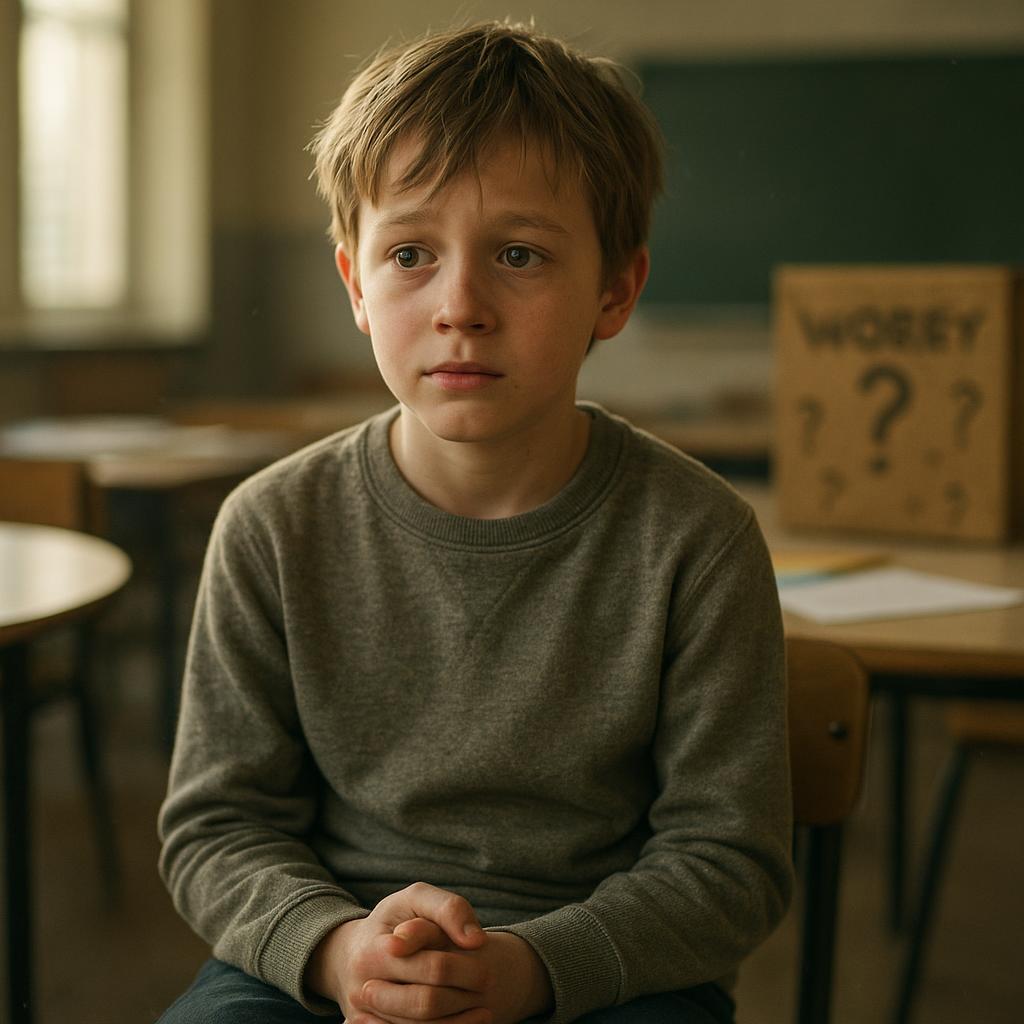 Image by RM AI
Maya's Return
Thursday morning brought a moment I'd been both anticipating and dreading – Maya's return to class. She stood in the doorway, her purple cast peeking out from her cardigan sleeve, eyes scanning the room with unmistakable apprehension. The children, who'd spent yesterday afternoon making welcome cards with more glitter than the art supply cabinet could reasonably spare, erupted in excited whispers. 'We missed you!' Emma called out, her newfound confidence still a marvel to witness. Maya's smile was tentative as she made her way to her desk, now decorated with paper flowers and a small stuffed unicorn from our class collection. During our celebration – complete with apple juice in paper cups that Tyler insisted on calling 'fancy glasses' – I watched Maya's shoulders gradually relax. It wasn't until lunch, however, when she lingered behind as others raced to the cafeteria, that I saw what was really troubling her. 'Ms. Mitchell,' she whispered, fidgeting with her cast, 'is Evan coming back?' The question hung between us, heavy with all the fear these children had carried. 'No, Maya. He won't be in our classroom anymore,' I assured her, watching relief wash over her face like a physical wave. What I didn't tell her was that yesterday, I'd received an email notification that Denise had created a Facebook group called 'Justice for Evan' – and she was naming names.
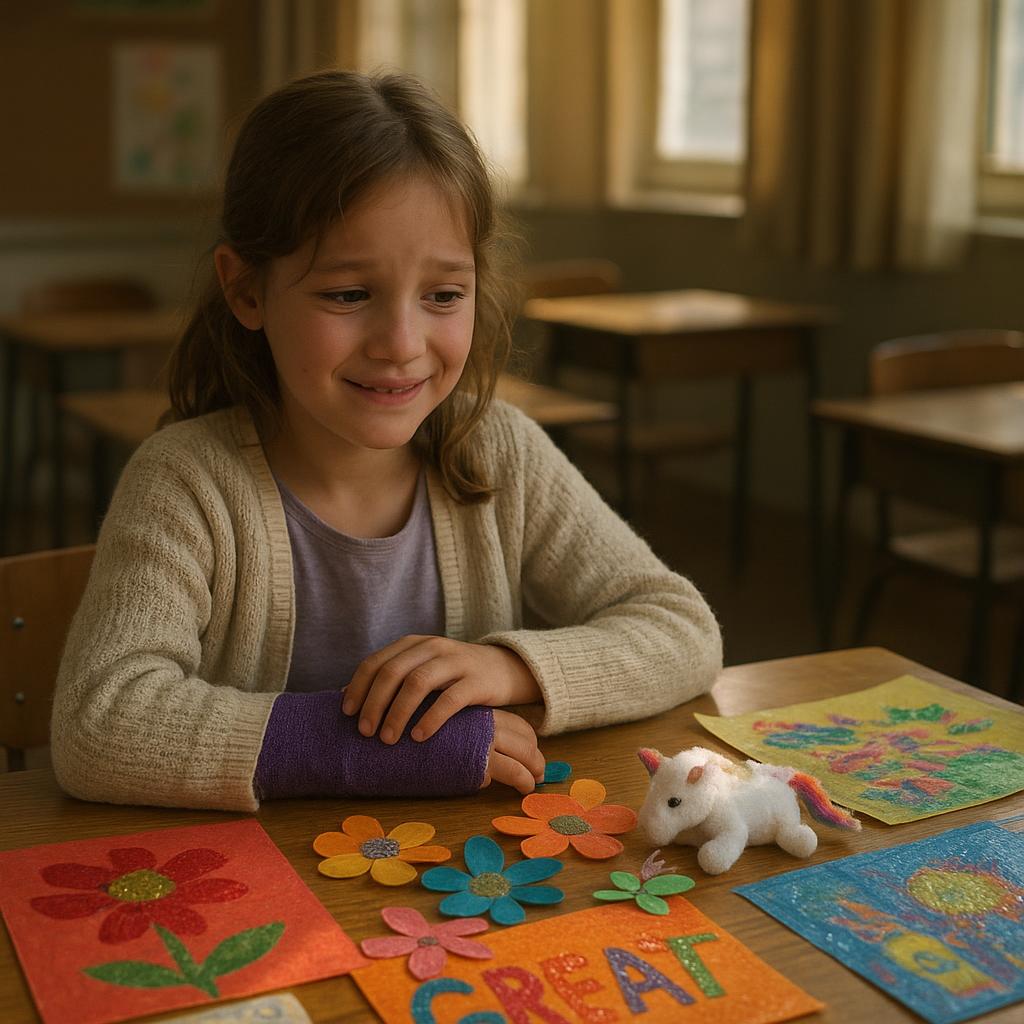 Image by RM AI
Denise's Appeals
The email arrived at 11:42 PM, just as I was grading spelling tests. 'Watch your back. Denise has friends in high places.' No signature, no return address I could trace. I forwarded it to Victor immediately, my hands shaking slightly. 'She's filed three separate appeals,' he told me the next morning over coffee in my classroom. 'Demanding Evan be returned to your class specifically.' I nearly choked. 'After the video evidence? After everything?' Victor's face hardened. 'She's claiming the footage was doctored and that you've orchestrated a witch hunt.' The absurdity might have been laughable if it weren't so terrifying. Thankfully, the superintendent was standing firm, backed by the district's legal team who cited our mountain of documentation. 'They're not budging,' Victor assured me, squeezing my hand. 'The evidence is too overwhelming.' Still, I couldn't shake the chill that email had sent down my spine. As my students filed in for morning circle, their faces brighter than they'd been in months, I wondered what lengths Denise would go to in her crusade. The woman who couldn't acknowledge her son pushing a child down stairs was now claiming conspiracy. What worried me most wasn't the appeals – it was what might happen when they inevitably failed.
 Image by RM AI
Policy Changes
Two weeks after the hearing, Principal Harmon called an emergency staff meeting. I arrived to find a thick packet titled 'Behavioral Intervention Protocol' on each chair. 'The district has approved new policies,' Harmon announced, his eyes darting everywhere but at me. 'In light of... recent events.' The room fell silent as everyone pretended not to look in my direction. The new guidelines were comprehensive: mandatory documentation of all behavioral incidents, required parental participation in intervention plans, and—most importantly—explicit protection for teachers who report escalating concerns. 'Teachers will no longer be expected to manage dangerous behaviors without district support,' Harmon read mechanically. Mrs. Abernathy, our veteran kindergarten teacher, raised her hand. 'So basically, we're finally acknowledging that parents can't just deny reality when their child hurts others?' Nervous laughter rippled through the room. Harmon cleared his throat uncomfortably. 'The district is committed to creating safe learning environments for all students.' As I flipped through the packet, I recognized entire sections that mirrored my documentation system—the very one Denise had mocked as 'excessive' and 'targeting' her son. The irony wasn't lost on anyone. After the meeting, three teachers approached me privately to share their own 'Evan stories' from years past. What shocked me wasn't that there had been warning signs before—it was that everyone had been too afraid to document them.
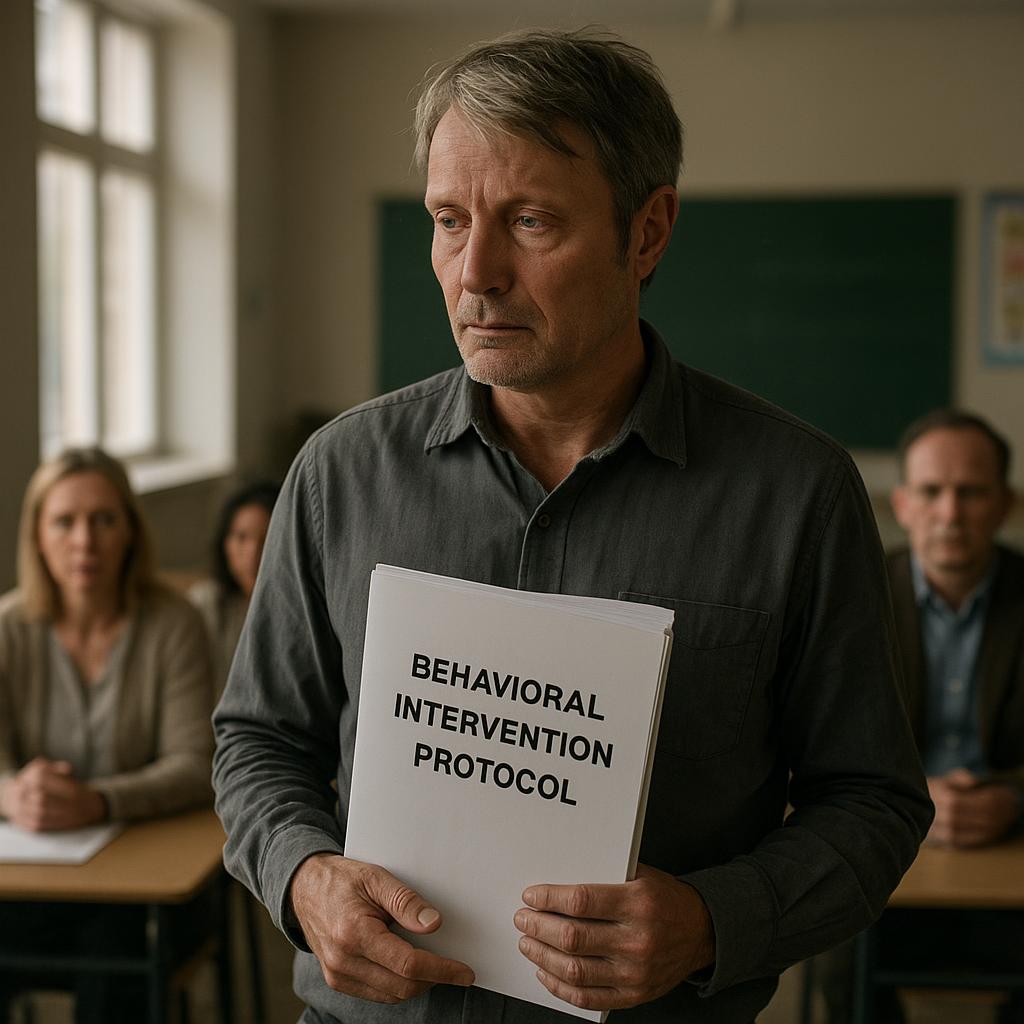 Image by RM AI
Classroom Renaissance
Two weeks after returning to my classroom, I witnessed what I can only describe as a renaissance. The transformation was nothing short of miraculous. Children who had once huddled in silence now raised their hands eagerly during discussions. Test scores weren't just improving—they were soaring. During our Friday art session, I circulated among the tables, admiring their creations when Emma's drawing caught my eye. She'd depicted our classroom in vibrant colors with 'Ms. Mitchell's Safe Place' written in careful rainbow letters across the top. 'That's a beautiful title,' I said, crouching beside her desk. Emma looked up, her eyes clear and untroubled for the first time in months. 'It's safe now because you didn't give up on us,' she explained simply. My throat tightened as I squeezed her shoulder gently. Later, watching the children laugh during partner reading—Tyler dramatically voicing a character while Maya giggled uncontrollably—I realized what we'd reclaimed wasn't just classroom order. We'd restored their childhood. The worry box sat empty that afternoon, but my email inbox pinged with a notification that made my blood run cold: Denise Cole had just been appointed to the district's Parent Advisory Committee.
 Image by RM AI
News of Evan
Sarah, our school counselor, caught me in the hallway during lunch break, her expression a mix of professional neutrality and cautious optimism. 'I thought you might want to know about Evan,' she said, lowering her voice. 'He's been in the specialized behavioral program for three weeks now.' I nodded, trying to maintain my own professional distance despite my curiosity. Sarah explained that Denise had initially refused to participate in the required parent counseling sessions, calling them 'punitive' and 'unnecessary.' 'It wasn't until the district followed through with truancy warnings that she finally showed up,' Sarah continued, rolling her eyes slightly. 'Classic Denise.' What surprised me most was hearing that Evan was actually showing small improvements. 'His new teacher says when boundaries are clear and consistently enforced, he's responding,' Sarah explained. 'No miraculous transformation, but he's learning that actions have consequences.' I couldn't help but wonder how different things might have been if those boundaries had been established years ago, before patterns became entrenched, before other children paid the price for one parent's denial. As I thanked Sarah for the update, my phone buzzed with a notification – an email from the Parent Advisory Committee with Denise Cole's name prominently featured in the signature line.
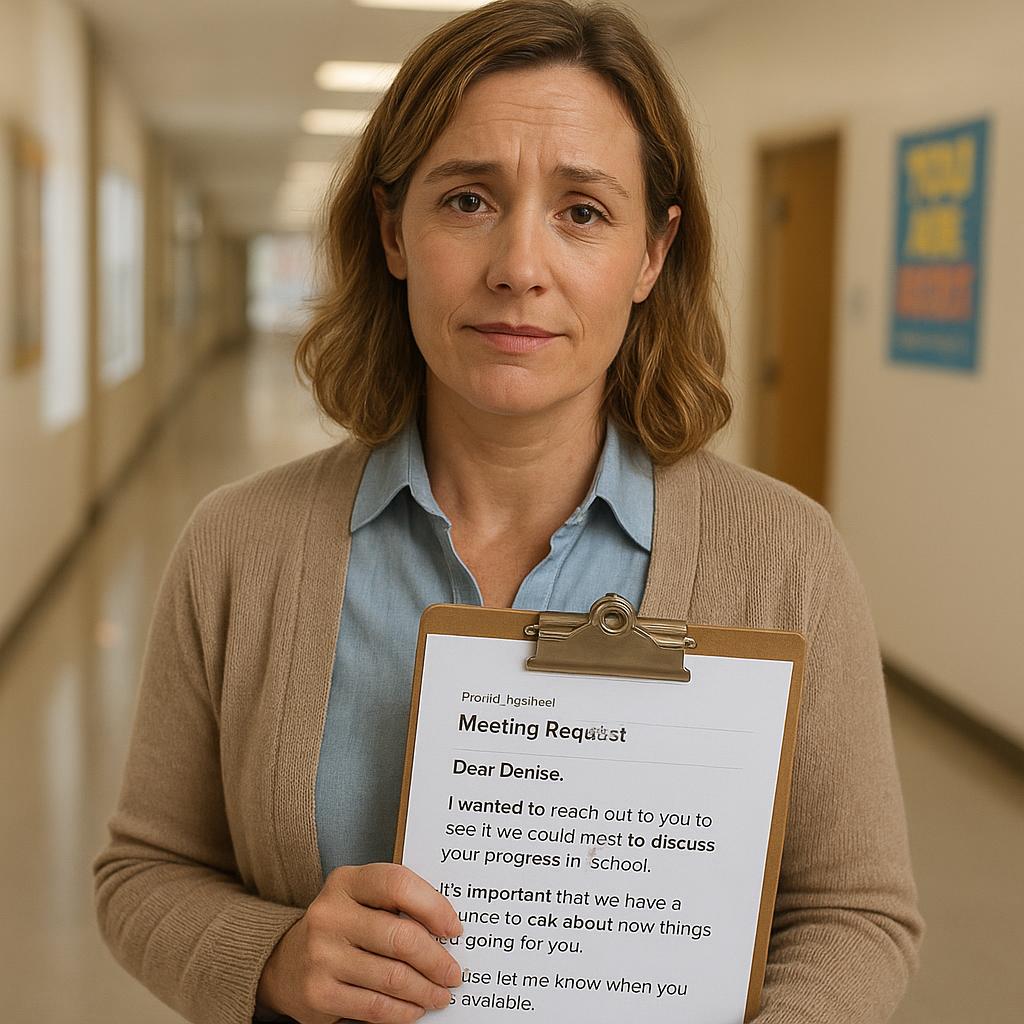 Image by RM AI
The Unexpected Visitor
I was loading the last of my graded papers into my tote bag when I spotted her—Denise Cole, leaning against her silver Lexus in the staff parking lot. My stomach dropped. After weeks of emails and appeals, here she was in the flesh. I quickly scanned for security, my finger hovering over Victor's number on my phone. But something was different. Her usual rigid posture was gone, replaced by slumped shoulders and none of that trademark defiance in her eyes. When she approached, I braced myself for accusations or threats. 'Ms. Mitchell... Laura... could we talk? Just talk?' Her voice lacked its usual sharp edge. Against every instinct and probably against better judgment, I nodded. 'Not here,' I said firmly. 'The coffee shop on Maple in twenty minutes.' As she walked away, I immediately texted Victor with the location, time, and a simple 'SOS if you don't hear from me by 5.' Sitting in my car, I took deep breaths to steady my racing heart. What could Denise possibly want now? Had the specialized program failed? Was this an ambush for some new legal strategy? Or—and this thought was almost too much to hope for—had something finally changed? As I pulled out of the parking lot, I couldn't shake the image of her defeated expression. It was the first time I'd ever seen Denise Cole without her armor, and I wasn't sure if that made her more or less dangerous.
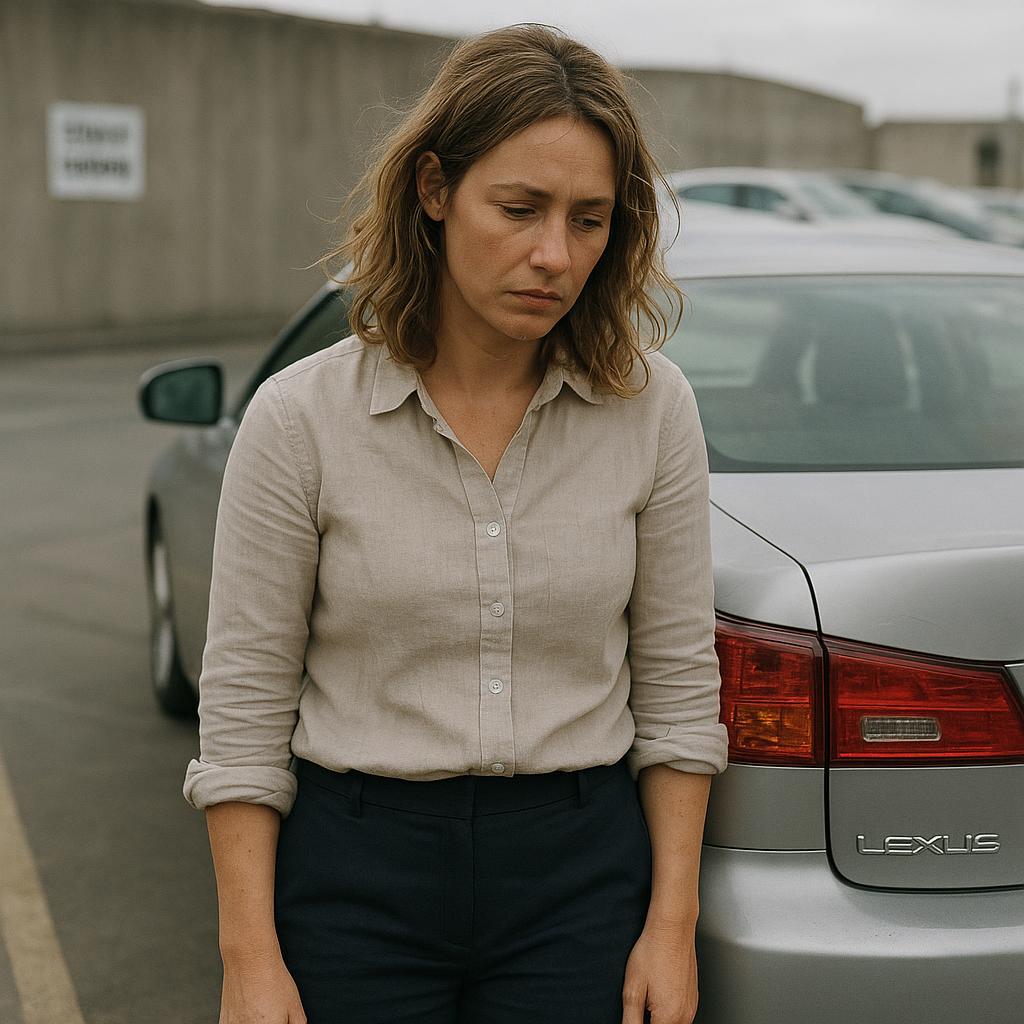 Image by RM AI
Coffee and Confessions
The coffee shop buzzed with afternoon chatter as I sat across from Denise, watching her stir her latte with uncharacteristic hesitation. 'Evan's father was...not a good man,' she finally said, her voice barely audible over the espresso machine's hiss. 'He left when Evan was four, after years of...' She trailed off, but the implication hung between us. 'I promised myself I'd never fail my son the way I failed to protect him then.' Her eyes, usually sharp with accusation, now brimmed with something raw and unfamiliar. 'Evan's therapist says I've been in denial, that I've been so afraid of being a bad mother that I couldn't see how my protection was actually hurting him.' She didn't say 'I'm sorry'—not directly—but her admission felt monumental nonetheless. 'I made it worse for everyone, didn't I? Even for Evan.' I sat perfectly still, afraid that any movement might shatter this fragile moment of truth. After months of battle, Denise Cole was finally laying down her weapons. What I didn't realize then was that this wasn't just a turning point for Denise and Evan—it would become a pivotal moment in my own understanding of what it truly means to protect a child.
 Image by RM AI
Mixed Emotions
The drive home from the coffee shop felt surreal, like I was floating between two realities. Rain tapped against my windshield in rhythm with my racing thoughts. Had I really just sat across from Denise Cole—the woman who'd nearly cost me my career—and felt a twinge of compassion? I pulled into my driveway and sat there, engine off, unable to move. I called Marianne, my voice cracking as I recounted the conversation. 'She actually admitted she was wrong, Mari. After everything.' My friend's sigh crackled through the speaker. 'Look, Laura, understanding why someone did something terrible doesn't mean you have to forgive them,' she said. 'Her trauma explains her behavior but doesn't excuse it.' That night, I dreamed of Evan—not the boy who'd terrorized my classroom, but a different version. In this dream, he sat attentively, hand raised high, eyes bright with curiosity instead of calculation. I woke up with tears on my pillow, mourning the child who might have existed in a different environment, with different choices. The most heartbreaking part wasn't what Evan had done; it was realizing how many adults had failed him long before he ever entered my classroom. As I prepared for school the next morning, I couldn't shake the question that had haunted me since meeting Denise: if I truly believed in second chances for my students, could I possibly deny one to their parents?
 Image by RM AI
The Parent Workshop
The idea came to me during a sleepless night – what if I could help prevent another Evan situation? I drafted a proposal for a parent workshop titled 'Recognizing Early Warning Signs: When Behavior Matters' and nervously submitted it to Principal Harmon. To my absolute shock, he not only approved it but offered the school library and refreshment budget. 'This is exactly what our community needs, Laura,' he said, his enthusiasm perhaps tinged with guilt over his earlier inaction. The first session drew fifteen parents – a modest turnout that secretly relieved me. Mr. Chen arrived early, helping arrange chairs in a circle rather than rows ('More conversational this way,' he explained). Mrs. Washington brought homemade cookies and a notebook filled with questions. 'My Jasmine never tells me what happens at school,' she admitted during introductions, 'and I worry I'm missing something important.' As parents began sharing their concerns – from playground dynamics to screen time battles – I noticed something remarkable: the vulnerability in the room was contagious. These weren't defensive parents like Denise; they were adults genuinely seeking guidance. 'Sometimes I don't know if I'm overreacting or underreacting,' Mr. Chen confessed, earning nods from around the circle. By the end of our two-hour session, three parents had approached me privately to discuss specific concerns they'd previously dismissed. What none of us realized was that Denise Cole had been watching from her car in the parking lot the entire time.
 Image by RM AI
The End-of-Year Assessments
May brought standardized testing season – that annual ritual of number two pencils and nervous energy. I'd worried about how my students would perform after everything they'd been through, but as I proctored the exams, I noticed something remarkable. Emma, who once couldn't focus for more than five minutes, worked steadily through each section. Tyler, who used to hide under his desk during assessments, methodically checked his work before submitting. When the results came in, I nearly cried in the teachers' lounge. Our class showed the highest growth rate in the entire school – a 32% improvement from mid-year assessments. 'It's the positive classroom environment,' the district curriculum coordinator noted during our review meeting, her eyes scanning the data with obvious surprise. Principal Harmon made sure to highlight our success at the next staff meeting, his voice carrying a hint of vindication. 'Ms. Mitchell's class has demonstrated exceptional resilience,' he announced, nodding in my direction. The other teachers applauded, but all I could think about was how these children had transformed once they felt safe again. What no one mentioned was the email I'd received that morning – Denise Cole had requested a meeting with both me and Evan's new teacher, and she wanted to bring Evan along.
 Image by RM AI
The Unexpected Letter
I was sorting through the usual stack of memos and supply catalogs in my mailbox when I spotted it – a pale blue envelope with my name handwritten on the front. Inside was a three-page letter from Ms. Winters, Evan's new teacher at the specialized program. 'Your meticulous documentation has been invaluable,' she wrote. 'We've been able to develop targeted interventions based on the patterns you identified.' My throat tightened as I read how Evan was making progress – slow but meaningful steps toward recognizing his emotions before they spiraled into harmful behaviors. She described a breakthrough where he'd actually removed himself from a triggering situation and asked for help instead of lashing out. 'We're using a modified version of your behavior chart,' she explained, 'and Denise has finally become consistent with follow-through at home.' The letter concluded with something I never expected: an invitation to collaborate on a case study for district-wide teacher training. 'Your approach to documentation and intervention could help countless other educators facing similar situations,' Ms. Winters wrote. I folded the letter carefully, my hands trembling slightly. After months of being villainized, my methods weren't just vindicated – they were being held up as exemplary. What Ms. Winters couldn't possibly know was that I'd already received another unexpected communication that morning: a formal complaint filed by Denise Cole against the entire school board.
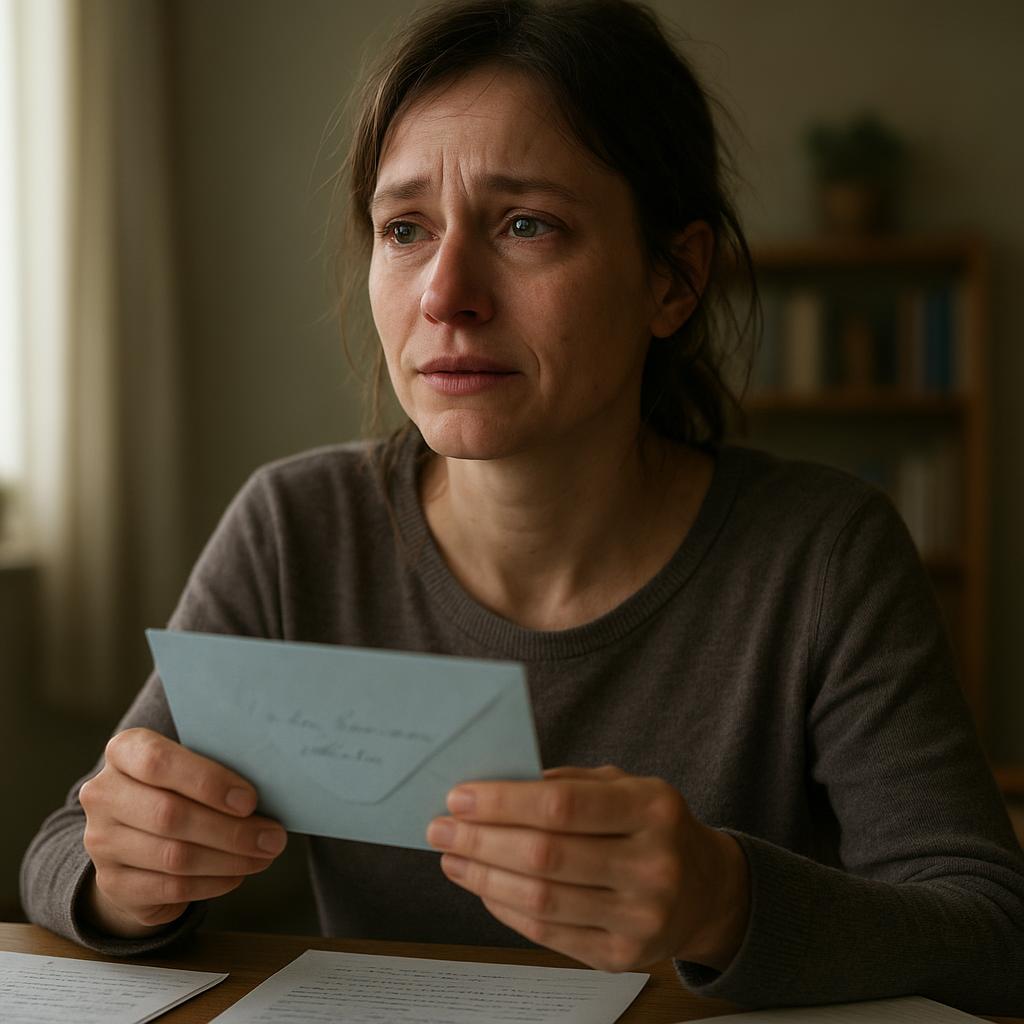 Image by RM AI
The Case Study Decision
After a week of soul-searching, I agreed to collaborate with Ms. Winters on the case study. We met in my classroom after the final bell, the late afternoon sun casting long shadows across desks that had witnessed so much. 'We'll change all names, of course,' I insisted, spreading my documentation across the table. 'This isn't about exposing Evan or Denise—it's about helping other teachers.' Ms. Winters nodded, her eyes widening as she flipped through my meticulously organized binder. 'Your approach to documentation is remarkable, Laura. So systematic.' We spent hours discussing which strategies had worked and which had failed, mapping out Evan's behavioral patterns like detectives piecing together a complex case. What surprised me most was hearing about Denise's transformation. 'She actually admitted it during family therapy last week,' Ms. Winters said, leaning forward. 'She acknowledged that Evan did push that child down the stairs.' I nearly dropped my coffee mug. After months of denial, that admission represented a seismic shift. 'She's attending every parent session now,' Ms. Winters continued. 'It's like she's finally realized that protecting Evan means holding him accountable.' As we packed up our notes, my phone buzzed with a notification—an email from the superintendent requesting my presence at an emergency board meeting tomorrow morning. The subject line made my stomach drop: 'Re: Cole Complaint Resolution.'
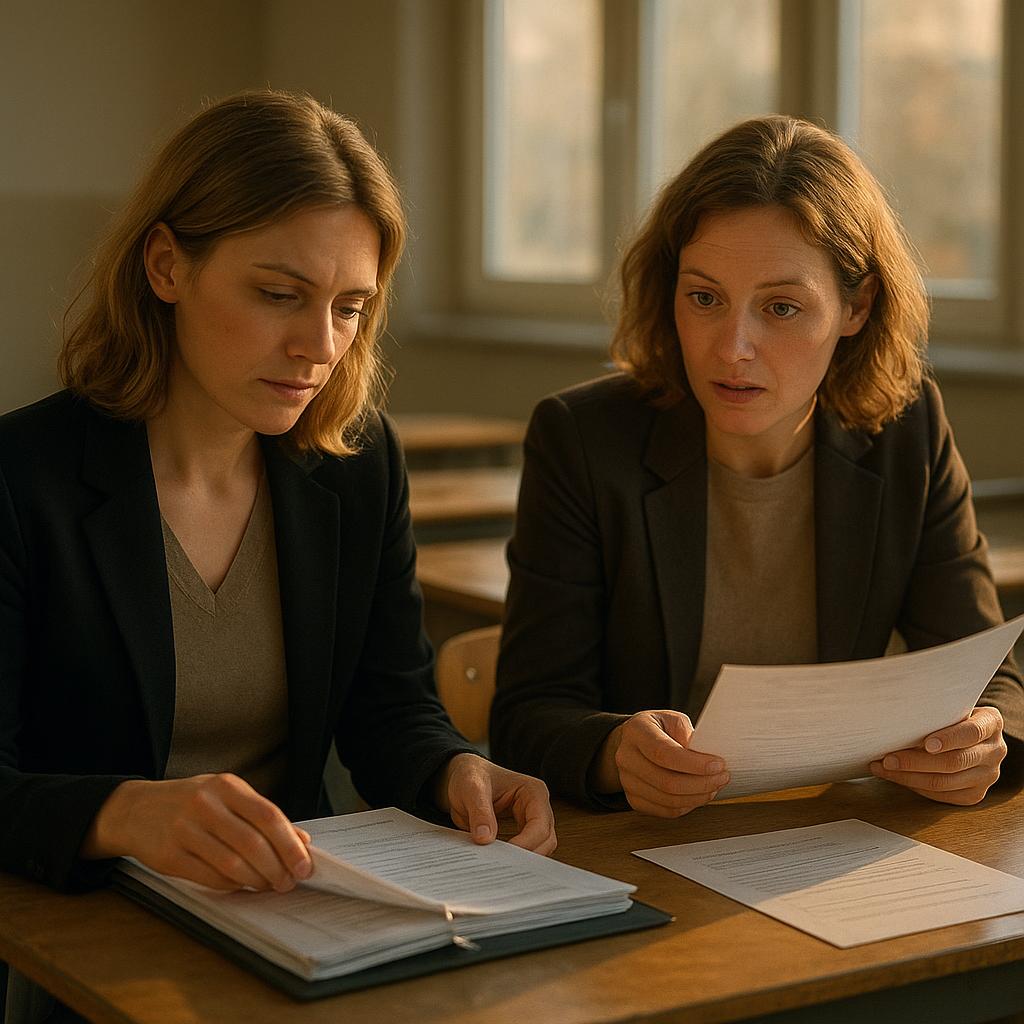 Image by RM AI
The Field Trip
The morning of our science museum field trip arrived with an energy I hadn't felt in my classroom for months. As the children lined up, permission slips clutched in eager hands, there wasn't a single tearful face or anxious glance—just pure, unbridled excitement. 'Remember our buddy system,' I reminded them, watching as they naturally paired up without the usual hesitation or complaints. On the bus, conversations flowed freely, punctuated by laughter that no longer carried nervous undertones. At the museum, I stood back and observed with a lump in my throat as my students scattered confidently toward different exhibits. Tyler and James, who once couldn't be within three feet of each other without conflict, worked together to build a bridge structure, high-fiving when it supported the test weight. Emma, who had spent months barely speaking above a whisper, enthusiastically explained the solar system model to a museum docent. The transformation was so profound it felt almost miraculous. On the ride home, exhausted but content, I watched Maya drift off to sleep, her head gently resting on Emma's shoulder. That simple gesture of trust—unthinkable just months ago—brought unexpected tears to my eyes. As I snapped a quick photo to share at our next parent workshop, my phone buzzed with a notification: Denise Cole was requesting to volunteer as a chaperone for our next outing.
 Image by RM AI
The End-of-Year Celebration
The gymnasium buzzed with excitement as our end-of-year celebration transformed the space into a gallery of third-grade accomplishments. Student projects lined the walls—dioramas, science experiments, and art pieces that told the story of our remarkable year. I stood near the punch bowl, watching my students proudly guide their parents through their work, their voices confident and animated. What a contrast to the hushed, anxious classroom of just months ago. Mrs. Washington approached me, eyes glistening with emotion, and pulled me into a tight hug that smelled of vanilla perfume. 'Ms. Mitchell,' she whispered, her voice catching, 'Tyler hasn't had a nightmare in weeks. He's actually excited about fourth grade now.' I squeezed her hand, unable to find words adequate for the moment. Across the room, Emma was showing her volcano project to a cluster of admiring parents, her explanation punctuated with theatrical hand gestures that would have been unimaginable from the girl who once hid behind her hair. Principal Harmon caught my eye and raised his punch cup in a subtle toast. The renaissance was complete—not just academically, but emotionally. As I scanned the room one last time, my heart nearly stopped when I spotted an unexpected figure lingering by the doorway: Denise Cole, holding a small gift bag with my name clearly written on the tag.
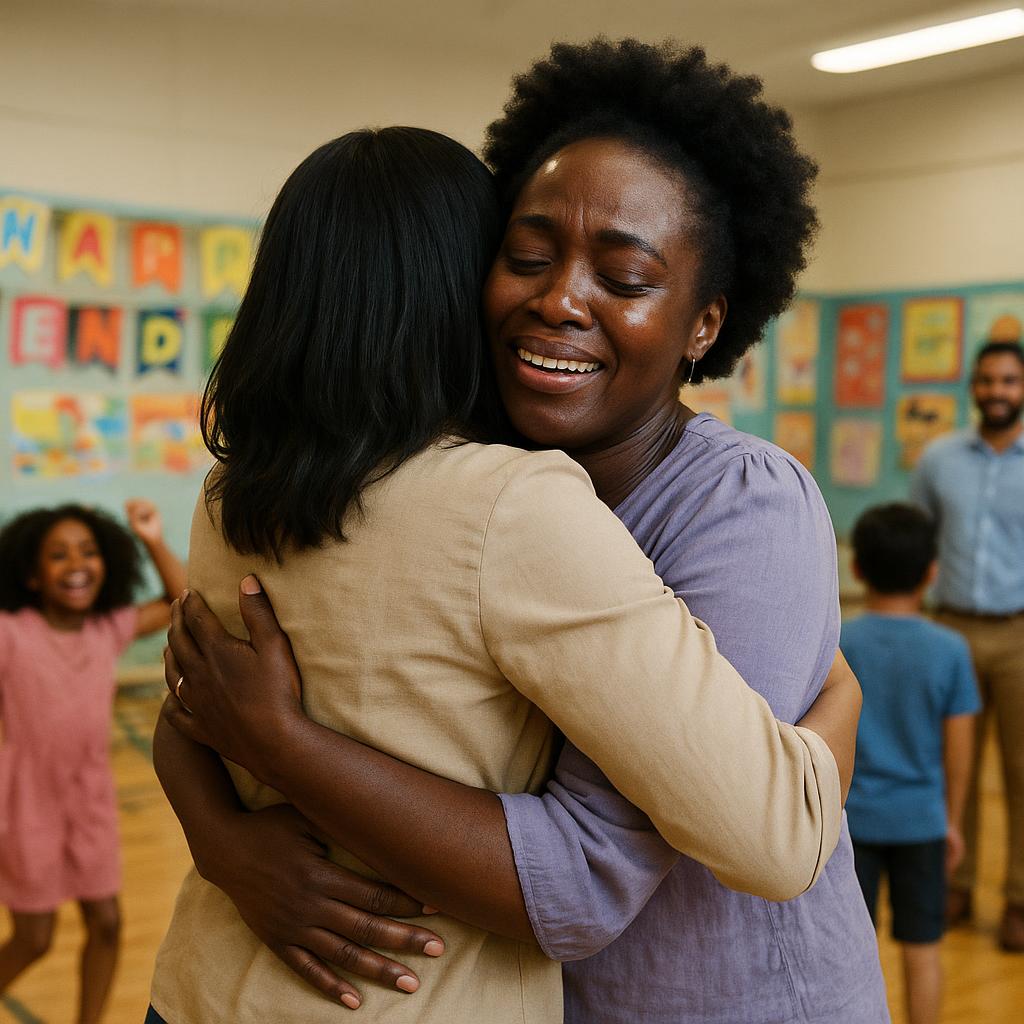 Image by RM AI
The Unexpected Encounter
I never expected to run into them at the farmers' market. I was examining a display of heirloom tomatoes when I felt that unmistakable prickle on the back of my neck—the sixth sense teachers develop after years in the classroom. I turned slowly, basket clutched against my chest like a shield, and there they were: Denise and Evan Cole, just three stalls down. My first instinct was to duck behind the organic honey display, but it was too late—our eyes had already met. The awkward tension hung between us like summer humidity. To my surprise, Denise offered a small, stiff nod of acknowledgment. But what truly caught me off guard was Evan. Gone was the calculating gleam in his eyes, replaced by something I couldn't quite identify. 'Hello, Ms. Mitchell,' he said quietly, his voice lacking its former edge. I couldn't help but notice the laminated behavior chart in his hand—similar to the one we'd used in class, but this version had rows of green check marks and gold stars. Denise's hand rested lightly on his shoulder, not restraining but reassuring. As they moved toward the berry stand, I realized I'd been holding my breath. What happened next would leave me questioning everything I thought I knew about second chances.
 Image by RM AI
The Teacher Training Workshop
The auditorium buzzed with nervous energy as I arranged my presentation materials at the podium. Two hundred teachers—some fresh-faced, others with the weathered look of classroom veterans—filled the seats for the district's annual training day. 'Ready?' Ms. Winters whispered, adjusting the behavior chart display we'd created. I nodded, though my stomach fluttered with butterflies. When Superintendent Wallace introduced me as 'an example of professional courage,' I felt my cheeks flush. Just months ago, I'd been called to HR meetings and treated like a liability; now I was being held up as a model. 'Documentation isn't about building a case against a child,' I explained, clicking to my first slide. 'It's about identifying patterns so we can actually help them.' As I walked the room through my system—the incident logs, the parent communication templates, the classroom restoration strategies—I noticed several teachers frantically taking notes. One woman in the back wiped away tears. 'Last year, I had my own Evan,' she admitted during the Q&A. 'I wish I'd had these tools then.' The validation felt both satisfying and strangely hollow. I couldn't help wondering where Evan was right now, and whether our case study would truly help the next child like him. What none of us realized was that someone unexpected had slipped into the back row halfway through my presentation.
 Image by RM AI
The New School Year
The first day of school always feels like a reset button, but this year was different. As I arranged colorful name tags on pristine desks, I noticed the changes throughout Oakridge Elementary—subtle but significant. New laminated behavior protocol posters adorned every classroom wall. A dedicated early intervention counselor, Ms. Ramirez, had her own cheerful office down the hall. And the parent handbook? It now contained an entire section titled "Mutual Accountability: Our Shared Responsibility." Principal Harmon stopped by as I was hanging my classroom rules chart. "Laura," he said, his voice carrying a weight it hadn't before, "I want you to know that documentation isn't just encouraged now—it's expected." He handed me a new binder system the district had implemented, complete with carbon-copy incident reports and parent communication logs. "What happened last year..." he hesitated, adjusting his tie, "it changed things around here. For the better." As he left, I noticed a familiar name on my class roster: Cole. Not Evan, but Madison Cole—his younger sister. I stared at the name, my heart racing. Had Denise deliberately requested me as Madison's teacher, or was this some cosmic test of everything I thought I'd learned?
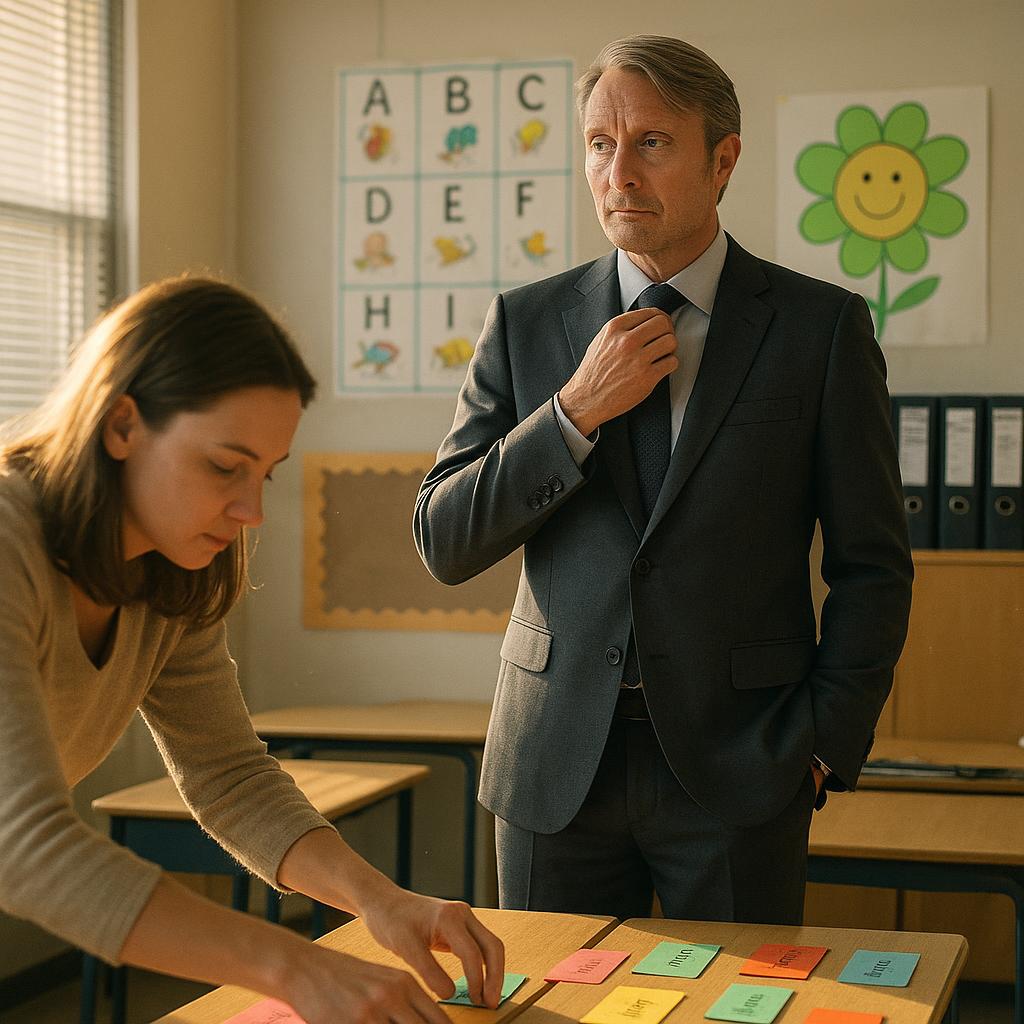 Image by RM AI
The Follow-Up Report
The email from Ms. Bergman arrived on a Tuesday afternoon, subject line: 'Evan Cole - Six Month Progress Report.' I stared at it for several minutes before finding the courage to open it, my cursor hovering over the unread message like I was defusing a bomb. 'Dear Ms. Mitchell,' it began, 'I wanted to share some significant developments regarding Evan's progress.' I held my breath as I read that Evan had been successfully integrated into a mainstream classroom with support services. He still struggled with impulse control—that wasn't surprising—but he'd developed a remarkable toolkit for recognizing his emotional triggers. The most shocking part? Denise had transformed into what Ms. Bergman called 'our most engaged parent.' She attended every meeting, implemented consistent consequences at home, and—this part made me set down my coffee—actually reached out proactively when Evan showed warning signs rather than waiting for incidents to occur. 'Your documentation provided the foundation for his intervention plan,' Ms. Bergman wrote. 'We still reference your behavior charts.' I printed the email and added it to my personal file, a strange mix of vindication and sadness washing over me. As I glanced across my classroom where Madison Cole sat quietly reading, I wondered if Denise had requested a meeting with me not to apologize, but to tell me this news herself.
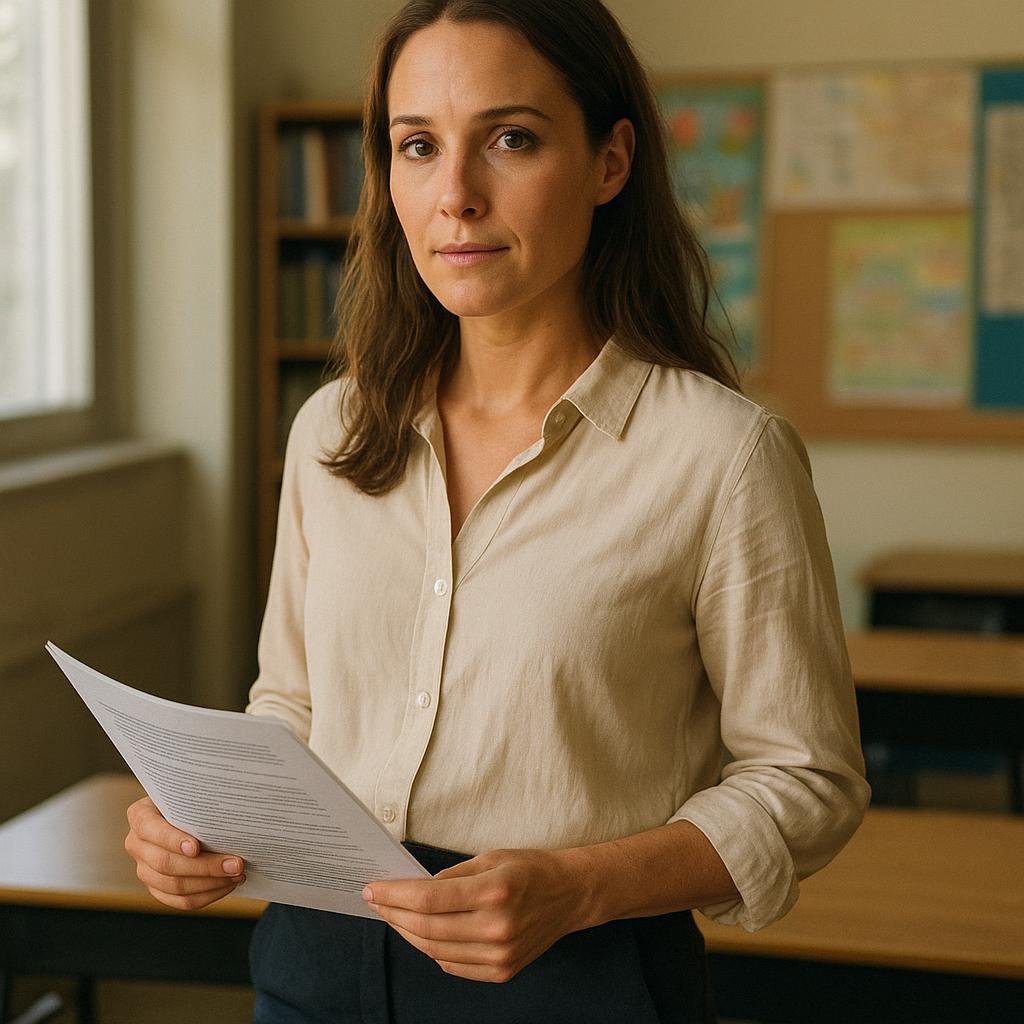 Image by RM AI
Full Circle
Mrs. Alvarez sat across from me, clutching a tissue as she described her son's recent behavior. 'He pushed another child off the swing yesterday, and when I confronted him, he just... laughed.' The tremor in her voice took me back to those early days with Evan. 'I'm afraid he's becoming a bully,' she whispered, 'but his father says it's just boys being boys.' I leaned forward, sliding over the documentation system I'd developed. 'What you're seeing matters,' I told her firmly. 'Early intervention is everything.' For the next thirty minutes, we mapped out a home-school accountability plan with clear consequences and rewards. When she asked if I thought her son was 'bad,' I shook my head. 'Children test boundaries—that's normal. What's not normal is adults refusing to hold those boundaries.' As she gathered her papers, Mrs. Alvarez looked at me with tear-filled eyes. 'Thank you for not dismissing me,' she said. 'My sister told me I was overreacting.' Walking her to the door, I thought about Evan, about Madison, about all the children whose paths might have been different if someone had simply acknowledged reality sooner. What Mrs. Alvarez couldn't know was that tomorrow, I would receive an unexpected invitation that would bring my journey with the Cole family to its most surprising chapter yet.
 Image by RM AI
KEEP ON READING
10 Greatest Quarterbacks Of All Time & 10 That Overrated
Do You Disagree?. Few topics in sports generate as much…
By Farva Ivkovic Dec 2, 2025
The Tsarist Forgery that Poisoned a Nation's Mind
Boissonnas & Eggler on WikimediaThe document, titled Protocols of the…
By Cameron Dick Dec 19, 2025
20 Shakespearean Words, Translated For A Modern Audience
What’s In A Word?. Shakespeare was a wordsmith of the…
By Breanna Schnurr Dec 17, 2025
20 Inspiring Stories From Native American History
Incredible Stories Of Resilience And Endurance. Many of us didn't…
By Ashley Bast Dec 17, 2025
You Think You Have Problems? These Royal Families Were Cursed
Boasson and Eggler St. Petersburg Nevsky 24. on WikimediaHeavy is…
By Ashley Bast Dec 5, 2025
MH370: The Plane That Can't Be Found
Anna Zvereva from Tallinn, Estonia on WikimediaEleven years after Malaysia…
By Christy Chan Dec 10, 2025