

My Husband Demanded I Quit My Job to Stay Home—So I Sent Him an Invoice for My 'Services'
My Husband Demanded I Quit My Job to Stay Home—So I Sent Him an Invoice for My 'Services'
The Campaign Launch
The campaign materials were spread across my desk in three distinct stacks — final copy, approved visuals, and the timeline grid I'd rebuilt twice after the client changed their launch window. I'd been in the office since seven, and by noon I had the conference call running with my team while simultaneously marking up the last round of print proofs. The numbers were solid. The messaging was tight. Seven months of strategy work had compressed into a single week of execution, and every moving part was exactly where I needed it to be. I walked my team through the rollout sequence one more time — digital push on Tuesday, press release Wednesday morning, retail activation by Thursday close — and nobody had questions because we'd already answered them all. When I finally set the phone down and leaned back in my chair, the quiet in my office felt earned. I gathered the portfolio into my bag, the weight of it settling across my shoulders as I headed for the door.
 Image by RM AI
Mark's Client Loss
I got home a little after six to find Mark at the kitchen table, papers fanned out in front of him and his laptop open to what looked like a contract spreadsheet. He had that particular stillness about him — the kind that meant he was working through something he didn't want to say out loud yet. I set my bag down and asked if he wanted me to start dinner. He said sure, barely looking up. I pulled chicken from the fridge and started moving around the kitchen, and we talked in the easy, half-distracted way we usually did on weeknights — the kids' schedules, whether the gutters needed cleaning before the rain. Then he went quiet again, and I turned around. He was staring at the same page he'd been on when I walked in. I asked him what was going on. He pressed his thumb against the edge of the paper, smoothed a crease that wasn't there. "I lost the Brennan account," he said.
 Image by RM AI
The Afternoon Shuffle
Tuesday afternoons had their own particular choreography. I left the office at three-fifteen, which meant I could get to Emma's school by three-forty, drop her at the piano studio by four, and still make it to Tyler's soccer field before his practice ended at five-thirty. In theory. In practice, Emma's teacher wanted to talk about the spring recital, which pushed everything back twelve minutes, and I sat in the car outside the piano studio answering client emails on my phone while the clock ticked. Tyler's coach texted that practice was running long — could I do five-fifty instead of five-thirty? I said yes, rerouted, and used the extra twenty minutes to review the campaign's social rollout schedule. By the time I had both kids in the car, it was nearly six-thirty. I heated up the pasta I'd made Sunday, checked Emma's math homework at the counter while Tyler narrated his entire practice in real time, and got them both through baths and into bed by eight-forty-five. I sat at the kitchen table afterward with my coffee going cold, and the quiet settled around me the way it always did — familiar, a little worn at the edges, but mine.
 Image by RM AI
The Henderson Contract
We were halfway through dinner when Mark's phone buzzed on the counter. He glanced at it the way you do when you're expecting something you're not sure you want to see, then pushed back his chair and picked it up. I watched his face go flat. Emma was telling me about a book she'd checked out from the school library, and I kept nodding, kept asking the right questions, but I was watching Mark read whatever was on that screen. He set the phone face-down and came back to the table. Tyler asked him something about soccer and Mark answered, but his voice had gone somewhere else. After the kids were excused, I asked him what the email said. He told me Henderson Industries wasn't renewing. The contract that had been paying a reliable monthly amount — gone, effective end of quarter. I suggested reaching out to a few contacts he hadn't tapped in a while, maybe updating his consulting profile, looking at some of the industry groups he'd let lapse. He nodded at each suggestion with the careful patience of someone who had already thought of all of them. The kitchen felt very still after that, the hum of the refrigerator the only sound between us.
 Image by RM AI
The Laundry Comment
My alarm went off at five-forty-five because the client presentation was at eight and I needed the extra time. I was in the kitchen by six, coffee brewing, laptop open, running through my slide deck one more time while the house was still quiet. Mark came downstairs around six-twenty in his robe, poured himself a cup, and leaned against the counter. We didn't talk much — I was focused, and he knew it. I was sliding my folders into my bag when he glanced toward the hallway and said, almost as an aside, that the laundry basket had been sitting there since Thursday. I said I knew, I'd get to it this weekend, the campaign week had been relentless. He made a small sound — not quite agreement, not quite anything — and took another sip of his coffee. I zipped my bag and told him I'd be home by seven. It wasn't until I was backing out of the driveway that I kept turning the moment over in my head, trying to figure out what exactly had been underneath the edge in his voice when he said it.
 Image by RM AI
The Pile-Up
I got home Thursday evening to find the living room rearranged in a way that stopped me in the doorway. Mark was on the couch, folding the last of what looked like three or four loads of laundry, and he'd sorted everything into neat piles along the cushions — my work clothes in one stack, the kids' things in another, towels at the far end. Tyler was on the floor with his LEGOs, and Emma was at the dining table with a book. Mark looked up when I came in and said his afternoon call had been cancelled, so he'd had time. I said thank you, and I meant it, but something about the arrangement of those piles — the precision of them, the way they were facing outward — made me feel like I'd walked into a presentation rather than my own living room. I set my bag down and asked if the kids had eaten. He said he'd handled it. I thanked him again and went to change out of my work clothes, and when I came back downstairs, the piles were still there on the couch, sorted and waiting.
 Image by RM AI
The Hours Discussion
It started as a reasonable question. We were cleaning up after dinner on Sunday when Mark asked how late I was planning to work during the rollout week. I told him the client expected us to be available through the evening for the first few days — that was standard for a launch this size. He asked if the company gave us comp time for that. I said not formally, but the visibility on a campaign like this was worth it. He asked whether I'd thought about what that meant for the kids' pickup schedule. I said I'd already arranged backup coverage with Sarah for Tuesday and Wednesday. He nodded slowly and asked if I'd talked to my manager about whether the hours were sustainable long-term. I said they weren't long-term, they were one week. He said right, of course, he just wondered if the company really valued my time the way it should. Each question landed reasonably enough on its own, but somewhere between the third and fourth one I noticed I was standing at the kitchen sink explaining my professional decisions in a level of detail I'd never felt the need to justify before, and the sound of my own voice doing it was unfamiliar.
 Image by RM AI
The Passive Edge
The weekend should have been easy. The campaign had launched clean, the client was happy, and I had two full days with no early alarms. But Mark had a comment for most of it. Saturday morning it was the grocery situation — we were out of a few things, and he mentioned it while I was still on my first cup of coffee. I said I'd go in the afternoon. Then it was Emma's permission slip for the field trip, which had apparently been sitting on the counter since Wednesday. I signed it and said I'd been slammed, and he said sure, no problem, in a tone that suggested it was at least a small problem. After breakfast he made a remark about the state of the kitchen, and I wiped down the counters while Tyler climbed on my back asking me to be a horse. I told myself Mark was still processing the Henderson loss, that losing two clients in a month would put anyone on edge. Each comment on its own was small enough to set aside. But by Sunday evening, sitting in the quiet after the kids were in bed, I could feel the accumulated weight of all of them pressing down, steady and low.
 Image by RM AI
The Campaign Week
The campaign launch week hit like a wall. Monday morning I was on a call with the Singapore team before six, and by the time the kids were out the door I had already fielded three client emails flagging concerns about the rollout timing. The office was running on coffee and adrenaline — my team had been prepping for this for eleven weeks, and the first forty-eight hours were always the ones that made or broke a launch. I was in back-to-back meetings most of Tuesday, coordinating feedback loops between the creative leads and the account managers, and by Wednesday afternoon we had a minor crisis when one of the regional partners flagged a compliance issue that needed immediate escalation. I barely sat down. I ate lunch at my desk two days running and stayed late enough that the cleaning crew had already come through by the time I packed up. Thursday evening I finally had a window to breathe, and I pulled my phone out of my bag on the way to the elevator. The screen was full of notifications. I scrolled to the call log and counted — seventeen missed calls from Mark.
 Image by RM AI
The Emergency That Wasn't
My stomach dropped. Seventeen calls meant something had happened — one of the kids, an accident, something at the school. I stepped back from the elevator and called him immediately, heart already moving faster than I wanted it to. He picked up on the second ring, voice completely even. I asked what was wrong. He said he'd been trying to reach me all day. I said I knew, I was sorry, what happened — and he told me he couldn't find Tyler's soccer uniform and needed to know if I'd moved it. I stood there in the hallway for a second, not quite processing. He also wanted to know what time I'd be home because he hadn't started dinner yet and didn't want to guess. I told him the uniform was in the mesh bag on the hook behind the laundry room door, and that I'd be home by seven. He said okay, like that settled it. I said goodbye and stood there another moment after he hung up, the phone still warm in my hand. The relief that nothing serious had happened was real. But underneath it was something quieter — a kind of disorientation I couldn't quite name, like the ground had shifted slightly and then shifted back.
 Image by RM AI
The Involvement Question
A few nights later, Mark brought up Emma at dinner. He said she'd seemed quieter than usual lately — not upset exactly, just withdrawn — and he wondered if I'd noticed. I looked over at her. She was working through her pasta with one hand and had a library book propped against her water glass with the other, which was about as normal as Emma got. I said she seemed fine to me. Mark said maybe, but that he'd noticed it over the past couple of weeks, and that sometimes kids pulled inward when things felt unsettled at home. He didn't say it with any particular edge, but the implication landed anyway. I asked Emma directly if everything was okay at school, and she looked up from her book and said yes, a little puzzled that I'd interrupted her reading. Tyler knocked over his juice approximately thirty seconds later and the conversation dissolved into cleanup. But later, after the kids were in bed, I sat with what Mark had said. I knew my hours had been long. I knew the campaign had taken more than it usually did. And even though Emma had seemed completely herself to me, the suggestion that I might have missed something — that I might have been too distracted to notice — settled somewhere uncomfortable and stayed there.
 Image by RM AI
The Value Speech
The conversation about my work started calmly enough. Mark made a comment about work-life balance over the weekend, and I decided to actually explain — not defend, explain — what my role involved. I walked him through the portfolio: the accounts I managed, the revenue they represented, the fact that I was one of two people on the leadership track in my division. I told him that the hours weren't arbitrary, that they were tied to a specific window of career capital that I'd been building for eight years, and that stepping back now would cost me more than just a title. He listened. He nodded in the right places. He said he understood that my work mattered, but that there had to be a way to find more balance, that the kids needed consistency, that he was picking up a lot at home. I said I heard him and that I was trying. And then I mentioned the promotion timeline — the review cycle coming up in the spring, what it would mean for us financially if I made the next level. Something shifted in his face. It wasn't anger exactly. It was more like a door closing — his expression going flat and careful in a way I hadn't seen before, and I couldn't tell what was on the other side of it.
 Image by RM AI
The First Real Fight
The real fight came on a Tuesday. Mark had a list — not a figurative one, an actual mental inventory he'd clearly been keeping — of things that hadn't been handled over the past month. The dry cleaning that sat in the car for two weeks. The permission slip situation. The fact that Tyler had worn mismatched shoes to school one morning because nobody had checked his bag. I told him I had been managing a major campaign launch, that these things happened during crunch periods, and that I needed him to see the context. He said context didn't help Tyler at school with two different shoes on. I said that was one morning out of thirty. He said it wasn't just one morning, that was the point. His voice went up. Mine did too. He said the kids needed consistency and presence, not just a parent who showed up when the calendar allowed. That one landed hard. I told him that was unfair. He said he wasn't trying to be unfair, he was trying to be honest. We stood in the kitchen not looking at each other for a long moment, the refrigerator humming between us. Then he said someone needed to prioritize this family, and the silence that followed was the loudest thing in the room.
 Image by RM AI
The Budget Concern
We didn't talk much the next day, the way you don't after a fight that didn't fully resolve. By Thursday evening things had thawed enough that we were at least in the same room without the air feeling charged. That's when Mark brought up the finances. He sat down at the kitchen table with his laptop and said he'd been going through the monthly numbers and was concerned. He said his freelance income had been inconsistent lately — a couple of projects had pushed to the following quarter — and that our spending hadn't adjusted to account for it. He pulled up a spreadsheet and walked me through some of the line items: the mortgage, the kids' activities, the grocery average, utilities. He said he thought we were running closer to the edge than we should be. I looked at the numbers he was showing me and they seemed plausible. I didn't have a reason to question them. I told him I took it seriously and that we should sit down together and go through everything properly. He agreed. He closed the laptop and said we'd need to think about making some real changes, and I nodded, already running through the numbers in my own head, a low-grade worry settling in that I couldn't quite shake loose.
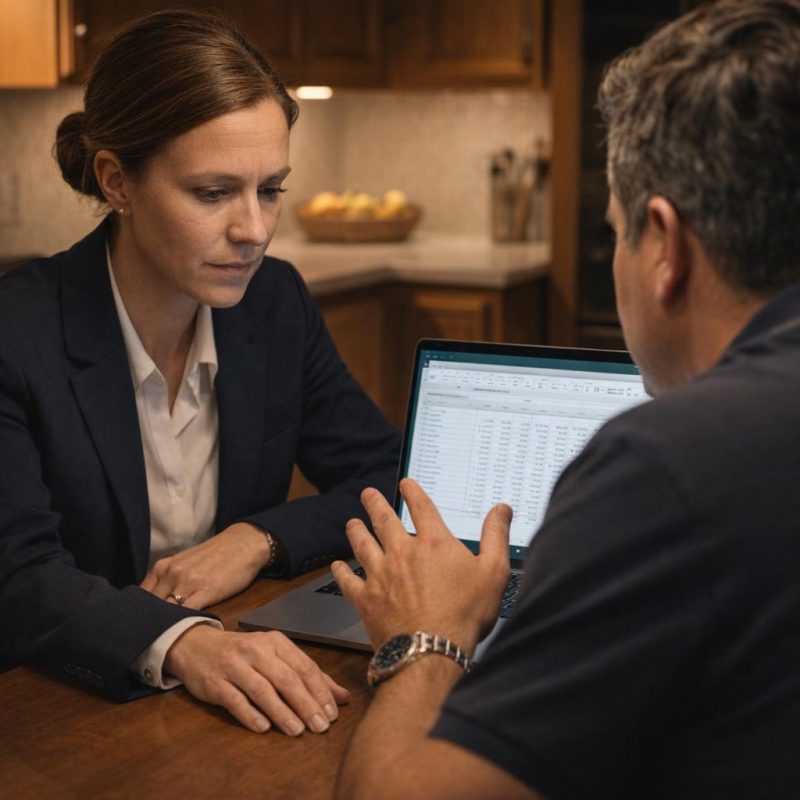 Image by RM AI
The Offer to Help
A few days later I came back to the conversation with what I thought was a practical solution. I told Mark that given my background — I'd spent three years doing financial analysis before I moved into account management — I could take over the household budgeting entirely. I said I could build out a proper tracking system, categorize everything, identify where we were bleeding money, and put together a realistic plan. It would take me a weekend, maybe less. I thought he'd be relieved. He looked at me for a moment and then said he appreciated it, but that he had it under control. I said I wasn't trying to take anything over, just to help — that this was literally something I was trained to do. He said he knew that, and that he'd let me know if he needed a second set of eyes, but for now he preferred to manage the finances himself. He said it the way you say something that isn't really up for discussion. I told him okay and let it go, because pushing felt like starting another fight, and I didn't have the energy for that. But as I walked back to the living room, something about the exchange sat slightly wrong — not enough to name, just enough to notice. Then he said it again, quieter, almost to himself: he had it under control.
 Image by RM AI
The Defensive Wall
I gave it a few days before I brought it up again. I wasn't trying to make a point — I genuinely wanted to understand what we were dealing with so I could help plan around it. I asked Mark if he could pull up the bank statements from the last three months, just so I could see the actual picture. He was standing at the counter, and I watched his shoulders pull up and back, a small tightening that he didn't seem aware of. He said I didn't need to worry about the details, that he had a handle on it. I said I wasn't worried, I just wanted to look at the numbers myself — that it was hard to help plan if I couldn't see what we were working with. He turned toward me and said the accounts were fine, that he was managing it, and that he'd come to me if anything changed. His voice was even, his words were reasonable, but his shoulders stayed up near his ears the whole time I was asking. I let the subject drop. But I kept thinking about those shoulders — the way they'd moved the moment I mentioned the statements, quick and involuntary, like something had pulled tight underneath the surface.
 Image by RM AI
The Guilt Spiral
I don't know exactly when the doubt started settling in, but by the time it did, it had already made itself comfortable. I lay awake one night listening to the house — Tyler's small snore from down the hall, the refrigerator cycling on and off — and I started doing the math in my head. Not financial math. The other kind. How many school pickups I'd missed in the last month. How many times Emma had asked Mark for help with her homework because I wasn't home yet. How many dinners had been reheated instead of shared. Mark's words had a way of replaying themselves in the quiet, and in the quiet they sounded less like criticism and more like observation. Maybe he wasn't wrong. Maybe I had been telling myself the hours were necessary when really they were just — easier than being present. I got up around midnight and sat at my desk with my laptop open, telling myself I was just going to look. I wasn't going to do anything. I was just going to look. By two in the morning, I had three browser tabs open with listings for part-time project management roles in my field.
 Image by RM AI
The Daily Drip
It wasn't any single thing he said. That's what made it so hard to push back against. Monday, he mentioned — gently, almost in passing — that Tyler's class had done a little presentation and I hadn't been there. I hadn't even known about it. Tuesday, he opened the refrigerator and stood there for a moment before saying we were out of basically everything again. Wednesday, he told me Emma had come to him for help with her science project because, and I quote, she knew I'd be busy. He said it without any edge in his voice, which somehow made it worse. Thursday, he looked at me across the dinner table and said I seemed tired, that he was worried about me, that the job was clearly taking a toll. Friday, he asked — quietly, reasonably — whether it was really worth it. Whether the salary justified what we were all giving up. Each comment, on its own, was the kind of thing a concerned husband might say. Taken together across five days, they sat on my chest like something I couldn't quite lift. By Friday night I was too worn down to sort out what I actually thought from what I'd simply absorbed.
 Image by RM AI
The Afternoon Observation
My three o'clock meeting got cancelled with about forty minutes' notice, and I decided to head home instead of filling the time at my desk. It felt almost indulgent, leaving before five. I pulled onto our street just after two and saw Mark's car sitting in the driveway. I assumed he'd come home for lunch and stayed to take a call — that happened sometimes. I parked behind him and grabbed my bag, and that's when I noticed it. The windshield on his car was still carrying a thin film of frost along the edges, the kind that burns off within the first few minutes of driving. It hadn't moved. Not recently, anyway. I stood there for a second, my hand on my car door, looking at that frost line. When I got inside, Mark was at the kitchen table with his laptop, and he looked up and said he'd had a slow morning, moved his afternoon calls to remote, and decided to work from home. He said it easily, like it was nothing unusual. I nodded and said that made sense. But I kept thinking about that frost — still sitting there, undisturbed, in the middle of a Tuesday afternoon.
 Image by RM AI
The Demand
The kids had been in bed for about twenty minutes when Mark came and sat down across from me at the kitchen table. Not next to me — across from me. He folded his hands on the table and said he needed to talk about something important, that he'd been thinking about it for a while and he wanted to be honest with me. I put down my phone. He said the family was struggling — not just financially, but in terms of what the kids needed, what the house needed, what he needed — and that he'd come to the conclusion that something had to change in a real way. He said he'd looked at it from every angle. He said he thought the only solution that actually addressed all of it was if I stepped back from my position. Stepped back. That was the phrase he used first. Then he said it plainly, without softening it: he needed me to quit my job.
 Image by RM AI
The Weighing
I didn't argue with him that night. I went to bed, lay there staring at the ceiling for an hour, and then got up and went to my home office and opened a spreadsheet. I told myself I was just going to look at the numbers. If the numbers said it was impossible, then it was impossible, and that would be the end of it. I typed in my salary first. Then I typed in our mortgage, the car payments, the insurance premiums, Emma's piano lessons, Tyler's soccer registration, the utilities, the groceries. I added the line items slowly, the way you do when you're hoping the total will surprise you. It didn't. Mark's freelance income covered roughly forty percent of our fixed monthly expenses on a good month. I sat with that number for a long time. I tried moving things around — cutting the lessons, dropping one car payment, trimming the grocery estimate. The gap didn't close. It narrowed, but it didn't close. I wasn't ready to tell him that yet. I wasn't ready to tell myself what it meant, either. I just sat there in the blue light of the screen with the spreadsheet open in front of me, and the numbers sat there right back.
 Image by RM AI
The Mental Ledger
After that night with the spreadsheet, I couldn't stop seeing numbers everywhere. Emma's piano lesson on Thursday — I sat in the parking lot and did the mental math without meaning to: forty-five dollars a session, four sessions a month, twelve months a year. Tyler's soccer registration form came home in his backpack on Friday and I unfolded it at the kitchen counter and saw the seasonal fee before I even read the rest of the page. At the grocery store on Saturday, I found myself turning packages over to check unit prices, something I hadn't done since my mid-twenties. I stood in the cereal aisle for longer than I should have, comparing two boxes that were maybe thirty cents apart, and I thought about how strange it was that I managed six-figure project budgets at work without blinking and yet here I was, paralyzed by cereal. Emma asked me what I was doing and I said I was just thinking. Tyler grabbed the brightly colored box and put it in the cart and I let him, and then I stood there a moment longer while they moved ahead. The total in my head — lessons, fees, groceries, everything — just kept sitting there, heavy and unmoving.
 Image by RM AI
The Statement Request
A few days after the spreadsheet night, I told Mark I wanted to sit down and go through the credit card statements together before I made any decisions. I said it carefully — I wasn't accusing him of anything, I just wanted to understand where the money was actually going each month so I could think clearly about what cutting my income would mean in practice. He didn't hesitate. He said that was fair, that he thought it was a good idea, and he went and got his laptop from the other room. He set it on the kitchen table between us and pulled up the online banking portal, navigating to the most recent credit card statement without any prompting from me. He turned the screen slightly so I could see it better. I pulled my chair closer, watching as the statement loaded — a full month of line items appearing on the screen, the cursor blinking at the top of the list.
 Image by RM AI
The Surface Review
I went through it slowly, line by line. Grocery store charges appeared regularly — two, sometimes three times a week, which tracked with how our household actually ran. The utility payments were there: electric, gas, water, all roughly what I expected for a house our size. The kids' activity fees showed up mid-month, the amounts matching what I already had in my head from the registration forms. There were pharmacy runs, a pediatric co-pay, a charge from the school book fair that I remembered Emma mentioning. Insurance premiums, the streaming subscriptions, a tank of gas. Nothing jumped out. The categories were familiar, the rhythm of the spending looked like our life. I sat back slightly in my chair and felt something loosen in my chest — not relief exactly, but the absence of the specific dread I'd carried into the room. The numbers on the screen looked like the numbers of an ordinary family getting through an ordinary month.
 Image by RM AI
The Daily Pressure
It started the morning after I'd reviewed the bank statements. Mark was already at the kitchen table when I came downstairs, coffee in hand, and before I'd even reached for a mug he asked if I'd had any more time to think about the resignation. I told him I was still thinking. He nodded, but the nod had an edge to it — tight, impatient. The next morning it was the same question, same table, same coffee going cold between us. By the third day he'd stopped framing it as a question and started framing it as a timeline. He mentioned the kids' school schedule, the summer coming up, how much easier the transition would be if I gave notice sooner rather than later. I kept saying I needed more time. He kept saying time was the one thing we didn't have a lot of. I'd pour my coffee, answer in as few words as possible, and get the kids moving toward the door. But the question followed me out of the kitchen every single morning, and by the end of the week it had started to feel less like a conversation and more like a clock I couldn't turn off.
 Image by RM AI
The Lunch Confession
I'd been holding it together at work, but by Wednesday I needed to say it out loud to someone who wasn't Mark. Sarah and I had a standing lunch spot — a sandwich place two blocks from the office — and I got there first and ordered before she arrived, which she clocked immediately. She slid into the seat across from me and said, 'Okay, what happened?' I told her everything. The conversation at dinner, the daily questions, the way Mark had started talking about my resignation like it was already decided and we were just working out the paperwork. Sarah listened without interrupting, which was unusual for her. She kept her eyes on me the whole time, and when I finally stopped talking she was quiet for a moment. Then she set down her fork and asked me, very calmly, whether Mark had a concrete plan for replacing my income once I stopped working.
 Image by RM AI
The Warning Signs
I didn't have a clean answer for that, and Sarah could tell. She didn't push, but she didn't let it go either. She pointed out that Mark had lost two clients in the past year — I'd mentioned that to her months ago — and that the timing of his push for me to quit felt worth paying attention to. She wasn't accusatory about it. Her voice stayed level, almost careful, like she was choosing each word before she said it. She asked why he needed an answer so quickly, what the urgency was, whether I'd seen the full picture of where his freelance work actually stood right now. I told her I trusted him to handle his side of things. She nodded slowly and said she wasn't questioning his intentions, just suggesting that a decision this big deserved full information on both sides before I made it. It was a reasonable thing to say. I knew it was reasonable. But sitting there across from her, hearing my marriage laid out like a business case with gaps in the data, left me with a discomfort I couldn't quite shake loose.
 Image by RM AI
The Defense
I told Sarah she was reading too much into it. Mark wasn't controlling — he was stressed. There was a difference, and I needed her to understand that. I explained that losing clients in freelance work wasn't unusual, that the industry had been rough for a lot of people, and that his push for me to stay home came from a real place — he worried about the kids, about Emma's focus at school, about Tyler being so young still. He wanted stability for them. I said it clearly and I meant it, mostly. Sarah listened with her hands wrapped around her coffee cup and her expression doing that thing it does where she's being polite but not convinced. She said she understood, that she wasn't trying to make me doubt him, and that she was sure he had good reasons. But even as the words were leaving my mouth — the part about him just being worried, just wanting what was best for the family — I could hear something slightly hollow in them, like I was reading from a script I'd written quickly and hadn't had time to check.
 Image by RM AI
The Ride Home
The drive home took twenty minutes on a good day. That afternoon it felt longer. I had the radio on but I wasn't hearing it — I kept replaying the lunch in my head, specifically the moment Sarah set down her fork and asked about the financial plan. I'd answered her, but I hadn't really answered her, and I knew it. I ran through the logic again the way I would a work problem: Mark's income had been inconsistent, mine was stable, he was asking me to remove the stable element. I told myself that couples made decisions like this all the time, that it didn't have to be a spreadsheet, that trust was part of the equation. But Sarah's questions had a way of sitting in the room even after she'd stopped asking them. I turned onto our street and tried to let it go. I told myself I was overthinking it, that I'd been in analytical mode all week and was applying it to the wrong situation. I pulled into the driveway and sat for a moment before going inside, the engine ticking quiet in the afternoon.
 Image by RM AI
The New Headphones
A few evenings later I went into Mark's home office to ask if he'd seen Tyler's permission slip for the field trip. The room was dim, just the desk lamp on, and Mark wasn't in there — he'd stepped out to take a call. I scanned the desk for the slip and didn't find it, but something else caught my eye. Sitting next to his monitor was a pair of wireless headphones I hadn't seen before. They were matte black, the kind with the wide cushioned band and the noise-canceling logo on the side — the sort of thing I'd seen advertised for a few hundred dollars. I picked them up without thinking much about it, just the automatic reflex of noticing something new in a familiar space. The price tag was still looped around the left ear cup. I turned it over. Four hundred and twenty dollars, from an electronics retailer I recognized. I set them back down carefully, exactly where they'd been, and stood there in the quiet of his office with the number still sitting in my head.
 Image by RM AI
The Casual Explanation
I mentioned the headphones at dinner, keeping my voice easy, the way you do when you're not sure if something is worth making into a thing. I said I'd noticed them on his desk and asked if they were new. Mark looked up from his plate and said yes, he'd picked them up last week. I asked what they were for and he said his current headset had been cutting out on client calls — the audio quality was making him sound unprofessional, and in his line of work, how you came across on a call mattered. The kids were talking about something that had happened at school and the conversation moved on the way dinner conversations do. I nodded and said that made sense. He went back to his dinner. But before the subject closed, he added, without looking up, that it was an investment in his business.
 Image by RM AI
The Acceptance
The next morning I sat down at my desk with a client presentation due by noon and told myself to focus. The slides were mostly done — I just needed to tighten the executive summary and check the figures on the third page. I opened the file and got through the first two slides without trouble. Then I stopped. I was looking at a bar chart but thinking about a price tag. I pulled my attention back, fixed a label that was slightly off, moved on. By the time I reached the summary section I'd drifted again, back to Mark's explanation at dinner — the audio quality, the professional presentation, the investment framing. It was a reasonable explanation. I'd accepted it. I typed a sentence, deleted half of it, typed it again. I finished the presentation with ten minutes to spare and sent it before I could second-guess the summary any further. I closed the laptop and sat back in my chair, and Mark's words from the night before settled somewhere just below the surface, not quite gone.
 Image by RM AI
The Membership Fee
I logged into our joint account that afternoon to check the balance before a grocery run — something I'd started doing more carefully over the past few weeks. The numbers loaded and I scrolled down through the recent transactions the way I always did, half-expecting nothing. Then I stopped. There was a charge I didn't recognize, listed under a name that included the words 'Executive Club.' I read it twice. I didn't remember Mark mentioning anything about joining a club. I scrolled back up to make sure I was reading the right account, then back down again. The charge was there, recurring, marked as a monthly subscription. I sat with it for a moment, trying to place it — maybe he'd mentioned it in passing and I'd missed it, maybe it was something he'd signed up for before the job loss and forgotten to cancel. I opened a new tab and searched the name. It came back as a private business networking club, the kind with a lobby and a dress code and a waiting list. I closed the tab and looked at the charge again. The monthly fee was larger than what we spent on groceries.
 Image by RM AI
The Networking Justification
I waited until after dinner, once the kids were settled, before I brought it up. I kept my voice even — just a question, nothing more. I told Mark I'd seen a charge on the account for an executive club membership and asked him about it. He didn't miss a beat. He leaned back slightly and explained that the club was one of the best networking resources in the city, that the membership gave him access to private events where the right kind of clients actually showed up. He said he'd already had two conversations that looked promising. He talked about the caliber of the members, the introductions he'd been able to make, the way that kind of environment accelerated relationship-building in a way that cold outreach never could. It all sounded reasonable. It sounded like something I might have said myself in a different context, about a different investment. I nodded and said I understood, and I did understand the logic of it — I just hadn't been told. He kept going, describing an upcoming event with the kind of confidence that made it hard to find a foothold for doubt, his hands moving as he talked about the opportunities waiting on the other side of it.
 Image by RM AI
The Timeline
The next morning, after I dropped the kids at school, I sat down at the kitchen table with a notepad and a pen. I wasn't sure what I was doing exactly — it felt more like needing to see something laid out than having a plan. I wrote down the date Mark had first told me I should think about resigning. Then I wrote down the date the headphones charge had appeared on the account. Then the club membership. I added the dates of the conversations where he'd pushed hardest about my hours, about the toll my schedule was taking on the family. I wrote them all in a column, then drew a second column next to it for the purchases. I looked at what I had. The headphones had appeared the same week he'd first raised the idea of me stepping back from work. The club membership had shown up two days after the conversation where he'd used the word 'resign' for the first time. I sat back and looked at the two columns sitting side by side on the page.
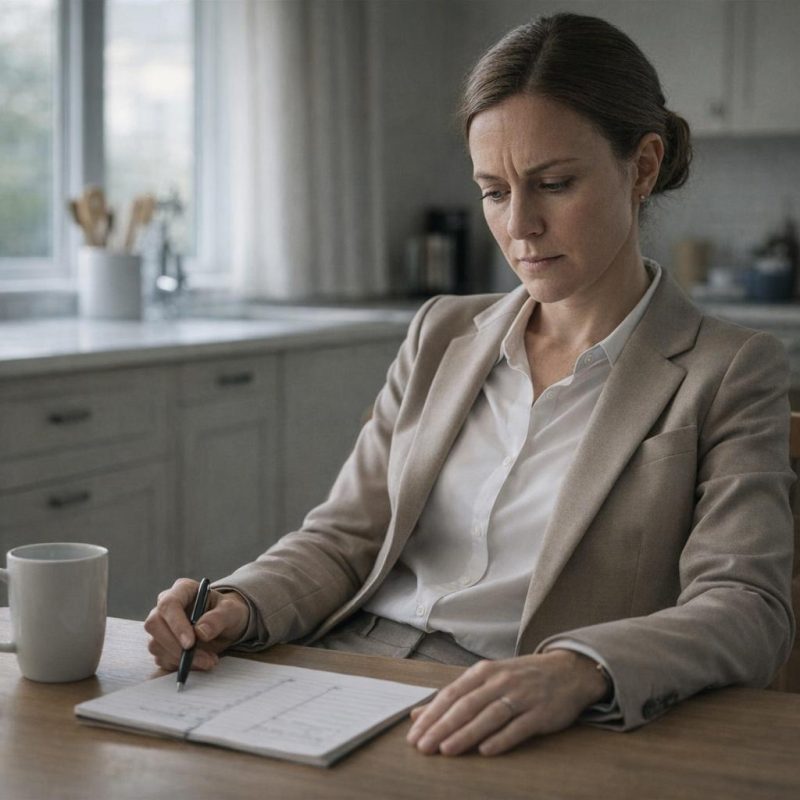 Image by RM AI
The Access Request
I chose a quiet moment two evenings later, when the kids were in bed and the house had settled. I told Mark I'd been thinking seriously about the financial picture and that before I could make any real decisions about my job, I needed to see everything — all of it, not just the joint account. I said I wanted login access to every bank account and credit card we held, individually and jointly, so I could do a proper review. I kept my tone the same way I'd keep it in a meeting — calm, direct, matter-of-fact. He looked at me for a moment without saying anything. It was brief, just a second or two, but his expression shifted in a way I caught before he smoothed it over. Then he said of course, that made complete sense, and that he'd send me everything that evening. He picked up his phone and went back to whatever he'd been doing. I said thank you and went to make tea, and when I glanced back at him from the kitchen doorway, his face had gone somewhere I couldn't quite read.
 Image by RM AI
The Wait
He didn't send it that evening. I checked my email after I finished the dishes, then again when I sat down with a book I wasn't really reading. Mark was on his laptop across the room, the blue light catching the side of his face, and I didn't ask. I'd said what I needed to say and he'd agreed, and pushing before he'd had a chance to follow through felt like the wrong move. So I waited. I refreshed my inbox around nine, then again closer to ten, telling myself it was fine, that he was probably still pulling things together. The kids had been asleep for hours. The house was quiet in the way it gets late at night when there's nothing left to fill the silence. Mark closed his laptop around ten-thirty and said he was heading to bed, that he'd get me the information tomorrow. I said okay. I sat there after he'd gone upstairs, the room dim, my phone face-up on the cushion beside me, the screen dark and still.
 Image by RM AI
The Download
The email came at eleven-fourteen the next night. I was still at my desk — I'd told myself I was finishing a work report, but I'd been checking my inbox every twenty minutes for two days. The subject line just said 'Account Info' and the body had a list of usernames and passwords, one for each account, typed out in a plain block of text with no explanation. I opened each account in a separate tab and started downloading statements, going back six months on every one. The downloads came through in batches — PDFs stacking up in my downloads folder, named with account numbers and date ranges that meant nothing until I organized them. I created a folder on my desktop and sorted everything by account type, then by month. Checking accounts, savings, two credit cards in Mark's name I hadn't known existed. I labeled each subfolder carefully and moved the files in. By the time I was done it was past midnight and the folder held more documents than I'd expected. I sat back and looked at the files lined up on my screen, each one a month I hadn't seen before.
 Image by RM AI
The Spreadsheet
I started the spreadsheet the following morning before the kids were up. I opened a blank workbook and built the column headers first — date, account, merchant, amount, category — then I started entering transactions one by one, working through the PDFs in chronological order. It took most of the morning and part of the afternoon. I categorized everything: groceries, utilities, school expenses, subscriptions, dining, clothing, and a column I labeled 'discretionary' for anything that didn't fit neatly elsewhere. I color-coded by date range, three months in one shade, the next three in another, so I could see at a glance where spending shifted. The discretionary column filled up faster than I expected. There were restaurant charges I didn't recognize, retail purchases I had no memory of, subscription services I'd never heard of. I kept entering, kept categorizing, kept my focus on the data rather than what it might mean. By the time I'd finished the first three months, the spreadsheet had grown longer than I'd anticipated. I saved the file, leaned back, and opened the completed tab showing the full first quarter laid out row by row.
 Image by RM AI
The Correlation
I added a second sheet to the workbook and started building a timeline from memory — every conversation where Mark had raised my job, my hours, the financial pressure, the kids needing more of me at home. I wrote down what I remembered of the dates, or at least the weeks, and cross-referenced them against the spreadsheet. Then I mapped the purchases onto the same line. The club membership had appeared two days after the first time he'd used the word 'resign.' The headphones had shown up the week he'd started pushing hardest about my hours. A restaurant charge I didn't recognize landed three days after a conversation where he'd told me the kids were struggling because I was never home. I went through every major discretionary purchase in the spreadsheet and placed it on the timeline. I sat with the finished sheet for a long time, the two rows running parallel across the page — his words in one, the charges in the other — the alignment between them too close to be coincidence, though I still couldn't quite believe what it suggested.
 Image by RM AI
The Chronological Map
I added a third sheet to the workbook and labeled it simply: Timeline. I went back through everything — every entry in the spending spreadsheet, every note I'd made about our conversations — and I started placing them in order. The club membership: three days after the first time Mark used the word 'resign.' The noise-canceling headphones: the same week he called me seventeen times in a single afternoon to tell me the kids needed more of me at home. A new laptop: the day after our worst argument about household duties, the one where he'd said I was choosing my career over my family. I kept going. A gym membership upgrade. Premium streaming services. A jacket I'd never seen him wear. Each one had a date, and each date had a conversation sitting right beside it on the timeline. I printed the sheet and laid it flat on the desk. The two rows ran parallel across the page — his words in one column, the charges in the other — and the space between them felt very, very small.
 Image by RM AI
The Correlation Coefficient
I went back through the timeline with fresh eyes and started looking at the numbers themselves, not just the dates. The smaller purchases — the streaming upgrades, the gym add-ons — had come early, in the months when his complaints were still measured, still framed as gentle concern. Then the amounts climbed. The headphones were two hundred and forty dollars. The laptop was over a thousand. And the complaints had climbed with them — sharper, more frequent, more personal. I pulled up the credit card statement for the month he'd sat me down and told me we needed to have a serious conversation about our budget. I cross-referenced the dates carefully, moving line by line. I almost missed it because it was listed under a retailer name I didn't immediately recognize. I had to search the name to confirm what it was. The charge had posted at 9:47 in the morning — a fifteen-hundred-dollar purchase at a luxury watch retailer — dated the same morning he'd asked me to sit down and talk about cutting our expenses.
 Image by RM AI
The Cross-Reference
I pulled up every account we had access to — the joint checking, the joint savings, both credit cards — and I started verifying each entry on my timeline against the actual statements. I wasn't going to let myself rely on memory or inference. I needed the numbers to confirm themselves. They did. Every purchase I'd flagged matched a posted charge, down to the cent. But as I worked through the statements line by line, I found entries I hadn't caught before. A premium golf club set I'd missed because it had been split across two transactions on the same day. A designer belt listed under a vague merchant name. A subscription service that had been quietly renewing for four months. I added each one to the spreadsheet, updated the timeline, and kept going. By the time I reached the end of the last statement, the documentation covered six months of accounts across four financial sources, and every line told the same story — the charges were there, confirmed, dated, and accounted for across every account we held.
 Image by RM AI
The Undeniable Pattern
I added a totals row at the bottom of the spreadsheet and entered a SUM formula. I'd been avoiding it, I think — working through the individual entries one at a time so I didn't have to see the number all at once. I hit enter and the cell populated. I stared at it. Then I opened the tab where I'd logged our actual necessary monthly expenses — the mortgage, utilities, groceries, the kids' school fees — and I ran those numbers too, month by month, against what we actually brought in. The math was straightforward. Our income covered our needs. It had covered them every month for the past six months. I sat back in my chair and looked at the two figures side by side: what we needed, and what had been spent beyond that. Mark had told me we were stretched thin. He'd told me we were one bad month away from real trouble. He'd said it in the kitchen, at the dinner table, in the car on the way to Emma's school. I looked at the total sitting at the bottom of my spreadsheet: $12,340.
 Image by RM AI
The Manufactured Crisis
I sat with the number for a long time before I let myself follow it all the way to the end. Twelve thousand dollars. Spent on watches and golf clubs and gym upgrades and designer clothing, across six months, while he told me we couldn't afford for me to keep working the way I was working — that the cost of childcare, the household imbalance, the financial pressure, all of it pointed to one solution. Me. Quitting. I looked at the timeline again. Every major purchase had landed within days of a conversation where he'd turned up the pressure. The budget talk. The parenting criticism. The late-night argument where he'd said I was failing our family. He hadn't been responding to a financial crisis. He had been creating one — spending us into a shortfall that didn't exist until he built it, then using that shortfall to tell me we couldn't sustain my career. The purchases weren't impulsive. The timing wasn't coincidence. He had manufactured the emergency he used to demand my resignation.
 Image by RM AI
The Sitting Still
I didn't close the laptop. I didn't get up for water. I just sat there, in the chair, with the screen still open in front of me, and I didn't move for a long time. I replayed the kitchen conversation from February — the one where he'd set his coffee down and said, very quietly, that he was worried about us. I'd believed him. I'd felt the guilt of it settle into my chest like something physical, like I'd been carrying weight I hadn't noticed until he named it. I thought about the drive to Emma's school, the way he'd sighed before he spoke, the careful pause before every sentence. I'd read all of it as concern. I'd read it as a husband trying to hold something together. The screen in front of me hadn't changed. The numbers were still there, still in the same columns, still adding up to the same total. The house was quiet around me, and the quiet had a different quality now — not peaceful, just still.
 Image by RM AI
The Reframing
I thought about the laundry comment first — the one that had started all of this, the offhand remark that had lodged itself somewhere I couldn't reach. At the time I'd filed it under tired husband, long week, nothing to worry about. Then I thought about the comments that followed it, each one a little more pointed than the last, each one arriving after I'd had a good week at work or landed a new client or come home later than I'd planned. I'd spent months second-guessing my schedule, adjusting my hours, apologizing for conference calls that ran long. I'd felt genuinely guilty about Emma's homework and Tyler's school pickups and the dinners I hadn't cooked. That guilt had been real. I'd carried it carefully, the way you carry something fragile, trying not to let it spill. What I understood now was that the guilt had been handed to me, piece by piece, in conversations timed to land when I was already stretched thin. The weight of it hadn't changed — but what I was holding felt entirely different than what I'd thought it was.
 Image by RM AI
The Calculation
I opened a new spreadsheet and titled it simply: Valuation. I sat up straight in my chair — the same posture I used in client meetings — and I started with what I knew. My consulting rate was two hundred and fifteen dollars an hour. That was the number my employer billed for my time, the number clients paid without question, the number that reflected a decade of expertise and professional judgment. I typed it into a reference cell and started building the framework below it. Cooking: I estimated seven hours a week, accounting for planning, preparation, and cleanup. Laundry and household management: four hours. School coordination for Emma and Tyler — pickups, homework supervision, activity scheduling: I started listing each component separately, because that was how you built an accurate model. You didn't round. You didn't estimate loosely. You documented every line item so the total couldn't be disputed. I moved to the next row and began entering the childcare hours — the bedtime routines, the sick days, the weekend mornings Mark spent on the golf course while I managed everything at home.
 Image by RM AI
The Itemization
I worked for three hours without stopping. The spreadsheet was already built — now I needed the invoice itself, formatted the way I'd format any professional deliverable. I opened a blank template and typed my name at the top, then the service description: Household Management and Domestic Services. I listed meal planning and preparation first: fourteen hours weekly, fifty-six hours monthly. Laundry, cleaning, and household maintenance: twelve hours weekly, forty-eight hours monthly. Childcare and activity coordination for Emma and Tyler — pickups, homework, scheduling, bedtime routines, sick days: twenty hours weekly, eighty hours monthly. Household management and scheduling, including finances, appointments, and vendor coordination: eight hours weekly, thirty-two hours monthly. I applied my consulting rate — one hundred twenty-five dollars per hour, a conservative figure, well below what my employer billed for my time. The monthly subtotal came to twenty-seven thousand dollars. I added a line for benefits and overhead, the way any contractor would, and the total landed just above their mortgage and utilities combined. I formatted it cleanly: invoice number, date, payment terms of thirty days, a remittance line at the bottom. It looked exactly like every other professional document I had ever produced. I printed two copies and set them face-down on the desk, and the house was very quiet around me.
 Image by RM AI
The Rehearsal
I gave myself one evening to rehearse. Not because I was nervous — I had presented to boardrooms, to skeptical clients, to executives who thought they already knew the answer before I opened my mouth. I knew how to hold a room. But this was different, and I wanted to be precise. I stood in the kitchen after the kids were asleep and said my opening statement out loud, the way I used to practice before high-stakes pitches. I kept it short. I told him I had a document I needed him to review. I told him it was a professional assessment of the services I currently provided to this household. I ran through his likely responses in my head — the laugh, the dismissal, the pivot to emotion — and I prepared for each one the same way I prepared for client objections: with data, with silence, and with patience. I wasn't going to argue. I wasn't going to explain myself more than once. I had the invoice, I had the spending timeline, and I had ten years of evidence. When I was satisfied that I could deliver every word without my voice shifting even slightly, I picked up both documents from the desk and slid them into a manila folder.
 Image by RM AI
The Presentation
I waited until both kids were asleep and the house had gone quiet. Mark was in the living room with the television on low, the way he always was on weeknights, and I came in and sat down across from him rather than beside him. That was deliberate. I set the manila folder on the coffee table and said, "I need about fifteen minutes of your time. No interruptions." He muted the television, which surprised me a little. I opened the folder and slid the invoice across to him — printed cleanly, formatted professionally, my name at the top and a thirty-day payment term at the bottom. I told him it represented the full market value of the household management services I currently provided. I told him the monthly total, and I watched his eyes find the number. Then I said, clearly and without any particular emphasis, that I was prepared to discuss resigning from my position the moment he could guarantee payment of that amount each month, in writing, in advance. I didn't add anything to soften it. I didn't explain the math or apologize for the format. I just sat back in my chair and let the document speak, and the room held that stillness the way a conference room does right after a proposal lands.
 Image by RM AI
The Dismissal Attempt
He laughed first. It was a short, sharp sound — the kind that's meant to signal that the other person has said something slightly embarrassing. "This is ridiculous," he said, and set the invoice down like it had offended him. "You're being dramatic. I had one conversation with you about our finances and you turned it into — this." He gestured at the document. I didn't respond. He waited for me to defend myself, and when I didn't, he tried a different angle. He said I was overreacting, that he'd simply raised a reasonable concern, that any reasonable person would understand his position. I let him finish. I didn't nod, didn't shake my head, didn't shift in my seat. I had learned a long time ago that silence in a negotiation is not emptiness — it's pressure, and it lands differently than any argument you could make out loud. He said my name once, the way people do when they want you to confirm you're still listening. I was listening. I just wasn't going to fill the space for him. His voice, which had started out dismissive and a little amused, lost some of its certainty, and the laugh didn't come back.
 Image by RM AI
The Evidence
I reached into the folder and pulled out the second document. This one was the spending timeline — twelve pages, organized by date, with each purchase listed alongside the account it came from and the running total at the right margin. I had highlighted three entries in particular: the watch, the noise-canceling headphones, and the annual club membership renewal. I set it on the table between us and smoothed it flat with one hand. I told him I had cross-referenced every significant purchase he'd made in the past eight months against the dates he had raised concerns about our household finances. I told him the total came to just over twelve thousand dollars. I told him I wasn't asking him to explain all of it — just the timing. He looked down at the first page, and I watched the shift happen in his face as the columns registered. I asked him, in the same tone I would use in any client meeting, whether he could walk me through the reasoning behind those three highlighted items, given that each one had been purchased within six weeks of a conversation in which he told me we needed to cut back. I slid the full timeline across the table toward him.
 Image by RM AI
The Justification Attempt
He started with the watch. He said it was for client meetings, that appearance mattered in his industry, that showing up to a pitch wearing something cheap sent the wrong message. I didn't respond. He moved to the headphones — a business necessity, he said, because he worked from home and needed to manage audio quality on calls. His voice was steady when he said it, but his hands weren't. He picked up the timeline and set it back down without looking at it again. The club membership, he said, was networking. Pure networking. He knew three people who had brought him referrals through that club in the past two years. I let him finish every sentence. I didn't interrupt, didn't challenge, didn't write anything down. I just kept my eyes on him and let the silence after each explanation do what silence does. The justifications came out in the right order — confident first, then qualifying, then slightly too detailed, the way a story gets when someone is building it as they go rather than remembering it. He reached the end of the third explanation and stopped. There was nothing left on his list. He looked at the table rather than at me, and his mouth stayed closed.
 Image by RM AI
The Confrontation
I waited until I was certain he was done. Then I said it plainly, the way I would state a finding in any professional report: the pattern in the documentation showed that his largest discretionary purchases had occurred within weeks of every conversation in which he told me we couldn't afford our current expenses. I said I had looked at it from every angle I could think of, and there was only one conclusion the data supported. He started to say something — I heard the beginning of a denial, the intake of breath before a deflection — and I kept going. I told him I was not going to argue about individual line items. I told him I was not going to debate whether the watch was technically a business expense. I told him that what I was naming, clearly and on the record between the two of us, was that I had been pressured to give up my income and my career based on a financial picture that did not reflect reality. I looked at him directly and said the word out loud: manipulated.
 Image by RM AI
The Realization
He didn't answer right away. He reached across the table and pulled the spending timeline toward him, then set it aside and opened his laptop. I watched him navigate to his freelance income records — the invoices, the payment confirmations, the months where the work had been thin. He pulled up the household budget next, the one we kept in a shared folder that I had been maintaining for years. He looked at the mortgage line, the utilities, the insurance, the kids' school fees. He didn't say anything while he did it. I didn't say anything either. I had already run these numbers. I knew what he was going to find before he found it: that his monthly freelance income, even in a strong month, covered less than half of what it cost to run this household. That the gap between what he earned and what we needed was not a rounding error — it was my salary. He scrolled slowly, the way people do when they're hoping the next line will say something different. It didn't. He closed the laptop partway and left his hands resting on the edge of it, and the quiet that settled over the room had a different weight than any argument we had ever had.
 Image by RM AI
The Withdrawal
He sat with his hands on the edge of the laptop for a long time. Then he said it. Not loudly, not dramatically — just flatly, the way someone reads a number off a page they've been avoiding. He said he couldn't pay it. He said the invoice amount was more than he brought in most months, and that even if he had a strong quarter, it wouldn't cover what I carried. I didn't respond. I let the words sit in the room. He looked at the budget spreadsheet still open on the screen, then back at me, and said that he couldn't ask me to resign. That the numbers didn't work without my salary. That they hadn't worked without it for a long time. I had known that. I had known it before I built the invoice, before I ran the projections, before any of this started. But hearing him say it out loud was different from knowing it quietly by myself. He wasn't angry when he said it. He wasn't performing. He was just a man looking at a spreadsheet, and the spreadsheet was telling him something he had spent months refusing to hear. He said he was withdrawing the request. Those were his exact words: withdrawing the request. His income covered less than half of what it cost to keep our lives running.
 Image by RM AI
The New Terms
We didn't hug after. We didn't cry. We sat at the same table and I opened a new document on my laptop and we talked through what came next the way two people might negotiate a contract they both needed to sign. I told him I required full access to every financial account — his freelance invoices, his payment records, his savings, all of it. He nodded. I told him we were doing weekly budget reviews, together, no exceptions. He said fine. I told him the household tasks were going on a shared calendar and that I expected them to be completed the same way I completed them — without being asked twice. He didn't argue. I told him my career was not a variable in this equation. It was not something we would revisit in six months or frame as temporary. It was a fixed line, like the mortgage. He looked at the table when I said that, but he said he understood. None of it was warm. None of it felt like a turning point in the romantic sense. It felt like a restructured agreement between two people who had let the original terms go unexamined for too long. I saved the document and sent him a copy. The house was quiet around us, and neither of us moved to fill it.
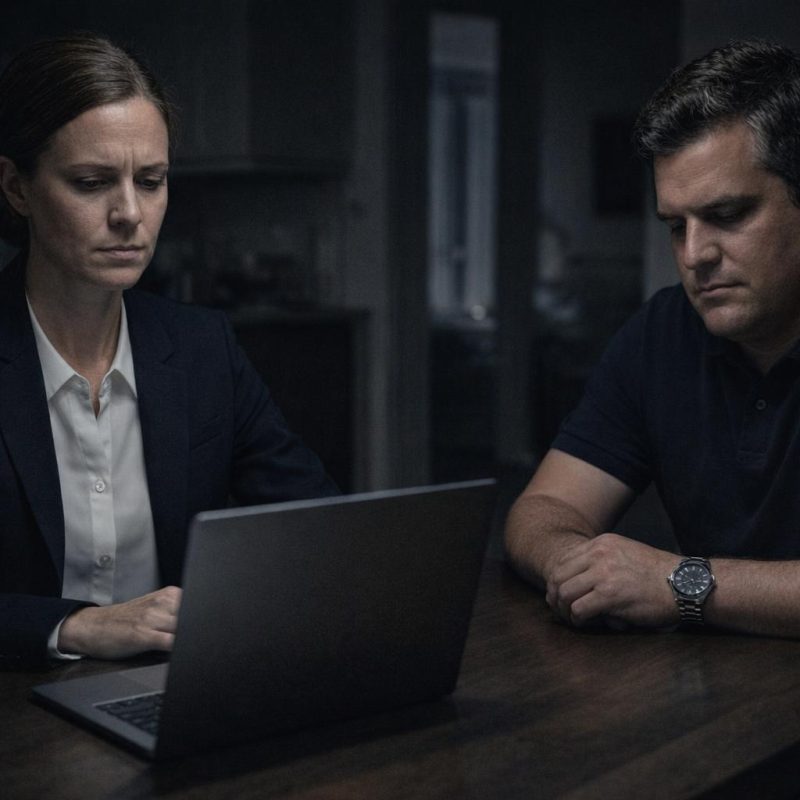 Image by RM AI
The Morning After
I was up before my alarm. I stood in the kitchen while the coffee brewed and I didn't feel the thing I had been carrying for months — that low-grade pressure behind my sternum, the one that had made me second-guess every meeting I scheduled and every evening I stayed late. It was just gone. Emma came downstairs first, her hair still half-undone, carrying a book she'd apparently been reading since before she got out of bed. I made her toast and helped her with the braid she couldn't quite finish herself, and I didn't feel like I was stealing time from somewhere else to do it. Tyler came down at full speed, the way he always did, sock-footed and loud, and I reviewed his reading worksheet with him at the counter while he ate cereal and narrated everything he was doing as though I couldn't see it. I laughed at something he said. It was a real laugh, not the managed kind. I kissed them both before I left. I drove to work with the windows down a little, even though it was cold, and I thought about the quarterly review I had to prep and the call I needed to return and nothing about any of it felt like a burden. The manufactured guilt was gone, and what was left underneath it was just my life — the one I had actually built.
 Image by RM AI
The Invoice
I printed one final copy of the invoice that afternoon. Not because I needed it — the digital version was filed and timestamped and wasn't going anywhere — but because I wanted to hold it. I wanted to feel the weight of the paper. I read through it one more time at my desk: the line items, the hourly rates, the total at the bottom that had made Mark go quiet in a way nothing else had managed to. I thought about how close I had come to just giving in. How many times I had almost convinced myself that the path of least resistance was the reasonable one, that keeping the peace was the same thing as being fair. It wasn't. I had known my own value in every conference room I had ever walked into. I had just forgotten, for a while, to apply the same standard at home. The marriage was different now. Not broken, not fixed — different. I didn't know yet what that meant for the long run, and I wasn't going to pretend I did. What I knew was that I was not the same person who had sat across from Mark six weeks ago and wondered if he might be right. I folded the invoice once and slid it into the folder at the back of my desk drawer, behind my employment contract and my performance reviews, where it would stay.
 Image by RM AI
KEEP ON READING

The 20 Most Recognized Historical Figures Of All Time
The Biggest Names In History. Although the Earth has been…
By Cathy Liu Oct 4, 2024
10 of the Shortest Wars in History & 10 of…
Wars: Longest and Shortest. Throughout history, wars have varied dramatically…
By Emilie Richardson-Dupuis Oct 7, 2024
10 Fascinating Facts About Ancient Greece You Can Appreciate &…
Once Upon A Time Lived Some Ancient Weirdos.... Greece is…
By Megan Wickens Oct 7, 2024
20 Lesser-Known Facts About Christopher Columbus You Don't Learn In…
In 1492, He Sailed The Ocean Blue. Christopher Columbus is…
By Emilie Richardson-Dupuis Oct 9, 2024
20 Historical Landmarks That Have The Craziest Conspiracy Theories
Unsolved Mysteries Of Ancient Places . When there's not enough evidence…
By Megan Wickens Oct 9, 2024
The 20 Craziest Inventions & Discoveries Made During Ancient Times
Crazy Ancient Inventions . While we're busy making big advancements in…
By Cathy Liu Oct 9, 2024