

I Comforted My Grieving Neighbor Every Day—Until He Snapped At Me Out Of Nowhere… And The Real Reason Left Me Speechless
I Comforted My Grieving Neighbor Every Day—Until He Snapped At Me Out Of Nowhere… And The Real Reason Left Me Speechless
The Shift
I can pinpoint the exact moment everything changed. It was a Thursday afternoon, three months into helping Tom, when I knocked on his door with a container of chicken soup and he wouldn't answer. I could hear him moving around inside—the shuffle of slippers on hardwood, the creak of that old rocking chair—but he didn't come to the door. I knocked again, called his name, even left the soup on his porch with a note. The container sat there untouched for two days before disappearing. No thank you, no explanation, nothing. When I tried again the following week, same thing. Radio silence. I stood on that porch feeling like an absolute fool, confused and hurt in a way I couldn't quite articulate. What had I done wrong? For weeks I replayed every conversation, every visit, searching for the moment I'd overstepped. I asked mutual neighbors if Tom was okay, if something had happened. They just shrugged, said he seemed fine to them. The rejection stung worse than I wanted to admit. And when his daughter finally told me why, I realized nothing was what it seemed.
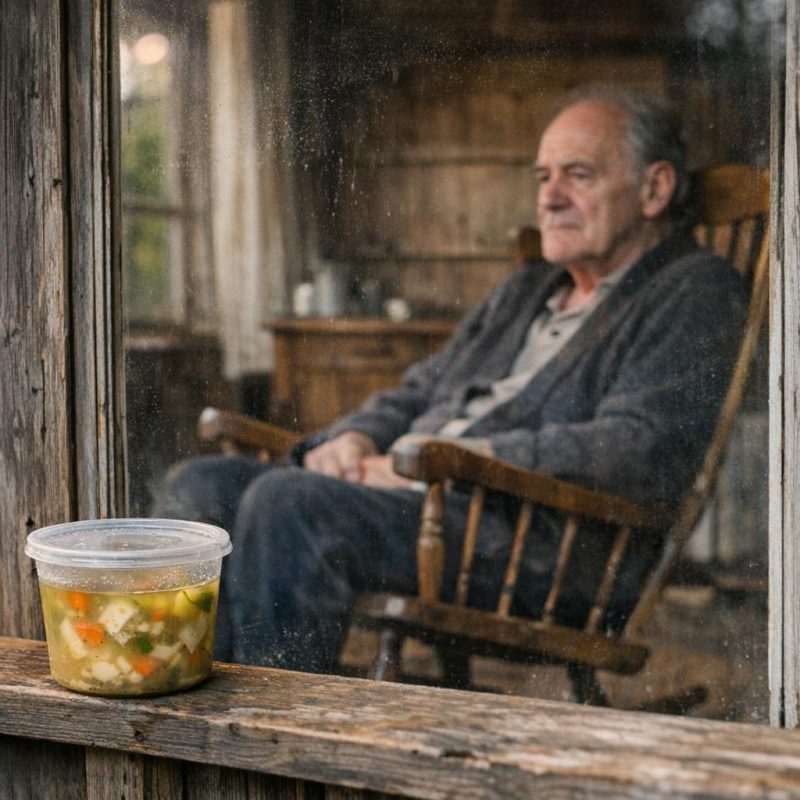 Image by RM AI
Before the Fall
Tom and Elaine had been my neighbors for nearly six years. They were the kind of couple you notice—not because they were flashy, but because they just fit together so perfectly. Every morning, I'd see them on their porch with coffee, Tom reading the paper while Elaine tended to her ridiculous collection of potted geraniums. They'd wave if they saw me leaving for work. We'd chat about weather, neighborhood gossip, the usual surface-level stuff neighbors talk about. Friendly, but not exactly friends. I knew Elaine volunteered at the library. I knew Tom had retired from something in finance. They had two grown children who visited on holidays. That was about it. We existed in each other's periphery in that comfortable, undemanding way. I liked them. They seemed to like me well enough. It was easy and uncomplicated, the way neighbor relationships should be. Then Elaine collapsed in the garden on a Tuesday morning, and everything changed.
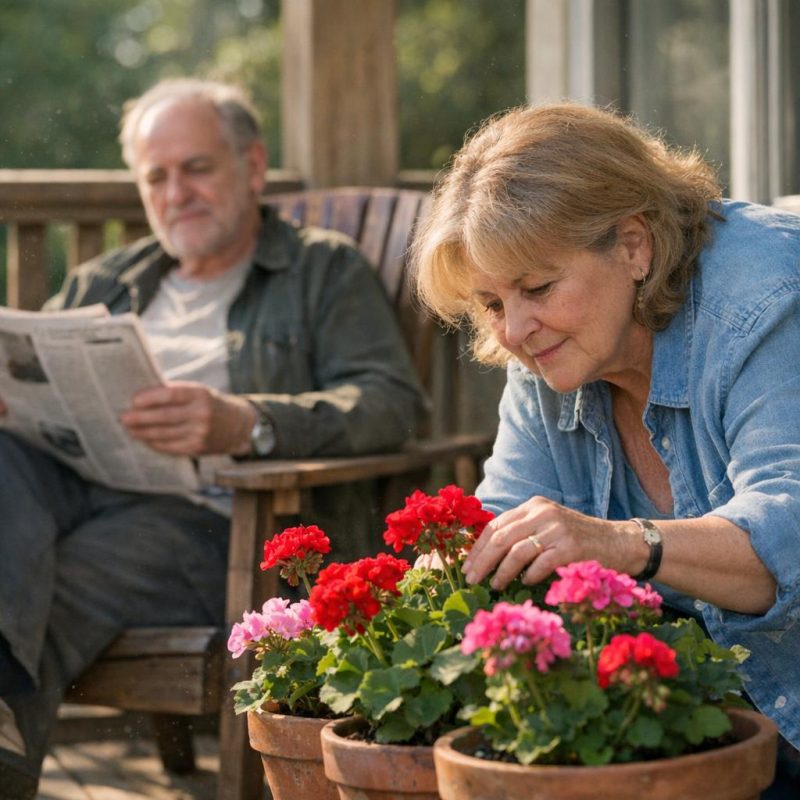 Image by RM AI
The Empty House
The funeral was small and dignified, exactly what you'd expect for someone like Elaine. I went, paid my respects, brought a plant because flowers die and that felt too much like an ending. Tom looked hollow standing there in his dark suit, accepting condolences with mechanical nods. After that, he just disappeared into that house. I'd see him sometimes through the window, or sitting on the porch in Elaine's old rocking chair, staring at nothing. He'd sit there for hours, absolutely still, while the geraniums she'd loved slowly withered and died. No one else seemed to notice or care—his kids had their own lives in other cities, the other neighbors kept their respectful distance. I'd watch him from my kitchen window while making dinner, this man who'd lost half of himself, alone in that too-quiet house. It felt wrong. It felt cruel to just let him sit there drowning. I'm not usually the type to get involved, but something about Tom's grief got under my skin. I watched him sit on that porch for hours, and I knew I couldn't just do nothing.
 Image by RM AI
The First Casserole
I spent an embarrassing amount of time deciding what to make. It needed to be something comforting but not too heavy, something that would reheat well, something that didn't scream 'I pity you' too loudly. I settled on lasagna—classic, unthreatening, the universal language of casserole diplomacy. Walking up to his door that first time, I felt ridiculous. My hands were sweating. What if he thought I was overstepping? What if he was offended? I almost turned back twice. But I knocked, and after what felt like an eternity, Tom answered. He looked smaller than I remembered, like grief had physically diminished him. 'I made too much,' I lied, holding out the dish. 'Thought you might want some.' For a long moment, he just stared at it. Then his hands came up, trembling slightly as he took it from me. He looked down at the lasagna, and his whole face crumpled. 'Elaine used to make this,' he said quietly, and I watched a single tear track down his weathered cheek.
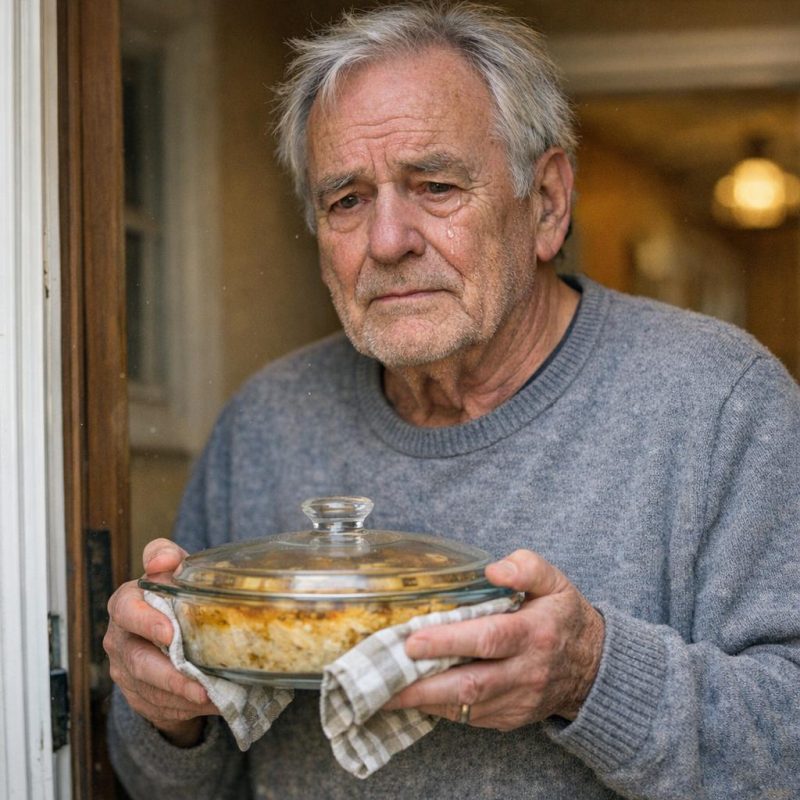 Image by RM AI
Building a Routine
After that first lasagna, it became a thing. Every few days, I'd bring something over—soup, casseroles, occasionally baked goods when I was feeling ambitious. Tom would answer the door, accept the food, and we'd chat for a few minutes. Small talk, mostly. How he was sleeping. Whether he'd talked to his daughter. Sometimes he'd invite me in for coffee. I'd sit at his kitchen table while he reheated whatever I'd brought, and we'd eat together in comfortable silence. It felt good, helping him. Natural, even. I could see him slowly coming back to life—not healed, exactly, but less lost. He started showering regularly again. He mentioned joining a grief support group. Once, I even saw him smile at something I said. My visits became routine, expected, a bright spot in both our weeks if I'm being honest. It gave me purpose, made me feel useful. I thought I was helping him heal—I didn't realize I might be doing something else entirely.
 Image by RM AI
Small Conversations
Tom started talking about Elaine during my visits. Little things at first—how she always burned toast, her terrible sense of direction, the way she'd hum off-key while gardening. He'd tell these stories with this soft smile, like he was visiting her in his memories. I'd listen, asking gentle questions, letting him remember out loud. It seemed healthy, cathartic even. He told me about their trips to the coast, their annual Christmas tradition of watching old musicals, the time Elaine accidentally dyed all his white shirts pink. The stories painted a picture of a life fully shared, and I felt privileged that he trusted me enough to share them. But whenever I'd ask about how they met, his face would shutter. 'That's a long story,' he'd say, or 'Another time, maybe.' I didn't push—everyone has memories too tender to share, especially when they're grieving. But his reluctance stuck with me. There was something about that particular story, something he was protecting. But there was one story he refused to tell—the one about how they met.
 Image by RM AI
The Photograph
I'd seen the wedding photo a dozen times—it hung in his living room, impossible to miss. But this particular afternoon, I found Tom standing in front of it, just staring. Elaine looked radiant in white lace, Tom impossibly young in his tuxedo, both of them glowing with that specific joy of people who have no idea what's coming. He didn't notice me at first. I watched him reach up and touch the frame, his fingers trembling slightly. The grief on his face was so raw it felt invasive to witness. I must have made a sound, because he turned suddenly and caught me watching. For just a second, something flickered across his expression—something I couldn't quite read. It wasn't anger, exactly. Not embarrassment either. It was something more complicated, something that made my stomach twist uncomfortably. Then it was gone, replaced by his usual sad smile. 'She was beautiful, wasn't she?' he said, and I agreed, but I couldn't shake the feeling that I'd seen something I wasn't supposed to. When he caught me looking, something in his expression shifted—just for a second.
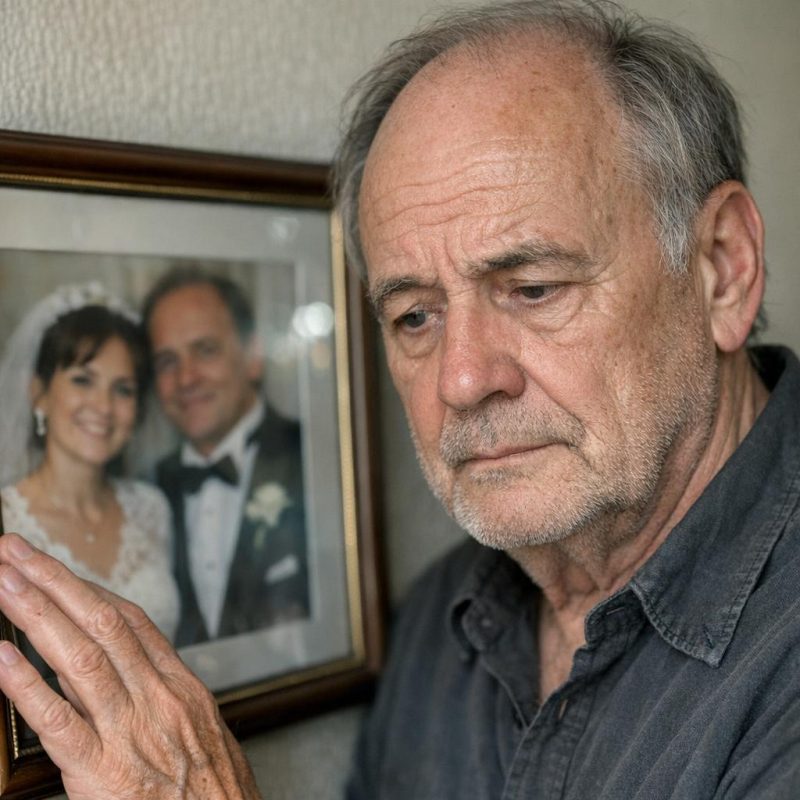 Image by RM AI
Rachel's Question
Rachel cornered me at the coffee shop on a Saturday morning. 'So you're still doing the whole meals-on-wheels thing for your neighbor?' she asked, stirring her latte. I bristled at her tone. 'I'm helping someone who's grieving,' I said defensively. She gave me that look, the one that meant she was about to say something I didn't want to hear. 'I know, and it's sweet, really. But don't you think maybe it's getting a little... much? How often are you over there?' I told her a few times a week, no big deal. 'And you're not worried that's crossing some kind of boundary? That maybe he might misinterpret your intentions?' I actually laughed. Tom was old enough to be my father. The idea was absurd. 'He's a grieving widower, Rachel, not some creep.' She held up her hands in surrender, but her expression stayed concerned. 'Okay, okay. I'm just saying, be careful.' We changed the subject, and I pushed the conversation from my mind. I laughed it off, but her words stayed with me longer than I wanted to admit.
 Image by RM AI
The Grocery Run
Tom called on a Tuesday afternoon asking if I could grab a few things from the store. 'Just some milk and bread,' he said, his voice thin. 'I don't feel up to driving today.' Of course I said yes. By the time I got to his place, though, the list had expanded—eggs, coffee, cereal, canned soup, toilet paper. I loaded everything into my car and brought it over, noticing how empty his fridge looked when I started unpacking. 'You really need to keep more food in here,' I said, trying to sound light about it. He hovered near the doorway to the living room, hands in his pockets. 'I appreciate this,' he said quietly. 'I know it's a lot to ask.' I told him it was fine, that I was happy to help, but as I arranged the cans in his cupboard, I realized how often I'd been doing this lately. Three, four times a week now. When had that happened? I turned to tell him I'd finished, and caught him watching me with an expression I couldn't read—something between gratitude and something else, something that made my skin prickle.
 Image by RM AI
The Thank You
The next time I stopped by, Tom was waiting by the door like he'd been expecting me. He thanked me before I'd even set down the casserole dish. 'I want you to know how much I appreciate everything you've done,' he said, standing stiff and formal like we were at a business meeting. 'You've been very kind.' The words were right, but his tone felt wrong—measured, careful, like he was reading from a script. I laughed nervously and told him it was no problem, that's what neighbors do. He didn't smile. 'Still,' he continued, 'I don't want to impose on your time. You have your own life.' I assured him he wasn't imposing, but he just nodded once and retreated into the house. The whole exchange lasted maybe two minutes. As I walked back home, I kept replaying it in my head, trying to figure out what had just happened. It felt less like gratitude and more like a warning I didn't understand.
 Image by RM AI
The Garden
I'd noticed Elaine's garden from my kitchen window—the roses she'd loved were browning, the herbs overtaking the vegetable beds. It seemed like the kind of project that might help Tom, give him something to focus on besides grief. I mentioned it one afternoon, offering to help him tidy things up, maybe plant some new bulbs for spring. He actually flinched. 'The garden,' he repeated flatly. I nodded, said I knew how much Elaine had cared about it, that maybe working in it would feel like honoring her memory. Tom walked to the window and stared out at the tangled mess of plants. His shoulders were rigid. 'That's where she was,' he said after a long silence. 'When she collapsed. Right there by the roses.' I felt my stomach drop. I hadn't known the exact spot. 'I'm sorry, I didn't mean—' He cut me off with a wave of his hand. 'Maybe some things should just stay dead.'
 Image by RM AI
David's Observation
David brought it up while we were cooking dinner together. 'You're over at Tom's place a lot lately,' he said, chopping onions with more force than necessary. I told him Tom needed help, that he was struggling. 'I know,' David said. 'And it's good that you're helping. But maybe you should think about boundaries?' I felt my defenses go up immediately. What boundaries? I was being a decent human being. David set down the knife and looked at me. 'I'm not criticizing you. I'm just saying, you're there almost every day now. You're doing his shopping, cooking his meals, organizing his house.' I argued that it was temporary, that Tom would get back on his feet eventually. David's expression shifted to something like concern mixed with frustration. 'Does Tom know you're just being neighborly?' The question hit me like cold water. 'What's that supposed to mean?' I asked. 'I mean, does he understand that this is just... neighborly kindness? That you're not—' He trailed off, but the implication hung there between us, making my stomach drop.
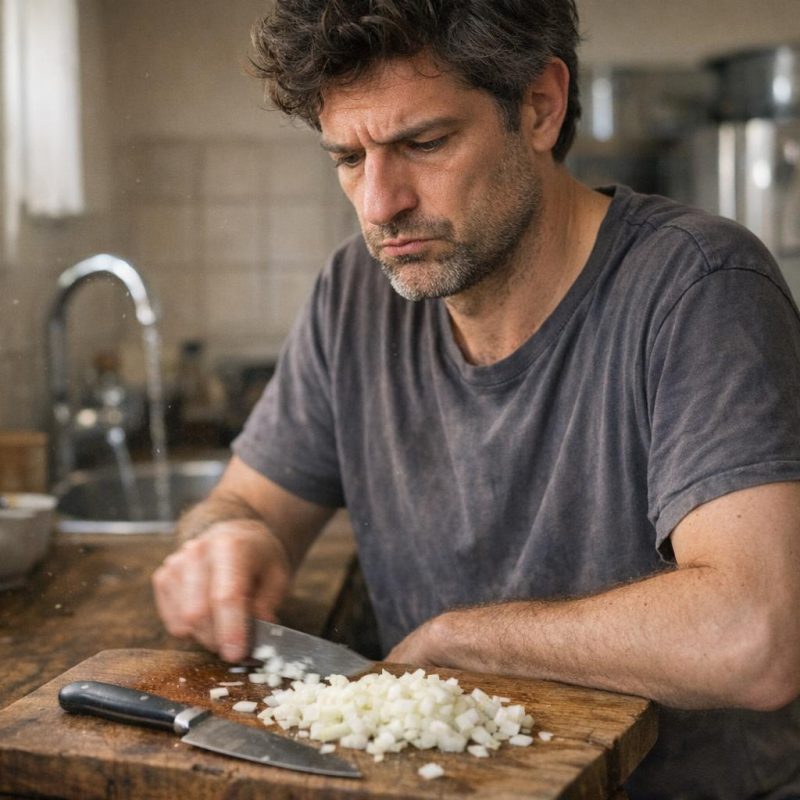 Image by RM AI
The Missed Call
I found the missed call when I got out of the shower—unknown number, no voicemail. Something about it bothered me. Tom usually texted if he needed something, and Rachel always left a message. I stared at the number for a minute, debating whether to call back. Probably a telemarketer. But what if it was Tom calling from a different phone? What if something had happened? I hit the callback button before I could overthink it. It rang three times, then a woman answered. 'Hello?' Her voice was crisp, professional, unfamiliar. I stammered through an explanation that someone had called me from this number. There was a pause. 'Oh,' she said, and I heard something shift in her tone. 'You must be the neighbor. I've been meaning to reach out.' I asked who she was. 'I'm Melissa,' she said. 'Tom's daughter.' I felt a strange jolt of surprise—Tom had mentioned a daughter, but she lived out of state, and he never talked about her much. When I called back, a woman answered—Tom's daughter, though I didn't know it yet.
 Image by RM AI
The Voicemail
The voicemail notification appeared five minutes after we hung up. I must have missed it loading while I was on the call. I pressed play. 'Hi, this is Melissa—Tom's daughter,' her recorded voice said. 'I got your number from my father's phone. I was hoping we could talk about his situation. Nothing urgent, just... I think it would be good for us to connect. Please call me back when you have a chance.' I played it twice, trying to parse the meaning behind her words. His situation? What situation, exactly? That he was grieving? That I was helping him with groceries? Her tone was perfectly polite, the kind of politeness that felt rehearsed and deliberately neutral. But there was something underneath it, something I couldn't quite identify. I saved the message and sat on my couch, staring at my phone. David was at work. I could call Rachel, but I already knew what she'd say. Her tone was polite but cold, and I had no idea what situation she meant.
 Image by RM AI
The Daughter Calls
When Melissa called back that evening, I was ready with questions. She introduced herself properly this time, explained she lived in Portland and tried to check in on Tom regularly. 'I really appreciate what you've been doing for him,' she said. 'He mentioned you've been bringing meals, helping with errands.' I confirmed that yes, I'd been trying to help out where I could. There was a pause, just a beat too long. 'That's very kind of you. I know this has been a difficult time for him.' I waited for her to continue. 'I'm actually going to be visiting next week,' she said. 'I'd love to meet you in person, if you're available. Just to, you know, coordinate care and make sure we're all on the same page.' Coordinate care? He wasn't an invalid. I told her sure, that would be fine. We made tentative plans to meet for coffee. After we hung up, I sat with the phone in my hand, replaying the conversation. She'd thanked me for helping him, but something in her voice felt like an accusation.
 Image by RM AI
The Awkward Dinner
I brought chicken soup that Thursday, Tom's favorite. He opened the door but barely looked at me, mumbled his thanks and took the container from my hands without inviting me in. 'Are you feeling okay?' I asked. He nodded, eyes on the floor. 'Just tired.' I tried to make conversation, asked if he'd heard from Melissa, mentioned that we'd spoken. His expression tightened. 'She told me,' he said curtly. I stood there on his doorstep, uncertain. This was the coldest he'd been since Elaine died. 'Tom, if I've done something wrong—' 'You haven't,' he interrupted. 'I just need some space today.' He stepped back, already closing the door. I nodded and said okay, told him to call if he needed anything. The door shut before I finished speaking. I stood there for a moment, stunned, then turned to walk home. Behind me, I heard the distinct sound of the deadbolt sliding into place—as I left, I heard him lock the door behind me, something he'd never done before.
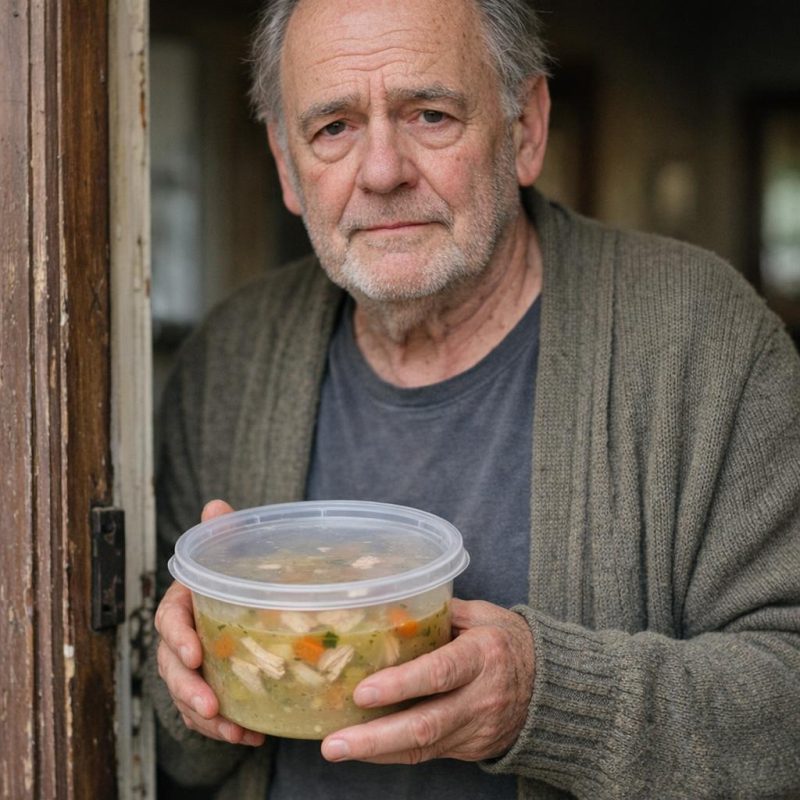 Image by RM AI
The Soup Day
I made his favorite soup again the following Tuesday. Homemade chicken noodle with extra carrots, the way he'd told me Elaine used to make it. I kept telling myself this was just about being a good neighbor, about not giving up on someone who was hurting. The walk to his house felt longer than usual. I rehearsed what I'd say if he tried to turn me away again—something light, reassuring, non-threatening. When I reached his door, I could hear the television on inside. I knocked three times, clear and friendly. Waited. The volume on the TV didn't change. I knocked again, a little louder. 'Tom? It's me. I brought soup.' Nothing. I pressed my ear closer to the door. He was definitely in there—I could hear shuffling, the creak of his recliner. My throat tightened. He was choosing not to answer. I stood there holding that stupid container of soup, feeling the heat seep through the plastic into my palms, and I knocked on the door, heard him inside, and waited—but he never answered.
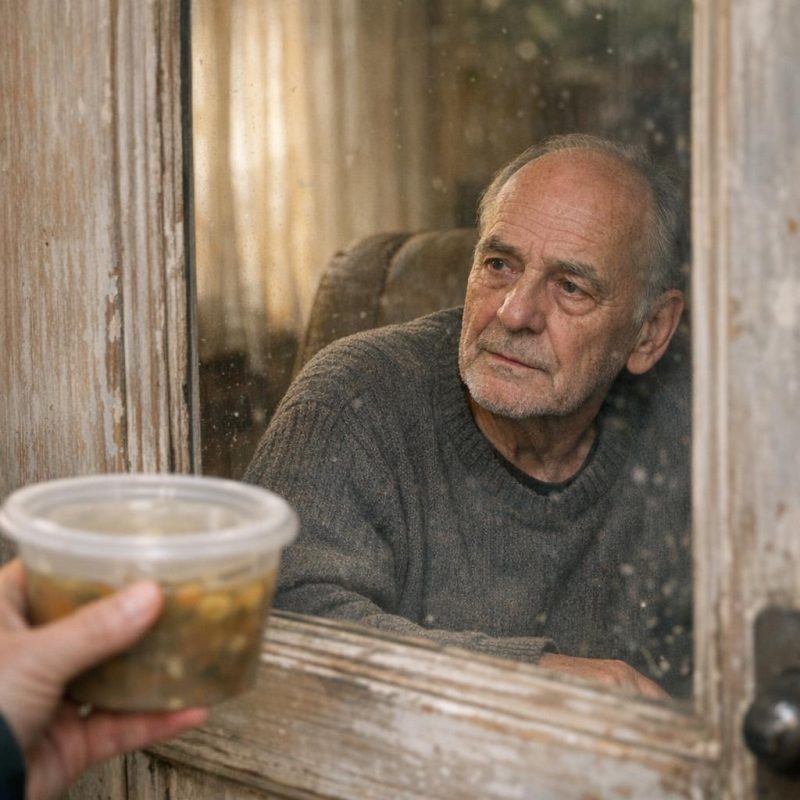 Image by RM AI
The Rejection
I was about to knock a fourth time when his voice came through the door, muffled but clear enough. 'I don't need your help anymore.' Just like that. No explanation, no softness. I froze, my hand still raised. 'Tom, I just—I made soup. Can we talk?' A long pause. I thought maybe he'd open the door, that we could sort this out face to face. Then: 'Please stop coming by.' The words hit like a slap. My eyes stung. I wanted to argue, to ask what I'd done, to defend myself, but my voice wouldn't work. 'I don't understand,' I finally managed. 'I'm just trying to help.' Another silence, longer this time. When he spoke again, his tone was harder. 'I didn't ask for your help. I don't want it.' I heard him walk away from the door, his footsteps fading back into the house. I stood there stupidly, still holding the soup, trying to process what had just happened. His voice was sharp, almost angry, and I couldn't understand what I'd done wrong.
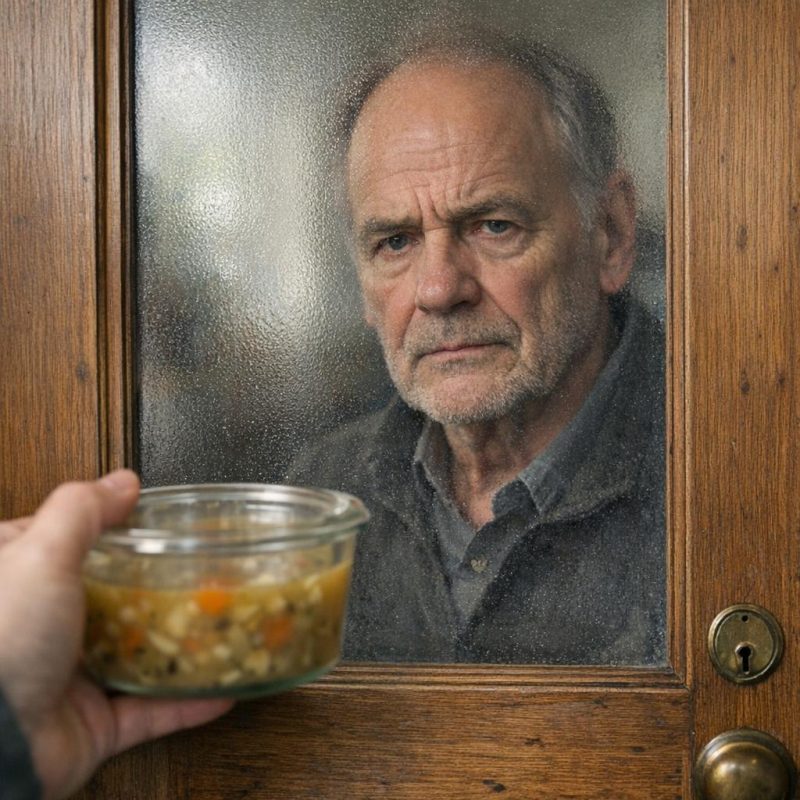 Image by RM AI
Susan's Theory
Susan found me on my front porch twenty minutes later, sitting on the steps with that container of soup beside me. 'Everything okay?' she asked, and I guess my face gave me away because she sat down without waiting for an answer. I told her what happened. She listened, nodding occasionally, and when I finished she patted my knee in that maternal way of hers. 'Oh honey, he's probably just embarrassed,' she said. 'Some people, especially men of that generation, they don't like feeling dependent. You've done so much for him—maybe he feels like he's imposing.' I wanted to believe her. It made sense on the surface. Tom had always been proud, self-sufficient. But I shook my head. 'Then why not just say that? Why be so cold?' Susan shrugged. 'Pride makes people do strange things. Give him time.' I thanked her, tried to smile, but as she walked away I couldn't shake the feeling she was wrong. Embarrassment didn't explain the anger in his voice—or the way he'd looked at me before.
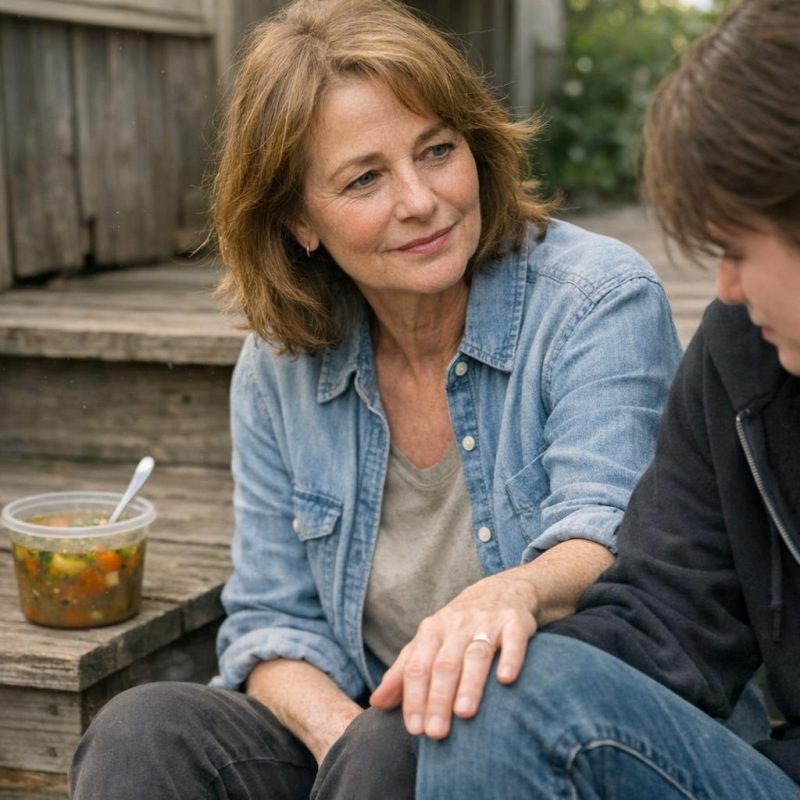 Image by RM AI
Sleepless Night
I didn't sleep that night. I lay in bed replaying every conversation, every visit, every meal I'd brought over. Had I been too pushy? Too familiar? I thought about the way I'd rearranged his kitchen, how I'd suggested he join that grief support group, the time I'd mentioned Elaine should have planted tulips instead of roses. God, had I overstepped without realizing it? At two in the morning, I was convinced I'd somehow insulted Elaine's memory. By three, I decided I'd been too informal, treating him like a friend instead of respecting his space. At four, I wondered if maybe Susan was right and this was just about masculine pride. I ran through our interactions like footage on a loop, scrutinizing my tone, my words, my intentions. Nothing made sense. Every kindness now felt suspect under this new, harsh light. The digital clock glowed accusingly in the darkness. My mind wouldn't quiet. By morning, I still had no answers—only more questions.
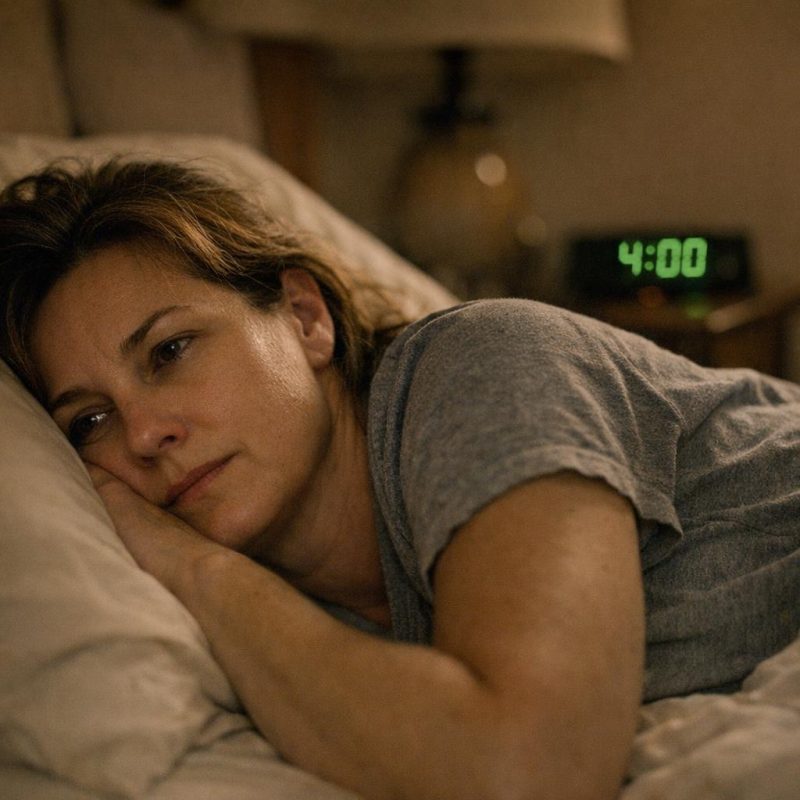 Image by RM AI
Melissa's Call
Melissa called that Friday afternoon. I almost didn't answer—seeing her name on my phone made my stomach clench—but curiosity won out. 'Hi,' she said, and her voice sounded careful, measured. 'I know things have been weird with my dad.' That was an understatement. I waited. 'I want to explain what's going on,' she continued. 'I've talked to him, and I think I understand what happened. But this isn't really a phone conversation.' My heart started hammering. Finally, someone was going to tell me what the hell I'd done wrong. 'Okay,' I said. 'When?' 'Are you free tomorrow? There's a coffee shop on Maple Street, near the bookstore. Would eleven work?' I said yes before I could overthink it. We confirmed the details and hung up. I spent the rest of the day oscillating between relief and dread. At least I'd get answers. At least someone was willing to talk to me. She asked if we could meet in person, and I felt my pulse quicken.
 Image by RM AI
The Coffee Shop
The coffee shop was busy for a Saturday morning, filled with the hiss of espresso machines and low conversation. I spotted Melissa at a corner table, already halfway through what looked like a latte. She waved me over, gestured for me to sit. I ordered a coffee I didn't really want and joined her. 'Thanks for meeting me,' she said. She looked tired, older than she had during our first call. 'I owe you an apology—well, my dad does, but he's not in a place to give it right now.' I nodded, waiting. 'He's been through so much,' she continued. 'Losing Mom broke something in him. And I think—' She paused, choosing her words carefully. 'I think he's confused your kindness with something else.' My coffee arrived. I wrapped my hands around the cup. 'What do you mean?' Melissa looked at me directly, sympathy in her eyes. 'He's interpreting your help as something more than neighborly concern.' Then she said the words that changed everything: 'He thinks you're trying to replace my mom.'
 Image by RM AI
The Explanation
I must have looked shocked because Melissa quickly continued. 'I know you're not. Of course you're not. But Dad sees you cooking his meals, organizing his house, spending time with him—and in his grief, he's twisted it into something threatening.' Her words tumbled out faster now, apologetic. 'He thinks you're positioning yourself to step into Mom's life. Into her role.' I felt my face flush hot. 'That's insane. I was just being nice. Being a neighbor.' 'I know,' Melissa said gently. 'But grief isn't rational. He's seeing patterns that aren't there, connections that don't exist. In his mind, you're moving in on territory that still belongs to Mom.' I shook my head, trying to process this. 'I would never—Elaine was wonderful. I'm not trying to replace anyone.' 'I know that,' Melissa repeated. She reached across the table like she might touch my hand but didn't. 'And honestly? I think deep down he knows it too. But right now he's not thinking clearly.' I told her I would never do that, and she said, 'I know—but he doesn't.'
 Image by RM AI
Processing
I drove home in a daze, Melissa's words echoing in my head. Replace Elaine. The idea was absurd, offensive even. I'd barely known the woman. Yes, I'd been kind to Tom, but that's what people do for grieving neighbors—they help. They bring food. They check in. How had that become something sinister in his mind? I tried to put myself in his position, imagining loss so profound it distorted reality. Maybe Melissa was right. Maybe grief had warped his perception so badly he couldn't see kindness for what it was. It made a certain sad sense. And yet. I kept circling back to moments that didn't quite fit. The way he'd warmed up to me initially, almost eagerly. How he'd specifically asked for certain meals, requested my company. The sudden coldness after talking to Melissa that first time. Something about the timeline felt off, though I couldn't articulate what. I told myself I was overthinking it, that Melissa had given me the answer I needed. But the more I thought about it, the more something felt off about Melissa's explanation.
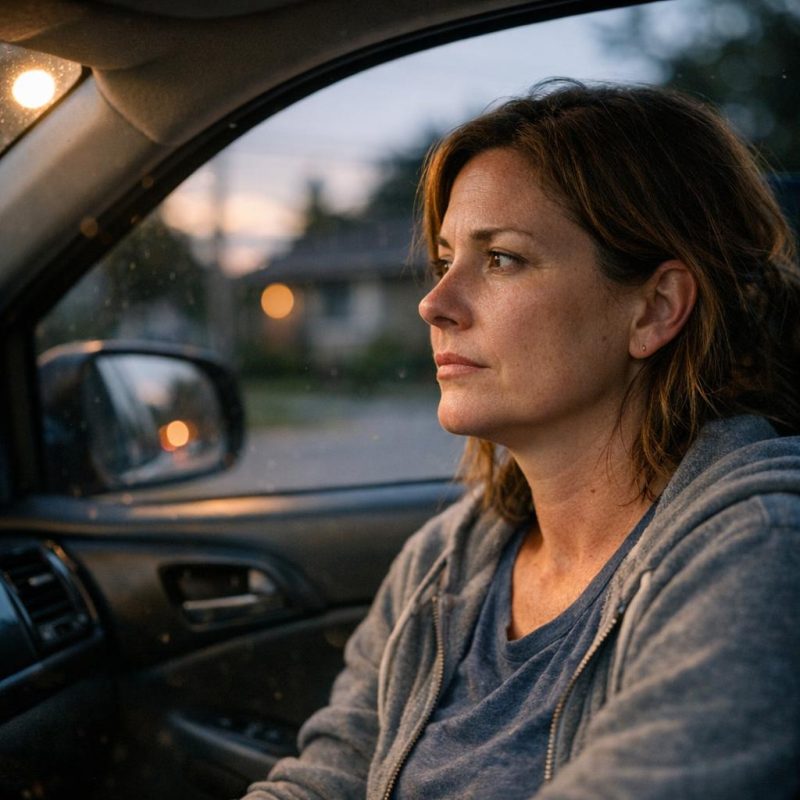 Image by RM AI
Giving Space
So I stopped. Just like that, cold turkey. No more casseroles left on his doorstep, no more knocking to check in, no more texts asking if he needed anything from the store. I figured Melissa was right—I'd overstepped without realizing it, and the kindest thing I could do now was give Tom the space he clearly wanted. It felt wrong, though. Like abandoning someone drowning because they told you they didn't need a life preserver. But what else could I do? He'd made his position clear through Melissa. I was making him uncomfortable, projecting something onto our interactions that wasn't there. The rational part of my brain accepted this. The rest of me felt like I'd failed somehow. Days turned into a week, then two. I found myself standing at my kitchen window more often than I'd like to admit, looking across at his house. The lights went on and off at irregular hours. Sometimes the curtains stayed drawn all day. I'd see his car in the driveway but no sign of him. Watching his dark house from my window, I wondered if I'd made things worse by caring too much.
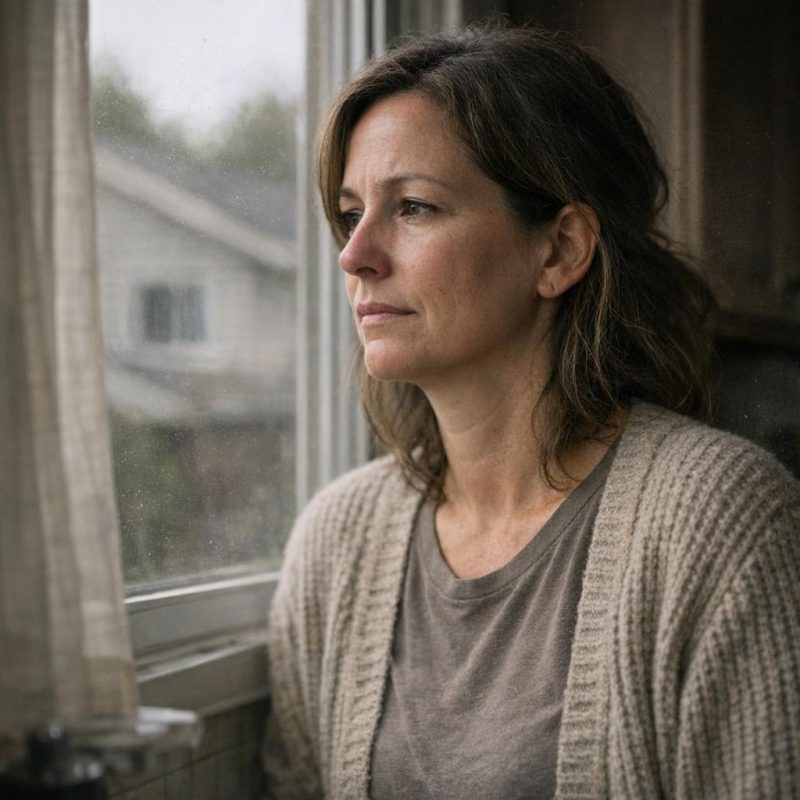 Image by RM AI
The Brief Nod
Three weeks after I'd stopped checking in, I finally saw Tom outside. I was getting my mail when he emerged from his front door, moving slowly toward his own mailbox. He looked different. Thinner, definitely. His clothes hung on him like they belonged to someone else, someone who'd taken up more space in the world. His shoulders had this defeated slump I hadn't noticed before. For a second, I froze with a catalog in my hand, unsure what to do. Making eye contact felt like it might violate the invisible boundary Melissa had drawn. But ignoring him completely seemed cruel. So I gave him a small nod, the kind you'd give a stranger. He returned it—just barely, this tiny acknowledgment that we existed in the same neighborhood, nothing more. Then he grabbed his mail and shuffled back inside. The whole interaction lasted maybe ten seconds. But God, it hit me hard. He looked thinner, sadder, and I wanted to help—but I didn't know if I still could.
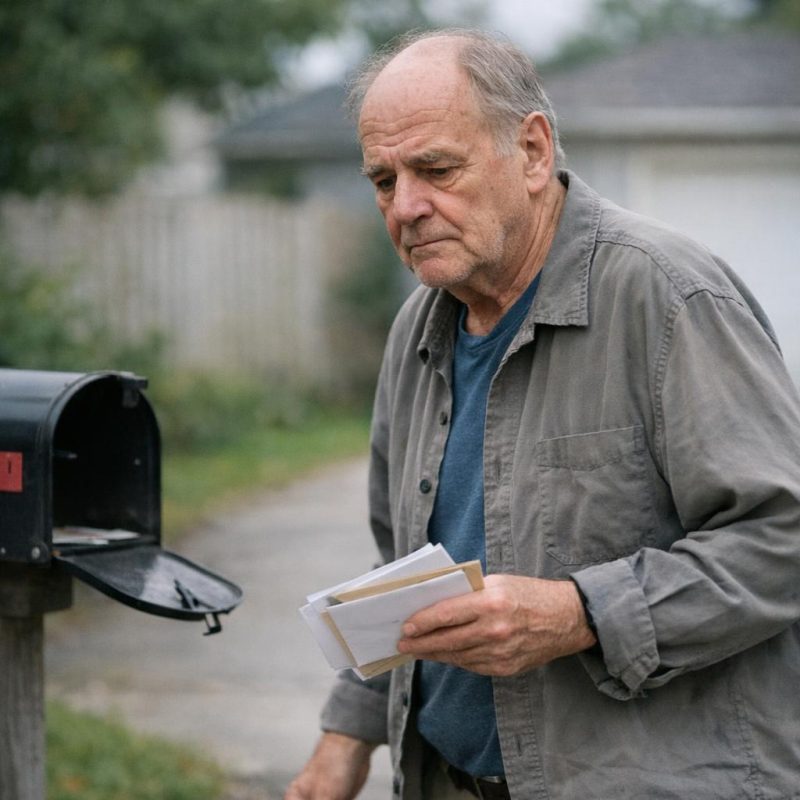 Image by RM AI
Rachel's Suspicion
I told Rachel about it over coffee at her place. She'd been asking how things were going with my neighbor, and I'd avoided the topic until now. But seeing Tom like that—it had shaken something loose in me. Rachel listened to the whole story: the meals, the conversations, Melissa's visit, the grief explanation, my decision to back off. When I finished, she was quiet for a moment, stirring her coffee in slow circles. 'You know,' she finally said, 'Melissa's explanation is convenient.' I asked what she meant by that. 'I mean, maybe Tom did feel uncomfortable. Or maybe Melissa had her own reasons for wanting you gone.' The idea hadn't really occurred to me in those terms. I'd been so focused on respecting Tom's boundaries that I hadn't questioned whether Melissa was accurately representing his wishes. Rachel leaned forward. 'I'm just saying—grief doesn't usually make people completely ice out someone who's genuinely helping. Unless someone's telling them a different story about what's really happening.' When I asked what she meant, Rachel said, 'Daughters can be protective—or possessive.'
 Image by RM AI
The Research
Rachel's words stuck with me for days. I felt ridiculous at first, like I was turning into one of those conspiracy theorists who sees hidden agendas everywhere. But curiosity is a funny thing—once it takes root, it grows. So one evening, after David went to bed early, I opened my laptop and typed Melissa's full name into Google. I wasn't even sure what I was looking for. Professional information, I guess. Just... something to either confirm or dispel Rachel's insinuation. The first few results were pretty mundane. LinkedIn profile showing she was a financial advisor with a local firm. A few mentions in community event photos. Business listings. Nothing unusual. Then I scrolled to the second page of results, which honestly, who ever goes there? That's where things got interesting. Articles from about two years ago, back when she worked for a different company. Community newsletter pieces. And then—buried on page three—a headline from a local business journal. One headline caught my eye: 'Local Financial Advisor Faces Client Complaint.'
 Image by RM AI
The Complaint
My heart started beating faster as I clicked the link. The article was brief, maybe three paragraphs. It explained that a complaint had been filed with the state regulatory board against Melissa regarding her handling of an elderly client's estate. The details were vague—privacy laws, apparently—but it mentioned concerns about 'undue influence' and 'questionable transactions' following a spouse's death. The complaint had ultimately been dismissed due to insufficient evidence, the article noted. Melissa had declined to comment beyond saying the allegations were 'baseless and hurtful.' Reading it, I felt this sick tightening in my chest. An elderly client. After a spouse's death. The language about undue influence. I told myself I was making connections that weren't there, seeing patterns in random noise. Plenty of people face complaints in financial services that turn out to be nothing. The fact that it was dismissed meant something, right? But I kept rereading those three paragraphs, and each time, they felt heavier. The client's name wasn't public, but the circumstances sounded eerily familiar.
 Image by RM AI
David's Warning
I probably should have kept this discovery to myself, but I've never been good at that. The next morning over breakfast, I told David what I'd found. I expected him to be at least a little concerned, maybe validate that it was weird. Instead, he looked annoyed. 'So you're internet-stalking your neighbor's daughter now?' he said. 'That's not what this is,' I protested. 'I just wanted to understand—' 'Understand what? She told you what happened. Tom wanted space. You're looking for a different answer because you don't like the one you got.' That stung because maybe he was partially right. But also, he wasn't seeing what I was seeing. I tried to explain about the complaint, the similarities, but David cut me off. 'A dismissed complaint from two years ago? That's what you're basing this on?' He shook his head. 'This isn't your business. You barely know these people. Let it go.' He left for work before I could respond. But I couldn't shake the feeling that Tom was in trouble—and Melissa was the reason.
 Image by RM AI
The Second Meeting
Two days later, Melissa called me. I saw her name on my phone screen and almost didn't answer. But curiosity—and okay, strategy—won out. She opened with pleasantries, asking how I'd been, hoping she hadn't upset me during our last conversation. 'Not at all,' I lied. 'I understand completely. I'm glad you told me.' There was this pause, just a beat too long, before she continued. 'I just wanted to follow up, make sure there were no hard feelings. And to see if Dad had... reached out to you at all?' The question felt loaded. Why would she need to know that? 'No,' I said. 'I've been giving him space like you suggested. I saw him getting his mail once, but we didn't talk.' 'Oh good,' she said, and I swear there was relief in her voice. 'That's good. I think the distance is really helping him process everything without, you know, confusion.' The word 'confusion' hung there like an accusation. Her concern felt rehearsed, and I started to wonder if she was checking to see what I knew.
 Image by RM AI
Tom's Mail
The next afternoon, I noticed Tom's mailbox was overflowing. Like, truly stuffed, with envelopes and catalogs jutting out at angles. It had been that way for at least two days—I'd seen it yesterday but told myself it wasn't my problem. But today it was worse, and some mail had fallen onto the ground beneath the box. The compulsive part of my brain that can't stand disorder kept nagging at me. What if there was something important in there? What if he just hadn't felt up to checking it? I walked over, telling myself I'd just straighten it up, maybe put the fallen pieces back inside. As I picked up the scattered envelopes from the ground—grocery store ads, credit card offers, a utility bill—I saw something that made me freeze. Sandwiched between two catalogs was a large manila envelope. Law office return address in the corner, one of those downtown firms with three surnames. And below that, marked clearly: 'Forwarded by Melissa Greene.' Among the junk mail, I saw an envelope from a lawyer's office—and Melissa's return address.
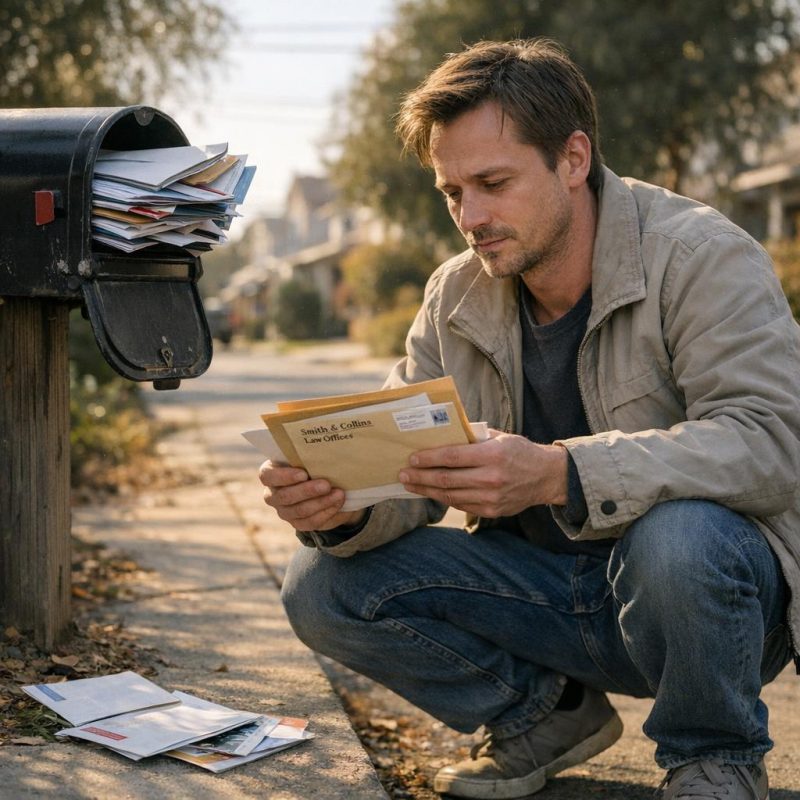 Image by RM AI
The Lawyer
I called the law office the next morning, heart pounding as I rehearsed my script. When the receptionist answered, I tried to sound casual—just a concerned neighbor checking in. 'I'm calling about Tom Henderson,' I said. 'I noticed he received something from your office, and I wanted to make sure everything was okay.' There was a pause. 'Are you family?' she asked. 'No, I'm a neighbor. I've been helping him since his wife passed.' Another pause, longer this time. I could hear typing in the background. 'I'm sorry, but I can't discuss client matters with non-family members.' My chest tightened. 'I understand, but I'm worried about him. Can you at least tell me if—' 'Ma'am,' she interrupted, her tone shifting to something more formal, 'if you're calling about Mr. Henderson, his daughter is handling everything.' The way she said it—like Melissa had already established herself as the gatekeeper, the only point of contact—made my stomach drop. I'd hit a brick wall, and Melissa had built it.
 Image by RM AI
Kyle Arrives
Two days later, I was pulling weeds in my front garden when a rental car parked in Tom's driveway. A guy in his late twenties got out—tall, thin, with Tom's same sandy hair but darker circles under his eyes. He looked exhausted, like he'd driven straight through the night. I stood up, brushing dirt from my knees, and walked over. 'Hi,' I said, extending my hand. 'I'm Tom's neighbor. You must be Kyle?' He nodded, shaking my hand briefly. 'Yeah. Just got in from Portland.' His voice was flat, guarded. I smiled, trying to seem friendly. 'Your dad's lucky to have you here. I've been helping him out a bit since your mom passed—bringing meals, that kind of thing.' That's when his expression changed. His jaw tightened, and something cold flickered across his face. 'Right,' he said slowly. 'My sister mentioned you.' My smile faltered. The way he said it—like Melissa had given him a warning, not an introduction—sent alarm bells ringing. When I mentioned helping his father, Kyle's face darkened: 'My sister said you've been a problem.'
 Image by RM AI
The Accusation
I blinked, certain I'd misheard. 'I'm sorry, what?' Kyle crossed his arms, his posture defensive. 'Melissa told me you've been... I don't know how to put this... She said you've developed some kind of inappropriate attachment to our dad.' The words hit me like a slap. 'Inappropriate attachment?' My voice came out higher than I intended. 'I brought him casseroles. I helped him with his mail. That's it.' Kyle looked uncomfortable but didn't back down. 'She said you've been coming over constantly, that Dad's confused, that you're taking advantage of his grief.' I felt my face flush hot with anger and humiliation. 'That's not—that's completely—' I couldn't even form a complete sentence. 'Look,' Kyle said, his tone softening slightly but staying firm, 'I don't know you. I don't know what's going on. But my sister's been dealing with Dad's affairs, and she's worried. So I'm asking you—' He paused, meeting my eyes. 'Please stay away from my family.' I stood there speechless as he asked me to stay away from his family.
 Image by RM AI
Susan's Information
I was still reeling when Susan appeared at my door that evening with a bottle of wine and a knowing look. 'I saw the son arrived,' she said, letting herself in. 'How'd that go?' I told her everything—the accusations, the 'inappropriate attachment,' Kyle's cold dismissal. Susan listened, her expression darkening. 'I heard something yesterday,' she said finally, pouring us each a glass. 'I was out front when Melissa was on her phone in Tom's driveway. I wasn't trying to eavesdrop, but she was talking loud.' Susan leaned forward. 'She was discussing the house. Not Tom's health, not his grief—the property value. She was asking someone about comparable sales in the neighborhood.' My breath caught. 'You're sure?' 'Positive,' Susan said. 'She said something like, 'We need to move quickly while the market's still hot.' Then she laughed—actually laughed—and said something about 'finally getting something out of this whole mess.'' Susan shook her head, disgusted. She said Melissa sounded more interested in the house than in her father's wellbeing.
 Image by RM AI
The Property Records
I couldn't sleep that night. Susan's words kept replaying in my head—'move quickly,' 'property value,' 'getting something out of this.' By four a.m., I was at my laptop, pulling up the county assessor's website. Public records are just that—public. Anyone can look them up. I typed in Tom's address and waited for the page to load. The property record came up: purchased in 1989, assessed value, tax history. Normal stuff. Then I clicked on the deed history tab. My heart started pounding. There, dated just five weeks ago, was a quit-claim deed. Tom had added Melissa Greene to the title as a joint owner with right of survivorship. The date of the change was three weeks after Elaine died—right when I started helping Tom. I stared at that date, my mind racing. Three weeks after his wife's funeral. When he was barely functional, when he couldn't remember to eat, when he'd spent entire days sitting in his dark living room staring at nothing. That's when Melissa had him sign over half his house.
 Image by RM AI
The Timeline
I grabbed a notebook and started writing everything down—dates, events, Melissa's visits. When I laid it out chronologically, a pattern emerged that made my skin crawl. Elaine died on March 12th. I brought Tom his first meal on March 15th. The property deed was changed on April 2nd. Melissa's first hostile visit to me was April 8th—right after I'd started coming by regularly. Then the accusation about the earrings, the confrontation at Tom's door, her sudden increased presence at the house. Every single escalation happened after I'd gotten closer to Tom. It was like watching a predator circle its prey, getting more aggressive whenever another animal approached. But here's what frustrated me—I could see the pattern, but I couldn't prove intent. Maybe Melissa was genuinely worried about her dad. Maybe the property transfer was innocent estate planning. Maybe her hostility toward me was protective, not possessive. Every time I got close to Tom, Melissa pushed harder—but I couldn't prove why.
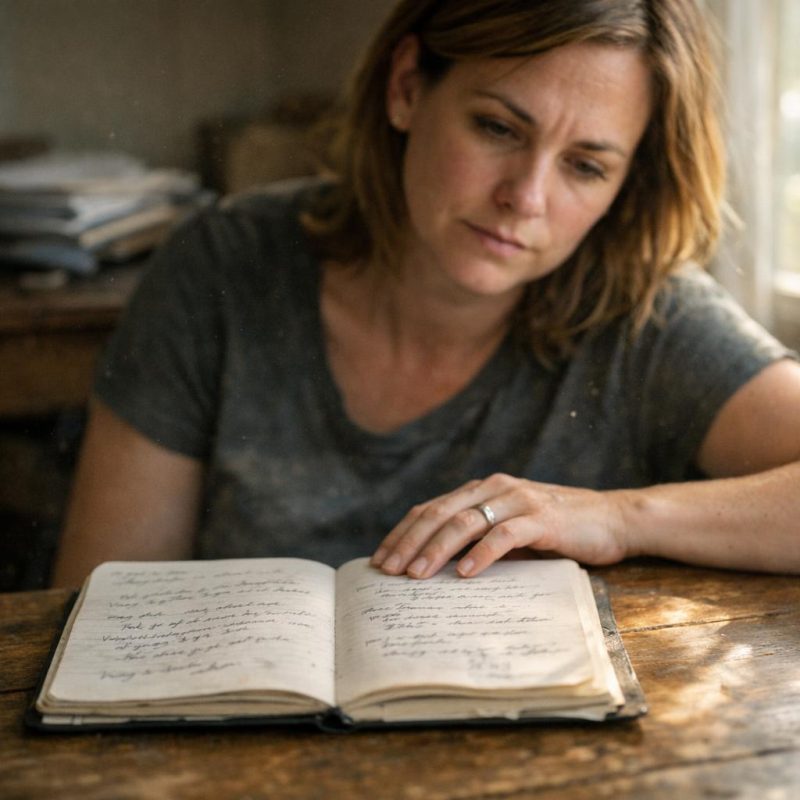 Image by RM AI
Rachel's Friend
Rachel called that afternoon, and I unloaded everything. The timeline, the property transfer, Kyle's accusations. 'Okay,' she said when I finished. 'This is beyond neighborhood drama. I have a friend who works in elder care advocacy—like, she deals with this stuff professionally. Want me to connect you?' Twenty minutes later, I was on the phone with a woman named Diane who listened without interrupting as I walked through the whole story. When I finished, there was a long silence. 'Can I ask you something?' Diane said finally. 'Since Melissa became more involved, has Tom seen other people less? Old friends, other family, even you?' I thought about it. 'Yeah. He barely leaves the house now. He used to go to his men's group at church, but I haven't seen him go in weeks.' 'And when you do see him, is Melissa usually there?' 'Almost always,' I said. Another pause. Then Diane spoke again, and her tone made my blood run cold. The advocate listened to my story and said one word that made my blood run cold: 'Isolation.'
 Image by RM AI
The Power of Attorney
Diane explained it to me like she was teaching a class. 'Financial exploitation of the elderly almost always starts with control—legal control. That usually means getting power of attorney during a vulnerable period. A death, an illness, a moment when someone's defenses are down.' My hand was shaking as I held the phone. 'And you can just... get someone to sign that? Even if they're grieving?' 'If someone's competent—legally competent—they can sign whatever they want,' Diane said. 'Grieving doesn't make you incompetent. Depression doesn't either. So yes, someone in Tom's state could absolutely sign a power of attorney, or change a deed, or make financial decisions they might not make under other circumstances.' 'But that's—' 'Predatory? Yes.' Her voice was matter-of-fact. 'It happens all the time. Adult children, caregivers, even neighbors sometimes. They move in during a crisis, isolate the person, and gain control.' I asked if someone could manipulate a grieving person into signing one, and she said, 'It happens more than you'd think.'
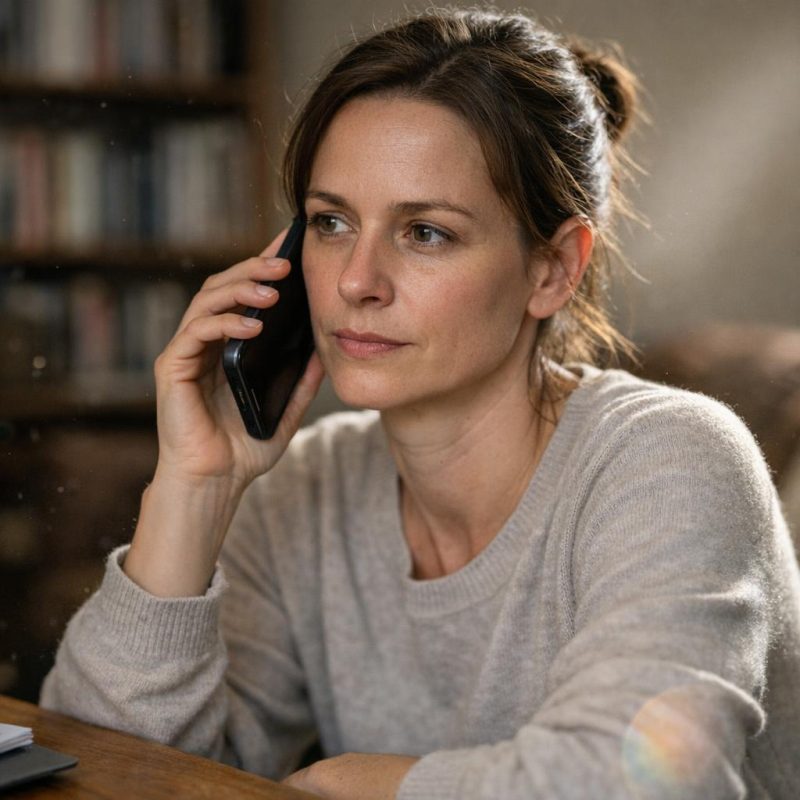 Image by RM AI
The Confrontation Plan
David didn't want me to do it. We were in the kitchen when I told him I was going to confront Melissa directly, and he actually put down his coffee mug harder than necessary. 'What exactly do you think that's going to accomplish?' he asked. I told him I needed to hear it from her—needed to look her in the eye and ask her about the power of attorney, the property changes, all of it. He shook his head, said I was walking into a situation where I had no leverage and she had every reason to lie. But here's what he didn't understand: I couldn't just sit with what Diane had told me. I couldn't keep researching and speculating from a distance while Tom was potentially being manipulated right across the street. David said if I accused her of anything without proof, she could turn it around on me, make me look like the unstable one. He wasn't wrong. But I'd already made up my mind. I had suspicions, fragments of evidence, and a sick feeling in my stomach—but I needed the truth.
 Image by RM AI
The Call
I called Melissa the next morning, trying to keep my voice as neutral as possible. My hands were shaking as I dialed, and I'd rehearsed what I was going to say at least a dozen times. When she picked up, I told her I'd been thinking about our last conversation and wondered if we could meet again—just to clear the air, I said. There was a pause on the other end that felt like it lasted forever. Then she said, 'Of course. I think that's a really good idea.' Her tone was warm, almost relieved, like she'd been hoping I'd reach out. We arranged to meet at the same coffee shop the next afternoon. She suggested the time, the place, everything. When I hung up, I sat there staring at my phone for a long moment. The whole conversation had been too easy. She hadn't asked why I wanted to meet or what I wanted to talk about. Melissa agreed too quickly, and I realized she thought she'd already won.
 Image by RM AI
Preparing Evidence
I spent the rest of that day pulling together everything I'd learned. I printed out the property records showing the deed transfer. I made a timeline of when Margaret died, when I'd started helping Tom, when Melissa suddenly reappeared, and when the harassment complaint was filed. I wrote down every detail Diane had shared about financial exploitation patterns. Looking at it all spread across my dining room table, the narrative seemed pretty clear: Melissa had waited for her mother to die, moved in during Tom's most vulnerable period, isolated him from anyone who might interfere, and gained control of his assets. On paper, it looked damning. But I kept thinking about what David had said—that Melissa could just deny everything, turn it back on me. What was I actually going to do with this information? Confront her and hope she confessed? Show her the documents and watch her explain them away? I didn't have smoking-gun proof of manipulation, just a pattern that suggested it. It looked damning on paper, but I wondered if it would be enough to break through Melissa's narrative.
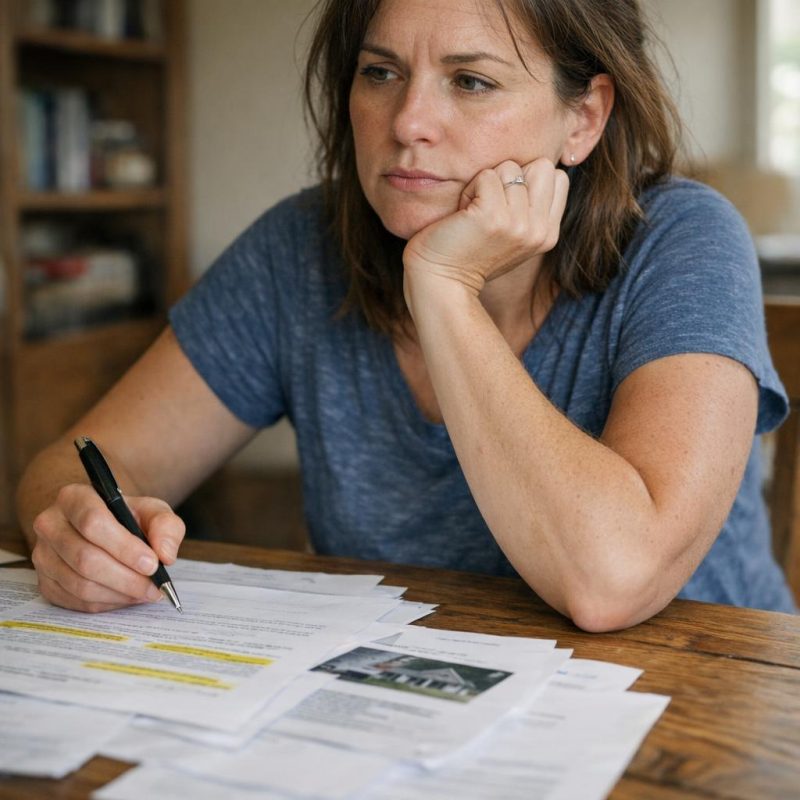 Image by RM AI
The Second Coffee Shop
The coffee shop looked exactly the same as it had the first time. Same exposed brick, same hum of the espresso machine, same smell of burnt coffee and vanilla syrup. I got there early and chose a table near the window, then immediately second-guessed the choice and moved to one in the back corner. When Melissa walked in, I felt my whole body tense. She spotted me right away and smiled—actually smiled—like we were meeting up for a friendly catch-up session. She was wearing a navy blazer and carrying the same leather bag from before. She went to the counter, ordered something I couldn't hear, then came over and sat down across from me. 'It's good to see you again,' she said, settling into her chair like she had all the time in the world. I noticed she'd chosen the same seat she'd sat in last time, positioned so she could see the whole room. Melissa ordered the same drink, sat in the same seat, and smiled like we were old friends.
 Image by RM AI
The Questions
I didn't waste time with small talk this time. I asked her directly about the power of attorney—when Tom had signed it, why he'd needed one so suddenly after Margaret's death. Melissa's smile stayed perfectly in place as she said it was a standard precaution, something any responsible child would help their parent establish. So I asked about the property deed changes. She explained that Tom had wanted to simplify his estate planning, make sure everything was organized for the future. Her answers were smooth, practiced, delivered with just the right amount of patient concern. I pushed harder. Asked why she'd filed a harassment complaint against me when all I'd done was help her father with groceries and yard work. She tilted her head slightly, said she understood why I was confused, but that she'd only been trying to establish appropriate boundaries. 'Dad was becoming too dependent on you,' she said. 'It wasn't healthy for him.' Every question I asked, she had an answer for. Every concern I raised, she reframed as a misunderstanding. Melissa's smile never wavered as she said, 'I'm just protecting my father from people who might take advantage.'
 Image by RM AI
The Turn
That's when I stopped trying to be subtle. I looked her straight in the eye and said, 'You isolated him. You waited until he was grieving and vulnerable, you cut him off from anyone who cared about him, and you did it so you could control his finances.' The words came out harder than I'd intended, louder. A woman at the next table glanced over. Melissa's expression didn't change right away—her smile stayed frozen for just a beat too long. Then it faded. Not into anger or defensiveness like I'd expected. Into something else entirely. Her eyes went flat and cold, and when she spoke again, her voice had lost all its warmth. 'That's a serious accusation,' she said quietly. 'And you have absolutely no proof of any of it.' She leaned back in her chair, studying me like I was a problem she was calculating how to solve. The shift was so complete it actually made my breath catch. For the first time, I saw something cold and calculating behind her eyes.
 Image by RM AI
The Threat
Melissa set her coffee cup down very deliberately. 'I've tried to be understanding,' she said, her voice low and controlled. 'I've tried to explain the situation to you clearly and respectfully. But if you continue to interfere with my father's care, if you continue to spread these accusations, I will have no choice but to pursue legal action for harassment and defamation.' She let that hang in the air between us. My heart was pounding so hard I could hear it in my ears. She gathered her bag and stood up, buttoning her blazer with precise movements. I wanted to say something, anything, but my throat felt tight. As she turned to leave, she paused and looked back at me. What she said next was delivered almost casually, like an afterthought. But I knew it wasn't. As she stood to leave, she said something that made everything click into place: 'You're not the first neighbor who's tried to play hero.'
 Image by RM AI
The Pattern
I went straight home and started searching. If there had been others—other neighbors, other 'heroes'—there would be a pattern. Melissa had said she was a geriatric care manager, so I started there, looking up her business and any reviews or complaints. What I found made my stomach drop. There were three other cases I could piece together from public records and online forums. Three other elderly clients who'd suddenly cut ties with friends and neighbors shortly after Melissa began 'managing their care.' In each case, the client had transferred significant assets or granted power of attorney to Melissa within months of her involvement. In two cases, family members had tried to intervene and been threatened with legal action. One daughter had posted in a caregiver forum about a 'predatory care manager' who'd isolated her father—the details matched Melissa's pattern exactly. Tom wasn't the first person Melissa had manipulated—and the 'grief counseling' explanation wasn't about protecting him; it was about eliminating anyone who might interfere with her access to his assets.
 Image by RM AI
The Previous Victims
I tracked down two of them through the caregiver forum posts and public records. The first was a woman named Janet whose father had been Melissa's client three years ago. When I called, she went silent for a long moment before saying, 'How did you find me?' I explained about Tom, about the pattern I'd discovered, and she let out this bitter laugh. 'She did the exact same thing to my dad,' Janet said. 'Convinced him his neighbors were taking advantage of him, that I was trying to steal his money. By the time I realized what was happening, he'd already signed a power of attorney.' The second person, a man named Robert, had a nearly identical story about his mother. Same isolation tactics, same manufactured paranoia, same financial manipulation. 'We tried to fight it legally,' Robert told me, his voice heavy with defeat. 'But by then, Mom didn't trust any of us anymore. Melissa had become the only person she'd listen to.' I felt sick listening to them, recognizing Tom's situation in every detail they described. Both said the same thing: by the time they realized what was happening, their loved ones had already signed everything away.
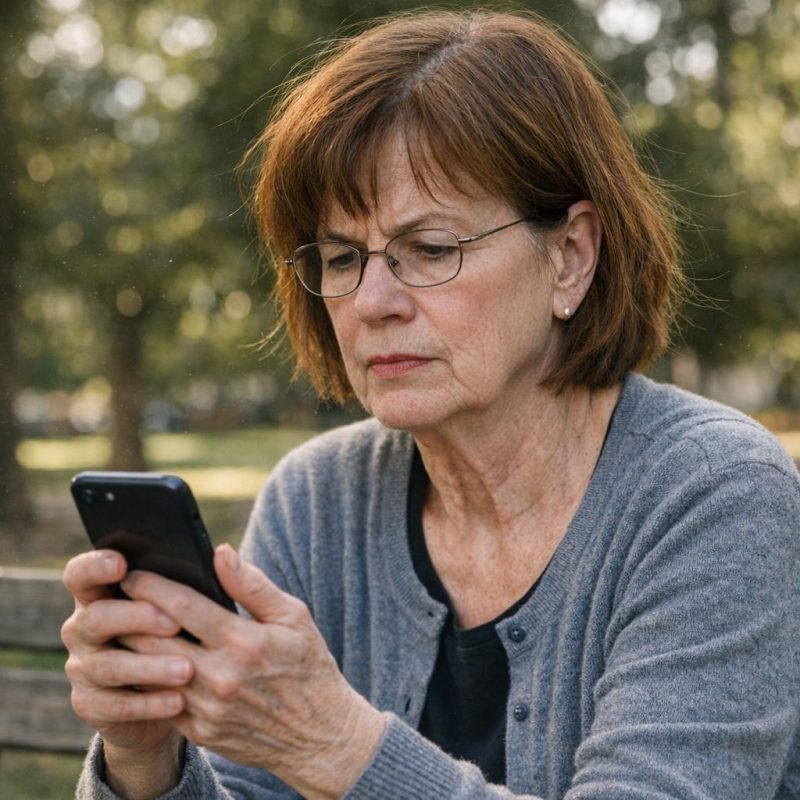 Image by RM AI
The Race Against Time
I hung up the phone with Robert and just sat there, my mind racing. How long had Melissa been working on Tom? Months, at least. What had she already convinced him to sign while I was just trying to bring him casseroles and keep him company? The documents Janet and Robert described—power of attorney, property transfers, beneficiary changes—those things didn't happen overnight. They required planning, manipulation, the slow erosion of trust in everyone except the predator. Tom had stopped talking to me weeks ago. That was weeks Melissa had unfettered access to him, weeks she could have been putting papers in front of him while he was grieving and vulnerable. My hands were shaking as I pulled up my state's legal aid website, trying to understand timelines and what could be reversed. But everything I read made it worse—once someone signs over power of attorney willingly, especially an elderly person whose competence hadn't been questioned, unwinding it was nearly impossible. I had to reach Tom before Melissa realized I knew the truth—but how could I get to him when she'd made sure he'd never trust me again?
 Image by RM AI
Kyle's Doubt
Kyle was my only option. I texted him asking to meet, half-expecting him to ignore me like his father had. But he agreed, meeting me at a coffee shop the next morning looking tired and wary. I'd brought everything—the forum posts, the public records showing Melissa's other clients, the pattern of isolation and financial manipulation. I spread it all on the table between us, watching his face as he read. His expression shifted from defensive to uncertain to something that looked like dread. 'These people,' he said slowly, pointing to Janet's father's name, 'I remember her mentioning him. She said he was difficult, that his daughter was causing problems.' I leaned forward. 'Kyle, does any of this seem familiar with your dad? The isolation? The sudden distrust of people who cared about him?' He looked up at me, and for the first time, I saw real doubt in his eyes. 'There have been some financial things,' he admitted quietly. 'Account transfers I didn't understand. She said it was just better organization, estate planning stuff.' He stared at the documents I'd brought and whispered, 'She told me you'd make up lies.'
 Image by RM AI
The Alliance
The silence between us felt heavy with everything shifting. Kyle ran his hands through his hair, looking suddenly older than his twenty-eight years. 'I wanted to believe her,' he said finally. 'After Mom died, Melissa stepped up. She handled everything. It was easier to just... trust her.' I understood that—grief makes us vulnerable to anyone who offers to carry the weight. 'I'm not trying to destroy your family,' I told him. 'But your dad is in danger. Real danger.' He nodded slowly, then pulled out his phone. 'She's been tracking Dad's finances through some app. She showed it to me once, said it was to monitor for fraud. But if what you're saying is true...' He met my eyes. 'I can get you into the house tomorrow afternoon. She has a client meeting across town, always takes two hours minimum.' Relief flooded through me so intense I nearly cried. 'Thank you,' I whispered. Kyle's jaw tightened with determination. 'If she's really doing this, if she's using Dad like those other people—' He didn't finish, but I understood. Together, we made a plan—but we had to move before Melissa realized Kyle was turning against her.
 Image by RM AI
The Visit
Kyle let us in through the back door while Tom was in the living room. I heard the television playing, some news program Tom used to watch when I'd visit. My heart was pounding as we walked in, and when Tom looked up and saw me, his whole body went rigid. 'What is she doing here?' he demanded, looking at Kyle with betrayal in his eyes. 'Kyle, I told you—Melissa said—' His voice was shaking, and I could see him trying to stand, to either confront us or flee, I couldn't tell which. 'Dad, just listen,' Kyle said, moving to his father's side. 'Please. Just five minutes.' But Tom was staring at me with this mixture of anger and something else—something that looked like shame. 'You need to leave,' he said, but his voice cracked. 'Melissa explained what you were trying to do. Taking advantage of a grieving old man. I should have seen it myself.' The words hit me like a slap, but worse was seeing how much he believed them, how thoroughly Melissa had poisoned his perception of me. Tom looked at me with a mixture of anger and shame, and I realized Melissa had convinced him I was dangerous.
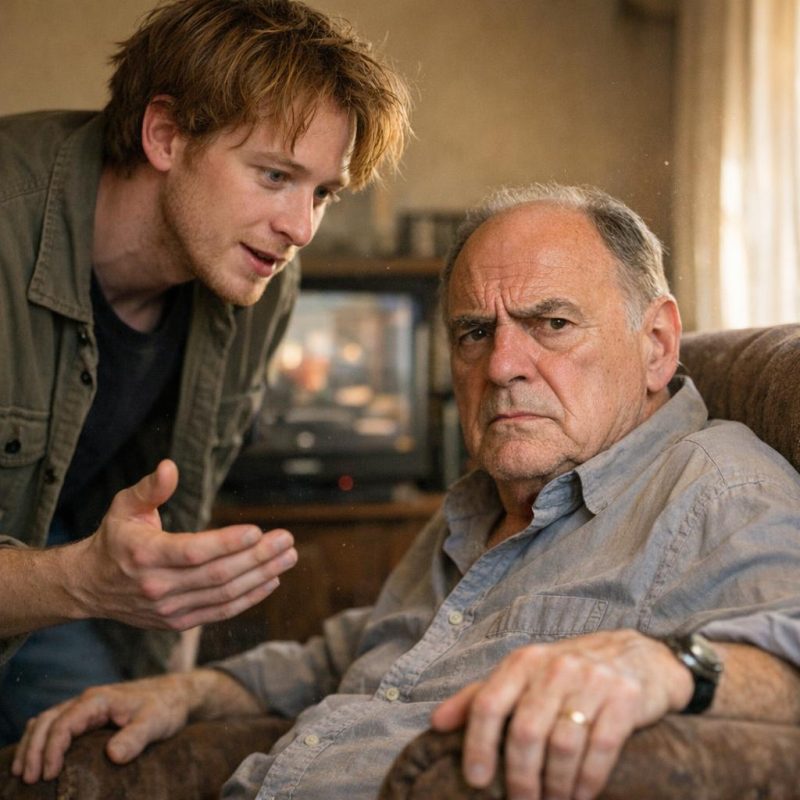 Image by RM AI
Breaking Through
I pulled out the documents slowly, non-threateningly, like you'd approach a wounded animal. 'Tom, I'm not here to hurt you. I'm here because I found something you need to see.' Kyle took the papers from me and handed them to his father, a gesture of trust that seemed to matter. Tom looked at them reluctantly, but he looked. I watched his face as he read about Janet's father, about Robert's mother, about the pattern of isolation and financial exploitation. 'These people,' I said quietly, 'they all had the same thing happen. A care manager who convinced them their friends and family were threats. Who isolated them. Who got them to sign over their assets.' Tom's hands started shaking. 'Melissa wouldn't—she's my daughter.' But his voice had no conviction. Kyle sat beside him. 'Dad, when's the last time you talked to anyone besides me and Melissa? What about your poker group? Your church friends?' Tom opened his mouth, then closed it. I could see him trying to remember, trying to understand when his world had shrunk so small. His hands shook as he held the papers, and he asked the question I'd been dreading: 'What has she already made me sign?'
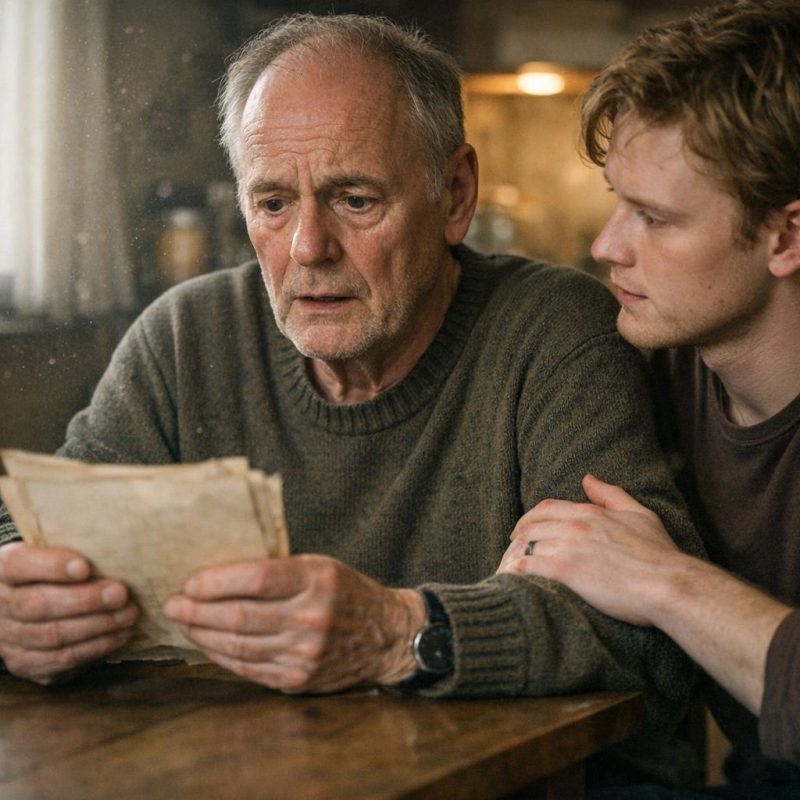 Image by RM AI
The Documents
Tom stood up slowly and walked to his study, Kyle and I following. He pulled out a filing cabinet and retrieved a folder, his movements mechanical, like he was in shock. Inside were documents—so many documents. Power of attorney forms. Beneficiary change notifications. Property transfer agreements. Kyle spread them across the dining table, his face getting paler with each page. 'Dad, this one transferred the house to her name,' he said, his voice barely above a whisper. 'This one gives her complete control of your accounts.' Tom sank into a chair, looking decades older than he had minutes ago. I scanned the documents, trying to understand the full scope, when I noticed something in one of the property transfers. A clause, buried in legal language. I read it once, then again, my blood running cold. 'Kyle,' I said. 'Look at this.' It was a conditional clause, small print that most people would never notice. If Tom remarried or entered into a domestic partnership, all transferred assets would revert to him—unless the marriage was deemed 'manipulative or coercive.' As we reviewed them, Kyle found something that made his face go white—a clause that would trigger upon Tom's remarriage.
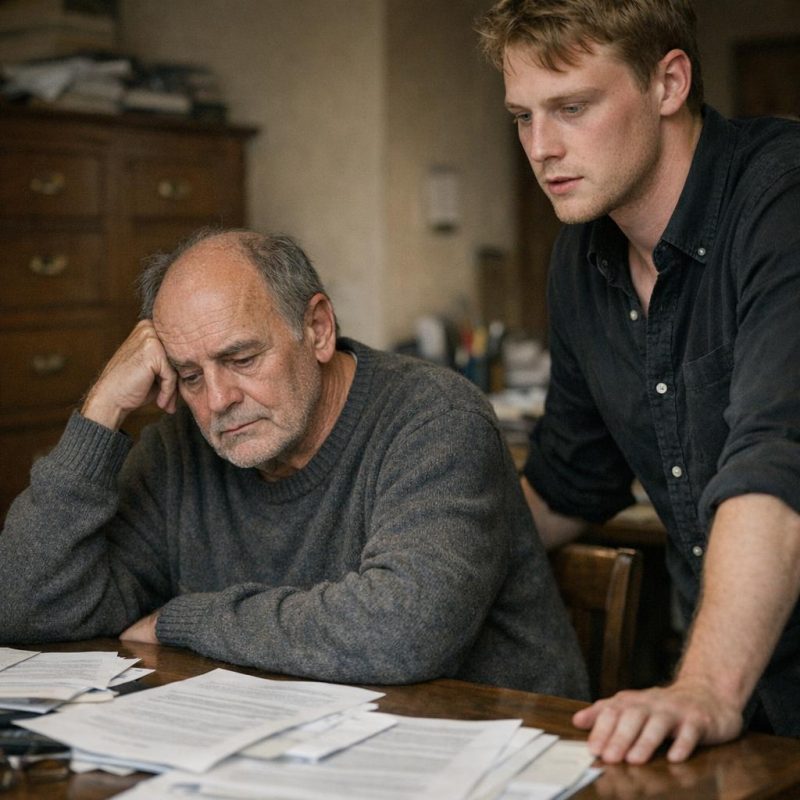 Image by RM AI
Melissa Arrives
We were still staring at that clause when we heard the front door open. All three of us froze. Footsteps in the hallway, familiar and purposeful. Melissa appeared in the doorway and stopped dead, her eyes sweeping across the scene—me, Kyle, Tom, and the documents spread across the table like evidence at a crime scene. For a moment, nobody moved. Then her expression shifted, morphing from shock to something calculated and cold. 'Dad,' she said, her voice suddenly gentle, concerned, 'what's going on? Kyle, why is she here?' She looked at me then, and the mask slipped for just a second. I saw pure rage in her eyes before she schooled her features back to worry. 'I've been trying to protect you,' she said, moving toward Tom. 'This is exactly what I warned you about. She's been planning this, turning you against your own family.' Kyle stepped between them, and I saw Melissa's eyes narrow. Tom just sat there, looking between his daughter and the documents, and I could see him trying to reconcile the two realities. She looked at me with pure hatred and said to Tom, 'I was protecting you from this manipulator—and now you're letting her destroy our family.'
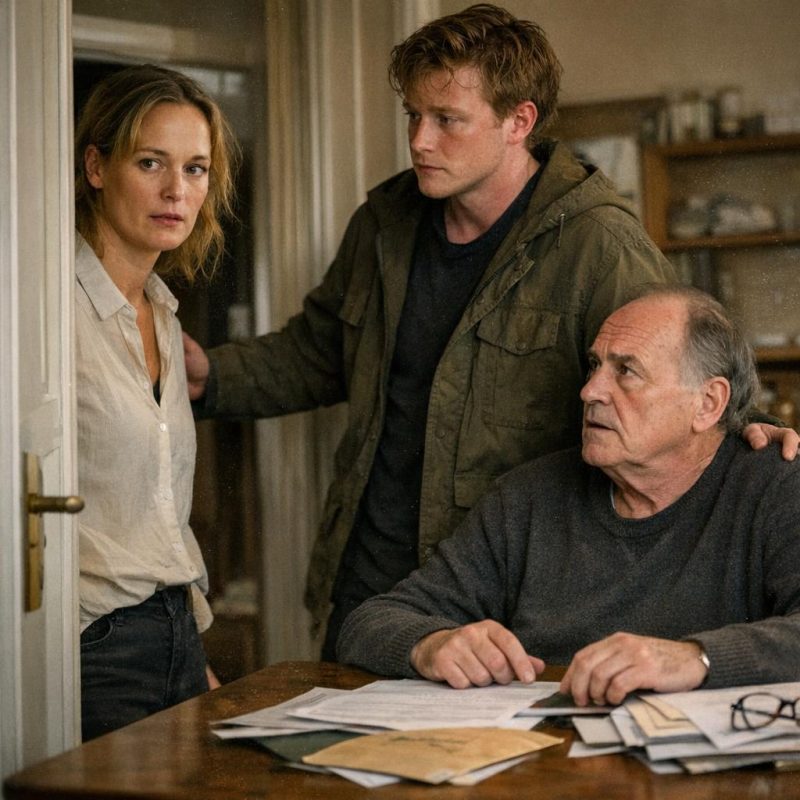 Image by RM AI
The Confrontation
Tom's voice cut through the room, quieter than I expected but somehow more devastating. 'Melissa,' he said, and she turned to him with that practiced concerned expression. 'Tell me about the trust revision. Tell me why you needed me to sign those papers so urgently.' I watched her face cycle through emotions—surprise, calculation, defiance. Kyle stood rigid beside me, and I could feel how much this was costing him too. 'Dad, I was protecting your interests,' she started, but Tom held up his hand. 'No more,' he said. 'I want the truth. Did you tell me the lawyer needed those signatures immediately? Did you tell me it was standard estate planning?' The silence stretched out unbearably. Then something in Melissa just broke. The mask came off completely, and what was underneath was raw and ugly and so painfully human. 'You want the truth?' she said, her voice shaking with years of resentment. 'Fine. I was there every single day after Mom died. I held your hand. I made sure you ate. I sacrificed my time, my life.' She stopped pretending and said what she'd been thinking all along: 'I earned this—I was there taking care of you while he barely knew you existed.'
 Image by RM AI
The Lawyer's Visit
The lawyer came two days later. She was younger than I expected, efficient and direct in a way that felt reassuring. Tom sat at the same dining room table where this whole thing had unraveled, and Kyle and I flanked him like supports holding up something fragile. She reviewed the documents methodically, making notes on her tablet, occasionally asking Tom questions about what he remembered being told. 'This clause here,' she pointed to the screen, 'was this explained to you as temporary or permanent?' Tom shook his head, looking exhausted. 'She said it was standard. That everyone does estate planning this way.' The lawyer's expression didn't change, but I saw her jaw tighten slightly. She explained that some elements could potentially be challenged—the timeline was suspicious, the circumstances could suggest undue influence, and Tom's grief state at the time might be relevant. But then she looked at all of us with the kind of gentle honesty that makes you trust someone. The lawyer said some documents could be challenged, but the process would be long—and painful for everyone involved.
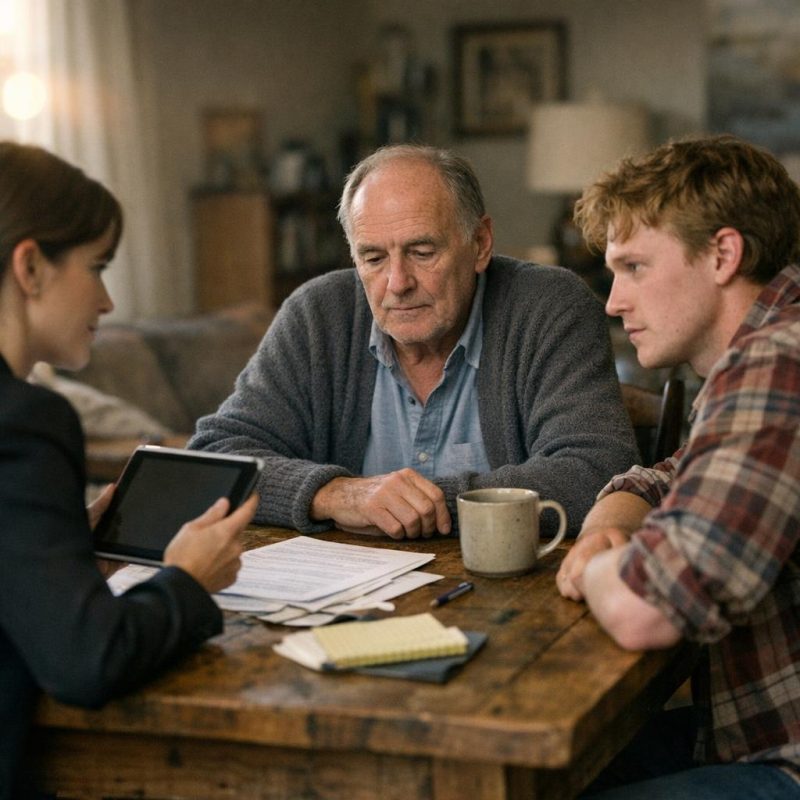 Image by RM AI
Rebuilding Trust
Tom asked if he could talk to me alone, and Kyle quietly left the room. We sat in his living room—the same space where I'd first brought him that casserole what felt like a lifetime ago. He looked older now, more worn down, but also somehow clearer. 'I owe you an apology,' he said, and his voice cracked slightly. 'I let grief make me stupid. I let my daughter convince me you were something you weren't, and I pushed away the one person who was actually trying to help.' I felt tears threatening and blinked them back. Part of me wanted to say it was all okay, that I understood completely. But the other part—the part that had spent weeks being cast as a predator, being whispered about, being treated like I had ulterior motives—that part needed something different. 'I appreciate that,' I said carefully. 'I do understand that grief makes people vulnerable. I get it.' I paused, making sure he was really hearing me. I told him I understood grief makes people vulnerable—but I also told him I needed time to heal from being cast as the villain.
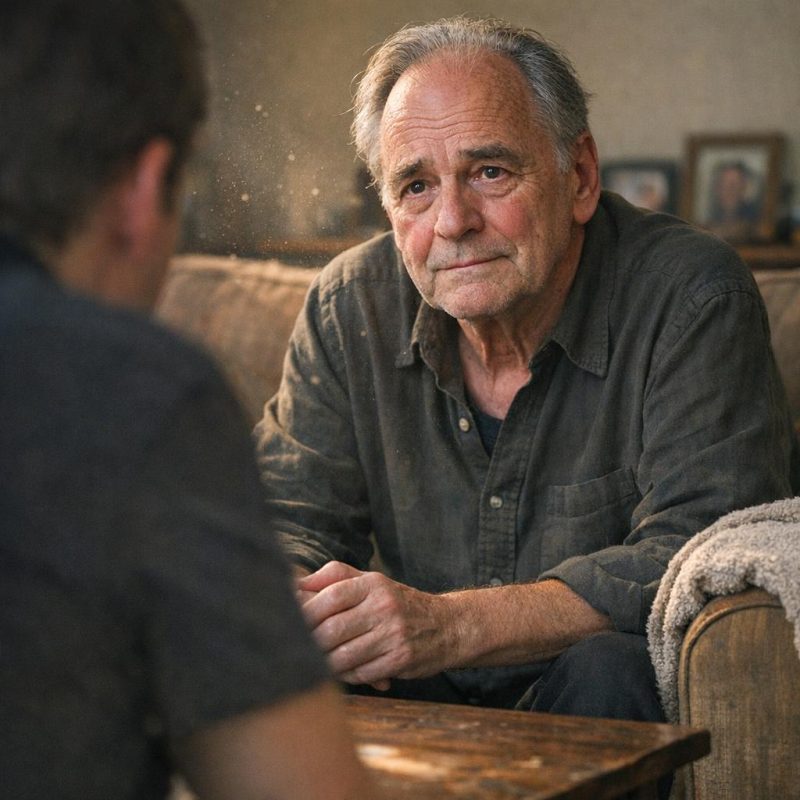 Image by RM AI
What I Learned
Looking back now, I understand so much more about what happened. Grief doesn't just make people sad—it makes them susceptible, vulnerable to anyone who claims to have their best interests at heart. And sometimes the people who claim to love you most are the ones who see your pain as an opportunity. Melissa wasn't entirely wrong that she'd been there for Tom, that she'd sacrificed. But somewhere along the way, her sacrifice turned into entitlement, her care into control. I learned that kindness can be weaponized by people who don't want anyone else close to their vulnerable family member. I learned that doing the right thing doesn't always protect you from being painted as doing the wrong thing. I learned that families are complicated, and money makes them exponentially more so. Tom and Kyle are still working through the legal mess. Melissa hasn't spoken to either of them since that day. Sometimes I see Tom at the grocery store and we exchange careful, friendly waves. I still help my neighbors when they need it—but now I know that sometimes the real danger isn't from the person accepting help, but from the one who wants to make sure no one else can give it.
 Image by RM AI
KEEP ON READING

The story of Ching Shih, the Woman Who Became the…
Unknown author on WikimediaFew figures in history are as feared…
By Emilie Richardson-Dupuis Dec 29, 2025
Einstein's Violin Just Sold At An Auction—And It Earned More…
A Visionary's Violin. Wanda von Debschitz-Kunowski on WikimediaWhen you hear…
By Ashley Bast Nov 3, 2025
This Infamous Ancient Greek Burned Down An Ancient Wonder Just…
History remembers kings and conquerors, but sometimes, it also remembers…
By David Davidovic Nov 12, 2025
The Mysterious "Sea People" Who Collapsed Civilization
3,200 years ago, Bronze Age civilization in the Mediterranean suddenly…
By Robbie Woods Mar 18, 2025
This Time Period Was the Single Best Time to be…
Rowyn flowerdew on WikimediaIf you ask the question in purely…
By Emilie Richardson-Dupuis Mar 24, 2026
20 Soldiers Who Defied Expectations
Changing the Rules of the Battlefield. You’ve probably heard plenty…
By Annie Byrd Feb 10, 2026