
The Victorian Taxidermist Who Created Entire Scenes With Stuffed Animals
 Unknown authorUnknown author on Wikimedia
In a small Sussex village, a pub landlord's son spent most of his long life arranging dead animals into tiny human dramas. Walter Potter posed kittens at a wedding and seated rabbits in rows at a village school, and he did it with enough conviction that people came by the trainload to look. The railway eventually had to lengthen the platform to fit them all.
Victorian Britain was full of taxidermy, most of it glass-domed birds on a parlor shelf. Potter did something odder with the craft. He built whole scenes with props he made himself, and the results land somewhere between folk art and a mild fever dream. A century after his death, a single auction scattered his work around the world and made him more famous than he'd been in generations.
The Robin That Started It
Potter was born in Bramber on 2 July 1835, and his family ran The White Lion, the inn now called The Castle Inn. It was a village he would scarcely leave for the rest of his life.
As a teenager he took his cue from a nursery rhyme book belonging to his sister Jane and set out to build The Death and Burial of Cock Robin in three dimensions. The project took seven years and 98 species of British birds, each one posed to act out the rhyme, from the sparrow with his bow and arrow to the mourners at the grave.
He put it on display at the family inn in 1861, and it caused a sensation. Commissions from wealthy Victorians soon followed, and his collection kept growing. He also married a local woman, Ann Stringer Muzzell, and the couple raised three children in a home increasingly crowded with his creations.
The Scenes That Filled The Museum
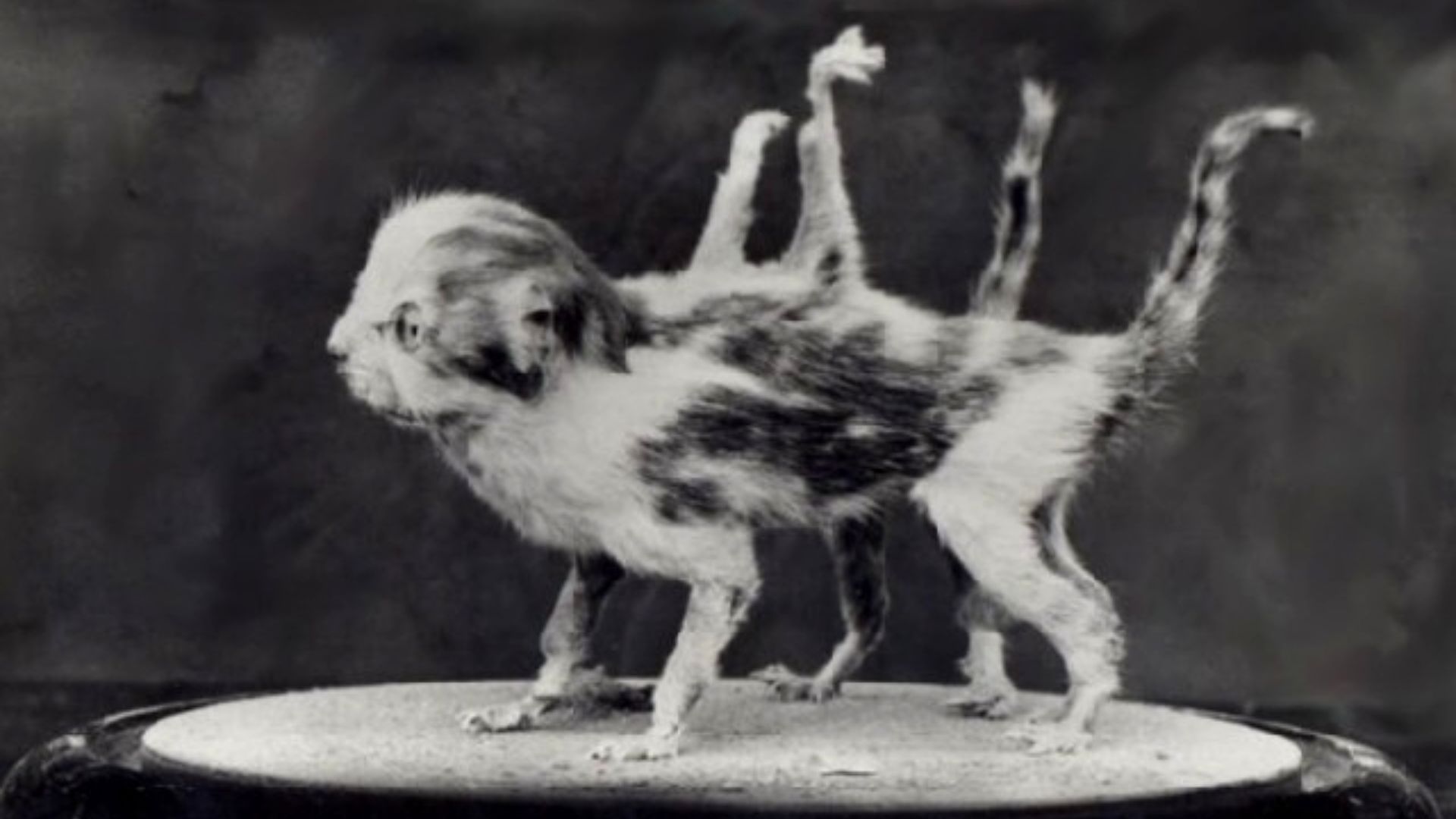
Demand quickly outgrew the inn, so the family built a museum nearby, and so many visitors arrived by train that the platform at Bramber Station had to be extended. Keeping the cases full took a steady supply of small bodies. Kittens came from a farm in nearby Henfield, and villagers turned up with specimens of their own. By then the place had a name, Mr Potter's Museum of Curiosities, and it was firmly on the day-trip circuit.
Squirrels lounged around a gentlemen's club with tiny brandy decanters at their elbows, and a den of rats got raided by the police. His animals don't always look anatomically right, and visitors seem not to have minded much, given how much else is going on in each case. The kittens wore jewelry and frilly knickers (no guest at the wedding was ever going to see the knickers, and he made them anyway). Elsewhere, rows of rabbits bent over their lessons in The Rabbits' Village School.
The Kittens' Wedding came later, around 1890, and it's the piece most people picture when they hear his name. Twenty kittens stand at the altar rail in morning suits and dresses of cream brocade, with a parson on hand to marry them. It was his last complete grand tableau, and the only one where the animals wear clothes throughout.
How The Collection Came Apart
Potter died in 1918 and was buried in Bramber churchyard, leaving behind around 10,000 specimens. His family kept the museum running until the early 1970s, after which the collection moved to Brighton and then Arundel. In the mid-1980s, the owners of Jamaica Inn in Cornwall bought it, attracting more than 30,000 visitors a year. One piece stayed closer to home, though. A pet Potter had preserved for a Bramber family eventually found its way to Steyning Museum, where it went on display.
In September 2003 the inn's owners sent the lot to Bonhams, and the collection was broken up for the first time and sold piece by piece. The two-day sale raised more than £500,000, with the artist Peter Blake among the crowd.
Damien Hirst had offered £1 million to keep it together, and the owners later sued Bonhams over how that offer was handled. Hirst went on to champion Potter anyway, and that attention set off a fresh wave of interest in his work around the world. Cock Robin made £20,000 against an estimate of £5,000 to £7,000. The rabbits' school went for £13,000. The kittens' wedding party went for £21,150 with fees, and when it changed hands again in 2016, the reported price was $121,000.
KEEP ON READING