

 Unknown authorUnknown author on Wikimedia
Today, when we think about exotic animals in public view, we usually picture zoos, documentaries, or conservation campaigns. For centuries, though, the most prestigious place to keep a lion, an elephant, or a bear was a royal court. In England and France, especially, rulers used menageries to display rare animals as visible proof of wealth, reach, and authority.
That image of luxury had a harsher reality underneath it. These collections depended on capturing, transporting, and confining wild animals far from their habitats, often in spaces designed for spectacle rather than welfare. Seen from a modern angle, royal menageries look less like glamorous curiosities and more like an early system for turning living creatures into status symbols.
A Luxury Built on Power
The most famous English example was the royal menagerie at the Tower of London. Historic Royal Palaces says the Tower housed exotic wild animals from the 1200s to 1835, and the collection is often described as London’s first zoo. Its lasting medieval foundation is usually tied to 1235, when Henry III received three “leopards,” probably lions, from the Holy Roman Emperor Frederick II.
More remarkable gifts followed. In 1252, Henry III received a white bear, presumed to have been a polar bear, from the king of Norway, and Historic Royal Palaces notes that it was allowed to swim and hunt fish in the Thames on a long cord. In 1255, the king of France sent Henry an elephant, and the monk Matthew Paris famously drew it from life, leaving behind one of the best-known visual records of the Tower’s early animals.
France built its own grand version of the same idea at Versailles. The Palace of Versailles says Louis XIV ordered the Royal Menagerie from 1663, and that its exotic animals were arranged around a central octagonal pavilion that gave the king and observers a panoramic view of the enclosures. The architecture made the point plain enough: the animals were there to be watched, organized, and folded into the theater of monarchy.
Spectacle Over Welfare
Menageries were never just collections of unusual animals. Historic Royal Palaces describes the Tower beasts as status symbols, while the Palace of Versailles presents the royal menagerie as part of Louis XIV’s broader court project at Versailles. That symbolic role mattered more than the animals’ comfort, which is why these collections could be celebrated as luxuries even when the conditions were plainly harsh.
The Tower elephant is one of the clearest examples. Historic Royal Palaces says it was given a new 40-foot by 20-foot house and a dedicated keeper, but it still died after only a couple of years. The same source notes that many animals in the menagerie struggled to survive in captivity, which is not exactly shocking when medieval England was improvising its way through the care of animals from entirely different climates.
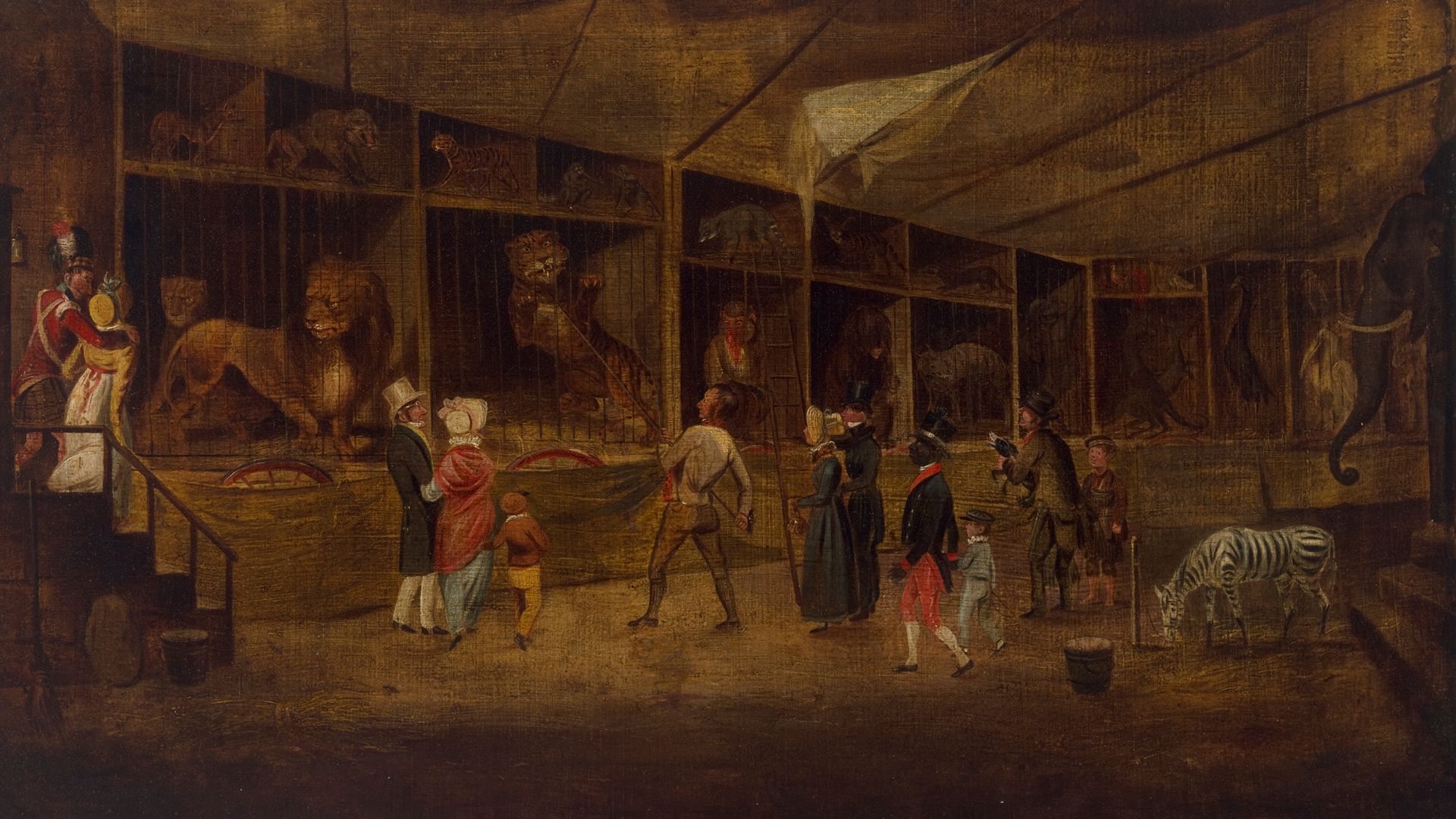
The collections were also staged for human excitement. Historic Royal Palaces records that under James I, the lions’ den was refurbished so visitors could see more of the lions moving around their circular yard. The same source points to an eighteenth-century demonstration involving a cheetah brought from India and set against a stag, a reminder that royal animal display could slide very easily into orchestrated aggression.
Why the Menageries Faded
 Melchior d'Hondecoeter on Wikimedia
By the nineteenth century, the old model was harder to defend. Historic Royal Palaces says that by the time the Tower menagerie closed, the animals were increasingly seen as both a public safety threat and victims of inhuman conditions. That didn’t mean the monarchy suddenly discovered compassion. It meant the old arrangement had become harder to justify, harder to manage, and less impressive than it once seemed.
The end came gradually rather than all at once. Historic Royal Palaces says the remaining Tower animals were moved to Regent’s Park in the early 1830s, while the Tower collection itself is described as lasting until 1835. That shift overlapped with the rise of the Zoological Society of London, whose official history describes London Zoo as the world’s first scientific zoo.
Even then, the underlying attitude didn’t vanish overnight. The London Museum notes that the early London Zoo was founded for scientific study and only later opened to the public, while ZSL frames it as the start of a new model for zoological institutions. That was a real change in language and purpose, but it didn’t instantly erase the older habit of treating exotic animals as things to collect, display, and interpret for human purposes.
KEEP ON READING
The 20 Most Recognized Historical Figures Of All Time
The Biggest Names In History. Although the Earth has been…
By Cathy Liu Oct 4, 2024
10 of the Shortest Wars in History & 10 of…
Wars: Longest and Shortest. Throughout history, wars have varied dramatically…
By Emilie Richardson-Dupuis Oct 7, 2024
10 Fascinating Facts About Ancient Greece You Can Appreciate &…
Once Upon A Time Lived Some Ancient Weirdos.... Greece is…
By Megan Wickens Oct 7, 2024
20 Lesser-Known Facts About Christopher Columbus You Don't Learn In…
In 1492, He Sailed The Ocean Blue. Christopher Columbus is…
By Emilie Richardson-Dupuis Oct 9, 2024
20 Historical Landmarks That Have The Craziest Conspiracy Theories
Unsolved Mysteries Of Ancient Places . When there's not enough evidence…
By Megan Wickens Oct 9, 2024
The 20 Craziest Inventions & Discoveries Made During Ancient Times
Crazy Ancient Inventions . While we're busy making big advancements in…
By Cathy Liu Oct 9, 2024