

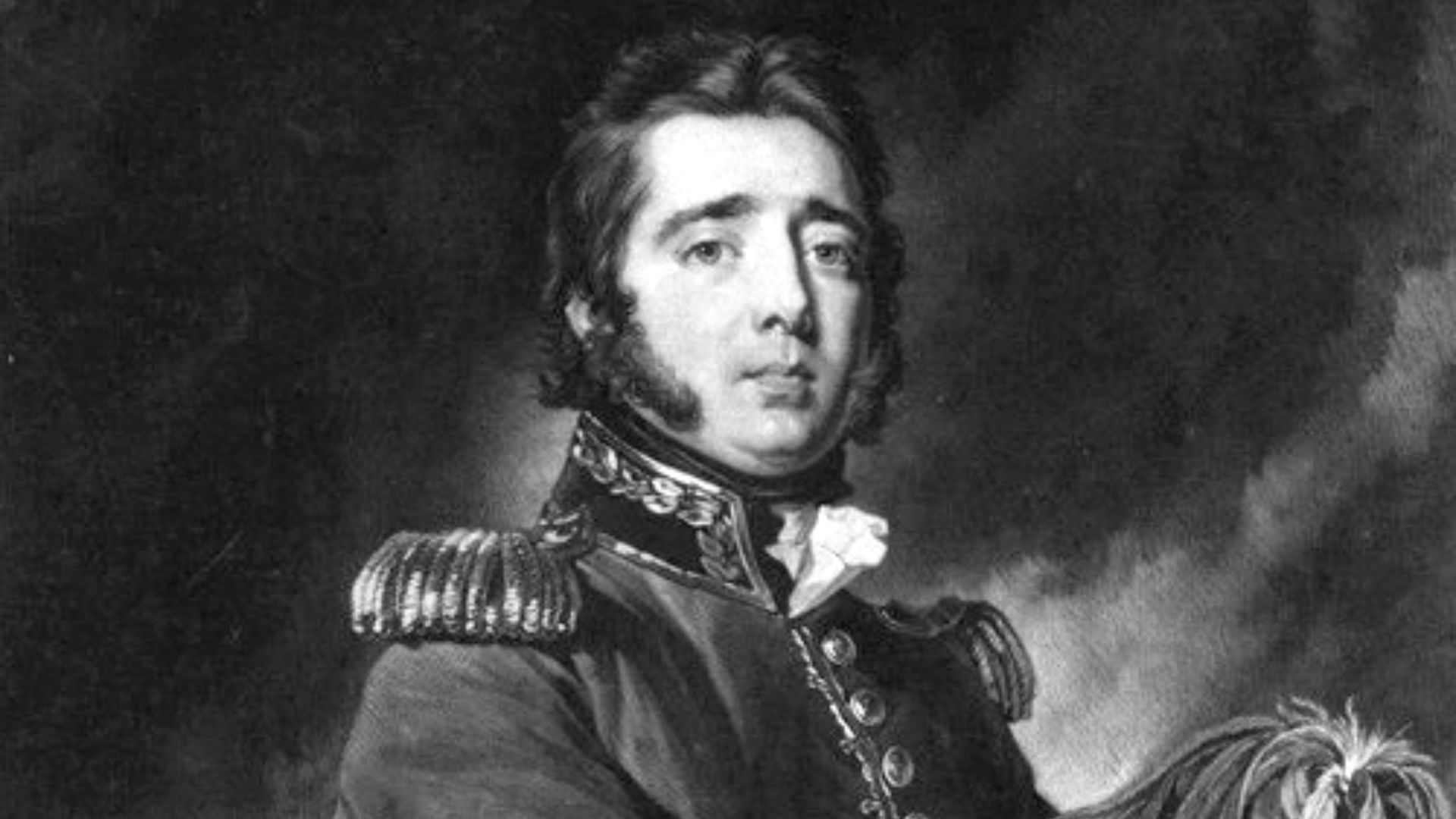
 en:Samuel William Reynolds (1773–1835), after Simon Jacques Rochard (1788–1872) on Wikimedia
The wildest part of Gregor MacGregor’s scam is not that he invented a country. The wildest part is that he invented one in a form people were already primed to trust. Early nineteenth-century Britain was full of speculation, imperial fantasy, and investor appetite for distant opportunity. A man with a military title, a dramatic backstory, and enough printed paper could make a lie feel almost administrative.
That is what makes Poyais feel modern even now. It was not built on one forged letter or one reckless pitch. It was built on atmosphere, paperwork, confidence, and a public willing to believe that prosperity was waiting just over the horizon. What MacGregor sold was not land alone. He sold the thrill of getting in early on a future that sounded official.
He Built A Country Out Of Paper
MacGregor’s opening move came after his time in Latin America, where he had attached himself to independence campaigns and returned to Britain able to present himself as a seasoned soldier and man of consequence. He claimed that an Indigenous ruler on the Mosquito Coast had granted him an eight-million-acre tract of land and named him cacique, or prince, of a place he called Poyais. Earlier scholarship on the scheme traces the original grant to April 29, 1820, when George Frederick, king of the Mosquitos, gave MacGregor control over a huge tract near the Black River.
He did not stop at the title. He created the usual furniture of state. There were land certificates, bonds, maps, currency, flags, and the appearance of a working government. In 1822, a 355-page guidebook called Sketch of the Mosquito Shore, including the territory of Poyais appeared in Edinburgh and London, presented as a settler’s handbook by Thomas Strangeways. The copy now held through the Library of Congress record shows it was published in 1822 and sold by William Blackwood in Edinburgh and T. Caddell in London, which is exactly the sort of solid detail that helped the fantasy look anchored in print culture rather than pure invention.
That printed world did a lot of the work. MacGregor was not merely asking people to trust his face. He was surrounding them with the props of legitimacy. Britannica notes that he secured two loans of £200,000 through bond issues, the first in October 1822 and the second in October 1823. The money was real, the paper was real, and the place behind it was not. That combination is what turned a fraud into something much bigger than a colorful hoax.
People Did Not Just Invest. They Packed
The most brutal part of the story begins when the scam leaves the drawing room and heads for the docks. Britannica says that in 1822 and 1823, hundreds of people left England and Scotland for Poyais believing they were heading to a functioning colony with a harbor, a capital city, and cultivable land. Reports summarized in later coverage put the emigrant total at about 250, enough to fill multiple ships and turn belief into migration.
What they found was coastline and wilderness. There was no ready-made town waiting for them, no organized state, and no infrastructure capable of receiving settlers who had crossed an ocean in good faith. More than 150 people died, and that before rescue came from British Honduras, almost three-quarters of one group had died from malnutrition or tropical disease, including malaria and yellow fever. This was not a financial embarrassment with a few duped speculators licking their wounds. It was a lethal colonization fraud.
The part that still catches in the throat is how ordinary the victims were in their ambitions. They were not all aristocrats gambling on paper. Some were families trying to relocate into what they believed was a promising new settlement. That changes the emotional scale of the story. Poyais was not just fake sovereignty. It was fake refuge, fake upward mobility, and fake stability sold to people willing to reorganize their lives around it.
The Scam Worked Because The Moment Wanted It To
MacGregor’s success makes more sense once you put it back inside its market. London in the early 1820s had a strong appetite for overseas speculation, especially tied to the newly independent states of Latin America. Scholarship on the Poyais scheme places it squarely in that climate, when distant territory, sovereign debt, and development talk could all sound exciting rather than absurd. He was not pushing fantasy into a skeptical void. He was feeding an existing hunger for imperial opportunity and fast legitimacy.
That is also why exposure did not end the story as quickly as common sense suggests it should have. MacGregor was never really brought to justice and fled to France in 1823, where he tried again. Accounts of the wider scheme show that later Poyais loans and certificates kept circulating even after the disaster had become visible, in part because many investors still treated the earlier failure as a bad investment rather than a complete fabrication. The fiction held because enough people preferred a damaged dream to the humiliation of admitting the whole country had been invented around them.
That is why Gregor MacGregor’s fake country still matters and remains a lesson in how easily official language, printed confidence, and public appetite can turn nonsense into policy-shaped reality. Poyais never existed as a country, yet it existed long enough in documents, markets, and human plans to kill people, move money, and leave a stain that still feels surprisingly fresh.
KEEP ON READING
Gregor MacGregor’s Fake Country
en:Samuel William Reynolds (1773–1835), after Simon Jacques Rochard (1788–1872) on…
By Cameron Dick Apr 23, 2026
The Strait Panic That Already Happened Once
Navy of the Army of the Guardians of the Islamic…
By Cameron Dick Apr 23, 2026
How Castles Were Designed To Withstand Siege Warfare
Nuria Duran on PexelsWhen you picture a medieval castle, it’s…
By Rob Shapiro Apr 23, 2026
20 Historical Figures Who Ruled From the Flat of their…
Power From the Sickroom. History likes its rulers upright, armored,…
By Cameron Dick Apr 23, 2026
10 Artists Who Captured History in Real Time & 10…
Two Ways Artists Preserve the Past. Art doesn’t just reflect…
By Rob Shapiro Apr 23, 2026
20 Scientific Frauds That Set Research Back for Years
Ruining The Fun for Everyone. One fake result can do…
By Elizabeth Graham Apr 22, 2026