

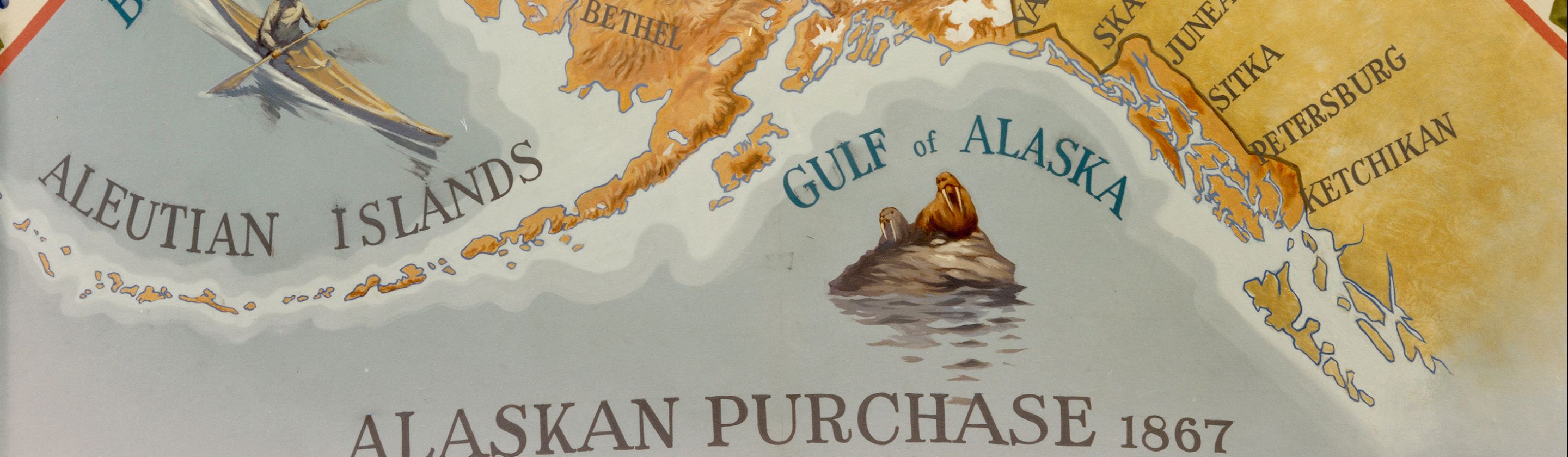

A lot of people hear “Russia sold Alaska” and immediately assume it was because Russia didn’t realize what it had. This version of the story always puts a smirk on the face of Americans considering Alaska’s later gold and oil stories, but it’s not really how it went down. The sale happened in a specific political moment, with particulat anxieties, and Russia was thinking more about risk than riches.
If you want the short version, Russia didn’t sell Alaska because it was worthless—the deal was a lot more strategic than that. Russia sold Alaska because it was hard to supply, expensive to hold, and even harder to defend, especially with Britain sitting nearby in Canada and Russia still nursing financial wounds after the Crimean War.
Alaska Was Remote, Costly, & Turning Into a Headache
First off, it's important to consider the context in which this story took place. To Russia, Alaska wasn’t a cozy nearby province; it was a far-flung outpost that required a long, complicated supply chain just to keep settlements functioning. Maintaining control over a place that was distant meant constant costs, plus the ongoing hassle of provisioning people and infrastructure across huge distances.
Even if a territory is large, it still has to justify itself financially, and Alaska’s early value was tied heavily to the fur trade rather than farming or dense settlement. Over time, the most lucrative fur resources were pressured and harder to extract at the same scale, and the colonial model depended on a trading system that wasn’t guaranteed forever. The Library of Congress notes the centrality of furs in Alaska’s early economy, which helps explain why the place could look less attractive once the easy profits thinned.
Russia also had bigger domestic concerns competing for attention and money. After the Crimean War, the Russian Empire was under significant financial strain, and maintaining an expensive overseas holding wasn’t a priority compared with problems closer to home.
The Fear Factor: Britain Could Take It, & Russia Knew It
Here’s the part that makes the sale feel very cold and strategic: Russia worried that in a future conflict, it might not be able to defend Alaska at all.
At the time, Britain was Russia’s arch rival, and it controlled nearby Canada, meaning Alaska could be vulnerable if another war broke out. If you can’t hold a territory in wartime, it becomes the kind of asset that turns into a liability overnight.
Once you think in those terms, selling starts to look like a way to avoid losing Alaska for nothing. A negotiated sale at least produced cash and allowed Russia to control the terms of transfer. The alternative scenario, a takeover that yields zero compensation and hands a rival a strategic advantage, was grim from Russia’s perspective.
What's more, this is pre-communism, when Russia and the U.S. were on good terms. Part of why Russia wanted to sell it to the U.S. was to foster better relations. There was also a diplomatic bonus in choosing the United States as the buyer. Russia didn’t love Britain, and putting Alaska in American hands created a kind of buffer dynamic in the North Pacific. It’s not that Russia and the U.S. were super tight, but at that moment, Russia preferred a U.S. presence to a stronger British footprint right on its edge.
The Deal Itself Was a Calculated Exit, Not a Brain Freeze
The treaty was signed in Washington on March 30, 1867, and the purchase price was $7.
2 million, which is why Americans later joked about “Seward’s Folly,” mocking Secretary of State William H. Seward, who was in charge of the deal. At the time, Americans saw Alaska as a frozen wasteland, and purchasing it seemed like a waste of money. Little did they know the riches it had in store, or the strategic position it later proved to hold.
However, if you read the official documents, the sale looks extremely formal and carefully worded, indicating that both sides knew they were doing something significant. The Library of Congress preserves the original treaty, which was written in English and French, with signatures from U.S. Secretary of State William H. Seward and the Russian minister. The Alaska Historical Society also hosts the treaty text and lays out the signing and ratification timeline, which helps show how quickly the process moved once negotiations were serious.
So what was the “real reason” Russia sold Alaska? It wasn’t one single motive, and it definitely wasn’t simple ignorance. It was the combination of high costs, low confidence in defense, and a strategic choice to cash out rather than risk a humiliating loss in a future war. If you’re expecting a romantic story, you won’t find one, but if you like pragmatic empire decisions, this is a classic case.
KEEP ON READING

The Brutal Realities Of Gladiator Life Beyond the Arena
David Cruz asenjo on PexelsWhen most people think of gladiators,…
By Rob Shapiro Mar 31, 2026
The Volcano Winter That Nearly Toppled Europe
Collin Ross on UnsplashMost people, if asked to name a…
By Cameron Dick Mar 31, 2026
From School Plays To Starting A Cult: 20 Of The…
The Books That Made Us. Many people will tell you…
By Farva Ivkovic Jan 31, 2025
20 Facts About Jane Grey, The Forgotten Queen Of England
A Quick, Messy, and Tragic Reign. Lady Jane Grey never…
By Maria Cruz Jan 31, 2025
20 Priceless Historical Art Pieces Rescued By The Monuments Men
Protecting Human History. While the soldiers on the front lines…
By Sara Springsteen Mar 31, 2026
Almost Every Ancient Statue Has a Missing Nose, And It's…
Gary Todd from Xinzheng, China on WikimediaWalk through the classical…
By Elizabeth Graham Mar 31, 2026