

 commons.wikimedia.org on Google

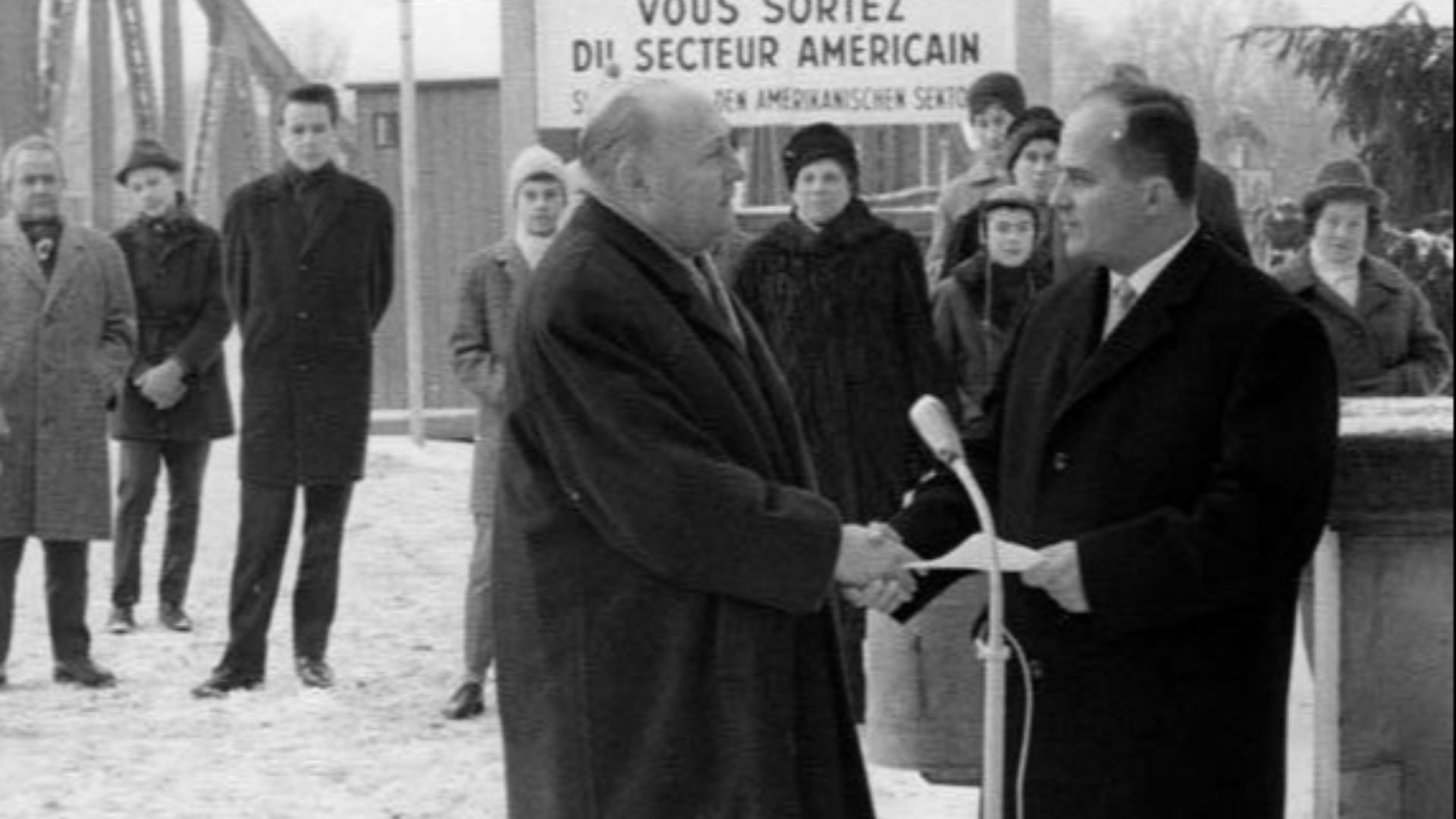
On the morning of February 10, 1962, two men walked toward each other from opposite ends of the Glienicke Bridge in Berlin. One was Francis Gary Powers, an American U-2 pilot who had spent nearly two years in Soviet captivity. The other was Rudolf Abel, a KGB colonel who had spent nearly five years in a federal penitentiary in Atlanta. The swap lasted minutes. The consequences did not.
We tend to remember the Cold War through its biggest flashpoints. The Cuban Missile Crisis, the Berlin Wall, the nuclear standoffs played out in coded cables and press conferences. The Glienicke Bridge exchange rarely makes those lists, and that's part of what makes it worth understanding. What happened that February morning wasn't just a trade of two men. It was the moment both superpowers quietly acknowledged that espionage was a permanent feature of their relationship, and that its practitioners would be treated as assets to be recovered rather than liabilities to be buried.
How Two Spies Ended Up in Each Other's Custody
Francis Gary Powers was flying a Lockheed U-2 reconnaissance aircraft at approximately 70,000 feet over the Soviet Union on May 1, 1960, when a Soviet surface-to-air missile brought him down near Sverdlovsk. The CIA had believed the U-2 flew too high to be intercepted. They were wrong. Powers survived, was captured on the ground, and within days was in KGB custody, presenting the Eisenhower administration with one of the worst intelligence embarrassments of the Cold War. The administration had told the public the aircraft was a weather research plane. The Soviets revealed Powers was alive, and the cover story collapsed entirely.
Powers was tried before a Soviet military tribunal in August 1960, convicted of espionage, and sentenced to ten years with the first three to be served in prison. His capture had already contributed to the collapse of the Paris Summit that May, a planned meeting between Eisenhower and Khrushchev that might otherwise have produced meaningful arms discussions. The U-2 incident didn't start the Cold War's tensions, but it deepened them at a moment when cautious hope for a diplomatic thaw had briefly seemed possible.
Rudolf Abel, whose real name was Vilyam Genrikhovich Fisher, had been operating on American soil since at least 1948 under a series of aliases. He was one of the KGB's most accomplished illegal agents, meaning he worked without diplomatic cover and with no official connection to the Soviet state. He was arrested in 1957 after an associate defected to the FBI, convicted of espionage in a New York federal court, and sentenced to thirty years, which he served quietly at the Federal Penitentiary in Atlanta.
The Lawyer Who Made the Deal
James Donovan was a New York attorney who had no particular obligation to take Abel's case and did so anyway. A former OSS officer appointed by the court to represent Abel, Donovan mounted a serious defense despite enormous public pressure to treat the trial as a procedural formality. He also made a quiet argument to the sentencing judge that Abel should remain alive because he might someday be useful in exactly the kind of exchange that eventually materialized. The judge agreed.
When the State Department needed someone to negotiate Powers' return, they turned to Donovan as a private citizen, which gave both sides the plausible deniability that formal diplomatic channels could not have provided. Donovan traveled to East Berlin and conducted meetings that, by his own later account in his 1964 memoir Strangers on a Bridge, were exhausting, opaque, and frequently misleading. He also managed to secure the simultaneous release of Frederic Pryor, an American economics student who had been detained in East Germany with no connection to intelligence work whatsoever.
The exchange happened at two locations at once. Powers crossed the Glienicke Bridge while Pryor was released separately at Checkpoint Charlie. Donovan received no government salary for his work, no formal title, and almost no public recognition for years. The quiet efficiency of the whole operation was part of the point. A transaction that visible had to look like it wasn't happening at all.
What the Bridge Actually Settled
The most significant outcome of the Glienicke swap was largely invisible at the time. By completing the exchange, both governments implicitly agreed to a set of unwritten rules. Intelligence officers, if captured, would be treated as recoverable assets rather than permanent problems. That understanding made it possible for both sides to continue running operations with some confidence that their people had a path home if things went wrong. It professionalized the shadow war in a way that no formal treaty could have managed.
For Powers, the return was complicated. He testified before the Senate Armed Services Committee in March 1962 and faced pointed questions about whether he had done enough to destroy the aircraft or resist interrogation. The CIA's internal review ultimately concluded he had not violated his obligations, but the suspicion trailed him anyway. He left government service, worked as a test pilot, and later became a traffic reporter for a Los Angeles television station. He died in a helicopter crash in 1977.
The exchange also quietly established what both sides could accomplish when official rhetoric stepped aside long enough to let practical necessity through. The Cold War ran on two tracks simultaneously, the public posture of ideological opposition and the private diplomacy of mutual self-interest. The Glienicke Bridge was one of the rare moments when both tracks converged in the same place, at the same time, and produced something that actually worked.
KEEP ON READING
20 Powerful Ancient Egyptian Gods That Were Worshipped
Unique Religious Figures in Ancient Egypt. While most people are…
By Cathy Liu Nov 27, 2024
The 10 Scariest Dinosaurs From The Mesozoic Era & The…
The Largest Creatures To Roam The Earth. It can be…
By Cathy Liu Nov 28, 2024
The 20 Most Stunning Ancient Greek Landmarks
Ancient Greek Sites To Witness With Your Own Eyes. For…
By Cathy Liu Dec 2, 2024
10 Historical Villains Who Weren't THAT Bad
Sometimes people end up getting a worse reputation than they…
By Robbie Woods Dec 3, 2024
One Tiny Mistake Exposed A $3 Billion Heist
While still in college, Jimmy Zhong discovered a loophole that…
By Robbie Woods Dec 3, 2024
30 Lost Treasures That Vanished From History
Buried treasure, missing artefacts, legends of ancient gold in them…
By Robbie Woods Dec 3, 2024