

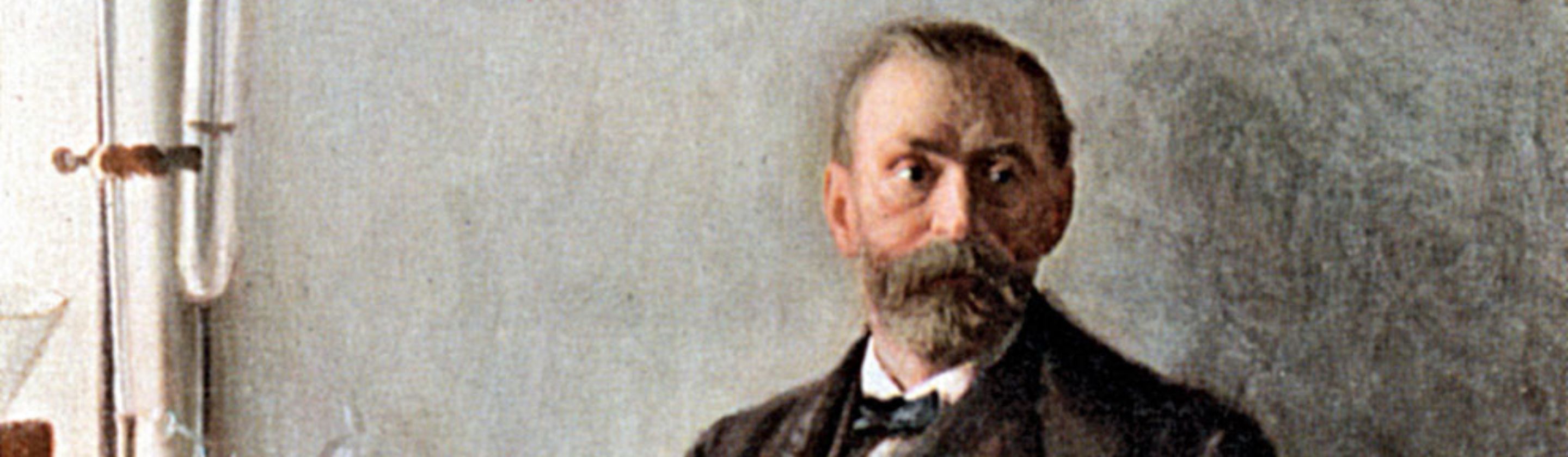
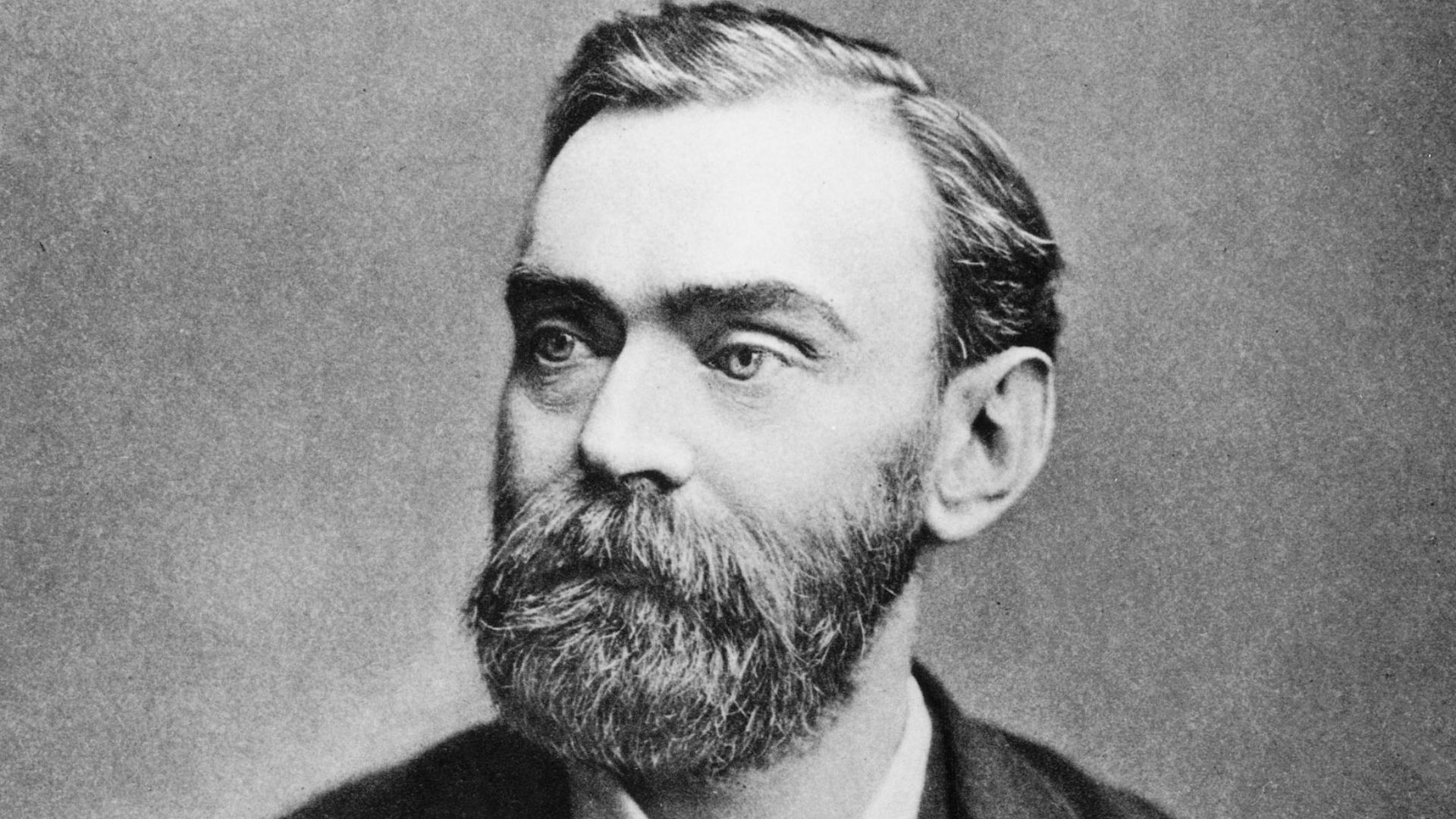
 Unknown authorUnknown author on Wikimedia
There are few biographical contradictions as clean or as consequential as Alfred Nobel's. The man who invented dynamite, held over 350 patents, and built a fortune supplying explosives to armies across the world also endowed the most prestigious peace prize in human history. He died anxious about his legacy, having spent decades wrestling with what his work had actually unleashed. The Nobel Prize wasn't an act of generosity so much as an act of reckoning.
Understanding how someone ends up in that position requires going back to the beginning, to a childhood shaped by industrial ambition, a father who treated invention as a survival strategy, and a Europe that was industrializing faster than it could manage the consequences. Nobel wasn't a warmonger who discovered a conscience late in life. The tension was there from the start, running through everything he built, and the story of how he navigated it remains genuinely strange and worth sitting with.
The Making of an Inventor Under Pressure
Alfred Nobel was born in Stockholm in 1833, the fourth child of Immanuel Nobel, an engineer and inventor whose career swung between inspired success and total financial collapse. The family relocated to Saint Petersburg when Alfred was nine, following Immanuel's business interests in Russia, where he eventually secured contracts supplying naval mines to the Russian military during the Crimean War. Alfred grew up watching his father treat invention as a commercial tool first and an intellectual exercise second, a framing he absorbed and never entirely escaped.
He was largely educated by private tutors and proved exceptionally capable across languages, chemistry, and literature. By his late teens he had studied in the United States under John Ericsson, the engineer who would later design the ironclad warship USS Monitor, and had traveled widely enough to understand that industrial chemistry was about to reshape the world. When he returned to Sweden and began working with nitroglycerin, a compound first synthesized by Italian chemist Ascanio Sobrero in 1847, he understood both its commercial potential and its terrifying instability. Sobrero himself had serious reservations about what he'd created and reportedly expressed regret about the compound for the rest of his life.
The work was dangerous in ways that weren't theoretical. In 1864, an explosion at the Nobel family's factory outside Stockholm killed five people, including Alfred's younger brother Emil. The Swedish government responded by banning further nitroglycerin experiments within Stockholm's city limits. Nobel moved his operations onto a barge in the middle of a lake and kept working. Whatever the personal cost, he was not someone who stopped.
Dynamite and the Logic of Useful Violence
The invention that defined Nobel's public identity came in 1867, when he successfully stabilized nitroglycerin by combining it with diatomite, a porous silica-based sediment, producing a compound he named dynamite. The key breakthrough wasn't chemical so much as practical. Nitroglycerin was already powerful, but it was so volatile that transporting and deploying it reliably was nearly impossible. Dynamite changed that. It could be shaped, handled, and detonated on a predictable schedule, which made it immediately valuable for mining, tunneling, and construction projects that were reshaping industrial economies worldwide.
Nobel patented dynamite in the United States, the United Kingdom, and Sweden in 1867 and moved quickly to establish manufacturing operations across Europe and eventually in more than 20 countries. By the time he died in 1896, he controlled a network of roughly 90 factories producing explosives globally, according to the Nobel Prize organization's own historical records. The commercial logic was straightforward: industrializing nations needed to blast through mountains, dig canals, and lay railway beds at a scale that required something far more efficient than black powder. Nobel supplied that need and became extraordinarily wealthy doing so.
The military applications followed as naturally as the commercial ones. Armies understood immediately what stabilized high explosives meant for artillery, demolition, and siege warfare, and Nobel sold to them too. He later developed ballistite, one of the first smokeless powder propellants, which became a precursor to cordite and contributed directly to advances in military firepower. Nobel's own stated position was that he believed more powerful weapons would make war so destructive that nations would abandon it as a strategy. That argument, which appeared in his correspondence with the Austrian pacifist Bertha von Suttner, sounds either visionary or self-serving depending on how charitable a reading you're willing to give it.
The Prize as Personal Verdict
The story most often told about Nobel's decision to establish his prizes involves a 1888 newspaper incident in which a French paper mistakenly published his obituary following the death of his brother Ludvig. The obituary reportedly called him a merchant of death and asked what good had come from his work. Whether that account is fully accurate remains contested by historians, but Nobel's correspondence from his later years makes clear he was genuinely preoccupied with how he would be remembered and whether his work had helped humanity or harmed it.
His final will, signed in Paris in 1895, directed that the bulk of his estate, which amounted to roughly 31 million Swedish kronor, equivalent to several hundred million dollars today, be used to fund annual prizes in physics, chemistry, medicine, literature, and peace. The peace prize was to be awarded by a Norwegian committee, a choice that reflected his admiration for Norway's more progressive political culture relative to Sweden's at the time. Bertha von Suttner, with whom Nobel had maintained a long friendship and correspondence, won the prize herself in 1905, nine years after his death. He had told her in letters that he wanted to do something meaningful for the cause she represented.
What we're left with is a legacy that resists simple resolution. The prizes bearing his name have honored some of the most significant contributions to human knowledge and peace in recorded history. The fortune that funds them came directly from making destruction more efficient. Nobel understood that tension and apparently couldn't resolve it either, which may be the most human thing about him.
KEEP ON READING
The Brutal Realities Of Gladiator Life Beyond the Arena
David Cruz asenjo on PexelsWhen most people think of gladiators,…
By Rob Shapiro Mar 31, 2026
The Volcano Winter That Nearly Toppled Europe
Collin Ross on UnsplashMost people, if asked to name a…
By Cameron Dick Mar 31, 2026
From School Plays To Starting A Cult: 20 Of The…
The Books That Made Us. Many people will tell you…
By Farva Ivkovic Jan 31, 2025
20 Facts About Jane Grey, The Forgotten Queen Of England
A Quick, Messy, and Tragic Reign. Lady Jane Grey never…
By Maria Cruz Jan 31, 2025
20 Priceless Historical Art Pieces Rescued By The Monuments Men
Protecting Human History. While the soldiers on the front lines…
By Sara Springsteen Mar 31, 2026
Almost Every Ancient Statue Has a Missing Nose, And It's…
Gary Todd from Xinzheng, China on WikimediaWalk through the classical…
By Elizabeth Graham Mar 31, 2026