


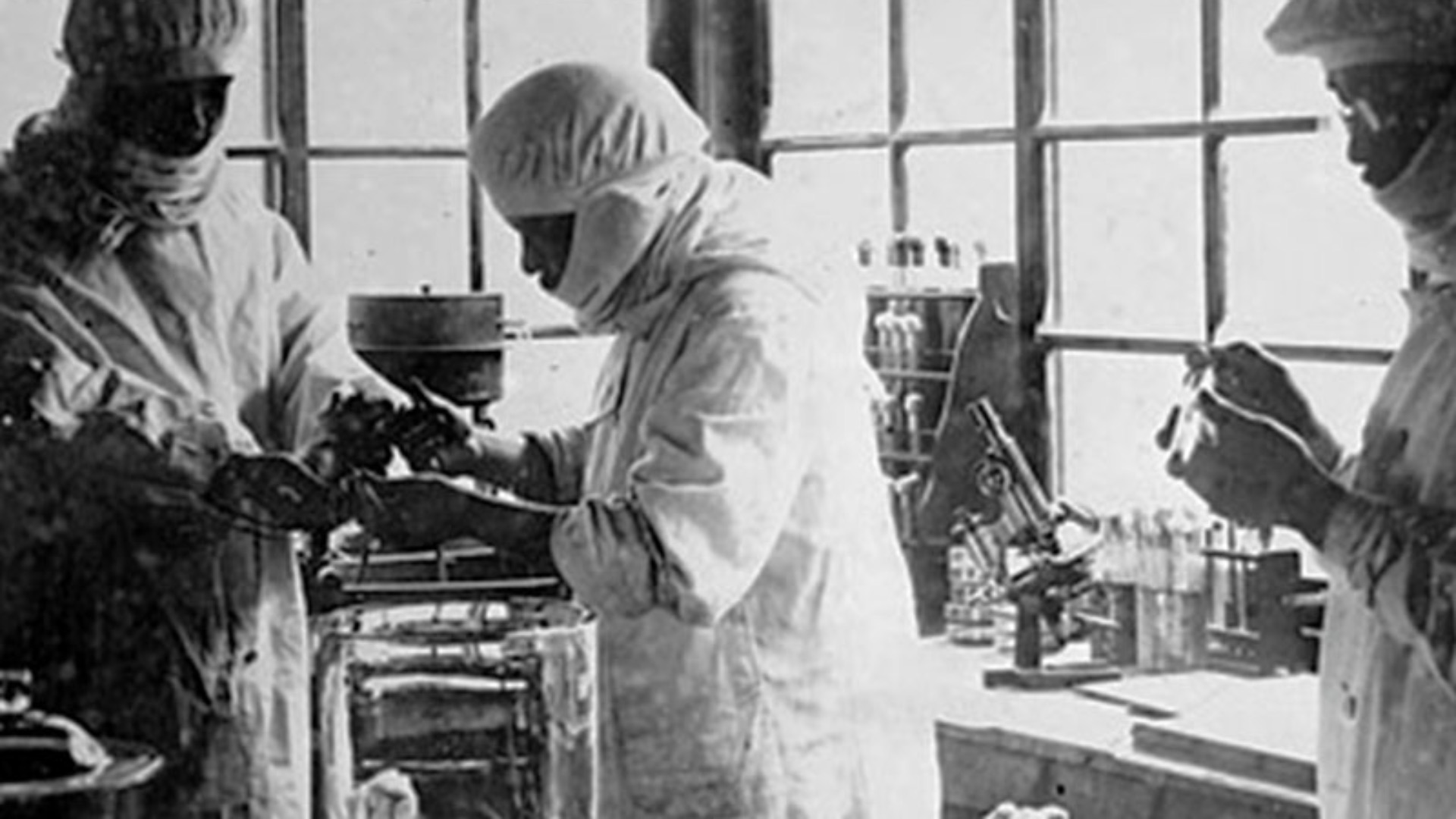
 Bain News Service on Wikimedia
It's a scene from a nightmare. Captured prisoners are purposely infected with deadly diseases, from plague to cholera and tuberculosis, exposed to freezing temperatures, given poisoned food, dissected without anesthesia, limbs stitched back in places they don't belong. The experiments are grossly inhumane, but Shiro Ishii and the rest of the doctors there don't see it that way at all. Instead, to them, Unit 731 is a masterpiece, a necessary project that will give them incredible intel on how the human body fights, survives, and works. Years later, the U.S. government would agree and scramble to help them cover up their horrific crimes.
If this is the first time you've heard about Unit 731, that's not a surprise. Many details about this grim era of Japanese history have been buried deep, though not often out of remorse. In this article, we'll cover what happened inside this biological and chemical warfare unit from hell.
A Program Built for Secrecy—and for Results
Unit 731 didn’t appear out of nowhere; it grew from a militarized view of medicine that treated disease as both threat and opportunity. Historians describe how the Japanese Army created an institutional umbrella for “water purification” and “epidemic prevention” that sounded defensive, yet expanded into research with offensive biological warfare applications.
Pingfang’s location also did real work for the project. Being situated in occupied territory meant the program could operate at a distance from Japan’s civilian press, courts, and ordinary professional oversight. Unit 731 was not a single room with a few instruments, either; it was set up in a large complex big enough to house staff, laboratories, and prisoners in one controlled space.
Secrecy often works best when it’s paired with strict protocol and routine. Unit 731’s core operations ran for roughly a decade; it was formally established in 1936 and dismantled in 1945, with the Pingfang complex most actively used for human experimentation from about 1938 to 1945. The death toll estimates often land in the thousands—some sources report an estimated 3,000 to 5,000 detainees perished there between 1938 and 1945—while broader totals tied to germ warfare in China are frequently cited as far higher, with some historians arguing the overall civilian impact reached into the hundreds of thousands.
What Happened Inside Unit 731
Inside Unit 731, people were reduced to material for study, and that language wasn’t incidental; it trained staff to treat cruelty as routine. Experiments involved exposure to chemical and biological agents and other forms of forced testing, carried out on prisoners of war and civilians.
Victims were subjected to vivisection shortly before their deaths so that any observations made would not be skewed by decomposition. There was no line drawn between research and abuse, and the guards and doctors working at the unit certainly paid no mind to the gruesome scenes being played out. To them, this was just a day's work.
Unit 731’s violence also extended outward, beyond the compound’s fences. The unit sat within a broader biological warfare program that pursued production, testing, and potential deployment of pathogens, and historians stress that the program wasn’t confined to one site or one detachment. That matters for understanding impact: the suffering was dispersed across communities, not contained within a single facility.
The program harmed more than its direct victims. In China, it added another layer of trauma to occupation, one that still shapes public commemoration, museum curation, and national narratives about the war. In Japan, it left a different kind of wound: a legacy of denial, partial acknowledgment, and contested memory that complicates how society talks about wartime responsibility.
The Cover-Up, the Cold War Bargain, and the Long Afterlife of Unit 731
As the war turned against Japan and the Soviet advance in 1945 became unavoidable, Unit 731 moved to erase itself. Still, the absence of complete files hasn’t prevented historians from establishing the program’s core purpose, structure, and criminality. When a project is designed for secrecy, the paper trail will always be uneven.
Postwar justice, meanwhile, fractured along the new geopolitical lines of the Cold War. The Soviet Union held the Khabarovsk war crimes trials in December 1949, prosecuting Japanese personnel for biological warfare-related crimes and publicizing evidence that many Western audiences dismissed at the time as propaganda. Later scholarship has revisited how these proceedings fit into the wider landscape of postwar accountability, including what was pursued, what was ignored, and why.
Then there’s the part that still unsettles people because it suggests an institutional willingness to trade justice for information. U.S. records initiatives and later scholarship discuss how American occupation authorities sought biological warfare data, and how that pursuit contributed to shielding key figures from prosecution, including Shiro Ishii. Unit 731’s afterlife, in other words, isn’t only about what happened in Pingfang; it’s also about what powerful governments decided to do once they learned the truth, and that was to keep their mouths shut.
KEEP ON READING

The 10 Youngest Monarchs In History & The 10 Oldest
Age Is Just A Number. Imagine being crowned king or…
By Chase Wexler Mar 11, 2025
You Think You Have Problems? These Royal Families Were Cursed
Boasson and Eggler St. Petersburg Nevsky 24. on WikimediaHeavy is…
By Ashley Bast Dec 5, 2025
You Can Thank This Greek-Canadian For Creating Pineapple On Pizza…
Love it or hate it, pineapple on pizza sparks debate…
By David Davidovic Dec 1, 2025
Yes, Female Gladiators Existed, And Here's Everything You Need To…
History of Women in Combat. Most people picture gladiators as…
By David Davidovic Jan 17, 2026
Yes, Australians Once Lost A Battle Against Flightless Birds
David Clode on UnsplashIn 1932, the Australian military went to…
By David Davidovic Nov 24, 2025
The Y2K Bug: Why Did Everyone Think Year 2000 Was…
Alan W on UnsplashOn December 31, 1999, people all over…
By Christy Chan Dec 22, 2025