


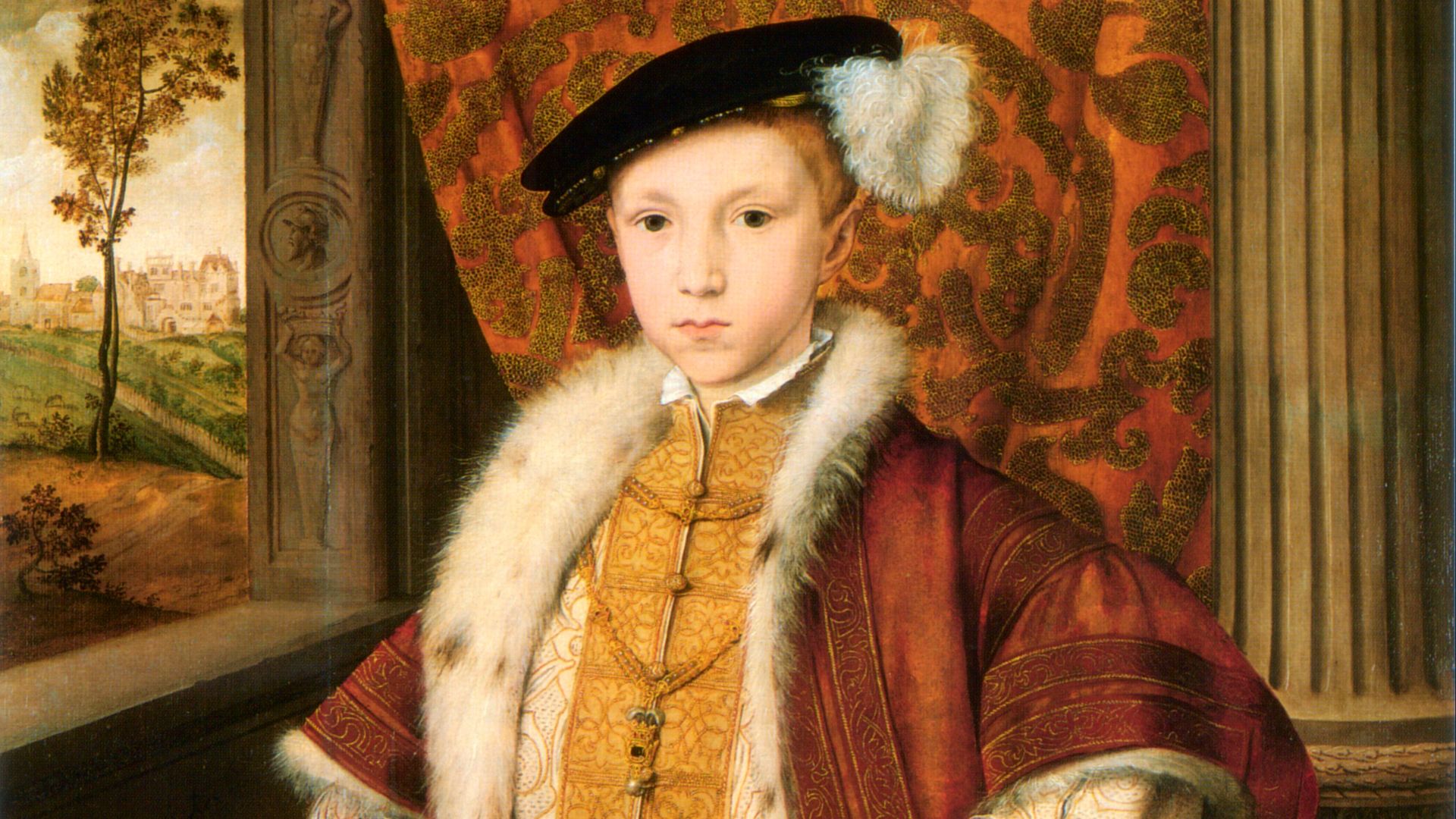
 Attributed to William Scrots (active 1537-1553) [1] on Wikimedia
Somewhere around 1477, a boy was born in England who would be crowned king, lead an invasion, and then spend the rest of his life serving meat to the man who defeated him. His name was Lambert Simnel, and his story reads less like medieval history and more like something a novelist would get rejected for being too implausible. Yet it happened, and the paper trail is solid enough that we can trace most of it through chronicles written within living memory of the events.
The story gets reduced to a footnote about early Tudor instability, but it deserves more than that. It touches on the fragility of Henry VII's grip on England, the raw ambition of Yorkist exiles, and the strange mercy of a king who chose to humiliate his would-be usurper with an apron rather than an axe. Here is how a ten-year-old child became the centerpiece of one of the most serious challenges the first Tudor monarch ever faced.
A Boy Groomed for a Throne
The earliest reliable account of Simnel comes from Polydore Vergil's Anglica Historia, written in the early sixteenth century with access to firsthand witnesses. According to Vergil, Simnel was the son of a tradesman, most likely an organ maker or joiner named Thomas Simnel. A priest named Richard Symonds identified the boy as physically suitable for a deception and took him under his tutelage around 1486, drilling him in courtly manners, Yorkist genealogy, and the kind of speech that would need to hold up under scrutiny from people who actually remembered the court of Edward IV.
The original plan was to pass Simnel off as Richard, Duke of York, one of the princes who had vanished in the Tower under Richard III. Symonds eventually settled on a different target: Edward, Earl of Warwick, the young nephew of Richard III whom Henry VII had imprisoned in the Tower of London after Bosworth in 1485. Warwick had a strong Plantagenet claim, and his near-total invisibility to the public made him far easier to counterfeit than someone people had actually seen.
Henry VII, apparently aware the plot was gathering momentum, paraded the real Earl of Warwick through the streets of London to publicly demonstrate that Simnel was a fraud. The gesture landed with a thud. The Yorkist network had already committed too much to stop, and some of them suspected the man Henry was parading around was himself a substitute. The propaganda war was already lost before it started.
The Making of a King in Dublin
Ireland turned out to be the conspiracy's most important asset. Gerald FitzGerald, the eighth Earl of Kildare and Lord Deputy of Ireland, threw his considerable political weight behind the pretender. On May 24, 1487, Lambert Simnel was crowned King Edward VI in Christ Church Cathedral in Dublin. Contemporary accounts note that the coronation used a circlet borrowed from a nearby statue of the Virgin Mary, because no proper regalia was available. That single detail captures how improvised and desperate the whole enterprise really was.
The money and military muscle came from Margaret of Burgundy, the sister of Edward IV, who funded the operation from the continent with serious resources. She hired Martin Schwartz, a skilled German mercenary captain, who brought roughly 2,000 Landsknecht soldiers to the cause. Combined with Irish levies and a contingent of English Yorkist exiles led by John de la Pole, Earl of Lincoln, the invasion force that landed on the Lancashire coast in June 1487 was far from a ragtag mob.
John de la Pole was the most dangerous figure in the coalition by a significant margin. He had been named Richard III's heir before Bosworth, he carried genuine military experience, and his presence transformed Simnel from a puppet into the public face of a credible Yorkist restoration. Whatever you think of the enterprise, it was not amateurish at its core.
The Kitchen That Swallowed a King
The invasion ended at the Battle of Stoke Field on June 16, 1487, which many historians consider the true final engagement of the Wars of the Roses. Henry VII's forces, better organized and fighting on home ground, crushed the rebel army. John de la Pole was killed in the fighting. Schwartz died alongside him. Symonds was captured and imprisoned for the remainder of his life. Lambert Simnel, barely eleven years old and the nominal king of the entire operation, was taken alive.
Henry VII's response was calculated and, for a fifteenth-century monarch, almost theatrical in its restraint. Rather than executing a child, he put Simnel to work as a scullion in the royal kitchens. The Great Chronicle of London and later Tudor sources confirm that Simnel eventually rose through the household to become a falconer in the king's service, a position requiring genuine skill and a degree of trust from his employer.
We don't know when Lambert Simnel died. He simply fades from the record sometime in the early sixteenth century, an ordinary man at the end of a wildly unordinary life. Henry kept him close, which was smart politics, and apparently treated him well enough that Simnel never became a cause again. The kitchen boy who was made a king lived out his days turning spits and training birds of prey for the man who took his crown, and the whole thing is stranger, sadder, and more human than most history books bother to say.
KEEP ON READING

From Heroes To Zeroes 20 Historical Figures Whose Heroism Was…
History is full of legends, but not every hero lived…
By Noone Feb 25, 2026
The Clueless Crush: How I Accidentally Invited a Hacker Into…
Fluorescent Lights and First Impressions. My name is Tessa, I'm…
By Ali Hassan Nov 4, 2025
This Infamous Ancient Greek Burned Down An Ancient Wonder Just…
History remembers kings and conquerors, but sometimes, it also remembers…
By David Davidovic Nov 12, 2025
Einstein's Violin Just Sold At An Auction—And It Earned More…
A Visionary's Violin. Wanda von Debschitz-Kunowski on WikimediaWhen you hear…
By Ashley Bast Nov 3, 2025
The Mysterious "Sea People" Who Collapsed Civilization
3,200 years ago, Bronze Age civilization in the Mediterranean suddenly…
By Robbie Woods Mar 18, 2025
What Prehistoric Footprints Reveal That Bones Never Could
Jeremy Bishop on UnsplashBones are powerful evidence, but they usually…
By Elizabeth Graham May 14, 2026