

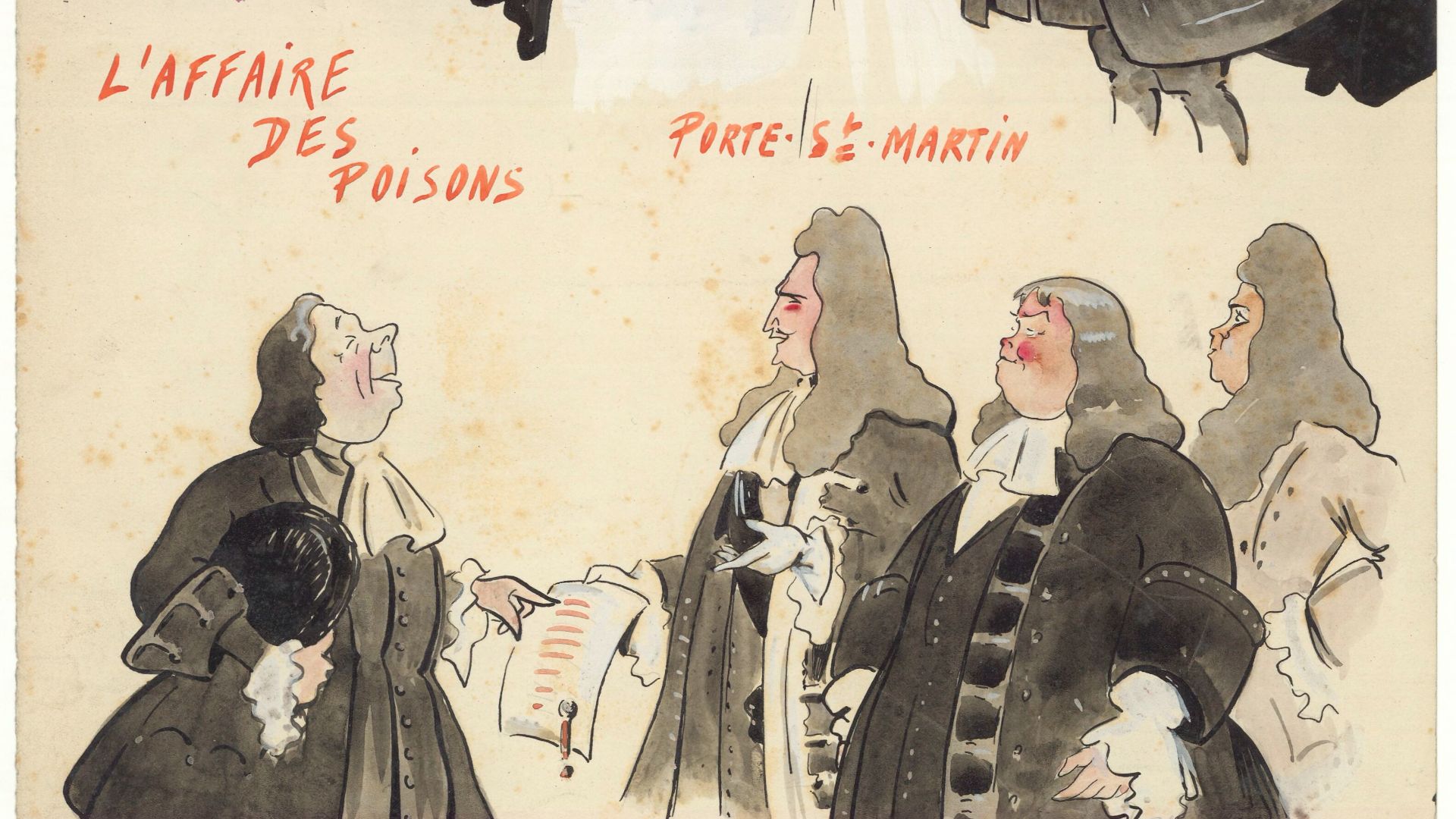
Paris in the late 1670s had a poison problem, or at least believed it did, which for the purposes of a moral panic amounts to the same thing. Aristocrats were dying at inconvenient moments. Fortunes were changing hands faster than inheritance law could account for. Somewhere underneath the gilded surface of Louis XIV's France, a shadow economy of fortune-tellers, abortionists, and alleged poisoners had built itself a thriving clientele that stretched, investigators would eventually discover, all the way to Versailles.
The Affair of the Poisons began formally in 1677 when the Paris chief of police, Nicolas de la Reynie, launched an investigation that would last five years, result in the arrest of more than 440 people, and eventually implicate the king's own mistress. What it produced was one of the most revealing episodes in French history, not because poison was quite as ubiquitous as the panic suggested, but because of what the panic itself exposed about power, gender, and the strange underground life that flourished beneath the court's elaborate surface.
When the Investigation Opened a Trapdoor
The case cracked open through the arrest of a woman named Marie Bosse in 1679, who had allegedly bragged at a dinner party about how effectively her poisons had produced certain very convenient widows and widowers. La Reynie, already suspicious of a broader network after years of unexplained aristocratic deaths, began pulling the thread. What unraveled was a web centered on a midwife and fortune-teller named Catherine Deshayes Monvoisin, known to her clients as La Voisin, who operated out of a house in Villeneuve-sur-Gravois and whose customer list read like an index to the French nobility.
La Voisin was not a lone operator. She worked with a network of priests, apothecaries, and self-styled alchemists who supplied love potions, aphrodisiacs, and poisons disguised as cosmetics, and who allegedly performed black masses over the bodies of young women for clients seeking supernatural insurance on their romantic prospects. Historian Anne Somerset, in her 2003 study of the affair, noted that La Voisin's operation was less a criminal conspiracy than a service industry that had quietly grown to fill needs the official world refused to acknowledge.
The Chambre Ardente, the special judicial commission Louis XIV established in April 1679 to try the accused, eventually processed 442 defendants. Of those, 36 were executed, 23 were banished or sent to the galleys, and 218 were dismissed without conviction. The numbers alone suggest how quickly the investigation outgrew any tidy definition of guilt, and how much of the panic was producing its own momentum.
How the Panic Fed Itself
Moral panics follow a structural logic that historians have traced across centuries, and the Affair of the Poisons followed it with uncomfortable precision. Each confession extracted more names. Each name suggested a wider conspiracy. The accused, many of them tortured, had every incentive to implicate as many people as possible, both to demonstrate their cooperation and to spread suspicion broadly enough that it became impossible to prosecute everyone cleanly. The investigation began generating its own evidence.
Poison had specific cultural resonance in this period because it was understood as a woman's weapon. The term circulating in French pamphlets and court documents was la poudre de succession, inheritance powder, a phrase that collapsed murder, gender, and economic motive into three words. Women who stood to benefit from a husband's death were structurally suspicious in a legal system that otherwise gave them almost no economic agency. Lynn Wood Mollenauer, writing in her 2006 study of the affair, argued that the prosecution disproportionately targeted women precisely because poison had been gendered as a crime before the investigation even began.
The panic also had a geography. It was concentrated in Paris and Versailles, among people wealthy enough to pay for the services La Voisin and her associates provided, and prominent enough that their deaths or remarriages would register politically. The idea that poison was everywhere was largely the idea that it was everywhere among the people who mattered, which revealed as much about whose safety counted as it did about the actual distribution of arsenic across the capital.
When the King Closed the Lid
The investigation collapsed not from a lack of evidence but from an excess of it. In 1680, testimony began implicating Françoise-Athénaïs de Rochechouart, the Marquise de Montespan and Louis XIV's most powerful mistress, in allegations involving black masses and attempts to poison both the king and a romantic rival. La Reynie documented the accusations meticulously, and his personal papers, preserved today at the Bibliothèque nationale de France, show a man who took the charges seriously and was profoundly uncertain about what to do with them.
Louis dissolved the Chambre Ardente in 1682. Several of the most sensitive defendants, including those who had named Montespan directly, were imprisoned indefinitely under lettres de cachet rather than brought to trial, which meant they could neither be convicted nor publicly exonerate themselves. The king had used the investigation to dismantle the Parisian underworld and then shut it down the moment it threatened to reach Versailles. It was a pragmatic decision that left the historical record permanently smudged and the question of Montespan's guilt permanently unanswerable.
What the Affair of the Poisons ultimately demonstrates is that the panic was never purely about poison. It was about what happens when an unofficial economy of desperate people and powerful clients becomes briefly visible to the state, and then has to be made invisible again before it can say too much. The trapdoor opened, France looked down into it, and the king quietly pressed it shut.
KEEP ON READING

20 Powerful Ancient Egyptian Gods That Were Worshipped
Unique Religious Figures in Ancient Egypt. While most people are…
By Cathy Liu Nov 27, 2024
The 10 Scariest Dinosaurs From The Mesozoic Era & The…
The Largest Creatures To Roam The Earth. It can be…
By Cathy Liu Nov 28, 2024
The 20 Most Stunning Ancient Greek Landmarks
Ancient Greek Sites To Witness With Your Own Eyes. For…
By Cathy Liu Dec 2, 2024
10 Historical Villains Who Weren't THAT Bad
Sometimes people end up getting a worse reputation than they…
By Robbie Woods Dec 3, 2024
One Tiny Mistake Exposed A $3 Billion Heist
While still in college, Jimmy Zhong discovered a loophole that…
By Robbie Woods Dec 3, 2024
30 Lost Treasures That Vanished From History
Buried treasure, missing artefacts, legends of ancient gold in them…
By Robbie Woods Dec 3, 2024