

I Got Fined $200 for Being 10 Minutes Late With My Trash Can, So I Investigated My HOA President and Discovered Something Much Worse
I Got Fined $200 for Being 10 Minutes Late With My Trash Can, So I Investigated My HOA President and Discovered Something Much Worse
The Cream-Colored Envelope
I got home from the grocery store on a Tuesday morning, reusable bags cutting into my forearms, and there was a cream-colored envelope taped to my front door. Not tucked under the mat, not left in the mailbox — taped. Centered. Like someone had taken their time with it. I figured it was a flyer for a lawn service or maybe a neighborhood potluck, so I peeled it off with my elbow and didn't even look at it until I'd dropped the bags on the counter. The letterhead stopped me cold: Meadowbrook Homeowners Association, Official Violation Notice. I actually laughed. I read it twice, thinking I'd missed something, because the fine listed at the bottom was two hundred dollars. Two hundred. For a trash can. Specifically, for leaving my trash can at the curb past the eight o'clock retrieval deadline. I grabbed my phone off the counter and pulled up the screen history — I'd been home since 7:45, and my last app timestamp showed 8:10 when I'd gone outside. Ten minutes. I owed two hundred dollars for ten minutes. I set the notice down on the counter next to a bag of apples and just stood there, the refrigerator humming behind me, the whole thing too absurd to be properly angry about yet.
 Image by RM AI
The Flat Expression
I gave myself about twenty minutes to calm down, then I walked across the street with the notice in my hand. I was completely reasonable about it — I want to be clear about that. I wasn't storming over there. I genuinely thought there'd been some kind of clerical error, that Janice would look at the paper, look at me, and say something like, 'Oh, ten minutes, let me get that corrected.' She answered the door in a blazer. At ten-thirty in the morning. On a Tuesday. She looked at the notice when I held it out, then looked back at me with an expression that gave away absolutely nothing. I explained the ten-minute discrepancy, kept my voice even, even smiled a little. She said, 'The rule is eight o'clock, Ms. —' and then just my last name, flat, like she was reading from a manual. No apology. No acknowledgment that ten minutes and two hundred dollars were wildly disproportionate. She handed the paper back to me and said the fine was due within thirty days. I stood there for a second, genuinely at a loss, and then I said okay and turned to leave because what else do you do — and that's when I saw it, just at the corner of her mouth, the smallest upward tick.
 Image by RM AI
Brad from Accounting
Here's the thing — it wasn't even like I'd forgotten about the trash can. I knew exactly where it was and exactly what time it needed to come in. The problem was Brad. Brad from accounting. We had a seven-thirty video call that morning, which I'd logged into from my kitchen table still in pajama pants because I work from home and that is one of the few genuine perks. Brad had a quarterly budget update to walk through, which should have taken twenty minutes. Brad does not do twenty minutes. Brad opened a spreadsheet so large it had its own loading time, and then he shared his screen and started narrating every single cell out loud. I watched the garbage truck roll down my street at 7:52 through the kitchen window, made a mental note — can, after call, two minutes, easy — and then Brad pivoted to a sub-tab about projected Q3 variances. I muted myself and mouthed something I won't repeat here. The call finally ended at 8:07. I jogged outside in my slippers, grabbed the handle, and dragged the can up the driveway. Eight-ten, according to my phone. I'd been watching that clock for fifteen minutes, counting down, and I still missed it by ten. I sat back down at my kitchen table afterward and just stared at the spreadsheet still open on my screen, the garbage truck long gone, Brad's voice still somehow echoing in my head.
 Image by RM AI
Standing in the Driveway
I'd been so focused on getting back inside and rejoining whatever Brad was still saying that I almost didn't register it. But I did register it, and now I couldn't stop thinking about it. When I grabbed the trash can handle at 8:07, I glanced up out of habit — the way you do when you step outside — and Janice was standing in her driveway across the street. Not walking to her car. Not checking her mailbox. Not doing anything, really. Just standing there, completely still, holding her phone in one hand, facing my house. I waved, because that's what you do when you make eye contact with a neighbor. She didn't wave back. She didn't move at all. She just kept looking. I dragged the can up the driveway and went back inside, and I remember thinking it was a little odd, the way she was so completely stationary, but I had a call to get back to and a spreadsheet to pretend to care about, so I let it go. That was the part that kept coming back to me now, sitting with the violation notice on my counter. She'd been standing there. Phone in hand. Completely still. Just standing there, facing my house, at 8:07 in the morning, and I hadn't thought anything of it at the time.
 Image by RM AI
How It Used to Be
The thing is, this neighborhood used to be genuinely nice. Not nice in a performative, everyone-has-matching-shutters way — nice in a real way, where people waved from their porches and nobody measured your lawn with a ruler. I moved in five years ago and the HOA was basically a formality. There were rules, sure, but they were the obvious ones: don't park a boat in your front yard, keep the grass under control, that kind of thing. Then Janice got elected president three years ago, and within six months there was a twenty-page addendum to the bylaws sitting in everyone's mailbox. Twenty pages. Covering things like acceptable mailbox fonts — plural, there was a list — and approved shades of window trim. I'm not exaggerating. Someone got cited for a lawn that measured half an inch over the height limit. A garden gnome was rejected as 'visually disruptive to neighborhood aesthetic.' The neighborhood Facebook group became a running support thread, full of screenshots of Janice's enforcement emails with laugh-cry emojis and neighbors venting about whatever the latest enforcement was. But here's the thing — everyone paid. Every single time. It was easier than fighting, and nobody wanted to be the person who made it worse. I'd done the same thing myself, honestly, until now. And then I remembered the post someone had shared a few months back: one neighbor, fined three separate times in a single month.
 Image by RM AI
The Documentation File
I sat back down at my desk after the Janice conversation and opened a work document I had absolutely no intention of reading. I just needed something to stare at while my brain caught up. Two hundred dollars. For ten minutes. I kept turning it over, not in a hot, explosive way — more like a slow burn, the kind that's actually worse because it doesn't go anywhere. I thought about all the neighbors who'd gotten notices, all the laugh-cry emojis in the Facebook group, all the people who'd just quietly written the check and moved on. I pulled up my bank account and looked at the balance for a long moment. I could pay it. That wasn't the issue. The issue was that paying it felt like agreeing that this was fine, that two hundred dollars for ten minutes was a reasonable thing that happened to reasonable people. I closed the bank tab. I wasn't going to write that check. I didn't have a plan yet — I want to be honest about that, I had no idea what I was actually going to do — but I knew I needed to start somewhere. I opened a new blank document, clicked into the title field, and typed: Janice Documentation.
 Image by RM AI
The Facebook Group
I'd been in the neighborhood Facebook group before, mostly to see if anyone knew why the power was out or whether the ice cream truck had a schedule. I'd scrolled past the Janice posts without paying much attention, the way you scroll past anything that doesn't directly affect you yet. Now I went back and actually read them. There were a lot. Screenshots of her enforcement emails, which were written in this very formal, slightly airless tone that somehow made them funnier and more infuriating at the same time. Posts about neighbors who'd repainted their shutters the wrong shade of beige and gotten notices within forty-eight hours. Someone whose recycling bin was two inches outside the designated retrieval zone. A guy who'd gotten a written warning because his holiday lights were still up on January 7th — one day past the approved display window. The comments were all the same flavor: laugh-cry emojis, 'this can't be real,' 'I got one too,' and then nothing. No one pushing back. No one saying they'd refused to pay or filed a complaint or done anything except vent and comply. I kept scrolling, and then I stopped on a post from a woman three streets over who'd written, in all caps, that she had received three separate violation notices in a single month, totaling over four hundred dollars in fines.
 Image by RM AI
The Decision
I closed the Facebook group and sat in the quiet for a while. My laptop was still open, the Janice Documentation file sitting there with nothing in it yet except the title. I thought about that woman three streets over and her four hundred dollars. I thought about the guy with the holiday lights and the neighbor with the recycling bin and the person whose garden gnome got rejected. I thought about all of them sitting down and writing checks, one after another, because it was easier. I understood that impulse completely — I'd felt it myself, standing on Janice's porch an hour ago, saying 'okay' and turning to leave. But something had shifted. Paying that fine meant the ten minutes were the problem. It meant the rule was reasonable and I was the one who'd failed to meet it, and I didn't believe either of those things. I wasn't going to write the check. I didn't have a plan — not even close to a plan — but I knew that I was going to be the first person in this neighborhood to not just quietly comply, and that felt like something. The house was still around me, the laptop screen glowing, and for the first time since I'd peeled that envelope off my door, the absurdity of it had stopped being funny.
 Image by RM AI
The Bylaws
I found the HOA bylaws on the community website around ten o'clock that night, tucked under a tab labeled 'Governing Documents' that I had never once clicked in the two years I'd lived here. There wasn't just one document. There was the main bylaws PDF, a CC&R addendum, a separate enforcement protocol document, something called the Architectural Review Guidelines, and a fine schedule that had apparently been updated three times since 2019. I downloaded all of them. The main bylaws alone was forty-seven pages. I started at the beginning, which felt responsible, and by page six I was already lost in language about quorum requirements and notice periods and something called a 'cure period' that I had to read four times before I understood it meant the window you get to fix a violation before the fine kicks in. There were sections on board meeting procedures, documentation requirements, appeal rights, and a whole subsection on how violations had to be issued and recorded. Janice clearly knew every word of this. I was going to have to learn it too. I made a fresh coffee, pulled the laptop closer, and settled in. The pages kept coming, dense and procedural and relentless, and the night stretched out around me.
 Image by RM AI
The Full Guidelines
The full guidelines document was a separate download from the bylaws — sixty-two pages, formatted like a government manual, with a table of contents that had subsections inside subsections. I started with the sections most likely to be relevant: exterior modifications, property maintenance, and what they called 'aesthetic compliance.' The maintenance standards were exactly what you'd expect — lawn height maximums, weed thresholds, that kind of thing. But the section on accessory structures was more detailed than I anticipated. Sheds, pergolas, detached garages, even decorative fencing — all of it required prior written approval from the Architectural Review Committee, which, as far as I could tell from the board roster, was basically Janice. The approval process had a checklist. Materials had to meet specific standards. And then I hit the color requirements. Accessory structures had to be painted in one of two approved colors: Mountain Gray or Forest Green. Those were the only options. The document even included the specific paint brand and code numbers. The HOA's stated reason was 'visual harmony and a cohesive neighborhood aesthetic.' I sat back and read that sentence again. Mountain Gray or Forest Green. No exceptions listed. No variance process mentioned. I kept reading, but something about that section stayed with me.
 Image by RM AI
The First Walk
Monday morning I decided to actually walk past Janice's house instead of just thinking about it. I told myself it was just a walk. People walk. I live in a neighborhood. This is a normal thing that normal people do. I left around nine-thirty with my hands in my hoodie pocket and took the long way around so I'd approach from the far end of her street rather than directly from mine, which, in retrospect, was maybe not the behavior of someone who was just casually walking. Her house was a beige two-story with black shutters — I'd driven past it a hundred times but never actually looked at it. The lawn was immaculate. Aggressively immaculate. The kind of lawn that makes you feel judged. The flower beds were edged with military precision. I slowed my pace just slightly, taking in the details, and caught a glimpse of movement through the front window — Janice, or someone, passing through the room. I kept moving, looped around the block, and headed home. Nothing dramatic happened. No confrontation, no revelation. But somewhere between leaving my front door and getting back to it, something had shifted in how I was moving through the neighborhood — like I'd switched from passenger to something else entirely.
 Image by RM AI
Grass and Oil
Tuesday afternoon I went back. I'd been thinking about the grass height maximum from the guidelines — three and a half inches — and I wanted to see if Janice's lawn actually held up under that standard. I walked slowly on the sidewalk side, which is public property, which I kept reminding myself. The lawn looked perfect at a glance, but when I really focused on it, the grass near the far edge by the flower bed looked just a little shaggy. Maybe a quarter inch over. Maybe less. Honestly, it was hard to tell without a ruler, and I did not have a ruler, and I was not going to crouch on the sidewalk with a ruler in front of Janice's house. I kept walking. And then I saw it — near the garage door, a dark patch on the driveway. Small, maybe the size of a dinner plate, but unmistakably an oil stain. I pulled out my phone. The guidelines had a clause about vehicle storage areas being kept clean and presentable. I took one photo, then stepped slightly to the left and took another from a better angle. The stain sat there on the concrete, dark and unambiguous, and I added it to my camera roll.
 Image by RM AI
The Phone Notes
That evening I opened the notes app on my phone and created a new file. I titled it 'Janice Observations' and immediately felt like either a very organized person or a person who had made some interesting life choices. Probably both. I transferred everything I'd mentally logged into actual timestamped entries — Monday 9:34 a.m., grass length near east flower bed, estimated quarter-inch over maximum, visibility good, overcast. Tuesday 2:17 p.m., oil stain on driveway, approximately twelve inches in diameter, located three feet from garage door, photos attached. I added a column for the relevant HOA rule section next to each entry. I noted weather conditions, which felt either thorough or unhinged depending on how you looked at it. I cross-referenced the fine schedule to see what each violation would theoretically cost. The oil stain alone would have been a fifty-dollar fine if issued to anyone else in the neighborhood. I reviewed the entries twice, adjusted the formatting so the timestamps were consistent, and set the phone down on the coffee table. The list was short. Two entries, two minor infractions, nothing that would make anyone blink. But it existed now, organized and dated, and I found myself already thinking about what the next entry would say.
 Image by RM AI
The Sprinkler Head
Wednesday morning I carried a travel mug of coffee on my walk, which made the whole thing feel significantly more casual and not at all like I was conducting surveillance on my HOA president. I timed it for seven-fifteen, before most people were out, and took my usual loop. Janice's sprinkler system was running when I passed. I slowed down — just a little, just enough — and watched the spray pattern on the front lawn. One of the heads near the sidewalk edge was angled wrong. Not dramatically wrong, but the spray was clearly reaching the public walkway, sending a thin arc of water across the concrete. The guidelines had a section on irrigation systems and water conservation, and there was specific language about spray not extending beyond property boundaries onto public infrastructure. I took a photo of the sprinkler head, then a wider shot showing the wet patch on the sidewalk. I added the entry to my phone notes when I got home: Wednesday 7:22 a.m., sprinkler head on north lawn edge, spray extending approximately eighteen inches onto sidewalk, photos attached, relevant section 4.7(b). I sat at my kitchen table and looked at the list. Three entries now. Grass, oil, water. Each one technically a violation, each one the kind of thing that would get anyone else in this neighborhood a formal notice. Each one also, on its own, completely insufficient for whatever it was I was actually trying to do.
 Image by RM AI
The Morning Routine
Thursday morning I woke up and my first thought — before coffee, before checking my phone, before anything — was what time I should do my walk. Not whether I should do it. Just when. I noticed that, in the way you notice something that's already been true for a few days without you officially acknowledging it. I made my coffee, put it in the travel mug, grabbed my phone, and headed out at seven-twenty, which had apparently become my time. The route had settled into something automatic — down my street, left on Birchwood, past the Hendersons' place, and then Janice's block. The Hendersons waved from their driveway. A woman I vaguely recognized from the neighborhood Facebook group gave me a nod. I was, to all outward appearances, a person who had simply developed a healthy morning walking habit. I added a note when I got home, same as every other morning. And then I sat down and scrolled back through the entries to add something and realized the timestamps went back seven consecutive days. Seven mornings in a row, same route, same block, same house. I'd been doing this every single day for a week without once deciding to start.
 Image by RM AI
The Wrong Sticker
Thursday afternoon I went out again — I'd started doing a second pass some days, telling myself it was just a different time of day, different light, different things to notice. Janice's recycling bin was at the curb for pickup, the blue lid propped open slightly. I almost walked past it. But I glanced at the side panel out of habit, where the address number sticker is supposed to go, and something looked off. I stopped, took a step back, and looked again. The sticker on the bin read 412. Janice's house was 421. Wrong number, wrong bin — which under the waste management identification requirements in the HOA guidelines counted as a recordable violation, because bins had to be clearly and correctly labeled to prevent misrouting. I took a photo of the sticker, close enough that the numbers were legible. I walked home, opened my notes app, and typed the entry: Thursday 3:48 p.m., recycling bin at curb, address sticker reads 412, correct address 421, photo attached, relevant section 6.2(c). Then I scrolled up and read through the whole list from the beginning. Grass. Oil stain. Sprinkler. Recycling bin. Four violations, all documented, all timestamped, all completely minor. Nothing that added up to anything yet.
 Image by RM AI
The Trash Can at Noon
Thursday morning I looped past Janice's street a little before eleven-thirty, mostly out of habit at that point. I wasn't expecting anything. I was just walking. And then I stopped dead on the sidewalk, because there it was — Janice's trash can, sitting right at the curb, bold as anything, in full view of the entire neighborhood. Pickup had been hours ago. I checked my phone: 11:43 a.m. The same rule I'd been fined two hundred dollars for violating — section 4.1(b), cans must be removed from the curb by eight a.m. on collection day — was being broken by the woman who had written me that fine herself. I took photos. Multiple. I made sure the timestamps were visible and the house number was in frame. Then I stepped back across the street and waited, because I am apparently that person now. At 11:47 a.m., the front door opened and Janice walked out in a linen blazer, completely unbothered, and wheeled her trash can back up the driveway like she had all the time in the world.
 Image by RM AI
The Insufficient Evidence
I sat at my desk that evening and opened everything — the notes app, the photo folder, the little running log I'd been keeping since this whole thing started. Grass clippings on the sidewalk. Oil stain on the driveway. Sprinkler running during a restriction window. Recycling bin with the wrong address sticker. Trash can at the curb until 11:47 a.m. Five entries. Timestamped, photographed, cited to specific guideline sections. It looked thorough. It looked organized. And it added up to almost nothing. The trash can one was satisfying in a deeply petty way, don't get me wrong — the hypocrisy of it was almost beautiful. But I couldn't exactly march into a board meeting and demand justice over a recycling sticker and some overspray. Janice would laugh me out of the room. She'd call it a personal vendetta, and honestly, looking at my list, I wasn't sure I could argue otherwise. Minor infractions. Technical violations. Nothing that justified a two-hundred-dollar fine, and nothing that would make anyone take me seriously. I closed the folder and sat there in the quiet, knowing I needed to find something that actually mattered.
 Image by RM AI
Looking Deeper
I kept thinking about Janice's house. Not the front of it — I'd walked past the front a hundred times. I knew the front. Perfectly edged lawn, matching planters, the little brass house numbers that were probably polished on a schedule. The front was the whole point. The front was the performance. But I'd never really looked at the rest of it. I thought about that for a while, sitting at my desk after I closed the documentation file. Someone who cared that much about appearances — who spent that much energy making sure everything visible was flawless — made me wonder what was happening in the parts that weren't as easy to see. I wasn't sure what I was looking for. I didn't have a theory. I just had a feeling, the kind that's hard to explain without sounding paranoid, that the perfect exterior was doing a lot of work. I decided I'd take a different route on Friday. Come at the block from the other end, walk slower, pay attention to angles I'd been ignoring. I didn't know what I'd find. Maybe nothing. But the feeling that there was something to find had settled in and wasn't going anywhere.
 Image by RM AI
The Gap in the Fence
Friday morning I came at Janice's block from the far end, the way I almost never walked. Different angle, slower pace, actually looking instead of just moving. The front of the house was the same as always — immaculate, symmetrical, aggressively normal. But as I kept walking and the angle shifted, I noticed the privacy fence running along the side yard and around the back. Six feet tall, cedar boards, the kind that's meant to make sure nobody sees anything. I'd registered it before without really seeing it. This time I was paying attention. Near the back corner, where the fence met the property line, two boards had shifted slightly out of alignment — not a big gap, maybe an inch and a half, two inches at most. I slowed down. I adjusted my position on the sidewalk, staying on the public side, and tilted my head just enough to look through. And there, past the corner of the garage, tucked back where you'd never spot it from the street, was a backyard I had never actually seen before.
 Image by RM AI
The Beige Shed
I stood there on the sidewalk and looked through that gap for probably thirty seconds, which felt like a lot longer. The backyard was tidy — of course it was — but what caught my eye immediately was the structure sitting behind the garage. A storage shed, decent-sized, the kind you'd use for lawn equipment or seasonal stuff. It was tucked back far enough that the garage blocked it completely from the street view, which explained why I'd never noticed it in two years of walking this block. What I noticed, standing there squinting through a two-inch gap in a cedar fence like an absolute professional investigator, was the color. Not gray. Not green. The shed was beige. That specific contractor-beige that comes standard on prefab structures when nobody has bothered to paint them to match anything. I'd seen other sheds in the neighborhood — the Hendersons' was a dark gray, the one on Maple Court was forest green. This one was just beige, sitting there behind Janice's garage, completely unbothered. I took a photo through the gap, steadied my hand, made sure the color came through clearly. Something about that color felt like it didn't belong here.
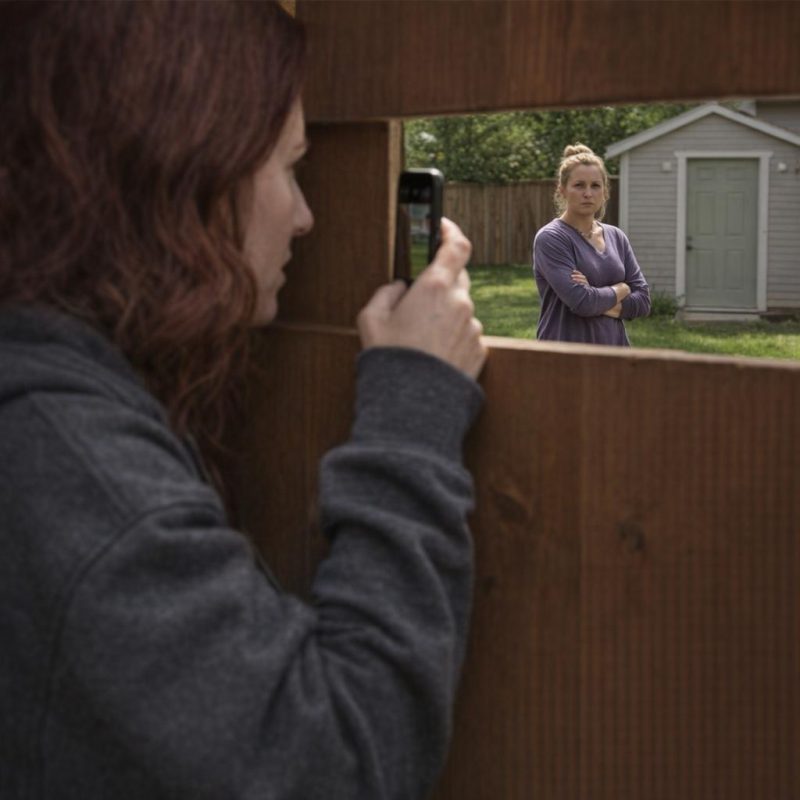 Image by RM AI
Page Fourteen
I walked home faster than I needed to. I opened my laptop before I even took off my shoes and pulled up the HOA guidelines PDF — the full document, not the summary version they hand out at move-in. I typed 'accessory structures' into the search bar and let it run. The results took me to page fourteen. The language was not ambiguous. Section 8.3(a): all accessory structures, including but not limited to storage sheds, detached workshops, and playhouses, must be painted or finished in one of the two HOA-approved colors for visual harmony with the neighborhood aesthetic. The approved colors were listed directly below: Mountain Gray and Forest Green. That was it. Two options. No exceptions noted, no variance language, no 'or equivalent.' Mountain Gray or Forest Green. I pulled up the photo I'd taken through the fence gap and held my phone next to the laptop screen. The shed in the photo was not Mountain Gray. It was not Forest Green. It was contractor-beige, plain as anything, sitting there in violation of section 8.3(a) of the same document Janice had used to fine me two hundred dollars. I set my phone down and just sat with that for a moment.
 Image by RM AI
Documenting the Structure
Saturday morning I went back. I told myself I was just going for a walk, but I had my phone out before I even turned onto Janice's street. I positioned myself at the fence gap again and took my time. Multiple angles, as many as I could get through that two-inch opening — straight on, tilted up to catch the roofline, tilted down to get the base where the color was most saturated and unambiguous. I got seven photos total. In three of them, you could see the shed clearly enough to make out the structure and the color without any question. I stepped back, opened my notes app, and started a new entry. Saturday, 9:14 a.m. Accessory structure observed behind garage at 421. Beige exterior finish. Does not conform to approved colors listed in section 8.3(a), page fourteen of HOA Architectural and Property Standards Guidelines. Photos attached, timestamps visible, observed from public sidewalk. I read it back twice to make sure it sounded like documentation and not like a grudge. Then I opened my evidence folder, dropped in the photos, and added the new entry at the top of the list — section 8.3(a) violation, with the page citation right there next to it.
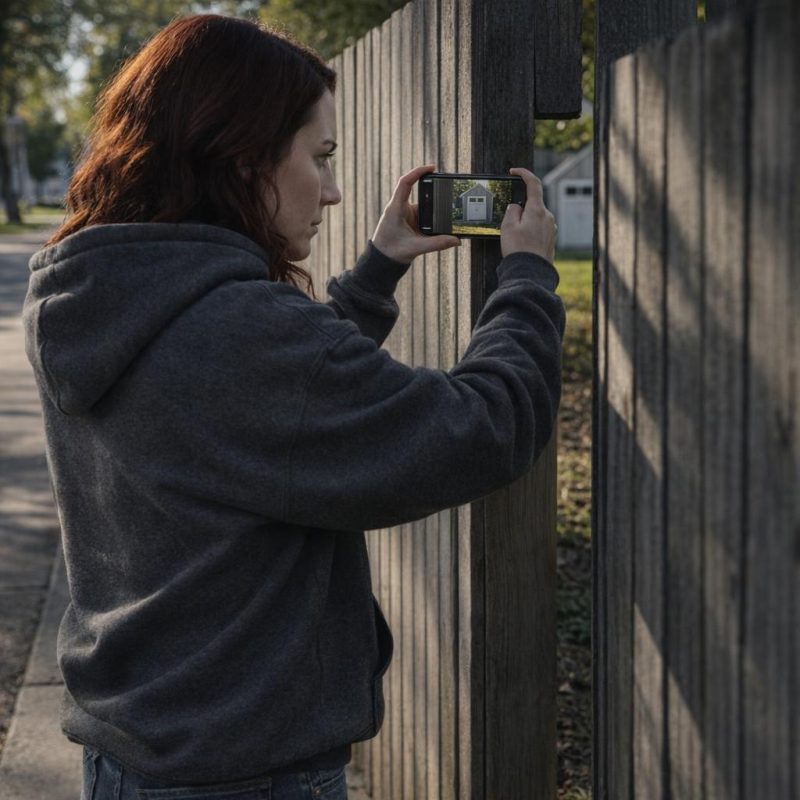 Image by RM AI
The Question of Approval
I spent Sunday afternoon staring at the shed photos and feeling slightly less triumphant than I expected. Because here was the thing I kept circling back to: what if Janice had gotten approval? HOA boards could grant exceptions. Variances happened. Maybe there was a meeting somewhere in the past few years where someone had motioned to allow a beige shed at 421 and everyone had said sure, fine, whatever, and it was all sitting in the minutes somewhere. I wouldn't know. I had no idea how to access board meeting minutes without going through the board, which meant going through Janice, which was obviously not an option. I didn't even know if the minutes were public record or just internal documents. The color violation was real — I could see it in the photos, I could read it in the guidelines — but if there was an approved exception on file somewhere, my entire case collapsed into nothing. I pulled up the guidelines again and searched for anything about variance procedures or exception requests. The document referenced board approval in two places but didn't say where those records were kept or how a resident could access them.
 Image by RM AI
Widening the Search
So I sat back and thought about it differently. The shed was real, the color violation was real, but one violation from one structure felt thin. Janice had fined me two hundred dollars over a trash can that was ten minutes late getting pulled in. If I was going to bring something to the board — or to anyone — I needed more than a single beige shed that maybe, possibly, had an approved exception buried in some file cabinet somewhere. I needed a complete picture. I pulled up the HOA guidelines again and went through every section that mentioned modifications, improvements, or additions. Fences over a certain height needed approval. Decks and patios needed approval. Any permanent structure needed approval. The list was longer than I expected, and the language was specific. I grabbed a notepad and wrote down every category. Then I opened Google Maps and pulled up the satellite view of Janice's property, which I knew was outdated but at least gave me a baseline. I was going to walk every accessible angle of that property — front, both sides, whatever I could see from the street or the sidewalk — and I was going to document every single thing I could see.
 Image by RM AI
The Weekend Watch
Saturday morning I put on my sneakers and told myself I was just going for a walk. Very casual. Totally normal. I was not a person conducting surveillance on my HOA president. I was simply a resident who enjoyed the neighborhood and happened to loop past the same house four times in two hours. The first pass I took from the front, slow enough to clock the fence line and the side yard. The shed was exactly where it had been, still beige, still wrong. Nothing else jumped out. I went around the block and came back from the opposite direction, checking the other side of the property. Same result. I did it again an hour later, this time cutting down the alley that ran behind the row of houses, trying to get a different sightline. The backyard was mostly blocked by the fence, but I could see through a gap near the garage — just enough to confirm the shed and not much else. No new deck. No fence extension. No mysterious additions. Just the one shed, sitting there in its unauthorized beige glory. I walked home feeling like I'd wasted my morning, and the quiet of my kitchen felt like it was agreeing with me.
 Image by RM AI
Something New
By Tuesday I had settled into a routine. Morning coffee, quick loop past Janice's street, back home to work. It had started to feel almost boring, which I think is what made Tuesday different — because when something actually changed, it hit me like a cold splash of water. I came around the corner at my usual pace and slowed down as I approached the fence gap near the garage. I looked through out of habit more than anything. And something was there that hadn't been there before. Something white and wooden, set back behind the garage area, catching the morning light. I stopped walking entirely. I stood on the sidewalk and stared through the gap, trying to make sense of what I was seeing. It wasn't the shed. The shed was still there, off to the left. This was something else, something bigger, and I was absolutely certain it had not been there on Saturday. I had looked through that exact gap twice. I had a photo from that angle. Whatever this was, it was new, and the certainty of that settled over me like a weight I hadn't expected to feel.
 Image by RM AI
The White Pergola
I didn't leave. I moved along the fence line slowly, trying different angles, looking for a better gap. About six feet down from the first one there was a spot where two fence boards had warped slightly apart, and if I positioned myself just right I could see a wider slice of the backyard. I pulled out my phone and held it up to the gap. What I was looking at was a pergola. A big one. White painted wood, four posts, a latticed roof structure, the whole thing. It looked like something out of a home improvement magazine — the kind of project that takes a full weekend and a crew of people who actually know what they're doing. It was set on a concrete pad behind the garage, positioned to face the back of the house. I took as many photos as I could through the gap, adjusting the angle each time to get different parts of the structure. The posts were thick and solid. The crossbeams were evenly spaced. And the wood — even from where I was standing, even through a warped fence board — the lumber was pale and clean, the paint bright white without a single scuff or weather mark, like it had come straight off the shelf.
 Image by RM AI
Hardware Store Stickers
I went straight home and pulled the photos up on my laptop where I could actually see them. On my phone screen they had looked fine, but on a fifteen-inch monitor I could zoom in properly. I went through each one slowly, enlarging different sections of the pergola. The wood grain was tight and pale, the kind that hasn't had time to open up from sun and moisture. The paint was flat and even, no fading, no chalking at the edges. And then I spotted them. On two of the visible beams, near the ends where they hadn't been cut, there were stickers. Small rectangular ones, the kind that come on lumber at the hardware store — price codes, product numbers, that orange-and-black color scheme I recognized immediately. They hadn't been peeled off. They were just sitting there on the wood, completely intact, which meant nobody had even bothered to remove them yet. I sat back and looked at the screen for a long moment. Those stickers don't survive weather. They don't survive a single rainstorm. The fact that they were still there, still clean, still readable — that told me everything I needed to know about how recently this thing had gone up.
 Image by RM AI
The Approval Requirement
I had been putting off going back through the full bylaws document because it was forty-three pages of dense HOA legalese and reading it felt like a punishment. But now I had a reason, so I opened it and went straight to the section on property modifications. It took me about ten minutes of ctrl-F searching to find what I was looking for, and when I found it, the language was not subtle. Any permanent structure — and the document gave examples, which included pergolas specifically, right there in the text — required written board approval prior to construction. Not after. Prior. The approval had to be formally requested, the board had to vote on it, and the vote had to be documented in the official Board of Directors meeting minutes. There was also a minimum seven-day notice requirement, meaning the request had to appear on a posted meeting agenda at least seven days before the vote could happen. I read the section three times to make sure I wasn't misreading it. I wasn't. The bylaw was clear: written approval, board vote, documented in meeting minutes, seven-day notice on the agenda.
 Image by RM AI
The Meeting Search
The HOA had a community website — one of those generic template sites with a stock photo of a neighborhood at sunset on the homepage. I had visited it exactly once, when I first moved in, and immediately forgotten it existed. I navigated back to it now and found the board meeting section, which listed agendas going back about eighteen months. I went through every single one. I searched for pergola. I searched for Janice's address. I searched for structure, approval, modification, improvement. I read through the agenda items line by line on the ones from the last two months, which was the window that mattered given how new the lumber looked. Nothing. Not a single entry that came close to what I was looking for. The agendas were short — usually a single page, sometimes two — with items like treasurer's report and neighborhood maintenance update and open forum. They read more like a rough outline of a meeting than any kind of official record. I closed the last one and sat there with the search results still open on my screen, all of them empty, and the quiet of that felt less like relief and more like hitting a wall.
 Image by RM AI
The Incomplete Record
I went back through the agendas one more time, slower, and that's when it really sank in. These weren't records. They were outlines. The longest one I could find was a page and a half, and it listed maybe eight agenda items with no detail under any of them — just a topic heading and a time estimate. There were no attachments. No linked documents. No minutes from the actual meeting, just the agenda that had been posted beforehand. Which meant I had no idea what had actually been discussed, voted on, or approved at any of these meetings. The agenda could say open forum and the board could have approved a seventeen-story addition to someone's house during that slot and I would have no way of knowing from what was posted on this website. The full meeting minutes — the actual official record of what happened — were somewhere else entirely, and I had no idea how to get to them, whether they were public record, or who even held them. I closed the laptop and sat with that gap, the one between what I could see on the website and what I actually needed, and it felt a lot wider than I'd hoped.
 Image by RM AI
Remembering Marcus
So I sat there staring at the laptop screen, thinking about who actually had access to the real meeting minutes — not the agenda skeletons on the website, but the actual documented record of what got discussed and voted on. The board had to keep those somewhere. And then it hit me: Marcus. Marcus Chen, the HOA treasurer. I'd almost forgotten about him. When I first moved in, I was completely lost on the parking rules — there was this whole thing about guest passes and overnight permits that made zero sense — and Marcus had walked me through all of it without making me feel like an idiot. He'd been patient, genuinely helpful, the kind of person who actually wanted neighbors to understand how things worked. As treasurer, he'd have access to all the board documentation. Financial records, meeting minutes, the whole paper trail. The question was whether I could ask him without it getting back to Janice and tipping her off that I was poking around. I didn't want to walk up to his door and make it weird. I needed something low-key, something that sounded like normal new-homeowner curiosity. I pulled the laptop back toward me and opened a new email.
 Image by RM AI
The Careful Email
I typed Marcus's name into the To field and then sat there for a solid two minutes just staring at the blinking cursor. This had to sound completely normal. Friendly. Slightly boring, even. I started with hey Marcus, hope you're doing well, which felt appropriately casual without being weird. Then I said I'd been thinking about getting more involved in the HOA and wanted to better understand how the board operated. Which was technically true, just not in the way I was implying. I mentioned that I'd looked at the website but the agendas didn't have a lot of detail, and asked if he'd be willing to share the last six months of meeting minutes so I could get a clearer picture of how things worked. I kept it short. No bullet points, no formal language, nothing that screamed I am building a case against your colleague. I read it back three times, changed the word appreciate to thanks because appreciate felt too stiff, and then read it one more time. It looked fine. It looked like a mildly civic-minded neighbor email. I moved the cursor to the send button and held it there for a second. Then I clicked it, and immediately felt my stomach drop the way it always does right after you do something you can't take back.
 Image by RM AI
No Problem
I told myself not to check my email for at least a few hours. I lasted maybe forty minutes. I was in the kitchen pretending to be interested in a podcast when my phone buzzed on the counter. I picked it up and there was Marcus, already in my inbox, timestamp showing less than an hour since I'd sent my message. The subject line just said Re: HOA Meeting Minutes and the body was maybe three sentences — something like hey, of course, happy to share these, here you go. No questions. No why do you want them, no let me check with the board first, no I'll have to get back to you on that. Just cheerful, immediate, completely unbothered helpfulness. And six PDF attachments, one for each month, sitting right there in the email like it was nothing. I downloaded all six files to my desktop and lined them up in a folder. The whole thing had taken less than ninety minutes from the moment I hit send. I'd spent more time agonizing over the wording of that email than it took Marcus to respond to it. Six months of official board meeting minutes, just sitting on my computer now, and nobody had asked me a single question about why I wanted them.
 Image by RM AI
Opening the Files
I sat down at my desk and looked at the six PDF icons lined up in the folder. March through August, each one labeled with the month and year in Marcus's tidy filename format. I felt this weird combination of excitement and something close to dread, like when you're about to open test results you've been waiting on. I clicked on March first. The document opened and I immediately noticed how different it looked from the agenda skeletons on the website. This was the real thing. There was a header with the HOA name and address, a list of board members present with their titles, timestamps for when the meeting was called to order and adjourned. Every agenda item had actual notes underneath it — discussion summaries, who made each motion, who seconded it, the vote count. It was dense and a little dry and formatted like something a paralegal would produce. I scrolled slowly, taking it in, getting a feel for how the information was organized before I started searching for anything specific. The language was formal in that particular way that official documents always are, full of phrases like it was moved and seconded and the motion carried unanimously. I hadn't expected it to feel so official, and somehow that made the whole thing feel more serious than it had five minutes ago.
 Image by RM AI
No Pergola
I started with the March file and used the search function to look for pergola. Nothing. I tried Hawthorne, which is Janice's street. Nothing. I tried backyard structure and outdoor addition and just Janice for good measure. Nothing in March. I opened April and ran the same searches. Nothing. May, same thing. I went through June, July, and August the same way, trying every variation I could think of — structure, construction, improvement, even just the word approval to see if anything came up near her name. Six files, six months, and not a single entry that mentioned anything about a pergola or any kind of backyard construction project at Janice's address. No motion. No vote. No approval. Not even a passing reference in the open forum sections. I leaned back in my chair and looked at the ceiling for a second. That pergola was sitting in Janice's backyard right now. I'd seen it. It was not small. And according to six months of official board meeting minutes, it had never once been brought before the board for approval. The same board that fined me two hundred dollars for leaving my trash can out ten minutes past the deadline. The same president who sent me a formal violation notice with her signature on it.
 Image by RM AI
The Expense Reports
I sat there for a minute feeling pretty satisfied with myself, honestly. I had something real now. Something documented. But I didn't close the files right away — I started scrolling back through the minutes more slowly, not looking for anything specific, just reading. That's when I noticed the expense reports. Each month's minutes had a financial section near the end, and attached to that section were itemized expense reports I'd completely blown past during my pergola search. I'd been so focused on finding the word pergola that I'd skimmed right over the financial pages. I went back to March and actually read through the expense section this time. There were line items for landscaping, pool maintenance, the usual stuff you'd expect an HOA to spend money on. But there were also reimbursement entries. Payments back to individual board members for expenses they'd apparently covered out of pocket. I scrolled through April, May, June. The reimbursements showed up in every single month. Sometimes there was one, sometimes two in the same month. The names and amounts varied, but one name kept appearing more than the others. I kept scrolling, month after month, the same entries showing up with quiet regularity.
 Image by RM AI
Administrative Expenses
I clicked back to the March expense report and actually read each line item instead of skimming. There was a reimbursement entry for administrative expenses, printing, seventy-five dollars. Below it, office supplies, one hundred twenty dollars. Both listed under the same name. I went to April — eighty-three dollars, described as administrative materials. May had a line for community outreach materials at ninety-eight fifty, and then a second reimbursement the same month for general office expenses. June had two separate entries as well, each with its own vague description that sounded plausible enough on its own. The minutes noted each one as approved with minimal discussion, just a motion and a second and a unanimous vote, same as everything else on the agenda. Individually, none of the amounts were outrageous. Seventy-five dollars for printing, sure. A hundred and twenty for office supplies, okay, maybe. But I kept clicking through the months and the entries kept appearing, month after month, always described in that same slightly vague administrative language. I couldn't point to any single line and say that's wrong. It was more that the pattern of it sat with me in a way I couldn't quite shake.
 Image by RM AI
Adding It Up
I grabbed a notebook from my desk drawer and a pen that actually worked, which took three tries. I went back to March and wrote down every reimbursement entry with the amount next to it. March: seventy-five dollars, one hundred twenty. That was a hundred and sixty-five just for the first month. April: eighty-three dollars. May: I counted three separate entries that added up to just over two-fifty. I kept going, flipping through June, July, August, writing down each number and adding as I went. The total kept climbing in a way that made me slow down and recheck my addition. I added it up twice because I thought I'd made a mistake the first time. Six months. One name on almost every line. I looked down at the number at the bottom of the notebook page and just sat there for a second. Nearly eighteen hundred dollars in reimbursements for things like printing and office supplies — and I couldn't stop turning that number over in my head, wondering how it had gotten so high.
 Image by RM AI
What Kind of Printing
I sat there staring at the number I'd written at the bottom of the page. Nearly eighteen hundred dollars. For a thirty-seven-home neighborhood. I tapped my pen against the notebook and tried to think about what that actually looked like in practice. Printing costs for newsletters — okay, sure. We got maybe four or five of those a year, one double-sided page each. Even if she was printing on fancy cardstock at a copy shop, that's what, twenty bucks a pop? Office supplies for a volunteer HOA board — what does that even mean? Sticky notes? A box of pens? I tried to do the math in a way that made the number make sense and I kept coming up short. Maybe HOA administration was more expensive than I thought. Maybe there were costs I wasn't aware of. I genuinely tried to give it the benefit of the doubt. But eighteen hundred dollars in six months, for a neighborhood the size of ours, for things like printing and supplies — the number just sat there on the page, not getting any smaller, not getting any easier to explain away.
 Image by RM AI
The Approved Vendor List
I remembered that the HOA had an approved vendor directory on the community website — I'd seen it when I first moved in and was trying to figure out who handled the pool maintenance. The directory existed specifically so homeowners knew which companies were vetted and authorized to work in the neighborhood. It was supposed to prevent conflicts of interest, keep quality consistent, that kind of thing. I navigated to the community portal, clicked through to the resources tab, and found it — a full list organized by service category. Landscaping, pool maintenance, printing services, general administrative vendors. It was actually pretty thorough. I pulled up the expense reports again in a separate window and set them side by side on my screen. The plan was simple: go through every vendor name from Janice's reimbursements and check it against the approved list. If everything was above board, they'd all match. I expected this to be the boring part — just confirming what was already there, crossing names off a list. I opened the first expense report and got ready to start checking.
 Image by RM AI
PrintQuick Solutions
I started with March. The first reimbursement listed a vendor called PrintQuick Solutions for newsletter printing. I scrolled through the approved directory — and there it was, PrintQuick Solutions, right under the printing services section. Okay. Fine. That one checked out. April had a landscaping vendor that also matched. I kept going, checking each name, and for a while it was exactly as boring as I'd expected. Most of them lined up. I was almost starting to feel a little silly about the whole thing. Then I hit May. There was a reimbursement for something called Summit Property Services — administrative support, the description said. I went through the approved directory twice. Summit Property Services wasn't there. I told myself maybe I'd missed it, scrolled through a third time. Still nothing. I went back to the expense report and kept reading. Two entries down, there was another one: Greenlawn Administrative Solutions. I checked the directory again. Greenlawn Administrative Solutions wasn't on the list either.
 Image by RM AI
No Search Results
I opened a new browser tab and typed Summit Property Services into the search bar. The results came back fast — a handful of generic business directory listings, the kind that get auto-generated when someone registers a name somewhere. I clicked the first one. The profile page was basically empty. No website link. No phone number. No address. No description of services. Just a name sitting in a template with nothing behind it. I tried a second listing. Same thing. I sat back and searched Greenlawn Administrative Solutions. The results looked almost identical — a couple of directory entries, no actual web presence, no contact information, no reviews, no history. I clicked through three different links and got the same hollow shell each time. No photos, no staff, no anything that would tell you this was a real company that did real work for real clients. I sat there with both search results open on my screen, one tab for each company, and something cold settled in my stomach. Two vendors. Two reimbursements. Two names that led absolutely nowhere.
 Image by RM AI
The Fake Vendors
I stared at those two empty browser tabs and the pieces just — clicked. These companies didn't exist. They weren't real businesses with a low web presence or a small local footprint. They were shells. Names on a form attached to a reimbursement request, and behind the names there was nothing. Which meant the expenses weren't real either. Janice had submitted reimbursements for services that were never performed, from companies that didn't exist, and the HOA had paid her back for all of it. Eighteen hundred dollars in six months, funneled through fake vendor names. And then I thought about the pergola. I pulled up the timeline in my head — when had it appeared? Spring. May, maybe early June. I went back to the expense reports. The Summit Property Services and Greenlawn Administrative Solutions reimbursements were clustered in May and June. The same window. The same months. The fake vendor payments and the pergola construction overlapped almost perfectly — and the pergola had never had a permit filed, the kind of structure that would have earned any other homeowner a violation notice before the concrete dried. I looked at the total in my notebook: eighteen hundred dollars, thirty-seven households, one president who controlled every line of the budget.
 Image by RM AI
Following the Money
I pulled up all six expense reports and lined them up across my screen as best I could, toggling between tabs with a running list in my notebook. I went through every single line and put a circle next to anything from Summit Property Services or Greenlawn Administrative Solutions. March had one. April had none. May had two — both clustered in the same two-week window. June had three, which was the heaviest month by a lot. July had one smaller one. August had two more. I added up only the circled entries, leaving out everything else. Nine hundred and forty dollars. Just from the fake vendors. Just in six months. Then I looked at the dates. May 3rd. May 17th. June 4th, June 9th, June 22nd. I thought about when the pergola had gone up. I'd noticed it sometime in late June — it had seemed to appear almost overnight, the way construction projects do when you're not watching closely. The payments and the construction overlapped almost perfectly. I wrote the total at the bottom of a fresh page, underlined it twice, and drew a line connecting it to the word I'd written at the top: pergola. Nine hundred and forty dollars, paid for by thirty-seven households who had no idea.
 Image by RM AI
The Smokescreen
I pushed back from my desk and just sat with it for a minute. Because here's the thing that kept turning over in my head — Janice wasn't just stealing. She was doing it while being the most aggressively rule-obsessed person in the entire neighborhood. She sent violation notices for trash cans left out ten minutes past the deadline. She documented paint colors that were half a shade off the approved palette. She fined people for parking on the street during family gatherings. She ran the HOA like a compliance audit that never ended. And the whole time, she was submitting fake vendor invoices and pocketing the money. The enforcement wasn't separate from the theft — it was cover for it. If you're the person who catches every infraction, who holds everyone else to an impossible standard, who projects total authority over the rules, nobody looks at you twice. Nobody questions your expense reports. Nobody asks what Summit Property Services actually does or why Greenlawn Administrative Solutions doesn't have a phone number. The fines, the notices, the two-hundred-dollar penalty she'd hit me with over a trash can — all of it had kept people too intimidated and too busy defending themselves to look at what she was doing. I sat there in my home office, the notebook open in front of me, and the whole thing finally made a terrible kind of sense.
 Image by RM AI
Three Years of Theft
Then I started thinking about the timeline. Janice had been HOA president for three years. I'd only pulled six months of expense reports — the ones I could access easily through the community portal. Six months, eighteen hundred dollars in total reimbursements, nine hundred and forty of that from vendors that didn't exist. If she'd been running the same scheme for three years, that was potentially thirty-six hundred dollars a year. Over three years, the number climbed past ten thousand dollars. Ten thousand dollars, pulled out of a fund that thirty-seven households paid into every single month. I thought about the beige shed she'd had installed in her backyard the previous fall — the one that had prompted exactly zero violation notices despite being a structure that definitely required board approval. I thought about every neighbor who'd quietly paid a fine rather than fight her, every household that had written a dues check without knowing where the money was actually going. Three years. Thirty-seven homes. And one person who had made herself so untouchable, so synonymous with the rules themselves, that nobody had thought to look. The number sat in my notebook, underlined twice, and the weight of it didn't move.
 Image by RM AI
Organizing the Evidence
I spent the better part of Wednesday evening at my kitchen table with my laptop, a printer that only jammed twice, and enough highlighters to stock a small office supply store. I created a new folder on my desktop — titled, with zero creativity, EVIDENCE — and started pulling everything together. Photos of the beige shed went in first, with a sticky note citing page fourteen of the HOA guidelines and the specific color requirements it violated. Then the pergola photos, the ones where you could still see the hardware store stickers on the brackets if you zoomed in. I printed six months of meeting minutes and highlighted every vote, every approval, every vendor authorization — and notably, the complete absence of any approval for either structure. I added the approved vendor directory alongside the expense reports, with Summit Property Services and Greenlawn Administrative Solutions circled in red. Printed search results showing exactly nothing for both companies. My calculations, showing nine hundred and forty dollars in reimbursements to vendors that didn't exist. The timeline connecting those payments to the month the pergola appeared in Janice's backyard. And finally, a one-page summary I'd written and rewritten four times until it was clean, factual, and impossible to misread. I stacked everything in order, slid it into a manila folder, and set it on the counter where I'd see it first thing in the morning.
 Image by RM AI
The Next Board Meeting
I'd been so focused on building the evidence packet that I hadn't actually checked when the next board meeting was. Classic. I pulled up the HOA community website Thursday morning, clicked over to the calendar, and there it was — board meeting, Thursday evening, seven p.m., community center room B. Thursday. As in, today. I sat back in my chair and did the math. I had roughly ten hours. That was fine. That was enough. The meetings had an open comment period for residents — I'd seen it listed on every agenda I'd downloaded — and that was my window. I went through the folder three more times, checking the order, making sure the summary page was on top. I practiced out loud in my living room, which felt ridiculous but helped. I kept my voice flat and factual, the way you'd present a spreadsheet to someone who didn't want to hear the numbers. I thought about how Janice might respond — the polite dismissal, the redirect, the suggestion that I'd simply misunderstood the vendor approval process. I ran through answers to all of it. By six o'clock I had my folder, my keys, and a very specific Thursday evening circled in red marker on the paper calendar I kept on my fridge.
 Image by RM AI
The Board Room
I got to the community center at six fifty-five, which meant I was the fourth person through the door and had my pick of seats. I took the back row. The room was a standard-issue HOA meeting setup — folding chairs arranged in loose rows, a long table at the front with name placards, fluorescent lighting doing nobody any favors. I counted about fifteen other residents filtering in over the next few minutes, most of them looking like they'd rather be anywhere else. Janice was already at the front table when I arrived, blazer pressed, blonde bob perfect, posture like she'd been installed there. Marcus sat to her left with a neat stack of papers in front of him. Sarah and Tom filled out the rest of the table, both of them scrolling through phones or shuffling documents. At exactly seven o'clock, Janice called the meeting to order in that clipped, efficient voice she used when she wanted everyone to know she was in charge. I had the folder in my lap, both hands resting on top of it. My heart was doing something loud and unhelpful. The agenda was printed on a half-sheet tucked under my chair — open comment period, last item before adjournment. I read it twice and set it down, and the weight of the folder under my hands felt like something I'd been carrying for weeks.
 Image by RM AI
Routine Business
The first twenty minutes were aggressively normal. Marcus walked the board through a landscaping bid for the common areas along the east fence — two contractors, a price difference of about three hundred dollars, a brief discussion about whether the cheaper option used the right grass seed. They voted. The motion passed. Then came the pool maintenance contract renewal, which generated a longer conversation than I would have thought possible about chemical treatment schedules. Sarah raised a question about guest parking enforcement near the visitor lot, and Tom suggested they add a clarifying sentence to the existing rule language so there was no ambiguity. Janice facilitated all of it with her usual efficiency — smooth, controlled, never a wasted word. She looked completely at ease up there. She looked like someone who had run a hundred of these meetings and expected to run a hundred more. I watched her and kept my hands flat on the folder in my lap. The clock on the wall read seven twenty-three. I'd checked it four times in the last ten minutes. Every vote, every motion, every polite procedural exchange felt like it was happening at half speed. But the agenda was the agenda, and open comments were next, and the folder in my lap held everything I needed.
 Image by RM AI
Open Comments
Janice looked down at her agenda sheet and announced the open comment period in the same tone she'd used for the landscaping bid — efficient, routine, like it was just another box to check. She asked if any residents had concerns they'd like to address. I took one breath. Then I stood up. The scrape of my chair on the linoleum was louder than I expected, and every head in the room turned toward the back row. I walked down the center aisle with the folder held against my chest, and I kept my eyes on the front table. Marcus looked curious, head tilting slightly. Sarah and Tom both straightened in their chairs. Janice's expression didn't move — same flat, controlled look she'd worn through the entire meeting, the polite smile that never quite reached her eyes. I reached the front of the room and turned to face the board. The fluorescent lights hummed overhead. Fifteen residents sat behind me in folding chairs, and the four board members sat in front of me, and the folder in my hands felt both very light and very heavy at the same time. I'd practiced this moment in my living room. Standing here, in the actual room, with the actual people, it felt nothing like practice — and exactly like something I had to do anyway.
 Image by RM AI
The Unauthorized Structures
I opened the folder and pulled out the first set of photos. I told the board I wanted to raise a concern about two structures recently added to a property in the neighborhood — structures that didn't appear to have received board approval. I set the photos of the beige shed on the table and slid them toward Marcus. Page fourteen of the HOA guidelines, I said, required all exterior structures to be painted Mountain Gray or Forest Green. The shed was neither. I watched Marcus pick up the photo and examine it. Then I laid out the pergola pictures — the white lattice, the hardware store stickers still visible on the metal brackets in the close-up shot. I explained that the pergola had appeared within the last month. I cited the bylaw requiring board approval for any permanent structure added to a property. I told them I had reviewed six months of meeting minutes and found no approval motion for either structure. I slid the highlighted minutes across the table. Tom leaned forward to look. Sarah picked up one of the pergola photos. I kept my voice even and my eyes on the table in front of me, not on Janice — but I could see her in my peripheral vision, jaw tight, hands folded, and then Marcus looked up from the photos and asked whose property these were on.
 Image by RM AI
The Fake Vendors
I answered Marcus's question by setting the expense reports on the table. I told the board I wanted to show them something connected to the structures. I pointed to two line items I'd highlighted in yellow — Summit Property Services and Greenlawn Administrative Solutions, both listed as vendors reimbursed from HOA funds in May and June. I slid the approved vendor directory next to the reports and asked them to find either name on it. Neither was there. Then I laid down the printed search results — multiple pages, nothing but dead ends, no business registrations, no websites, no addresses, no phone numbers. I explained that as far as I could determine, neither company existed. The reimbursements to both totaled just over nine hundred dollars. I showed them the timeline: payments approved in May and June, pergola appearing in the backyard of the property in question by the end of June. Marcus had gone very still. His face had lost color in a way that was hard to miss under the fluorescent lights. Tom set down the vendor directory slowly. Sarah had stopped taking notes. Janice's hands were flat on the table in front of her, and for the first time all evening, she wasn't looking at the agenda.
 Image by RM AI
The Composure Breaks
Janice was the first one to speak. She said there must be some mistake, that vendor paperwork moved through a lot of hands and she couldn't be expected to remember every name on every invoice. Her voice came out thinner than usual — not the clipped, efficient tone from earlier in the meeting, but something that had lost its footing. Marcus asked her directly about Summit Property Services. He said he was the treasurer and he didn't recognize it, and he wanted to know who had authorized the reimbursement. Janice said she'd have to look into it. Tom asked why neither vendor appeared on the approved directory, which was a requirement she herself had implemented two years ago. Janice's hands moved to the edge of the table. Sarah asked about the pergola — specifically, whether Janice could provide the meeting date when board approval had been granted. Janice said she believed it had been approved, that she thought it had gone through the proper process. Tom asked her to point to it in the minutes. She reached for the highlighted pages I'd set on the table, flipped through them once, then again, and the flat, composed expression she'd worn through three years of HOA meetings finally cracked — and the room went very, very quiet.
 Image by RM AI
Immediate Suspension
The silence didn't last long. Marcus cleared his throat and said he wanted to make a motion. He said, given the evidence presented and the inability to provide documentation for the expenditures in question, he was moving to suspend Janice from her position as HOA president effective immediately and to initiate a formal financial investigation. Sarah seconded it before he'd even finished the sentence — no hesitation, no diplomatic pause, just a clean, quiet second. Tom said aye without looking up from the highlighted pages still spread in front of him. Marcus said aye. Sarah said aye. Three votes. Unanimous. Marcus looked at Janice and told her that pending the outcome of the investigation, she was relieved of her duties, and that the HOA attorney would be in touch. He said it calmly, the way you'd read a weather report. Janice stood up. She didn't say anything. She picked up her blazer from the back of her chair, left the folder sitting right there on the table, and walked out of the room. I watched the door close behind her. Three hands went up, and just like that, it was over.
 Image by RM AI
The Investigation
The HOA's attorney spent three weeks going through every financial record from Janice's entire presidency — all three years of it. Marcus called me when it was done. He said the investigation had confirmed everything I'd found, and then some. The fake vendor companies were all there: Summit Property Services, the landscaping invoices, all of it. But the attorney had also found additional shell companies I hadn't turned up in my own digging — ones that had been running even longer. When Marcus told me the total, I had to ask him to repeat it. Twelve thousand dollars. Twelve thousand dollars funneled out of a neighborhood HOA over three years, used for a shed, a pergola, and what the attorney described as various home improvement expenditures. The case had been referred to the district attorney's office for criminal prosecution. Janice was looking at fraud and embezzlement charges. Marcus thanked me. He said he didn't know what would have happened if I hadn't pushed back. I didn't really know what to say to that, so I just said I was glad someone finally looked at the numbers. After I hung up, I sat with that for a while — twelve thousand dollars, hiding in plain sight the whole time.
 Image by RM AI
New Leadership
The special election happened about a month after the suspension. Sarah won by a margin that wasn't even close — something like eighty percent of residents who voted. I wasn't surprised. She'd been the one at that meeting who asked the hard question about the pergola approval, and people remembered that. Her first official act as interim president was a full review of the bylaws and every addendum Janice had tacked on over the years. A lot of them didn't survive the review. The rule about trash cans being visible for no more than thirty minutes after pickup — gone. The one about holiday decorations requiring prior written approval — gone. Enforcement went from zero-tolerance to actually proportionate. Marcus stayed on as treasurer, but with a new oversight structure and a second set of eyes on every reimbursement. The neighborhood Facebook group, which had basically been a complaint forum for three years, started filling up with block party invitations and lost-dog posts and someone asking if anyone had a good plumber recommendation. A few neighbors stopped me on my walk one evening to say thank you. I didn't need the thanks, but I won't pretend it didn't feel good. The street felt quieter in the best possible way — like something that had been wound too tight had finally been allowed to breathe.
 Image by RM AI
Ten Minutes
The letter came on a Tuesday, in a plain white envelope with the HOA's return address in the corner. I almost didn't open it right away — I'd had enough HOA correspondence to last a lifetime. But I did, and it was exactly one page. The new board formally voided my two-hundred-dollar fine. They acknowledged that the original citation had been issued without reasonable cause and expressed, in actual written words, an apology for the enforcement action. There was also a paragraph thanking me for bringing the financial irregularities to the board's attention. I stood at my kitchen counter and read it twice. I thought about that first envelope — the cream-colored one taped to my front door, the one about my trash can being ten minutes late. I thought about how close I came to just paying the fine and moving on, the way you do when something feels unfair but the fight doesn't seem worth it. If Janice had written me a warning instead of a two-hundred-dollar citation, I probably would have shrugged and forgotten about it by the following week. Instead, I got angry, I started asking questions, and twelve thousand dollars in embezzled HOA funds came to light. The board stamped VOID across the fine in red ink, and I set the letter down on the counter.
 Image by RM AI
KEEP ON READING

20 Greek Gods We Don't Often Talk About
Step Aside, Zeus. Greek mythology isn’t only about Zeus and…
By Elizabeth Graham Jan 16, 2026
10 Historic Courtship Practices That Should Be Brought Back &…
Old-School Dating Was a Mix of Charming & Unhinged. Historic…
By Emilie Richardson-Dupuis Jan 20, 2026
Pooches Of The Past: Extinct Dog Breeds
Unknown authorUnknown author on WikimediaDogs have been showing up in…
By Elizabeth Graham Jan 27, 2026
The 20 Craziest Silent Films Ever Made
When Silence Let the Madness Speak. Silent cinema didn’t just…
By Chase Wexler Jan 5, 2026
Legendary Tales: 20 Most Fascinating Mythical Creatures from Folklore
Mythological Beasts. Stories about mythical creatures endure for a simple…
By Christy Chan Jan 16, 2026
The three most expensive historical artifacts ever sold at auction
Attributed to Leonardo da Vinci on WikimediaAuctions are where history…
By Emilie Richardson-Dupuis Jan 9, 2026